On Chickens and Eggs

A brief progress report.

After two flocks of chickens — the original flock and my replacement flock — being killed last year by a neighborhood dog (who will get shot if he steps foot in my yard again), I dove back into chicken rearing this summer by buying 18 pullet (female chicken) chicks with the attention of raising them for eggs and sale as laying hens.

Because I like colored eggs, I bought 12 Ameraucanas, which lay green, blue, or brown eggs. I also bought 3 Rhode Island Reds and 3 Golden Sex Links. This was in mid-March; they were just a few days old.

I built them a brand new chicken coop from scratch and moved them into it in May when they’d gotten too big for the stock tank I’d been raising them in in my garage.

I fed them chicken feed, chicken scratch, and kitchen scraps. They grew.

One of the Ameraucanas died. It happens sometimes. That left me with 17 chickens.
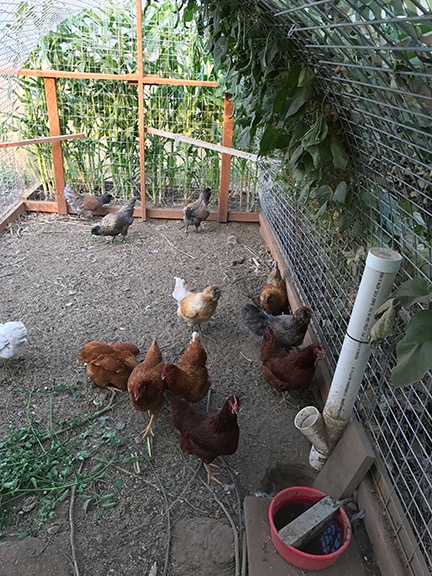
Chicken Yard
My main chicken yard is 15 x 8. Made of hog panels hooped over the yard, it protects the chickens from predatory birds, such as eagles. I planted string beans against one side and they grew right into the yard. This photo also shows their old PVC feeder and automatic waterer.

They seemed to eat a lot of food, but I began suspect that they had help. Rodent help. Voles and mice are pretty common out here and there’s no way to keep them away from spilled food. Chickens are notoriously messy eaters and were spilling a ton of food from the PVC pipe feeders I’d made for them. At first, I didn’t think it was a big deal. But when it got to the point where they were going through a 50-pound bag every 10 days or so — at $15 per bag — I realized I needed to try to fix the problem. So I bought them a galvanized feeder that hung on the side of the coop building. They didn’t want to use it — probably because they couldn’t easily get the food out on the ground — but when I pulled the other feeders out, they had no choice. What a difference! A 50-pound bag lasted at least twice as long. What’s even better is that the feeder holds more food so I have to fill it far less often.

In late July and early August, they started laying eggs. At first, they were laying only a few eggs a day. But as each hen matured, she added her eggs to the daily count. Soon I was getting about a dozen eggs a day. It was time to move into the revenue portion of my plan.

I bought really nice Farm Fresh Eggs for Sale signs. I put one at the end of my road, one (with an arrow) at the exit to the winery 1/2 mile away, and one at the end of my driveway. On weekends, I prepped egg cartons for sale. I’d have 3 dozen available, as well as some garden veggies.

Of course, this was a dumb idea. I live 2 miles from pavement on a dead-end road and although I was hoping winery customers would drive that extra 1/2 mile, they didn’t. So every Monday I was giving my eggs away to whatever friends didn’t have chickens.

The other part of the plan was to sell the laying hens. That part worked like a charm. I knew from experience how tough it was to get laying hens — I’d struggled to replace the first flock my neighbor’s dog had killed the year before. Surely there were other folks out there who wanted to skip the 4- to 5-month process of raising chicks to laying age. So I put an ad on Craig’s List.

I had decided to sell the Ameraucanas. Yes, I liked their colored eggs. But I had discovered that, for some reason, this batch of chickens were laying medium and small eggs. I wanted large ones. The Rhode Island Reds and Golden Sex Links were laying much larger brown eggs. I’d keep them and let most of the Ameraucanas go.

The first four went very quickly to a man who drove a hard bargain: 4 for $75. The trick was catching them. I’d never tamed them so I had to chase them around the chicken yard to get them.

Time passed. I was still getting too many eggs. No one was buying them. I brought the signs in.

But I wasn’t giving up on hen sales.

I realized that there were two benefits for starting chicks in the summer:

  • I wouldn’t have to deal with a heat lamp to keep them warm. It was in the 90s nearly every day, which was warm enough for them. At night, they could huddle together for warmth.
  • They would be laying eggs by winter time. (More about that in a moment.)

So I bought 8 more Ameraucana chicks, this time from the same place I used to buy my chicks when I lived in Arizona. Maybe they’d lay bigger eggs. They came in the mail and I was ready for them. I’d built a brooding area inside the chicken coop, over the nests. I set them up in there and they seemed happy enough.

I figured a good goal would be to keep my laying flock at 8 hens. I had 13 left. I renewed my ad on Craig’s list. A family came by to buy four of them and decided to take a fifth. I figured out that if I trapped them inside the coop building, they’d be a lot easier to catch. (Duh.) I got $20 each for them. I was down to my ideal flock size: 8 laying hens with 8 pullets that would begin laying by winter. I was still getting more eggs than I needed, but it’s always better to have too many than not enough. I really don’t like store-bought eggs anymore. Besides, with my glamping setup in full swing — more on that in another blog post soon — I’ve been giving a dozen eggs to each of my guests and they seem to really love it.

As the pullets grew, they began outgrowing the small brooding area. I made some changes to the coop to give them an indoor area under the hens’ nighttime roosting area, along with a separate outdoor pen for them to run around in. (I had designed the coop with two exits and merely opened up the one that had been closed.) If the the chickens in the two different age groups are put together when there’s a big difference in size, the bigger chickens will pick on and possibly kill the smaller ones so they had to be kept separate for a while. Over time, I moved their food and water outside. I eventually bought them a galvanized feeder, too.

I suspect that I’ll be able to put them all together before I start my winter travels. There’s a slight chance they might even be laying by then.

Of course, chickens don’t lay as many eggs in the winter here. It has to do with the number of daylight hours. Apparently, the more light they have, the more eggs they’ll lay. So if I put a light in their coop — maybe on a timer to simulate longer day times — they might lay more eggs. But since I’m not going to be around much, I really don’t care how many eggs they lay. So I’ll skip the light.

People have asked me what I do about the chickens in the winter months. The last time I had chickens over the winter, I had a neighborhood kid come by once or twice a week to check them, give them water, top off their food (if necessary), and take their eggs. Right now they have an automated water system that fills from my garden irrigation system — this makes it possible for me to leave them for extended periods of time. But when winter comes, that would freeze up. So I have a heated water dish — like you might have for a dog — and I set that up for them. The chicken watcher brings a gallon of water with her when she comes and just tops off that bowl each visit. The water doesn’t freeze and everything works out fine.

The coop is not insulated, but the last time I had chickens over the winter they had an uninsulated coop and managed okay. I did buy a chicken coop heater for them and will install it before I leave. That should keep the temperature above freezing for most of the winter.

In the meantime, my neighbor’s kids are incubating some fertilized eggs for me. (I got the eggs from a friend who has chickens and roosters.) If they manage to hatch more than 4 (out of 16 eggs), I’ll likely sell all or most of the layers I have now so I start next season with some very young layers. (I’ll know how well they succeeded by next week; they’re due to begin hatching September 20.) My goal is to sell all layers before they’re a year old so I always have a young flock and the person who buys my layers gets a young chicken who will likely lay reliably for at least two years.
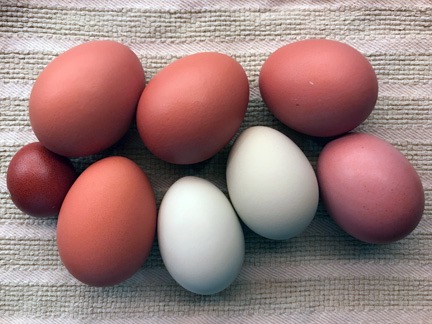
Eggs
Yesterday was the first time I got an egg from each of my eight laying hens. (The tiny egg might be that hen’s first.)

I forgot to take my ad off Craigslist when I got down to the desired flock size of eight layers and someone called. I sold the last two Ameraucanas for $25 each around midday today.

The net result of all this chicken work? Well, I get delicious fresh eggs — that’s pretty obvious. But I also get a stronger connection to my food, which I blogged about back in May. If you do gardening or raise chickens or livestock for your own consumption, I’m sure you know what I mean. If you don’t, well, you’re missing out on something special.

For those of you who like the idea of raising your own chickens for eggs but don’t know much about it, here are a few tips:

  • You can order chicks online. They come in the mail. Really. Learn more at Ideal Poultry’s website, which is where I order my chickens online.
  • Chickens are easy to raise and a lot of fun to watch, especially if you raise them to be tame.
  • Raising chickens is a great project for families.
  • Chickens are a great way to rid your yard of pesky insects.
  • You don’t need a noisy rooster to get eggs.
  • Fresh eggs from your own chickens are amazing, with big, deep orange yolks you can’t find in most store-bought eggs.
  • The average laying hen lays about 5-6 eggs a week. 3-4 hens is enough to supply a couple with all the eggs they need, with some left over for gifting.
  • Chickens don’t need a lot of room. They can fit in virtually any back yard.
  • Most municipalities do allow a limited number of chickens, although roosters might be forbidden. Check with your town hall.

You can also learn a lot about raising chickens, as well as getting plans for building your own coop and feeders online. Remember: Google is your friend.

If you have questions or comments, please don’t hesitate to post them as comments to this blog post. I’ll answer them as well as I can.
Prime Rib Rub

Good on steak, too.

I’m going out to spend a few days with a friend at his house out on Lopez Island next week and, as usual, I’m bringing a ton of food from my garden, as well as eggs from my chickens. He has already promised me sea asparagus, which grows wild at his place, and a 13-year old bottle of wine he said he’s been saving for me. And what would be better with a nicely aged wine than a roasted prime rib? I just happen to have a small one in my freezer from the 1/4 cow I bought not long ago.

The last time I made a prime rib was years ago on my Traeger. My friend Mike had bought the meat at Costco and handed it over for me to cook. When I saw the price on it — $52! — I went into panic mode. What if I ruined this expensive cut of meat?

I had never cooked a prime rib and I went online for instructions. I was living in my Mobile Mansion at the time, so I didn’t have an oven big enough to cook it in. It had to go on the Traeger. I found a recipe for a Prime Rib Rub (see below), rubbed it on, stuck a thermometer in the meat — Mike had bought me a new wireless one; my old one was still packed in Arizona — and put it on the Traeger at whatever the recommended settings were. A few hours later, we had the most amazing prime rib dinner.

In the years since, I’ve used the rub extensively when grilling beef. As a matter of fact, I used up the last of my most recent batch on a nice filet mignon that I grilled up the other night. I went in search of the recipe to make another batch and figured it might be a good idea to just document it here for future reference. So here it is.

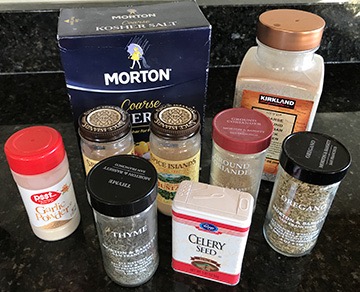
Spices

Ingredients:

  • 1/3 cup coarse kosher salt or 1/4 cup fine sea salt
  • 3 tablespoons dry mustard
  • 4 teaspoons coarsely ground black pepper
  • 1 tablespoon granulated garlic or dried minced garlic or 1-1/2 teaspoons garlic powder
  • 1 tablespoon onion powder
  • 2 teaspoons dried thyme, crushed
  • 2 teaspoons dried oregano, crushed
  • 2 teaspoons ground coriander
  • 2 teaspoons celery seeds

Instructions:

  1. Mix all ingredients together in a bowl or jar.
  2. Rub on beef prior to grilling or smoking.
  3. Store leftover in a tightly sealed container.

I made two batches this morning: one for me and one for my friend.

Tip: For lamb or goat, try ras el hanout, which I mention in this recipe.

The Eclipse Trip Days 5-7: The Palouse, Spokane, and Lake Roosevelt

I finish up the trip in an uneventful way.

Although I tried hard to blog about each day of this trip shortly after it happened, I ran out of steam after my trip to Walla Walla. I think there are two reasons for this:

  • The rest of the trip wasn’t very interesting.
  • I spent a lot of time driving.

So I’ll just sum up here.

Day 5: Walla Walla to Palouse Falls

In the morning, I went down to the motel breakfast room for coffee, eggs, and sausage. They were all horrible. Honestly: I’d rather have a cold and stale Egg McMuffin than just about anything served up at a motel’s “free” breakfast. The eggs and sausage were so bad that even Penny wouldn’t eat them.

Later, after packing up and stowing my things back in the camper, we went for a walk on Main Street. I stopped at an outside cafe for a good cup of coffee. They sold fresh figs by the pound inside so I bought a pound to munch on later in my trip. I love figs so, as you might imagine, they didn’t last long.

I wanted to get some wine tasting in before I left town and to do that I had to wait until 11 AM. That’s when I hit Trust Cellars on 2nd Street. The hostess from the restaurant where I’d had dinner the night before had recommended it. I chatted with her father, the wine maker. I soon began to realize that very few Walla Walla area wineries grew their own grapes. The wine was pretty good, so I bought three bottles.

From there I went to lunch at a “southern comfort food” restaurant on Main Street called Whoopemup Hollow Cafe. I had a gumbo that was good but took half of it to go. I also had a peach cobbler for dessert that was excellent.

Then on to Walla Walla Airport. Yes, the airport. Believe it or not, quite a few of Walla Walla’s wineries have tasting rooms at the airport. It used to be an air force facility and there are lots of barracks and other buildings there dating back to the World War II era. Wineries have set up shop in these buildings. Although most are simply tasting rooms, a few also do production and/or bottling. I visited two tasting rooms next to each other, Buty Winery and Adamant Cellars. Buty had been recommended by the winemaker at Trust. Neither impressed me, but I bought a bottle from each because I always buy wine when I go tasting unless it’s simply undrinkable.

I’d wanted to hit a third winery at the airport but since I was so unimpressed with the first two and had drunk enough before 2 PM, I headed out instead.

My destination was Palouse Falls, where I hoped to spend the night. The drive would take me through much of the Palouse, a sort of mecca for photographers.

The Palouse is an area of Washington State with rolling hills covered with wheat. At a certain time of the year — July and early August, I expect — it’s an amazing place to photograph — well, rolling hills covered with green (July) or golden (August) wheat. Google Palouse Image and see what I mean.

I’ve always wanted to get out there in just the right season, but that season happens to be my cherry drying season when I’m pretty much stuck in the Wenatchee area. So I can’t see it until the wheat has already been harvested and it isn’t nearly as attractive.

The drive was a lot longer than I expected but was pleasant and scenic without the least bit of traffic. Honestly, I think that my road trips have spoiled me because of often travel to places on routes that no one else seems to use. The only time I experience traffic these days is when I’m driving through Wenatchee and have to deal with traffic lights.

Palouse Falls is a 200-foot waterfall on a place along the Palouse River where it cuts through a canyon and drops into a crack in the terrain. The visitor parking area is on a hillside overlooking the falls so most of the photos you see of the place look like aerial shots.

Palouse Falls from the Overlook
I shot this photo of Palouse Falls from the parking area not long after our arrival. The light was flat and never did get interesting during my stay.

Permit me to vent a little about No Fly zones for drones.

First of all, the No Drone rule at Palouse Falls is a Washington State law. It prevents people from launching a drone from within any State Park. Palouse Falls is a State Park.

What it doesn’t prevent is launching a drone from outside a State Park and flying it into that park. You see, the state doesn’t control the airspace. That’s the FAA’s jurisdiction. As I pilot, I know a lot about airspace and where it’s legal to fly. I also wrote a whole book about FAA Part 107, which lays out regulations for commercial drone flight that include regulations for non-commercial drone flight.

So there would be nothing stopping me from launching the drone from outside the park and flying it into the park as long as I didn’t fly over any people, kept it below 400 feet above ground level, and somehow — this is the tricky part — managed to keep it within sight at all times.

But do you want to know what’s really crazy? I could fly my helicopter into the park, which I guarantee would get a lot more notice than a half-pound drone, and maneuver it down into the canyon to get the shot I wanted. Legally. Again, the state does not control airspace and as long as my skids didn’t touch the ground inside the park I wouldn’t be breaking any laws.

Would I do that? What do you think?

It’s just an example of how absurd the rules can be — prohibiting one activity that could be a minor annoyance to a few people while allowing another activity that would definitely be a major annoyance to everyone within the park.

In reality, a better view of the falls would be from a drone hovering below the operator inside the canyon. In fact, it would be a perfect shot. But although I had my Mavic Pro with me, there were enough No Drone signs and other visitors to prevent a launch.

It was a gray day. Beyond the smoke-induced haze were clouds spreading rain in the area. I had a cell signal and could track a few rainstorms on radar. It rained a little on us, but not enough to get wet.

Tired from driving and still hoping to do some nighttime photography there, I paid for a campsite and parked next to it. This was apparently a no-no, as I learned from a ranger in the morning. He didn’t cite me but he did lecture me until I pretended to understand and agree with the absurd rule. Yes, tent campers are allowed to park in the lot and then pitch a tent on the grass and sleep in that. But no, people without tents can’t just park a car or truck in the lot and sleep in their car or truck. The rule had nothing to do with parking but everything to do with where you actually slept. If I had pitched a tent and slept in that, there would have been no problem. Next time, that’s what I’ll do.

Palouse Canyon
I think the view down the river from the falls is far more interesting than the falls themselves. Look at those layers of basalt!

In the meantime, the girl who’d parked near me and slept in her car, slipped away while I was being lectured. I didn’t turn her in. Heck, not everyone can afford camping gear. Why shouldn’t she be allowed to spend the night in a safe place, sheltered by her own vehicle? The rule was absurd and I certainly had no intention of helping them enforce it.

Of course, the sky never did clear up that night so I didn’t get the opportunity to do any night photography.

All in all, I consider my trip to Palouse Falls a disappointing bust.

Day 6: Palouse Falls to Lake Roosevelt via Spokane

My Palouse Falls experience left a bad taste in my mouth that I was eager to wash away. I figured that a trip to Trader Joe’s in Spokane to stock up on a few pantry goods followed up with lunch in my favorite Ethiopian restaurant — okay, so the only Ethiopian restaurant I know — would fix me right up.

But I did make one interesting stop along the way: Steptoe Butte.

Steptoe Butte is a granite outcropping that juts up out of those rolling hills. It’s tall so, as you might expect, they put antennas on it. There’s a road that spirals up to the top and offers unobstructed views in every direction.

View from Steptoe
The view from Steptoe Butte. I think this was north, but it could have been any direction. The view is pretty much the same no matter where you look: lots of rolling wheat fields.

Road to Steptoe Butte
When I say the road spirals, I’m not kidding. Here’s how it looked on Google Maps on the way down.

On the day of my visit, it was still hazy with smoke. It was mid afternoon and the light was flat. In other words, not the best conditions for landscape photography. Of course, camping isn’t allowed up there so anyone with the thought of spending the night after a golden hour evening shoot or before a golden hour morning shoot (or both) would be disappointed. No camping anywhere near there at all. Still, photographers make the long drive out there pretty regularly before dawn or back after sunset to be there at the right time. That wasn’t going to be me, at least not that day.

I came back down and continued on to Spokane. A little over an hour later, I was battling local traffic to maneuver my rig into a Trader Joe’s parking lot (which, fortunately, was part of a strip mall parking lot), shopping for things I can only get at TJ’s (if you like sardines, their sardines in olive oil are the best), and then making my way to Queen of Sheeba Ethiopian Cuisine on the Spokane River (great food).

Then I faced the option of ending my trip by making the 3-1/2 hour drive home or staying on the road one more day and finding an interesting campsite to spend the night. Not really fully decided either way, I found a few potential overnight destinations on the map that were also on the way home. If I found a spot I liked, I’d stop. Otherwise, I’d drive home.

I wound up along Lake Roosevelt, a very large lake on the Columbia River created by the Grand Coulee Dam. I’ve flown over it a few times and it’s the kind of place I’d really like to spend more time exploring, preferably with a boat or even a houseboat.

It was late Thursday afternoon, and the first campground I stopped at, Keller Ferry Campground, was crowded with loud RVers and their loud families. I almost backed into a campsite that was not much more than a glorified parking space in an asphalt lot with a picnic table on the grass nearby. But I knew I’d hate it and I hate paying for things I hate. So I pulled out and continued on my way.

The second campground, Spring Canyon, which was nearly all the way to Grand Coulee, was much more pleasant. Lake Roosevelt is a National Recreation Area and this campground was managed by the park service. The other was managed by a concessionaire and you can really tell the difference. The sites were on a hill with views of the lake. The spots were spread out a bit with lots of shade but little underbrush. I drove around and finally found an open spot that just happened to be designated as handicapped. A sign said that if it was still available after 6 PM, anyone could have it for one night. (Apparently, handicapped campers need to get where they’re going by 6.) It was 6:30. I only needed it for one night. I backed in, checked the level, was satisfied, and shut the engine.

It wasn’t until after I paid the $12 fee in the self-pay station that I regretted my choice. That’s when the white trash family in the site next to me went off the rails. They had three young sons aged 12 and below and one of them — I never could figure out which one — was misbehaving. That got dad yelling and threatening. Then mom joined in. Soon they were both yelling and cursing at each other and the kids. I have never heard a couple throw the F-bomb so loudly in public in front of their own kids and other kids as much as these two did. Fuck this fucking fucked up thing. Well, okay, not exactly that, but close. It reminded me too much of time spent with my ex-brother-in-law, a low-life loser who couldn’t complete a sentence without some form of the word fuck in it. But these people were doing it loudly in a campground full of families.

I wanted it to stop. I looked around for a ranger but didn’t see anyone. I was just starting to wonder if it was worth complaining to the campground host when they finally settled down. I think someone got sent into the tent. Mom settled into a chair to study her phone. Dad disappeared.

You don’t get scenes like this when you camp out in the middle of nowhere. You get the sound of nature — wind, birds, falling water, coyotes, squirrels high in trees chattering at small dogs on the ground — or no sound at all.

Anyway, things were fine after that. I ate reheated leftover Ethiopian food on the back steps of my camper, looking out over a campground that was settling down for the night. Someone nearby — maybe in the camper van? — started playing a flute and it sounded very nice. I took Penny for a walk around the campground and then we climbed up into the sleeping area for bed.

Day 7: Lake Roosevelt to Home

I woke up before dawn, as usual. I had coffee while Penny slept in. I caught up on Twitter and did the word puzzle I try to start each morning with. Each morning I have an Internet connection, anyway. It’s a daily puzzle and I’ve done it faithfully every day for the past 70+ days.

When it got light, I took Penny for a walk down on the beach. I let her loose to run on the sand. She loves the beach.

Dawn at Lake Roosevelt
Dawn at Lake Roosevelt.

It was quiet and very pleasant. I watched the sun rise and saw the first light hit hillsides beyond the dam. I wished I had my boat with me. I thought about boat camping. I had recently bought a new tent that would give me, Penny, and even a companion plenty of space to camp in and was eager to use it along a lake or river.

Back at camp, I made breakfast and ate it on the back steps. Other campers were waking. There was no sign of life from the tents at the loud family’s camp. I wondered if the husband or wife had killed the family during the night.

I did the dishes and went through my morning routine. By that time, the loud family was awake and breaking camp. They sure didn’t look like happy people. I wonder sometimes why people bother going on vacation when they spend so much time fighting with each other and staring at their phones.

Penny and I went out for another walk. Although I’d only planned to walk around the campground, I found a “nature trail” and started up that. It was a dirt path that climbed up a hillside with numbered markers along the way that had likely, at one time, corresponded to points on a self-guided tour. There were a few benches along the way that looked like good places to stop and look out at the lake and contemplate life. I stopped at the one at the top of the hill. There were nice views from up there of the lake and campground. The trail continued and we followed it, not sure where it would lead us. It wound up bringing us back down to the campground, no far from our site.

Lake Roosevelt
A view of Lake Roosevelt from the highest point on the trail.

The loud family was gone. There was an inflated beach ball under my truck. I fished it out and gave it to a family with small kids that was camped nearby. The one that spoke English thanked me and handed it off to two young girls who immediately started playing with it. The rest seemed to speak Russian.

I was already ready to go. So I hopped into the truck, started up, and asked Google to show me the quickest way home.

I did stop at the dump station on the way out to dump the holding tanks. I have a very convenient place to dump at home, right near the door to the garage where the camper lives. But I’d rather dump before going home. Then I can add a gallon of clean water and chemicals to the tank and let it slosh around in a sort of cleaning cycle on the way home. It’s a losing battle to keep the tank sensors clean but I haven’t given up. This is just one strategy in my fight.

Our route home took us down the east side of Banks Lake, over the dam at Coulee City, and then up onto the Waterville Plateau. I made a quick stop to look at a vintage pull trailer in Waterville where I chatted at length with a man who’d stopped to do the same thing. Then we descended down to Orondo. I stopped at Katy Bee’s farmstand-turned-cafe for lunch and an ice cream. From there, it was less than 30 minute to get home.

My first vacation for the season was over.

When Lifelong Republicans become Democrats

Look into your heart, Republicans. You may see what this man saw.

I saw an interesting tweet this morning and clicked the link to see what it was all about. Just as the title suggests, it’s an essay by political blogger and activist, Bob Schneider, author of the Politics Now column on the Chicago Now website, who has recently given up on the Republican party.

There’s a lot that makes me — someone who leans left — really happy about what this conservative had to say:

  • He talks about why he was a Republican for so many years. This helps me understand where Republicans are coming from. I’ve heard versions of his story before.
  • He clearly understands why, in today’s U.S. political system, there are only two parties that matter. If you don’t understand why, read his explanation. (Please don’t use the comments for this post to whine to me about it.)
  • He explains what drove him to make the jump from Republican to Democrat. It’s the same stuff we’re all seeing: dishonesty, betrayal, corruption.
  • He explains, in his section headed “Why I left the GOP,” exactly what Republican viewpoints turn him off. This list is the best part of the essay and, if you only have time to read part of it, read this part. He’s nailed it all, from the GOP’s view on the poor to their xenophobia and outright racism to their hatred of education and science.
  • He lists the reasons why he joined the Democratic party. For the most part, it’s the same reason I finally signed up as a Democrat last year. (I’d always been independent but I wanted to vote in primaries.)

This essay isn’t new. It dates back to July. I’m not quite sure why he tweeted about it today. Maybe it’s because there are additional essays available that refer to it.

It doesn’t really matter that it’s two months old. What matters is that he wrote it and he published it under his own name and he’s someone with a good political following. What matters is that it might help other Republicans do some soul searching and admit to themselves that the GOP isn’t exactly in line with their own personal convictions, especially about how other people should be treated.

Personally, I don’t care if someone is a Republican or a Democrat as long as they are capable of thinking for themselves based on factual information and doing the right thing. Blindly voting for party candidates, even when you know they’re “dumb as a rock,” as so many people seem to do these days, is about, well, as dumb as a rock.

I honestly believe that if far right nut jobs and their media outlets — yes, I’m talking about Bannon/Breitbart, Hannity/Fox News, Jones/Infowars, Limbaugh, etc., etc. — would just STFU or start presenting unadulterated facts for listener/viewer consideration, anyone with a brain would realize how bad things have become in the GOP and politics in general.

It shouldn’t be us vs. them. It should be us.

Got something to add? Great! Use the comments link for this post. But please don’t comment unless you’ve read Mr. Schneider’s essay first. I think you’ll find it as enlightening as I did, no matter how you vote.

The Eclipse Trip Day 4: The Travel and Wine Tasting Day

I visit Walla Walla, get a good, hot shower, and have a great dinner.

I slept until nearly six — which is late for me — and woke up feeling refreshed. The first thing I did was look out my side window to see if my neighbors were up and about; that would determine how loud I could be. But they were gone.

All traces of them were gone.

Somehow, they’d managed to pack up three tents and a bunch of other gear into their cars and drive off while I was sleeping less than 100 feet away. How was that possible?

My sleeping pattern is regular. I sleep like the dead for the first three to four hours every night. You could set a bomb off next to me and I’m unlikely to wake. For the rest of the night, however, I’m a very light sleeper. So unless they packed up and left without sleeping there, they somehow managed to pack up and leave so quietly that I didn’t hear them. If that’s the case, thank you mystery campers.

The site on the other side of me just had a pickup truck parked in it. There hadn’t been a sign of people since I arrived. I had begun to think that the truck’s owner had parked there and then just wandered off into the woods to camp. Beyond them was a camping van with a tall, skinny tent — the kind often used for a bathroom or shower. Those people were gone, too. The guy at the far end was still there with no sign of life in his campsite.

So I opened the door and let Penny out to do her business. And then I got to work making coffee. She was back before the water had boiled.

I spent the next two hours working on my Day 3 blog post. There was no signal at all in my campsite, so posting it was not an option. When I was finished with that, I made a breakfast of bacon and eggs. Then I spent some time planning my day.

I knew I wanted to end up in Walla Walla for some wine tasting. If you’re not familiar with it, Walla Walla is one of the AVAs (basically, wine production regions) in Washington. It has dozens of wineries. (Too many, if you ask me.) I could just continue up 395 to Pendleton and follow Route 11 north from there. But I wanted to do some exploring along the way and tracing my path back to Pendleton would not accomplish that. I saw a place called Lehman Hot Springs on a side road that went east to La Grande and thought that might make an interesting stop along the way. From La Grande, I’d head north and then come down the Blue Mountains southeast of Walla Walla.

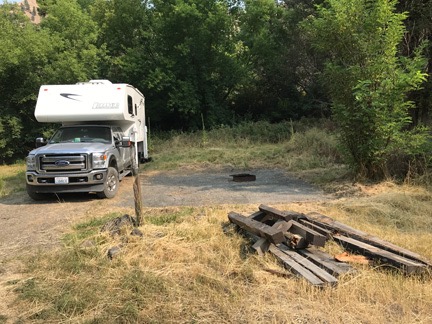
Campsite
My campsite in the tiny 5-site campground. I think that pile of wood used to be a picnic table.

Plan made, I cleaned up my breakfast mess, got dressed, and stowed my loose belongings. By this time everyone else in the campground had gone. Even the pickup truck; apparently two people had been sleeping in it. (Compared to everyone else there, I was sleeping in the Ritz.)

It was about nine when I headed out. That’s when I discovered that the creek that went past the campground was actually the North Fork of the John Day River.

The Drive

On Route 395, I passed the parking area I’d spent my first night on the road in. Three miles later, I reached the campground that had been full; I pulled in to take a look around. It was a nice place with a creek running through it and still half full. It’s in the Ukiah-Dale Forest State Scenic Corridor, in case you want to look it up.

I turned right on Route 244 and, a few miles later, passed through the sad little town of Ukiah, OR. (Sorry folks, but I just report it as I see it.) Not much going on there, but there were about 20 motorcycles. Big cruisers, mostly. I kept going. The road continued into rolling hills with patches of forest. It was a very pleasant drive. For most of the way, I saw traces of an old railroad bed that predated the road. I have an eye for these things — old railroad or road right-of-ways — and it always gets me wondering where the train (in this case) went and why they removed its tracks.

I climbed up into the forest. There were now national forest roads going off into the woods on either side of me. Plenty of camping opportunities if I was looking for them. It was after I crossed the county line that I consulted the map again. Thats when I realized that I’d passed the Hot Springs. There hadn’t even been a sign. Just another point on a map that barely existed.

I kept going.

A while later, Route 244 dumped me onto I-84, where I definitely did not want to be. There wasn’t much of a choice, though. I followed it east and after a quick side trip to see a historic bridge, got off at the first exit in La Grande.

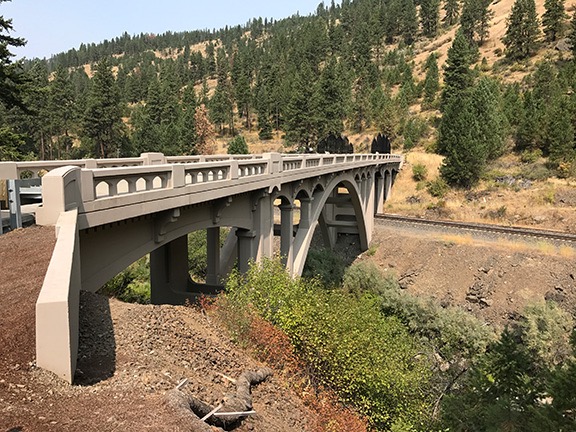
Perry Arch Bridge
The Perry Arch Bridge near La Grande.

I had decided about 40 miles earlier that what I really wanted was ice cream. So imagine my joy when the first business I encountered on my way into town was an old-style ice cream/hamburger joint. I slid into a parking space out front, cracked the windows, and went inside. I arrived after two big parties and waited while the woman at the counter took their orders. For a while, I considered having a burger, too, but by the time it was my turn to order, I’d settled on a rocky road waffle cone for me and a vanilla pup cup for Penny. $4 later, I was on my way back out to the truck. I didn’t realize until much later that it was the first money I’d spent on food during my entire trip so far.

I’d been noticing a sort of haziness in the air for most of the day and it wasn’t any better in La Grande. I followed the road through town, passing the Ford dealer where I’d bought my truck less than two years before, then turned left onto Route 82 heading northeast. I had to trick Google Maps into finding me the route I wanted by telling it I planned to stop in Elgin on the way. Otherwise, it tried to route me along I-84 through Pendleton. The road was fast and there wasn’t much traffic on it. The valley I was in was big and broad but the haziness really made it feel sort of closed in.

I turned left onto 204 at Elgin and headed northwest, back into the mountains. The road twisted and turned and I passed more than a few SUVs towing very small pull trailers. R-Pods seem to be pretty popular, although I don’t understand why. One of the models I passed had a narrow body with its wheels extending on either side of it. If the designers had built the body out over the wheels like most pull trailers, they could have added a foot of space on either side. For a 14-foot trailer, that’s 140 square feet of additional space. Go figure, huh?

I reached the community of Tollgate, which looked like a mountain retreat with homes on a small lake. There was a ski resort up there and lots of turnoffs into the forest for Sno-Parks. Not many people, though. No reason to stop, so I kept going.

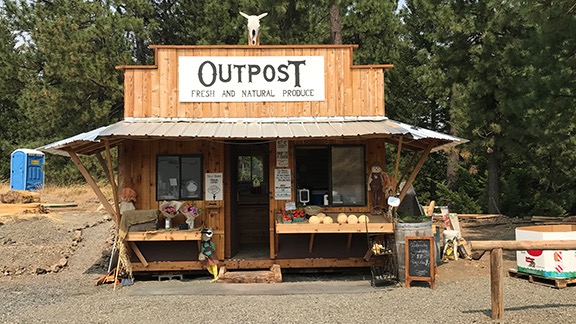
A little while later, though, I passed a sign for a farm stand that had a magic word on it: Pies. I pulled into a parking lot in front of a tiny building called The Outpost. There were fresh vegetables outside — the absolute last thing I needed. Inside was a young woman at a little counter with pies behind her and handmade fragrant soaps on the other side of the room. The room smelled wonderful.

The Outpost
The Blue Mountain Outpost has fresh eggs, produce, and pies, as well as handmade soaps that smell really nice.

We chatted for a while as I smelled the soaps. I had to buy one, of course. I asked her which one she liked and she picked one up. I sniffed it and it smelled good. Then I asked about the pies. Peach, huckleberry, and peach-huckleberry. I picked the peach-huckleberry and paid for my purchases. When I picked it up, it was still warm from the oven.

Back on the road, I continued down the mountainside. After a few Google-directed turns, I found myself driving through Milton-Freewater.

I remembered the town mostly because back when I first drove through — on my midlife crisis road trip back in 2005 — there had been a lot of frog related stuff. I wondered how that was playing these days with the famous Pepe being taken as a symbol of the Alt-Right. But that day, when I drove through, I only saw a frog in two places: on a very old sign near the outskirts of town and in a statue in town. They had obviously moved on from frogs in town and I thought that was a good thing.

I continued north on Route 12 toward Walla Walla. For a while, my rig was one of three Lance truck campers heading that way. We were all bunched up at traffic lights more than once. Onlookers probably thought we were all together. But when we got to Walla Walla, I turned off into town and they kept going.

I stopped at the Chamber of Commerce. I wanted to ask about parking for the night. I had stayed at two different campgrounds in town in the past and had no idea whether they still existed. I also wanted to ask about wine tasting. But the only guy in the Chamber of Commerce was clueless about both things. Apparently, he was new to town. I knew more about the town than he did — and I hadn’t been there for four years.

I left with a wine tourist magazine that listed all the local wineries — did I mention there were a lot of them? — and a brochure for Palouse Falls, where I hoped to spend the night. I’d also left a message at the RV park closest to town and had called the historic Marcus Whitman Hotel about getting a room. I decided that $200 including tax and a $30 pet fee was more than I wanted to spend. (I’m certain I’d stayed there with Penny and a friend a few years back and did not spend that much.)

I drove the few blocks into town and parked on a side street. (I really do love the parking flexibility T2 offers.) That’s when I realized that there could be more hotels within walking distance of downtown. I wound up finding a room at the Red Lion Inn only two blocks away for a much more reasonable $70/night. I drove right over and checked in.

By this time, it was 3 PM. I figured that there was a chance that a lot of the downtown shops and wineries would close at 5 or 6. So rather than go up to our room, Penny and I took a walk up and down Main Street.

Wine and Dinner in Walla Walla

Walla Walla is a really nice town. It’s a lot like Wenatchee, but it has a lot more going for it in terms of wine tasting rooms, restaurants, and shops. The downtown is vibrant and was relatively busy, even on that Tuesday afternoon. I was sad to see that the shop with the walk-in, glass-sided cheese closet had closed down, but glad to see T. Macarrone’s, a favorite restaurant of mine, was still open. I wasn’t in the mood to shop or taste wine, though. I think it was the weather; the heat, light humidity, and thickness in the air from smoke was taking its toll on me.

Still, I did manage to squeeze in a tasting on my way back to the hotel. It was the brand new tasting room for Bledsoe. It was a really nice space, tastefully designed with big windows looking out onto the street from its corner. Although the tasting room was not normally open on Tuesdays, the girl in there was pouring for another customer and didn’t mind pouring for me.

To say I was not impressed was an understatement. The four wines — which started at $40/bottle — had definitely been released too early. I tried not to be critical — after all, it could be my palate that was mistaken. The wines all tasted different but all had that bite that’s common with wines that haven’t been aged enough.

While I was tasting, the girl at the counter gave me some background information about the winery. It had “split off” from another winery called Doubleback that was also in the area. Both wineries were run by the same people but they had two lines of wine and two tasting rooms. I tried to figure out why someone would do that and finally realized that it was a marketing scheme. Hell, it was from the Marketing 101 class I’d taken in college. To maximize exposure of your products, make as many versions of it as the market will support. In this case, they’d taken one winery and instead of selling six or ten different wines under that name, they were selling eight or twelve wines under two different names. Two tasting rooms. Twice the exposure. Of course, this is just a theory. The way Google works these days, I wouldn’t be surprised if someone from Bledsoe or Doubleback found this blog post and set me straight.

I did buy a bottle of wine, though. The tasting rooms in Walla Walla all have a tasting fee that can be applied to a purchase. I wasn’t interested in spending $10 for four tastes of disappointing wine. Instead, I’d spend $40 and take home a bottle I thought was least offensive. I figured I’d share it with people knowledgeable about wine to see what they thought. Maybe they’d educate me.

From there, I went right back to the hotel. I fetched some clothes and toiletries and Penny supplies out of the truck and camper, locked everything up, and went up to my room. This part of the hotel was in an obviously old motel building that had been nicely refinished. The walls were painted cinderblock and because they’d been painted in bright colors — yellow and purple (really!) — the place looked kind of hip. There were two queen beds with their blankets wrapped in sheets. (I really like when they do that.) The pillows were big and fluffy. There was a table and chairs, a fridge in the cabinet, and even a balcony overlooking the pool.

I made reservations for 6 at T Macarrone’s, then set Penny up with food and water, showered, and got ready to go. I left a little after 5, walking back into town alone.

Feeling more refreshed, I stopped for another tasting, this time at Henry Earl. What a difference! These wines were quite good — at least more to my taste — and I wound up buying three bottles. An interesting thing about this winery: the grapes come from the Red Mountain and Wahluke Slope areas of Washington state, making me wonder why they had a tasting room in Walla Walla.

Again, it’s all marketing. First there was Napa and Sonoma Valleys in California, producing wine, offering tastings at the wineries, and getting an audience for what they made. I was in Napa back in the 1980s and it was a great place to explore wines. At each stop, you’d get an opportunity to not only taste wine, but have a production or history tour of the winery. There was no tasting fee. It was a service they offered to attract new customers. At the tasting bar, you could chat with someone knowledgable about the wine — maybe even the winemaker. Fast-forward to 2013, when I returned with some friends. Now tasting was a business, with tasting fees ranging from $10 to $20 per person and advance tickets needed for the few wineries that offered tours. The tasting bar was staffed by sales people who often only knew what they’d been told about the wine. And there were dozens and dozens of wineries, many of which had absolutely no participation in the growing of grapes.

In Washington state, it’s the same thing, but more insidious. Yes, there are some great wineries, including estate wineries, throughout the Columbia Valley, Walla Walla, Chelan, and the Red Mountain area. But since tourists are apparently too lazy to drive out to the wineries these days, winery owners have opened tasting rooms in centralized areas. Downtown Walla Walla is one of those areas. So is Woodinville — conveniently placed near Seattle to make it easier for city folks to go wine tasting without actually visiting a winery. They don’t grow many (or any?) grapes or make much (or any?) wine in Woodinville, yet people think of that as “wine country.” It’s a real shame. There’s nothing quite like visiting an actual winery and chatting with a winemaker, especially when you’re part of a group of people who truly understand and appreciate wine and want to learn all they can.

That said, I should have made more of an effort to get out to the actual wineries the Walla Walla area. But I think I’ll try again another time, hopefully with a wine tasting buddy.

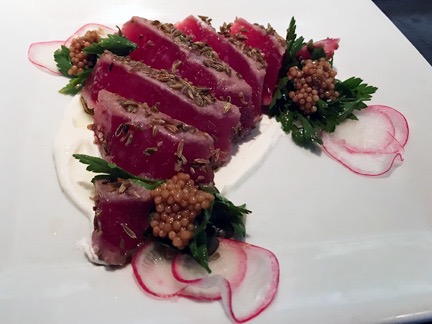
Tuna Crudo
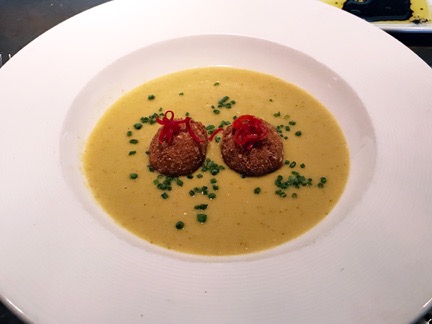
Corn Soup
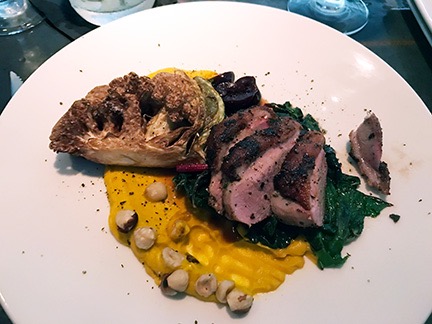
Seared Duck Breast
My dinner, in three courses.

At T Macarrone’s, I sat at the bar. I’d been told their cocktails were good and the bartender helped me pair two different cocktails to my first two courses of dinner. The first one was a somewhat spicy Thai concoction that I liked a lot. It went well with the Tuna Crudo appetizer. The second one was some sort of margarita that I liked a little less; I had that with a creamy Sweet Corn Soup. I had the Seared Duck Breast (which I had them cook more than just seared) for dinner with a glass of wine that I was unable to finish. It wasn’t that I didn’t like it — I did! — it was just that I worried about being able to walk the four blocks back to my hotel if I kept drinking. I skipped dessert because I was absolutely stuffed.

Back at the hotel, I made some finishing touches on my Day 3 blog post and got it online. I spent some time taking care of email and responding to text messages that had come in while I was off the grid.

When I took Penny out for her last walk of the evening, we went to the truck to fetch a few things I’d forgotten, along with that pie. I had a nice slice before going to bed — it was delicious! — and put the rest of it in my hotel room fridge with my truck keys so I wouldn’t forget it.