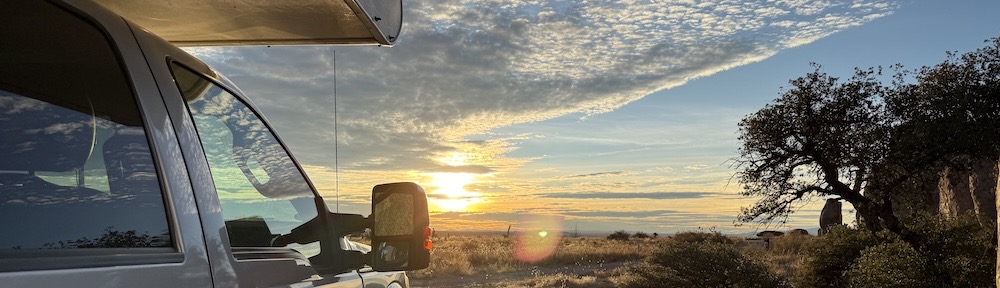
If you’re properly prepared and have the right approach, it’s a surprisingly affordable way to travel in the southwest and beyond.
As I mentioned in my previous post, I got a request from one of my YouTube subscribers for more information about boondocking in an RV. This is a topic near and dear to me, as I spend a good portion of every winter camping for free on public land in Arizona and California. It’s a nice, inexpensive way to enjoy nature and solitude. Kind of like having your own mobile Walden Pond.
Boondocking Defined
Boondocking — at least the way I see it — is camping without any RV hookups or conveniences. Although this is usually done in parking lots (think Walmart) or on public land, you can be boondocking in a campground if that campground has no services. It basically means relying on your own equipment for power, water, sanitation (toilet), and food storage/prep. It usually refers to staying in a vehicle or RV, although I suppose you can do it with a tent, too. (I’ve already had enough tent camping in my life, so I won’t address that here.)
I’m about halfway through my three-month winter trip now, having boondocked in the following places:
- Pahranagat National Wildlife Refuge, south of Alamo, NV off route 93. This is technically a campground, but its free and has no hookups, although it does have pit toilets.
- Boulder Beach Campground, Lake Mead, NV. This is a campground and it charges a fee, but there are no hookups for RVs. There are bathrooms, however and centralized water spigots for topping off a tank and there’s a dump station, so I’m not sure if this really counts as boondocking.
- Constellation Park Campground, Wickenburg, AZ. Technically, this is a campground, but since it has absolutely no services except garbage pails, I may as well be boondocking out in the desert, which is what I actually prefer.
- Litchfield Park, AZ. I boondocked for four nights in a parking lot while I participated in an art show at the nearby resort.
- *You can get detailed information with photos about my New Mexico campsites in a recent blog post titled “New Mexico Explorations.”
Isleta Resort and Casino*, Isleta Pueblo, NM. I shared an enormous parking lot with a few big rig trucks, a giant fifth wheel camper, and a few Sprinter vans.
- The Box*, Socorro, NM. This was a BLM trailhead parking lot with the filthiest pit toilet I had ever seen.
- Old Ladder Ranch Road*, south of Truth or Consequences, NM. This was a BLM dispersed campsite on the Rio Grande with a horrendous access road.
- City of Rocks State Park*, south of Silver City, NM. This was a state park campground with no facilities other than pit toilets although there were some electric/water sites in the park.
- Walmart parking lot*, Silver City, NM. Although lots of Walmart parking lots no longer allow overnight parking, this one did and was actually suggested by a ranger at Gila Cliff Dwellings.
- Dispersed Campsite* north of Lordsburg, NM. At least I think that’s where I camped. Nothing there except open range cattle and power lines.
- Cave Creek, AZ. I boondocked for four nights in a parking lot in town (with permission) while I participated in an art show in town.
- Seven Springs, north of Carefree, AZ. I tried the CCC campground but there wasn’t enough sun so I spent the next two nights at what may have been a campsite in a parking area. This was BLM land.
- Arizona Sonoran National Monument, between Gila Bend and Buckeye. I’m here now. It’s BLM land. There’s a campground called Margie’s Cove but the road was so gnarly and narrow that I stopped about 3 miles short of it and found a nice level spot right off the main road. There are two other campers who did the same thing, but didn’t get quite as far as I did. I’ve been here for four nights and will leave tomorrow.
My plans for the next few weeks include three nights in a full-hookup campground followed by two full weeks at a BLM long term campground at Holtville Hot Springs. After that, who knows?
Boondocking Equipment
To boondock with some level of comfort you need appropriate equipment. The equipment you have will determine the level of comfort and convenience you have.
I’m not going to cover the bare minimum because everyone’s idea of “minimum” is different. I personally would not hit the road with plans of boondocking with anything less than I have. Other folks — and I’ve met some of them — are perfectly happy sleeping in the back of their hatchback car, using public toilets, and eating fast food. That’s not me. If that’s you, you don’t need to read this blog post.
Instead, I’ll cover what I have and other versions of it that might appeal to you.
Camper
A camper is a vehicle or trailer designed with a living space and related equipment. It could be a van, motorhome, travel trailer, tent camper, or slide in truck camper like I’ve got. It basically has a bed, a bathroom (or toilet), a place for storing and preparing food, and a place to eat meals or do work, like a table with chairs or benches. It usually has the ability to store fresh and waste water.
Each type of camper has its own pros and cons. I’ve had a bunch of different types. Large campers like my old fifth wheel (36 feet long with 4 slide outs) are very comfortable, but a pain in the ass to park or travel with. I’d never get my old fifth wheel in where I am now and wouldn’t even try. Small campers are tight on space, forcing you to either live inside your box or spend a lot of time outdoors. They might also lack convenient amenities. What works for me might not be what you want so I can’t advise you. All I can say is that you should have a good idea of what you want and where you want to go before you buy something. A friend of mine who wanted a small pull trailer with a walk-around bed, bought the first one she found; oddly, it came with an AC powered refrigerator, forcing her to stay at campgrounds or run a generator when parked. Not smart.
My truck camper sits atop my pickup so it can go and be parked anywhere my truck can. Inside is a queen sized bed, a table with bench seats that seat three and converts into another bed, a bathroom with a toilet, sink, and shower, a three burner propane stove and oven, a two bin sink, a three-way (propane, AC, and DC) refrigerator and freezer, propane hot water tank, 40 gallons of fresh water storage, 30 gallons of blackwater storage, and 30 gallons of graywater storage. It has a microwave and an air conditioner that only work when the camper is plugged into power. I have lots of windows, two overhead vents with fans, and a skylight. There’s lots of onboard storage, including a slide-out pantry and a clothes closet. It’s very comfortable — and currently for sale. (I’d like to switch to a small motorhome.)
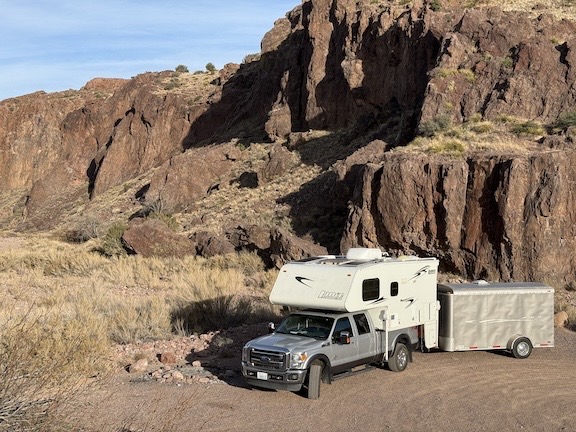
Here’s a shot of my rig this year, boondocking at the Box near Socorro, NM. I usually do not have that utility trailer with me. It limits where I can go, although it does provide me with nearly limitless storage options.
Off-the-Grid Power
If you’re going to boondock in comfort, you need some sort of off-the-grid power solution. That’s normally solar power, but some folks stubbornly (and stupidly, in my opinion) rely on noisy generators to keep their camper batteries charged.
But first you need to understand how you’ll use the power you’ve got.
Understanding Power Usage
When your camper is not plugged into power at a campground or in someone’s driveway, it’s using DC power from the batteries on board. If the batteries are not charged, they will eventually run out of power. You need to know what the capacity is and have a way to monitor remaining power. In my camper, my solar panel controller displays current voltage and that’s how I monitor it. You should have a setup that works for you and use it.
What uses power? The basics are the lights, which are likely all DC so they’re always available. Then there’s your vent fans, water pump, heater fan, and refrigerator thermostat. (I highly recommend buying a camper with a 2-way fridge. That’s AC and propane. DC refrigerators will wear down your batteries at an alarming rate.) If you have an inverter that enables you to plug in AC devices, that has vampire power when turned on and uses even more power if something is plugged in and drawing power.
To boondock in comfort without having to listen to a generator the whole time you’re parked, you need to know how to monitor and conserve power. I could write an entire blog post about that. The bottom line is this: know what draws power and how much it draws. Conserve power whenever possible.
Solar Panels
All of my recent campers have had solar panels professionally mounted on the roof and wired into a solar controller that charges the onboard batteries. While some people believe that a solar panel is useless unless it’s pointed directly at the sun — requiring manual repositioning or fancy solar tracking — they are wrong. My two roof-mounted solar panels (100 watts each) will fully charge my camper’s two batteries on a typical Arizona winter day. That’s full sun in the southern sky. Because my panels are mounted on a slightly slanted surface, they get more sun if I point my rig to the south, but I don’t bother doing that. I don’t need to if I’m parked in a spot with sun all day long. The panels get enough sun on them to work.
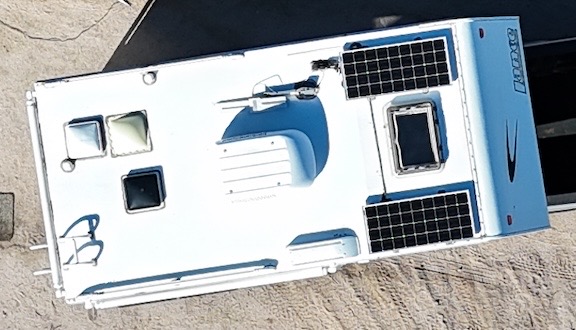
Here’s a drone photo of the top of my camper. You can see the two solar panels permanently mounted on either side of the skylight. They are wired directly into a solar controller that is wired, in turn, into my batteries.
The benefit of mounted solar panels? You don’t have to do a damn thing to get them to work. No pulling them out, plugging them in, moving them around, worrying about theft. They’re just up there working during daylight hours.
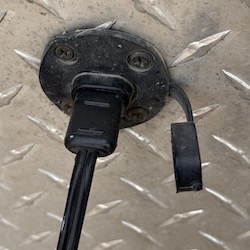
The portable panel is currently plugged into my cargo trailer, but the same plug works with a port I had installed on my camper.
I also have a portable solar solar panel (160 watts) I bought years ago. I had my camper wired with a two prong plug that goes from that solar panel’s controller right into my batteries. So if it’s not very sunny or I’m using lots of battery power, I can charge my batteries from a total of 360 watts. But these days, I’m traveling with a utility trailer that has an inverter on board and its own two batteries. I’m using the portable panel to keep that battery charged and using that battery to keep a portable battery pack charged. (More on that in a moment.)
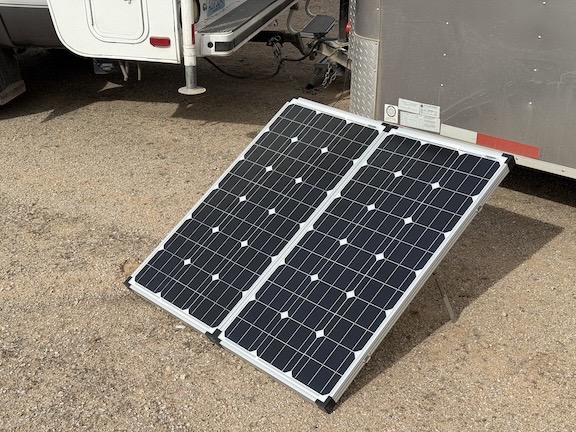
I bought this folding portable solar panel at least 8 years ago; the same capacity is about one quarter of the price now. I can plug it in to provide more power to my camper or the batteries in that cargo trailer.
As we all know, solar panels only make power during daylight hours. And once a battery is full, it’s full. For this reason, it’s a good idea to use power hog conveniences early in the day. I do my dishes in the morning, right after breakfast, and do not do them after dinner. This way, I’m not running a pump late in the afternoon or at night when the batteries can’t get charged back up. The other day I wasn’t thinking and took a nice hot shower late in the afternoon. The result: I started my nighttime hours with 1/4 discharged batteries instead of full ones. Fortunately, I didn’t need much heat overnight so it was all okay, but I won’t make that mistake again.
Generators
Onboard generators make charging batteries and running appliances like microwaves more convenient. Flick a switch, the generator turns on, and you can run just about anything you like. But do you really want to listen to that noise? I can assure you that the folks quietly camping nearby don’t.
And yes, you can have a portable generator. I travel with a Honda 2KW generator I bought about 25 years ago. I have not used it yet on this trip. However if the weather turned cold and cloudy, I’d likely have to run it a few hours a day while boondocking. Cloudy means less solar power. Cold means I need to run more heat to stay comfortable. I don’t want to go to bed with my batteries at half capacity. So when I have to, I’ll pull out that generator, fire it up, and plug in. But it’s my personal goal to not have to do that. I don’t want to hear my generator any more than I want to hear someone else’s.
Portable Battery Power Packs
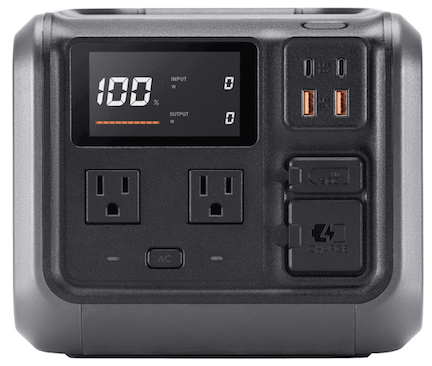
DJI Power 500 is a nice portable power solution for camping.
Lots of companies make portable battery packs, often with built-in inverters and USB ports for powering devices. Late last year, DJI (the drone maker) had its battery packs on sale for 50% off. I bought a DJI Power 500 unit for $250. (If you click the link, you might still be able to buy one for 40% off; I suspect they are being discontinued. I really like mine.) It has 2 USB-C, 2 USB-A, and 2 AC outlets. It tells me exactly how much power is left when it’s turned on so I never run it all the way down. I bought it because it had the option of charging off a 12v car power source; when I’m in transit, I charge it with my truck.
Although I’m using it now to keep the battery in my laptop topped off as I type, I mostly use it to run my StarLink Mini, which is a bit of a power hog and a definite luxury. Having something like this is handy, especially if you’re driving a lot between overnight campsites (so you can charge it) and you’re already using enough camper power when parked.
You might also want a few phone charging battery packs handy. I’ve got five 10,000 mAmp packs that I keep charged in case of emergency. I usually charge them in my truck while underway, although I can easily charge them off my camper batteries early in the day on a sunny day.
Water
Your camper should store a reasonable amount of fresh water for its size. I’m pretty sure mine holds 40 gallons. I can easily make that last more than a week without seriously cutting back on usage.
When I know I’m going to spent more than a week boondocking between RV refreshes (more on that later) I bring water jugs. I have four 6-gallon jugs, although I only brought two of them with me this year. I fill them when I refresh the camper and carry them in my truck. I have a battery operated fuel transfer pump I use to pump water out of the heavy jugs into my water port.
I should mention that I have three “flavors” of water on board.
- Tank water is the water I store and carry in my onboard water tank and refill from the jugs. This is water I wash things with.
- Filtered water is water in reused one-gallon plastic water jugs that I fill from a water source through a water filter on my own hose. This is water I cook with.
- Spring water is water I buy in one-gallon plastic water jugs. This is water I drink and make ice cubes with.
I know this sounds a little extreme, but who the hell knows what’s in the 18-year-old water tank in my camper? I definitely do not want that going into my body. As for the drinking water, if I don’t like the way water tastes, I won’t drink it. I prefer spring water, although I will drink Brita-filtered tap water at home.
Connectivity
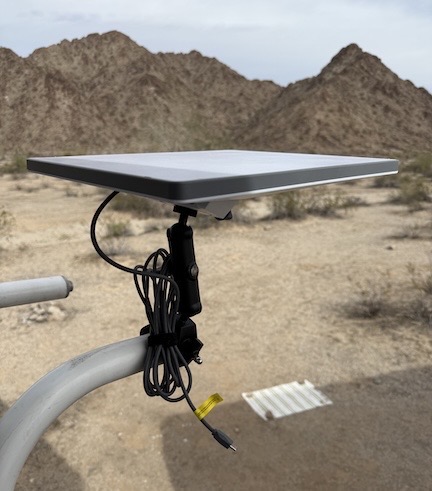
When parked, I use a RAM mount to mount my StarLink Mini to my camper’s folded up ladder. I do not leave it attached like this when traveling. I’m not using it now because I don’t need it, but I did use it yesterday for livestreaming from my drone.
I prefer camping in remote places and the big problem with that is Internet connectivity. While I know some folks claim they like that, I don’t. I like the option of being connected wherever I am. So when I go places where cell service is not an option, I set up my StarLink Mini.
And yes, I know Elon Musk is a rich, crazy asshole who is filling the sky with satellites that will eventually drop down to earth, likely killing someone. I hate him just as much as most democracy-loving, greedy billionaire-hating folks do, if not more. But I also know that if I’m in a remote place and my truck doesn’t start or I’m hurt in a fall or from an animal encounter, I want a way to communicate with the outside world. StarLink is currently the only viable affordable solution.
(Plus, I really bought it for my boat so more people would want to charter it and I’d make more money on charters. So there.)
In general, however, my cell phone does provide sufficient coverage. This is a good thing because StarLink is a power hog and I do not want to sacrifice camper battery power to use it — which is why I bought the DJI portable battery solution discussed above.
The RV Refresh
I spit my time between boondocking and staying at campgrounds with hookups primarily so I can do what I call an “RV Refresh.” For example, when I came back into Arizona from New Mexico and prepped to boondock in Cave Creek and beyond, I booked one night at the Cave Creek Regional Park campground with a power and water hookup. Afterwards, I spent four nights boondocking in a parking lot and another three nights boondocking at Seven Springs. Then back to one night at the Regional Park for a refresh.
On a refresh, I do the following:
- Plug into power. This tops off my batteries (in case conditions haven’t been good enough for solar power) and switches my refrigerator to AC power to save propane. It also enables me to run a tabletop electric heater, which is a bit quieter than my propane/dc fan heater and also saves propane. And I can use the power to charge my ebike and any other item I have that needs a lot of power to charge up.
- Connect to water or top off my water tank just before departure. I don’t always connect directly to city water supplies, although doing so gives my water pump a rest. But I always completely top off my fresh water tank with filtered water coming through my hose. I’ll also fill any water jugs — big or small — that are empty and stow them for future use.
- Dump black and gray water tanks. If the site has a full hookup, I do it just before I leave. If the site has a dump station, I do it on my way out of the campground. If a threaded hose is available at the pumpout station, I’ll use it with the SaniFlush system on my camper to rinse out the black water tank. I also add chemical and a half gallon of water to my blackwater tank so it can swish around and further clean the tank as I get on my way.
Ideally, I like to do this after every 5 to 10 days of boondocking, but I can go as long as 14 days if I need to.
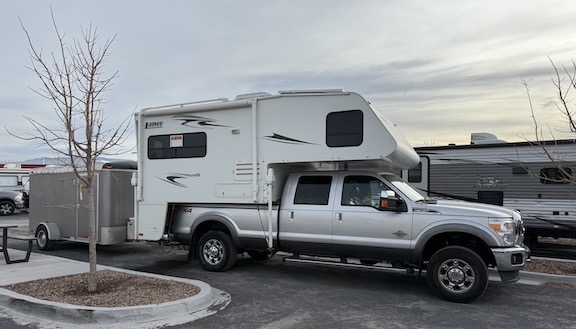
I don’t like full hookup campgrounds, mostly because they’re like parking lots. Here I am parked at one in Albuquerque, where I had some business in December. The main benefit of staying here was that I was able to do a complete RV refresh (and laundry) before I moved on.
Finding Places to Boondock
This is where a lot of people get hung up when they want to boondock. They either don’t know where to go, think they are limited to Walmart parking lots, or are afraid to get into the relatively remote areas where the best boondocking can be found.
I have no solid answer for you.
One thing you should know is that you can camp just about anywhere on BLM (Bureau of Land Management), NFS (National Forest Service), or some State land. For example, Arizona State Trust land allows camping but you need an annual permit. I think it costs $30 and you can buy it online. Keep an eye out for “No Camping” or “No Overnight Parking” signs and stay out of wilderness areas with motorized vehicles. (There’s actually a wilderness area just south of the road I’m parked along; I’m on the north side.) I have driven up into the mountains near Mount Rainier (but not inside the National Park) and found campsites right off a forest road that have been perfectly fine (and legal) for boondocking. BLM, especially in Arizona, Utah, Nevada, and Southern California, has thousands of acres to camp on.
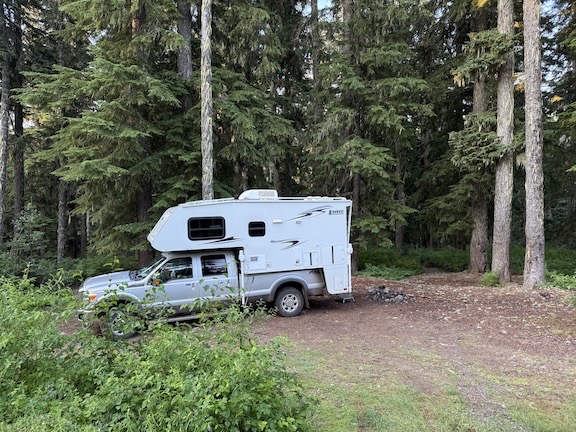
Last July I drove up a national forest road in Washington and found a turnoff with a fire ring. I spent the night in the total silence of the forest.
In the winter of 2020/21, I found a spot along the Colorado River Backwaters about 7 miles south of I-10 where I was able to camp for 2 1/2 months without being bothered by anyone. I had a mile of backwater channels to paddle my kayak, which I actually left in the water at my campsite. I set up my jewelry studio and took my camper off my truck. The only problem with all of this is that you’re supposed to be limited to 2 weeks in any one spot. But I really think that rangers who come by (admittedly seldom) will turn a blind eye to a camper with decent equipment who keeps a neat campsite and doesn’t cause trouble. I tick of all three of those boxes.
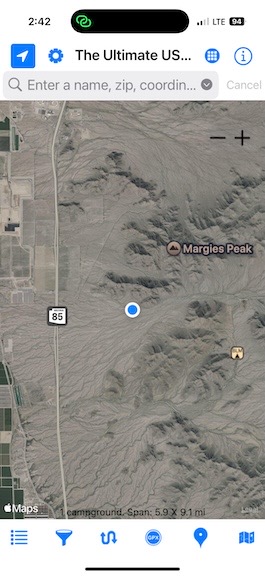
Here’s a satellite view of where I am that includes the BLM campground I was headed for. This is so misleading because it makes it seem as if the only place you can camp is at that BLM icon when, in reality, you can camp anywhere on BLM land except wilderness areas or places where camping is prohibited with signs.
Some of the BLM long term areas in southern Arizona and California do require that campers pay a fee. That’s the deal at my next boondocking destination, the Holtville Hot Springs. If I camp within one mile of the springs, I have to pay a nominal fee and am limited to two weeks. But if I camp just beyond that — which I’ve done for short stays — it’s free.
There are apps that help you find places to boondock. Although most were free — in the true spirit of boondocking — everyone wants money these days and now they’re not opposed to getting you to subscribe to an app that pulls data from free sources. I have an app called Ultimate CG that lists all the free and commercial camping options, with filters to help you weed out the ones you won’t want. To my knowledge, the app is no longer available but the same guy makes a bunch of apps, each of which focus on a specific type of camping option. It still works, although it’s not exactly reliable.
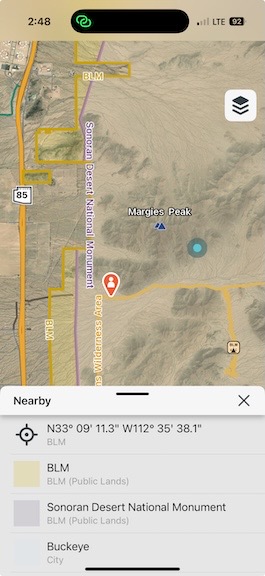
Here’s Tread for this area. My position is the orange tag; I’m just north of that wilderness area. I tapped where you see the blue dot to get the popup screen with land ownership.
One neat app I recently found is from Garmin. It’s called Tread and although it’s free, it does require you to set up a free Garmin account. (I already have one for my boat electronics.) What’s neat about it is that if you display the correct layers and/or tap on the map it’ll tell you who owns the land. Here’s what it looks like for where I am now; it clearly shows boundaries for the BLM land and wilderness area, as well as the location of the BLM campground.
One way to find good spots is to talk to other boondockers. A friend on Mastodon, my social media of choice these days, recommended a number of spots — including the one I almost got to here. Most of them were a bit too remote or at higher elevations than I was looking for in a winter site, but it’s good to know they’re out there. And although I was supposed to go another three miles on this road to an actual designated campground, there’s nothing stopping me from pulling over in a suitable spot to camp along the way. Yes, the campground would probably be nicer, but you don’t need a campground on BLM or National Forest Land to camp. Just don’t damage trails and vegetation by driving over them with your rig and don’t dump gray or blackwater.
Be Considerate
One more thing I want to mention about boondocking.
Don’t park right next to or even near another boondocker, especially when you’re out in a remote area. Chances are, they’ve come all this way to camp in privacy, without other people nearby. They don’t want to see or hear you and your pets or kids or generator. They found their spot; keep driving to find yours.
This is common courtesy. There’s a lot of land out there; there’s no reason to cram yourself in near other folks trying to enjoy it on their own.
Enough?
That’s all I’ve got for now. If you think I forgot something, let me know in the comments. If there’s enough to add, I’ll do a Part II for this post.
I just want to finish by saying that boondocking is the closest you can get to real camping in an RV. Taking your luxury motorhome to a KOA and plugging in between two other rigs is not camping. And with the prices some of these places charge these days, you might be better off driving something more fuel efficient and staying in motels.
Boondocking gives you a chance to be out in nature in a place where you can enjoy your surroundings. If you haven’t tried it, what are you waiting for? Prep your rig and get out there!
Discover more from An Eclectic Mind
Subscribe to get the latest posts sent to your email.
Reversing that wide rig with the trailer attached must be a challenge. Do you have cameras?
LOL. No cameras! And you’re right: it is quite a challenge. It’s especially challenging because the trailer is narrower than the truck with the camper on it so I normally can’t see it behind me. The good part about that is that if I’m going backwards and I can’t see the trailer in either mirror, that means I’m going straight back. Turning is more of a challenge. I’m hoping that this is my last season camping with this rig. I don’t mind the truck camper so much, but pulling the trailer is a real hassle and totally defeats the purpose of having a truck camper in the first place.