
Good news and bad news about that copyright lawsuit I’m part of.
Since writing a post last month about my participation in the huge copyright lawsuit against Anthropic, there have been a few developments.
The Good News
First, a settlement was reached between the plaintiffs and Anthropic. A big settlement: $1.5 billion to be paid to affected authors. This came out to $3,000 per infringed work. Whoa.
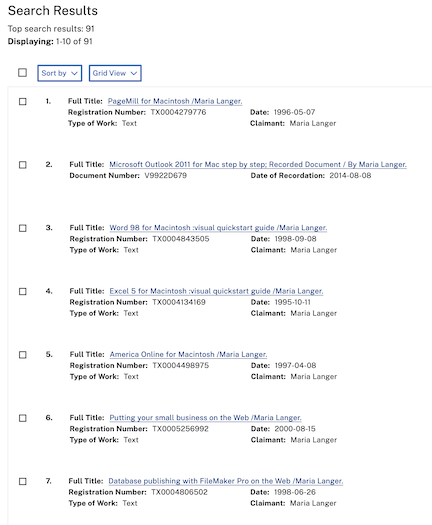
Here’s part of the first page of my copyright registrations.
To qualify, the work needed to not only be on the list I mentioned and searched for that post, but registered with the Copyright Office. If you recall, I had 16 titles on the list. I hurried over to the US Copyright Public Records System and did a search for my name. I came up with a list of 91 records, more than half of which were for my books. I was very pleased to see that Peachpit Press registered my titles in my name, although McGraw-Hill, Sybex, and O’Reilly did not. Still, at least 10 of the titles on the first list were registered in my name. (I did not bother to cross-reference the two lists, although I might do so later.)
So it looked to me as if I might be able to pull in at least $30,000 on this case.
Holy crap.
I’ve been part of class actions before and I think the most I’ve ever gotten was about $130, which was for an Apple keyboard issue I barely remembered. But this — well, this was real money.
The Bad News
Just when I was starting to think of how I would spend this little windfall, the bad news broke: The judge overseeing the Anthropic case rejected the settlement.
Alsup [the judge] expressed grave concerns that lawyers rushed the deal, which he said now risks being shoved “down the throat of authors,” Bloomberg Law reported.
Well, this is something I don’t mind being shoved down my throat.
Look at it from my point of view: I wrote how-to books about using computers. The vast majority of them had a “shelf life” of less than a year. That means royalty income for each title lasted about a year — if the book even earned out. I had to keep writing them to keep earning a living. That’s why I wrote more than 80 of them between 1991 and 2012.
To me — and probably everyone other than a greedy and mindless AI consumer — these books were dead. No one was buying them — heck, I assume all inventories were destroyed. I could not expect any more income from them. In most cases, I couldn’t even use part of them as the basis for an updated book about the same topic. Some of the software I wrote about doesn’t even exist anymore.
The thought of earning $3,000 per title on these dead books is pretty appealing. Knowing that Anthropic isn’t the only AI copyright infringer out there and that its settlement could be the first of many that benefit me is even more appealing.
But the judge put the brakes on the deal and threw everything back to the parties.
As you can imagine, I’ll try to stay involved in this process to make sure I’m on any list out there. I just hope it doesn’t drag on too long.
And a lesson to writers…
Intellectual property is a real thing that deserves protection. It is the fruit of your labor. Whether your book sells three copies or a million, it has real value. And who knows? It could end up on a list that earns you $3,000 (or more) when AI companies are brought to court.
Register your copyrights. Go to the Registration Portal on the US Copyright website and follow the links and instructions to register all of your work. Yes, it’s copyrighted without registration, but it’s only really protected when it’s registered.
Discover more from An Eclectic Mind
Subscribe to get the latest posts sent to your email.
Congratulations!
I confess that I imagined the case would drag on for years with only a modest payout.
Well done Maria.
It still might drag on and on if the judge doesn’t let them settle. Honestly, I’m pretty surprised that there’s a chance I’ll get anything, considering the age of my books.