Why I’m Not Taking Photos at the Grand Canyon

And why I didn’t finish this post right after I started it.

I’m at the Grand Canyon. Again.

I come here 20 to 30 times a year, often on helicopter charters. This time, I’m taking a couple from Montana on a Southwest Circle Helicopter Adventure. That’s a 6-day/5-night excursion. The second day (and night) is spent at the South Rim of the Grand Canyon.

Bright Angel Lodge

A fisheye view of my room at the Bright Angel Lodge. Simple and relatively cheap.

As usual, I have one of the tiny rooms in the Bright Angel Lodge. The historic lodge and cabin buildings were designed by Mary Colter and built in the early 1900s. My room lacks the features most guests take for granted: television, air conditioning, and shower. I don’t need the first two and the third is down the hall.

I lucked out this trip and wound up with a corner room that has windows on two sides. There’s even a window in the bathroom. But best of all, it’s literally 100 feet from the rim of the canyon. In fact, if I look out one of my windows, I can see the wall of the North Rim 10 or 15 miles away.

Not bad for $80 a night.

My passengers are staying at the Thunderbird Lodge, with a partial view of the canyon. Their room is modern and has all amenities. It also cost $180 per night.

Grand Canyon

A shot taken in passing on my way to lunch today. The clouds were great; they really added depth to the scene.

This trip, for some reason, is different than the others. I didn’t feel at all motivated to walk along the rim and shoot pictures. I think I’m tired of photographing the Grand Canyon. Is that possible?

I have hundreds of photos of this place. But none of them can really capture its magnificence. Every time I try, I’m disappointed. I feel that it’s time to stop trying.

So I spent most of the afternoon in my hotel room, pulling movies off SD cards to clear them for more movies, catching up on Twitter and e-mail, and putting a few videos online. By 5 PM, I realized that I was avoiding my photographic duties. And that made me wonder why I considered taking photos a “duty.” Almost as if it were a chore. Was it?

I sat down to write this post. I entered the title in my offline editor. And then I stopped and scolded myself.

No, I was not going to miss a beautiful Grand Canyon sunset. I was going to get my ass outside and walk along the rim. I didn’t have to take photos, but I could if I wanted to. It was more important to be outside, in the fresh air, on a beautiful late summer afternoon with one of the world’s Natural Wonders in front of me.

So I went outside with my camera. Less than a minute later, I was on the Rim near the Lookout Studio, admiring the way the late afternoon sunlight played on the buttes and canyon walls right in front of my face.

There were lots of other people out there. Most were moving about, snapping photos along the way. Many spoke in languages other than English. They were all ages, although I can’t say I noticed any school-age kids.

El Tovar

El Tovar, in the late afternoon light.

I noticed an artist sitting on a rock with an easel in front of him. This week is the Grand Canyon Celebration of Art: Plein Air Event & Modern Masters Show. The artist, Sedona-based Williamson Tapia, was using oils to paint his interpretation of the cliff on which El Tovar Hotel sits and the magnificent clouds above it. His piece was mostly clouds.

We chatted for a while about art and the Canyon as I watched the light change. The red light and deep shadows behind the buttes were calling me. I excused myself, ducked through Lookout Studio to the cliffside overlooks below it, and snapped a few photos.

Grand Canyon

A look into the Grand Canyon in the light of the setting sun. The dark and hazy canyon is Bright Angel Canyon.

I shot RAW + JPEG Fine. I don’t usually shoot RAW. I’m hoping that I can learn more about it and use it to make better photos. I figure that I can’t learn more about RAW unless I have some photos to work with. So today was the day to start collecting them. The JPEG Fine will give me some thing easy to play with until I’m ready to work with the RAW format images.

When I was finished, I went back. Will claimed I’d given him good luck; that he’d found his style for the painting. We chatted some more as he worked. I watched him paint the green bushes and trees on the cliff below the hotel and then touch up the clouds with bright white tops and lavender gray bottoms. The light got softer and redder, but it didn’t affect his work; he was painting something completely different, something he saw. Onlookers came and went, admiring his work. None lingered. We continued to talk, agreeing (among other things) that one day a week, there should be no television broadcasts.

Finally, the light faded to the point that he couldn’t continue his work. He stepped aside and I got a good look at it. He told me he’d put it in the fridge back where he was staying so the oil would stay pliable. If those clouds were back the next day, he’d continue working on it to finish it.

We exchanged cards, shook hands, and went our different ways. I came right back to my room to finish the blog post I’d started with a title two hours before.

Now, as I listen to the crickets outside my window, I wish I’d spent the day outdoors, exploring some new part of the Rim.
On Irresponsible and Inconsiderate People

A costly let down.

Today, four days before I was supposed to accompany two pilots as they flew my helicopter from Seattle to Phoenix, I received an e-mail message from one of the pilots. He claimed that his companion couldn’t get time off from work for the trip. Since he couldn’t afford to make the flight on his own, he was going to have to cancel. I should contact one of my “backups” to make the trip with me.

There are no backups. There were two other pilots interested in making the flight, but I told them that the seats were already taken. That was two months ago, when these clowns said they’d do the flight. Did these guys think I had a room full of pilots waiting for them to back out? Or that most people can drop everything to arrange a spur-of-the-moment, two-day trip between Seattle and Phoenix? Or that I can get someone else on my insurance that quickly?

Yes, I’d planned this flight two months ago. I was in Washington State with the helicopter for cherry drying season and I knew I needed to get the helicopter back. I put the word out to the five people I had on a list who’d said they were interested in doing ferry flights with me. Two dropped out right away because of date conflicts. I chose one of the guys who was left because I’d flown with him before. Back then, he’d asked if he could do the return trip and I told him I’d keep him in mind. He was a known. The other two were unknowns. I went with the known. He was bringing along his student pilot to share the costs. Seemed like a good plan.

The trip had several date changes. At first, it was August. Then I gave him a choice between late August or Labor Day week in September. He chose September. We were supposed to go on Wednesday, but my helicopter is waiting for a part, so I had to push it back to Friday.

I was assured there would be no problem right up until I got the e-mail message this morning.

The bastard was too cowardly to call. (That rumor about me being able to beat people to a pulp over a phone line is simply not true.)

Clearly, he knew he wasn’t going for at least a week. If he planned to go, he would have bought his return plane ticket. I bought my ticket up there as soon as I had a solid date — nearly two weeks ago. He probably never bought his. Never made an investment in the flight. Nothing to lose by canceling.

Shitheel.

The trip will cost me over $3,000. I expected to receive almost that much from the pilots renting my aircraft for the flight. It would have been an almost break-even ferry flight. They would have built R44 time for about half the cost of renting one through the usual channels. I would have had my helicopter moved 1,000 miles for next to nothing.

But now I’m scrambling for paying passengers or other pilots willing to take their place.

In the end, Mike will likely go up to Seattle with me and we’ll share flying duties for the return flight. It’ll be a very costly two days together.

What amazes me about this is how completely irresponsible and inconsiderate some people can be. Not only are these clowns costing me at least $3,000, but they caused me to let down two other pilots who likely would have done the entire flight with me.

I wonder how reliable these guys will be when employed as pilots. Will they fail to show up at work for their week on at the Canyon? Sleep late when they need to pick up passengers in the Gulf? Cut corners on the routes when running tours in Hawaii? Let accident victims die because they don’t feel like firing up the medevac helicopter so medics can scrape them off the pavement?

Do I sound angry? I am.

Jeez, I would never do this kind of thing to someone.

But, as my friend Jim reminded me this afternoon, I’ve been riding with Lady Luck for quite a while now. Gotta take the bad with the good. So I’ll cough up the money and try not to think about it.

As for the little bastard that cost me all this money, I just hope he’s stupid enough to put me or one of my friends down on his resumé as a reference.

Interested in making the flight? Check out the Craig’s List listing if you don’t mind me doing the flying.

Real Pilot Experience

Not all flying hours are equal.

A fellow helicopter pilot and I often debate the merits of the current system of pilot experience building.

In the U.S., a pilot generally gets his (or her) private, commercial, and CFI ratings, often picking up an instrument rating along the way. He then spends the next 500 to 1000 hours as a flight instructor, teaching other people how to fly under the close supervision of a chief flight instructor. With the golden number of hours — 1,000, for most helicopter pilot jobs — logged, the pilot goes on to an entry level position in a company where he’s closely supervised by a chief pilot who calls all the shots. Through the logging of time in various aircraft, the pilot works his way up to better-paying, more challenging jobs.

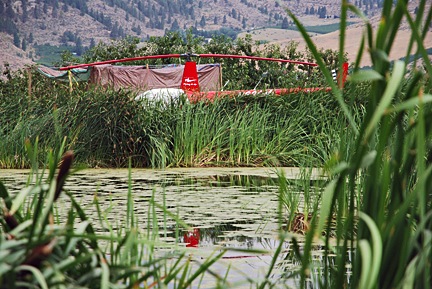
Parked in an Orchard
My helicopter, parked beside a pond in an orchard, waiting for rain during cherry season.

My friend and I didn’t follow this typical career path. Instead, we learned to fly, bought our own helicopters, and started our own flying businesses, learning through more varied experiences in a much shorter time. We both worked closely with the FAA to get our Part 135 certificates and pass annual check rides and inspections. And we generally agree that the hours we’ve logged are “worth” more than those logged by a typical pilot on the typical career path.

Now I know that the mere idea that all logged hours are not the same will bother a bunch of readers who are pilots on that typical career path. So I’ve decided to provide a comparative list of experiences based on real-life pilots so you can objectively consider my argument.

I recently had the opportunity to fly with two relatively new helicopter pilots. And a year ago, I flew with another one. I spent more than 14 hours of flight time with all three of them. Here’s how their experience stacks up against mine.

ThemMe
All three of these guys had private, commercial, and certified flight instructor (CFI) endorsements. At least one also had an instrument rating and a CFII rating.I only went through Private and Commercial helicopter training. I never became a CFI and although I started work on an instrument rating back in the beginning of 2008, I haven’t finished it.
All three of these guys had right around 300 hours of flight time. The vast majority of that time was in Robinson R22 helicopters — although I think one of them might have had most of his training in Robinson R44s because of his size. (He wasn’t fat, but he was very tall and with height comes weight.) Virtually all of their flight time was built with a CFI in the seat beside them, flying within 50 miles of the airport where they learned to fly.I have about 2,100 hours of flight time these days, built in Robinson R22, Robinson R44, and Bell 206L helicopters, with a tiny bit of stick time in a Hughes 500 and a Bell 47. I’ve flown in nine states, including Arizona, New Mexico, California, Nevada, Utah, Colorado, Oregon, Washington, and Idaho. I’ve flown over deserts, mountains, lakes, forests, canyons, and coastlines.
All three of these guys built their flight time in basic and more advanced training. That’s 300 hours of hovering, flying traffic patterns, practicing autorotations, and performing other textbook maneuvers to textbook standards. They flew mostly during the day in good weather, at or near sea level. When (or if) these guys get jobs as CFIs, they’ll build their next 700 hours of flight time sitting in a seat beside a variety of student pilots, handing the controls only until the student can perform basic maneuvers without assistance. Then they’ll keep the student pilot out of trouble by being ready to get on the controls while daydreaming about their next flying job — the one that might actually pay them enough money that they can afford to pay their rent.I built my flight time with about 200 hours of basic and advanced training followed by an enormous amount of cross-country flying — including far more solo flight time than the average pilot — and flights for hire. The for-hire flights include short rides, sightseeing tours, photo flights, aerial survey flights, video flights, air-taxi flights, wildlife survey flights, cattle spotting, and cherry drying. I’ve flown in perfectly clear daytime weather, under (and over) low clouds, around thunderstorms, through rain showers, and into the complete darkness of a remote desert night. I’ve landed on and off airports, from sea level to over 10,000 feet density altitude.
These guys have always flown under the close supervision of a CFI or chief flight instructor, following the rules laid down by their flight schools. Decision-making was likely limited to go/no go decisions that were likely based on conservative guidelines; in other words, if there’s a real go/no go decision to make, don’t go.About 1/4 of my flight time was flown under the close supervision of a CFI, chief flight instructor, or chief pilot. The rest of it was flown under my own supervision. I made all the decisions that needed making, from how much fuel to load and where to seat the passengers to what route to take and where to stop for fuel to how to find my way around the unforecasted thunderstorm in my path. And go/no go, of course.
All three of these guys are qualified to teach student pilots how to fly helicopters.I’m not.

What bothers me most is that limited experienced pilots are the ones teaching people how to fly. Then, after logging hour after hour of doing the same thing in the same basic conditions, they’re more qualified for a job than someone else with “better” experience but fewer hours.

Is there something wrong with this situation?

I’m not complaining about not being able to teach. I don’t want to. I like life far too much to put it into the hands of someone who doesn’t know how to fly. I just question the wisdom of using our least experienced certificated pilots to teach non-pilots how to fly.

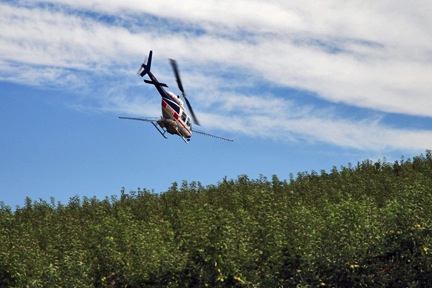
Spraying with a Helicopter
An experienced agriculture pilot sprays wax on Apple trees from a JetRanger in Washington state.

When I was an 800-hour pilot, it bothered me that a typical 1,000-hour pilot on the typical career path was considered more experienced than I was. I was willing to prove that I was an as good — if not better — pilot than he was, but no one wanted to give me the opportunity. Sure, he can do autorotations better than I could — after all, he’d been doing them every day for much of his 1,000 hours of flight time. But how was he on off-airport landings? Planning cross-country flights? Landing at unfamiliar airports? Flying around or under or through weather? Managing power with a full load of full-sized passengers at high density altitude? Simply feeling the aircraft as an extension of his body that gave him the ability to fly?

That’s water under the bridge now. I’ve built my time and now qualify for a wide range of jobs. And if I get my CFI — which I expect to this winter — I could probably be a pretty good flight instructor.

But for now, I’ll just continue on my own career path. It may not be typical, but it’s challenging. And every flight offers the possibility of a real learning experience.

Arizona Storm Clouds Time-Lapse

So very cool to watch the clouds grow and move.

One shot every ten seconds, compiled at 30 frames per second.

The forecast called for a 30% chance of rain late in the day yesterday, so I thought I’d set up my time-lapse camera and capture the cloud build-up. This video starts at about 7:20 AM and ends at 7:30 PM, right when it had gotten dark. The first 25 seconds is a typical Arizona day — perfectly blue sky with nothing going on. Then some light clouds chase each other across the sky. Finally, the storm builds and moves in. This is one of my better efforts.

These shots were taken from just outside my front door with the camera pointing almost due north. And no, the cactus isn’t crooked. Its the wide angle lens distorting the shot.

Note to Self: Not Everyone Flies

I have to keep reminding myself because I do forget.

Yesterday afternoon, I sat down with the September 2009 issue of Flight Training magazine (because “a good pilot is always learning”), prepared to page through the mostly airplane-specific content for a few good tidbits that also applied to flying helicopters. I started with the “President’s Perspective” by new AOPA president Craig Fuller.

The fourth paragraph nearly knocked me off my seat:

Over the Independence Day holiday, I urged everyone to celebrate their freedom to fly by getting out and into the air, whether for a family vacation or a quick sightseeing expedition. I also urged certificated pilots to take a nonpilot for a ride to let them experience a new perspective on general aviation. There’s no better way to make sure that GA remains relevant and vibrant than to get out in the sky and do it! Taking nonfliers along for the ride can introduce them to a new world, and might even be the key to bringing the next generation of pilots into the cockpit.

I added the emphasis here; these are the phrases that woke me up from my afternoon burn out.

These phrases reminded me that as a pilot, I’m a member of a tiny community of folks who can just get out and fly. Very few people are as fortunate as we pilots are in this respect.

It’s a Natural Part of My Life

Oddly, flying has become such a part of my life that I don’t think twice about doing it. Here’s a good example from this week.

I need to reposition my “redneck truck” to Grand Canyon Airport (GCN) before next Thursday. The truck is one of the few vehicles I own that can seat three people comfortably. Ground transportation from GCN into the park sucks — the shuttle service is inconsistent and a huge time suck and there are no rental cars (what’s that about?) — and I’ll be there by helicopter at least three times within the next three months with at least two passengers each time. I need to get my people into the park quickly and comfortably — they’re not paying all that money to sit around waiting for a shuttle van. Since I can’t rent a car and I happen to have a spare truck, I figured I’d just put my own transportation there for the season.

I have to drive the truck up there. No getting around that. It’s a 2-1/2 to 3 hour drive. But I didn’t even think about getting someone to drive me back. Instead, I figured I’d ask a friend to fly up and fetch me in return for a fuel top-off. I sent out an e-mail to a friend with a Mooney who is always looking for an excuse to fly, we picked a date and time, and we’re good to go. If he didn’t want to do it, I could think of at least four other people — including my husband, who is half-owner in a Grumman Tiger — who might do it. The idea of driving back never even entered my mind.

Until I read Fuller’s comments and realized that just about everyone else in the world would plan to drive back. The idea of flying back would never even enter their minds.

What It Means to Me

It’s hard to explain to a nonflier what flying means to me. Part of that is because I can no longer imagine things from their perspectives — not being able to just get out and fly. But the other part is their sheer lack of understanding of what it’s like to be airborne. Yes, I know what my town, a good portion of Arizona, and lots of the western states look like from 500 or 1000 feet above the ground. I know how the air will behave as I cross over a dark green alfalfa field on a sunny day or slip into the shade of a cumulous cloud just starting to get heavy with precipitation. I know what it’s like to fly over or past or under a large bird, to cross over the top of an airport with a plane just touching down on the runway beneath me, to slip 1,500 feet below a 747 landing at Sky Harbor Airport (PHX). I know what it’s like to fly up a twisting canyon, level with the tops of the canyon walls, and how it feels to zip low over the surface of a lake or desert plain. I know the feel of the aircraft around me, responding to inputs that my hands and feet automatically feed into it at the whim of my brain — to be one with a vehicle that can move freely in three dimensions, against the pull of gravity.

North to the Future

When I started up my laptop to write this, this is the photo that popped up as my random desktop picture. The world is wide open to a pilot.

I’m not the only one around here who can say all of these things. Once I learned to fly and began spending more and more time at airports, it was only natural to meet and become friends with other pilots. Whether they’re helicopter pilots like me, owners of well kept classic airplanes like my friend’s Mooney, or tinkerers who built their aircraft with their own two hands, they’ve all tasted and perhaps feasted on the freedom of flight. From the guys who put fat tires on their taildraggers so they can land in dry riverbeds to the folks flying big twins and small jets to places like Washington, Idaho, or Colorado, they’re all the same. They’re pilots.

Get on Out There and Fly!

It’s strange that I can no longer see the other person’s point of view — strange because of the number of nonfliers I take flying routinely for my flying business. Perhaps that’s because I fly helicopters. I take it for granted that most people don’t fly in helicopters. But the reality is that most people don’t fly in small aircraft at all.

So here’s my request to all the readers of this post:

If you’re a pilot, take someone who’s never been in a small aircraft flying with you sometime between now and the end of the year. Let them experience the wonder of flight; give them the “new perspective” Craig Fuller wrote about.
If you’re not a pilot, grab a friend and go flying. Take a flight at your local airport or the next time you have a chance to take a tour where aerial tours are offered. Do it before the end of the year.

And then think about it — from all perspectives — and feel fortunate that such an activity is within your grasp.