The Joy of Journaling

The older I get, the more important it becomes.

Journaling Image
A blank book with lined pages makes an excellent journal.

I’ve been keeping a personal journal off and on for most of my life. In most cases, it was well-intentioned attempts to write daily — or at least regularly — in a blank book. These journals never lasted long and usually were misplaced. I found one of them when I was packing for my 2013 move and was somewhat shocked by entries that foreshadowed the end of my relationship years later.

Blogging as a Form of journaling

I kicked my journaling efforts up a notch when I began blogging in 2003; my blog — which you’re reading now — documents a lot of what was going on in my life as I wrote the entries.

It’s an excellent chronicle, for example, of what was going on during the various stages of my long, drawn out divorce (which is still dragging on but finally close to an end) and will form the basis of my book about it. It’s also a great resource for my evolution as a pilot, my work flying at the Grand Canyon, and the way I’ve tackled new hobbies and interests such as beekeeping and glass work.

Along the way, I wrote lots of opinion pieces about politics, religion, current events, and social issues. My blog’s 2300+ entries are a really good look at my past and what was going on in my mind over the past (so far) 13 years.

Back to Paper

Back in January 2014, I embraced a real paper-based journal again. I was house-sitting for a friend in Malaga, taking a break from the RV I’d been calling my home since I left my house in Arizona in May 2013. My journal, kept in the same kind of blank books I’d used years ago, contained daily entries of what I was doing and thinking. Every entry was limited to just one double-sided page, so I couldn’t go into much detail.

I soon realized that the only way I’d regularly write those journal entries was to make it part of my personal routine. And the only part of my personal routine that’s pretty much the same every single day is that first cup of coffee. So I’d write the entry for the previous day’s activities while I drank my coffee. In most cases, everything was fresh enough in my mind to get down the important information I wanted to document.

Although I didn’t do nearly as much traveling in 2014 as I’d done in 2012 and 2013, the journal book traveled around with me, going to California for frost season, back to Washington for cherry season, and on vacations with me to Lopez Island, Seattle, and Winthrop. I found that while my home was being built from May through July, I didn’t write a single journal entry — my blog has far more details on those days. But I picked it up again later in the season and started a brand new journal book in January 2015.

Then again, in the spring of 2015, when I made the move out of the RV and into my new home, the journal was left behind in the RV down in my cavernous garage. It wasn’t until the other day that I brought it up into my kitchen and set it down on the breakfast bar where I usually have my morning coffee. I made a feeble attempt to bring it up to date, then got back into the routine. I hope to keep journaling regularly.

Journaling as a Memory Tool

I was secretly thrilled to learn that Kirk, my “boyfriend” (pardon the quotes, but it’s such a silly word at our age), also keeps a journal.

It’s important to me that my significant other be literate. Kirk is not only able to read and write well, but he likes to read and write. You can’t imagine what a thrill it is for me to be able to discuss books and articles with the same person I share so much of my life with.

And having a journal means that he’s just as interested as I am in recording his activities to remember in the future. There’s a lot in common between us there and I’m very pleased about it.

As I get older and my memory starts to get iffy, I find journaling a valuable tool for simply remembering things. The entries, after all, form a good reminder of what was going on in my life each day. I can look back and remember things I’d forgotten, including events, emotions, and opinions.

As my life and relationships evolve, I can see how events from the past contributed to that evolution. I can learn from my own mistakes. I can see how what’s important in my life changes from day to day, week to week, and month to month. I can track my recovery from significant emotional events or financial setbacks and learn better about coping with similar issues in the future. I can see how my opinions evolve with input from others. I can see how my relationships with others grow and change.

In a way, when I skip a day of journaling, I feel as if I’ve lost that day. As time goes by, if nothing significant happened on that day, all memory of it is lost. In a way, that makes journaling so much more important.

It’s the little things that make life interesting — when memory of them is lost, part of your life is lost. Why not spend 20 minutes a day jotting down the things you want to remember? I think it’s worth it.

The Hover Power Posts

Most of my blogging about helicopters is now published on one of AOPA’s blogs.

Just a quick head’s up to let pilot readers know that I am still blogging about flying helicopters. But instead of posting most of them here, they go right to AOPA’s Hover Power blog. The main reason: they pay me to write for them. Girl’s gotta make a living, no?

Here are the most recent posts, in reverse chronological order:

Keep in mind that you can always get an up-to-date list of my work published elsewhere on my Articles page.

If you have any ideas for topics you’d like to see me cover, why not take a moment to comment on this post with your suggestions? I’ll either cover it for Hover Power or here.

And if you’re an editor or publisher looking for a professional writer to create fresh content about flying helicopters for your magazine or blog, I hope you’ll contact me.

There I Was…

My first contribution to Vertical Magazine.

Vertical is a high quality helicopter magazine out of Canada. Beautifully designed and laid out and stuffed to the gills with quality writing and photography, it’s a real pleasure to read.

I’ve been wanting to write for Vertical for a long time, but never found a way to get my foot in the door. Until a month or two ago. I’d exchanged a few messages with one of the editors there and was passed on to another editor. He was looking for short articles for the magazine’s “There I Was…” column. This column, which is similar to AOPA’s “Never Again” column, showcases first person accounts of pilots in dangerous and/or stupid situations.

Any pilot who claims he’s never done anything stupid or dangerous is either lying or doesn’t fly very much. We all do dumb things once in a while. Those of us who are lucky, live to tell about it — and hopefully learn from it. Others don’t.

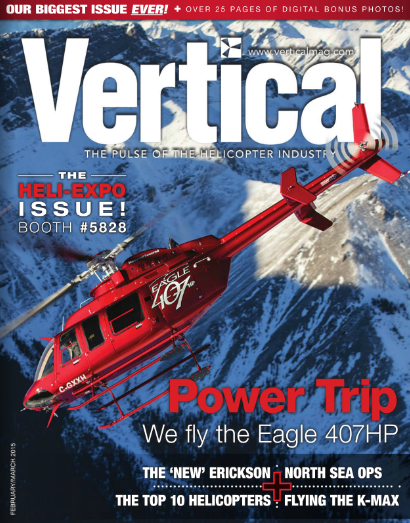
Vertical CoverThe cover of the March 2014 issue of Vertical Magazine, their largest issue ever. You can get your copy of the print edition at HeliExpo for free.

By the way, one of the reasons I occasionally read NTSB accident reports for helicopters is to learn from other pilot’s mistakes. Contrary to what the general public believes, at least 90% of aviation accidents are due to pilot error.

Anyway, I thought long and hard about what I could share with Vertical readers and decided to tell about the time I nearly killed myself trying to get over the Cascade Mountains in low visibility. I submitted it and it was accepted. It appeared in the March 2015 issue of Vertical on page 226, with the title “Scud Running in the Cascades.”

If you attend Heli Expo next month, I hope you’ll visit the Vertical booth and pick up a free copy of the magazine. Maybe one of you can send me a copy for my clip file?

Overqualified and Unemployable

The irony of today’s job market.

I’ve been thinking a lot lately about a friend of mine. For the sake of anonymity, I’ll call her Sally.

Like me, Sally spent years writing computer how-to books, turning her expertise into easy-to-understand instructions readers could learn from. Like me, she had strong selling titles that earned her a good income. She writes about more technical topics than I wrote about: mostly web-related programming. And unlike me, she stuck to freelance work as her main source of income where I grew and then slid into a career as a helicopter pilot.

A few months ago, Sally mentioned on Twitter or Facebook that she was looking for a full-time job.

A full-time job.

I thought at the time about how I’d feel if I had to get a full-time job after more than 20 years as a freelancer and business owner. A job where I had to dress a certain way every day, work regular hours, attend pointless staff meetings, and answer to a boss with his/her own personal agenda or baggage. A job where my daily tasks would be determined by someone else, without giving me any choice in the matter. A job where the term “weekend” actually meant something.

I shudder at the thought.

Don’t get the idea that I don’t work. Or that Sally doesn’t work. Freelancers work when there’s work to do. When there isn’t, we’re usually looking for work.

But these days, the kind of work Sally and I did as freelancers is getting harder and harder to find. People don’t buy computer how-to books when they can Google the answers they seek. People don’t spend money on the educational content we produce when they can get it for free online. So publishers are letting books die without revision and, one-by-one, freelance writers like us are losing our livelihood.

The reason I’m thinking about Sally lately is because this week she posted another Twitter update to say that she was looking for a full-time job. She was using Twitter to network, to put out feelers, to help her connect to someone who might be hiring. I’m sure she’s following other avenues as well.

What resulted was a brief conversation on Twitter between me, Sally, and another freelancer our age. And that’s when I learned a tragic fact:

Sally had applied for a job at a college teaching the computer language she’d been writing about for years. In fact, the college was using her book as the textbook for the course. But they wouldn’t hire her. Why? She didn’t have a Master’s degree.

Now those folks who are working to get a Masters or already have one probably think that’s a good thing. Makes that extra two years in college really worthwhile, huh? Gives you job security, right?

But does anyone honestly think they can teach the course better than the person who wrote the textbook?

It gets worse. Sally wanted to work for a local organization that has a tendency to hire young people at low starting salaries. When she applied, she even offered to work at that low salary. And she was turned down.

I know why. Young people are inexperienced and far more likely to do what they’re told instead of tapping into experience to suggest improvements as they work. Employers don’t want smart, helpful people. They want drones — bodies to fill seats, push pencils, and get a job done without questioning what they’re told to do.

I saw if myself firsthand when I flew at the Grand Canyon in 2004; the young pilots just did what they were told while older folks like me saw places where the operation could be improved and tried to suggest them. Or, worse yet, used their experience to to make a no-fly decision when weather was an issue. Can’t have that.

So employers are turning away older, more knowledgeable, more experienced workers in favor of young, inexperienced people who might have college degrees to meet arbitrarily established requirements — even when the more experienced workers can be hired at the same cost.

What does that say about our society and values?

AOPA Hover Power

A new monthly column.

AOPA LogoJust a quick note to let regular readers and visitors know that I’ve begun writing as a regular contributor to AOPA’s Hover Power blog. My first post appeared yesterday: “Maximum performance takeoffs and judgement calls.” My second post is already in the hopper for next month.

Hover Power is AOPA’s attempt to provide helicopter-specific content for minority pilots in the “A” of AOPA: aircraft pilots who fly helicopters. Although the blog got off to a reasonably good start, there was a short spell where there was a definite scarcity of new content. The Editor there has been working hard to get a good staff of pilot/writers together. I’m thrilled to have been asked to join the team.

I hope you’ll stop by and check out what we’ve shared with you. And don’t forget to comment.

And don’t worry — I’ll continue providing helicopter-related content here once in a while, too.