Why Write?

Money.

Author Mickey Spillane died last week at age 88. He was the creator of hard boiled detective Mike Hammer.

I don’t recall reading any Mickey Spillane, but I must have. I’m a huge fan of hard boiled detective fiction — a la Chandler and Hammett. But reviewers don’t usually use the names Spillane, Chandler, and Hammett in the same sentence unless it is to comment on how Spillane fails to stack up to the two masters of the genre.

Spillane’s writing has been called “hard boiled boilerplate,” full of cliches and odd visualizations. The critics were not kind to him. But he didn’t write to please the critics. He wrote to make money, as CNN’s obituary piece confirms:

Spillane, a bearish man who wrote on an old manual Smith Corona, always claimed he didn’t care about reviews. He considered himself a “writer” as opposed to an “author,” defining a writer as someone whose books sell.

“This is an income-generating job,” he told The Associated Press during a 2001 interview. “Fame was never anything to me unless it afforded me a good livelihood.”

Which got me thinking.

I’ve often been criticized by writing acquaintances — you know, the folks who want to be authors and are always working on short stories and novels but never actually publishing them — for “selling out.” In their eyes, writing non-fiction (computer how-to books, of all things) isn’t quite as impressive as creating art by writing fiction.

But they obviously don’t understand why I write computer books. It isn’t because I love composing sentences like: “Choose File > Open. The Open dialog appears. Locate and select the file you want to open. Click Open.” It’s because I like to eat, have a roof over my head, and buy cool toys like helicopters.

Yes, it’s true. I write computer books for the same reason most people go to the office every day. The same reason Mickey Spillane wrote books with titles like The Erection Set.

As Spillane once said,

“I have no fans. You know what I got? Customers. And customers are your friends.”

Ah, if only I could have as many friends like that.

On the Intelligence of Quotes

Maria Speaks Episode 27: On the Intelligence of Quotes.

This short podcast is a reading from a recent article I wrote on my book support site for Microsoft Word users. It explains the difference between smart and straight quotes and tells you how to work with them in Microsoft Word. You can read the transcript of this podcast and see the accompanying screenshots at www.aneclecticmind.com

Transcripts:

Curly or “smart” quotes are single and double quote marks that curve in toward what they surround. This blog, if viewed in the intended font, displays all quotes as smart quotes. Smart quotes are also often referred to as “typographers” quotes because they’re common in printed work like books, magazine articles, and other documents.

You may not realize it, but a smart quote character is actually a different character than its corresponding straight quote. Think about it: it has to be. After all, it looks different, doesn’t it? That means it has to be a different character.

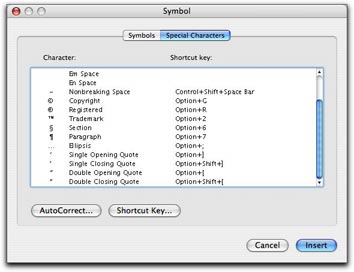
These characters are easy to type on a Macintosh. For example, to get the “ character, type Option-[. to get the ’ character, type Shift-Option-]. (Although there must be some way to type these in on a Windows computer, I don’t know how to do it; perhaps a reader can use the Comments link to share the keystrokes?)

Special CharactersIn Word, you can also use the Special Characters pane of the Symbols dialog. Choose Insert > Symbol to display the dialog and click the Special Characters tab or button. Scroll down to find the character you want (they’re listed at the bottom of the list) and double-click the one you want to insert it. This is a rather cumbersome way to get the job done, but it does work.

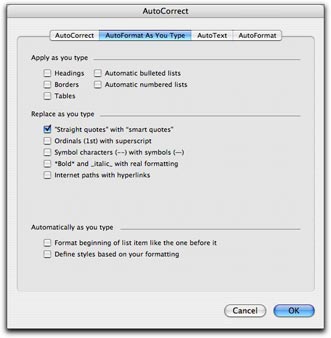
AutoFormat as You TypeFortunately, Word offers a better, automated way. You can set an option in the AutoFormat as you Type pane of the AutoCorrect dialog that will automatically convert every straight quote you type to the corresponding smart quote. Choose Tools > AutoCorrect and click the AutoFormat as You Type tab or button in the dialog that appears. Then turn on the “Straight quotes” with “Smart quotes” check box. (As you can see, that’s the only feature I have enabled in this pane on my copy of Word; I don’t like Word messing with the formatting of what I type, as I discuss in “Three Ways Word Can Drive You Crazy[er] and What You Can Do About Them.”) Click OK to save your setting.

From that point on, every time you type a single or double quote, Word will convert it to a smart quote. If your computer isn’t very fast, you might actually be able to see the conversion happen. And, if you use Word’s Undo feature, you can undo the conversion to revert the character back to the regular quote you typed.

I should mention here that this feature is enabled by default, so if you never changed this setting and you want smart quotes, you don’t have to do a thing to get them.

Now suppose you have a document that was typed without smart quotes. Perhaps a passage of text copied from a Web site or a document someone wrote with a plain old text editor. You want to dress up the document for printing and smart quotes are important to you. Do you have to retype all those quotes to “educate” them? Heck no! Just use Find and Replace.

Find and ReplaceFirst double check to make sure that the “Straight quotes” to “Smart quotes” feature is enabled as discussed above. Then choose Edit > Replace to display the Find and Replace window. Type the same plain old double quote character in the Find What and Replace With boxes. Then click Replace All. Word will replace the dumb double quotes with the correct smart quotes and tell you how many it replaced. Click OK to dismiss the confirmation dialog. Then type the same plain old single quote character in the Find What and Replace with boxes and click Replace All. Word replaces all the dumb single quotes with smart single quotes. Click OK to dismiss the confirmation dialog and close the Find and Replace window.

If you do this a lot, you might consider writing a macro that does the job for you. But that’s beyond the scope of this article.

What if you have a document with smart quotes and you need to turn them into straight quotes? Easy enough. Follow the same process, but before you use the Find and Replace window, check to make sure that the “Straight quotes” to “Smart quotes” option is turned off. Find and Replace should dumb up the quotes.

Now that you know the tricks, there’s no reason why your Word documents shouldn’t have the smartest quotes around.

Microsoft, Word, smart quotes

The Sleeping Tiger Stirs

I get pretty fed up about what’s going on in Wickenburg…and start to do something about it.

Small town politics sucks. There’s no doubt about it. And it sucks even more when the politicians are fighting over a desert crossroads town with a weak economy and a part-time population.

When I moved to Wickenburg ten years ago, it was a small western town with a year-round population of about 4,000 people. Just enough shopping and services to make life convenient. Lots of space between the homes on the outskirts of town where I live. Privacy. Quiet. Clean air. Little crime. Slow pace of living. Just the thing a pair of New Yorkers needed to get a grip on their own lives.

One of the things we liked best about Wickenburg is that it didn’t have a lot of high density housing. Sure, it had some condos and apartments and the homes in the older downtown area were small and on small lots. But the rest of the town was zoned for one house per acre (or more) and the outskirts of town were zoned for one house per five acres. (We have 2-1/2.)

Fast forward to 2004. A developer proposes a high density housing development at the 9-hole golf course known as Wickenburg Country Club. He promises to expand the golf course to 18 holes. All the golfers want it. But the people who will soon have condo roofs in their back yards don’t. And neither do the people who see that one high-density development will open the floodgates to others.

Voters put together a referendum to get the issue on the ballot. Proposition 421 was the result. And the voters voted the development down.

Let me make sure you understand what I just wrote. The majority of voters who voted on Prop 421 voted against it. They were saying that they did not want the development to proceed.

Fast forward to 2006. The Mayor and Council voted in favor of allowing a virtually identical development on the same site by the same developer.

Huh?

Silly me. I thought we lived in a democracy.

But it gets worse.

Another group of voters put together another referendum to stop the development again. It was submitted the same way as the first one and should have been accepted. But they Mayor decided that because an attachment was made with a staple rather than a paper clip, it was not properly submitted. He directed the Town Clerk to reject it.

What?

I’ve been sitting back watching all this bullshit unfold for the past three years. Occasionally, I’d write an article or a letter to state my point of view. But I pretty much kept out of things — there were other people writing for my Web site, wickenburg-az.com who were saying pretty much what I would have said anyway.

But now I’m pissed. This little twerp who was voted in as Mayor — I couldn’t vote because I live outside of town limits, but I never would have voted for him — is making decisions that are not only beyond his authority, but they’re clearly against the will of the people.

This is wrong.

And I’m not going to sleep through this one. I’ve already made my first contribution to the voters efforts by writing an article about the paper clip rejection. More to come.

I promise.

Fan Mail

Why I find it so embarrassing.

Every once in a while, I get an e-mail message that’s clearly categorizable as fan mail. The messages are usually the same in tone: “I can’t believe how much you’ve accomplished! I try to do some of the things you do and can’t manage to succeed. How do you do it?” The only thing they don’t say is “You’re my idol,” but if you read between the lines sometimes, it’s there.

I’m embarrassed by all this.

I’m a pretty normal person from a pretty average background. Lower middle class parents, not much money in the family. I got my first jobs at age 13: paper route, babysitting, fence painting. Because there weren’t too many things handed to me, I quickly learned that if I wanted something, I had to work to get it. So I did.

(Personally, I think this is why America is doomed. With so many parents handing out things to their kids, kids don’t build healthy work ethics. They’re lazy and unmotivated, concerned more with what they’re wearing than what they’re learning, and someday they’ll be running this country. Hopefully, I’ll be dead by then. But I digress.)

I think the only thing that sets me apart from other people is that I’m driven. I see something I want to achieve and I do what I can to achieve it. I work hard almost all the time. As I finish one project, achieve one goal, I’m thinking of the next.

Back in college, I took a management course where they discussed Maslow’s Hierarchy of Needs. At the top of the pyramid is Self Actualization, the need that must be filled after all others are filled. The trouble is, if you fulfill the need for self actualization, there’s nothing left. So to remain happy, self actualization must always be growing and changing, like a moving target. That’s the way I understood it back in my late teens. And I think that’s what drives me to this day — the need to always have something different to reach for and achieve. I think you can say that I live for challenges.

But are my achievements that incredible? I don’t think so. I admit that I’m fortunate in that I have a good brain and decent health (although the health thing has been a bit questionable lately), but there’s nothing special about me. I’m not a genius. I don’t live on four hours of sleep a night (I wish!). I’m not rich. I just make the most of what life’s dealt me.

People marvel at my achievements as a writer. I’ve written 60+ books and hundreds of articles since 1992. Do you think that’s because I’m the world’s greatest writer? Of course not! It’s because writers generally don’t make much money, so if you want to earn a living as a writer, you have to produce an awful lot. I learned how to work with editors and publishers to deliver what they wanted when they wanted it. My mind has the ability to take a task and break it down into its most basic steps — this is natural to me and I don’t know why. My writing skills make it easy to communicate the steps of a task to readers — my writing skills come from years of reading and writing. I don’t let ego get in the way of delivering what my editors want. By reliably producing year after year, I got into a position where I didn’t have to look for work anymore. It looked for me. I kept producing. And I still keep producing.

People think it’s incredible that I fly a helicopter. It’s not that incredible. It took me a year and a half of part-time lessons, driving 180 miles round trip each lesson day and thousands of dollars, to build my flight time and to get my private helicopter license. That’s not an achievement — it’s perseverance and the willingness to throw large sums of money at what I thought would be a hobby. If I’d quit doing my other work for a while, I could have completed that training in three months. But you’re not independently wealthy or supported by someone with deep pockets, you have to work before you can play. And, for the record, just about anyone can learn to fly. Helicopters aren’t harder to fly than airplanes, either; they’re just different. Anyone who says they’re harder to learn is using that as an excuse for not really trying. Unfortunately, they are more expensive to learn. And that’s usually the stumbling block that stops people from learning.

You want to achieve something? Go out and do it! Stop making excuses, stop procrastinating, and for God’s sake, stop watching crap on television — the eternal time-waster. Only when you dedicate yourself to your goal, fitting each task of its achievement into your regular work and family schedule, can you make it happen.

If you keep at it, the achievement of one goal will surely lead to the next.

And please, stop embarrassing me with fan mail.

Vocabulary Words

It’s never too late to expand your vocabulary.

I learned to read in the summer between first and second grades.

I’d gotten the basics with the Dick and Jane books in first grade. Back in those days (the mid 60s), kids weren’t learning to read at home with their parents, by watching Sesame Street, or in kindergarten. It was first grade and beyond or pretty much nothing.

Unless you had a thirst for more, which I did. I wasn’t a popular kid — I had a few local neighborhood friends, but that was it. At school, I was one of the outcast kids — a nerd, as we’d say today. I wasn’t a physical kid. Kick the Can and Running Bases was the extent of my athleticism. So what else was left? Reading.

After discovering the joys of reading, I was hungry for more. My mother recommended that I read the Nancy Drew books that she’d grown up with. Nancy Drew books are a big step up from Fun with Dick and Jane. I’d ride my bike (without a helmet on!) the mile or so to the local library (in those days, a kid could get around pretty good by herself, without fear of predators), take out a book, and ride home. I’d then annoy my mother for the next few days by asking her every single word I didn’t know.

There were a lot of them.

Finally, she had enough. “Sound out the word like you learned in school,” she instructed. “Get the meaning from the sentence.” It took some practice, but pretty soon I got the hang of it.

I figured out that Nancy’s pumps were shoes and that a chum was a friend. Of course, I also thought the word determined was pronounced deter-mined (short e in dEter, long I in mIned). That went on for a few years. Nancy Drew was always determining things and my “sound it out” skills simply failed me for that one.

I enjoyed the books and my reading skills improved. In my second grade year, a test showed I had fifth grade reading skills. In fifth grade, I achieved the highest score ever for all of New Jersey on a reading and comprehension test.

I might be bragging a little here, but that’s not my purpose. [Steps up onto soapbox.] My main purpose in relating this story is to show that it is possible for a youngster to get involved in reading to the point where reading becomes a self-sustaining task. The student reads because she likes to. In an effort to find more interesting things to read, she teaches herself the vocaulary in books consdered far beyond her age level. This, in turn, opens her to new ideas and turns on the wheels of free and independent thought. And it does incredible things for a student’s writing skills. After all, how can you be a bad writer when you consume so many expamples of good (or at least acceptable) writing? [Steps off soapbox.]

Almost forty years have passed. I still read as much as I can. I always have book on the table beside my bed — something to page through before passing out at the end of the day. Some days, when I have time and a good book at hand, I’ll get into what I call a “reading marathon.” That’s when I pick up a book and pretty much don’t put it down until it’s done. Otherwise, I’ll busy myself in the morning or evening with current events articles from Web sites I like or pieces in the few magazines I subscribe to (AOPA Pilot, Technology Today, Rotor & Wing, Vertical, and The Virginia Quarterly Review.

I’ve been concerned lately about my vocabulary. It seems to me that it just isn’t growing anymore. This has become all the more apparent as I read and hear words that I’m not quite sure of. Yes, I can still figure out what a word means by the sentence it’s in or the context in which it is used. But you have to really know the word to get the full meaning of what the author intended.

The word ubiquitous is a great example. Have you been listening to the news and commentary lately? I hear this word almost daily these days. Yet I’d never read a formal definition of the word and was left on my own to figure out what it meant. At first I wasn’t too concerned, but the more ubiquitous the word ubiquitous got, it became clear to me that I was missing something.

I bought a vocabulary CD and a few vocabulary books. But the trouble with these tools is that they present the words some author thinks you don’t know but should. My problem is that I knew about half the words, was curious about a quarter of the words, and didn’t give a damn about the rest.

So I started writing down words I’m not completely sure of as I encounter them in books and articles. Yesterday, as I read P.D. James’s Unnatural Causes, I wrote down 23 of them.

Oxford New American English DictionaryNow I’ll use the Dictionary application that comes with Mac OS X Tiger to look them up. The Dictionary in my Mac OS X installation has words and definitions from The Oxford American Dictionaries. (I usually use the Dictionary widget, which has the same source of information, but I want to do some copying and pasting here, so I’ll stick with the app.)

Learn with me.

cosset: verb; care for and protect in an overindulgent way.

somnambulant: adjective; sleepwalking

gules: noun; red, as a heraldic tincture

vulpine: adjective; of or relating to a fox or foxes

spurious: adjective; not being what it purports to be; false or fake

histrionics: noun; exaggerated dramatic behavior designed to attract attention; dramatic performance; theater

innocuous: adjective; not harmful or offensive

lubricious: adjective; offensively displaying or intended to arouse sexual desire.

viva voce: noun; Brit. an oral examination, typically for an academic qualification

numinous: adjective; having a strong religious or spiritual quality; indicating or suggesting the presence of a divinity

helot: noun; a member of a class of serfs in ancient Sparta, intermediate in status between slaves and citizens

moue: noun; a pouting expression used to convey annoyance or distaste

Eumenides: Greek Mythology; a name given to the Furies. The Eumenides probably originated as well-disposed deities of fertility, whose name was given to the Furies either by confusion or euphemistically.

capitulation: noun; the action of surrendering or ceasing to resist an opponent or demand

syncopate: displace the beats or accents in (music or a rhythm) so that strong beats become weak and vice versa

doldrums: plural noun; low spirits; a feeling of boredom or depression

amorphous: adjective; without a clearly defined shape or form

éclat: noun; brilliant display or effect

miasma: noun; poetic/literary; a highly unpleasant or unhealthy smell or vapor

truculent: adjective; eager or quick to argue or fight; aggressively defiant

shibboleth: noun; a custom, principle, or belief distinguishing a particular class or group of people, esp. a long-standing one regarded as outmoded or no longer important

innate: adjective; inborn; natural

indolent: adjective; wanting to avoid activity or exertion; lazy