Last Day on the Road

I finally make it to Quincy.

[When we last left our intrepid traveler, she’d settled down for the night in a campsite alongside a stream in Oregon, where she sipped good coffee and listened to a light rain falling on the roof of her travel trailer. You can read about the first day of her trip here and the second day here.]

I’ll be the first to admit that although I pushed hard and covered a lot of miles on the first day of my journey from Wickenburg, AZ to Quincy, WA, I pretty much slacked off on the second day. I blame that on two things: I was tired from a poor night’s sleep and the rainy weather made driving difficult and tedious. So when I pulled into the campsite in an Oregon State Park, I didn’t really care that I’d only covered about 400 miles that day when I should have been able to make it all the way to Quincy.

But that left my third day with a very easy goal. I was only about 250 miles from Quincy and could easily cover the distance before lunch.

I got back on the road at 7:10 AM. It was still overcast and rainy and the clouds seemed to dip down onto the highway. I drove through a light mist, wondering if it would become real fog. There weren’t many other vehicles on the road, which was a good thing. There was construction at various small bridges, bringing the road down to one lane. If a bridge was on an uphill climb, whoever was behind me was forced to slow to my climbing speed, which was seldom faster than 40 miles per hour. I think the truck was more tired than I was.

After a climb to the Blue Mountain Summit, I started seeing warning signs about an upcoming 6% grade. The signs were kind of funny. The first proclaimed, “First Warning! 6 Mile 6% Grade Ahead!” The second said pretty much the same thing as a “Second Warning.” Huge signs set forth maximum speeds for trucks with 5 or more axles — the really heavy ones were limited to just 18 miles per hour. This was obviously serious business.

Before the hill, there was a turnoff for a scenic view. I could see that the clouds ended just ahead and could imagine a view from the mountain over a broad valley. I knew that if I’d been in my Honda without a 3500-lb trailer behind me and a parrot in a plastic box next to me, I would have pulled off to take in the view. But in my current situation, all I wanted was to get to Quincy and set up camp. So I kept driving.

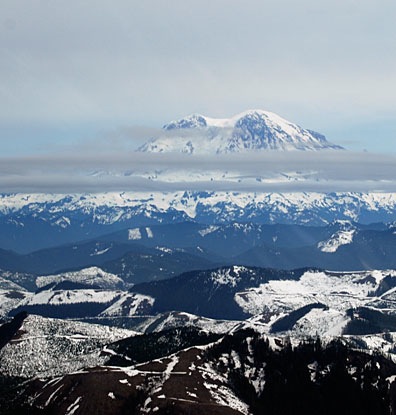
After a “FInal Warning!” sign, I began the descent. The cloud bank ended abruptly at the top of the hill, revealing a huge area of rolling green hills. In the distance, I could clearly see the bulk of Mount St. Helens rising, snow-capped, out of the ground. A tiny cloud hovered near its summit; it might be steaming again. The view was breathtaking, but I had to concentrate on the task at hand: keeping the truck at or below 50 mph on the steep downhill grade without burning up the brakes. I passed a truck and two runaway truck ramps. About a dozen cars passed me. Then I was at the bottom, continuing northwest toward Pendleton.

You may have heard of Pendleton, OR — it’s where Pendleton blankets are made. A piece of trivia for you: Pendleton blankets were much prized by the Navajos, who commonly wore blankets as part of their clothing, in the late 1800s. The Fred Harvey Company convinced the Navajo people, who are known for their excellent weaving, to begin weaving rugs instead of blankets — so they could trade the rugs for Pendleton blankets. These beautiful, soft wool blankets can be found in just about any trading post in the west.

I’d been in Pendleton once before, during my 2005 road trip, eager to take the factory tour. Unfortunately, the factory was closed that week for vacation. (My luck.) I was not going to try again that day.

But I did need gas and I wanted to top off the propane tanks. I’d be using propane to cook in the camper and I didn’t want to run out, since I couldn’t lift the tanks to put them in the truck. I watched the highway signs and pulled off at an exit with a Shell station that had both gas and propane. I was the only vehicle at the pumps and both attendants came out to service me. (Oregon, like New Jersey, is full service fueling only.) One guy pumped the gas while the other actually cleaned my windshield. Then I repositioned my rig and one guy added 6 gallons of propane to my tanks. I was surprised; I thought it would have taken more.

Then I was back on the road again, continuing northwest on I-84. Past Hermiston, I got on I-82 northbound. I crossed the Columbia River for the first time just downstream from the McNary Dam. The water approaching the bridge seemed to boil with currents and columns of mist rose from the downstream side of the dam. The Columbia was at flood stage because of snowmelt in the mountains.

Now I was in Washington state.

The area around me had become more and more agricultural after descending from Blue Mountain. It was a mix of farm field and orchards — including what I’m pretty sure were cherry trees. Most of the Columbia River Valley is cultivated. While Idaho may be famous for potatoes, I passed a sign somewhere in Washington that proclaimed that local county produced more potatoes than anywhere else in the country. Take that, Idaho.

I made the mistake of taking directions from my GPS to get through the Richmond area. The GPS, which is set up for off-road travel, didn’t give accurate and timely directions, so I missed a turn. I wound up detouring through Benton City to catch State Route 225 north to State Route 240. This farm road (225) was narrow and wound through hills. Pretty, but not the kind of road I wanted to be dragging my rig through.

I took State Route 240 to State Route 24 to State Route 243. Along the way, I crossed the Columbia again, passed the community of Desert Aire (which features a private runway), and the farm community of Mattawa, which is also known for its cherry orchards. Route 243 followed the Columbia River and I could easily see the flooding — just the tops of the tall green trees that had been on the shore poked out through the water. Then I got onto I-90 eastbound. Twelve miles to George, where I exited for northbound State Route 281. Just five miles left.

I pulled into the parking lot for the Quincy Golf Course at 11:45 AM.

The site I’d asked them to hold for me was occupied. I didn’t really care. I was tired and just wanted to get the camper parked, disconnected from the truck, and set up. I spent the next two hours doing just that.

Now, the next morning, I’m about 80% settled in. The camper is completely set up, with both beds extended. I put both mattresses on the back bed where I’ll sleep and set up Alex’s cage on the front bed. I’ve got a full hookup here, so I’m all plugged in. This will become important when it gets hot and I need the camper’s air conditioning. It also makes it possible to use the microwave, which our off-the-grid camping makes useless. It’s weird having unlimited access to water — I’m so accustomed to conserving it, especially when I’m away from home. It was a real treat to take a good, long shower. I also put out the awning, which will give me shelter from both sun and rain.

The campground’s five hookup spots are now full. I’m very glad that I got here when I did.

Wickenburg to Seattle: Day Three

We finish our journey with a flyby of Mt. St. Helens and a hair-raising (for me) descent to Boeing Field.

Other Articles in the
Wickenburg to Seattle Series:

Prepping for the Long Flight
My Co-Pilot
Day One (Wickenburg to Ukiah)
Day Two (Ukiah to Portland)
Day Three (Portland to Seattle)

We’d stopped in Portland so I could get some specialized cherry drying training in preparation for my summer job in Quincy, WA. I worked with Dave, who was kind enough to spend some time with us, on Sunday evening to cover some of the basics over dinner. We flew on Monday morning. I’ll go into detail about that flight — and even show off a bit of video — in another post.

When I was finished flying with Dave, Louis and I reloaded the helicopter and started north. We were on the last leg of our flight from Wickenburg to Seattle and had chosen a relatively direct route. Expected flight time was less than an hour and a half.

The day was overcast, with high clouds masking the sun. A dreary light illuminated the landscape. Although the temperatures were mild — in the 60s — it felt like winter. I didn’t take many photos. The light was just too darn ugly.

As we flew, we had clear views of Mount Hood, Mount Adams, Mount St. Helens, and Mount Rainier, four of the tall peaks of the Cascades. All were covered with thick caps of snow. The photo below shows the south side of Mount St. Helens with Mount Rainier in the background (on the left).

Mount St. Helens and Mount Ranier

Spirit LakeOur course took us quite close to Mount St. Helens. So close, in fact, that when Louis asked if I wanted to fly over Spirit Lake (see photo; Mt. Ranier is in the background), I said yes. Mount St. Helens, which was once just another beautiful snow-capped peak, had a massive eruption in 1980 that blew off its top and most of the north side of the mountain. Nearby Spirit Lake was the recipient of much of the ash and other debris that increased the water level and changed the look of the lake. The best views of the volcano are from the north, where you can see the lava flow and debris field. Since we were so close, it made sense to take a look. Here’s a shot looking back to the south from near Spirit Lake.

Mount St. Helens

By the way, if you’re ever in the area, visiting Mount St. Helens, I highly recommend taking a helicopter ride up the valley to the mountain. The views are up close and personal, much better than the photos here.

Mount RainierI punched Boeing Field (BFI) into the GPS and we got back on course. We passed far to the west of Mount Rainier, then headed inbound. Louis had done much of his training at Boeing Field, which is squeezed into a tight area north of Seattle-Tacoma International (SEA) and Renton (RNT), I so I turned all navigation and communication over to him.

In the meantime, I was getting seriously stressed about the amount of small airplane traffic around us, most of which was showing up as targets on the helicopter’s TIS system. We were flying up in “airplane land” — the same altitude small airplanes fly at when they’re trying to stay under the class Bravo airspace. This wouldn’t have been so bad if we were talking to a controller who could advise us of traffic, but we weren’t. I urged Louis to descend and he did. But it wasn’t until we were cruising at about 500 AGL that I felt comfortable again.

We landed at Boeing Field and set down near Pad 6. The mechanic who was going to be doing my helicopter’s annual inspection, Rich, came out to meet us. A while later, all of our gear was unloaded and they were wheeling Zero-Mike-Lima away. I wouldn’t be seeing or flying it for more than two weeks.

We’d completed the flight from Wickenburg to Seattle in about 13 hours of flight time. Louis was home, but I was only halfway through my travels.

Travel Plans

Three trips in just over a month.

Pity me. I’ll be on 9 different airliners over the next 40 days.

First Stop: Florida

There’s a joke that New Yorkers “get” and I’ll be so bold as to try it here:

Q: What’s a good Jewish wine?

A: [whining] I want to go to Florida.

While midwesterners and northwesterners retire to Arizona, New Yorkers (and others from the northeast) retire to Florida. Not only do they retire there, but they vacation there. And since New York has a huge Jewish population that vacations and retires in Florida — mostly in the Fort Lauderdale area — this joke is funny. Well, at least it’s funny to New Yorkers. (And having heard it from a Jewish person, I don’t think it’s offensive to Jews. You may correct me if I’m wrong.)

Both of my parents retired to Florida. While many people think that might make sense — that they retired together — it’s not as easy as that. They’re both remarried and they each moved to different parts of Florida with their spouses.

My mother, who I’m going to see next week, moved to the St. Augustine area. Technically, she lives in Crescent Beach, which is on the far southern reaches of St. Augustine. She lives with my stepdad on the barrier island there. Her home, which she had custom-built about 10 years ago, sits on a tiny canal.

She and my stepdad used to have a boat, but fuel and maintenance costs made that impractical, considering the amount of time they actually used it. So now they have a bulkhead with a bench overlooking the canal. Their neighbors have boats that they seldom use, too, and they can look out on those.

The area is nicely treed and quiet. There are lots of sea birds.

My mom’s house was built in a U-shape. On one end of the U is the master bedroom and bath. On the other end is another bedroom with its own bathroom just up the hall. That was supposed to be my grandmother’s bedroom, but like so many people back east, she couldn’t leave the area she’d lived in for her whole life. (In fact, she died within 50 miles of where she was born, having lived in only three or maybe four places her entire life.) Grandma’s room is the best room in the house, with privacy, easy access to the pool and hot tub between the arms of the U, a nice bathroom, and its own thermostat. Although the house has four bedrooms, I try to manage my trips so I get Grandma’s room. I stayed in the “kid’s room” once with Mike and was incredibly uncomfortable sharing the tiny space beside the trundle bed with a treadmill’s bulk.

My mother and stepdad are going to Italy at the end of the month for two weeks. This is a huge deal. They don’t travel much and I can’t remember the last time they left the country. They’re going with a tour group (of course) and I don’t know the itinerary, but I’m sure I’ll be filled in when I get there on Tuesday evening.

I haven’t been to my mother’s house since Thanksgiving 2006. She hasn’t been out here since Thanksgiving (or perhaps Christmas?) 2004 (?). She really doesn’t like to travel by plane. One year, they decided to drive out. Yes: St. Augustine, FL to Wickenburg, AZ, a distance of more than 2,100 miles. You might be asking yourself: what were they thinking? The answer: they weren’t. It was a long drive and they were on freeways the entire way. It might not have been so bad if they didn’t hit a dust storm in the Tucson area, but they were tired when they encountered that and it really rattled them.

It takes two planes to fly to visit them — no one has a direct flight from Phoenix to Jacksonville or Daytona (she lives right between them). I could get a direct flight to Orlando, but then I’d spend more than an hour driving from there. I’d rather spend that hour on the ground, in Houston, looking for a nice lunch and shopping in the airport terminal.

I’ll be in Florida for five days: Tuesday through Saturday. Two jets each way equals four different jets.

California, Here I Come!

My next trip is for business. I’m flying into Burbank, CA to meet with a new client for a brand new job. I can’t go into details because I’m under nondisclosure (NDA), but I can say that I’m working on a new project that should be completed by the end of May. I’ll talk about it more then.

I’m flying Southwest into Burbank. I don’t like flying Southwest. The lack of seat assignments is a royal pain in the butt. I like to know before I get on a plane where I’ll sit on that plane. And since I’m likely to have carry-on luggage, I like to know for sure that I’ll be able to stow it. Southwest makes knowing these things impossible, so I tend to avoid it.

But my client paid for this trip’s airfare and booked it for me, so I can’t complain. It’s a more convenient flight than I’d get with another airline — Burbank is closer to my final destination than LAX, and a heck of a lot less crazed. I’ll probably save a whole hour of travel time by avoiding traffic. And maybe, just maybe, Southwest isn’t as bad as I remember it.

Because this trip is for business, I don’t expect to have much fun. I have to finish the entire project in 4-1/2 days. (I arrive on Sunday and depart on Friday at about noon.) The quicker I work, the more time I’ll have to goof off, so that’s a good motivator. And not finishing up on time is not an option.

It’s just one jet each way, but if you’re counting, that brings the total up to six jets between now and May 9.

The Washington Trip

In mid-May comes the trip I’ve been looking forward to: a helicopter flight from Wickenburg to Boeing Field in Seattle, Wa. There’s nothing I love more than long cross-country trips by helicopter. If I could figure out a way to earn a living doing it, I’d be doing it all the time.

The trip is to reposition the aircraft for my summer job. Yes, this year, after two years of false hopes, I’ve been signed up to do cherry drying for growers in central Washington state. But to do the work, I need to get the aircraft up there. That means a 10-12 hour ferry flight which I hope we can complete within two days. Once at BFI, I’ll leave the helicopter with a buddy’s mechanic for an annual inspection, which will be due by then.

Since I’ll be in central Washington for at least a month, I’ll need a place to stay. So right after I drop off the helicopter, I’ll hop on a plane for Wenatchee, WA, rent a car, and start scouting around. I plan to drive up with my new old truck pulling my travel trailer. Alex the Bird and I will camp out for the entire time. I’m interested in finding an affordable campground with full hookup and WiFi, but there’s a chance I might get a free (or almost free) partial hookup with (fingers crossed) WiFi at the same private airport where the helicopter will be based for the first part of the season. Since I have time, I figured I’d go check out my options. It’s a long drive from Wickenburg, AZ to Quincy, WA, and I want to make sure I know where I’m going to be parking my rig before I get there.

The plane from Seattle to Wenatchee may not be a jet, but it will be part of an airline. I fly from Seattle to Wenatchee and then back to Seattle before flying home to Phoenix. If you’re keeping count, that’s three more plane rides for a total of nine.

Other Work

Between all of that, I have other work to do.

I have two helicopter charters for Flying M Air — one of which is later today. After that, Flying M Air’s Phoenix-area operations are closed for the season. I have 21 hours left on the Hobbs meter before I need a 100-hour inspection (which is about the same as an annual, but must be done every 100 hours). If I fly 2-1/2 hours today and 3-1/2 hours on Monday, that leaves 15 hours for the ferry flight and helicopter training I need to do (in Portland, OR, which I hope to hit on the way to Seattle). While I’m allowed to go over the 100 hours if the flight is repositioning the aircraft to where the maintenance will be done, I’m not allowed to go over it for training flights. So I simply can’t take on any new charter flights until I get to Washington.

(And yes, I can continue to operate my tour and charter business in Washington State. My Part 135 certificate is “portable.” So when I’m not drying cherries, I hope to make a few extra bucks by transporting growers and other folks who need to get from place to place near my summer base(s).)

I also need to record a training video for macPro Video. I would have started this last week, or this week, but I’ve been having trouble getting satisfactory recording equipment together. (See my video blog entry about this.) I might try to do some of it in Florida. We’ll see. Otherwise, I’ll have to do it between the Florida and California trips.

I also need to go to Howard Mesa to pick up a few things I’ll need on my summer-long trip. Among them is Alex the Bird’s mid-size cage, which should fit nicely on a shelf in the camper, my low-wattage one-cup coffee maker, and some odds and ends that’ll come in handy for off-the-grid camping, if I need to do any of that. I’d also very much like to get away from here for a weekend because of a variety of other crazy things going on.

And I need to get ready to write a new book about QuickBooks Pro for Macintosh. I’ll work on that while I’m away this summer. I’ll be bringing two (possibly three) laptops with me so I can write. There’s another book I’ll be working on while away, but I’m under NDA about that and can’t say more.

In any case, I’m looking forward to a challenging summer away from Wickenburg.

I’m also looking forward to my three shorter trips over the next 40 days. I really do love to travel.

Bald Eagle

Not endangered anymore…and I can see why.

At the end of our trip to Alaska in June 2007, Mike and I stopped for a few days in the Seattle, WA, area where Mike’s cousin, Rick, lives. Rick took us northwest for a day trip, where we went island hopping via ferry. During our travels, we stopped at the northern part of Deception Pass State Park on Fidalgo Island, where we went for a walk.

There was a bald eagle perched at the top of a pine tree. Normally, this would have floored us, but we’d just come from 10 days in Alaska, where eagles are considered nuisance birds, like pigeons or seagulls. Still, it looked like a good opportunity to get a photo of an eagle doing sometime more interesting than waiting for the fishermen to dump their garbage. So I raised my camera, which (fortunately) had a 200 mm lens on it, focused, and waited for something interesting to happen.

ImageThe bird took off and I caught him in flight.

The photo isn’t perfect, but it is, by far, the nicest picture of a bald eagle I got while on vacation.

We saw a lot of bald eagles in captivity in Alaska. They were all injured birds that would never return to the wild. They were beautiful animals — quite large and very majestic looking. But those small, close-set eyes and sharp beak and claws were enough to remind anyone that these are birds of prey. Not a coincidence, I think, for the national bird of this country.

But I’m not complaining — it could have been worse. As you may know, Benjamin Franklin wanted the turkey to be our national bird.