A Trip to New York In Pictures: Part I

Some photos of my Thanksgiving trip to New York and New Jersey.

Last week, I went to New York with my husband, Mike. We spent a few days in Manhattan, visiting our old stomping grounds, then headed to New Jersey to spend a few days at my brother’s house in Colonia (near Rahway). Along the way, we made a quick stop in Queens for an unremarkable Thanksgiving dinner at an Italian restaurant.

I brought two cameras with me: my Canon Powershot 500 and my relatively new Nikon D80. It was a good thing I brought 2 cameras. My recently repaired Canon crapped out on me again. So most of the photos were taken with the Nikon.

I just put the photos on my iMac and looked at them. I thought I’d share a few with readers. They may not be the best photos of New York and the vicinity, but I’d like to think they’re at least a little bit interesting.

The Flight

Out the Airplane windowWhen you have 4+ hours to kill in coach on a Phoenix to Newark flight, you do run out of things to do. I killed some time playing with my new 10.5mm lens. Here’s a look out the window. I think we were over Kansas or maybe eastern Colorado at the time. See the checkerboards of the terrain?

If you’ve never flown across the country during the day, do it and make sure you get a window seat. If the weather is clear, you’ll get an education about the geography of the United States that no textbook can offer. I always sit by the window when I fly and I spend much of the flight time with my face right up against the Plexiglas.

Into Manhattan

To Times SquareAfter landing at the airport and getting a much-needed shoeshine in the terminal, we made our way to the rental car area and picked up our Avis rental car. Mike then drove us right into the city, by way of the Lincoln Tunnel. This photo was taken as we made our way across town toward Times Square. Okay, so it’s not the best image. But what do you expect? The camera was sitting on the dashboard and we were stopped at a light. You can see the shadowy figure of a pedestrian crossing the street — this was a long exposure.

The View from Our Room

View from the SheratonOur tiny but comfortable room at the Sheraton Hotel and Towers on 52nd and 7th was on the 37th floor. From the big windows, we got a glimpse down into Times Square. I set up my tripod on the desk along the windowsill and captured this image as we settled down for our first night.

Did you know that the Sheraton we stayed at is the flagship Sheraton hotel? That’s what it said in the hotel services guide in the room. I do know that it was the nicest Sheraton I’d ever stayed at. Sheratons, in general, aren’t so good. I prefer Marriotts. I used to like Hiltons, until my multiple-week stay at the Mount Laurel Hilton in New Jersey. But that’s another story.

View in DaylightWondering what that view looked like in daylight? Wonder no more. Here it is. Not quite as colorful or glamorous on a gray New York day. The buildings in the foreground are all office buildings. There was a very large conference room right across the street from our room; they had a big meeting in there the day we left.

Rockefeller Center

GE BuildingOn Tuesday we did a lot of walking. That’s the best way to get around in New York. My only wish was that I’d brought thinner socks — my heavy cotton socks aggravated my 25-year-old corns. But that’s probably more information than you need, so I’ll stop there.

We went to Rockefeller Center first. This photo was taken inside the GE building (formerly the RCA Building), an Art Deco masterpiece on 6th Avenue. This particular photo was taken right after security told me I couldn’t set up my tripod. I was very disappointed. (I’m being polite here.) The color of the light is the actual color inside the building — very yellow.

We didn’t stick around for any more indoor shots. Instead, we went outside. I got a photo of the Promenade, but rather than show it here, I’ll show you the one I took that night. Keep reading.

Grand Central

Grand CentralIt’s Grand Central Terminal, not Grand Central Station. Many people get that wrong. It doesn’t matter. It’s Grand Central and it’s a magnificent piece of architecture on 42nd Street at Park Avenue.

This photo shows the Concourse, taken with my 10.5mm lens from the steps up to one of the restaurants. No tripods here either, I’m afraid. Not without a permit. (Can you believe this crap?) So I set the camera down on the railing and used the self-timer to snap the picture. What I like about it — other than the outrageous curves — is the motion of the people down below.

The ceiling of Grand Central’s main concourse shows the constellations — cream colored stars with drawings of the constellation figures. Incredible. And the windows you can see at the far end are actually huge — about 8 stories tall. The horizontal lines across them are walkways where people in the office spaces above walk from one side of the building to the other.

Back in the mid 1980s, when I worked for the City of New York, I had a job on Madison at about 45th Street. Each day, I’d take the subway up to Grand Central and walk across this concourse from the lower-left of this photo to the middle right. There were underground corridors you could follow for blocks, keeping you out of the elements. One of the corridors was carpeted with multi-colored carpets at the time. They were doing a test. In those days, they used to judge how durable carpets were by putting them down in Grand Central and letting commuters walk all over them all day long.

The New York City Public Library

Library Entrance HallThe New York City Public Library is a monument on Fifth Avenue at about 40th Street. People know it for the matched statues of reclining lions out front. But few tourists ever step inside to see how incredibly beautiful it is.

This photo is of the main entrance hall, taken from the north stairway. This is mid-day on a Tuesday. Not terribly busy. We’d walked through a Jack Kerouak exhibit downstairs before climbing up and wandering around the exhibits. Highly recommended. You can’t get more culture for less money anywhere in New York — it’s free.

And yes, I did get a few lion photos outside. But you don’t need to see them.

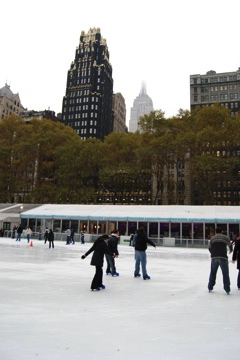
Bryant ParkOut back, in Bryant Park, they’d set up a skating rink. This shot, taken with that funky 10.5mm lens again, shows the rink, the back of the library, and a few of New York’s skyscrapers, including the Empire State Building. There were craft vendors set up all around the rink for the holidays.
Back when I worked for the City, I had a job on 41st between 7th and 8th. Yep — right by Times Square. Once in a while, we used to walk up to Bryant Park with our lunch. It was summer and it was hot. The park was filled with druggies back in those days, but they didn’t bother us. The Stand Bookstore had a row of kiosks along 6th Avenue, filled with used books, and I’d occasionally pick up something to read. They tell me Bryant Park has been cleaned up. It certainly looked friendly that day.

Times Square

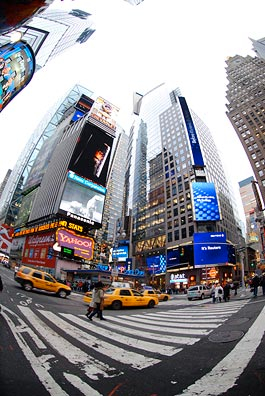
Times SquareI’m convinced that the best way to take photos in a place as busy as Times Square is with a wide angle lens. Can’t get much wider than this. I know it looks funky, but it really does show a lot. And if your mind can take out weird curves — since Photoshop can’t seem to do it — you can get a real feel for what’s there.

Times Square used to be a real sleaze pit. Now it’s just a very dirty, very brightly lighted place where a lot of tourists come for reasons I can’t quite understand. They must be like moths attracted to the lights. The place is full of tourist junk shops, electronics places selling gray market goods, and big name retail establishments like the Virgin Megastore and the Hard Rock Cafe. They tell me Disney even has a place there, although I didn’t see it. The place is full — and I do mean full — of advertisements. Not the kind of place to come if you suffer from seizures brought on by flashing lights.

Times SquareThe above photo looks downtown. This one looks uptown. I’m standing at the divider between 7th Avenue and Broadway, between 44th and 45th Streets. I snapped quite a few shots while I was standing here. I like this one the best. The exposure isn’t very good, but that’s mostly because the light sucked on such a cloudy afternoon.

And yes, this is the wide angle lens again.

More to Come

That’s all for now. I’ll share the rest of the interesting shots another day. I’ve got a few night shots to show off and a bit of New Jersey wildlife. So do check in again.

And if you want to read more words about my trip, do check out “Impressions of New York: An Assault on the Senses.”

Impressions of New York: An Assault on the Senses

A former New Yorker sees the City through a tourist’s eyes.

I spent the first 36 years of my life in the New York City metro area, living in New Jersey, Long Island, and Queens, NY itself. I even worked in downtown Manhattan, near the financial district, for five years. I grew to know New York, to understand it and to make myself part of its rhythm. It made me strong and helped turn me into the zero-tolerance for bullshit person that I am today.

I left the New York area in the late 1990s in search of a more laid-back lifestyle, one where I could keep more of the money I earned, instead of spending it on property taxes and car insurance. I wanted warm winters and friendly people. I wanted space between my home and the next, privacy, quiet. I wound up in a small town in Arizona where, until recently, I’ve been very happy.

But Arizona is completely different from New York — like black is different from white or day is different from night. I didn’t realize just how different the two were until this week, when I returned as a tourist, and spent two days in midtown Manhattan. For the first time ever, I was able to see New York through the eyes of someone who didn’t know it quite so well — through the eyes of a tourist.

The Sound of New York

View from the Sheraton Hotel and TowersThe first thing I noticed as we settled down for the night in our hotel room was the sound of the city. New York, you see, has a background noise, like a soundtrack. At its very base is a low rumble, like a low frequency hum. It’s the conglomeration of the movement of cars on city streets and the hum of climate control systems on rooftops and restaurant exhaust fans at street level. It includes subways rumbling under the streets and bus and truck engines and planes and the odd helicopter. Sometimes it includes the sound of the wind whistling down streets and around buildings. During the day, it includes voices: people in conversation as they walk the streets, whether it’s with a physical companion or the virtual companion on a cell phone.

The sound is punctuated, day and night, by other, louder sounds. Listen and you’ll hear them and often be able to identify them. There is, of course, the orchestra of car and truck horns. (It’s impossible for a New Yorker to drive for more than 15 minutes without using his car horn at least once and taxi drivers must use their horns at least three times per fare.) A bus engine revs, a heavy sheet of metal drops, a jackhammer breaks up a sidewalk. A truck backs up with a stead beep, beep, beep. A police car, ambulance, or fire truck — or sometimes all three together — speed to their destination, sirens wailing. A policeman blows his whistle, someone shouts. This time of year, Christmas music blares from speakers outside the windows of Saks, Lord & Taylor, and Macy’s.

To be fair, the sound does seem to calm a little at night, but the underlying rumble of noise is always there. The sound is the pulse of the City. If it were to stop, surely the City would be dead.

The sound is clearly audible to anyone who cares to listen — as long as that person has the experience of true silence to compare it to. I know true silence — the utter soundlessness of a still night atop a high desert mesa, a silence so complete you can hear your heart beat. That’s why the sound of the city is the first thing I noticed when we settled down for our first night here. Even 37 stories above the streets, closed in behind the thick glass of the hotel’s windows, we could still hear that sound. Open the window a crack and it fills the room.

The Lights & Sights of New York

The next thing I noticed was the brightness. True, our hotel is less than ten blocks from Times Square, but the brightness still surprised me. SImply stated: it doesn’t get dark here.

Times SquareThe light comes from the lights in building windows — office lights that are apparently never extinguished. It comes from the hundreds of television screens, many of which are larger than my two-story house, that display a never ending barrage of advertisements at anyone who glances at them. It comes from neon signs at street level or high atop skyscrapers: Ernst & Young, Kodak, Reuters, UBS, GE — these are just the few I see with a quick look out my window. The light comes from search lights that dance off buildings and pierce the sky, drawing attention to some new nightclub or the Christmas decorations on a posh shop. It comes from the Christmas decorations themselves: snowflakes twenty or thirty feet across, strings of lights wound around windows and trees and buildings, flashing lights forming wreaths and reindeer and Christmas trees. The scene pulsates with colored lights.
There may be streetlights — I don’t know; I didn’t notice them. They’re not needed here.

Dawn is so gradual here that it’s a non-event. The gray sky of night gets brighter and brighter until it becomes the gray sky of day. Only the clock can confirm that it’s daytime. But that’s just because it’s been cloudy since we arrived. I remember blue skies in New York and the shafts of sunlight between the buildings. Sadly, I think we’ll miss that sight on this visit.

And what does all this light reveal? Hundreds of buildings fifty or more stories tall with narrow, canyon-like streets in a grid pattern between them. Brick buildings a hundred years old standing proud beside steel and glass towers. Bright yellow taxicabs speeding down the avenues (with car horns blaring, of course), followed by lumbering, ad-wrapped buses. Thousands of pedestrians walking down sidewalks, gathering at street corners, ignoring traffic signals to cross when the time is right. People from every race and walk of life: white, black, asian, rich, poor.

At street level are shops showing off their inventories in bright, creative displays. In the tourist-trafficked areas, the merchandise spills out into the street with brightly colored signs and shop employees calling out bargains to lure the tourists in.

Bryant Park SkatingAround every corner is another surprise: a landmark building, a skating rink, a park, a farmer’s market, a holiday crafts market. The Public Library offers an exhibit of Jack Kerouac’s notebooks and his famous scroll, along with permanent displays of artworks and a real Guttenburg Bible (one of fewer than 200 made). There’s a fresh food market between corridors deep inside Grand Central Terminal. On Vanderbilt, there’s a public display of proposed designs for land development over the west side’s train yard — at least these developers understand the importance of open space park land. Step inside the lobby or study the facades of buildings on Sixth Avenue to see a WPA mural or art deco entrance or mosaic history. It’s impossible to be bored in a city like this.

At night the horse-drawn carriages come out to pick up tourists at Rockefeller Center and whisk them away to Central Park or Times Square or some other destination. The horses blend into traffic, stopping behind taxis at traffic lights, clomping along at their own pace while the cars and buses and trucks whirl around them. Stopped at a traffic light in front of Saint Patrick’s Cathedral, a horse urinates on the city street. The carriage driver looks at the police officer standing nearby and says, “He’s overheating.” Everyone laughs.

The Smell of New York

New York can keep any sensitive nose awake and alive. From the sickly smell of steam rising from the street to the sweet smell of carmel roasted nuts in a vendor’s cart, it’s all there, good and bad. You can smell a Chinese restaurant or pizza parlor long before you reach it — if the breeze is blowing just right.

Walk down an avenue and the smells parade past your nose: flowers in a park, perfume from a shop front, food from a restaurant or vendor car. Things can be less pleasant on side streets, depending on whether it’s garbage day, but with cold weather, pedestrians are usually spared the worst of the smells. But come summer time, pray the sanitation workers don’t strike.

The Feel of New York

The feel of New York depends mostly on the season and weather. This visit is overcast and damp, with some light rain. It’s not windy or cold enough to be really cold — which is good, because I no longer own a winter coat. Instead, it’s what I’d consider typical late autumn.

But come in August during a heat wave and be prepared for the “Three H’s”: hazy, hot, and humid. I’ll take 100°F in Phoenix in June over an 80°/80% humidity day in New York. Or try January, when the temperatures dip below freezing and the wind is howling down the streets or avenues. As you walk leaned into the wind, you feel as if your nose is going to freeze off before you reach your destination.

The air, of course, is filled with a fine dirt that coats you, your clothes, your skin, your car, and anything else exposed to it. Wash your face after a day walking on the streets and you’ll see the grime on your washcloth. Its especially bad when you ride the subway. It isn’t a gritty dust like you’ll find in the desert. It’s real dirt: a mixture of exhaust residue and pollution and plain, old-fashioned filth.

The Taste of New York

I’ve saved the best for last. I told friends I planned to eat my way through New York. So far, we are.

Every kind of food is available here, probably within walking distance of our hotel. On Monday night, we had Spanish food at a tapas bar on 53rd Street between 2nd and 3rd Avenues. Yesterday at lunch, we had Italian food at a restaurant overlooking the main concourse at Grand Central Terminal. Last night, we had Cuban food at a place on 52nd Street between Broadway and 8th Avenue. Today, for lunch, its dim sum in Chinatown followed up with Italian pastries from Little Italy. (I couldn’t resist buying a real New York black and white cookie at Grand Central yesterday; it was heaven.) Tonight, probably Rodizio at a place near my brother’s home in New Jersey.

We haven’t been picky about where we eat. The restaurants are all over the place. You can’t walk two blocks without finding some kind of interesting ethnic food. One glance in the window, to see how many people are inside, is enough to tell us whether it’s good. Last night’s Cuban restaurant, Victor’s Cafe, has been in business in the Theater District since 1963. A bad restaurant wouldn’t last that long in New York.

Or, as I pointed out to my husband, even if it’s bad, it has to be better than what we can get at home.

And sure, there’s the usual collection of chain restaurants: Applebees, Olive Garden, Hard Rock Cafe, McDonalds. But they’re all in the tourist areas — Times Square is full of them — and crowded with the same midwesterners who fill the same places in Arizona. Go figure.

What I’ve Learned

I’ve learned that I still have a love-hate relationship with New York. That it’s a nice place to visit, but I know I could never live there again.

I’ve learned that I could easily make myself go broke just by eating in New York. I’d also gain 10 pounds a week until I exploded. So it’s a good thing I don’t live here.

I’ve also learned that I’d like to come visit New York as a tourist more often. I may eat a lot here, but I also walk a lot. There’s just so much to see and do.

And that has to be good for something.

Telecommuting: One Solution to Slow Global Warming

And I don’t understand why no one sees it.

Later this morning, I’ll have the joy of joining thousands of other drivers on I-17 as we head southbound into Phoenix from points north. It’s a typical Monday morning, so I expect traffic to back up in the typical places — a few miles short of the Loop 101 intersection, down around Glendale Ave, at the “Stack” and “Mini-Stack,” at the Durango Curve, etc. The only thing that’ll make this trip to the airport tolerable for me is that my husband will be with me in the car and we can take advantage of the HOV lanes set up for carpoolers along part of the route. We’ll speed by the thousands of cars with only one driver in each one, getting to our destination in an almost normal amount of time while they take 50% longer to reach theirs.

Obviously, one of the best ways to slow global warming caused by auto emissions is to reduce auto emissions. You can do that by encouraging people to buy more fuel efficient cars, but you’ll always find people who need that status symbol Hummer or other ridiculous SUV in their driveway. (You know, the one with the shiny chrome extras that has never been off pavement?) You can do that by encouraging car pooling by adding HOV lanes to the highways. (You can see how well that works on the commute into Phoenix each day; ask the folks in New Jersey about their HOV lanes.) You can do that by encouraging people to live closer to where they work. (But with people changing jobs more often than most folks change hairstyles, that’s difficult to maintain.)

But you can also do that by implementing a solid plan for telecommuting — making it possible to work at home or in a local telecommuting center instead of making the long commute to park their butts in an office or cubicle for the day.

The Benefits of Telecommuting

The benefits of telecommuting go far beyond keeping single-driver cars off the roads during rush hour. For example:

  • Telecommuters spend less time traveling to and from work, so they have more time to spend with their families and friends. This can improve their lives and reduce stress.
  • Telecommuters can easily “pop back into the office” to get a bit of extra work done when necessary, especially if that office is in their own home or neighborhood.
  • Companies that allow telecommuting can reduce the amount of office space needed because fewer people will be coming to a central office. This can save the company money.
  • Companies that allow telecommuting can pay lower salaries because telecommuting employees have reduced commuting costs. (My sister, for example, spends more than $500 per month to get from her New Jersey home to her Broadway and Wall workplace, which is less than 20 miles away.) Savings can be spent on the equipment the employee needs to work away from the central office, such as a computer, Internet connection, and/or telephone line.

Clearly a telecommuting program can help a business and its employees, as well as the environment.

Not Always Possible

Obviously, telecommuting is not possible for all kinds of jobs. A car salesman, for example, can’t meet and greet prospective customers while sitting in his home-based office. Someone who works in manufacturing, where job duties require assembling parts or checking quality needs to be at the factory with tools and materials to get the job done. Policemen, firemen, and ambulance workers must be on the beat or at their base of operations, ready to spring into action when needed.

But there are so many jobs — especially in our predominately service economy — where an employee’s physical presence is not required at a specific workplace. Salespeople can do much of their work on the phone and in front of a computer, with visits to customers and clients to close a deal or provide service. Customer service personnel can work from any location where they have access to a telephone and the Internet. (If we can ship these jobs out to India, why can’t we ship them to people’s homes or telecommuting centers in the suburbs?) Editors, writers, and production people don’t need to come to an office to get things done. As long as they have the tools to work, they can work.

And telecommuting doesn’t need to be an all-or-nothing proposition. An employee can work in a main office two or three days a week and work the remaining days at a home office or telecommuting center. He can share an in-office workspace (cubicle or office) at the workplace with another telecommuter on the opposite schedule. Just taking one day a week off a person’s commute — that’s 20% fewer miles driven — can make a world of difference.

The Mindset

Unfortunately, the mindset of employers and employees makes utilizing a telecommuting program difficult, if not impossible.

Many employers have a complete distrust for their employees. They feel that if they’re not looking over an employee’s shoulders, the employee must be goofing off.

While that might be true of some employees, it isn’t true for everyone. Many employees are responsible individuals who understand that they’re being paid to get a job done. It’s those people who should be given the opportunity to telecommute.

The way I see it, telecommuting is a lot like working freelance, but for one client: your employer. If your employer gives you a job to do and it can be done in the amount of time allotted, there’s no reason why you shouldn’t be able to do it, whether you’re at a centralized workplace or at home with the necessary tools.

If an employee cannot finish a job at the office, he should not be given the opportunity to telecommute. Instead, the employer needs to understand why the employee is falling short of goals. Are the goals unrealistic? Is the employee simply not up to the task? This needs to be established before telecommuting is offered to anyone.

Employers can get peace of mind about telecommuting by granting telecommuting privileges only to proven employees and then monitoring workflow to ensure goals are met.

For example, suppose a support staff member is expected to handle 30 support calls in a day. If given all the right tools at a remote workplace, he should still be able to handle 30 calls. If his output drops to a consistent average of 20 calls a day, this should set up a flag for the employee’s manager. Why has the output dropped? Are there additional tools the employee needs? Or is he wandering away from his desk to chat with neighbors or do errands?

Output will always tell the story and that’s what should be used to evaluate the success of a telecommuting program or a specific employee’s participation in one.

I also think that while in some businesses, telecommuting can be used as a reward for hard-working employees, in other businesses, it can be the way to do business.

After all, why do employers pay employees? To spend a certain number of hours sitting at a certain desk in a certain place? Or to get a job done?

Conclusion

These are my thoughts about something that has been on my mind for years now. My ideas are a bit disjointed and perhaps idealistic. But two of my three primary editors are full time employees for publishers who allow them to telecommute. One editor lives and works more than 1000 miles away from her main office. Both editors are able to get all of their work done in home-based offices. While this is just one example of telecommuting in action — editors in the publishing industry — there can and should be more.

Telecommuting can solve so many problems. Why don’t more employers consider it?

Bribed

To make a holiday trip back east more palatable, my husband “bribes” me with two nights in Manhattan.

A few weeks ago, we started making plans for the holidays. I was given a choice: go back to New York to visit family for Thanksgiving or Christmas?

I chose Thanksgiving. My brother, who was trained as a chef, makes a great Thanksgiving dinner. A few years ago, I had a bunch of cheeses shipped to his house and we snacked on them with champagne while the turkey cooked. (Or while we waited for him to realize that he’d forgotten to turn on the oven and then waited for the turkey to cook.) It was a fun time with a small group of family members: my brother, his wife, his sister-in-law, my sister, Mike, and me. The next day, we went into Queens, in New York, to have dinner with Mike’s family.

Why Not Christmas

Christmas in New York is a crazy time. Traffic is maddening and the crowds are outrageous. And, to make matters even less pleasant, it’s usually cold and gray. So anytime you’re not snug in someone’s home or in a well-heated car, you’re shivering. Well, at least I am. (One of the top five reasons I left New York was the weather.)

I Love NYI do need to say that there’s something magic about midtown Manhattan at Christmas time. The tree and skating rink at Rockefeller Center, the window displays on Fifth Avenue, the smell of roasting pretzels and chestnuts, the steam rising from the manhole covers, the speeding cabs and blasting car horns on the avenues.

If I had unlimited financial resources, one of my homes would be in midtown Manhattan and I’d probably spend the weeks leading up to Christmas there. But that’s the only way I’d live in New York — if I had a ton of money and could elevate myself above those crowds and car horns and steam. Living down in it all just isn’t for me.

About Queens (the place, not the people)

Anyway, this year I chose Thanksgiving, fully expecting dinner at my brother’s New Jersey home again. Mike would invite his family to join us. That was the plan.

Except Mike’s family didn’t want to drive to New Jersey on Thanksgiving day. Instead, they wanted us to drive to Queens. I told Mike my brother wouldn’t want to do that. He said he’d ask. And then he did a sly thing. He called my brother’s wife and asked her. She, of course, said yes and managed to convince the rest of the party to come along. So we were going to Queens for Thanksgiving.

I don’t like Queens. And I certainly don’t mean to offend anyone who lives there. It just isn’t for me. I don’t see anything positive about it. I lived there for two years — in Bayside, in case you’re wondering — and did not enjoy that time at all. Living in Queens is like living in a buffer zone. Not quite real “city” like Manhattan but not quite “suburbs” like Long Island or New Jersey. It has all the unpleasantness of a big city with few of its benefits. And although there are houses like the ones you’d find in the suburbs, there’s little suburban atmosphere. In the two years we lived there, we had a car stolen and two cars and a scooter vandalized. (And Bayside was supposed to be a nice part of Queens.) Even if you find a pleasant pocket of homes on tree-lined streets, its surrounded by the same, miserable pseudo-city filth, traffic, crime, and graffiti.

(If you live in Queens and are outraged by my statements, accept my apologies. I really don’t mean to offend you — I’m just stating, as usual, my personal opinion. Use the Comments link or form to state your case on why I’m wrong. Just don’t expect to change my mind. I’ve been to a lot of places in 49 of this country’s 50 states — I’ve never been to Minnesota — and Queens is pretty darn close to the bottom of my list of places I might want to live. Like I said: it just isn’t for me.)

Yet every time we go back east, we go to Queens. That’s where Mike’s mom and sister and uncle still live. It’s tolerable on a regular day, but I knew it would be crazy with traffic and crowds on a holiday like Thanksgiving. (Did I mention the traffic? Well, it’s certainly worth mentioning again.) I didn’t want to go, but Mike had conned the rest of my family into it so I had no choice.

But I didn’t have to be happy about it.

The Bribe

Grand Central Terminal ConcourseHence, the bribe. Mike booked two nights in the Sheraton on 52st and 7th in Manhattan. Walking distance from Times Square, which I understand has been substantially cleaned up since I worked in the area 20+ years ago. (Did I ever mention the bum who touched my butt as I was walking up 7th Avenue at 41st Street at lunchtime one day? It was the first time I ever struck a stranger. Hmmm. It might be the only time.) Also within walking distance of Rockefeller Center, Grand Central (shown here), and numerous other interesting places.

The Municipal BuildingAnd with two full days to play tourist, I’d have a great opportunity to walk my old stomping grounds down in the financial district, City Hall area (including the Municipal Building (shown here), where I used to work), and Chinatown.

And eat. New York has the best restaurants. I’m especially looking forward to dim sum in Chinatown and a box of Ferraro’s Italian pastries from Little Italy. (They make the best rainbow layer cookies.)

I’m also looking forward to riding the subway (oddly enough) and to taking photos with my new lenses. I have some great ideas for using that fisheye lens on a subway platform. I hope to be able to show off the results here.

So I’m Happy

So I’ve been bribed and I’m happy about it. It’s the first time in years that I’ve really looked forward to going back east.

And as I told Mike this morning at breakfast, he’s going to have to get us a hotel room in New York for at least two nights every time we go back there.

The Big September Gig, Day Six

One last photo flight and the long flight home.

I was ready to go in the lobby with my luggage at 6 AM the next morning. The motel — like most “standard” motels these days — offered a free breakfast. It was the usual collection of high-carb breakfast junk food and juice from concentrate. I was nursing a cup of weak coffee at 6:30 AM when Mike appeared. After loading the SUV with luggage and waiting while the two of them had a cigarette, we headed back to the airport.

We pulled the left side doors off the helicopter and stowed them in their SUV, which they parked alongside a hangar nearby. Then I fired up the helicopter and started the warmup process. It was cold that morning — 37° F — and my papered aircraft usually doesn’t like starting on cold mornings after spending the night outdoors. But that morning it started right up, ready for more.

The Flight

Dawn broke through a layer of haze as we started off toward Shiprock. Suddenly, my passengers were in a hurry. With doors off, my speed was limited to 100 knots, but I used it all and got out there just as the light was getting good.

We made several slow flights over the north-south ridge line, as close to the ridge as I dared, so they could shoot up the ridge with Shiprock in the background. With each pass, we got closer to the peak. The shadows from the ridge and peak were long but got shorter with every pass.

As Mike snapped photos, he made lots of ooh and aah sounds, punctuated occasionally with a soft wow. At one point, he showed me the image in the LCD panel of his camera. Wow was an understatement. I’m hoping he shares a lo-res copy of the image with me so I can put it here.

We kept at it for quite some time. Then they told me to head on back to Farmington. As we neared the airport, they shot a few more images of the town — mostly fields alongside the river. The tower cleared me to land and I set down on the pad. Then it was over.

Getting Ready for Departure

We put the doors back on and loaded in my luggage. We said some parting words, and shared hugs. I handed over the piece of paper I’d been using to keep track of all the flight times. Mike passes my costs along to his passengers based on the amount of time each of them flew and I’d been keeping meticulous records for him for the past six days.

They drove off and I placed my fuel order with the FBO girl, who was still on duty. She gave me a lift back to the FBO office so I could use the facilities and settle my bill. When she dropped me off at the helicopter again, I handed over a pair of tens: one for her and one for the previous day’s FBO guy.

A while later, I was in the air, heading southwest.

If you look at a Denver sectional — which is where you’ll find Farmington and the area around it — and you trace a route that’ll bring you toward the Phoenix area (on the Phoenix sectional), you’ll soon find that there isn’t much in the way of airports between the two points. I estimated the flight at just under 3 hours which I should be able to do with the full tanks of fuel I had on board. But having come close to running out of fuel on long trips across open desert before, I wasn’t planning on doing it in one shot. I wanted a fuel stop. That meant stopping at Winslow.

But how to get there? I wasn’t interested in overflying the Chuska Mountains. It was getting windy and I simply didn’t feel like being tossed around while I climbed over 8,000 foot peaks. If I went around to the north, I’d overfly Chinle. If I went around to the south, I’d overfly Window Rock. I chose south.

Empty Rez HomeI don’t remember too much about the flight. I know that the first 40 to 50 minutes was spent flying first across some half-neglected farmland and then over relatively flat open and deserted desert. One highlight was seeing a pretty large herd of sheep being tended by a single dog; when he heard me coming, he rounded all the sheep up into a frantic group. After that, I got my camera ready for other photo ops. But the only interesting things I passed were the remains of old hogans or corrals.

Empty Rez HomeYes, I was still on the Rez. The Navajo reservation, as I’ve said earlier in this narrative, is huge. I was flying from near its most northeastern point (Farmington) to near its most southwestern point (near Flagstaff). It would take me about an hour and a half just to make that flight.

Empty Rez HomeI rounded the southern end of the Chuska Mountains and adjusted my course slightly to the west to overfly Window Rock. I started to climb. The terrain below me was rising with tall pines all around. The few homes I flew over looked more like winter residences than year-round homes.

A few very interesting rock formations appeared just outside of Window Rock. I tried to get photos but discovered that my camera’s card was filled. (I’d left photos on it from a previous trip when I started this one and didn’t even know it.) I managed to delete a photo (while I was flying!) so I could take one as I came into town.

Window Rock, AZ

Then I was over Window Rock, which is named for a huge hole in a rock on the north side of town. The government offices are built nearby it and there’s a park so you can walk right up to the formation. I’d been there on the ground when visiting the Navajo Nation County Fair in previous years. This time, I saw it but couldn’t snap a photo. How annoying!

I reprogrammed my GPS for my next waypoint: Winslow and made a slight course adjustment. For a while, I continued flying over tall pines. Then the terrain started to slope down and the pines faded away. I fumbled with my charts to switch to the right area on the Phoenix sectional. Although I was using a GPS for navigation, it’s always a good idea to know where you are on a sectional. I used landmarks such as powerlines and roads to track my route. Soon I was in the painted desert, flying between low buttes in an almost barren terrain.

As I neared Winslow, I tuned into its frequency. A helicopter was just departing to the south. An airplane was on its way in. I saw the Little Colorado River’s green belt and the town beyond it. A while later, I was landing on the ramp.

Oil Leak and a Long Walk

The first thing I noticed after shutting down were the spots of oil all over the ground under the helicopter. Oil from the helicopter.

Now I’d been noticing a higher-than-usual oil consumption during the past few days. I’d also been noticing more oil than usual in the engine compartment, which I try to keep clean. I’d been at a complete loss as to exactly where the oil was coming from. There wasn’t so much oil that it was a serious problem. It was more of an annoyance. Something to get looked at but not something to stop flying over. After all, it was holding enough oil to keep gauges in the green.

I called Ed, my Wickenburg (engine) mechanic and talked to him about it. Could he look at it as soon as I came in? I had a 6-day excursion coming up on Sunday (four days away) and would be in deep doo-doo if I couldn’t do it. He promised to check it out when I flew in.

I went with the FBO guy to the FBO office and put in a fuel order to top off the tanks. The girl at the counter ordered a cab to take me into town. The cab dispatcher said it would be 15 minutes.

I plugged my iPod’s charger into an outlet at the FBO office. (Guess I didn’t mention that I’d been listening to music during the entire flight. The iPod connects to the helicopter’s intercom system so it automatically cuts out when someone comes on the radio.) Then I used the restroom and stepped outside to wait. It was 9:45 AM, back on MST. (I was off the Rez.) A beautiful day with light winds. I waited.

And waited.

After about 15 minutes, I called the cab company to see what the status was.

“I told her it would be a while,” the woman snapped at me.

“Well, it’s a nice day so I’m going to start walking,” I told her. “So if you see someone walking on the side of the road toward town, it’s me. You can pick me up where you find me and take me the rest of the way.”

“I have two other people in front of you,” she said.

“Fine,” I replied.

We hung up and I started walking.

You can probably figure out the rest. I walked all the way into town. It’s about a 2-mile walk and I can’t say it’s very interesting. But the weather was nice and I can use the exercise. I just wish I was wearing my walking shoes instead of those damn Keds. They’re simply not designed for long distance walking.

By the time I got to La Posada — 45 minutes after I’d started walking — I was hot and a bit cranky. They sat me at a table near the window so I could look out over the gardens and the train tracks. I ordered eggs on polenta with green sauce — my favorite breakfast there — and started tanking up on iced tea. Then I paid my bill and went to the hotel desk to see if they could call a different cab company to pick me up.

The girl at the desk offered to run me over to the airport. We had a nice drive and, at the end, I gave her the money I would have given the cab driver. “Lunch on me,” I told her. That was two fares the cab company lost that day.

The Last Leg

I settled my bill with the FBO and walked out to the helicopter. The oil problem didn’t seem any worse, so it evidently leaked only when the engine was running. I added a quart of oil, did a quick preflight to make sure I wasn’t missing anything obvious, and climbed on board. Then I started up, warmed up, and headed southeast toward Sedona.

Although a straight-line route would have taken me south of Sedona, it also would have kept me away from any airport that I could have used if the oil leak started giving me bad indications — like loss in oil pressure or increase in oil temperature. So I chose a route that put several airports within range: Flagstaff, Sedona, Cottonwood, Prescott. I didn’t actually overfly any of these places. I just kept them within a short flight distance in case I felt a need to land. Sure, you can land a helicopter almost anywhere, but landing in the middle of nowhere, miles from help, isn’t exactly the best situation to put yourself into.

But everything was fine. I completed the flight in just under an hour and a half, flying a route I’d taken many, many times. It felt good to see familiar mountains and roads again. And it even felt good to see Wickenburg Airport in the haze as I descended from the Bradshaw Mountains.

Oil Leak Investigated

I was still cooling down the engine on the ramp when Ed came out of his hangar. He stood patiently nearby until the blades stopped spinning. I opened up the side panel, where he could clearly see oil splattered all over the top of the battery box. He’d cleaned the box cover when he’d done an oil change before the trip. I’d cleaned it at least twice during the trip.

His main concern was that the oil leak was coming from the filter — which would mean he’d screwed up on the oil change. But that was not the problem and I knew it wasn’t. Ed is extremely conscientious about his work. Heck, the man won’t even give you a bill for work done until he knows he’s done it right.

I offloaded my luggage and towed the helicopter into one of Ed’s hangars. He went to work on it. I was still at the airport a while later when he came up with his verdict: the oil was leaking from one of the engine’s connections to a magneto. All he had to do was tighten a bolt.

We pulled the helicopter out onto the ramp between two rows of hangars and let it down off its towing equipment so its skids were flat on the ground. Although I hardly ever run it up near the hangars, there was no one around other than Ed, his assistant Kenny, and me. All the hangars were closed. So I fired it up while Ed sat a safe distance away, looking at the affected area through a pair of binoculars. I ran it at idle speed (55% RPM) and then at warm-up speed (68% RPM) for about five minutes before Ed signaled that it was okay to shut down. The leak had been fixed.

I put the helicopter away and headed home for some well-deserved rest.