Quincy Tales: The Campground Lawns

Just blogging so I don’t forget.

For those of you who don’t know, I’m living in an RV park at Quincy, WA’s Colockum Ridge Golf Course. I’ve been here since June 8 and will likely be here until at least August 8.

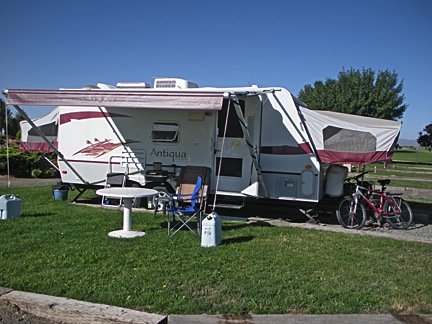
My Camper

Once again, I’m the only camper at the RV Park. That’s okay with me.

The RV park is small and not very fancy. It has five full-hookup parking spots along a gravel parking lot and at least another dozen of so with just water and power. The spots are short and you have to back into them — no pull-throughs here. There are no amenities like a pool or showers. Of course, there is an 18-hole golf course, but that’s not really of much interest if you don’t play golf. I don’t play golf.

The campground — as I like to call it — does have one feature that I seldom see in campgrounds: thick, luxurious grass between the campsites. For me, this is a real treat. We don’t have a lawn in Arizona — it’s really stupid to have a lawn in the desert where water is scarce. Our “yard” is a mixture of sand and fine gravel that we spread when we did our limited landscaping and natural desert that we simply don’t mess with.

At home, the very idea of walking around barefoot outdoors is silly. But here — holy cow! Brings me back to my childhood, when I rarely wore shoes in the summertime.

The grass adds a few quirky things to my stay here. The first has to do with the sprinklers. When I first arrived, the sprinklers in the campground started up every day at 4 AM. I know this because I could hear them. My camper’s bed extends out over the back of my camper, right over the grass. The sprinklers come on and one of them sprays the side of the tent-like covering over my bed. There’s a lot of quiet noise: the hissing of the sprinklers as they start up, the stead stream of water, the rain-like sound of the drops on the side of my bed tent. It wore me up every morning. At 4 AM.

This went on for a few days. Finally, I stopped by the golf course office and left a message for the manager. I requested a 5 AM start. After all, I’m usually up by 5 AM, which was about the time the sun rises here in the summer.

The next morning, the sprinkler didn’t go on at 4 AM. It didn’t go on at 5 AM either. Instead, it went on at 9:35 PM. And it stayed on until about 10 PM.

Well, at least it wouldn’t interfere with my sleep. But it also ensured that I wouldn’t be enjoying my lawn in the late evening, not long after sundown.

It also made for some entertainment when new neighbors arrived and attempted to enjoy their lawns in the late evening. I’d hear their squeals of alarm when the sprinkler cut short their outdoor activities.

Of course, I have to put away my canvas chair and zip up the screen on my bed tent every night.

My Garden

In this shot, you can see my bed tent, my “garden,” and the sunflowers growing around the electrical box. The planter is from last year; I replanted it with tomatoes, basil, rosemary, and some flowers when I arrived this year.

The lawn also adds responsibility regarding the grass. My site includes a flat-bottomed round table. The bottom of the table suffocates the grass. So every two days, I move it to a new spot to give the grass beneath it a chance to recover. I also use 7-gallon water jugs as tie-downs for my awning. I have to move those every two days or so, too.

Throughout the week, I pull out the dandelion flowers so they don’t have a chance to go to seed. Once in a while, I weed around the electrical box for the site next door, where I’ve planted sunflowers. This is mostly so the weed-wacking guy doesn’t cut my sunflowers down, like he did last year.

Lawn mowing day is a big deal for me. I untie and move the water jugs and move the table and any other furniture out of the way. The guys come through with a weed-wacker and a lawn mower. They usually put the table back for me — it’s heavy! If it’s not windy, I give the grass a rest from the water jugs.

A video tour of my campsite and its luxurious grass.

Anyway, I made this little video this morning so you can have a better idea of what I’m talking about here. The campground may not be fancy, but it’s relatively pleasant, safe, and cheap. This is my second year here and everyone knows me. I have a [barely] passable WiFi Internet connection, mail delivery, and access to a restaurant and its ice machine. My helicopter is across the street and down the block, about 1/2 mile away. (Blocks tend to be one mile square around here.) Can’t get much more convenient than that.

A Trip to the Wild Horse Wind Farm

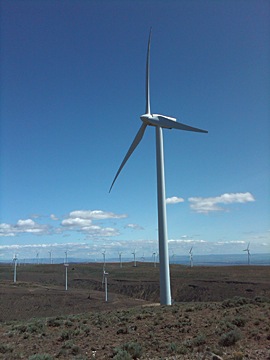
Huge windmills on a ridge.

The weather pattern here these days has been mostly sunny in the morning with increasing chance of showers in the afternoon. Because I have to fly after it rains (see “The Life of a Cherry Drying Pilot” for details), I need to be near the helicopter when it’s most likely to rain. That means the only time free for running errands and exploring my surroundings is when it’s least likely to rain. Lately, that means in the morning.

So yesterday morning I set out on a trip to the Wild Horse Wind Farm on a series of ridges northeast of Ellensburg. I can see the windmills from my camper down in Quincy and I visited them once before last year. This year, I bought along my Sony HD Handycam video camera and my new Flip Video. I wanted to capture the movement of the windmills, as well as the incredible “wooshing” sound the blades make as they cut through the air.

Visitor's Center

The Visitor’s Center at the Wild Horse Wind Farm.

I stopped for quite a while at the Visitor Center — mostly because it was cold outside. Wild Horse Ridge is quite a bit higher than it is in Quincy and, as you can imagine, it’s usually windy there. I threw a long-sleeved shirt on over my t-shirt but was still chilled. So I started out in the Visitor’s Center. Last time I’d been there, it had been crowded with kids, so I’d cut my visit short. This time I was able to look at the exhibits and video clips they had playing. One of the video monitors was playing a Nova episode about the Missoula Floods; I added it to my Netflix queue this morning. I especially liked the status monitor display which showed a video screen with a map of all 127 windmills, indication of which ones weren’t operating (two of them), and total power output of the operating generators.

I do recommend stopping at the Visitor’s Center if you ever go up there. There are plenty of easy-to-understand exhibits about the wind farm and energy, including some hands-on exhibits for kids. It’s also a great destination for school groups. The last time I was there, a busload of kids was on hand. They offer free tours of the facility that visit the controls in the base of one of the nearby windmill towers. I took the tour last time, so I skipped it this time.

Wild Horse Windmills

One of the windmills near the visitor center. This view faces out toward where I’m staying in Quincy.

When I was ready to go out and brave the wind, I took a short walk with my still camera before heading back to the truck for my Handycam and tripod. Even though the camera is tiny, I always put it on a tripod to shoot. I simply can’t hold it still enough to create good video on my own. I walked along various pathways and framed up what I think might be good shots. Then I took a series of 30-second clips, using my body and top shirt to shield the camera’s microphone from the wind. My goal was to capture the sound. I haven’t seen the clips yet, so I don’t know if I succeeded.

Afterwards, I stowed the camera back in the truck and brought out my Flip Video camera to do a few clips for use on my blog. I bought the Flip the other day as a birthday present to myself. I find that if I don’t get a new toy at least once every 6 months, I go nuts. I’ve been fiddling around a lot with video lately. My Sony takes amazing quality shots, but getting it Web-ready is a time-consuming, grueling process. I wanted an easier way to create Web-ready video at a better quality than my Blackberry Storm offers. When I saw the Flip while wandering around a mall the other day, I sprung for it. It certainly can’t be any easier to use. The video quality is so-so, but certainly good enough for the Web.

I shot the following three narrated sequences; I’ll let them speak for themselves. The second one, which shows off a blade on display, can give you an idea of the real size of these things — they’re huge.

Want some information about the Wild Horse Wind Farm? Here are three good links:

Or find other links by entering “Wild Horse Wind Facility” or “Wild Horse Wind Farm” in Google.

Cross-Country by Helicopter: E25 to BFI

14.4 Hours over four states.

Cross-Country, Defined
For those of you who are not pilots, allow me to explain the term cross-country as used by a pilot. A cross-country flight is basically any long flight with a landing a certain minimum distance from your starting point. For airplane pilots, it’s at least 50 miles. For helicopter pilots, it’s at least 25 miles. So while this blog entry discusses a very long cross-country flight, we did not fly all the way across the country.

This past Thursday and Friday, I flew by helicopter with two other helicopter pilots, Ryan and Bryan, from Wickenburg, AZ to Boeing Field in Seattle. Bryan and Ryan did just about all of the flying. I sat up front being a nervous passenger when we were near the ground and playing with the radio and GPS. Brian let me make most of his radio calls on the first day, but I didn’t get to do much of that the second day.

It was a mutually beneficial journey. I needed to get the helicopter from Arizona to Washington State. Ryan and Bryan were both CFIs who wanted to build time in an R44 helicopter. It was way cheaper for them to fly with me on this trip than to rent an R44 from a flight school. There was also the added experience of planning and executing a flight through unknown terrain, with fuel stops and an overnight stop along the way. And the money they paid to fly my aircraft helped me cover the cost of this very long and very expensive helicopter flight. Win-win.

Corona Fuel

A very cool but very helicopter-unfriendly fuel island at Corona Airport in California.

Our flight path took us west, with Bryan at the controls, along state route 60 to I-10, across the Colorado River, and then along I-10 through Bythe, Chiriaco Summit, Palm Springs, and Banning; then back on 60 past March to Riverside on the 91. We stopped at Corona for fuel at what’s likely the coolest but most helicopter-unfriendly fuel island in the world. (We didn’t notice the separate fuel island more suitable for helicopters until we’d stopped and shut down.)

Here’s a video of our transition along the California coast through the LAX airspace on the Shoreline transition route. You might want to turn down the sound while playing it; lots of helicopter noise.

Then Ryan took us west on 91 through the airspace for Fullerton and Long Beach, with a Torrance low pass. (Robinson has entirely too many helicopters waiting for owners on its ramp and in its delivery room.) He then got clearance for the Shoreline helicopter transition of LAX space, which requires the pilot to drop to 150 feet 1/4 mile offshore to pass under LAX departing traffic. We continued following the coast up past Santa Monica, Pacific Palisades, Malibu, Oxnard, Ventura, and Santa Barbara. By then, the marine layer was moving in, so we went inland for a bit. Eventually, we reached San Luis Obispo (and the chatty controller) and stopped for fuel and lunch.

Ryan at San Luis Obispo

Here’s Ryan on the ramp at San Luis Obispo before departure northbound. I shot this one with my Blackberry’s camera, so pardon the quality.

Bryan was back at the controls for our departure northbound. After a very close call with a large bird, we followed the path of Route 101 northbound. Most of the route was up a riverbed in a very pleasant valley. We got to Salinas and realized that any coastal route would be out of the question — the marine layer was creeping in even there. So we headed over the mountains, eventually ending up in the western part of California’s Central Valley. We stopped for fuel at Byron.

Ryan took over and we continued north over Rio Vista and Yolo, finally hooking up with I-5. We followed that through endless farmland — much of it flooded for a crop that apparently needs lots of water — over Willows Glen and Red Bluff, with more than a few crop-dusters flying nearby at altitudes far below ours. We stopped for the night at Redding, tied down the helicopter, and got a hotel shuttle into town.

We’d flown 8.8 hours.

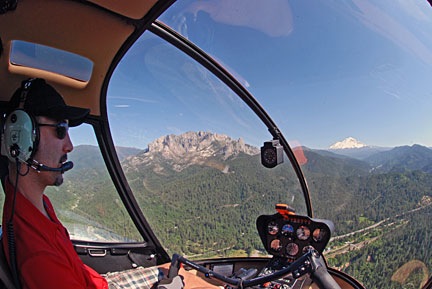
Ryan Flying Near Mt. Shasta

Ryan at the controls as we near Mt. Shasta in northern California.

The next morning, we were back at the airport at 9 AM, preflighting and getting ready to go. Ryan would start the flight. We headed north along I-5, over Lake Shasta and past Mount Shasta, which was snow-covered and beautiful. We were now past Central Valley’s vast farmland and up in the mountains. We flew past Weed, Siskiyou Co., Rogue Valley/Medford, and Grant’s Pass. Much of this flying was in canyons, along the same route as I-5 and a train line.

Things turned a bit iffy as I-5 swung to the east. We were hoping to go north and catch it on the other side of some mountains, shortening our route a bit, but clouds sitting on the tops of those mountains made that a bit uncertain. So we dropped altitude, slowed down, and followed I-5. Ryan flew while Bryan and I kept a sharp lookout for the power lines we knew — from both chart and GPS — were ahead. We weren’t that low and there wasn’t any real danger, but we were certainly not coming out of that canyon anywhere except the I-5 corridor. We passed the powerlines with plenty of room. The road descended into a valley and we stayed up beneath the cloud bottoms. Eventually, the sky cleared. We continued along I-5 past Myrtle Creek and Roseburg and stopped at Cottage Grove State for fuel and lunch.

Then it was Bryan’s turn again. We continued up I-5 past Hobby, Albany Municipal, and McNary. Then we headed northwest over Sportsman’s, Hillsboro, and Scappoose. We crossed the Columbia River and headed north on I-5 again over Kelso Longview and Olympia, with nice views of Mount St. Helens and Mount Rainier in the distance. Then on to Bremmerton, where we stopped for fuel. We probably had enough to make the last 20 minutes, but why take chances?

At BFI

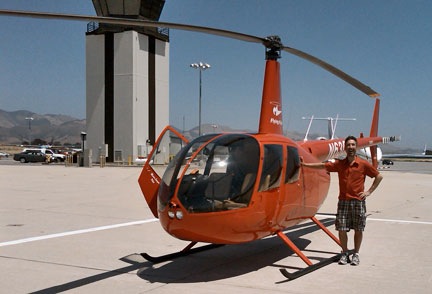
Zero-Mike-Lima on the ramp at BFI. Another Blackberry photo. And yes, that’s Mt. Rainier in the background.

I flew the last leg with Bryan up front to handle the radio and give me directions. It was only a 15-minute flight, but the airspace was complicated, so I was grateful for the help. I set the helicopter down sloppily in the parking area. We’d flown a total of 14.4 hours.

It was a great flight. We saw so much that most of it is just a blur in my mind. With luck, these photos and videos will help me remember the trip for a long time to come.

Many thanks to Ryan and Bryan for accompanying me on this trip. I hope they learned a lot about cross-country flying.

Southwest Circle Track

More of a squished oval, as you can see.

Southwest Circle TrackLast week, I flew about 8 hours, visiting several popular tourist destinations along the way: Sedona, Grand Canyon, Page, Monument Valley, and Flagstaff. For each leg of the flight, I had my Spot Messenger running, leaving a breadcrumb trail of my GPS location every 10 minutes. The result could be found on my Spot Public tracking page, http://tinyurl.com/FindMaria. (That page only shows my track points from the past 7 days, so it may be empty or showing something else when you view it.)

Yesterday, I viewed the results and captured them as a screenshot. Here it is. You can click the image to view a larger version that might be easier to read.

I guess I can say that this is the official track of Flying M Air’s Southwest Circle Helicopter Adventure.

And no, I’ve done geekier things than this.

About Goulding’s Lodge

The place to stay in Monument Valley.

I need to take a moment to talk about Goulding’s Lodge in Monument Valley, since so many of my Twitter friends commented on the photos I tweeted of the view from my room.

Goulding’s was founded by Harry and Leona (“Mike”) Goulding back in the 1920s or 30s. It was a trading post back then, where the Navajo would trade their rugs, blankets, jewelry, and other hand-made items for goods that the Gouldings stocked in their store, such as foodstuffs and items otherwise unavailable on the reservation. The trading post started as a tent and, after a while, moved into a stone building that still stands on the property, housing a museum.

First Light at Monument Valley
The view from my room at first light. I slept with my curtains open so this is the first thing I saw when I woke up on my most recent trip.

During the depression, many of the Goulding’s suppliers went out of business, making it difficult for them to get goods to trade. Harry Goulding got the idea of going to Hollywood to sell John Ford on the idea of using Monument Valley as a location for his western movies. He went out there with some photos of the place and, after some difficulty, got to show them off. Ford came east with film crews and John Wayne. The rest, as they say, is history. Many movies were filmed in Monument Valley, giving the local economy a real boost.

Goulding's Lodge
Goulding’s Lodge is built into the side of a hill overlooking the west side of Monument Valley.

Goulding’s Lodge is a pair of motel-like structures built on a hillside overlooking the western part of Monument Valley. Until recently, it was the only lodging in the valley — the Navajo have since built their own hotel inside the park. Just about every room at the lodge has a view of the valley from a private patio. There are also several houses that belong to the lodge that can accommodate larger parties — when I came to the valley with an Arizona Highways writer and video crew in October, we were lodged in a pair of homes that could have easily slept 10 people.

Gouldding's Trading Post Museum
The old trading post is now a museum.

Harry and Mike are long gone but Goulding’s remains privately owned. It’s staffed almost entirely by local Navajo workers. In addition to the lodge and trading post museum, there’s a newer “trading post” gift shop, a restaurant, and a small movie theater that shows slide shows, videos, and old John Wayne movies nightly. There’s a private landing strip across the street where pilots who stay at the lodge are welcome to land and park. Goulding’s also offers several different ground tours of Monument Valley; the passengers on my six-day Southwest Circle Helicopter Adventure take a 3-1/2 hour tour while we’re there.

If you’re interested in staying at Goulding’s Lodge, reserve your room now. I book a year in advance to make sure I can get the rooms I need. I recommend two nights, if you can, so you can get into the park and enjoy both a sunrise and a sunset at your leisure. Although you can take your own vehicle into the park, you can go much deeper into the park if you go with a guide; you can arrange for one at Gouldings or inside the park.

No matter how you get there, I highly recommend a stay. You’ll never forget it.