A crazy busy month with another eclipse trip, three very long drives, lots of jewelry making, and homeowner chores.
Folks might wonder why I don’t blog as often as I used to. It’s easy: my life is keeping me very busy.
That said, this post, which is long overdue, will give you an idea of what I’ve been up to and why I haven’t been blogging as regularly.
The Maintenance Saga, Resolved
If you don’t already know it, I’ve got another blog where I go into details on my Great Loop trip, which began back in October 2022. It’s called My Great Loop Adventure and I’ve been updating it a bit more frequently than this one. So if you’re wondering what all this boat talk is about, you might want to check out that blog. In it, you’ll also find links to YouTube videos from my trip.
In my last blog post, I whined about having to deal with boat maintenance issues — mainly, getting my boat to a reliable shop that could provide the services I needed when I needed them.
Those issues were pretty much taken care of when I arrived at Eastern Bay/Seven Seas Yacht Services. These are actually two different companies owned by the same folks in the same location. I get them confused. One does the maintenance and one provides marina slips and dry storage. In any case, these folks are very good to me. They worked within my schedule and, on Thursday, April 4, they hauled my boat out of the water for me. While the owner, who was driving the TravelLift at the time, was probably disappointed that my boat didn’t need its bottom painted, I was thrilled. Honestly, the bottom was so clean that I didn’t even think it needed the power washing I got for it. I have a feeling that doing 12-15 knots for hours on end in choppy salt water has its own cleaning benefits.
That doesn’t mean nothing needed to be done. The prop zinc, which I’d had replaced in Florida by a diver, was gone. The other zincs needed replacement. And I still needed regular engine maintenance. All that would wait, though.
They moved the boat into one of their yards and parked it on blocks for a month.
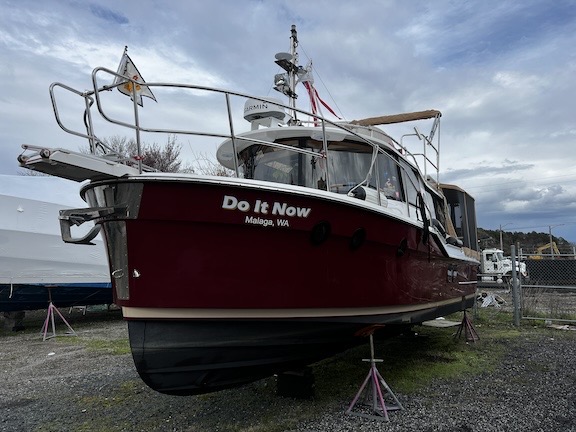
Do It Now on the hard on Kent Island. I can’t see any reason to leave a boat in the water for more than a month if it has to come out of the water anyway.
The Eclipse Trip
Meanwhile, I’d already packed everything on the boat that I no longer wanted on the boat, along with some stuff I’d need for the month. My friend Jason — you may remember him from my “Cruising with a Companion” post (as well as other posts in My Great Loop Adventure blog) — came with his pickup and we loaded everything on board. I had a lot of stuff, including my Lectric bike in a box — more on that in a moment. It’s pretty amazing that I’d had so much stuff on the boat. Jason said it floated higher out of the water with all that stuff off-loaded.
After a great sushi dinner on Kent Island, we went back to his boat — he’s a liveaboard in Washington DC — for the night. The next morning, bright and early, we added his luggage to the truck and headed out on the first leg of a road trip together: to Texas to see the total solar eclipse.
This would be the second time I traveled to see a total eclipse of the sun; the first was back in 2017 and I blogged about it in some detail. I saw that one in a National Forest in Oregon. This one would be on a friend’s 60 acres in Texas, just south of Dallas. My friend Rick, who also worked with me as a cherry drying pilot before I retired, happened to live right on the eclipse path. He was having a party and I was invited.
The drive was long and boring, mostly because the main goal was to cover a lot of miles and get to Rick’s place the day before the eclipse. We took turns driving, each getting about 3 hours or 230 miles in before we’d stop for gas, bathroom breaks, lunch, or the night. The highlight might have been stopping at the largest gas station in the country, a Buc-ees outside of Knoxville, TN featuring a 75,000 square foot convenience store, 120 fueling positions, and 20 EV charging stations.
Yeah. That was the highlight. It gives you an idea of just how dull the drive was.
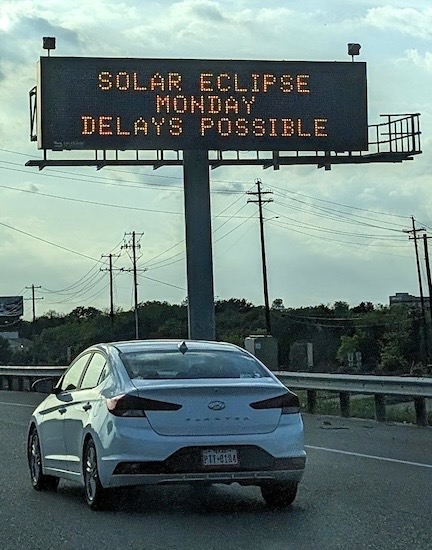
We started seeing these signs when we were still hundreds of miles from Rick’s place.
We wound up going a lot farther than expected on Saturday, mostly because the closer we got to the eclipse zone of totality, the more the motels started price gouging overnighters. When we couldn’t find a motel that allowed dogs for under $130/night and were just 200 miles from Rick’s place, we decided to just finish the drive.
(Now you might think that I’m being cheap here and I’ll agree that I am. But when I’m in drive mode for a long trip, I don’t like to pay a lot of money for lodging. After all, I’m spending about 10 hours in the room and not doing much more than sleeping and possibly showering. My spending limit is usually about $100/night, which is sometimes difficult when you travel with dogs and some motels want to hit you up for $20 or more per dog.)
Rick was happy to see us early, although we didn’t get in until right around sunset. We set up Jason’s rooftop camper and climbed in for the night. It was cozy.
At Rick’s
I spent the next day working on videos for my YouTube channel. Rick’s home is also his place of business and there was a nice employee lounge where I could get things done. That was after Rick showed us around town and took us to the airport to see his airplanes, one of which he’d sold to a mutual friend in Wenatchee. We had a great breakfast at a local restaurant and went back to Rick’s place. Jason went for a run while I worked. Then we drove around Rick’s property in a golf cart.
Sometime in the afternoon, Rick told us he wasn’t feeling well and he went in for a rest. His grandson, just 21 years old, offered to take us for a helicopter ride. The catch: he wasn’t actually a pilot yet and needed a pilot on board to be the PIC. So, for the first time in nearly a year, I climbed into the front seat of an R44 with a set of controls in front of me. Jason climbed into a back seat for his first helicopter ride. Rick’s grandson — and I can’t remember his name! — did all the flying, showing us around a flat Texas landscape dotted with ranches, residential neighborhoods, and small industrial complexes. The skylines of Dallas and Fort Worth were off in the distance.
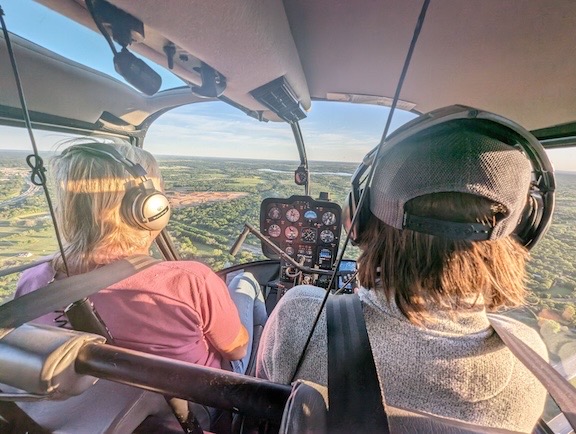
Jason took this photo from his seat in the back of the helicopter. I think he enjoyed this first flight, but I wish he could have sat up front.
Jason and I ate some of the food we’d brought along from our boats for dinner.
Eclipse Day
The next day was Eclipse Day. I took a shower while Jason put away his truck tent. We went into town for coffee and breakfast and to top off the truck with fuel.
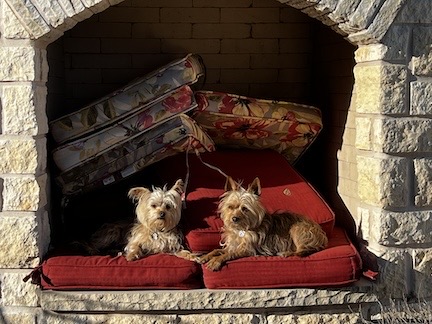
My pups found a comfy place to sit inside an outdoor fireplace — before we pulled all those cushions out for the outdoor furniture.
Back at Rick’s place, things started hopping around 8 AM. Rick’s employees, family members, and friends started showing up. Outdoor furniture was moved around, grills were set up, and the employee lounge was filled with food. There had to be at least 40 people there. The only one not around was Rick; he was feeling very ill and stayed in all day.
Rick’s son Chad pulled the helicopter out of the hangar. I worked as the loader for passenger rides. But soon he needed to take a break for fuel and he headed off.
Meanwhile, the weather had been overcast all morning. It wasn’t a surprise; the forecast made it seems as if we had a less than 50% chance of seeing the eclipse at all.
Sure enough, as the eclipse began to happen — the disc of the moon began blocking the disc of the sun — we only caught glimpses through our eclipse glasses as the clouds wizzed past overhead. We could clearly see most of the sky and it did not look good for us. But by the time the moon was half blocking the sun, the sky miraculously cleared. I don’t even know where the clouds went! One minute they were there and the next they were gone.
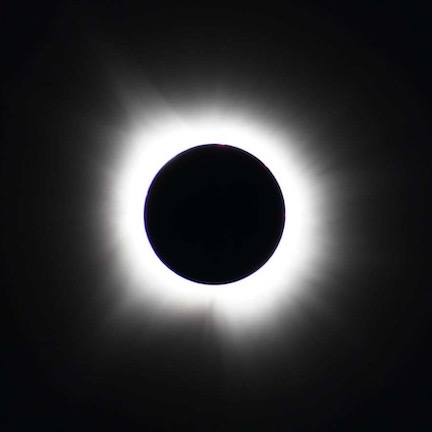
My view, through a 300mm Nikon lens, of the total eclipse.
We ate and talked and took photos. Music played. And then everything got dark and everyone settled down to watch.
This was my second total solar eclipse. I don’t know if it’s because it was the second or if it’s because someone left the music playing loudly or if its because I wasn’t experiencing it in the beauty of a national forest in Oregon after having camped out in my own camper, but it wasn’t quite as special as the first one. Don’t get me wrong — it was still amazing and I did not regret going through everything I had to experience it. But the first one seemed darker and more magical.
And I can’t say this enough: If you’ve never seen a total solar eclipse along the path of totality, you’re really missing out.
We watched intently until the diamond ring appeared on the other side. There were cheers. And as the landscape around us brightened, everything went back to normal, even though the sun was still mostly covered by the moon and the entire event would not be over for more than an hour.
The helicopter rides started again with Rick’s other son doing the loading. They didn’t last long. Chad claimed there was a power issue on the helicopter and decided (wisely) to stop the rides until it could be checked. The symptoms sounded like a sticky value, but it could also have simply been his attempt to fly a fully loaded helicopter with full tanks of fuel on a 90°F day.
We ate some more and started packing up our stuff. It was just past midday and although so many media outlets — and temporary road signs — warned of high traffic that day, we decided to head out anyway. Rick’s wife assured us that Rick’s condition was not something to be concerned about. She made sure we had lots of leftovers, including her excellent salsa, to bring with us.
We were back on the road, heading northwest toward my home in Washington, at about 2 PM.
The Lectric Bike Saga
I need to take a break in the narrative here to talk about my Lectric bike. I’d bought the bike to replace my MATE bike back in September. It was supposed to be lighter and it was definitely simpler and cheaper. But otherwise it was remarkably like the MATE. This is what happens when your Danish design is shipped to China for manufacture: the design is stolen and every foldable electric bike is pretty much the same damn bike.
This one did not have gears or a good suspension, but it did have fatter tires. I think it weighed the same as the MATE, which I sold to a sales guy at Pocket Yacht for $150. (It had issues, but it still ran and the battery still charged.)
The problem I’d discovered with my new bike was that if the pedal assist was turned on — which it usually is — and I was pushing the bike, say across a street, the pedals would turn on their own. That would engage the power assist and the bike would try to take off. If the power level was set to 1, I could easily hold it. But if it was set to 2 or 3, I could not. This had caused me to drop the bike with my pups in a basket on back on one occasion and had caused me to fall on the bike, hurting my knee, on another.
My old bike had never done this. Obviously, there was something wrong with this bike’s computer or something else. I wrote an email to Lectric with the subject line “Your Bikes are Dangerous” and detailed what was happening, requesting that they send me an updated computer if/when the problem was resolved.
They wrote back and offered to send me a new bike.
I’m not an idiot. I said yes.
And that started the process of getting the old bike back to them. You see, I was in Carolina Beach, NC when all this came down and I needed the bike as ground transportation until I took my break for the eclipse and trip home. I didn’t have the original box so they needed to send me one. Then I needed to get the bike in the box, put a label on the box, and get the box into the hands of FedEx.
And that’s where the comedy of errors began.
I told them to ship the box to Jason, since he’d be picking me up at the boat. They shipped the box to the marina where they’d originally shipped the bike. That would have been okay if I’d known I was going there, but I did not. So they had to ship out a second box, this time to Jason. Keep in mind that these boxes are not small.
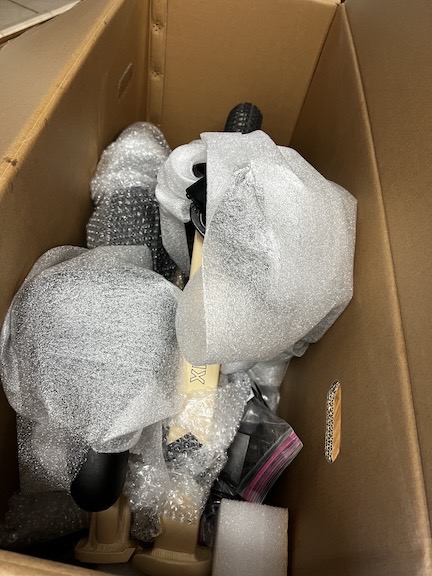
Here is one of the pictures I sent to prove that I’d used their packing material properly to pack the bike.
When Jason joined me at the marina — which, by the way, still had the box Lectric had sent there — I packed up the bike. I looked for the label in my email and saw that they required me to take photographs of the way I’d packed it before they would send a label. We had no time for that. So we threw the bike into the back of Jason’s truck and drove it all the way to Texas with us.
At Rick’s place, we opened the box and took the pictures. I sent the pictures. The next day, I got a FedEx label that had the marina as the return address. I was told FedEx would pick it up. Thinking FedEx would go to the marina, I didn’t give Rick the label for printing but pointed out the error. The weekend came and went with no answer. We left the bike at Rick’s; I’d email him the label.
On Tuesday, I was told that the label I had was okay as it was and that FedEx would pick it up at Rick’s on Wednesday. But I didn’t get that message until Wednesday — I was on the next leg of the trip. By the time Rick got the label, the bike had already been picked up.
How could that be? It didn’t have an unused label on it.
But somehow FedEx used the existing label. And instead of sending it back to Lectric in Arizona, they sent it back to Jason’s place in DC, where it was delivered to the marina office.
After more scrambling to get a new label, the bike was finally shipped from DC to AZ. By that time, I was already home and the clock was ticking for getting the new bike before I had to get on my way again. It wasn’t until the day we left my Washington home that they had inspected the returned bike and were ready to send out the replacement. I had them send it to the marina where my boat was, which was the same marina I’d received the original bike and the same marina they’d sent the original return box.
Spoiler alert: It arrived at that marina before I left with the boat in May.
Texas to Washington
The drive from Texas to Washington state was long.
We got to Vernon, TX the first night and stayed in a crappy motel where our next door neighbor played loud music until late at night. I had to call the office twice; the second time, at 11:30 PM, I suggested that the clerk call the police, hinting that if she didn’t, I would. That did the trick.
On Tuesday, we got as far as Page, AZ. I’m pretty sure Jason worked from the car that day, doing meetings and working on his laptop while I drove. We stopped in Albuquerque, NM for lunch at a Mexican place that was authentic and a little spicy. (Jason liked it a lot more than I did.) Our route then took us through the Navajo and Hopi nations, which I’d spent a bit of time in when I lived in Arizona. I was very sad to see that the shop where I’d bough my kachinas had been converted into a coffee shop.
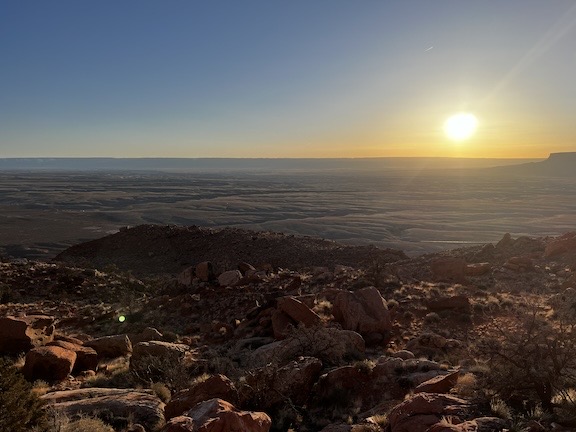
We stopped just before sunset at the overlook on Route 89 just outside Page, AZ. Marble Canyon and the Colorado River are down there somewhere.
With the time change, Jason was starting work very early in the morning, so he had Zoom meetings at the nice Motel 6 in Page where we’d overnighted while I got us coffee and then went down to Wahweap Marina at Lake Powell to see whether they could accommodate my boat in October. I was assured that they’d have a slip for me and assistance getting the boat launched and retrieved.
One of the folks there remembered me from when I’d wanted to buy a used rental houseboat there years and years ago. I told him I’d shed a husband since then. I was now fully in charge of my life and able to have some fun. Putting my own boat into Lake Powell for a month would be a blast — provided the water level came up a little more. (I’m watching this closely.)
We headed out of Page at around 10 AM and climbed into the mountains of Utah. We stopped at a gas station near a summit so Jason had a good cell signal for another meeting. Then on to Bryce Canyon for a short walk and look down at the hoodoos. Then back in the truck for the drive down to Salt Lake and beyond.
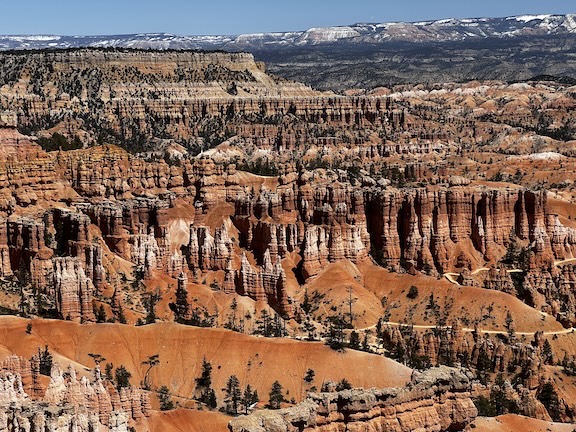
We made a side trip to Bryce Canyon — pretty much the only side trip on the whole journey.
We stopped for fuel in Bountiful and wound up buying what would be dinner at a DQ there. Although I’d been hoping to get to Burley, ID on I-84, we wound up at Tremonton, UT at another Motel 6. If you travel with dogs, Motel 6 is an easy option for a relatively cheap hotel along the way. All Motel 6s allow dogs and they don’t charge extra. The trouble is, they range in quality, and you never really know what you’re getting until you get there. This particular Motel 6 had been an old, family owned motel in excellent condition that had been converted to a Motel 6 franchise. The rooms looked like Motel 6 rooms inside and the quality was generally pretty decent. I’ve been in better and I’ve been in worse.
The next day, we were on the home stretch. After breakfast at a coffee shop, we headed out again with me at the wheel while Jason worked. We covered miles quickly, but it was still a long day. It was around 4 PM when we drove into East Wenatchee. We made a few stops for groceries, Thai takeout, and a handful of other supplies and drove the final 10 miles up to my house.
It was good to be home, but it was very good to be done driving.
Two Weeks at Home
There were three main reasons I’d come home in April:
- I wanted to remove large items from the boat and stow them in my garage. This included the Honda 2KW generator I’d had on board since buying the boat but had never used. It also included a ton of extra linens and clothes and jewelry making supplies that I simply didn’t need on board.
- I needed to get my irrigation system up and running for the summer. Yes, I live in Washington State but the entire state isn’t as rainy as Seattle. The entire east side of the Cascade Mountains is high desert with a climate very similar to Flagstaff, AZ. The natural vegetation is sagebrush and bunchgrass; I had planted trees along the road and had a lawn that all needed watering. Every autumn I blow out the system for the winter and every spring I get the system running again and make sure all the drip nozzles are dripping.
- I needed to make jewelry. I had sold much of my jewelry inventory to a new wholesale client on Bald Head Island and had very little left. I needed to make new inventory and then get some of it in the hands of my Winthrop wholesale client and a gallery in Ellensburg I sell at. I also needed some more inventory of a brighter, seaside nature to sell to new clients along my boat travels.
So that’s pretty much what I did while I was home.
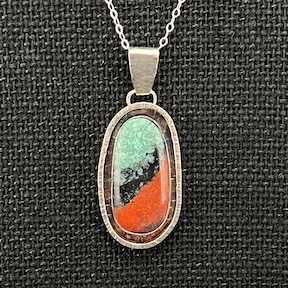
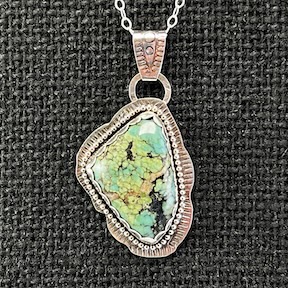
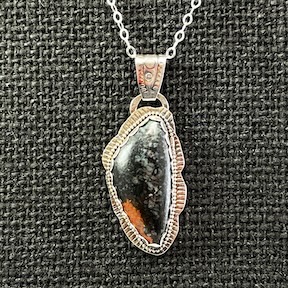
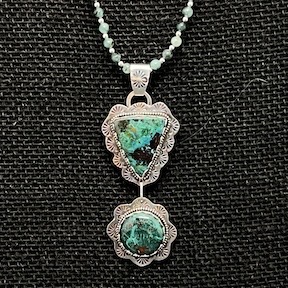
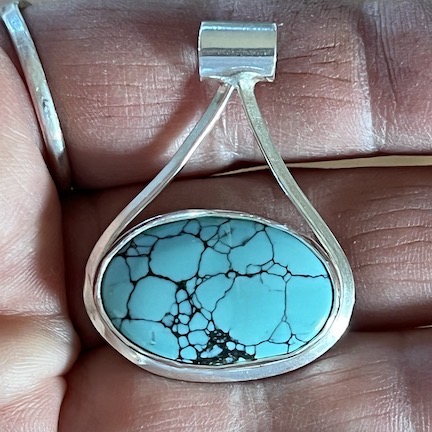
Here are four of the pendants I made while I was home.
Jason worked on weekdays while I mostly worked in my jewelry shop. He also helped me get my irrigation system running smoothly — it was great to have someone better able to climb down the steep areas next to the road to check and change the drips. On weekends, when he was off, he either went to visit friends in Yakima or in the Seattle area or did other things on his own. He spent a lot of time working on his truck in my garage to install some lights in his camper; I think it was a bit of a luxury for him to be able to do that in the shade, off a city street. One day we took the Jeep out, got a personal tour of the Rocky Reach Dam, and explored a mountain road between Wenatchee and Cashmere. I had lunch with my friend Kriss one day and we met up with other friends at their home or for dinner in town on other days. Jason even came with me to the neighborhood coffee gathering once.
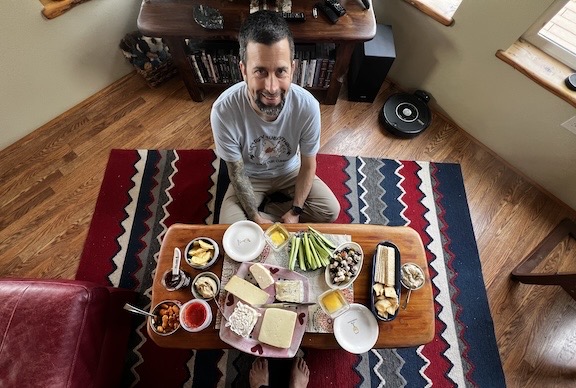
One night, we dined on cheese, crackers, and other goodies in my living room. Great food, great company. What else could a person ask for?
My big disappointment came when I was trying to arrange a trip to Winthrop with my fellow artist friend Cyndi. The same shop buys both of our work and I was hoping to make a big sale to them. But they were on vacation for the whole week and I was unable to meet with them. So all the new jewelry I made eventually got loaded into the truck and brought back to the boat. At least I had a lot to bring with me.
The Trip Back to DC
We had arrived at my home on Thursday, April 11. On Saturday, April 27, it was time to start the drive back.
Why such a short trip? Well, I got my Captain’s license back in October and I had two clients waiting for Ranger Tug training in the Baltimore area. Both were very interested in getting the training done soon and one was already disappointed that he had to wait until I returned. These were paying gigs and if there’s one thing a freshly retired member of the gig economy loves, it’s paying gigs. So I was highly motivated to get back quickly.
Jason was motivated, too. Working from the car wasn’t terrible, but it wasn’t a good solution. And if we left on Saturday, he’d be able to split the driving with me for the first two days, rather than leave 75% of it to me while he worked enroute.
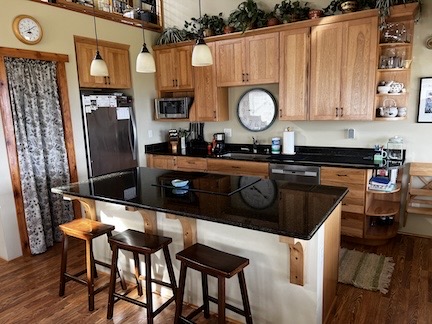
My house was absolutely spotless when we left.
So after giving the house a final cleaning, we got into the truck and headed out.
For some reason, we thought we might be able to make the trip in just three days. That notion was swept aside at the end of the first day in Bozeman, MT. We’d gotten a late start and then were delayed at lunchtime along the way. But we were determined to get there in four days.
The next stop was in Sioux Falls, SD. I think that’s where Jason found us a La Quinta for the night. Much nicer than any Motel 6, although it cost a bit more, too. I don’t think they charged us for the dogs, although they should have.
Then Indianapolis. Another La Quinta. This one had a nice Japanese restaurant across the street and we treated ourselves to a good sushi dinner.
Finally Washington DC. Our last fuel stop was in Frederick, MD, where Jason took over the driving for the final stretch. I can’t tell you how good it was to pull into a parking space and know that we were done driving.
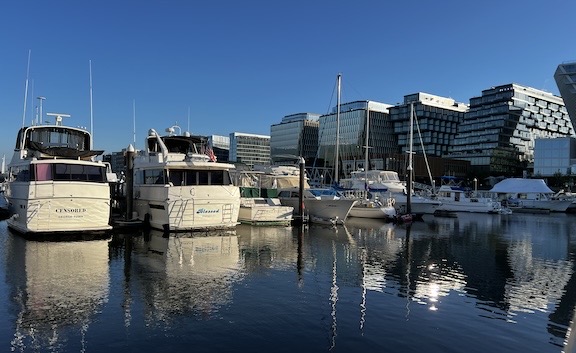
What a pleasure to spend the night on a boat and wake up on the water.
Would I ever make the drive again? Yes, of course I would. But would I do it in four days? Hell no. The next time I make a long, cross-country drive, I’ll do it at a much more leisurely pace, taking in the sights along the way.
I should mention here that we put more than 7000 miles on Jason’s truck.
More Boat Service Woes
Meanwhile, a few things were going on with the boat, which was on the hard on Kent Island in Maryland.
First was the total failure of a marine electrical contractor to get his shit together for my solar upgrade. He’d had an entire month to come up with a proposal, get it approved, order the parts, and get the work done. He’d dragged his ass on the proposal, claiming that he was waiting for me to complete and sign a form I never got. In mid month, he sent the proposal and “resent” the form. I approved the proposal and sent back the completed form with a 50% deposit. We established a date to get the work done — which would be right before I returned. Then, when I was somewhere between Sioux Falls and Indianapolis, I got a call from one of his guys saying that it would be 10 days before they could receive the solar panels. That would delay the job by more than a week. By this time, I was having trouble imagining them actually getting the job done at all. I told them to cancel. Then the boss called and said they could get the panels quicker from Amazon and install them with only a few days delay. I looked up the panels on Amazon, realized they were upcharging me more than 100% for parts, and told them not to bother and to refund my deposit.
I got my money back and nothing was done to upgrade my solar setup. I’ll get it done when I get the boat back to Washington state.
At the same time all of this was happening, the guys I’d hired to detail the boat had noticed that one of the trim tab parts was messed up. He sent me a picture. I sent the picture to the yard. They said they don’t know how they missed it. Yes, they could fix it, but it might take time if the system needed to be bled. I told them to get started; I wanted every part of my boat to work the way it should.
Returning to Do It Now
All this affected my plans when I returned to the boat. Originally, Jason was supposed to drop me off at the boat on Thursday. (We’d gotten to DC on Tuesday.) But now I had to start shuffling things around. I couldn’t drive my boat to Baltimore to meet my clients if the boat wasn’t ready to go. We also had bad weather in the forecast and it wouldn’t be good for doing the training I’d planned for that weekend.
I shuffled a lot of stuff around and, in the end, decided to get a one-way car rental to drive myself to the boat and then be able to commute by land to the clients for their training. The money I got from them would cover my expenses.
But by then it was May and that’s another story.




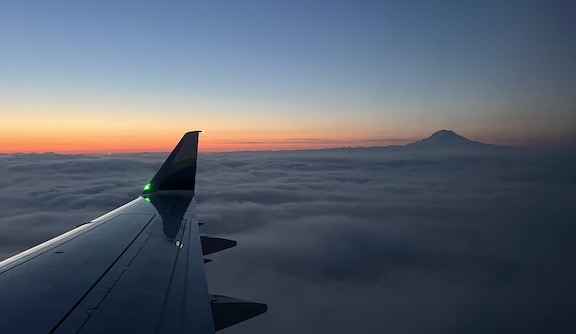


 This was one of the first duplicates, from 2006. It’s an aerial view of the confluence of the Colorado and San Juan Rivers over Lake Powell. If the water levels get anywhere near this high again by next year, I’ll be putting my boat in the lake for a few months in autumn 2024.