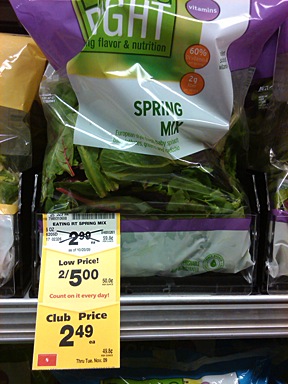
Hello, Safeway? What’s with the three prices?

Fantasy pricing and imaginary savings assault the senses and insult shoppers’ intelligence.

Wickenburg has two supermarkets: a Basha’s and a Safeway. Safeway is newer, better stocked, generally cleaner, and closer to my house. It’s also generally more expensive. I deal with it.

KleenexBut what has started to seriously bug me is the price tags Safeway has littered its stores with. If you’ve shopped in a Safeway or Vons, you know exactly what I mean. Half the merchandise in the store has three different prices on it: the “old price,” the “low price,” and the “club price.”

The old price is clearly bullshit. There’s no way in hell that a box of 200 Kleenex ever sold for $2.99 in our Safeway store. It’s clearly a fantasy price dreamed up by the folks in marketing. Say it cost a bunch of money and now it’s a whole bunch less! Customers are saving $1/box, right?

Wrong, if it never cost $2.99.

Then there’s the club price. If you join “the club” and submit your club card or phone number each time you shop, you get an even lower price. Of course, you also let the folks in the Safeway home office know every single thing you buy there. What do they do with this information? One thing they do is spit out coupons at checkout for items you’re most likely to buy. That’s not terribly harmful. But what else do they do with this information? Perhaps share it with other organizations so they also know what you buy? So they can target you with their marketing, too?

Do you really want people to know if you buy things like laxatives, hemorrhoid creme, or adult diapers?

Yet providing your magic club card number knocks another 49¢ off the box of tissues. That number is part of what’s tallied up as your savings at the bottom of your long receipt.

Spring MixI’m guessing, however, that they don’t expect people to really stop and think about it. Or do the math. Instead, they expect us to simply react to the yellow tags.

What else could explain this image? Look carefully. The club price saves you a whole penny over the supposed low price. This isn’t higher math, folks. $5 ÷ 2 = $2.50. The club price is $2.49. $2.50 – $2.49 = 1¢.

It’s bullshit, all of it. Yellow tags all over the place with fantasy prices and imaginary savings.

Why do they do this? It’s simple. They’re betting that people are too stupid or lazy to do real comparison shopping. They concoct in-store savings, conning people into thinking they’re really saving money. But are they?

In reality, if shoppers went to another store, that store’s regular price may be the same or less than Safeway’s “low price” or “club price.”

Mind games, that’s what it is.

And that’s what bothers me. These yellow tags all over the place make shopping confusing. They make the store an ugly mess. They sully the supermarket shopping experience — as bad as it already is.

You can’t just go into a supermarket and pick up the groceries you need. Instead, you have to face wall after wall of ugly yellow price tags that insult your intelligence with their fantasy pricing and imaginary savings.

Why? I call it bullshit.

When Is an Ad Not an Ad?

When it’s part of a blog post.

The other day, I was contacted by e-mail by someone who claimed to represent an advertising company that bought text ads on small blogs. They were interested in placing an ad on Maria’s Guides.

I was interested. It’s always nice to make a few bucks with advertising. I replied that I was interested but did not accept ads for pharmaceuticals, casinos/gambling, or sex/dating services. He got back to me within 24 hours and told me the rate they’d pay, which was agreeable, and the fact that they just wanted to ad to appear in one post on the site.

That should have started alarm bells ringing, but it didn’t. I had another advertiser some time ago who bought 10 ads, each on a different post. Targeting, I supposed.

He got back to me the next day with the text of the ad. It was about three sentences, one of which included a link to some kind of mobile Internet service. The ad was written in first person and ended with a the phrase “[Redacted company name] gets a big thumbs up in my book.”

I read the instructions. They wanted me to place the text of the ad, with its link, in the middle of a paragraph of blog post text. As if it were part of the post and I was the one giving the thumbs up.

I wrote back:

I don’t think you understand. I agreed to an advertisement. I didn’t agree to modify my blog post’s text to apparently recommend an organization I know nothing about.

I wouldn’t mind putting similar text — without the recommendation — in a box floating “above the fold” within the post. That box would be titled “Sponsored Link” or something similar. But I will NOT put it into the post itself as if I wrote it.

Obviously, he wasn’t interested in an advertisement. He was interested in a paid endorsement. He wrote back to thank me and let me know he’d remove me from his contact list.

I guess some bloggers will do anything for a few bucks. I won’t.

DocStoc Sells Your Personal Documents

Your privacy is obviously not their concern.

This morning, when going through the Google Alerts set up for my name — one of the tools I use to track down copyright infringement — I found a link on a company called DocStoc. The link was to a copy of my resume, created back in 2004, that included a variety of personal information about me, including my name; my city, state, and zip; my old e-mail address at my domain name; and my job history up to that point. The document was listed as “public domain,” but a Download link required you to have an account with DocStoc to download the document.

Needless to say, I was outraged.

I e-mailed the company and filled out a DMCA takedown notice on their site. I also demanded to know who had uploaded the document so I could take legal action against him/her.

If you have any sort of Internet or Web presence, I highly recommend that you go to DocStoc, perform a search on your name, and use their online DMCA Notification form to get whatever personal documents that are found removed.

Do not support this organization by buying documents that could be stolen from their sources.

Another Scammer Looking for Free Content

Business opportunity? Is that what you call it?

A few weeks ago, I received the following e-mail message from someone I didn’t know, with the subject line: “I like your work- Business Opportunity”:

Hi Maria,

My name is [redacted] and I got your contact info from Lynda.com and really like your work especially your blogging content.

I am involved in a start up company that is wanting to change the way entrepreneurs use and get content. We are composing information/articles in a platform for marketing, legal and financing and we are looking for great business content to provide our entrepreneurs. We are looking at several options to pay authors for their content.

One of the reasons I emailed you was because I really like your work and I wanted to engage you in your level of expertise and wondered if you would be willing to answer some brief questions about your work. If you are interested in learning more about this opportunity please email me at [redacted]@gmail.com or call me at [redacted].

Looking forward to hearing from you,

[redacted]

http://www.linkedin.com/in/[redacted]

A few things struck me about this:

  • Apparently the folks at Lynda.com had given this person my contact info. That meant this initial contact had an element of networking to it instead of being just a “cold call” e-mail. (More on this in a moment.)
  • This could be a lead on another good publishing opportunity. As print publishing declines and the beginner-to-intermediate user base I write for shrivels, I’m always looking for new opportunities to write or create content for paying markets.
  • There was no mention of a company name or a Web site name. The person contacted me from a Gmail account. That raised a red flag.

But heck, it was worth a shot. I e-mailed back:

What do you need to know?

Maria

The Questionnaire

The response came quickly:

Maria,

Thanks for the quick reply!

I have prepared these questions for you. If you would rather I called please let me know when you are available or if you would rather feel free to respond to these questions via email.

I know your time is very important so please feel free to be as vague or detailed as you want on the questions. I really appreciate your feedback and I hope when we launch, you will be apart of our expert authors. Any feedback you have regarding these topic would be great. We hope to be able to provide additional revenue streams for authors by breaking down content.

1. Would you be willing to resubmit your articles/book content in a 5 step format or less? And would this be doable for you?

2. What kind of opportunities are out there for you in regards to getting your work out?

3. Who are you currently partnered with right now?

4. How do you typically get your content published?

5. Is this your full time job?

6. What outlets do you seek to get your work published or do they come to you?

7. What products do you have? Do you have any content in any other format? Audio? Video?

8. How do you typically get paid?Is it a flat fee? Would you be interested in getting paid pay per click?

9. Would you be interested in getting an identity in our community and would it be useful for to you have a website on our site that allowed you to sell your work, that could connect to your Facebook and additional products? It would also have a fan reading for you too.

Thank you for your help in advance Maria!

[redacted]

By this time, the red flag was flying high. The questions proved that she knew little or nothing about me or what she was doing. After all, questions 3, 4, 5, and 7 could be answered by a visit to my Bio page. Question 1 clearly indicated that she had no knowledge of copyright and non-compete clauses that appear in standard book and other publishing contracts. Questions 2 and 6 certainly shouldn’t matter to her if she’s really offering me an opportunity. Question 8 told me she was going to try to pay me per click — which is something I’m not interested in, especially from a “startup.” And Question 9 told me (1) she had no idea that I already had two very well-trafficked Web sites, (2) that my publishers sold my work, leaving me to actually create content, (3) that she would attempt to tie me to a Web site her organization operated, and (4) that she’d likely try to sell me products.

But I played along to see where I could take it and whether I could get her to dig herself in any deeper:

I’m a freelance writer and have been since 1990. I’ve written 70+ books and hundreds of articles for dozens of legitimate print publishers (think McGraw-Hill, Macmillan, Random House, and Peachpit Press). My Mac OS X books for Peachpit have been bestsellers since 1999. I also produce audio and video — you’ve seen the video on Lynda.com; I’m working on another title for another publisher now.

You can get all this information and more about me on my Bio page: https://aneclecticmind.com/bio/
You can see a list of all my published work using links on my site, https://aneclecticmind.com/

I don’t have a “full time job.” That’s one of the benefits of being freelance.

I’m definitely NOT interested in getting an “identity” in any “community.” I have an identity and certainly don’t need another one. I’m not the least bit interested in being tied to another Web site. My publishers are doing a pretty good job of selling my work, so I don’t see the need to use another Web site to sell it, too.

If you’re looking for a low-cost content creator, don’t look at me. I get paid very well for my work.

That said, let’s cut to the chase. What did you have in mind?

And maybe you can tell me who YOU are and why you are contacting me through a Gmail account. Doesn’t your company have e-mail?

Maria

As you might imagine, I didn’t get a response.

I contacted the folks at Lynda.com to see if they knew anything about this person. I forwarded them the initial e-mail. They all confirmed what I had begun to suspect: they hadn’t given this person my contact information at all.

So I sent [redacted] a final e-mail message:

It turns out that no one at Lynda.com gave you my contact info. I’ve warned them about you and what appears to me to be some sort of scam. Don’t contact me again.

What Writers Should Take Away from This

There’s a lesson here for writers, including bloggers and other content creators.

There are many “startups” out there in desperate need of fresh content. They’ll make all kinds of promises to get you to submit content to them. They’ll promise ad revenue from the pages on which your content appears, they’ll promise you payment per click on your content, they’ll promise to give you an “identity” and make it easy for your “fans” to find you. They’ll flatter you and tell you they love your work — without even knowing what your work is. Meanwhile, you’ll be required to upload and format your content on their site. You’ll be required to moderate or respond to comments on your content — perhaps even give technical support or answer other questions. Your “business partner” will also likely keep all rights to your work and republish it elsewhere without paying you a dime.

But you think it’s a good idea — they’ve hinted at thousands of hits a day! — so you give it a try. Your work appears on a slick-looking Web site that’s just jam-packed with advertising. But you soon discover that the majority of people visiting the site are the suckers like you — and their clicks don’t count. Your work appears among the drivel spewed out by other writers trying to cash in on a “business opportunity.” You’ve lost the rights to republish your work elsewhere and you’re not making enough to buy lunch once a month.

You think I’m making this up? I’m not. I was suckered in by one of these about five years ago. Sadly, I didn’t blog about it so I can’t remember the name of the company. But I did blog about eZineArticles.com, which is probably the biggest ripoff out there for serious writers. (Publish with them and you never know where your work will end up; mine appeared on porn sites.)

What do they get? Advertising revenue. Or maybe they repackage and sell your content to someone else.

My advice is to avoid any operation like this — even if you’re just starting out. It’s rare that any relationship like this can benefit your career.

A legitimate publisher will pay you for the content you create. Up front, before or at publication. They will accept First Rights or reprint rights or negotiate with you for rights — they won’t take all rights unless they’re paying big bucks for them. Although they might offer bonuses based on content popularity (hits), the revenue will not be completely tied into that. And, for Pete’s sake, they won’t compensate you based solely on clicks or ad revenue.

Lazy Shopping…For a Helicopter?

Some people are willing to pay strangers to help them make a huge purchase decision.

A while back, I read a blog post on Pilot Mike’s Weblog titled “Purchase vs. Rent Robinson R22?.” In it, Mike discussed his thoughts about buying an R22 to do his training in.

While I didn’t buy a helicopter to do my primary training, I did buy one for my commercial training. It would have saved me a lot of money if my flight school didn’t charge $75/hour for the CFI to train me. (Yes, they ripped me off. Yes, I know it now and suspected it then. There were extenuating circumstances. I no longer do business with that organization or recommend them to anyone else. I’m not the only one they’ve burned like this. ‘Nuff said.) As it was, I probably saved $25/hour on dual time and $100 hour on solo time. Of course, I used the money save to actually pay for the helicopter and its related expenses, so you can easily argue that I didn’t save anything at all. Still, I wound up with my own helicopter, which I could use as I liked 24/7/356. That’s got to be worth something.

I made a comment on the blog post back in late May 2009 with some of this information. In it, I mentioned my old R22, which is for sale again. I also subscribed to the comment so I could be notified if there were any follow-up comments. (This is a great thing to do if you’re interested in a topic and want to stay involved.) Yesterday, I got an e-mail message from the blog with the contents of the first follow-up comment:

My brother is buying a R22…
I would like to contact Maria

Since the comment included the e-mail address of the commenter, I replied directly to it. After all, there’s no reason why our personal conversation should appear on Mike’s blog. So I wrote:

I should probably start out by clarifying — I’m not selling my old R22. I don’t own it. The guy who bought it from me is selling it. It’s listed on Trade-a-Plane.

If there’s anything else you have question about, let me know. Just keep in mind that I haven’t owned or flown an R22 since 2004, so I might not be able to answer your questions.

He replied quickly in an e-mail I received on my BlackBerry while out for a bike ride. Apparently, he had more than just a question:

Thank you so much for replying.
I have 0 (zero) knowledge about it, and my brother is going to ask me to buy a new one probably next week. I would like to pay for a trusted help/advise OUTSIDE dealers or any other info from a seller.

There is so much wrong with his statement that I don’t even know where to start.

First of all, he must be a good brother to simply buy a helicopter when his brother asks him to. I know what my helicopters cost and I know what even the least expensive ones are going for on Trade-A-Plane. He’s not going to touch anything worth flying for less than $75K. A “new” one — if he really means new — will cost $200,000 or more.

Second, who the hell spends that kind of money without doing their homework? And no, hiring someone to do the homework for you isn’t the same as doing it yourself.

Third, he doesn’t even know me! I could be some Internet con artist, trying to pass myself off as a helicopter expert to lure people like him to an inventory controlled by me or an associate.

Fourth, what makes him think I want to be part of his purchase decision…and possibly be held liable if he buys a lemon? By taking money to give him advice, I’m setting myself up for liability if things don’t go right. I don’t want any part of that.

So I wrote back from my BlackBerry:

I’m sorry. I can’t help you.

This morning, from my computer, I added:

I also want to add that anyone who has zero knowledge about an aircraft should not be buying it. Do your homework, don’t pay someone you don’t even know to do it for you.

I haven’t heard back from him. And that’s got me wondering….maybe he was trying to scam me? Maybe the next step was to ask me for my bank information so he could wire me payment before I started consulting with him?

Or maybe he’s just an idiot who is too damn lazy to do his own research.