The Waiting Game

Part of my summer job.

It’s coming up on 5 AM. I’m sitting in my RV, parked at the edge of a golf course in Quincy, WA, 1/4 mile away from where my helicopter is parked at an ag strip. I’m nursing a cup of coffee.

I’m waiting.

I’ve been up since 4 AM when I woke naturally, my brain using its built-in alarm clock to put my body on low alert. After all, there was rain in the forecast. If it rained overnight, the calls would start coming before dawn. If I wanted coffee in my body before I flew, I’d have to get up and make it before the calls came.

If they came.

On waking up, the first thing I did was reach for my iPad. (It, with my phone, is always within reach when I’m in bed here.) A few taps and WeatherBug was displaying local radar. The rain echoes were just to the southwest, moving my way. It was almost as if my brain had been watching the weather while I slept and knew the rain was coming.

While coffee brewed, I stepped outside into the predawn light. I could see the horizon in all directions. Low clouds, brightness to the east where the sun would soon rise. Later, back inside, as I sipped my coffee, WeatherBug would indicate that the rain was right on top of me and at least two of my orchards. Occasionally, my vigilance was rewarded with the sound of a few raindrops pattering on the roof of the RV.

I traded my nightshirt for a tank top, which is what I usually wear under my flight suit. I grabbed a pair of socks. Then I settled back into my comfy chair with my coffee.

I brewed a good cup this morning. Part of me hoped I’d get a chance to enjoy every drop in my 18 ounce mug. The other part of me hoped the phone would ring.

I was ready. I was waiting.

Oddly, I played a version of this game yesterday afternoon and evening. More radar echoes, but no rain. Still, it could come at any time. I spent the evening with my iPad, switching between an ebook, WeatherBug, and the National Weather Service Web site while texting back and forth with a pilot friend in the same situation 30 miles south. Had to keep the phone line open. When the sun set at 9 PM, I moved into the bedroom, finished the book I’d been reading, and went to sleep.

Six hours later, I was awake.

The sun is up now, hidden behind thick clouds to the northeast. I see rain falling out toward Moses Lake — no threat to any of my orchards. I’m waiting for the call that will launch me. I can be airborne in 15 minutes or less.

Will the call come? Who knows? That’s part of the game.

Reacting to Low Rotor RPM

Yeah, I know RPM = life, but think about it, guys!

I did my monthly perusal of the NTSB helicopter accident reports this morning and this one jumped out at me. It’s another instance of a pilot reacting badly to a low rotor RPM situation. (You can read my favorite example of a poor response to low rotor RPM here.)

The report is short and, for some reason, cut off before the end. (NTSB seems to be having trouble with its database lately.) Here’s the story:

The commercial helicopter pilot reported that he was on a Title 14, CFR Part 91 business flight transporting one passenger and seven dogs to a remote camp. He said as he approached the camp, which was at 3,800 feet msl on a snow-covered glacier, flat light conditions made it difficult to discern topographical features on the glacier, so he elected to land at an alternate landing site at 3,200 feet msl to wait for conditions to improve. During the approach to the alternate site, just before touchdown, the pilot said the low rotor annunciator horn sounded, and he lowered the collective to regain rotor rpm. The pilot said he was unable to initiate a go-around, so he brought the helicopter to a hover, but due to the prevailing flat light he was unable to discern his height above the site, and he unintentionally allowed the helicopter’s left skid to touchdown on the uneven, snow-covered terrain. He said that there was an “instantaneous dynamic rollover” as the helicopter rolled to the left, the main rotor blades struck the snow, and the helicopter came to rest inverted. The helicopter sustained substantial damage to the fuselage, tail boom and main rotor drive system.

Glacier Crash with Dogs

Coast Guard photo of crash site. We’re taught to keep the shiny side up. Note dogs.

The two human occupants were not injured. They don’t say anything about the dogs, but since they were likely crammed into the back seat area, they probably cushioned each other and are okay, too. (Seriously, who puts seven dogs in the back seat area of a 4-seat helicopter?)

About Low Rotor RPM

Helicopter pilots have a saying: RPM = life. It means that if your blades are spinning fast enough, you should be able to fly. But if you lose RPM, there’s a chance that you might drop out of the sky (yes, like a brick) and have a very ugly encounter with the ground. Why? Because the spinning of the rotor blades is what gives a helicopter lift. If they stop spinning, they’re not generating lift. If they’re not spinning fast enough, they’re not generating enough lift to keep the helicopter airborne.

Helicopters have low rotor RPM warning systems. In an R44, it consists of a light on the instrument panel and a “horn.” The sound of the horn is very annoying and impossible to miss. (See for yourself here.) Because RPM is so important, the full system — light and horn — are required for flight.

On a Robinson helicopter, the low rotor RPM warning system kicks in at 97% RPM. Since the helicopter is operating at 102% RPM, that’s just 5 units below normal operation. But as they teach in the Robinson Safety Course, the helicopter should be able to fly with RPM of 80% + 1% per 1,000 feet of density altitude. Using this accident altitude as an example and assuming that it wasn’t above the standard day temperature of 15°C at the “snow-covered glacier” landing zone, the helicopter should have been capable of flight with rotor RPM as low as 84% or 85% (see density altitude chart). I use the word should (and italicize it for emphasis) because this is a rule of thumb. I do not recommend flying a helicopter below normal operating RPM. This rule of thumb just helps pilots understand how critical a low rotor RPM situation might be.

What causes low rotor RPM? Engine malfunction is one cause. A bad magneto or stuck value could rob the engine of horsepower, thus preventing it from keeping the rotor RPM where it needs to be. Performance needs beyond what the engine can produce is another. For example, it takes more power to hover than to fly; attempting to hover with a heavy load at high density altitude could result in a loss of rotor RPM. That may have been the situation here; the pilot was in an R44 Raven I (or possibly an Astro) at more than 3,000 feet density altitude at or near max gross weight*.

Emergency!

During flight training, helicopter pilots are trained to react to low-rotor RPM situations. In fact, Robinson helicopter pilots get extra training every two years (per SFAR 73) because of the unusually high number of low RPM accidents in early Robinson helicopters. Although modern-day Robinsons have correlators and governors to help the pilot maintain proper RPM, this special training and endorsement is still required.

Low rotor RPM is treated as an “emergency.” That means it has an emergency procedure associated with it. Helicopter pilots are drilled on the procedure until it becomes second nature.

Page 3-10 (in the “Emergency Procedures” section of the R44 Raven II Pilot’s Operating Handbook) states:

A horn and an illuminated caution light indicate that rotor RPM may be below safe limits. To restore RPM, immediately roll throttle on, lower collective and, in forward flight, apply aft cyclic.

As a result, when we hear that low rotor RPM warning horn — which is directly related to the deterioration of life-giving RPM — we react quickly to recover lost RPM. That means increasing throttle (to add engine power) and lowering the collective (to reduce drag caused by the rotor blades). Pulling back on the cyclic, when moving forward, can also help recover lost RPM by transferring energy in the forward speed to rotor RPM (which is why RPM increases during a cyclic flare in an autorotation).

Lots of folks argue about which is more important and whether you need to do all three. I think rolling on the throttle is most important but will acknowledge that it doesn’t always resolve the problem. Lowering the collective usually helps.

Hold that Collective

While that is all well and good, I’d like to make this radical suggestion: is lowering the collective to recover RPM a good idea when you’re within 10 feet of the ground?

In this accident, the pilot heard the low rotor RPM horn “just before touchdown.” I’ll be generous and take that to mean anywhere within 10 feet of the ground. So he’s coming in for a landing. He’s already got his descent going and he’s either increasing power to bring it into a hover or he’s past that point and is reducing power gently to touch down. Either way, lowering the collective will cause him to descend faster than he already is. (It doesn’t say anything about rolling on the throttle; did he?) He’s less than 10 feet from the ground. The report goes on to state that he was able to bring it into a hover but was apparently lower than he thought (perhaps because of his collective work?) and touched a skid to the snow, causing dynamic rollover.

Low Rotor RPM Might Not Always be an Emergency

I’d like to argue that low rotor RPM is not an emergency situation when you’re very close to the ground.

After all, what’s the worst that can happen? At less than 10 feet, you don’t need the RPM to keep you alive. Even if the RPM dropped to 0 when you were only a few feet off the ground, you’re not going to die. You’ll drop like a brick — a few feet. Spread the skids a little. I don’t even think the belly would touch the ground. If it did, the seats would collapse as designed and (literally) save your ass. We’re talking less than 10 feet here.

Instead of dealing with low rotor RPM when you’re less than 10 feet from the ground, doesn’t it make sense to ignore the horn and just land?

Remember, in an R22 or R44, the horn sounds at 97% RPM. In this example, he could still remain in flight with the RPM all the way down to 85%.

Let’s review. The pilot is at a critical moment of flight: landing, just before touchdown. The low rotor horn goes off, zapping his concentration. Instead of completing the maneuver he was almost done with, a maneuver that would put him safely on the ground, he switches gears to handle the sudden “emergency.” That reaction just puts him closer to the ground with him focused more on the RPM situation than the ground he could very well make contact with. As a result, he botches the landing, possibly distracted by a non-emergency “emergency.”

A side note here: I have witnessed a low-time pilot literally freezing up when the low rotor RPM horn sounded on landing. I was sitting beside him, horn blaring, in a hover 3 feet off the ground at a very high density altitude airport — 10,000 feet. His brain simply shut off. I repeated the words, “Just set it down,” three times before he snapped out of it. There was no danger, but the damn horn sent him into some kind of mental seizure. If that happens in cruise flight, he’s definitely dead.

The horn is scary. We’re trained to react to it. But is low rotor RPM recovery always the answer? I’ll argue that any time you’re very close to the ground, you need to think about the consequences of all of your actions before making them. Don’t react to an emergency that doesn’t exist.


* Doing the math… I don’t have the details of the accident flight’s weight. But if you figure two grown men weighing at least 180 pounds each and seven 50-pound sled dogs in the back, you have 710 pounds for just the cabin occupants. A Raven I with minimal equipment weighs at least 1440 pounds. So that brings a total of 2150 pounds. Add half tanks of fuel for another 150 pounds; that’s a total of 2300 pounds. The max gross weight of a Raven I is only 2400 pounds. So with my guesstimates, he was pretty close to max gross weight.

Now because I know the mentality of the helicopter forum participants who often lurk here (and then share their opinions about me in the forums they troll), I feel compelled to defend my calculations here instead of in the comments thread. (I don’t waste my time in the forums anymore.)

The dogs were “sled dogs,” which you’d expect since that’s the kind of dog most useful at “remote camps” in Alaska. They were later rescued by the Coast Guard, which airlifted them off Godwin Glacier after the crash. I’m estimating 50 pounds each, but they could easily be larger. Here’s a photo of them. (Frankly, I’m having trouble imagining seven 50-pound dogs crammed into the back seat area of a helicopter like mine. I’m also cringing at the thought of vacuuming all the shedded fur out.)

And yes, both the pilot and the passenger could have been Weight Watchers graduates weighing in at 140 pounds or less each. And they could have been wearing shorts and sandals. Or nothing at all. And there might have been only 10 gallons of fuel on board.

But my guesstimates are based on what I’ve experienced in reality. People are fat and like to bring unclaimed baggage, pilots like to take as much fuel as they can for missions in remote areas. It’s far more likely that the passenger was even bigger and had gear with him and the pilot had his tanks much closer to full than empty. But until the FAA releases more info — which is not likely, since there was no fatality in this accident — guesstimates are the best we can do.

Hitching a Ride in a Helicopter

Looking back, I realize this was a bit over the top.

I’ve been wanting to blog this story, but a lot of time has gone by and it’s a bit stale in my mind. It is something I want to journalize so I can remember it in years to come. Since that’s mostly what this blog is about, and because a Twitter friend showed some interest in reading it, here it is.

It was April and I was planning to spend a few days down in our Phoenix apartment. I’d already paid for my monthly hangar rental down at Deer Valley Airport (DVT) and figured I’d fly the helicopter down and put it in the hangar in case I got any calls for flights while I was down there.

My faithful Toyota was sitting in the airport parking lot, waiting for me. A true “airport car,” I left it there so I’d have something to drive when I flew in. My to do list for the upcoming month included driving it home and stowing it for the summer, when it wasn’t needed. (No sense in letting the poor thing rot out in the sun.)

I pulled the helicopter out of my Wickenburg hangar with a golf cart I have just for that purpose and parked it on the ramp. I unhooked the tow gear and disconnected the ground handling wheels. I put the golf cart and tow bar away. I parked my Jeep in the hangar, too, and locked it all up. I was good to go.

I did my preflight and climbed on board. A few minutes later, the engine was running and the blades were spinning.

And then my Aux Fuel light came on. The circuit breaker had popped out.

Let me take a moment to explain what this means. A Robinson R44 Raven II is fuel injected. It has two fuel pumps. One is the engine-driven pump which is the primarily means of feeding the engine when the engine is running. The other is the auxiliary fuel pump, an electric pump that’s used to prime the engine and as a back up in the unlikely event that the engine-driven pump fails. It’s a secondary system. If it fails in flight, the helicopter will continue to run.

I have a history with Zero-Mike-Lima’s auxiliary fuel pump dating back to the day after I picked it up at the factory. Back then, I educated myself about the system to troubleshoot a popping circuit breaker problem. My thorough knowledge of the fuel system helped me out on an FAA check ride 2 years later when the circuit breaker popped again. I got the fuel pump replaced right after that incident, when the helicopter was only two years old.

The fuel pump had begun giving me problems a few weeks before — but I didn’t recognize it, at first, as a problem. Circuit breaker had popped during a tour in the Phoenix area. I (incorrectly, it appears) assumed that the front seat passenger had knocked the circuit breaker out with her sandals. Okay, so it was a stupid assumption, but since it didn’t pop again when I pushed it back in, what else could I assume?

On another flight a week or so later, it happened again. That’s when I realized the pump was acting up again and would likely need replacement soon. Fortunately, I still had the old one. I did some checking around and learned that the manufacturer could rebuild it for about 60% of the cost of a new one. Since saving $600 on a like-new part sounded like a good idea to me, I sent it off to be rebuilt and kept my eye on the situation.

Well, the situation came to a head that day on the ramp at Wickenburg. As I sat there, blades spinning, looking at that warning light, a few thoughts went through my mind:

  • If I flew down to Deer Valley, there was no one there to fix the fuel pump. If it completely failed, the helicopter would be stuck there.
  • If I left the helicopter in Wickenburg, my mechanic there could replace the fuel pump when the rebuilt one arrived. After all, he’d replaced the last one.
  • I really didn’t want to drive down to Phoenix. I already had a car there and my husband, Mike, already had two cars down there. Besides, it was a long drive.

I knew what I should do. I cut the throttle, flicked the Clutch switch off, and shut down.

While I was doing this, a helicopter flew in to the airport and landed at the fuel island. It was a MD helicopter that looked like a 500. I didn’t know who it belonged to, so it wasn’t someone local. That meant when the pilot was done fueling, he’d likely leave. It was late in the day. Maybe he’d go home. He was flying a helicopter. There are lots of helicopters based at Scottsdale, which is near Deer Valley. Maybe Deer Valley was on the way home for him. Maybe he could drop me off.

This gives you an idea of the way I think. I have a problem, I immediately consider all kinds of options — including wacky ones — as a solution.

Could I ask a perfect stranger to fly me to Deer Valley Airport in his helicopter?

Nah.

My blades slowed to a stop. I got out and looked at that helicopter by the fuel island.

Why not?

I walked over to the pilot, who was now out, messing with the hose. He was about my age — maybe a bit older — and looked friendly and easy-going in jeans and a casual shirt. He reminded me a bit of the two Hughes 500 pilots who lived in Wickenburg. Regular guys who just happened to own turbine helicopters.

After the usual, “Hi, how are you doing?” greeting, I asked, “Where are you based?”

“Stellar,” he replied. Stellar Air Park was a private residential/commercial airport in Chandler, south of Phoenix. Wickenburg was north of Phoenix. This was looking promising.

“You’re not going home from here, are you?”

“Well, I was just out tooling around the desert. Why? What do you need?”

I explained my situation.

Before I could ask for a lift, he said “Sure, I can drop you off at Deer Valley.”

“That would be great. I just need to put the helicopter away.”

I hurried back to my hangar and fetched my tow gear. Ten minutes later, the helicopter and tow gear was all put away again and the hangar was locked. I left my Jeep parked on the ramp outside my hangar door. I got to the helicopter at the fuel island just as the pilot finished fueling.

We introduced ourselves and he told me to hop in.

I climbed on board. It really was a climb. 500s have long legs. I maneuvered into the passenger seat with the cyclic stick between my knees and stowed my small bag behind me. He climbed in the other side.

The aircraft’s panel looked brand new, with glass cockpit instrumentation. I said something idiotic like, “Great panel. Did you have it redone?”

“No. The helicopter is new.”

That’s when I realized it wasn’t the same model as the Hughes 500s my friends flew. Theirs dated from the 1970s.

“It’s not a 500?” I asked.

MD 500f

This wasn’t the helicopter I flew in, but this is the same model. Photo from the MDHelicopters Web site.

“No. It’s a 530.”

I sat back as he started up. First, the rapid click-click-click of the igniter. Then the woosh as the jet fuel lit. Then the familiar whine as the jet engine spun up and the blades picked up speed over our heads. If there’s one thing I like about turbine helicopters, it’s the sound of the engine startup and the smell of burning JetA.

The flight to Deer Valley was uneventful. We talked about mutual friends — he knew one of my Hughes 500 pilot friends in Wickenburg and had heard of the other. We talked about places to fly. He was also an airplane pilot and had already flown much of the state — and then some. There was no place new I could suggest.

He offered to let me fly but I turned him down.

He was smooth on the controls and had the same low-flying habit the rest of us desert explorers have. (Once we know where the wires are, it’s not uncommon for us to cruise just a couple hundred feet over the empty desert floor.) He told me he’d never flown into Deer Valley, so I filled him in on what I usually do and where I park. He came in from the north, crossed over the top as instructed by the tower, and set down on one of the two helipads in front of the terminal. I grabbed my bag from the back, thanked him several times, and climbed out. He lifted off just as I got to the terminal gate.

It wasn’t until later that I gave the whole thing some serious thought. Did this qualify as hitchhiking? If so, what would my mother say?

No, It Doesn’t Work That Way

I don’t provide services for free.

Today, a potential cherry drying client stopped by my trailer. I think he heard about me from the ag strip where my helicopter is parked; those guys do his spraying.

I stepped outside to chat with him. He introduced himself as a cherry grower with 22 acres of trees in town. Turns out, his three orchard blocks are right by another orchard I’m signed up to start drying in a few weeks, right at the peak of the season in this area.

“I figured that if you were in the area, you might cover my trees, too,” he said. “If I need you,” he added quickly.

Drying CherriesHis exact thoughts became pretty clear as the conversation progressed. He wanted to be able to call me to dry his cherry trees, but he wasn’t willing to pay a daily standby fee. He figured that the other growers were already paying me for that. He’d just get my services when he needed them. In other words, he’d get the same service and hourly dry rate they were getting, without paying for a contract.

I should make something clear here: without standby pay, there’s no way in hell I’d be here, sitting in an RV in Quincy, WA (of all places), watching the weather every waking hour. It’s not fun to be stuck in a farm town 24/7, on call during daylight hours on days that last 16 hours. It costs money to come up here and stay, it costs money to bring the helicopter here, it costs money to have the helicopter sit out on a concrete pad, idle when it could be doing tour/charter work someplace far more interesting. While it’s true that I make more per hour when I dry cherries than when I fly tourists, if it doesn’t rain, I don’t fly. I flew less than 5 hours over a nine week period last year; if it wasn’t for the standby pay, I would have lost a shitload of money. As it is, I barely broke even. So, needless to say, I won’t work for any grower who won’t pay standby. It’s fair to me and its fair to the other growers who do pay. I also wouldn’t expect any other pilot to do it. In fact, if I met another pilot who dried without standby, I’d chew his ear off. He’d not only be screwing himself, but he’d be screwing the rest of us, too.

I’m already stretched very thin for the period this guy “might” need me. In fact, I wouldn’t mind having a second helicopter around to help me with the contracts I do have — especially for about 5 days when I’m swamped. But I don’t have enough standby pay to pay a second pilot. I explained that to him. I suggested that he find a few other growers that wanted coverage and pool the standby money. I gave him a dollar amount to shoot for and told him the contract would be a minimum of two weeks.

He changed his tune a bit, making it sound as if he really didn’t need a helicopter. “Not much fruit this year,” he said. “Some guys won’t even pick. They’ll let the rain ruin the cherries and collect insurance.”

I countered that statement with what I’d heard. “They lost 60% of the crop in Mattawa. This isn’t like last year. Everyone has fewer cherries and every time a crop is lost those cherries become more valuable.”

I think he was a bit surprised that I knew what was going on. I wasn’t blowing smoke, either. I was speaking the truth and he knew it.

He told me a little about a local pilot who offered to dry his cherries last year with a big helicopter. He didn’t want standby pay. He’d never done it before and he just wanted practice, to learn how to do it.

“You want someone practicing over your trees?” I asked with the proper tone of disbelief.

“No,” he replied. “That’s why I turned him down.” He queried me about the kinds of helicopters and what was best for the job. I told him what I knew. Then he said, “I was thinking of buying a helicopter and just hiring someone to fly it for me.”

The absurdity of that statement made it difficult to reply with a straight face. “You might have trouble finding a pilot willing to come work for you only two or three weeks out of the year.” I also wondered whether that pilot would be satisfied to just sit around and wait, without pay, until it might be time to fly.

There wasn’t much of a conversation after that. He didn’t get what he wanted; I wouldn’t back down. I repeated my suggestion. “If a few of you get together and put in the money, I can get another pilot and can easily cover another 50 or 60 acres.”

“I don’t know if there’s anyone else.”

I knew there were plenty of other growers in town. Last year, they’d taken the cheap route and had lucked out. Maybe they’d even done it the year before that. But this summer was different. This summer, it was raining and unprotected crops were being ruined.

“I’ll get you my card,” I said, going back into the trailer. I came out and handed him the card. “Call me if you think you want coverage. But don’t wait until the last minute. I’ll need at least two weeks notice to find a pilot.”

I watched him drive off and went back inside. Will I hear from him? It depends how much it rains over the next two weeks.

I’ll be doing a rain dance later tonight.

Hovering Over Cherry Trees before Dawn

What some people will do to make a buck.

The weather forecast last night was clear: there was a 78% change of rain starting at 11 PM. At 8:30 AM, the approaching storm was nearby. It was already raining in Mattawa, where my buddy Jim is working. It looked like the rain in our area would start within an hour.

I called my cherry drying client, who owns a 32-acre orchard 6 NM from where I’m camped. “Looks like it’s going to rain tonight,” I said.

My client was not surprised. This was our third conversation about the weather in 8 hours.

“It’s too late to dry tonight,” I told him. The sun would set in less than 30 minutes and I didn’t dry cherries in the dark. “Sunrise tomorrow is around five. I can be airborne as soon as it gets light.”

“I’ll spend the night down there,” he told me. “I’ll call you at 4:15.”

“I’ll go to bed now then,” I replied.

I hung up, feeling bad for him. He had an old, beat-up RV down in the orchard. I knew he wouldn’t be comfortable. He probably wouldn’t get much sleep. But someone had to be down there to monitor rainfall to know whether I was needed in the morning. Spending the night in an orchard is not part of my job description.

I set an alarm on my iPad for 4:30 and went to bed.

The rain started before 11. Steady but light. I had no trouble sleeping through it.

Wake Up Call

I woke to the sound of birds chirping. It was still dark, but the birds around here don’t seem to care. I grabbed my phone and touched it to bring it to life. It was 4:10 AM. I grabbed my iPad, fired it up, and took a look at the radar on WeatherBug. The storm system was mostly past, but a small blob of rainfall was headed toward the orchard. It could rain itself out before it arrived. Other similar blobs had done so, disappearing off the radar when I put it in motion.

I was studying this when my phone rang. It was my client.

“Is this my wake up call?” I asked cheerfully. I wanted him to know I was already wide awake, on the job — even if I was still in bed.

“Yeah,” he replied. He sounded tired.

“Did it stop raining down there?”

“Yes. Come on out and dry. I won’t be there; I have to get back to town.”

We hung up and I got out of bed. I’d already laid out my clothes, but had neglected to set up the coffee maker. I took care of that, letting it drip into a travel mug while I dressed and washed up. By 4:30, I was slipping out the door with coffee in hand.

Predawn Flight

It was getting light. I could clearly see thick clouds out to the west, in the direction of the orchard. I kept thinking about that little blob of rain.

The helicopter was already fueled and preflighted, so all I needed to do was take off the blade tie-downs and do a walk-around. By 4:45 AM, I was in my seat with the engine running. It took a long time to warm up. My breath quickly fogged the inside of the cockpit bubble. The outside was covered with raindrops.

I spent a bunch of time trying hard to catch a moth that was hitching its second ride in my helicopter. I failed. Again.

By 4:50 AM, I was ready to go. The cockpit bubble was barely clear enough to see through, but I knew how to clear it. I pulled the knobs that turned on the air vent and heat to full. Then I hovered out over the ag strip and took off along it, toward the well-defined horizon to the east. Within 30 seconds, the windscreen was clear, inside and out. I turned to the west and headed toward my client’s orchard.

Out in the distance, a thick blanket of clouds covered the foothills on the other side of the Columbia River. A similar but smaller blanket hovered around 200 feet over the farmland just west of the town of Quincy. Another one poked up from beyond the drop-off I’d have to descend to get to the orchard on the river. I started wondering whether there would be fog on the river itself.

But when I got to the end of the plateau, I could see that the river far below was clear. I pushed the collective down slowly and smoothly, stopping only when I had a descent rate of at least 1,000 feet per minute. I approached the orchard from slightly downriver, as I usually did, but instead of descending to orchard level over Crescent Bar, I made a descending circle over the river. I was hoping to reduce the amount of sound I might project over sleeping people.

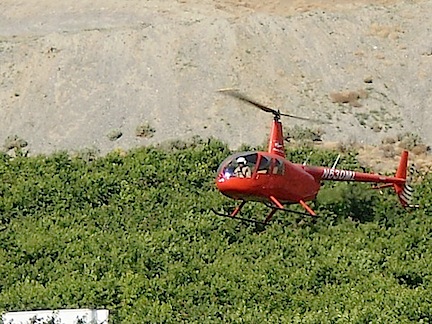
I settled into my usual five-foot hover in my usual place beside the water tank and got to work, flying up and down the rows at about 5 knots. Below me, the big, old tree branches went wild, throwing rainwater off the cherries. I varied my pattern only to avoid flying close to the bedroom window on the other side of the house there. I figured that if people were sleeping inside, I’d rather wake them from the other side of the house instead of 20 feet from their window.

The Rain

I was about 1/4 finished with the orchard when it started to rain. I looked up at the clouds floating over me and didn’t really see the rain coming down. But I could see it hitting the river, which wasn’t as smooth and glass-like as it had been when I first arrived. And it was certainly all over my cockpit bubble.

Now my goal is to dry the orchard and it’s pretty hard to ensure that everything I’ve flown over is dry if it’s getting rained on again right after I pass over. Without my client there to tell me what he wanted me to do, I had to do what I thought was right. I had two choices: land somewhere and wait it out and then start again or keep drying and just go over the areas that got rained on after they were dried. Landing wouldn’t have been a big deal — there was a sizable empty boat trailer parking lot nearby where I don’t think anyone would have bothered me at 5:15 in the morning. Still, I had a feeling the rain wouldn’t last and didn’t want to waste time landing and shutting down if I didn’t have to.

My decision to keep drying was based on the amount of rain falling. It seemed like a heavy drizzle. The trouble is, I couldn’t really see when it stopped. Because I was only moving at 5 to 10 knots, there wasn’t enough wind to blow the water off. So it just sat there. When it started dripping off, I figured the rain had stopped. In all, it lasted about ten minutes. I didn’t think the trees I’d already dried had gotten very wet. They certainly couldn’t have gotten soaked. A quick hover over every other row should shake off whatever moisture had settled on them.

But first I needed to finish the rest of the orchard.

This particular orchard is not easy to dry. The trees are a variety of sizes and thicknesses, ranging from very small young trees to very large old ones. There are obstacles. The rows don’t always go the same way and they’re not easy to see. I’m sure I must have whined about this elsewhere, so I’ll spare you any more whining.

The point is, despite the fact that the orchard is only 32 acres, it takes me at least 1.1 hours to dry it. This year, it’s been a lot wetter so it’s taken me 1.2 hours. Today, with the redo of part of it, it took me 1.5 hours. I’m doing it as fast as I can, but I need to be thorough, too. If the grower loses his crop because I did a shitty job drying, he’ll cancel the contract and never use me again. I don’t want that to happen.

Besides, his cherries are the best. I can’t wait until he starts picking.

Return Flight

I It was nearly 6:30 AM when I finished. I took one more low pass over the treetops and headed out over the river. I made my usual spiraling climb at 1200 feet per minute. The plateau was 500 feet above the river level; I needed at least 200 feet more to clear the edge comfortably.

Crescent Bar

I went back to a viewpoint near Crescent Bar and shot this photo about an hour after I landed. It really was a beautiful day.

As I climbed, I couldn’t help but admire the big, white puffy clouds that were scattered all around me. There was one just to the south of me that seemed to grow out of the top of the Babcock Bench, climbing like stretched cotton toward the sky. The low cloud that had been just west of the town of Quincy was still there, but seemed to have grown. I leveled off at 400 feet above the farmland south of Quincy and the cloud remained below me, as if unsure whether it wanted to be fog or the cloud it really was. I looked out over my shoulder and saw the windmills of the wild horse wind farm, basking in sunlight.

I was angry with myself for not bringing a camera.

I landed at the ag strip and did all the things I usually do: tie down the blades, refuel, do a post-flight inspection. It was about 7 AM when I returned to the RV. I made a second cup of coffee and had the pleasure of drinking all of it. Later, I went out with my camera and tried to capture some of the beauty I’d spotted on my way back.