
Two Close Calls

One, another pilot’s; the other, mine.

I flew up to Chelan, WA to visit a friend on Wednesday. The weather here in central Washington State has been too good to force a cherry drying pilot to sit around and wait for rain. I’m sure my clients didn’t even miss me. (Heck, I could have been back in Quincy in 30 minutes if they needed me.)

I flew direct to Chelan, enjoying some low-flying over the wheat fields of the Waterville Plateau. I know where all the wires are up there and I wasn’t that low. But I do admit that I enjoy the rush of flying at 120 miles per hour 100-200 feet off the ground. The flat expanse of the Plateau is perfect for this kind of flying — you can cover the entire north-south distance without flying over a single home or business.

The descent down to Chelan is always a thrill. First I sometimes need to climb a bit to cross over the tops of four or six sets of high tension power lines that run east-west across the north end of the Plateau. Then I’m at the edge of the Plateau and the earth drops away to the Columbia River over a thousand feet below. My two-bladed rotor system makes it dangerous to do a nose-over dive like you might see in the movies. Instead, I have to content myself with lowering the collective almost to the floor and settling into a 1,000 to1,500 foot per minute descent rate. I always descend downriver from Chelan Airport, so I have to bank to the right and follow the river northeast. By the time I get to the airport, I’m only 100 feet above its field elevation, mostly because it sits on a shelf over the river.

I used to do this flight a lot more often when my finances were better and I could afford to fly on my own dime. Things are different now and I’ll likely make this trip only once or twice this whole season. This was my first time this year and I’ve been here nearly two months.

Three R44s Parked at ChelanMy friend met me at the airport. He’s a helicopter pilot too and he’s also in Washington to dry cherries. His helicopter is parked at an orchard. There were two other R44s parked in a field at the airport and I parked with them. But I didn’t bother shutting down. I invited my friend to join me for a flight further up the river to Brewster, where another friend of mine’s old Sikorsky S55T (and that T stands for “turbine”) is recovering from a mishap last season. We flew up the river, pointing out all the orchards we’d dried in the past along the way.

Close Call #1

Back at Chelan, I parked with the R44s again and shut down. The Airport Manager drove up with his dog in his pickup and chatted with us as I locked up. We could hear the sound of a helicopter running on the other side of an old hangar. The airport manager told us about the pilot, a man who had likely been flying helicopters since before I was born. As we chatted, we could hear the engine winding up as the pilot got the helicopter to full RPM. My friend started walking toward the hangar to get a better look at the pilot’s departure; he was out of sight from where we stood.

A sickly bang! sound rung out. It was not the kind of sound I’d ever want to hear anywhere near where my helicopter was spinning. An older helicopter came into view around the front of the hangar, flying erratically. The pilot got it under control easily and continued hover-taxiing to the fuel pumps about 100 feet away. As he set it down, my friend picked up a piece of something and started walking back to us with it.

It was a splintered piece of wood.

Meanwhile, three men in a hangar nearby came out onto the ramp. Together, we watched as the pilot shut down the engine. The blades slowed. They didn’t even come to a full stop before I saw the damage.

The outboard 6 to 8 inches of each of the two main rotor blades had been severed. My friend was holding a piece of one of them; the other one was on the ramp. The blades had struck a steel I-beam that extended out beyond the hangar walls. He’d probably hovered past that spot a thousand times in the past. This time, he cut it a bit too close.

I call this a close call because of what could have happened. The blades could have disintegrated as the pilot hovered. He could have lost control of the helicopter. We could have been dragging his injured or dead body out of the wreckage. Worse yet, the wreckage would likely have flown all over as the helicopter beat itself to death on the ground. My friend could have been struck with flying debris. Heck, I could have been struck, too. And I wasn’t even that close.

Needless to say, the pilot was very angry with himself. We all felt bad for him, but there was nothing else to do but wheel the helicopter back into its hangar until repairs could be made.

Close Call #2

I had a nice day in Chelan with my friend. We had lunch at a downtown cafe where we could sit outside in the shade. Then we went to Blueberry Hills and had some pie. (I had to skip dinner to keep my calorie count down for the day, but it was worth it. I love rhubarb pie.) Finally, at about 6, my friend drove me back up to the airport. We said our goodbyes, I climbed aboard Zero-Mike-Lima, and started up.

A small private jet made a magnificent departure from the short runway just before I was ready to take off. He climbed out as if a rocket were strapped to his back.

Conscious of the wires around three sides of my landing zone, I took off on the fourth side, heading right over the river. I didn’t climb much; once I was over the cliff, I was already at least 500 feet over the river. I flew downriver at that altitude for a while. I wanted to follow the river all the way back, but there was a fire burning near Wenatchee and I’d forgotten to call the FSS to see if there was a TFR. So I figured I’d just go down the river a bit before I climbed back up to the Plateau and made my way back that way.

Powered Paraglider

You can find this photo of a powered paraglider on Wikipedia.

I saw the other paragliders first. There were at least five of them, flying in lazy circles about 200 feet above my altitude, to my left. They were close enough to see their colorful canopies, but not close enough to see whether they were powered. But I didn’t look long. Movement much closer caught my eye and I spotted one at my altitude less than 1/4 mile away.

I swerved to the right, away from him. I then kept scanning the airspace all around me, looking for others. Thankfully, I came up empty.

My onboard video camera caught the action. This is a clip from the flight. The paraglider is in the picture right from the beginning. Look slightly right of center near the top of the frame. His canopy is yellow. I spotted his friends at about the 0:09 mark and banked a bit to the right; I spotted him at 0:15 and made a more aggressive turn.

The quickness of this encounter (or near encounter) is quite evident in the video clip. The video is only 20 seconds long. When you’re moving along at 120-130 miles per hour, things happen fast. It turned out, he was going the same way I was — and I’m pretty sure he was powered — so he probably didn’t even hear me coming up behind him. At his near-stationary speed (when compared to mine), I was upon him only seconds after he came into view.

I am not accustomed to seeing any aircraft other than helicopters at my altitude, so to say that this shook me up a bit is an understatement. Just because you don’t expect to see something doesn’t mean it isn’t possible.

No More Mishaps

The rest of the flight was uneventful.

I climbed up to the Plateau, crossed over the big wires, and settled down for another relatively low flight across the wheat fields. I took a detour later on, following a canyon down into Lower Moses Coulee, over the town of Palisades and out over the Columbia River south of Wenatchee and its fire. I flew low-level along the eastern shore of the river to Crescent Bar, then climbed up to the Babcock Bench to scout out a geocache location up there. From there, I flew out to Quincy Lakes, overflew the Ancient Lakes and their waterfalls, scouted another geocache location, and headed back to the ag strip where I’m based until July 20.

I’d flown a total of about two hours. It was my first time out flying in two weeks. (I sure wish it would rain again soon — if only to wash the dust off the helicopter.)

It was good to get out — and good to get shaken up a bit. I’d seen two instances of complacency rearing its ugly head. Fortunately, no injuries; just lessons learned.

Low Rotor RPM Warning System, Illustrated

A video to go with an earlier blog post.

I’ve written at least twice in this blog about the low rotor RPM warning system on Robinson helicopter:

I thought it might be good to illustrate what it looks and sounds like on video. You can find the video at the bottom of this post.

Before you watch the video, please read this explanation. The video is not narrated; I wanted the helicopter sound to be heard. If you don’t read this, you won’t know what’s going on or why.

  1. At first the helicopter is at cool-down RPM (around 65%). I’d just come in from a flight and was getting ready to shut down when I decided to use my Flip camera to make the video.
  2. I wind up the RPM by twisting the throttle. Watch the tachometer in the upper right corner. Needles are matched for engine (E) and rotor (R) RPM.
  3. When RPM gets to about 80%, the R44’s electronic governor takes over and brings it up to 100-102% engine RPM (the green arc).
  4. I simulate a low rotor RPM situation to test the system. (The system is required to function for flight so I test before every flight.) This requires me to raise the collective about an inch and then slowly roll off the throttle to reduce RPM. You can hear the engine pitch change and see the needles start to droop.
  5. At 97% RPM, the warning system engages with an audible horn and a light. A pilot who misses this would have to be blind and deaf (and thus, would not be good as a pilot).
  6. In the test, I push the collective down to shut the horn off and let the governor roll the throttle back up. If the horn came on in flight, you’d use the low rotor RPM recovery procedure, as discussed in “Reacting to Low Rotor RPM,” to regain RPM before it dropped to the point where it was not recoverable and became catastrophic.

Here’s the video:

The system looks and works slightly differently on different helicopter models. But the basic operation and test is the same.

The Facebook Decision

Unhappily sitting on the fence; here’s why.

A while back, I wrote “Why I Suspended my Facebook Account.” I just reread it and it still rings true. But Facebook has again gotten in my face and I need to make a decision.

Facebook has proliferated to the point where it’s impossible for anyone in business — especially the business of writing computer-related content — to ignore. It’s everywhere. “Friend me on Facebook!” has become the robotic chant of businesses and individuals all over the country. I have tried to play the part of South Park’s Stan but Facebook continues to intrude on my life.

Recently, I discovered that Facebook had created a community page for me based on my Wikipedia entry. The opening paragraph states:

Our goal is to make this Community Page the best collection of shared knowledge on this topic. If you have a passion for Maria Langer, sign up and we’ll let you know when we’re ready for your help. You can also get us started by suggesting the Official Facebook Page.

So I have become a Facebook “topic.” I don’t know if I should be flattered or horrified.

(And, by the way, if you have “a passion” for me, I’d love to know. My husband might be interested, too.)

My Current Career Situation

Meanwhile, my dual careers as the creator of how to books, articles, and video training material about computers (which I’ve been doing for 20 years) and helicopter charter operator (which I’ve been doing for 5 years) are suffering along with the economy.

Print publishing — especially of computer how-to material — is dying a slow and painful death. The widespread availability of the same content — usually for free — on the Internet is destroying book sales. Just about anyone can use Google to find the answer to a computer or software question online. (That doesn’t mean the answer will be right, but that doesn’t seem to matter to anyone.) There are numerous blogs, including one of mine, that provide how-to information with the same step-by-step instructions I built my writing career on for free.

This is what publishers are competing with. They know it and they try to fight back by stressing the simple fact that their content is being created by experts. But no one seems to care. Why spend $20 on a book that might answer a question when you can spend 20 minutes with Google and the World Wide Web and get an answer for free?

As a result, most of my books are not being revised. The most recent casualty to this trend was my Excel for Windows Visual QuickStart Guide which I have been revising since I wrote the first edition for Excel 95. Look all you want for an Excel 2010 edition — you won’t find one.

The world of helicopter charters is even more shaky with the economy the way it is. My last season in Arizona was dismal, with very few good charters — certainly not enough to pay the bills. The agricultural work I do during the summer months is a lifesaver for the business. Without it, I’d likely have to sell the helicopter and close up shop.

And I’m not the only one in this situation. Helicopter operators and flight schools have gone out of business all over the country. Most people simply don’t have money to spend on things they don’t really need. Who needs to fly in a helicopter? Very few people.

Enter, Facebook

Facbook LogoAnd then there’s Facebook, sitting out there, presenting itself as a free way to make contact with potential readers, video learners, and helicopter passengers. A marketing tool, waiting to be used. Like a worm sitting on the grass, waiting for the a bird to snatch it. But is there a string attached that will drag me down into a hole?

I could reactivate my Facebook account. It’s easy. All I have to do is log in. Everything is there, just where I left it.

Of course, I did strip out all my personal information — or whatever information I could — to prevent it from getting into the hands of people I didn’t want to have it. I’d have to build that back up, selectively, to make a real profile page.

Then I’d have to build pages for each of my careers, keeping them up to date. I’d have to visit them regularly to keep in touch with my new “friends” and respond to their comments on my “wall.” I’d have to accept friend requests from strangers and then struggle to figure out which ones were real people and which were spammers trying to sell me their crap. I’d have to find new people to friend. I’d have to post on my wall and their walls. I’d probably have to fiddle around with the never-ending collection of applications, trying to figure out what they do, how they work, and why I should use them. I’d have to build a presence for myself on Facebook, in a community I have no desire to be part of.

I’d be going through the motions just to satisfy fans and mollify editors. I’d be playing the game because it was expected of me. I’d be spending hours of my life every week on a marketing tool that might get me a handful of new readers and video learners but would more likely expand the audience for the free content I already put on the Web.

Time is one of the most valuable things I have. My freelance lifestyle gives me more time than most people have. But I don’t want to waste it. I’d much rather spend it on things that are important to me, learning or doing something interesting, something worth remembering, worth writing about, worth sharing.

Is Facebook any of that?

There’s more to my life than writing on virtual walls and tending to imaginary farm fields.

I don’t want to sell out.

How to Set Up and Share a SPOT Messenger Page

It’s included in the Track Progress service, so why not?

SPOT Personal TrackerI’ve been using a SPOT Personal Tracker for the past two years. It was recommended to me by a helicopter pilot friend. We both fly in remote areas — the kinds of places that if you go down, rescuers are probably not going to find you before it’s too late.
Think I’m kidding? Check out this Cessna, which was not located for 31 months. I was just one of dozens of local area pilots who looked for this plane whenever I was in the area where it disappeared.

And what pilot can forget the disappearance of Steve Fawcett? Millions of dollars and lots of high-tech search techniques were used to try to find his plane. Over a year passed before a hiker found Fawcett’s ID and the wreckage was eventually found.

I didn’t want to end up like either one of these unfortunate flights. Even if I suffered a fatal crash, I wanted to be found as soon as possible. And if I simply went down and needed help, I wanted help to be able to find me without relying on cell phone signals.

The SPOT Service

So I bought a SPOT Personal Tracker and subscribed to two services:

  • Basic Service enables the SOS (AKA 911), Help, and Check-in/OK features of the unit. That requires a button push to send the message. This service costs $100/year and is required to use the device.
  • Track Progress drops “breadcrumbs” of your location every 10 minutes so others can track you. The track progress feature automatically plots your location signals on a map that’s accessible online. You can create a shared page, give the URL to whoever you want, and let them track you. The benefit of this — as far as I’m concerned as a pilot — is that if I go down suddenly and am incapacitated, people tracking me will not only know where I was within the previous 10 minutes of my mishap, but they’ll likely know which way I was going. Plus, if the unit is intact, it will continue to broadcast my location every 10 minutes. This non-moving signal should help them pinpoint my location — even if I’m dead. This extra service costs $50/year. While I have another pilot friend with a SPOT who doesn’t use it, I think every pilot who uses this device should cough up the extra dough for this service. You can’t always press a button when you need help.

I need to stress here that this is not a device designed for aviation. It’s really designed for “adventure activities” or travel — for hikers and campers and mountain climbers and kayakers. For folks who get out in the wilderness. Of course, pilots who fly in remote areas can benefit from the device and there are plenty of stories of how it may have saved aviator lives. Just keep in mind that it is not an approved FAA tracking device and that flight plans should always be filed and opened for remote area flights. And, if you’re an airplane pilot who flies at altitudes where FSS Flight Following is possible, why not use that service? Unfortunately, Flight Following is not usually available at the altitudes at which I fly my helicopter.

Creating a Shared Page

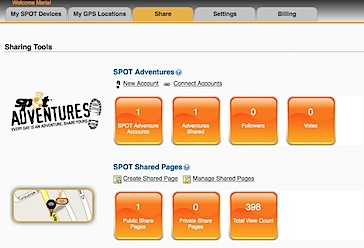
Of course, having a SPOT Personal Tracker with the Track Progress feature means a Share Page (example shown below) is included with your subscription fee. It makes sense to set up this page and share it’s URL with the folks who need to know where you are. You can also share it with the world at large if you’re like me and don’t care who knows where you are when you’re on the go.

Shared Page
Some recent activity; I did 20-minute helicopter rides the other day.

Setting up a SPOT shared page is easy. Assuming you’ve already set up your account on the SPOT Web site and have activated your device, just follow these steps:

  1. Sign into you account at FindMeSpot.com.
  2. Share TabClick the Share tab near the top of the page.
  3. Under SPOT Shared Pages, click the Create Shared Page link.
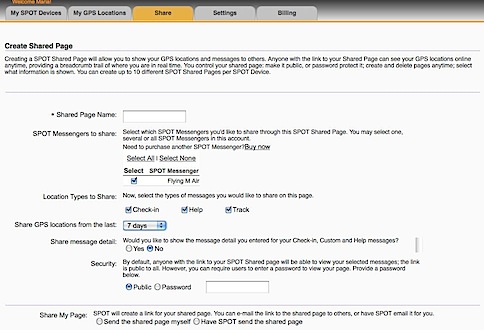
  4. Create Page SettingsSet the options in the Create Shared Page window that appears. Be sure to enter a Shared Page Name and select your SPOT device. Under Security, you can specify whether the page is Public or requires a Password to access. Personally, I recommend keeping it Public. You can always limit who you give the URL to. It would be terrible if someone needed to access the information and couldn’t remember the password.

  5. Select one of the options at the bottom of the page to determine how you’ll notify the people you want to share the page with about the page’s URL:
    • If you select Send the shared page myself option (recommended), a message appears, telling you that anyone with the link can view your shared page. Click Create Now to complete the process.
    • If you select Have SPOT send the shared page, a form appears for you to enter up to 50 e-mail addresses and create a custom e-mail message. Be sure to keep the Send a copy to you check box turned on so you get the URL, too. Click Send Now to complete the process.
  6. URL CreatedAt the bottom of the page, a very long URL should appear. Triple-click it to select it and chose Edit > Copy (or press Command-C (Mac) or Control-C (Win)) to copy it to the clipboard. We’ll use it in a moment to test the link and create a short URL.

Shared PagesIf, for some reason, you didn’t get the URL or you need to access it again in the future, click the Shared tab (shown above) and then click the Manage Shared Pages link under SPOT Shared pages. You can click the name of the shared page to display it. You can then copy the link for that page from the Web browser’s address bar.
Creating a Short URL

http://share.findmespot.com/shared/faces/viewspots.jsp?glId=0aISLWHRq9KlETLqzcfFGQuD8VboS6R8O is not exactly the kind of URL that’s easy to share with friends. Fortunately, URL shortening services enable you to create a custom URL for any page. Although this step isn’t required, it’s certainly recommended.

Although I originally created my short URL with the TinyURL service, you can use any service you like. Bit.ly makes even shorter URLs, but it requires an account to create a customized one. So in this example, I’ll use TinyURL again.

  1. Point your browser to TinyURL.com.
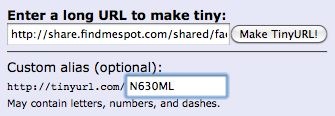
  2. TinyURLPaste the URL for your shared page in the top text box.

  3. Enter a short word or phrase that’s easy to remember in the bottom text box. In this example, I’ve entered the N-number for my helicopter. My original URL used FindMaria.
  4. New TinyURLClick Make TinyURL!
    A message like the one shown here appears, confirming that the new URL was created. You can now give this much shorter URL to family and friends.

Share Your SPOT Page!

Are you already using a SPOT device? If you’ve got a page set up, share it here. Use the Comments link or form for this post. No need to enter any HTML tags; just enter the complete URL. Once your comment has been approved, your shared page will appear. I’d also love to hear comments about the device — good or bad.

On Standby 17/7/60

What being on standby really means.

Occasionally, someone will comment about how I apparently get paid to do nothing during my summer job as a cherry drying pilot. I need to correct them. I’m not doing nothing. I’m on standby.

Specifically: I’m on standby during daylight hours seven days a week during my contract periods.

My Work Day/Week/Term

Let me start by providing a definition of each component of that statement:

  • Daylight hours means the time that it’s light enough to fly. Sunrise is at approximately 5 AM here; sunset is at approximately 9 PM. That’s 16 hours. But I can also fly during the twilight period that begins roughly 30 minutes before sunrise and ends 30 minutes after sunset. If a client wants me to fly the first thing in the morning, he’ll call as early as 4 AM, so my standby day starts then. Generally speaking, it’s not likely that I’ll be launched for a flight after 8:30 PM. I will, however, launch to dry a small orchard as late as 9 PM, so I consider that the end of my standby day. That’s a 17-hour day.
  • Seven days a week is pretty self-explanatory. It’s every day of the week. No days off, no holidays. I was even on call on my birthday — for the third year in a row.
  • My contract periods vary from year to year. This year, I have a total of seven contracts, most of which are for small orchards and overlap each other. From the first day of the first contract to the last day of the last contract is about 60 days. Last year, I had two days off between the end of one contract and the beginning of the last. The year before, I thought I’d have 10 days off, but nine of those days were filled with a last-minute contract.

So, to summarize: I’m on call 17 hours a day, seven days a week, for 60 days. That’s two months straight with no days off.

“On Call,” Defined

What does “on call mean”? On the surface, it means that I have to answer my phone any time a client might call me and be prepared to fly when requested.

What it also means, however, is that I have to do the following:

  • Be prepared to launch within 10-20 minutes of a call. That keeps me pretty close to the helicopter whenever there’s the slightest chance I might have to fly. One day, I waited in my truck where the helicopter was parked for four hours. (I flew 2.1 hours.) On Thursday, I waited in my RV for six hours. (I didn’t fly.) Friday morning, I was up at 4 AM and waited in my RV for two hours for a possible call; I was airborne within 15 minutes of getting it. The 27-acre orchard was dry less than an hour later. That’s the kind of service my clients expect. That’s what they’re paying standby for.
  • Check for voicemail messages. If I take a shower, drive through a dead cell coverage area, or simply don’t hear my phone ring for more than a few hours, I need to check for messages I might have missed. I should always answer the phone when a client calls — even if I’m already on the phone with my husband or a friend. Some clients will actually panic if they can’t reach me on their first try. (I am, after all, hired to help protect a crop worth tens or hundreds of thousands of dollars.)
  • Monitor the weather all the time. I track the weather on the Internet, weather radio, and by looking/walking outside. I have a weather app on my phone that includes in-motion radar. I sleep with my iPad on the bed so I can check the weather before I go to sleep and as soon as I wake up. I also have to be prepared to answer weather questions for clients that aren’t as close to their orchards as I am.
  • Keep the helicopter ready to fly. That means keeping it fully fueled and preflighted between flights. I generally refuel right after landing. I keep the tanks completely topped off so I can get a full 3 hours of flight time if I need it. My clients can’t wait for me to refuel. My clients also aren’t interested in waiting for me to get routine maintenance (like oil changes) or repairs. That means the helicopter has to be ready to fly for the entire season before I get here.
  • Keep fuel for the helicopter available. I buy fuel in bulk for the 82-gallon transfer tank on my pickup truck. There are two places I can get it: In Wenatchee (35 miles away) and in Ephrata (20 miles away). I need to have at least 30 gallons in the tank at all times, so as soon as it drops below 50 gallons, I try to make a fuel run. I have to do it on a clear day when there’s little or no chance of flying. Although I also take that opportunity to run errands I can’t run in Quincy (where I’m based), I always buy the fuel first, just in case the weather turns bad and I have to rush back. That’s happened twice this season so far.
  • Schedule my errands around the weather — and be prepared to change my schedule at the slightest hint of rain. My errands include grocery shopping, banking, post office runs, laundry, and the occasional quick meal out. It also includes familiarizing myself with new orchard blocks I’m contracted to cover.
  • Not drink alcohol. Let’s face it: the rule in aviation is “eight hours from bottle to throttle.” If I’m on call 17 hours a day, there is no eight-hour stretch that I’m not on call. So, theoretically, I can’t drink.
  • Not see a movie. Heck, this bugs me more than the alcohol. Every summer, there are so many great new movies, but I can’t see any of them. The closest theater is 35 miles away and I can’t lock myself up in a dark room without checking the weather for two hours. And at night — well, I do need to sleep.

Two Sides to Every Coin

The other day, a friend of mine came to visit with his daughter and grandson. We had lunch at the golf course restaurant, within view of the helicopter and only 150 feet from my RV. Afterwards, we stopped by the RV for a diaper change.

My friend’s daughter told me how envious she was of me and my job. She said it was the greatest job she’d ever heard of.

I’m not complaining, but I do want to point out that there are two sides to every situation. I seriously doubt whether her job would get her out of bed with a phone call at 4:10 AM. Or live in an RV on a tiny campsite near a busy (read that “noisy”) intersection. Or keep her stuck in a farm town (that doesn’t have very much to offer except about a dozen Mexican restaurants) all day on any day there was the slightest chance of rain.

So yeah, I’m getting paid to just wait around. But there’s a huge responsibility that goes with that — and zero tolerance for not doing the job right.