So You Want to Be a Helicopter Pilot, Part 3: Start Young

The younger you start, the farther you can go.

In the last part of this series, I discussed the financial aspects of learning to fly helicopters and getting the ratings you need to move forward. I’m thrilled to see that a few folks have added comments from their own experiences. With luck, others will do the same. The more real experiences that are shared, the more real information readers can pick up here.

In this post I’ll discuss another important topic: age. Ideally, you want to have all certificates in hand by the time you’re 30 years old. Even better would be 25. This means you need to start young.

Look at it this way: if you were going to college for career training, wouldn’t you want to have your degree so you could get to work in your chosen field before the age of 30? This would give you plenty of time to pay your dues (discussed in another post), get your foot in the door, and work your way up the career ladder to the kind of flying job you want.

How Young Can You Start?

I honestly don’t know the minimum age for starting helicopter flying lessons. I’ve seen airplane flight schools offering training for kids as young as 14 years. On the helicopter side, however, I noticed that some flight schools require students to be at least 18 years old. I think that’s a pretty good minimum age for getting on the controls of a helicopter.

Rotorcraft Flying HandbookBut that doesn’t mean you have to wait until you’re 18 to start learning. There’s plenty to learn before you begin taking actual flight lessons. A good place to start is with the FAA’s Rotorcraft Flying Handbook. This free 207-page book in PDF format is an excellent source of information about helicopter aerodynamics and maneuvers. In fact, it’s the book I turn to to brush up on topics like gyroscopic precession and coriolis effect for my annual Part 135 checkride. Start here — no matter how old you are — and get a head start on the basics before you even meet your first flight instructor.

Midlife Career Changes

I get lots of e-mail and comments from guys who are in their 40s or even 50s or 60s who claim that they’ve always wanted to be a helicopter pilot. Always? What I want to reply is: why didn’t you do it when you were younger?

Reality check: 40 is not a good age to start training to become a career pilot. I’m not saying it’s impossible — hell, I was 37 when I started learning to fly. (An airline pilot I knew at the time told me point blank that I was too old to start a career as a pilot.) But it won’t be easy to build your career.

Part of the problem is this: although you’d think that entry level employers would be more inclined to hire older, more mature pilots, they aren’t. They want young guys who will do anything they’re told. They don’t want people who can think and reason based on life experiences. They want cheap robot pilots who will stick around just long enough to fulfill a contract that ends with the tour season. I experienced this first-hand at the Grand Canyon, working with guys young enough to be my sons.

If you’re starting to get up there in years, give this some serious thought before diving in. Do you have many financial responsibilities? Are you prepared to give up your current salary and start at the bottom of a helicopter pilot’s pay scale?

I am fortunate in that my other job as a freelance writer makes it possible to work around my flying activities; I’ve been working two jobs since I began flying for hire. I could never survive in without a serious lifestyle change on what I currently earn as a pilot.

Maybe you’re in a similar situation and have an income that will continue. Or maybe your first career has left you with enough residual income that you don’t need to worry about future income. Or maybe you’ll just prove to be the exception.

If you do decide to go for it, don’t wait. The sooner you start, the better off you’ll be.

And here’s one more thing to keep in mind: you don’t have to make flying your career to be a pilot. A man I knew got his private helicopter rating on his 65th birthday. No, he wasn’t a career pilot. He just wanted to fly helicopters.

Next up, an important decision: choosing a flight school.

So You Want to be a Helicopter Pilot, Part 2: Save Up

The more you pay up front, the less you’ll pay in the future.

Education is expensive. Helicopter pilot training is very expensive.

The good news is, financing is often available for flight training. The bad news is, the rates can be high. And did I mention that the training is expensive?

The Cost

Let’s look at the real cost of obtaining your ratings. Remember, at a minimum, you’ll need to get your Private and then Commercial helicopter pilot rating. That’ll cost at least $40,000 that’s if you manage to do it with nearly the minimum number of required flight hours. A more accurate number might be closer to $50,000.

Now unless you have access to a helicopter that you can fly to build another 900 hours of pilot in command time, you’ll likely need to get an entry level helicopter pilot job. In the U.S., that’s a Certified Flight Instructor (CFI) which requires yet another rating. If you want to make yourself more marketable in the future, you’ll likely go for your instrument rating (which will help if you plan on flying in the Gulf of Mexico or in a medevac job) and, if you’re going to do that, you might go for your CFII so you can provide instrument training for other pilots. Getting all that and building the time you need to get the CFI job will add another $10,000 to $20,000 to the cost of your training.

Don’t forget ground school, books and study guides, flight computer and related flight planning tools, test preparation, tests, and check flight costs.

So you’re looking at a total training cost of $50,000 to $80,000. That’s easily as much — if not more — than degree at a private college or university.

Speaking of which, you may want to get a degree while you learn to fly. Some flight schools are associated with major universities and can make that happen. The benefit is that when you finish your education, you’ll have more than just a pilot’s license. You’ll have a degree that can help you get your foot in the door for any aviation business job.

Financing: Do the Math

Many flight schools offer financing through deals they’ve made with local or nationwide financial institutions. One flight school I know not only offers financing to its own students, but extends financing to students at other flight schools. (Why would it do this? Do the math and the answer is easy.)

While it might seem like a no-brainer to you to sign up for financing, stop and think about the deal you’re being offered. What is the interest rate? What’s the payback period? When do payments start? This information is vital to calculate what the loan will cost you in the near and distant future.

One of the commenters on my popular blog post, “The Helicopter Job Market,” wrote:

Also, how is someone to payback an $80K loan at 19% on an entry level salary of 30K/year? That’s a freakin’ house payment each month without having a house! My “off-the-cuff” figuring say’s that equates to about $800 a month for 20-30 years!

His point was on target but his “off-the-cuff” calculations were way off. Using Excel, I calculated $1,271 per month over 30 years — if they give you that long to pay. (The monthly payment is even higher if the loan term is shorter.) That’s a total of $457K. Ouch!

(To be fair, that 19% number quoted by the commenter was evidently the going rate at the end of 2007. The rate is probably much lower now. At least I hope so.)

Do the math.

The simple truth is, financing your training will leave you in deep debt at a point when you’re least likely to be able to pay it off. While I’m not saying you should pay for the whole thing out-of-pocket — although if you can, do it! — you should try to minimize training debt as much as possible. The more you pay up front, the less you’ll pay in the future.

And do you really want to be saddled with a huge loan just when you’re starting out on a new career?

Pay as You Go

One way to minimize training debt is to do your training part time while working at another job. That’s what I did. It took a long time — 18 months to get my private certificate and another six months to get my commercial — but I didn’t have a penny of debt when I was done. (Of course, my other job generated a good cash flow, so I wouldn’t say my situation was typical.)

On a pay-as-you-go plan, you might give the flight school $2,000 on account and then fly and do ground school until it’s done. Then another $2,000 and so on. Obviously, the faster you train, the more money you’ll need to come up with. Perhaps you can work a deal with financing to pay part of the costs as you pay the rest.

Something I did early on was to join AOPA and get an AOPA MasterCard. Back in those days (late 1990s) the card gave cardholders 3% cash back on training and FBO expenses. I’d make my $2,000 account payment on my card and then pay the card balance when it was due to avoid interest charges. I’d then collect 3% of the training costs at the end of the month. While that doesn’t seem like much, it did add up. The card has since switched to a point system that also offers some cash back; I use it for all my flying expenses.

One drawback to the pay-as-you-go method — especially if it considerably slows down training: if you don’t fly often, you’ll need to fly more hours to get and keep the skills you need to pass a check ride. For a while, I only flew once or twice a week; I found in the beginning that I was “rusty” and needed at least half of a flight to relearn motor skills. I also took off an entire summer — you try practicing hovering autorotations in 115°F weather! Because of this, I probably required at least an extra 10-20 hours of dual flight time over the 18 months of my primary training just to be ready for my Private check flight.

The Military Option

If the military is an option, remember that the GI Bill (or whatever they’re calling it these days) will pay for all or part of career flight training. Do your homework to find out what’s involved and whether this can work for you.

If you’re already in the armed services, you might quality for pilot training. There’s nothing better than having your Uncle Sam foot the bill for flight training and pay you to build hours of experience. (Especially, of course, if your Uncle Sam is your mom’s rich brother who needs a pilot.)

If you’re not already in the armed services but you’re young enough to sign up, consider it. It’s not as crazy an idea as you might think. If you’re young, exposure to a disciplined lifestyle and trying circumstances can make you a better, stronger person. It can also help you mature quickly. And you’ll build relationships with other men and women from all over the country — relationships that’ll last a lifetime.

Remember that not all flight schools are eligible to receive GI benefits. Do your homework before you sign anything.

Ignore this at your Peril

Of all the advice I give you in these articles, this one is likely to be the most ignored. Why? Because in our society we want immediate gratification and don’t think twice about going into debt to get what we want.

Sure, you can ignore this advice and finance your entire flight training. Just remember, when you’re struggling as a CFI trying to build time at a flight school that hires all of its students as CFIs — more on that in a later post — that that loan is likely to be a heavy burden when you also need a roof over your head, food in your stomach, and gas in your car to get to work.

Next Up: Some age advice.

So You Want to be a Helicopter Pilot, Part 1: Read This First

Read up; this will tell you everything you need to know.

I’ve been blogging since 2003 and have been writing about my experiences as a helicopter pilot since the very start. A lot of what I’ve written covers the commercial side of flying helicopters — flying for hire. I’ve also written about the helicopter job market; that post, now about three years old, remains one of the most-read posts on this blog, with dozens of comments that help make it even more valuable for blog readers.

Along the way, I’ve been accused of “shooting people down,” “destroying people’s dreams,” etc., ad nauseam. That is not my purpose. I like to see people achieve their dreams, but I am a realist. I believe that people can achieve their dreams if they work hard and smart and do the right things to make it happen.

Captain MariaAfter all, I did it. I’m a woman (which, sadly, does matter in this particular field) from a middle-class family with absolutely no aviation background. I waited until I was in my late 30s to start flight training, doing it more as a hobby than a career change. I covered the cost of training to get my private and then commercial ratings. When I realized I was hooked, I set a goal of flying helicopters at the Grand Canyon. I achieved that goal in 2004, working as a seasonal pilot for one of the tour operators there. Now my goal is to get a job as an ENG or movie pilot. I’m working on that and believe I can achieve it.

But what are the right things to do if you want to build a career as a helicopter pilot? That’s what this multi-part post will attempt to address.

Who Needs to Read This

If you are a man or woman at least 16 years old with a serious desire to become a helicopter pilot, this post might be for you. Answer these questions honestly:

I want to become a helicopter pilot because:
(A) I love to fly and want to do it as much as I can.
(B) I think helicopters are cool and being a helicopter pilot would really impress my friends.
(C) I want a job earning $80K or more a year.

I’m sure I can fly a helicopter because:
(A) Well, I’m not really sure, but I think a good instructor can teach me.
(B) I can fly helicopters on my flight simulator.
(C) It looks pretty easy.

The most important thing to learn about flying helicopters is:
(A) It’s all important, from basic maneuvers to FAA regulations.
(B) Being able to do autorotations.
(C) Knowing how to fly like the pilots in the movies.

Helicopters are:
(A) Utility aircraft designed to perform missions that airplanes can’t.
(B) Like airplanes but without wings.
(C) Built for fun.

If you knew that the “right” answer to each of these question was A, there’s definitely hope for you. You might have the right attitude to be a helicopter pilot. And that’s important because, as I’ll discuss, attitude is vital to success.

If you honestly picked B or C for any of the answers, you need to think a bit harder about a career as a helicopter pilot. You likely have some misconceptions about what flying helicopters is all about. Why not stop by your local medevac base or helicopter charter company office and chat with some of the professional pilots there? Don’t chat with folks at a flight school — they’ll simply tell you anything you want to hear. Talk to the folks who are actually flying helicopters for a living. They’ll give you the facts and set you straight.

Who Doesn’t Need to Read This

This post is for people who want to build a career as a helicopter pilot. In other words, they want to fly helicopters for a living.

If you just want to learn to fly helicopters — as a hobby or just another skill — you don’t need this advice. Just go find a flight school and sign up. That’s what I did. I never intended to fly professionally. I just got hooked and then needed to be paid to fly in order to keep flying.

If you’re thinking about flying helicopters for a hobby, be aware that it is a very expensive hobby. It’ll cost about $10K to get your private helicopter pilot certificate. Flight time in the cheapest helicopter you can find will cost at least $180/hour and likely much more. Ownership is even more expensive — especially if you don’t fly more than 100 or so hours a year. Even home-built helicopters are costly to acquire and operate.

I’m not trying to talk you out of it — I’m just pointing out the facts. I know quite a few private helicopter pilots, most of whom own their own helicopters. They’re all rich guys. All of them. I am the poor kid on the block; I need paying passengers to fly.

And if you’re interested in helicopter ownership, be sure to read this.

The Advice

In the next part of this series, I’ll start providing my advice. While you might be tempted to skip one or more of the parts, don’t. Every single one will provide vital information you’ll need to succeed. Read them all; post your questions as comments on the appropriate post. I’d love to see a good discussion start — something that’ll really help you and others achieve your goals.

Oh, and by the way. I think the information you’ll find here applies to getting started in a career as any kind of pilot — even fixed wing.

Strangers Know My Name

And that’s kind of spooky.

The other day, on my flight from Page, AZ (PGA) to Phoenix Deer Valley Airport (DVT), an odd thing happened. I was about 12 miles out, coming down through the mountains near New River on the east side of I-17 when I caught sight of a low-flying aircraft ahead of me. The tiny dot in the distance moved left to right in front of my flight path at about my altitude. When it made a sharp turn, I knew it was a helicopter.

I was tuned into the helicopter air-to-air frequency, 123.025, and keyed my mic. “Helicopter over New River, are you on frequency?”

Nothing. Repeating this call twice also brought no response. In the meantime, it appeared that the helicopter was circling in that area. It couldn’t be a media helicopter; they monitor the helicopter frequency. Who was it, what were they doing, and — most important — did they see me?

I started to climb. That in itself was odd. Normally, when I see traffic in my vicinity, I descend to avoid it. But this guy seemed as if he were looking at something on the ground. As he moved from right to left, I veered off a bit to the right, planning to either pass behind him or into his view if he turned again.

I had the helicopter’s nosecam running and just inspected the video. It reminds me that I was flying into the low-lying winter sun for most of the flight; this clip was from about 11:30 AM. The other helicopter is almost impossible to see because of the wide angle lens exaggerating distances, but as the video progresses, I can clearly the the flash its blades as the sunlight reflects off them at certain bank angles. Here’s a capture from the movie with an inset blowup of one of those flashes; he was 2-3 miles away at this point:

Traffic

He didn’t turn. He continued to the left, eastbound, out of my path of flight. I resumed normal navigation, keeping an eye on him to make sure he didn’t come back. He didn’t. Instead, he began heading south about a mile east of me, slightly higher. I could see from the shape of his helicopter that he wasn’t flying a Robinson or a Hughes. It could have been a JetRanger.

Meanwhile, I was nearing Deer Valley and had listened to the ATIS on my second radio. I was about 7 miles out and ready to call in when another helicopter called in, using the same position report I’d use: “7 miles north.” Unless there was another helicopter right behind me, it had to be the guy I’d been watching. He was going to the north hangars, which is a huge group of hangars on the northeast side of the runways. The tower responded, telling him to report a mile out.

I called in immediately with basically the same call but to the Atlantic ramp, which is on the south side of the runways. I added: “I have the other helicopter in sight.” I was told to report a mile north and expect a midfield crossing at 2,000 feet. The usual.

The tower frequency was unusually quiet, but the controller did talk to one or two other pilots. Then the other helicopter came on. “Helicopter 1-2-3 (I can’t remember its real tail number and wouldn’t use it anyway) is just crossing Carefree Highway.” There was a pause and then he added, “Maria.”

He was talking to me. On the tower frequency. Creepy.

A little surprised, I spoke up, “Helicopter Zero-Mike-Lima has you in sight.” What I later realized is that he still didn’t see me and was trying to get me to tell him where I was in relation to him. I should have added, “I’m at your two o’clock low,” which is where I was, still at least a half mile away. But I was a bit frazzled by a stranger speaking to me directly, by name, on the tower frequency.

Hell, wouldn’t you be?

But was he a stranger? Maybe I did know him. But I couldn’t think of anyone I knew who owned a helicopter like that. If he’d been landing on the south side, it could have been a media or medevac helicopter and then I might know the pilot, but he wasn’t. He was landing at the rental hangars on the north. That meant his helicopter was likely privately owned or he was visiting someone up there. Who was it? Beats me.

A minute or two later, he called again, “Deer Valley Tower, Helicopter 1-2-3 has the red Robbie in sight.”

(Why does it bug me just a tiny bit when other helicopter pilots refer to Robinsons as Robbies?)

Then I was making my call a mile out and getting instructions to cross midfield at 2,000 feet. I was making my spiraling descent on the other side of the runway when the other helicopter reported a mile out and got his instructions to land.

And that was the last I heard from him.

Of course, all this reminds me that the helicopter community is a small world where most folks know most other folks. Of all the helicopter pilots out there, how many are women? Likely 5% or less. Of all the female helicopter pilots, how many are flying red Robinson R44 helicopters in the Phoenix area? Probably just one: me.

And it’s a lot easier to remember the name of the one oddball in the pack than every other pilot out there.

I just wish I knew who was flying the other helicopter.

On “Aspiring” Helicopter Pilots

Get a clue.

Earlier this week, I pulled together clips from a two-hour flight between Phoenix and Page, AZ and made it into an eight-minute video set to some solo piano music. It’s not a masterpiece of video editing — hell, that isn’t what I do. It was just a way to create some fresh marketing material for Flying M Air using what I thought was some pretty awesome video footage from my flight.

I blogged about the trip and embedded the video here.

A Tiny Bit More about the Video

I need to make a few points about this video before I start my rant:

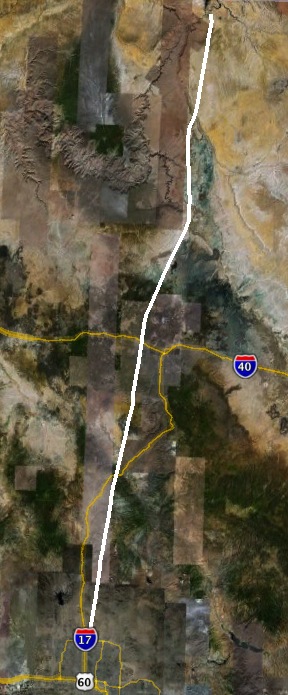
  • Route to PageThe purpose of the flight was not to make the video. The purpose of the flight was to get from Phoenix to Page as quickly as possible. My clients paid for two hours of flight time; every minute past that was being paid for out of my pocket. I flew nearly a straight line, as shown in this Google Earth plot created from actual GPS points. (I sometimes run a geologger while I fly; I happened to have it running that day.)
  • The primary purpose of the video was as a marketing tool. I had good, smooth footage of places I often fly. The lighting for some of the flight was excellent. The footage was representative of what a client might see while flying with me. Why not turn it into a marketing video?
  • The only footage in the entire video that I considered not including were the low flight clips over the Navajo reservation, including the clip where I fly between two buttes. The reason: it is not representative of what a client might experience when flying with me. Why? Because my Part 135 certificate requires me to maintain minimum altitudes of 300 feet AGL with passengers on board during a Part 135 flight. Coincidentally, this footage also documented some of the more exciting portions of the flight — 110 knots at low level isn’t exactly dull when you’re experiencing it.
  • The overall tone of the video is peaceful and serene. I was showing off beautiful scenery that floated by beneath us. The music seemed to work with it.

I shared the video on this blog (as mentioned earlier) and linked to it in a few places, including a social networking site for helicopter pilots. I got a lot of positive feedback that made me feel good.

Enter, the “Aspiring Pilot”

On the helicopter site, a lot of pilots complemented me. A few asked questions, which I answered. And then Dan (not his real name) commented:

I’ll still look like a little jerk, but god that that flight is boring. I dare not imagine the other 112 minutes. A helicopter is made for fun, caution kills the fun !!

I was immediately taken aback. I never intended the video to be exciting. Hell, if I made it too exciting, it would have raised all kinds of red flags with my contacts at the FAA. It was just a marketing video.

And then I started thinking about what the little jerk — hey, it was his self-applied label — had just said: “caution kills the fun!!” What kind of pilot would say such a thing?

I checked out his profile and it became clear. He was an “aspiring pilot.” In other words, he wasn’t a pilot at all.

Instead, he was an immature, idiotic wannabe.

I knew the type. They think flying helicopters is cool, mostly because of what they’ve seen in the movies. (I assume not the scenes where the helicopter explodes.) They’ve never been at the controls of a helicopter, they’ve never read anything about helicopter aerodynamics or maneuvers. They don’t know the first thing about flying helicopters. Maybe they’ve never even been close enough to a helicopter to touch it — let alone sit in one.

But they’re experts!

A helicopter is made for fun, caution kills the fun!!

They hang around helicopter forums, trying to fit in, trying to make cool comments that’ll score points with people they see as their peers. Instead, they just spout inane bullshit:

A helicopter is made for fun, caution kills the fun!!

The helicopter forums are full of little jerks like this — which is why you won’t find me on the helicopter forums. I have no patience for the kind of crap put out by wannabe helicopter pilots who haven’t got a clue about flying helicopters.

A helicopter is made for fun, caution kills the fun!!

Attention “aspiring pilots”: a helicopter is not “made for fun.” It’s a utility aircraft that can perform maneuvers and operate in situations impossible for an airplane. It is a complex piece of machinery. It takes real skill and knowledge to fly.

A lot more skill and knowledge than you’ll get playing with your Flight Simulator.

And caution? Well, that’s what keeps you alive so you can fly again tomorrow. It’s also what keeps your passengers alive so they can tell their friends about how great it was. It keeps your helicopter in one piece so its owner doesn’t take a huge financial hit. It keeps the FAA off your back so you keep your license. That’s what caution does.

Flying helicopters is serious business. It isn’t a game. Any pilot who doesn’t take flying seriously is a pilot I don’t want to see at the controls of an aircraft.

Wanna Be a Pilot?

Stop pretending and start studying.

And shut the hell up until you know what you’re talking about.