About the Wind Machines

An important part of crop protection.

The economy of this area of Washington State is based primarily on tree fruit production: apples, cherries, pears, and apricots. Indeed, Columbia River Valley around Wenatchee is one of the biggest apple producing regions in the world.

Fruit trees bloom in the spring, are pollinated by migratory bees, and form fruit. Throughout the summer, the fruit develops and grows. Months later, when the fruit ripens, it’s picked, sent to processing plants, and either shipped out immediately, as in the case of cherries, or stored for later shipment, as in the case of apples.

The timing of all this is determined by the weather and can fluctuate by several weeks every year. The trees get a cue from temperature to start budding and once the buds are formed, there isn’t much that can stop the seasonal progression.

Except frost.

Frost can kill flowers and developing fruit. A bad enough deep freeze over the winter months can even kill trees.

And that’s where frost protection comes in. Growers are deeply concerned about frost destroying a crop so they take steps to protect the crop from frost. In this area, they rely on wind machines to circulate the air in parts of an orchard prone to pockets of cold air.


This video shows wind machines in action at a pear orchard in Cashmere, which is near here. It looks to me as if the trees are in bloom. Unfortunately, the sound is turned off so you can’t get the full effect.

Wind machines look like large, two-bladed fans on a tall pole. Usually powered by propane, they’re often thermostatically controlled — in other words, they are set to turn on in the spring when the temperature drops down to a certain point. The blades spin like any other fan and the fan head rotates, sending wind 360° around the machine’s base.

The idea, of course, is that the cold air has settled down into pockets and that warmer air can be found around it and above it. By circulating the air, the warm air is brought around the trees and frost is prevented.

In California, they use helicopters to protect the almond crop from frost. (As a matter of fact, as I type this my helicopter is in California for a frost contract for the third year in a row.) The principle is the same, but the orchards tend to be much larger and I can only assume that it isn’t financially feasible to install and run wind machines in that area. (Hard to believe it’s cheaper to use helicopters, though.)

This year, some unseasonably warm weather has triggered a very early bloom. My clients tell me that their cherry crop is running 2 to 3 weeks early. Right now, cherries are in various stages of bloom throughout the area; apricots are pretty much done with their bloom. (Apples and pears will come next.) And since winter has not let go of its tenuous grip on us, the temperature has been dropping down into the low to mid 30s each night this week.

Well, not at night. It actually starts getting cold around 4 or 5 AM, as you can see in this weather graph:

Weather Graph
The National Weather Service weather graph page for this area shows the forecasted highs and lows over time.

The result: the wind machines kick on automatically when it starts getting cold: around 4 or 5 AM.

Want to hear what a wind machine sounds like close up? This video has full sound as a field man starts and runs up a wind machine. He’s wearing ear protection for a reason. Stick with it to see the spinning head on top.

Wind machines are not quiet. In fact, from a distance, they sound exactly like helicopters. And as they spin, they sound like moving helicopters — so much so that when I first heard them in action back in Quincy in 2009 or 2010, I thought they were helicopters and actually got up to see what was going on. I suspect that to someone on the ground, they sound exactly like a helicopter drying cherries would sound.

Although there aren’t any orchards on my end of the road, my property does look out at quite a few orchards, some of which have wind machines. There are at least 5 within a mile of me — I can see 4 of them from my side deck. I can also see others much farther out into the distance. And when the close ones are running, I know it. It’s not loud enough to wake me up in my snugly insulated home, but it sure did wake me up when I was living in my thin-walled RV outside. And it’s definitely not something you can pretend you don’t hear.

Fortunately, wind machines are a seasonal nuisance — much like other orchards noises: sprayers, tractors, helicopters, and pickers. Although frost season runs through May in this area, the machines only kick on during cold weather. Looking at the forecast, I can expect to hear them tomorrow morning and probably Wednesday morning, but not likely on Monday or Tuesday morning.
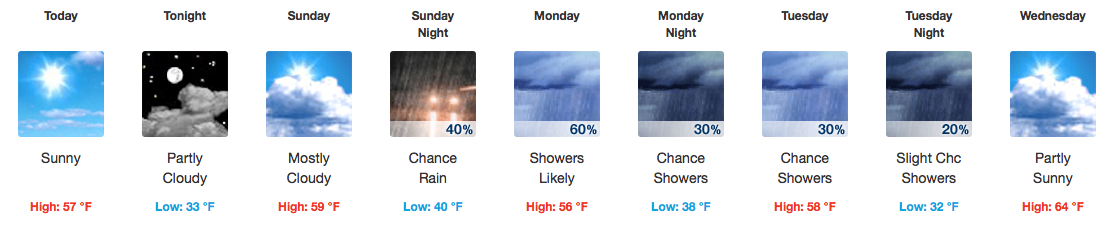
Weather ForecastNWS Wenatchee forecast for this week.

In the meantime, I’ve already gotten the heads up from my California client who might need me down there on Monday. After all, they don’t have wind machines.

For a helicopter pilot working in this area, wind machines are one of the obstacles that can be a hazard when drying cherries. They tower higher than the trees and their blades can be “parked” at any angle or direction. Although some growers will try to use wind machines to dry trees while waiting for pilots, my contract states I won’t fly in an orchard with wind machines spinning so they’re usually turned off when I arrive — or right afterwards. But if the blades aren’t parked, they can move. And one pilot I know learned the hard way about what happens when a helicopter’s main rotor blade hits a wind machine. (He’s okay; the helicopter is not.)

To sum up, wind machines are an important crop protection device that can be a bit of a nuisance with predawn operation in the spring. But I don’t mind listening to them. Like so many orchard owners in the area, my livelihood depends on a healthy cherry crop. If that means tolerating some noise 10-20 mornings out of the year, so be it.

Kind Words from a Client

Really made my day.

These days, I make most of my living doing cherry drying work in Washington State. It’s an extremely short season — I consider myself lucky to get 10-11 weeks of work — and 2015 will be my eighth season doing it.

Each year I’ve managed to build up my client base from the handful of clients originally contracted by the guy who brought me up from Arizona to help him in 2008. I now have a total of 10 clients managing 15 orchards. At the peak of the season, I hire three pilots to help me provide adequate coverage for all of it. This year, I might hire a fourth.

Each year, as cherry season approaches, I get more and more stressed. Will last year’s clients sign up with me again? Can I get more acreage to cover? Can I find enough reliable pilots to help me? Will a late-season frost wipe out half the crop, as it did in 2008?

Even when I have all the answers to those questions — usually yes, yes, yes, and no — and cherry season is under way, the stress doesn’t stop. I watch the weather incessantly — several apps on my phone with forecasts and a very good radar app to watch storms moving around the area. I stare at the sky and watch the clouds. I worry about my helicopter being fueled, preflighted, and ready to fly. I worry about the guys working for me and I worry about their helicopters. I worry about whether I trained the new pilots well enough and whether they’ll be able to find the orchards I showed them.

And when a weather event is possible, I worry even more. Which direction is the weather moving? How hard is it raining? Is it windy, too? Will it drench all of the orchards at once? Do my clients have people on hand to monitor the moisture and call me to fly? Will it stop raining early enough in the day to finish drying before it gets dark? Are my pilots really at the airport waiting to launch? Did the pilots get the GPS coordinates for the orchards so they can get there fast enough? Can that new pilot cover the acreage I assign to him effectively in a reasonable amount of time?

Then the rain happens and the phone starts ringing. I fire up my helicopter and launch, sometimes even as I’m dispatching the other pilots. I hover over the trees, at first trying to judge how wet they are after this particular event, trying to get my speed just right to dry them enough without wasting time. I do my job, stealing glances at the radar on my iPad so I know just which client will call next and when. I listen to the radio to hear from my pilots or other pilots in the area. I answer the phone and place calls, sometimes while still hovering within 10 feet of the tops of cherry trees.

Cherry Drying

And I’m always beating up on myself if I can’t get someone to an orchard as fast as I’d like. Last year, I felt that I’d failed one of my best clients. I even worried that I would lose his contract for this year. So this year, when I emailed him to ask if he wanted my services again this year, I pointed out where I could have done better and told him how I planned to handle it.

His response made my day (names changed to protect privacy):

ABC is very pleased with the opportunity to work with Flying M Air again for the 2015 season!

I’m sure that Joe can attest to this also, when the call is made to dry cherries you or a member of your team is on site drying within 15 minutes.

That’s a relationship that I want to continue!

All the stress and worry somehow seem worthwhile now. Our work is appreciated. I have another season full of clients to serve this year.

And the cherries are early. Can’t wait to taste some!

Being an Inspired Pilot

An interview and more.

Inspired Pilot LogoA few weeks ago, I was contacted by Marvyn Robinson, a U.K. pilot and podcaster. He wanted to interview me for his podcast, Inspired Pilot.
I was flattered, of course. (I’m flattered any time someone contacts me with a request like this.) How could I not say yes?

About the Podcast

The About page on the Inspired Pilot website explains what the podcast is all about:

This will be a weekly show where I interview inspiring pilots, pilots with inspiring journeys from all around the world. Each week we will highlight the life of our featured pilot, follow their journey and how they got to where there are now.

We’ll examine how and why they got started, the decisions made along the way, experiences gained and lessons learned. All this with the view to INSPIRE seasoned pilots, mere mortal low hour pilots like myself, wannabe pilots and pilot enthusiasts alike, by guests sharing their inspiring journeys.

Just to give you an example of the spectrum of our guests, we are going to be talking to pilots from all areas of the aviation industry, from airline pilots, bush pilots, flight instructors, private pilots, bizjet, military and even retired pilots.

The whole idea behind the podcast is to inspire other pilots. The people chosen to be interviewed are supposed to be inspiring. So again, how can I not be flattered?

Who Needs Inspiration?

Every pilot knows at least one other pilot — or wannabe pilot — who just couldn’t seem to get it together to achieve his or her aviation goals. These people often have legitimate or imagined excuses for not moving forward. (I was married to one of these people for a while so I’ve seen it firsthand.)

For many people, the excuse is a life change. For example, a guy is taking flight lessons part time and gets married or his wife becomes pregnant. All of a sudden, his priorities change and he puts flying on the back burner. Many times, he never goes back to it.

For other people, the excuse is simpler: money. Learning to fly isn’t cheap and not everyone has disposable income to throw at what might only be a hobby. When the economy tanked, flight schools were hit hard because fewer people could afford lessons. Renting an aircraft once you become a pilot isn’t cheap either. It has to fit into your budget.

For a select group of people, there are medical issues that can stop a prospective pilot in his or her tracks. Uncorrectable vision, diabetes, untreatable high blood pressure, heart problems — there are a multitude of conditions that pilots simply are not allowed to have.

These are the people Inspired Pilot was created for. To get them excited about flying. To get them thinking of ways to work around the hurdles that face them. To inspire them to achieve their flying goals.

These are the people I want to inspire.

It’s More than a Piece of Paper

I’m one of the people who want to fly. I’m not interested in collecting pilot ratings just because I can.

For example, I learned to fly an open cockpit gyro last spring. It was a ton of fun. I got to fly that gyro again last week. George, who owns it and taught me to fly it, told me what I need to do to get my rating in it. I’m very close — all I need is a check ride.

But why get a rating for something I seldom have an opportunity to fly? That piece of paper is meaningless to me. I’m perfectly satisfied to fly the gyro occasionally with George. In the unlikely event that I buy a gyro or have access to one on a regular basis, I might reconsider getting that piece of paper. Until then, why bother?

And then there are just the folks who claim they want to fly and even move toward the goal of becoming a pilot and perhaps even become pilots — but then don’t do what it takes to stay current and safe. These are the nervous pilots, the pilots who are afraid to push the limits of their experience, the pilots who use the slightest possibility of inclement weather as an excuse not to fly. They’re pilots only because they have a piece of paper saying that they are. (This was the situation with my wasband.)

But are you really a pilot if you seldom fly? If you can come up with more excuses not to fly than reasons to fly? If you never seem to want to fly?

In my experience, a real pilot wants to fly.

If you’re not driven to fly, if you don’t feel a need to get up in an aircraft and explore your world from above, if the responsiveness of an aircraft under your control doesn’t excite you or fill you with joy — well, then you really shouldn’t waste your time and money becoming a pilot. There might be other activities that do for you what flying does for real pilots — bicycling, skiing, painting, writing, golfing, skydiving, whatever. Pursue the activity that means the most to you — because you will never be an inspired pilot.

The Podcast

All that said, if you want to get inspired — or even if you just want to hear what I said on the podcast — you can find it here: 12: Maria Langer – Commercial R44 Helicopter Pilot & Blogger – Inspired Pilot.

Pilot Motivations

What drives pilots at various career levels.

I’ve been flying helicopters since 2000, when I got my private pilot certificate. I learned to fly as a hobby but soon realized that if I wanted to fly, I needed an aircraft. Back in those days, I was earning a good living as a freelance writer and had authored two “bestsellers” in my field. I bought a helicopter and flew it in my spare time. I also worked toward my commercial pilot certificate, which I received in 2001, so I could fly for hire. After all, I wasn’t rich and who knew when the money from my writing career would dry up? Over time, I grew my business, bought a larger helicopter, and found a few lucrative niche markets for my services. Since the money from my writing career has pretty much dried up, I’m glad to have a solid standing in my flying career.

That’s the very short version of how I got to where I am today: an owner/operator with just one helicopter and a handful of regular clients, doing the occasional rides gig, tour, and photo/survey flight as need arises.

As I head home from two days of callout on a frost control contract in California’s Central Valley, I’ve been thinking a lot about what motivates pilots on each level of the aviation ladder: new pilots, experienced commercial pilots, and owner/operators. I’ve spent time in each group — although admittedly in unusual circumstances. I though I’d share a few thoughts from my experience — as well as what I’ve gleaned from talking to other pilots.

New Pilots

New pilots are mostly interested in doing one thing: building time.

Until they get enough experience as pilots, they’re not able to get a “real” flying job. Instead, they’re usually forced to take jobs as flight instructors, which most of them don’t really want to do. That’s the most common way for new pilots to build the 1,000 hours or more of pilot-in-command (PIC) time that’s usually required to get a non-training job.

This is an unfortunate time for any new pilot who doesn’t have the “right stuff” to be hired by a flight school. What is that right stuff? Flying skills, good attitude, patience, and a body weight under 180 pounds come to mind. Luck is part of it, too. Despite what flight schools tell their students, they can’t hire all graduates of their training program to be flight instructors. Sometimes new pilots need to be lucky enough to get their certified flight instructor (CFI) certificate just when one or more instructors are moving on to their first flying jobs.

For those new pilots who can’t secure a flight instructor job, things can be tough. They can’t get a job and move forward in their careers until they build time and they can’t build time without getting a job. Catch 22. These are the guys who will take any opportunity to fly, no matter what kind of flying it is, even if they have to pay for that flight time. I’ve had at least ten new pilots fly with me on long cross-country flights in my R44, paying an hourly rate much lower than what it would cost them to rent a helicopter, just to build time. There used to be a guy in Southern California who sold time in his JetRanger while he conducted traffic flights. (Is he still doing that?) And then there a few questionable operators who “hire” low time pilots to fly for them, requiring these “employees” to pay at least part of the helicopter’s operating cost when they fly.

Cherry Drying
No, I’m not interested in having a 300-hour pilot who can’t/won’t get a job as a CFI hovering at treetop level over cherry trees in my helicopter — even if he doesn’t want to be paid.

And don’t get me started on operators who use low-time pilots for potentially dangerous flying jobs, with that flight time as their only compensation. Every year I get at least one pilot calling or emailing me, offering to do cherry drying flights for free. My point of view on this: a professional should be compensated with money for his work, no matter what he does, and responsible operators should be hiring — and paying — sufficiently experienced pilots for the type of flying that needs to be done.

Time building is everything for new pilots — as it should be. Experience is vitally important for safety. And no matter how good a 300-hour pilot thinks he can fly, he’s nowhere near as good or safe as most 1,000-hour pilots.

Experienced Commercial Pilots

Once a pilot has gotten past the time-building stage and is able to qualify for a flying job, his main concern is — or should be — finding the right job. That should meet one (or all) of three criteria:

  • Be the kind of flying the pilot wants to do.
  • Give the pilot the flying experience he needs to get a future job doing the kind of flying he wants to do.
  • Pay a living wage — or better.

In other words, an experienced pilot’s main motivation is the advancement of his career down the path he prefers.

For example, someone interested in EMT work will need turbine flying experience, as well as night flying experience. He may have gotten night experience as a CFI doing all those night cross country flights with student pilots on board, but he likely didn’t get turbine time. A tour job at the Grand Canyon or in Alaska might be a good start. Those jobs are a good start for other kinds of helicopter work, including utility work, since some operators also have utility operations and might have a career path with training right into those jobs.

The $80K Helicopter Pilot Job

I want to point out here that those $80K/year helicopter pilot jobs do exist. They just don’t exist right out of flight school. If your flight school lured you in with promises of a big paycheck doing a cool job, they did you a disservice. Different types of flying pay different rates, but they all require a lot of experience to reach the higher pay levels. If your primary motivation is making a lot of money, you’re probably in the wrong career.

The more experience a pilot has, the more opportunities he has. And I’m not just talking about flight time, either. While logged PIC time is important, having a lot of time doesn’t automatically make a pilot qualified for a specific job. For example, I’ve got about 3200 hours of flight time logged, but I could never expect to walk right into an EMT job since I have limited turbine time and very little night flying time. But I could qualify for a job as a heli-skiing pilot because of my extensive experience in high density altitudes and off-airport landings. At this point in a pilot’s career, PIC time and experience, although related, are not of equal value.

So once a pilot has paid his dues and can start getting the jobs he wants, he’s mostly motivated to do the kind of flying he wants to do or that will help him further his career goals and earn a decent living.

Owner/Operator

And that brings us to where I am today and why I didn’t mind spending 40 hours traveling to and from and waiting around in California this week without turning a blade.

Owner/Operators are motivated primarily by one thing: making enough money to keep their helicopters, stay in business, and make a profit — often in that order.

In 2006, when I started seeing a decline in my writing income after riding a wave since 1998, I began to realize that if I didn’t keep my business in the black, I’d have to give up my hobby-turned-part-time-business. As the situation got worse, it changed the way I operated my aircraft. The ratio of non-revenue to revenue flight hours dramatically decreased as I flew more for hire and less for fun. While I still wanted to fly as much as I could — after all, I got into this business because I love to fly — money became my primary motivator.

Think about it: why would I let other pilots fly my aircraft if I love to fly? Because I was getting compensated for that flight time. That compensation would go toward paying my aircraft expenses.

Parked in California
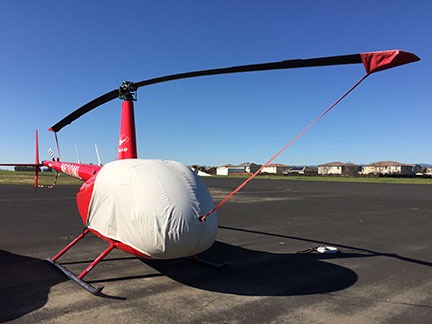
Here’s my company’s most valuable asset on Wednesday, parked in California, waiting to be flown. A smart owner/operator will find ways to earn money without turning a blade.

As my Alaska Air flight descends into Seattle, I think about the chain of events that led me to seat 9A today: getting a frost control contract in December with a start date in March, repositioning the helicopter to California in late February (with another pilot at the controls), spending a few days on standby for an early contract start date before returning home. Then a phone call at 3:22 PM on Tuesday followed by a scramble to book and catch a flight to Sacramento, two nights on standby, another call to release me from standby, and a trip to Sacramento airport to catch this flight. Along the way, there were rental car reservations, hotel stays, and meals. I preflighted the helicopter once and woke up long before dawn both days.

And I didn’t turn a blade.

But I’m happy. No, I’m thrilled. Why? Because without putting any wear and tear on my company’s most valuable asset — my helicopter — I netted more money in less than 40 hours than I did during the period of from October through January. More than most new pilots make in a month.

Some people might think this is a great deal — after all, I’m making money without doing anything except traveling and waiting around. But these people are missing the big picture. I paid $346K plus interest to buy my helicopter. It costs more than $20K a year to insure it and keep it airworthy. Shouldn’t that enormous investment not only pay for itself but earn a profit? Every opportunity it can?

And, sadly, that’s what’s most important these days for me: keeping my bottom line healthy enough to keep flying for a living. That’s what’s on the minds of most owner/operators who aren’t independently wealthy.

Respect that — and don’t expect handouts.

Think About It

So here are three different ways three different pilots might look at what’s important to them about flying.

Why bring this up? Mostly so that pilots on each rung of the career ladder can better understand what’s motivating the other pilots.

I think about the new pilots and how eager they are to build time at almost any cost. I think about the more experienced pilots who are willing to be picky about the jobs they take just so they get set on a career path that’s right for them. And I think about owner/operators who have a helicopter at their disposal all the time but must responsibly choose how to deploy that asset for maximum returns.

I want the folks just starting to climb that ladder to understand the rest of us — and realize how their priorities will change if they slip into our positions some day.

On Spur-of-the-Moment Travel

It’s amazing where you can be in just a few hours.

I’m on my third consecutive year as a frost control pilot. I haven’t written much about this, mostly because I haven’t actually had to fly a mission. But for the third year in a row I’m being paid to have my helicopter ready, with relatively short notice, to fly slowly over almond trees on cold California mornings.

The Back Story

My first year’s contract, back in the winter/spring of 2013, had a relatively low standby pay for 60 days, along with compensation to move the helicopter from its base — in Arizona, in those days — to California’s Central Valley. Because I wasn’t sure about my living situation that winter — after all, my future ex-husband could get his head out of his ass and accept the very generous settlement offer I made and I’d have to move — I moved my truck and RV to California as well, thus guaranteeing a cheap and comfortable place to live near my work. (After all, that’s why I bought the RV; as a place to live when I was on the road with the helicopter.) I spent about two months traveling with Penny the Tiny Dog between Phoenix, Sacramento, and Las Vegas, getting called out just once for two days. I happened to be in Vegas at the time, so it wasn’t a big deal to change my plane ticket and spend a few days in California instead of returning to Arizona.

Last year I took a very different contract. It paid a generous standby rate for six weeks but I had to live near the fields. This turned out to be very convenient for me since I was out of my Arizona home for good and didn’t have a home in Washington yet. I brought the RV and helicopter down in mid-February and stayed until the middle of April. I really got to know the area, made new friends, went hiking and kayaking several times, got comped on a balloon ride, and even learned to fly a gyroplane. It was like being on a paid vacation in a pleasant place, with warm days and lots to do and see. If I did have to work, it would likely be between 3 AM and 7 AM, so days were free to do as I pleased.

Although the money was great, the drawback to that contract was the simple fact that I couldn’t get back to Washington until April. I wanted to be back earlier. I wanted to experience the spring: seeing orchards in bloom and leafing out, hiking along streams full of snow-melt runoff, starting a garden. So when December 2014 rolled along, I decided to try to get a frost control contract like the first year.

And I did.

I brought the helicopter down to California on February 22. The RV would stay home — with me — as I finished work on my home and enjoyed the spring.

That’s the back story.

Call Out

Frost control is not like cherry drying. In cherry drying, I’m required to be ready to fly at a moment’s notice. I can monitor the weather closely and vary my daily routine based on the likelihood of rain. When my clients call, they expect me to be airborne in minutes.

In my frost contract, the client monitors the weather closely and, if there’s a possibility of frost, he initiates a callout. My contract requires him to do this by at least 12 hours before he expects me to fly. This gives me the time I need to get to California from Washington. I’m paid for the callout — the fee covers my transportation with a bit to spare. And then I’m paid a generous hourly pilot standby fee from the moment I get to my California base until I’m released the next morning. If I fly, I’m paid a flying rate for that. The next time I’m called out, the process starts all over again

When I brought the helicopter down to California this year, I built in a few extra days to spend some time with friends in the area. When those plans fell through, I kept myself busy by reacquainting myself with the area and visiting other friends. But I couldn’t have timed it better. I was put on standby two of the three nights I was already down here. I was able to earn the callout and standby fees without incurring the related travel expenses. Although it did require a minor flight change for my return home with a $25 fee, that’s still pretty sweet. Really made it worth the trip.

I went home last Wednesday and got back to work on my home. The cabinets were installed on Thursday and Friday and the appliances were delivered on Saturday. Timing was everything and I lucked out.

My client called on Friday to make sure he understood how much lead time I needed to get back to California. Cold temperatures were forecast for Sunday through Wednesday nights. He wasn’t calling me out — yet. But he wanted to make sure he knew how much time would be needed to get me in position. I told him that if he called me by 3 PM, I’d be able to make it to the helicopter by 10 PM and be on standby overnight.

Of course, I watched the temperatures, too. Unfortunately, the forecasts of my various weather sources aren’t nearly as accurate as those available to almond growers, by subscription, from an agricultural weather resource. I had to rely on them to call me and didn’t want to fly down unless I had to.

So each day the forecasted low was 40°F or lower, I’d be a nervous wreck, wondering whether I’d get a call. Once 4 PM rolled along, I’d relax. I did this on Sunday and Monday and got a lot of work done at my place. But I did pack an overnight bag on Monday afternoon, just in case.

On Very Short Notice…

On Tuesday, at 3:22 PM, my phone rang. It was my client. He’d been sitting on the fence about calling me down. Forecasted lows were 32° to 39° in the area. He told me that he knew from experience that if the forecast said 32°, it could go lower. Better safe than sorry. He was calling me out.

Fortunately, I was sitting at my desk answering an email message when he called. When I hung up, I got on the Alaska Air website. There was a flight out of Wenatchee at 5:20 PM — less than two hours from then — and I needed to be on it. I booked the flight from Wenatchee to Seattle to Sacramento. I’d arrive at 9:28 PM.

While I was at the computer, I searched for car rentals in Sacramento. Thrifty had one for $22/day. Rather than book online, I called directly. With my bluetooth earpiece in my ear, I made car reservations as I changed my clothes and put a few more things into that suitcase.

I decided to board Penny. She’d been with me on the last trip and I thought I’d keep things a lot simpler by leaving her behind this time. So I packed an overnight bag for her with enough food for 2 days — just in case I needed to stay over an extra night. Club Pet is on my way to the airport, so dropping her off only took 5 minutes, especially since the paperwork was already waiting for me. As I type this, she’s likely playing out in the yard with the other dogs.

I checked into my flight and chose my seats using the Alaska Air app on my phone while stopped at a traffic light. I only had one bag — a carry-on — so I didn’t need to stop at the counter.

Seattle Sunset
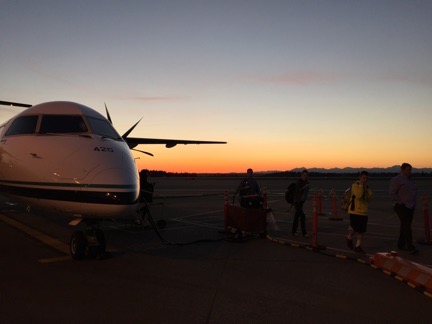
I got off the plane in Seattle just after sunset.

I was at the airport, through security, and sitting in the waiting area by 4:45. That’s less than 90 minutes after getting the call. At 6:07 PM, I stepped off the plane from Wenatchee onto the tarmac at SeaTac. This is one of the best things about living in a small town with airline service: it’s so damn quick and easy to catch a flight out of town when you need to.

I grabbed dinner at SeaTac’s Terminal C before catching my flight to Sacramento.

It was an amazing flight. The moon had risen and was almost full. The land beneath us was illuminated with moonlight. I sat at the window on the A side of the plane and watched as we passed Mt. Rainier and Mt. Hood. Our flight path took us down the Cascade range in Oregon, over the Three Sisters and other mountains there. I could clearly identify the towns I knew on Route 97 from the location of their airport beacons in relation to the town’s lights. The moon’s bright orb reflected back up at me from streams, marshes, and lakes. The flight couldn’t have been any smoother, either.

We touched down in Sacramento fifteen minutes early. I was out of the terminal waiting for the rental car shuttle bus by 9:30 PM. Later, I’d settle down in a Best Western for the night. I slept like a log until 5 AM.

Although a call to fly never came, I don’t mind making the trip. I will be well compensated for my time and the inconvenience of dropping everything to spend a few days in California. My client is satisfied, glad he can count on me to come when called. It’s all good.

I’ll kill some time here today and catch a flight home either tonight or tomorrow morning. I’m flexible and it’s a beautiful day.