The Wayside Inn

A lengthy account of a trip for a hamburger.

Three-Niner-Lima’s attitude indicator was replaced for the second time in a month earlier this week. The first replacement unit I’d purchased had a “balancing problem.” It was a reconditioned unit ($970 vs $1,795 for a new unit) and the place I’d bought it from in Chandler repaired it at no cost.

The hobbs meter was replaced at the same time. A hobbs meter is like an odometer for an aircraft. It measures the amount of time the engine runs. It didn’t cost much to replace, but it can’t be preset with the previous meter’s number. So when I climbed into Three-Niner-Lima, on December 5, the meter read 0000.0. Very strange. The old one, which got terminally ill on my flight from Placerville to Mammoth CA, read 1068.5.

So it was two helicopter components that I needed to test that day. I wanted to give the new attitude indicator a thorough workout. And I wanted to make sure that the hobbs meter didn’t read 0000.0 when I got back from my test flight.

It was a beautiful morning when I took off from Wickenburg and headed west. My plan was to scout out the location of a house Mike and I were supposed to photograph in Forepaugh. The woman had given me a description that included phrases like “red roof,” “pasture of green grass,” and “round pen made of cut telephone poles.”The air was smooth and the wind was light, out of the south. I flew along highway 60, then altered course to fly over Forepaugh, where, as usual, nothing was going on. I headed for the first red-roofed house I could see. It had a round pen, but it wasn’t made out of telephone pole. And no green grass. A few more red-roofed houses were also the wrong ones. Then I caught a glimpse of green in the near distance. I flew over to investigate. Bingo.

All the time, of course, I was checking the attitude indicator. It was pointing straight up when I was flying straight and pointing to the appropriate side by the appropriate amount when I banked to the left or right. The first broken on had indicated I was doing aerobatics when I wasn’t. And the second broken one listed 5° to the right when I was flying straight. So far, this one was a major improvement.

I headed north, toward Robson’s Mining World off highway 71. Robson’s is a cluster of off-the-grid buildings nestled up against a small mountain range. It’s a picturesque place from the ground, with dense saguaro growth and other Sonoran desert vegetation around its quaint western buildings. Very quiet. I don’t fly over because I know the sound of my rotors would shatter the silence, which I consider one of the best features of the place.

Instead, I headed northeast along 71. There’s a place along the road where someone has spelled out “Congress Jct 15 mi” in rocks, complete with an arrow pointing to Congress. It’s hard to find sometimes and I decided to find a few landmarks near it so I’d be able to locate it any time I wanted to show someone. I found it and noted my landmarks.

The attitude indicator was still working fine.

I was done with what I’d planned to do, but I wasn’t ready to go back. I decided to fly along the back side of the mountains at Robson’s. I dropped down to about 300 feet AGL and flew across the empty desert, looking for interesting spots below me. I found a deep eroded washbed and began following that to the northwest. The wash widened. A few deer ran across it. I followed it with my eyes and realized that it went all the way to Alamo Lake.

Alamo Lake is a manmade lake (all Arizona lakes except one are manmade) north of 60, west of 93, and east of 95. It’s out there, in the middle of the desert, where the Bill Williams River, Santa Maria River, the Big Sandy Wash, Burro Creek, and Date Creek meet. The earthen dam was originally built for flood control downstream on the Bill Williams. I don’t think there are any canals or pipelines coming out of the lake and I don’t think the dam generates any power — except perhaps for the state park facility along the lake’s southern shore. The lake is popular with fisherman. It isn’t large enough for serious boating. Besides, it’s too far away from civilization. Heck, it takes about an hour and a half to drive there from Wickenburg. Add an hour from Phoenix and you have an inconvenient body of water.

Mike and I went camping there twice. The first time was in a tent, when we first came to Arizona to find a place to live. We were woken by coyotes, which we weren’t really familiar with, and Mike suggested that we sleep in the car. The car, at the time, was my Toyota MR-2, a microscopic two-seater. In my opinion, sleeping in that car was not an option.

The second time was in Mike’s old Suburban, with the horses. We camped in what the park people consider an equestrian campground. I think the single hitching post is what makes it equestrian. We couldn’t want for the ranger to bring water for the horses, so we rode them down to the lake. A completely silent electric-powered fishing boat glided into my horses view. It was his first experience with such a monstrous thing and he did what he usually did on first scary experiences: he got up on his hind legs and did a 180° turn, dumping me on the ground in the process. I still remember lying flat on my back on the sand (thank heaven it wasn’t rock), looking up at my horse’s face, which seemed to say: “What are you doing down there?”Anyway, Alamo Lake is a good place to get away to if you want to get away, especially if you like quiet. Other than that, leave it for the fishermen.

There are two main roads to get to Alamo Lake. The paved road, Alamo Lake Road, goes north from Wenden, which is about 50 miles west of Wickenburg. It crosses the valley, goes through Cunningham Pass, crosses another valley, goes through another pass, and ends up at the lake near the park entrance. The unpaved road, Alamo Road, goes west from highway 93, right around Date Creek. It’s well-maintained and follows the Date Creek wash, which cuts deep and wide into the desert on its way to the lake. Although it might be a shorter drive along Alamo Road from Wickenburg, it’s a dusty, dirty drive that requires 4WD in wet weather. So most people take the paved road.

Along Alamo Road (the unpaved road), about 5 miles short of the lake, is a place called Brown’s Crossing. It’s a crossroads out in the desert that used to have a store and gas station. Built to service the dam construction builders on their way to and from the dam in the 1960s (I guess Alamo Lake Road hadn’t been built yet), it was destroyed (I forgot how). The Wayside Inn was built nearby to replace it.

The Wayside Inn is a strange place. (And that is an understatement.) It’s a combination general store, bar, restaurant, pool hall, video rental place, and gas station in the middle of nowhere. Around it is a kind of town consisting of a collection of old, rickety, and somewhat sad trailers, motorhomes, and sheds. I bet about 100 people live there in the winter months. And it wouldn’t surprise me if most of them lived there during the heat of the summer, too. They seem pretty dug in and not the kind of people who have someplace else to go.

With the Wayside Inn as a destination, I followed the wash I was over, then Alamo Road. Then I dropped into Date Creek Wash, flying at about 200 AGL, which was just about level with the top of its cut. I saw plenty of animal tracks, as well as fences and corrals. Not many tire tracks. The rock formations near the end of the wash look like wet sand sculptures. In a few places, there are caves high in the rock walls. As I was climbing out of the canyon to go to the Inn, I thought I saw a cliff dwelling, and swung around for another look. Could be, but I’m not sure. I’d need to get out and explore. Another time, maybe.

An old airstrip had been carved out of the desert on one of the crossroads of Brown’s Crossing years before. It was not maintained and has various shrubs and other desert plants growing on it. Xs on either end tell pilots that it’s closed. I landed on it anyway, kicking up a huge cloud of dust. A man in a red shirt watched me land, then waited by a nearby fence for me to shut down and get out. When I apologized about the dust, he laughed.

This was actually my second time landing at the Wayside Inn. The first was during the summer, when I got a chance to fly a Bell 47 that was doing burro work for the BLM in the area. I’d arrived on a Wednesday, hot, hungry, and thirsty. The Bell’s fuel truck driver was parked on the old runway, reading a magazine. He told me that the restaurant was closed on Wednesdays. I finished my bottled water, then started on his before the Bell returned.

It was a Friday and the restaurant was open. The man in the red shirt told me where I could get through the fence, I followed his instructions, anxious to see what I’d missed that summer. And hungry. Along the way, I met the “doorman,” Charlie, a well-behaved pug who lived on a blanket beside the door.

I’ve already described what’s in the Inn, but I haven’t touched on its atmosphere. Imagine coming into a somewhat decrepit trailer park in the middle of the desert, miles from civilization, on a bright, sunny day. There’s no one around outside, but you hear the diesel generator that powers the place humming away nearby. You step up onto a porch where a cute ugly dog watches you expectantly, then step through an open doorway. Your eyes adjust to the relatively dim light and you see a bar with a television, a pool table, and a bunch of tables and chairs. You sit at the bar and take in the rest of the place, which is a mixture of practical and not-so-practical. Shelves of canned food, a strip of lights along the bar edge, fishing tackle, an ice cream freezer, a video game, shelves of videos for rent. Montel is on the television and although you can’t hear what’s being said, the picture caption tells all: “Racism in the same race.”There was a blond woman behind the bar. She was in her forties or fifties and her face was all made up as if she was ready to go out for a night on the town. She gave me a menu and took my drink order — iced tea since I was flying. Three other people were sitting at the bar, all men. Two of them were young, in their thirties, perhaps, and are probably fishermen. They were eating lunch. The other was older, the usual retired type you see around Arizona. He was drinking a beer.

I ordered a green chili burger and read about the history of the place on the back side of the menu. The older man, who was sitting two seats away from me, seemed as if he wanted to talk, so I started a conversation with him. I learned that he lived in Alaska during the summer and was staying in a camper on a mining claim north of the lake. I asked him how he got to the Inn from his place and he told me there were three roads, then started to go into detail about them. As I suspected, one of the roads wound through what he called “the jungle,” an area at the top end of the lake where you could cross when water levels were low. It got its name from the dead trees (probably cottonwoods) and dense vegetation in the area. It was the shortest route — probably only 10 or 15 miles compared to 40 or more on one of the other routes — but it required 4WD to get through sand and couldn’t be travelled safely when it was raining. When he asked, I told him I was from Wickenburg.

My food came and another waitress or bartender showed up. The man in the red shirt came in, too. We all chatted, talking about things like gambling in Laughlin, Schwan’s deliveries, helicopters, and places like Wickiup and Wickenburg. They told me about how Charlie the dog had reacted to that Bell 47 over the summer. He’d seen it come in for a landing and had run towards it, barking. The rotor wash had tumbled him away in a cloud of dust. He got to his feet and went at it again. But after a few landings, he’d lost interest. I hadn’t seen him coming toward me when I landed.

I asked if airplanes ever landed on the runway and was told that they usually just landed on the road. That started another conversation about one of the local residents who had converted a single-engine kit plane into a twin engine model that had a speed range of 25 to 125 miles an hour. The man in the red shirt had gone flying with him and had used up an entire disposable camera on the flight. The film, however, had been lost at a K-Mart one-hour processing place so they’d never seen the pictures.

It was almost 2 PM and I had to be at the airport to work at 3, so I paid my bill and left them. I took a photo of the outside of the place to remember it better. I’d had a good lunch in a weird place and would be back.

Photo
The entrance to the Wayside Inn. If you fly over, you can see its name on the roof.

Back in Three-Niner-Lima, I started up then stored a GPS waypoint so I could tell other pilots about the place. The coordinates are N 34° 14.72′ – W 113° 29.16′.

I took off and, since I was so close to the Santa Maria River (one of my favorite flights), I followed it upstream toward highway 93. I flew low for a while and was surprised to see a few houses down in the flood plain, not far from the lake. No signs of life, though. Just before I reached the deep canyon, I saw another cave that looked like it could have been a prehistoric dwelling. That one would definitely be worth checking out.

The rest of the trip was relatively uneventful. I flew out to 93, then followed that down almost all the way to Wickenburg. Along the way, I veered off to check out a few cattle tanks and people camping out in the desert. I got back to the airport with plenty of time to spare.

The attitude indicator worked fine and my new hobbs meter read 0001.5.

Placerville, CA to Wickenburg, AZ – Day 3

The journey continues…and finally comes to an end. There’s no place like home.

On Sunday, I woke at the usual time, made coffee in the little coffee maker, and started packing. Since I’d never really unpacked, I started by doing that. After all, I had at least three hours before I’d be able to leave. I had to do something with that time.

So I packed and watched the Weather Channel. They were forecasting clear skies and light winds for the southwest. Sounded good to me. Local temperatures were around freezing and winds were 5 to 10 miles per hour. The FBO, which I’d called the day before, didn’t open until 8:00 AM. I planned to be there when it opened. I wanted to be in the air by 9:00 at the latest.

I took a long, hot shower and dressed in clothes that were of questionable cleanliness. I’d been smart enough to wash all my clothes at Liz’s house three days before, but I was on my last pair of underwear and I’d only brought three longsleeved shirts along. Fortunately, I had plenty of socks.

I called the taxi company at 7:10 AM and woke up the cab driver. I asked him to pick me up at 7:45 for a trip to the airport. Then I gathered up my belongings and went downstairs to check out.

I left my luggage in lobby and went across the street to get a large latte and roll at a bakery there. I still had my headache and my stomach wasn’t feeling quite right. Migraine, I knew. But I couldn’t take my regular collection of painkillers when I was going to fly so I had to deal with it. I certainly felt okay to fly: alert and eager to be on my way. This headache wasn’t going to stop me.

The cab driver arrived in a van. He was wearing a short-sleeved shirt and was shivering. The van hadn’t warmed up yet and it was freezing outside. He claimed to have forgotten his jacket. How someone can forget to bring a jacket outside when it’s freezing is a mystery to me.

At the FBO, things were warm inside. One of the two women who had been there on Friday was already there. I went with the line guy on duty to retrieve Three-Niner-Lima from the hangar. We pulled it out onto the ramp and I started my preflight while he went to get the fuel truck. Everything looked fine, although I did need to add oil. I loaded my luggage and set up my iPod. I put my bottle of water where I could reach it. I organized my charts. Then I went back to the FBO office with the line man to settle my bill. Fuel was $3.49 a gallon there — that’s $1.10 per gallon higher than Wickenburg. The bottle of oil I bought to replace my empty was $6.50. And the hangar was $50 a night, although she only charged me $50. Between the hotel stay and the FBO charges, Mammoth had not been a cheap stopover. But I’d take it over Rosamond any time.

The line man gave me another lift to Three-Niner-Lima. I told him that if I wasn’t gone in 30 minutes, I probably would be staying for the day. I checked the fuel caps again, climbed in, and buckled up. Although the hangar had been heated, the thermostat had not been set to 68°. The ship was still cold. I gave it two pumps of the primer, then started it up. It ran extremely rough and I think carburetor ice was the culprit. I pulled the carb heat level to full and, as the engine began to warm, some of that warm air made it into the carburetor. It smoothed out. I settled back to wait as the ship warmed up.

A twin taxied past me, to the end of runway 09. By the time I was ready to go, he still hadn’t departed. He finally made a call, then took off. When he passed my position, I picked up into a hover, adjusted the carb heat to full again, made my call, and took off after him.

My the first half of my first leg would be easy. I’d follow the highway — route 395 — southeast, past the towns (and airports) of Bishop, Independence, and Lone Pine. This route was in a deep valley with elevations dropping from 7128 at Mammoth to 4120 at Bishop and 3680 at Lone Pine. The Owens River and an aqueduct ran to the east of the road. The Sierra Nevada Mountains ran along the west side of my path and the Inyo Range ran along the east. Both ranges were snowcapped and beautiful, especially in the early morning sun.

The day was clear and the winds were calm. It was perfect flying weather, except for the cold. At one point, my outside air temperature (OAT) gauge read -2°C. The cabin stayed pretty warm, though, with the morning sun shining into the bubble. I was wearing my baseball cap, to keep the sun out of my eyes.

Other than the mountains and the river beside me, the only other point of interest I passed on that first part of the trip was an array of radio telescopes, or “telescope antennas,” as they were identified on my sectional chart, south of Bishop. Although they were east of my route, I swung over to take a look — and a photo — without getting close enough to affect them.

Photo
An array of radio telescopes in the Owens Valley.

The airports along the way were pretty much dead. Bishop, which I didn’t fly directly over, had three runways; it must have been a busy place at one time. The choice of runways probably made it a favorite alternate for pilots who feared Mammoth’s crosswinds. Independence and Lone Pine were nothing more than paved strips. I passed another closed runway along the way and I wondered how long before there were big Xs over the runways at Independence and Lone Pine.

At Lone Pine and Owens Lake (mostly dry), my route got a little tricker. I had to head east, crossing the ends of several mountain ranges, to get into Death Valley. There were a few roads that went my way, but I couldn’t follow just one of them. The trouble with following roads from the air is that you can’t read the road signs. That makes it very easy to take the wrong road when you have a choice. Although some roads appear on a sectional chart, my GPS doesn’t show roads. So to navigate, I need to closely follow my path on the chart while relying on my GPS to point me in the right direction for the next waypoint, keeping in mind that I probably won’t be going on a straight line.

Photo
Owens Lake. The reflections of the mountains in the calm water (where there was water) were beautiful.

Why not a straight line? Well, in this case, the darn mountains were in the way. When you’re cruising along in a valley at 500 feet AGL, climbing over mountains just to follow the shortest path isn’t always practical. For example, if I were flying at 4000 feet MSL and I needed to go over a 7000 foot mountain (which meant a climb to 7500 feet or thereabouts), I’d have to climb. My best climb speed is about 60 knots, so I’d have to slow down. Say I could climb at 500 feet per minute at 60 knots. It would take me 7 minutes at that speed to reach the elevation I needed to cross the mountains. Up there, I could be subjected to higher winds and mountain waves (caused when winds cross over mountains and mountain ranges). But if there were a mountain pass just a few miles away, I could detour and slip through that, without climbing as much or dropping speed. While the detour might still take longer, it wouldn’t take much longer and it might be a more comfortable ride.

That’s my take on it, anyway. Other helicopter pilots might have different opinions. Airplane pilots can’t understand this argument at all, since they’re already flying at 10,000 or more feet to go from point A to point B. (They’re also not admiring radio telescopes in the desert and flocks of birds over lakes.) On this part of my journey, I also had to switch from the San Francisco sectional chart to the Las Vegas sectional chart, which I’d borrowed from Rod (mine was in my ship when I was doing my flight planning). Switching charts always makes life interesting, when you’ve only got one hand to do any kind of work. But since my charts had been prepared before I left, it wasn’t so bad.

I headed east at Owens Lake, crossing the mountains in the gap between the Inyo and Coso Ranges. I entered the boundaries of Death Valley National Park and followed a road to Panamint Springs. There wasn’t much going on there, but I did notice a few vehicles, including a motorhome, parked on an overlook for the valley I’d have to cross. I wondered what they thought of the tiny helicopter making its way eastbound.

I followed a road across the dry lake bed at the northernmost end of the long valley, marveling at the sand dunes to my left, which were clearly marked on my chart. The road turned northeast and climbed into a pass of the Panamint Range.

Photo
Telescope Peak, which rises over 11,000 feet from the desert floor, was snowcapped and looking beautiful in the midday light.

I followed the road down to Stovepipe Wells, which has a tiny paved strip walking distance from a store, motel, and campground. I’d flown there in May, on my trip to Death Valley, and had regretted it. It was a long walk to the store for a Gatorade and a long walk back to my helicopter.

I was now in Death Valley proper. I headed southeast around the end of the mountain range and zeroed in on Furnace Creek. As usual, it took me a few moments to actually see the airport. Imagine the floor of Death Valley as a dry lake bed, which it mostly is. The airport is on the east bank of that lake and, beyond it, are the campgrounds, lodges, and other facilities that tourists visit. There’s even a golf course — the lowest one on earth. I made a few radio calls and got no response, so I just landed at the pumps. My altimeter read -200.

I’d been at Furnace Creek Airport before, so I knew the drill. I left my ship and headed over to a building where I found a house phone, a pay phone, and a restroom. I took care of business in the restroom first, then used the house phone to call the Chevron station. A while later, a white pickup pulled up to the pump with two men on board. They unlocked the pump, unwound the hose, and let me do the filling. I topped off both tanks and they put everything away. A plane flew overhead, landed, then parked while we worked. Then we all climbed into the pickup truck for the mile or so drive to the Chevron station, where I could pay.

After settling my bill with them (20+ gallons at $3.20 a gallon!), I called for a shuttle ride to the Furnace Creek Inn, where I hoped to get a good meal. The driver was friendly. He told me that the park would get very busy on the upcoming Thanksgiving Day weekend. He dropped me off at the Inn and I gave him two dollars for his time.

At the Inn, I was in for a special treat. First of all, you have to realize that the Furnace Creek Inn, which is a historic monument, is also a 4 diamond resort, as rated by AAA. It’s a nice place. It sits on a hillside overlooking the valley and the Panamint Mountains beyond. It has a pool and tennis courts and a very good restaurant.

Photo
Furnace Creek Inn.

What I didn’t know was that the restaurant had a Sunday brunch. And my arrival at 11 AM was just in time for it to begin.

I ate curried chicken salad, chilled asparagus, two kinds of caviar, smoked trout, smoked salmon, and seared ahi tuna. I ate osso bucco, risotto, and roast beef au jus. I ate other things that I can’t remember. All while sitting at a window table, overlooking the stark, silent beauty of Death Valley. The view from Furnace Creek Inn.

Sure it was expensive, but so what? You only go around once, and I don’t like to skimp when it comes to eating good food.

By 11:30 AM, I was ready to move on. The same shuttle driver took me back to the airport. I gave him another two bucks. Then I checked the fuel caps and the oil, climbed aboard, started up, and departed to the east.

I followed the main road past the Inn and out of the valley. I climbed with the terrain, about 400 feet per minute. Once outside the Valley, I set my GPS for my next waypoint, Shoshone. I’d cross a lot of empty, lonely desert to get there and, once there, I kept going toward my next waypoint, Jean, NV. Jean featured a pair of runways beside a pair of casinos on I-15. I never quite made it to Jean, though, because I steered too far to the south. When I came out of the Pahrump Valley, I saw Jean about 10 miles north of my position. So I set my GPS for my next waypoint, Bullhead City.

There isn’t much to say about my leg from Death Valley to Bullhead City because it wasn’t very interesting. The terrain was standard southern California/Nevada desert. That meant a lot of mountains and valleys with very little vegetation or signs of civilization. It was odd to see a road in many places and even odder to see a car on it. Not the kind of place you’d want to land if you didn’t have to. Cell phones would not work — no question there. Nights would get cold. It would be a long walk to help. And wildlife would include predators, like coyotes and perhaps mountain lions. Well, maybe not mountain lions, but definitely coyotes.

But when you spend as much time flying in the desert as I do, you get used to the isolation. And you bring along some supplies that might help you if you do need to land in the middle of nowhere. I carry a small green bag filled with emergency supplies. It contains matches, a signal mirror, some water, a space blanket, medicines, first aid supplies, a yellow bandana (sun shade, signal flag, tourniquet, etc., all in one!) a scissor, an extremely high quality all-in-one tool (like a Leatherman, but better), and lots of other goodies. I don’t carry this bag with me on all trips, but I did carry it on this one and I usually carry it when I fly alone and know I’ll be crossing wide expanses of nothingness. Hell, I don’t want them to find me dead with nothing on board that could have helped me.

I’m looking at my charts and noticed something I failed to mention throughout this narrative: the MOAs. MOA stands for Military Operations Area. It’s a place that the government has set aside for its military pilots to practice in. The southwest is full of MOAs. On this particular day, I passed through a bunch of them: Bishop, Owens, Panamint, Shoshone, Turtle, Bagdad 1, and Gladden 1. Each MOA has its own operating hours, altitudes, and controlling agency. When you pass through an MOA within its operating altitude during its operating hours, you run the risk of interfering with a military training exercise.

As a helicopter pilot, I normally fly below operating altitudes of MOAs. For example, the Gladden 1 MOA’s floor is at 7000 feet MSL or 5000 feet AGL, whichever is higher. I fly at 500 AGL, so I technically don’t fly in the MOA’s airspace. But I often see the F-16s from Luke Airforce Base (south of Wickenburg) streaking across the airspace in pairs, occasionally breaking the sound barrier. And I was once “buzzed” by four F-16s as I crossed through the northeastern corner of the Bagdad 1 MOA at a 80 knots, 500 feet up, minding my own business. Talk about a wake-up call!I can’t remember if I read this or saw it on one of the King written test videos, but the advice was to avoid MOAs at all cost. A pilot in the southwest couldn’t do that. If he tried, he’d severely limit where he could fly. The proper thing to do is to contact the controlling agency to see if the MOA is “hot.” If it is, you should stay out of it.

But I didn’t make any calls. I just flew through at 500 AGL, too low to get in anyone’s way. Heck, I have a transponder. They can see me. Besides, it was Sunday and I figured all the pilots would be back at base, watching a football game.

I passed between Searchlight and Kidwell, flew over the northern end of a small mountain range, and saw Lake Mohave before me. I planned on following the lake south to Bullhead City.

As I rounded the bend and crossed the lake, the wind picked up. I looked at my GPS. I had a 20 knot tailwind. Yee-ha! Ride ’em cowgirl!I called Bullhead City tower when I was still 10 miles out. Things were quiet, as usual. That place is always quiet. The controller told me the winds were 25 knots from the north. No fooling. He told me to report one mile north.

I closed the distance to the airport in record time and reported as requested. The controller told me to land direct to the helipads. That would have me landing with a 20+ knot tailwind. Not a chance. I asked to do a left downwind along the river. He told me to proceed as requested. I came down the river and tried to make my base turn short of the Home Depot parking lot, so I wouldn’t overfly it. The wind wouldn’t let me get away with that and blew me right over the lot, sideways, about 200 feet up. Must have given customers in the parking lot a good show. Look at that tiny helicopter, flying sideways. Fine. I pointed into the wind and headed toward the pads. Eventually, I made it, touched down, and shut down.

I called for fuel and they sent a golf cart instead of a fuel truck. Seems I had to go inside to place my fuel order. I told the woman at the desk to top off both tanks. By that time, she was distracted by the arrival of a Citation jet that would probably take on a lot more fuel than I would. I retreated into the bathroom, which was filthy and didn’t have any toilet paper. Fortunately, I had some tissue in my shirt pocket. It was the worst stop I ever made in Bullhead City and I sincerely doubt whether I’ll buy fuel there again.

A while later, at about 3:15 PM local time, I was airborne, on the last leg of my trip. The tailwind stayed with me for most of the flight. It was a direct flight from Bullhead City to Wickenburg, with no intermediate waypoints. I passed east of Grossman Peak (near Lake Havasu) and east of Alamo Lake. I crossed a lot of empty desert. But this was familiar desert, desert I’d flown over dozens of times — if not more.

I started my radio calls to Wickenburg from just north of Alamo Lake, 50 miles out. No response. Again at 40 miles out. No response. Again at 30 miles out. No response. I finally got a response at 20 miles out: Alta giving me the wind speed and direction and unofficial altimeter setting. “Welcome home,” she added.

I touched down in Wickenburg at about 4:30. Thanks to the tailwind, I’d made record time from Bullhead City, which was over 100 nautical miles away.

Mike drove in just as I was shutting down. He helped me offload all my bags, including the bag of apples and mandarin oranges I bought in Placerville for him.

After a week away, it was good to get home.

Placerville, CA to Wickenburg, CA – Day 2

A non-skier in a ski resort town.

I woke up at 4 AM (as usual). It had been a bad night at the Holiday Inn. The room had a thermostatically controlled heater that went on several times during the night. That was good because it kept the room warm, but it was bad because the blower made a heck of a lot of noise.

That wasn’t the only noisy thing to wake me up. The room next to mine had a connecting door. Although it was closed and locked, I could hear my next door neighbors right through it. They had evidently gone out for the evening and it took them a while to settle down for the night when they returned.

To further complicate matters, I got one of my headaches during the night and woke with it. Fortunately, it wasn’t one of my killer headaches. Just one of those nagging ones that keeps you from feeling good.

So when I woke up at 4 AM, I wasn’t in the best mood.

I watched TV for a while. I caught the last hour and a half of “The Secret Garden,” which I enjoyed very much. By the time that was over, it was getting light out. I looked out the window. There was about an inch or two of fresh snow on the ground. I thought about Three-Niner-Lima, snug in the heated hangar and was glad I’d put it there.

The TV had lots of channels, including the Weather Channel. They were forecasting strong winds throughout the southwest. I called Mike and told him about the wind. I told him I couldn’t go through another day like the one before, especially since I wasn’t sure where I could stop between Mammoth and Wickenburg if things got really bad. On the west side of the Sierras, there are dozens of airports and hundreds of towns. On the east side, things are a little different.

So I decided to spend the day in Mammoth. At least there was something to do.

I had breakfast at the same restaurant I’d had lunch in the day before. I wish I could remember the name of it. Breakfast wasn’t terribly good. I think they cooked my eggs in a microwave. Lunch the day before had been better.

I pumped myself full of painkillers, walked over to the Bass outlet, and bought a pair of heavy-soled shoes with treads. I was already slipping on ice and was getting tired of it, so I put them on in the store and put my Keds in the bag. I also bought a pair of gloves. I returned the gloves I’d bought the day before at the other store.

I went back to my room and put away my new things. Then I went down to the desk and asked about the ski resort. The “Main Lodge” was about 5 miles down the road. There was a bus that went there. I could take a gondola up to the top of the mountain. There would be good views. It sounded like a plan to me.

The bus arrived just as I reached the bus stop. Outside, it had a bunch of ski racks, some of which had skis in them. The bus ride was free and took about 15 minutes. We wound our way through the woods. There was snow on the ground up there, more than what had fallen the night before. The roads had some snow on them, too. I think the bus may have had chains.

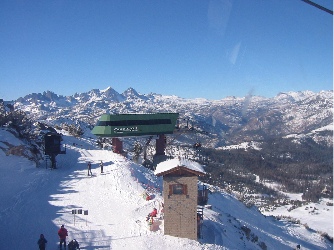
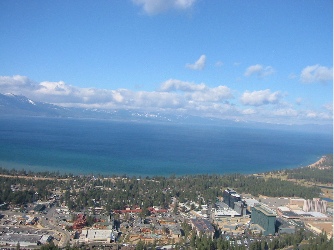
At the last stop, I got off with everyone else. After poking around a bit and spending $8 for a 24-caplet bottle of Alleve, I bought a ticket for the gondola and hopped on board. A skier climbed in with me just before the doors closed. He was out of breath and his eyebrows were icy. He told me he’d just snowboarded from the top and that he’d loaned his goggles to a friend. We climbed the mountain along with at least a dozen ski lifts. I watched skiers and snowboarders slide past beneath us. At one point, I could see the airport, about 10 miles to the southeast.

Photo
The view looking back down the slope from the gondola.

The skier with me got a phone call and told the caller he’d be there in 15 seconds. A few seconds later, we arrived at the halfway point and he got off. Two skiers took his place. They said it was windy at the top. I’d already read the sign that said winds there were 40 to 60 MPH. And I could see the blowing snow on the ridges. But then I realized that the blowing snow was from snowmaking machines.

Photo
The valley from the gondola before it arrived at the top. The airport is almost dead center, although it’s hard to see in this shot.

We all got out at the top. There wasn’t much there: just the gondola terminal with stairs leading down to the snow. The wind was fierce — I stepped outside for a moment and felt as if I was going to get blown away. There was a handful of people outside, getting ready to ski or snowboard down the mountain, I guess. It had been a steep climb and I couldn’t imagine anyone strapping skis or a snowboard to their feet and going down the fast way. I got back into the gondola for the trip down.

Photo
Some crazy skiers and snowboarders at the top of Mammoth Mountain. Winds were at least 40 MPH.

I got off at the halfway point, where there was a cafeteria called “The Marketplace,” a big dining area, a game room (so you could buy a lift ticket and then pump quarters into a video game machine halfway up a mountain), and a ski shop. I skipped the $8 bowl of soup and went with the $2.75 muffin. It was good, but not that good.

I walked around outside for a while. The northwest side of the building seemed to be sheltered from the wind. There were lots of people around, some of them coming in from further up the slopes and some of them preparing to go out. There was a deck on the roof of the building and there were two dogs up there who occasionally got into barking fits aimed at whoever walked on the snow below them. Rescue dogs, I assumed. There were plenty of snowmobiles and ski resort personnel around to make sure things were safe.

Photo
A shot of one of the other lifts.

After a while, I got bored and went back inside to hop on the gondola for the trip down. I rode alone again. At the bottom, I looked around for a shop or someplace I could browse around to pass the time. There was nothing. So I waited for the bus and got on when it arrived.

Rather than getting off at my hotel, I took the bus to the Vons shopping center. I thought I’d pick a snack or something that I could heat up in my room’s microwave, as well as some milk for my morning coffee.

There was a sign for a Radio Shack and I figured I’d stop in quick and pick up an Ethernet cable for my laptop. My room had high-speed Internet access, which was free because it was new. But I didn’t have a cable and I could bet the hotel didn’t have one either. Trouble was, I couldn’t find the Radio Shack. I finally wound up going into a hardware store that was going out of business to ask. They told me that the Radio Shack was gone. I wondered why they hadn’t taken their sign with them.

The Vons was probably the most depressing supermarket I’d ever been in. First of all, the employees were on strike and a bunch of them stood picketing outside with signs in English and Spanish. I had no pity for them until I got inside. That’s when I wondered why anyone would want to work in a supermarket that was so dark and gloomy. Although all the light fixtures seemed to be on, the store just wasn’t as bright as a supermarket should be. The place looked unclean and the shelves weren’t stocked. I guess it was the strike. I almost bought a few things, then decided not to bother. I wound up with a bottle of water that, for some reason, rang up with the wrong price. The cashier noticed it, but just shrugged. I saved 50 cents. Whoopie.

I stopped in to an Internet Access/Art Supply store. The guy at the counter, who was probably younger than me, had a shaved head. A small propeller on a pole attached to his head with a suction cup. I wanted to take a picture, but didn’t want to embarrass him. He was fresh out of Ethernet cables, but would have them later in the week. I told him that later in the week I hoped to be 500 miles away.

I walked back to the hotel. It was about a mile, maybe more. I stopped at a Rite Aide along the way and picked up some microwave popcorn and small bottle of chocolate milk, with the idea of making some hot chocolate back at my room. But when I got back there, I wasn’t hungry.

I took some more painkillers, and settled down to watch TV. Sometimes, when my headaches are bad, TV does wonders for me. It helps me forget I have a headache. It’s actually one of the few leisure things I can do — I can’t read or write with a pounding head. I kept wishing the headache would go away already but knew that it would have to run its course. I’d be lucky if it were gone the next day.

Somewhere along the line, I talked to Mike again. He told me that the wind was howling down in Wickenburg and that it was a good thing I hadn’t tried to come home. I was glad to hear it because although it had been very windy on the mountaintop, it was quite calm at ground level. I had begun feeling guilty for not trying to come home.

I wound up having dinner at the place the cab driver had recommended. I got there at about 4:50 pm. Although dinner in the main dining room didn’t start until 5:30, I could have the full dinner menu in the bar. So that’s where I sat, at a table near the window. I had a glass of wine and some smoked prime rib. The wine was drinkable and the prime rib was pretty good. The garlic mashed potatoes that came with it were very good.

I paid my bill and walked back to the hotel. By 9:00 PM, I was sound asleep.

Placerville, CA to Wickenburg, AZ – Day 1

Foiled by wind…again.

After sorting out my insurance problems (which required Mike to FedEx a check to the Bahamas) and spending a few pleasant days with Liz and Rod, it was time to head home. It was Friday, November 21 and I’d been away from home for four nights.

The weather was a mystery for quite a while. I used my laptop to connect to the Internet and check weather and flight planning info via Duats. The forecast called for clear skies and light winds. There was some mention of a storm coming in from the northwest later that afternoon, but I was pretty sure I could beat it out. So things looked good, at first. Of course, I did check all this at 5 AM, before it got light. When it got light, I found that the clouds were so low, we were in fog. Not a good thing.

Liz’s house is at 4800 feet. The airport is at 3600 feet. That meant that I’d have to fly through a layer of fog to climb above it. Not an option.

I said goodbye to Rod and he left for work at 6:30. I told Liz I wanted to be at the airport to fuel up and preflight by 8 AM. She got me there just as I requested. Three-Niner-Lima was completely covered with…well, I guess it must have been dew. But it was the dewiest dew I’d ever seen. It took six shop towels (you know, the blue paper ones on a roll?) to get the bubble dry. At least I’d been smart enough to leave the door vents closed so I didn’t have to dry the inside, too. And, of course, fog drifted across the runway as I worked. The mountains were completely obscured. Things didn’t look promising.

I fueled up anyway. We waited around the terminal for a while. I’d already decided that if I couldn’t leave by 9:30, I’d stay. I think Liz was hoping I’d stay. She talked me into going down into town to pick up a muffin for breakfast. That killed about 20 minutes. It was 9:30 when we got back. I called the flight service station (FSS) and the briefer told me he didn’t see any clouds at all. According to him, he could see snow covered mountains in our area on the satellite images. The fog broke up enough for me to give it a try. I said goodbye to Liz, started up Three-Niner-Lima, warmed it up, and took off.

I was glad I did. The fog was definitely burning off and most of it was below me. Once I got up a few hundred feet, I could clearly see the snowcapped Sierras. My route would take me along Route 50, through Echo Pass, where I would descend down into the Lake Tahoe area. Once I realized that I’d be able to give it a good shot, I found Route 50 and followed it closely, keeping about 500 feet off the road.

Liz and I had driven the road the day before, so I knew what to expect. Although I missed Bridal Veil Falls (I must have flown right over it), I did see Horsetail Falls. I also saw where a landslide had taken a huge chunk out of the mountain years before. I followed the road and the creek alongside it. I was surprised to see some kind of narrow canal running along the edge of the mountains on my right — I still need to check a map to see what that was.

All the time I flew, I climbed, getting higher and higher. I don’t remember what the elevation of Echo Pass is — I don’t have my charts in front of me right now — but it must have been about 7500 feet. Really not that high. Unfortunately, the clouds weren’t that high either. There were puffy clouds, like the fog down in Placerville, and they drifted about 100-200 feet above me. Going higher was not an option. Fortunately, I was high enough and the path in front of me was clear enough that I didn’t have to worry about terrain. And I was moving along at a good clip; with a 10-20 knot tailwind, my ground speed was about 100 knots.

For a few minutes as I neared the pass, things got a little tense. The clouds were close, the canyon was narrow. But then the canyon opened up to the valley beyond. The road veered off to the left, where it hugged the cliff for part of the way down. I could see Lake Tahoe airport ahead of me and, to my right, more of the Sierras. I started my descent to the Lake Tahoe area, a drop of about 2000 feet.

Photo
This photo taken just beyond Echo Pass, from the road the day before I flew though. Lake Tahoe Airport is dead center and you can see the lake beyond it, to the left.

Photo
Another photo taken just beyond Echo Pass, this time through my helicopter window as I cleared the pass.

I called in to Lake Tahoe Airport, requesting permission to transition to the east over the airport. Nothing was going on. The controller told me to proceed as requested. I crossed about 500 feet above the airport, to the south. I was quickly approaching the casinos of Stateline, NV. Liz and I had had lunch at Harrah’s the day before. The wind was howling that day, making it tough to walk across the parking lot. That morning, as I flew just south of the Casinos, the wind was calmer. Lake Tahoe tower called me again, asking where I was. I told him and he told me to have a nice flight.

Photo
South Lake Tahoe, CA and Stateline, NV. The two towns sit side by side. The highrises on the right are the casinos in Stateline; the green one is Harrah’s where we had lunch the day before.

I punched my next waypoint — Alpine, CA — into the GPS, then had to figure out the best way to get there. In all honesty, I didn’t want to go there. I wanted to go to the east of that point. I wanted to follow another highway, 395. But I wasn’t sure which of the roads leaving Lake Tahoe was the right road. And I didn’t want to go north, out of my way. I finally found a promising looking pass and headed for it, climbing with the terrain. There was a town there — I don’t know what it’s called — that has great views of the lake. As I flew over the lowest point, I saw another broad valley open up far below me. It had to be at least 3,000 feet down. I started my descent.

And that’s when the turbulence started. Gusts of wind slammed my ship repeatedly, knocking it all over the sky. Although I’d pushed the collective almost all the way to the floor to descend, at times I was climbing, carried up by updrafts. Three-Niner-Lima shook and rocked. For the first time in a long time, I felt a tang of fear. All I wanted was to descend to the valley floor. But the updrafts were making things very difficult. And against the huge backdrop of the Sierra Nevada Mountains, I felt like a tiny speck, an insignificant fly almost invisible to the world. It was scary.

It took about 10 minutes, but I eventually cleared the mountains and reached my cruise altitude of about 500 feet AGL. The turbulence were still with me, but greatly decreased. I continued on my way, feeling the fear subside.

After a few moments of confusion, I finally found the road I’d planned to follow. It would take me south, through a number of valleys along the east side of the Sierras. The view was stunning, with snowcapped peaks to my right and, in some cases, more to my left. I followed the road over small towns, through small mountain passes, past lakes, like Mono Lake. For the most part, I flew at about 7000 feet, but in some instances, I had to climb to 8000 or more.

Photo
Mono Lake, in the distance. I took this shot through the front of the bubble as I was flying; you can see my reflection (white shirt, black scarf).

Unfortunately, I couldn’t fully appreciate the view. The wind had kicked up and it was kicking me around. I don’t think I had more than 5 consecutive minutes of calm air at any one time. The turbulence definitely reached “moderate” levels. Although that doesn’t sound bad, believe me, it is. I was bobbing around like a cork on the ocean in a North Atlantic storm. I was having trouble keeping Three-Niner-Lima pointed in the right direction. I was starting to get airsick again. And I was not having fun.(And although I didn’t know it at the time, my Hobbs meter, which tracks engine running time, quit during this leg of my journey. I guess something got loose with all the shaking. I didn’t realize the Hobbs was dead until I got home, although the 1.3 hours it registered from Placerville certainly seemed low.)

Every time I reached one of my waypoints, I’d look down and see that there was nothing there for me. The airports I passed over were nothing more than paved strips. Some didn’t even have buildings. I didn’t bother making any radio calls; I would have been talking to myself. And the towns were never near the airports. They were always several miles away and very discouraging. I didn’t want to spend the night at another Rosamond.

So I’d set my GPS for the next waypoint and hope there was something better there. There wasn’t. But by the time I reached Mammoth, CA, I’d had enough. Mammoth, at least, had fuel. Supposedly, it had a restaurant. It would be a good place to take a rest.

Mammoth also had an AWOS. The recording reported winds of 18 gusting to 34 knots. Right across the runway. Nice. Good thing my wings weren’t bolted on. I made my radio call, then flew over the airport, planning a right crosswind toward the runway. I didn’t notice the hill in my path until it was close; I switched to the other side of the runway to make a left crosswind. My crosswind turn was more like a 180, so I was heading back the way I’d come. And that’s when I saw it: the storm that had been on my tail for the past hour and a half. All I could see was bright gray clouds and blowing snow. It didn’t look good.

I did my best to land along the taxiway. By that time, a golf cart had driven out to the ramp area. I used the radio to ask where I should park. He said something about a box that I didn’t see. The wind was making hover-taxiing very difficult. I had to move sideways, keeping my nose into the wind. I parked on a T-spot not far from the golf cart and told the driver it would take me a few minutes to cool down and shut down. Three-Niner-Lima was ready for shutdown in less than a minute. The outside air temperature was about 40Ôø? and the wind was howling.

The golf cart guy told me he was surprised to hear me coming in. He reported that a twin had tried twice to land and had given up and gone to Bishop (30 miles south) instead.

The golf cart guy took me to the terminal, which was beautifully appointed and warm. Two women sat at a desk. I hit the ladies room, then went to them for help. It was obvious that I wouldn’t be going any further that day. They helped me find a room at the Holiday Inn in town (7 miles away) and told me they’d call a taxi for me. They also told me that they were expecting snow that night and that there could be a lot of it. I asked about hangars and was told that they had one. A few minutes later, the two line men and I were dragging my helicopter across the ramp, tied to the back of a golf cart. I was never so glad that I’d brought along my ground handling wheels. When Three-Niner-Lima was tucked in for the night, I took my luggage back to the terminal and waited for a cab. It was about 1 PM local time.

The taxi driver took me to town, chatting the whole time. He recommended the restaurant across the street from the hotel. he saw me inside and drove away.

I got a room on the second floor at the front of the hotel, with a great view of the parking lot, a gas station, and Mammoth Mountain. But I couldn’t see much of the mountain because of the descending clouds. I relaxed for a while in my room, then went out to get lunch. It was cold outside, mostly because of the wind chill. I ate at a place across the street (not the one the taxi driver recommended), then went in search of warm clothes. Although I had my leather bomber jacket with me, I was wearing lace-up keds and didn’t have a hat or gloves. There was a row of “outlet” shops nearby and I hit a few stores, where I bought socks. (I’d buy winter shoes there the following day.) I then went to a ski outfitter shop where I picked up fleece headband, gloves, and a turtleneck. (For some idiotic reason, I’d left my scarf in the helicopter.)I spent the rest of the day back in my motel room, watching television. It wasn’t Rosamond, but I was beginning to wish I was home already.

Wickenburg, AZ to Placerville, CA – Day 2

What starts off as a bad day gets better, then worse, but ends up pretty good.

I was up by 4 AM. The only unusual thing about that was that I was in Rosamond, CA.

I killed time by working on the previous day’s blog and watching the news and weather. Arnold Schwartzenegger had been inaugurated as governor the day before. The weather north of Rosamond would be calm and relatively clear. When the sky brightened enough to see, I found a beautiful day waiting for me. Unfortunately, I still couldn’t get the cab company on the phone and didn’t know how I would get to the airport.

By 6:15 AM I was packed and ready to go. I woke the desk clerk, who came to the desk in her pajamas, with a sweater wrapped tightly around her. Together, we studied bus pamphlets and found another phone number. I finally spoke to the cab company. The woman who answered said they could pick me up at 2:15 PM that day. I hung up on her.

I spent the next 30 minutes trying to hire someone to take me to the airport. I failed. So I walked. I guess I was lucky. I thought it was 5 miles, but it turned out to be about 3. So I walked 2 miles less than I expected to. My bag was heavy and I worked up a sweat in the cool, early morning air. And as I walked, I made two resolutions: 1) I would never again stop for the night at an unattended airport and 2) I would trade in my Samsonite shoulder bag for a more practical backpack.

I reached Three-Niner-Lima at about 7:45 AM, did a good preflight, and spent about 10 minutes wiping the morning dew off the bubble so I could see through it. Then I climbed in, buckled up, and started up. I had to give it four hits of the primer to get it going. Three-Niner-Lima does not like cold, damp weather. The engine seemed to groan as it sucked cold oil. The blades didn’t start spinning right away. But ten minutes later, it was all warmed up, I had Tehatchapi programmed into the GPS, and native American flute music was coming through my headset. I picked up into a hover, announced my intentions to the Cessna doing touch and goes in the pattern, and took off to the north. It was about 8 AM.

Tehachapi was easy to find. Just head for the windmills. There had to be hundreds of them on the hills. I climbed and they got closer and closer. Some of them were spinning, but not many. They’d probably all been spinning hard the day before.

Photo
The windmills at Tehachapi Pass.

I cleared the windmills at about 6,000 feet MSL, listening to a Cherokee landing at Tehachapi airport. At the top of the mountain was a sort of bowl with two small airports and a mountain town. It looked like a much nicer town than Rosamond. But then again, any town looked much nicer than Rosamond. The more I thought about where I’d spent the night, the angrier I got about it.

Beyond the bowl, the mountains dropped away into the huge valley I’d be flying through. But from the air, it looked as if it were filled with water. Smog, fog, clouds? Who could say? Rod had recommended that I follow the foothills all the way to Placerville, heading northwest. The first waypoint on that side of the mountains would be Porterville. I punched it into the GPS, dropped to about 5,000 feet MSL, and flew along the west side of the Sierra Nevada Mountains. The air was smooth and the view was incredible. I could clearly see for dozens of miles along the foothills and beyond them to the snow-covered Sierra peaks. Below me were scattered ranches, cows, microwave antennas, and other signs of man. But mostly, there were the rolling hills, covered with grass and scrubby trees. The foothills in this area were high desert, similar to the area north of Malibu on the California coast. Drought was keeping the grass from getting really green, but it was still beautiful — much more pleasant than the barren desert I’d flown across the day before. My Rosamond experience was beginning to fade away to a dull lesson learned.

According to my GPS, I had a 10- to 15-knot tailwind. I was cruising along at about 100 knots ground speed, keeping my airspeed a bit low because of my altitude. At the Kern River canyon, that tailwind turned into a crosswind and tossed me around a little. I started thinking of the day before and how I’d started feeling sick. I realized that Porterville was at only 442 MSL and wondered why I was flying so high. I started a descent. At about 4000 feet MSL, I could see the smog layer in front of me. Above it, the sky was clear and blue and you could see for miles and miles. Below it, things were blanketed in a brownish haze. I could still see the ground there, so I continued to descend. By the time I was at 3000 feet MSL, the snow-capped peaks I’d been admiring for a while were hidden from view.

Photo
I begin my descent below the smog/haze level.

Once out of the foothills, I entered farmland. The land was filled with a patchwork of orange groves, dairy farms, cotton fields (already stripped of cotton) and fields of unidentifiable crops. I estimated visibility at about 8 miles. I passed over Porterville and set my GPS for the next waypoint, Hanford.

At this point, I was deviating from Rod’s suggestion to hug the foothills. This was the route I’d planned and it would keep me clear of the busy Fresno Class C airspace. There were more small airports along the way, more places to stop for rest and fuel. The visibility didn’t seem so bad so there was no reason to change my plan.

Of course, I was wrong. The farther west I flew, the worse the visibility became. By the time I reached Hanford, visibility had dropped to less than 3 miles and clouds formed a ceiling at 3000 feet MSL. It got chilly in the cockpit and looked like it might rain. I plugged in the next waypoint, Madera, and continued on my way. I was flying at about 800 feet MSL now, about 500 AGL. The ground was a flat quiltwork of farmland. That meant one thing: if there were any towers, they’d be tall. So I peered into the haze, searching for the flashing light that would reveal the presence of a tower before I hit it or its guy wires.

By the time I passed the Fresno Class C airspace, I’d had enough. I decided to head back to the foothills, taking a direct route to the fueling stop Rod had recommended: Columbia. I punched in the designator and saw that it was still over 70 miles away. I checked my fuel gauges. I did some quick math. It looked as if I could make it. I changed course and accelerated to 95 knots airspeed.

The farmland gave way to rolling hills and cattle ranches. The air cleared and I began to climb. As I climbed, I picked up a slight tailwind. My ground speed hit and exceeded 100 knots.

The next hour or so was tense, primarily because I wasn’t sure whether I had enough fuel to make it to Columbia. I steered the straightest course I could and kept my airspeed over 90 knots. As the ship lightened up, my collective began creeping up whenever I released it. Soon, I was making a conscious effort to hold it at 21 inches of manifold pressure. The farther into the foothills I flew, the fewer fueling alternatives there were. When the auxiliary fuel gauge slipped down to E and the main tank showed about 1/4, the GPS said I still had over 20 miles and 15 minutes to go. By that time, Columbia was the closest fuel stop and I was flying through an area filled with rugged hills and lakes. A low fuel light would really ruin my day.

But as I closed in on Columbia, I realized I’d make it. I overflew the field to get an idea of the lay of the land, then came in on Runway 17. I hover-taxied into a T-spot marked “Twins Only,” despite the fact that there was a helicopter parking area on the other end of the field. (Frankly, I’m getting a little sick of long walks just because my wings aren’t bolted on.) It was about 10:45 and I’d been flying for close to three hours straight.

One of the local airport bums walked out to check out my ship as I shut down. He told me about the helicopter parking area when I stepped out and I hold him I was too tired to walk. Besides, the airport was pretty quiet and it didn’t seem as if too many twins would be coming in during the next few hours. I asked him about restaurants and he told me about the closest one and then about the historic downtown area. I grabbed my purse, locked up the ship, and followed him into the terminal to order fuel and hit the ladies’ room. A bunch of airport bums were sitting in there, drinking coffee and eating donuts.

A while later, I was walking on the “nature trail” that wound from the airport toward the town’s historic area. Historic Columbia is quite a pleasant place, although at 11:30 AM on a Tuesday morning, things are pretty dead. Most of the quaint little shops were closed. A docent at the visitor’s center, dressed in a long black coat and black hat, recommended one of the saloons for a pastrami sandwich. I went in, had a seat at the bar, and ordered. I had to be very precise about how I wanted my sandwich; the bartender even asked if I want my bread heated. He served it with potato chips and a pickle. The bar was one of those high-ceilinged places that looked just the way you’d expect a saloon to look — if you think saloons should have bright, white walls and a spotlessly clean interior.

After lunch, I walked around the town a bit, peeked into stores, and bought some candy. The town’s architecture was interesting; many of the buildings dated back to the 1860s. Of course, the town had been destroyed by five two or three times during that decade, making you wonder why they continued to build with wood when so much stone was around. There were some brick buildings, too, as well as a brand new one that was being built with the same old architecture. I could imagine it housing a mini-mall of tourist shops.

Photo Photo
Two photos of Columbia, CA’s historic area. As you can see, it wasn’t too busy on that November Tuesday morning.

There were two separate fire stations in the town, and I’m not quite sure if it was always like that — they were within three blocks of each other. They were both open to the public, although the equipment they housed was safely behind bars. The first building had two or three old pumping wagons looking every bit as old as 150 years. The second one, however, had a fully restored pumping wagon dating from the 1850s. It was a beautiful old machine that was supposedly in full working order. I wished I could see and hear it in action.

I walked back to the airport, calculating that I’d probably walked a total of five miles so far that day. My helicopter had been fueled and the receipt was stuck in the passenger door. I did a preflight, added oil, and hopped in. As I took off over the airport’s grass runway (yes, I did say grass), I buzzed three deer that were grazing there. It was about 12:45 PM.

Calavaras County airport was my next waypoint. Calavaras was made famous, in part, by a short story by Mark Twain about a frog jumping contest. According to Rod, they did the contests annually until recently, when the animal cruelty people put a stop to it. Nothing like a bunch of frog huggers to ruin a 100+-year-old tradition.

I plugged Placerville into my GPS and closed the last bunch of miles quickly. I was flying at 3000 feet MSL now; Placerville’s runway was at 2600. Soon I saw it ahead in the distance, on a flat arm of of mountain, with canyons on both sides. I flew overhead, then made right traffic for runway 23. I touched down in a T-spot near the fuel island and shut down. It was about 1:30.

As I shut down, I thought about the flight. It had been long but relatively uneventful. If it weren’t for the wind the day before, I could have made it in one day. My total flying time had been about 7-1/2 hours. If the headwinds had been tailwinds, I could have shortened that time by about an hour.

I made a startling discovery when I tried to use my cell phone. Although I had a strong signal, I could not place a call. The system insisted on roaming and required a credit card number. This was the first time Verizon Wireless had failed me and I was angry. But the folks in the FBO were friendly and let me use their phone to call Liz and Mike. I left a message for Liz and spoke to Mike. Mike had bad news. He’d gotten a fax from Pathfinder, Three-Niner-Lima’s insurance company, that said my insurance had been cancelled two days before. Although I’d written the check to send them at least two weeks ago, I’d forgotten to mail it.

Liz showed up with her niece moments later. Our first order of business was to visit Bank of America and send a wire transfer. But it was after 2 PM, the cutoff time, and it would have to wait until the next day. Liz took her niece home, then took me on a quick tour of Placerville, pointing out good places to get coffee and eat. We stopped by the place where Rod worked and left him a message. Then we drove down twelve miles of twisty mountain roads to her house. Although most of the trees were tall pines, there were also a few oaks and other types showing off fall colors. It reminded me of the mountains of northern New York state, where we used to go to see the fall colors. The whole time we rode, I thought about how great it would be to go motorcycling there.

I spent the evening with my friends Liz and Rod and Rod’s mom, who was visiting with them. We went out to dinner, then came back to their house to relax in front of the television. Michael Jackson was all over the news. When I went to bed at 11 PM, it was in a comfortable bed, under a warm down blanket. Rosamond was a dim memory.