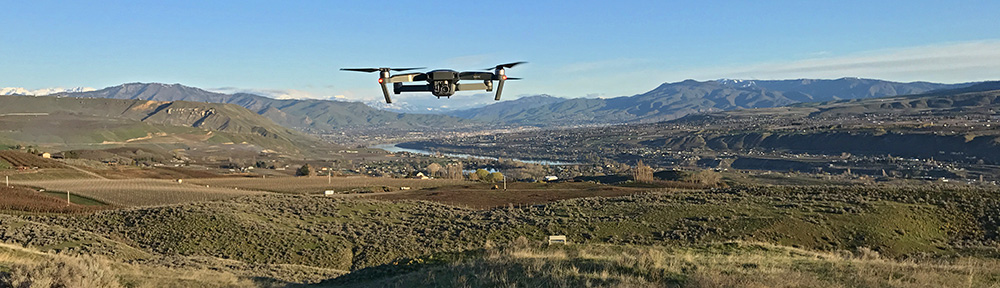
We give Kingman residents and visitors helicopter rides.
I started planning for the Mohave County Fair at least a year ago. I exchanged phone calls and e-mails with the folks who handle the concessions for the fair, including Betty Watters and her son Phil Richardson. I flew up to Kingman in June to check out possible landing zones. That’s when I paid the fee for my “booth” in the north parking area. The dates September 15-18 went from pencil to ink on my calendar.
Mike and I went up to Kingman early Thursday morning. I flew, Mike drove. Mike brought our camper up there. It’s a 3-horse slant trailer with living quarters. I left about an hour after Mike and arrived at the fairgrounds the same time he did. I did a lap around Kingman, planning my route for rides, while Mike parked and secured my landing zone. Then I landed in a huge cloud of dust, cooled down the engine and shut down. We spent the next two hours setting up boundaries for the landing zone, putting up banners and signs, and doing housekeeping chores in the camper. The nice folks at the fairgrounds allowed us to park the camper at one end of the landing zone. On the other side of the fence were a few portable toilets (which we wouldn’t need) and the trailers and living quarters for the carnival folks. Beyond that were the carnival rides and attractions. And beyond that was the rest of the fair.

Mike made a trip to the local True Value hardware store to pick up a sprinkler and another hose. Phil had run his own hoses to the landing zone and we decided to use a sprinkler, which we’d move periodically throughout the day, to keep the landing zone damp. That would keep dust down. Mike also had to take a trip to town to fill the camper’s two gas bottles so we’d have refrigerator, hot water, and stove use. The camper also has a full bathroom with two holding tanks, so we could use our own clean toilet and shower daily.
We also had Jack the Dog and Alex the Bird with us. Jack had to stay on a leash. Alex stayed under the trailer’s awning in his cage. Neither of them were bothered by a helicopter taking off and landing about 150 feet away from them.
Betty had asked her neighbor, Tony, to give us a hand. Tony is on permanent disability after being hit by a truck years ago, but he was fully capable of helping us with the things we needed to do. He wound up working with us on Thursday and Friday and lending moral support on Saturday.
By 2 PM, we were ready to do rides. The only thing we needed were passengers. That was the problem. It was 2 PM on a weekday. Kids were in school, parents were at work. No one was interested in the carnival or our rides.
The ride took off from the north parking area. I had to make a crosswind departure, since heading into the wind would have taken me right over the carnival rides. From there, we flew up the east side of Centennial Park, north of Wal-Mart, just north of the I-40 pass through the mountains, down to the Beale Street exit on I-40, along the south side of Andy Devine Boulevard, across Hualapai Mountain Road, and up the east side of the fairgrounds. I made a 1807deg; turn at a cell tower north of I-40, then came straight in to the landing zone, landing right into the wind. Total time was about 6-8 minutes.
I’d priced the rides at $25 per person including tax. This was before fuel prices went up, so it was a real bargain. My usual ride prices are $30 to $35 per person for an 8-10 minute flight, but the fair folks practically begged me to keep the price down. So I did, depending on the cheaper price to attract more passengers and shorter ride length to make it profitable.
We managed to give 11 rides on Thursday. Very disappointing. We went to the Dambar restaurant for a good dinner, though.
On Friday, things weren’t much different. I walked over to the nearby junior high school around 10 AM, suggesting that a few of the teachers might want to walk students over to see the helicopter and get one of my presentations on aerodynamics or how helicopters fly. The school was very interested, but Fridays are half days so classes are shorter. There wouldn’t be enough time for any of the classes to walk over and back and get the presentation.
Things picked up late Friday afternoon. We did 10 rides, most of which were after sunset. The moon was big and full and beautiful and the carnival rides looked great from the sky.
By that time, our two helpers, Alex and his college buddy Ryan, had come to help out. There wasn’t much for them to do. They pitched their tent behind our camper, uncomfortably close to those portable toilets on the other side of the fence. We ate carnival food for dinner and walked around the fair.
We were pretty disappointed at the turnout so far.
Saturday changed everything. Although I wasn’t supposed to start flying until 10 AM, my first passenger arrived at 9, before the fair even opened. Heck, I didn’t care. I gave him a ride. For the next two hours, I did a few rides. Then the dam burst (so to speak) and I had a nonstop flow of passengers. Mike, Alex, and Ryan loaded 2 or 3 people on board for each flight. The only time I shut down was to get fuel at the local airport 5 miles away (three times!) and to take a 20-minute lunch/bathroom break. I put 5.5 hours on the helicopter’s hobbs meter that day — quite a bit when you consider that the hobbs only ticks when I’m in flight so my time spinning on the ground didn’t count. I figure I took about 100 passengers for rides that day. Most of them were in a helicopter for their very first time. I gave all the kids who flew with me helicopter toys (while they lasted). One guy liked it so much he went up twice.
We celebrated with four steak dinners at the Dambar.
Sunday looked as if it might be a repeat of Saturday, but the flow of passengers was starting later. The wind was stronger than the previous few days and it was warmer, so taking off with a crosswind (rather than a headwind) when I was heavy was tough. I did about 20 rides before we decided to call it quits. It was 1:30 PM. We packed up, said goodbye, and got ready to go.
I stopped off at the carnival office to leave a card for the carnival owner. I’d had a good event and was interested in working with carnivals to do it more often.
Mike left with the camper and I took off with Alex and Ryan. We took the scenic route home: to Bullhead City and down the Colorado River to Parker, where we refueled (at $4.54 per gallon!). From there, we hooked up with the Bill Williams River, overflew Swansea and the Alamo Dam, and returned to Wickenburg.
We’ll go back to the Mohave County Fair next year. But we’ll just spend all day Saturday and Sunday. I’m already looking forward to it.
My thanks to Betty and Phil for all their help.
 Elizabeth arrived at 7 AM and I was ready to go. We started off with a little tour of Howard Mesa. Elizabeth used my camera to take a photo of her house (see photo). I pointed out all the little cabins and sheds and trailers that you can’t see from the road. Then we went up to Valle and followed 180 east. She showed me where some friends of hers had just bought some land and I showed her Red Mountain. From there, we headed north. It had rained the day before and I was interested in seeing if there was water in the Little Colorado River. There wasn’t. I took her to the Little Colorado Gorge lookout, just outside the Grand Canyon SUA, and was disappointed to see the canyon bottom just as dry as it had been the last time I flew over.
 As we flew along the cliffs near The Gap, she admitted that she’d never been to Page. I told her a little about it. I figured we’d land at the airport, then take the free shuttle to the marina where there was a restaurant. But when I pointed out the Vermillion Cliffs in the distance ahead of us, I got a better idea. Marble Canyon. The runway is right across the street from the lodge and restaurant. Elizabeth was game. Actually, I don’t think she cared where we went. I didn’t really care either, for that matter. Elizabeth took a few photos of the landscape we flew over, including this shot in the Cedar Ridge area. She was fascinated by the geology of the land, especially the tilted layers of multi-colored rock. I explained how some of the more obvious formations were made and told her I had a book about Grand Canyon geology that probably explained a lot more. We were flying over the Navajo Reservation and, when we were away from the main road, we saw lots of ruins of old hogans and animal pens. That’s the kind of stuff that interests me. I especially liked the animal pens that had been built into natural rock formations — like a box canyon with its open side fenced off or animal pens built entirely of stone.
 We crossed the Colorado River at Marble Canyon and landed at Marble Canyon’s airstrip. I set down on the dirt ramp area and shut down. It was about 8 AM and the morning sun was still low enough to make the Vermillion Cliffs behind us…well, vermillion. In my opinion this is the most scenic spot anyone can use as a backdrop for a photo of their aircraft. In fact, it’s enough of an excuse to fly in to Marble Canyon. Just be advised: the runway is very narrow.
 We had breakfast at the lodge restaurant. It wasn’t anything special. I think our waitress may have been more interested in listening to her MP3 player than serving us. Afterwards, we climbed back on board and took off to the north. A plane had just taken off from Marble Canyon’s runway, so I had to stay a bit low until it passed over us. (I didn’t use the runway.) Our flight path gave us great views of Navajo Bridge and the river at Lees Ferry, as well as Horseshoe Bend further upstream. Elizabeth kept snapping photos, like this one, which kind of gives you an idea of the visibility in a helicopter. Don’t mind the reflections in the bubble; I was wearing my loud white pants again. And yes, that’s my hand on the cyclic.
 Tyler was very surprised when I climbed on board beside him. He fiddled with the intercom switches so I could hear the radios, which I really appreciated. It really helped bring back memories of all the flights I’d done. I discovered that I was booked on the shorter North Canyon flight, which goes over to the Dragon Corridor on the west side of the canyon. But since there was a lot of smoke on that side of the canyon due to a controlled burn, we’d be doing an East Canyon tour. Although Papillon doesn’t sell that tour, it is the best one. It starts off like an Imperial Tour, going out over the east side of the canyon, then turns west at the confluence of the Little Colorado River and makes a big loop back to the rim.
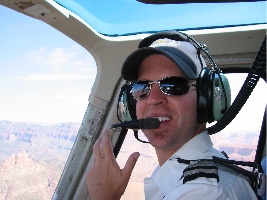 The canyon was hazy but beautiful. I had my camera with me and took a few pictures, including this one of Tyler in flight. (I always wished I’d asked one of my passengers to shoot a picture of me like this, at the controls with the canyon in the background. I’ll e-mail this to Tyler.) When we got back, I kept Tyler company while he shut down. Then I went inside to see if John was finished with his meeting. He wasn’t. I thanked Evelyn and Ilse for the flight and chatted a while with Ilse. Then, as it was getting late, I wrote a note for John on the back of a Flying M Air postcard and left it on his desk. It asked him to give me a call when he had time for a ride in my helicopter.
 I check out a few points of interest from the air.
 I headed northeast, right into the sun. Not good. I’d forgotten to put my hat on and the sun was shining right in my face, flickering through the blades. (I hate when that happens.) So I moved my headset down around my neck, put my hat on, and then put my headset back over my ears. Doesn’t sound like a big deal, does it? Well, you try to do it with one hand — your left hand. It was worth the struggle, though. The hat shaded my eyes nicely. I hit route 180 and followed it east, toward Flagstaff. I wanted an aerial view of Red Mountain, which I wrote about in another blog entry a few weeks ago. I had my camera and managed to snap two photos. Here’s one of them. Neither really shows the mountain well, but it’s hard to take pictures left-handed while flying a helicopter right toward a mountainside.
 This was my second trip along the Little Colorado River. It isn’t a very exciting flight, but it is mildly interesting. There are a few remains of Navajo homesteads and something that looked like an old mine. The highlight, of course, is usually the Grand Falls of the Little Colorado. But without any water falling over the big cliff, it was extremely disappointing. From that point, I headed pretty much straight toward Winslow cutting across the high desert, 300 feet above the ground at 100 knots.
 I headed west along I-40 for a short while, then spotted the “mountain” formed around Meteor Crater and headed straight toward it. I’d tried to get a summer gig at the Crater and they wanted me, but they also wanted $15 million in insurance, which I cannot get. (I don’t know anyone who can, either.) I like to fly over the crater when I’m in the area. I think it’s the best view; about 400 feet above the rim. I circled it once (D) and took a few pictures, then headed back toward I-40 again. I followed I-40 for a while, then decided to follow the traces of old Route 66. I did that past Twin Arrows, Winona, Flagstaff, Belmont, and Parks. It’s interesting the way the road fades in and out of existence along the way.
 When I got close to Williams, I caught sight of the black smoke spit out by the Grand Canyon Railroad’s steam engine. I caught up with it just short of Howard Mesa and managed to take a halfway decent photo of it from the air. (Remember, I’m doing this left-handed, and, in this case, through the passenger side window, while flying a helicopter. So cut me some slack.) Back at Howard Mesa, I followed the state road up to my property. I flew low and slow, trying to check out the road work they’d been doing. They were still working on it. I probably gave the road grader guy a mini heart attack when I passed him 50 feet off the deck about 100 feet to his left at 60 knots. (He’ll have something to tell his wife tonight.) I set down on my pad and shut down. I’d logged 2.1 Hobbs hours and had gotten a good fix.
 Last year, when I worked at Papillon, I had my R22, Three-Niner-Lima, up here with me. Sometime during the summer, we had a load of cinders (volcanic gravel which is widely available here) delivered and we — well, mostly Mike — spread it out to make an oddly shaped landing pad. That’s where I landed Three-Niner-Lima, and this year, that’s where I’m landing Zero-Mike-Lima. The pad is less than 50 feet away from our trailer and its screened-in room. It’s also less than 50 feet away from the horse corral, where our horses go to drink and to eat whatever we throw down to supplement their grazing. As I sit here in the screened-in room, typing this, it’s right in front of me. I put a little fence around it to keep the horses from wandering in. That’s probably a good thing, because they’ve been itchy lately and scratching themselves on anything handy: the corral gate, tree stumps, the BBQ grill shelf. I can just imagine them scratching themselves on the helicopter’s stinger and cracking a tail rotor blade in the process.