At the foot of Mt. St. Helens.
Last August’s road trip took me as far north as Mount St. Helens. I was extremely disappointed by the way the U.S. Government has turned a natural disaster site into an income-producing tourist attraction that requires a special National Parks Pass or admission fee for entrance. (Odd that a pass that can get me into parks like the Grand Canyon, Yosemite, and Yellowstone won’t work at a volcano in Washington State.)
The last time Mike and I were at Mt. St. Helens was not long after its eruption back in the 1980s. The only approach to the site was from the southeast. So after taking a helicopter tour from the north side and being turned away at the visitor’s center, I drove around to the south side to see it the way I had years before, from Windy Ridge. Because there were no gift shops on that side, there weren’t many tourists and there were no rangers checking wrist bands. The experience was much more pleasant.
 I took this shot of Spirit Lake from the parking area. Logs still float on the lake, but the photo features a nice reflection of the mountain and sky. Mt. St. Helens is to the left, out of the photo. When the volcano erupted, the side of the mountain slid down into the lake as a blast leveled all the trees in every direction for miles around.
The volcano was smoking when I visited in August 2005. But the area all around was lush and green — quite a difference from the ash-covered landscape we’d seen years before. I made quite a few stops along the way to Windy Ridge, taking time for short hikes and photos.
If you ever get up that way, skip the Visitor Center and its “interpretations” on the north side. Come in from the southeast to Windy Ridge and see the sights without the tourists.
Mount St. Helens, volcano, Windy Ridge, Spirit Lake
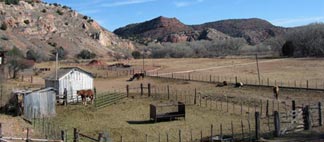 The ride ends at Perkinsville, where the canyon opens up to a broader valley. There’s a ranch there and the train stops literally in front of the ranch house. The place appeared occupied — there were horses and cattle there — but there wasn’t a person in sight. The conductor guy told us the story. Years and years ago, when the railroad was built, the land at the ranch was needed as a station to take on water and fuel for the steam engines. The railroad had offered the land owners a lump sum or a royalty for the use of the land. The Perkins family had taken the lump sum, giving up their control of the right of way. Today, under new ownership, the tour train had control of the land. The people who live in the house make themselves scarce when the train stops there on every run.
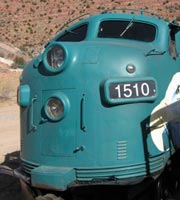 Why does the train stop at all? Well, this is the place the engines are moved from the front of the train to the back for the return ride. There’s a siding there and while we’re waiting, enjoying the scenery and feeling kind of bad for the people who have to deal with 130 tourists a day looking into their windows, the engineer takes the two engines and moves them. The task takes about 20 minutes and they sell ice cream sandwiches to us while we wait. Then we’re on our way back to Clarkdale at a slightly faster speed, leaving Perkinsville behind.
 The client called, wanting to know if it were possible to see Meteor Crater and the Grand Canyon in the same day. He was vacationing in Wickenburg with two kids. His son wanted to see Meteor Crater and his daughter wanted to see the Grand Canyon. He was thinking about driving but wisely realized that he’d be spending all day in the car.