Denny’s

I eat fast food and live to tell about it.

It was Mike’s idea. He felt like eating something different.

“We’ll go to Denny’s and order just a bunch of appetizers.”

I also felt like something different and agreed.

While Denny’s might not seem like something different to you, it is to us. We’ve only been in the Wickenburg Denny’s once since it opened 5+ years ago. And I can’t recall ever being in a Denny’s anywhere else.

And to be fair, Denny’s really isn’t fast food. It’s the kind of food you’d have at home if you did all your shopping in Costco’s freezer section. You know — everything prepared and ready to cook. It’s not as if it’s already cooked and waiting for you under a heat lamp.

When Mike saw the menu, the first thing he said was, “Okay, so this was a bad idea.”

Trouble is, Denny’s appetizers are the same things you can get from the supermarket freezer section. The kind of stuff you’d buy when people you didn’t like very much anyway were coming for a party and you knew they were very easy to impress. Mozzarella cheese sticks. Onion rings. Tiny hamburgers — like White Castle’s. Buffalo wings. Ho hum.

To us, that’s different. We don’t normally eat that kind of junk.

But was “different” an excuse to lower our standards?

We didn’t have much choice. We were there and sitting down with iced teas in front of us. The waitress had already tried to take our order once. We were committed.

We abandoned the appetizer idea. I chose country fried “steak.” He chose chicken fried chicken, which is basically country fried steak made with chicken breasts instead of beef.

I made the fatal error of not reading the description of my meal. Imagine a hamburger made with beef and filler. Now imagine it squished down so it’s thinner and wider than a regular burger. Now coat it in breadcrumbs — a lot of them — and throw it in a deep fryer. When it’s done — which it probably was before it went into the fryer — put it on a plate with instant mashed potatoes, and a white gravy made with cornstarch.

I ate it. I was hungry. And I think I wanted to teach myself a lesson.

Mike’s said chicken “breast,” but when I tasted it, I was pretty sure it had some filler in there, too.

We didn’t have dessert. And that was probably a very good thing.

The lesson I learned came in the middle of the night when I woke up feeling sick. Sick enough to get out of bed and take some Rolaids. And then put on Seabands (a pair of pressure point wristbands that fight nausea). For a while, I thought I was going to puke. But the Seabands kicked in and I fell back to sleep.

The next time he says he wants something different, he can bring it home from Phoenix with him.

Land of the Sun Endurance Ride

I mark horse butts and time in the riders.

Yesterday was the Wickenburg Horsemen’s Association’s annual Land of the Sun Endurance Ride. And, for the fourth year in a row, I was one of about 80 volunteers enlisted to help out and make the event run smoothly.

For those of you who don’t know what an endurance ride is, our endurance ride is a 25- or 50-mile horseback ride over trails in the Wickenburg area. Endurance riders — people who actually like to cover that many miles on horseback — come from all over the southwest to participate.

The trails are created or maintained and then marked with ribbons by volunteers organized by Robin Ollendick and Nancy Halsey, who manage the whole thing. There are two loops, each of which are 25 miles long. The 25-milers do one loop and the 50-milers do both. There are vet checks, water stops, and check points along the way. There’s food and beverages for riders and horses at the vet checks and riders are required to spend a certain minimum amount of time at each one to ensure the health and well-being of their horses. There are drag riders who follow the last group out and remove the ribbons.

It’s a big deal and a great western event. This year, we started out with 148 riders. A few were pulled early on or on the trail for various reasons — for example, a problem with a horses’s gait or a horse “tying up” — but the vast majority finished their courses.

As a volunteer, I had three official jobs.

The first, on Friday, was to use “paint sticks” to mark numbers on horse butts. Each horse had a number and the number had to be visible by the folks at the check points so each rider could be tracked through the course. We used yellow, pink, or green markers to put the numbers on. The markers are similar to Cray-pas — soft crayon-like markers I used as a kid. But they’re fat — at least an inch and a quarter in diameter — and they’re a pain in the butt (no pun intended) to get off your skin and out from under your nails.

My second job was to make the vegetarian bean soup I make every year for the lunch stop. A lot of the riders are vegetarians and it seems that most other people put some kind of meat in their soups or chilis. I make it without any meat at all. The flavor comes from the root vegetables I include — onions, carrots, turnips, parsnips — as well as celery and leeks. I got it cooking in our camper, which we parked at the rodeo grounds (It’s for sale and we wanted to show it off to potential buyers.), on Saturday and it was ready just in time for lunch.

My third job was to work with Janet, timing in the riders. The first 50-milers, who had left at about 7:00 AM (before dawn!), started showing up at 9:45 AM. That’s 25 miles in 2 hours and 45 minutes. On horseback. Janet wrote down numbers and times on a clipboard while I handed out check in slips with numbers and times. The 50-milers were required to wait for a hour after their horses “pulsed down” before leaving on their second loop. The 25 milers didn’t get check in slips, but they did get champagne. By 1:30, the 50-milers were coming back from their second loop. Janet and I were relieved at 2 PM, when all the excitement was pretty much over.

I didn’t take any pictures yesterday. I was too busy with my jobs. But if Janet sends photos of the winners, I’ll insert them here.

The big surprise: the winner for the 25-milers was a rider on a mule!

A Few Desert Gigs

I spend two Saturdays doing rides in remote desert locations.

One of the things I like to do to earn a little money with the helicopter is short rides at outdoor events. We did great at the Thunderbird Balloon Classic back in October, but that was held down near Phoenix and attended by people with money to burn. Up here on the edge of nowhere, people are a little tighter with their hard-earned money. As a result, I have to price the rides affordably and give each passenger a lot of bang for the buck. The margins are lower at these outdoor events, but I get a lot of satisfaction giving people their first helicopter ride or showing them something they can only see from the air.

The past two Saturdays each had gigs like that.

On December 30, I flew at the ghost town of Stanton. Stanton was a mining town established in the 1800s. At one point, it was a thriving community, with an opera house, hotel, and stage stop. Situated at the foot of the Weaver Mountains alongside Antelope Creek, it was a gold mining community. Legend has it that a man looking for a lost burro climbed to the top of what would later be known as Rich Hill and found gold nuggets the size of potatoes. Like any idiot from that time, he couldn’t keep quiet about his find and, before long, miners were flocking to the area to cash in. The town grew. It was named after a man named Stanton who, I believe, was involved somehow in the Wickenburg Massacre. (More on that another time.) The town was eventually abandoned when it became too difficult or costly to pull out more gold. Later, a group called the Lost Dutchman’s Mining Association bought the townsite. They installed caretakers, which prevented the town from being vandalized like most ghost towns in Arizona were. (For example, there’s really nothing left of nearby Octave, another ghost town.) As a result, the Saloon/Opera House, hotel, and stage stop still stand. They’re actually in use to this very day, maintained by the Lost Dutchmen group. And a campground has sprung up around the property, giving the group members a place to camp out during the winter months.

I’d flown at Stanton before and although it wasn’t a lucrative gig, it made a small profit and was a lot of fun. The Lost Dutchman have “outings” at Stanton a few times a year. The year-end outing is the big one. Everyone wants to see the “Potato Patch” at the top of Rich Hill but no one wants the all-day hike to get up there. I can get them up there and back in 8 minutes, so that’s what I did.

Flying at StantonSo on December 30, at 12:30 PM, I arrived at Stanton as scheduled and landed on a seldom-used road near the campground. My ground crew — Mike, John, and Lorna — got out and set up a little table. I shut down and waited for the crowd to gather. They came in pairs and trios and when I had at least 4 people waiting, I started up again. Lorna took the money — $30, including tax, per person. Mike and John gave the safety briefings and loaded up the passengers. Then I took off toward Wickenburg, climbing, climbing, climbing. I rounded the south end of Rich Hill and climbed up its east side. The passengers had excellent views of what was left of Octave and the mining activity going on in that canyon. Finally, 2000 feet above Stantons’ elevation, I rounded the north end of Rich Hill, still climbing. We were over the next valley, with Stanton far below us in the mouth of the canyon. I pointed out the Potato Patch and the miner types oohed and aahed. I started the descent, coming down at a rate of more than 1,000 feet per minute. On the way down, I pointed out Wickenburg, far to the south, and Congress, to the west. Also, North Ranch (which, you may recall, the management claims occupants are too old for helicopter rides) and the dairy farm. Even at a 1,200 feet per minute descent rate, I can’t get to Stanton without overflying it and turning back, making an elongated spiral to my landing zone.

We flew 22 people that day. Not bad for a gig less than 15 miles from Wickenburg. Even with a side trip to Lake Pleasant before the flight, we made some money.

On January 7, I was back in the desert with my ground crew. This time, we went to Robson’s Mining World in Aguila. This was my third gig out there for their anniversary celebration. Every year was a little better and this year, I’d dropped my price from $35 per person to only $30. I think that made a big difference. We gave about 50 rides.

The setup for this event was a little more deluxe. Robson’s was having its annual Anniversary celebration and they had lots of activities and food and vendors inside their “town.” John and Lorna took their truck out there, so we were able to bring a long a lot of extra supplies. Flags, banners, a table, some extra fuel. Our setup, alongside the road, was very noticable, especially since we got there early enough to keep the space in front of our table clear of cars.

Flying at Robson's Mining WorldI flew for a few hours, taking a break for lunch before starting up again and flying some more. The route started from our desert clearing, which was just big enough for Zero-Mike-Lima to fit comfortably, to the east alongside the base of the mountain behind Robson’s. I climbed as I flew, pointing out where Wickenburg would be if we could see it (we couldn’t), Vulture Peak, Congress, and Alamo Lake if we could see it (we couldn’t). Then I came along the back side of the mountain, crossing over a saddle on the west side. (There were a couple of guys and a dog working an old mine shaft up there and I wonder what they think of the helicopter flying over them every 10 to 12 minutes or so.) I came through the canyon where Robson’s is nestled, pointing out the trail to the petroglyphs along the way. I flew jsut to the east of town, where everyone could see me but not be bothered by the sound of the helicopter, before circling around to land back in my LZ.

The passengers were all thrilled. They always are. It’s a rewarding job.

When it seemed as if we were done and the event was winding down, I shut down and took a walk with Mike, John, and Lorna to enjoy the event. The crowds were gone and it was pleasant. We bought $1 ice cream cones (brings back memories, doesn’t it?) and watched the old engines run out back.

Later, when we were ready to leave, there were a few people gathered around the helicopter taking photos. Two men who were part of a party of three people wanted rides. Since they were going back to Wickenburg, I offered to take them there for the same $30 each. (That’s where being a Part 135 operator really pays off; I can do that kind of stuff.) They agreed and while their friend drove to Wickenburg, we took off, overflying Robson’s one more time as we headed back to Wickenburg.

I should be doing similar events like this down in Buckeye and up in Yarnell over the next few months. I’m hoping to pick up a few new gigs in the meantime.

If you’re reading this in Arizona and think you have at least a dozen people interested in taking rides at $30 to $40 per person (prices depend on distance to the gig), give me a call. You can learn more at the Flying M Air Web site.

The Chickies are Here!

A day late, but twice as many as I expected.

If you know anything about me, you know that I live in a rather rural area and have been keeping a small flock of chickens for the past six or seven years. My first flock was the best: eight hens who were tame and friendly because I’d raised them from chicks. Coyotes got three of them in a day (which is why I have a coyote tail hanging from the rearview mirror in my S2000), and, as a result, I had to keep them cooped up all day long, first in their relatively small chicken coop and later in a fenced in chicken yard my friend John built for me alongside the coop. The remaining five chickens produced, on average, four eggs a day. We’re not really big egg eaters, so we wound up giving away fresh eggs to just about anyone who showed up at our door — the farrier, the FedEx man, and the APS meter reader — as well as friends and neighbors.

Time passed. I got more chickens and coyotes and neighborhood dogs took some chickens away. We got a rooster from my friend Janet. I hatched one chick on my own, then bought two more to keep it company. One my my hens hatched her own brood of chicks, all of which were killed by the rest of the flock. Later on, I started replacing chickens with older birds that were less likely to be killed by the flock. Neighborhood dogs dug their way into the yard and killed all my chickens but one; we later electrified the outside of the yard fence to keep them out.

As I write this, I have two hens and a rooster that I got from my hairdresser, Sue. She was moving and looking for a home for her flock. When I got the hens from her, one of them was laying. But now neither of them do. We say they’re lazy chickens. And I’ve already decided that they’ll soon go to a new home in Wenden, where my Mexican friend Celia will turn them into enchiladas. She says fresh chicken is a lot better than store-bought. I don’t doubt her, but I’m not about to wring their necks, pluck them, and gut them to find out for sure.

When I decided to replace my little flock, I decided to start from scratch again — no pun intended — with a fresh batch of chicks. I ordered from Ideal Poultry in Texas. They’re one of the few hatcheries that will ship small orders (less than 25 chicks) and will vaccinate for Marek’s disease (which killed a few of my chickens a few years back). I ordered Ameraucanas (Araucanas), which are also known as the “Easter Egg Chicken.” Why? Because they lay colored eggs: brown, green, and sometimes even blue.

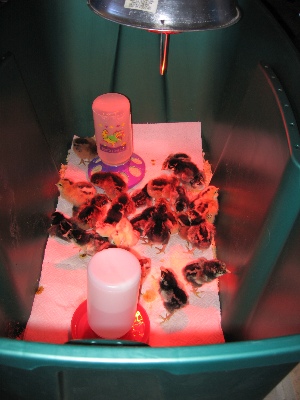
I’d had Ameraucanas before and I loved the green eggs. One of my hens laid a beautiful sage green colored egg that was almost the same color I’d painted my kitchen. The colored eggs are a novelty, but what’s nice is that this breed is a pretty good producer. All of my chickens laid regularly until their untimely deaths.I ordered 10 hens and 2 males from Ideal Poultry. I got an e-mail message a few days later, saying my chicks would be shipped out on December 7. Ideal ships via Priority Mail and I knew from experience that I could expect a call from the local post office on Friday morning, around 6 AM, telling me that my chicks had arrived. I prepared a large plastic storage container with pine shavings and paper towel sheets on the bottom. Bought new a new chick waterer and chick feeder, and bought the smallest bag of chick starter I could: 25 lbs. I also set up the heat lamp over my makeshift brooder. All I’d have to do when the call came was to plug in the heat lamp, fill the waterer and feeder, and bring the chicks home.

But the call never came on Friday. I went to the post office to try to track down the chicks, but without a tracking number, it was impossible. I was told to wait for the 11 AM express mail truck. It arrived at 1 PM. No chicks aboard.

Meanwhile, I’d called the hatchery and left numerous messages and e-mail messages. Chicks can survive without problems for up to 48 hours after hatching without food or water. After that, nothing’s guaranteed. All I could think of was a box arriving at Wickenburg Post Office the next day with a dozen dead chicks in it.

But there was nothing I could do. I had to be in Tempe that evening for Mike’s company Christmas party. The plan was to spend the night at the Embassy Suites on South Rural. I was hoping to do some Christmas shopping while I was down there — I needed a Lowe’s gift certificate for my brother and his wife — but I was already out of time. So I hopped in my Honda and zipped down to Tempe.

The hatchery called my cell phone just after I checked in at the hotel. The guy who called was probably the owner and he had a thick Texan drawl. He told me that the shipment had probably been delayed on Wednesday because of an ice storm in Dallas. (I guess I missed that on the news.) A lot of flights were cancelled. But the chicks, which had been hatched after noon on Wednesday, definitely went out. They should arrive by Saturday morning. The hatchery would replace them if they died enroute.

Not much I could do in Tempe, so I tried not to think about them.

We went to bed around midnight, which is almost like staying up all night for me.

Mike had a bad night. Neither of us drank very much at the party, but something he ate didn’t agree with him and he was up half the night. I woke at 7:30 AM and left him to sleep for a while. We had a suite, so I surfed the channels on the television in the other room while drinking coffee I brewed in the tiny pot in our kitchenette. I wanted to go home and get the chicks settled in — if they were still alive — but I was worried about Mike.

We finally checked out at about 9:30 AM. We each had our own car, so we went our separate ways. I got in to Wickenburg at about 10:45 AM and went right to the post office. I heard my new little babies peeping as soon as I got in the door.

The post office folks had been kind enough to cut down a plastic cup, put some water in it, and give it to the chickies. So I think some of them got something to drink. At this point, they were nearly 72 hours old and very vocal. I thanked the post office folks, put the box of chicks in the car, and drove home.

Ideal Poultry ships chicks in a small cardboard box with plenty of air holes. The box is held closed by a plastic strap, making it easy to open up the sides and peek in. The box is small on purpose; it forces the chicks close together so they keep each other warm. And it probably prevents them from falling over all the time. Normally, Ideal puts a rolled up straw thing in one side of the box, since I always place small orders. This time, it decided to fill the empty space with extra chicks. So when I started pulling them out, I didn’t stop until I had more than 20 of them in their new home.

There were two dead chicks on the bottom of the box; they’d obviously died early in transit because they were very small and their brethren had stomped them into the hay. Normally, I’d feel pretty sad about this, but with so many live chicks to occupy my mind, it didn’t bother me as much as it should have.

Most of the chicks were very active. I went through my ritual: taking each one and dipping its beak into the water to teach it how to drink. It sounds silly, but they really don’t know how to drink until you show them. And that’s kind of what gets them started on their unaided lives. Kind of like slapping a newborn baby on its butt to get it to breathe.

I haven’t gotten an exact count yet, but I think I have 28 chicks. The hatchery may have thought it was doing me a favor by shipping so many extras for free, but I have a definite space problem. The plastic bin I bought to house them for their first 3 to 4 weeks won’t last more than a week now. I’m already scrambling for a large box to move them into. Maybe they thought I had a nice, warm Arizona yard to keep them in. In reality, they’ll live in my garage for at least two months. That’s when they’ll have enough feathers and down to handle the cold winter nights.

They are cute. No doubt about it. Most of them already have feathers growing on the ends of their tiny wings. They’re babies, so they’ll walk around and eat and drink and jump over each other and then suddenly get tired and fall asleep. They’re fun to watch. And when they’re all awake, they make a ton of noise.

As for my current adult flock: their days are numbered. I’ll see Celia again right before Christmas. Although I already gave her her Christmas present, she might be taking three bonus birds home with her that day. Enchiladas? Tamales? Or just roast chicken? If those girls don’t start laying eggs soon, they’ll be the main course on Celia’s table one day soon.
A Ride in the Desert

We spend three hours on horseback, enjoying perfect weather.

Mike and I have two quarter horses. Jake, a retired ranch horse, is now about 24 years old and is starting to show his age. He’s sorrel (that’s brown) with some white on his feet. He’s also swayback — that means that the place you put his saddle is way lower than it should be on a normal horse —  and has very high withers. Mike bought a special saddle pad for him and then had his saddle custom made to fit the horse. I got Jake for a good price and I think I know why. He’s an alpha male and likes to boss around the other horses he lives with. He’ll bite them and chase them and generally annoy them. That must have really been a nuisance for his previous owners, so they sold him off. But he’s an excellent horse, serious about work, and can be ridden by almost anyone at all. As far as I’m concerned, he was a bargain.

Cherokee, is another story. Cherokee’s main problem is that he’s beautiful. He’s a paint horse, brown and white, and his face is just so pretty, with big gentle eyes and a forelock that’s just the right length. He was 11 when I bought him six or so years ago, and he’d already had at least three previous owners. They evidently spoiled the hell out of him because when I got him, he was lazy, poorly trained, and extremely spooky. That horse taught me more about staying in the saddle during a Cherokee-style rodeo than any other horse I’ve ridden (or fallen off of). To add insult to injury, he cost more than I should have paid. But like his previous owners, I was suckered in by his good looks.

Jake and Cherokee have completely opposite personalities. Jake was always very standoffish — he didn’t really want anything to do with people on his time off. His definition of time off was any time there wasn’t a lead rope or saddle on him. Cherokee is incredibly friendly and curious and loves to be petted. When Jake is ready for work, he works. He’ll do anything you tell him to. When Cherokee is saddled up and ready for work, he’ll do everything he can to get out of doing it. While they both like to be fed treats, Cherokee will actually beg for them. At least that’s what it looks like to me. And if you’ve been reading these blogs for a while, you’ve probably seen the photo of him eating dropped bird food out of the bottom of Alex’s cage.

Cherokee is a big eater and it shows. He’s fat. Jake’s thin. Now if you recall what I said about Jake being the alpha male and consider that they both share the same space, you might wonder how it is that Jake can’t scare Cherokee away from the food. It isn’t like he doesn’t try. He puts his ears back (a horse’s way of saying “f*ck off”) and chases Cherokee. He even bites Cherokee once in a while, putting three or four rows of parallel teeth marks on that beautiful coat. But Cherokee is accustomed to his place at the bottom of the pecking order and is very stubborn. He also eats very fast. So as Jake ages and seems to get thinner and thinner, we’ve taken to separating them at dinner time and overnight, giving Jake more food than he can eat and plenty of time to eat it. Cherokee, of course, doesn’t like this, and after he gobbles up his food, spends the rest of the night pacing around outside the gate to Jake’s enclosure. Over the years, they’ve both changed a bit. Jake is now more friendly. Although his previous owners probably hit him in the face (he was very hand shy when we first got him), he now lets us pet him, even around his head. Cherokee has calmed down and isn’t afraid of rabbits anymore, so I haven’t had any rodeo practice lately. He’s also been trained to walk when I tell him to — without the use of a riding crop! — and to let me position him so I can open and close gates while on horseback. And a few years back, they both posed for a Christmas photo, wearing antlers on their heads.

Photo
Christmas Horses

Anyway, yesterday Mike and I went for a long horseback ride out in the desert. The horses seemed very pleased about going. Of course, when we got to the top of the hill, Cherokee thought we were going to Uncle Pete’s house. That’s where they stay while we’re away and I think he spoils them. When he realized we were turning left instead of right, heading down the trail instead of down the road, he did some Cherokee dancing. In the end, he just followed Jake, like I knew he would.

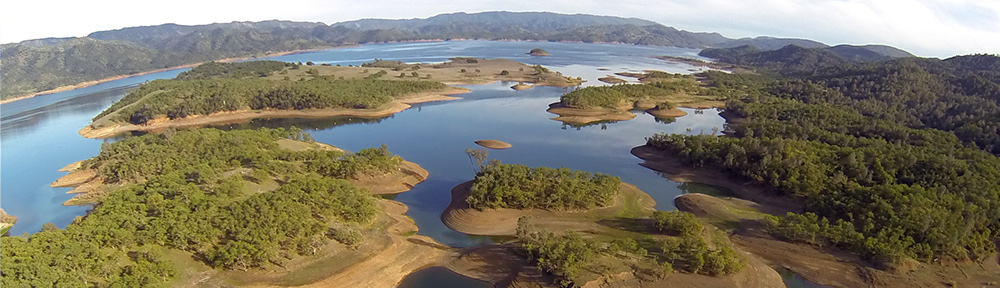
We live on the edge of town, about two lots from state land. So we normally saddle up and ride out from our house. We have two choices for a ride in the desert: turn down Cemetery Wash, which runs through our property, and take that or any of the trails that go into it or ride up the easement road from our house just past our neighbor’s house on 328th Avenue to a trail that goes right into the state land. We usually follow the second route, since there are far more trails closer to our house when we go that way. That’s also the same trails that the wranglers at Rancho de los Caballeros use for rides, so most of the trails are well worn in — perhaps too worn in in some cases — and easy to follow.

Jack the Dog came with us, of course. Jack likes to go horseback riding. He doesn’t ride a horse. He just runs along on the trail in front of us, chasing rabbits and birds. We realized that he liked horseback riding more than us when we sent two of our friends out for a ride on our horses and he went with them instead of coming back up to the house with us.

We went through the gate in the fence that separates state land from private property. The fence is there more to keep cattle out of people’s back yards than to prevent people from coming in or out of the state land. It also helps keep quads off the horse trails, although it doesn’t help enough. Every once in a while, a couple of quads will get in there and tear up the narrow trails with their wide wheels. There are so many places the quad riders can ride in town — hell, the hills are just criss-crossed with old mining roads and surrounded by sandy washes. Why do they insist on ruining the horse trails and going through people’s private property?We took the “golf course trail” west along the edge of the state land to Los Cab’s golf course, then we turned south to go around Los Cab’s property. We passed through another gate and followed a trail we’d followed a hundred times toward the west again. Spotting a new trail, we took that toward the east, climbing a small ridge that offered nice views of Los Cab. Then back down onto familiar trails, heading west again.

We spent three hours mixing old trails that we knew well with new trails. More than once, we were on trails I’d never been on before. And we wound up going a lot further southwest than we thought we were. I won’t say we were lost — that’s too strong a word — but at one point we were definitely not where we thought we were.

The ride was wonderful. Cherokee had settled down into a good pace and wasn’t the least bit jumpy. Jack chased rabbits and even a few deer. The temperature was perfect: warm enough that a long-sleeved shirt was fine without a jacket. There was some wind on the hills, but the air was quite still near the ground. We found one trail that took us high up onto a mountain, with incredible views of the town far below us, to the northeast. And we didn’t pass another soul.

It was the first time I’d been out for a good, long ride in a while. I’ve been so busy lately with work on my books, building up the helicopter business, and doing flights that I just haven’t had time to ride. And I seem too good at making excuses: it’s too hot, too cold, too windy, too early, too late. Sheesh. I’m an excuse machine when it comes to riding. I think that the truth of the matter is that I’m just too lazy to saddle up. But the reality is that it really isn’t that much work and it’s worth every minute once you get out into the desert on a nice trail.

I’d like to find a riding partner here in town who’d be willing to ride one day a week for about 2 hours. Sometime around noon or early afternoon. But it seems that few of the new people coming into town have horses and many of the ones who do prefer riding with big groups, so they can show off their riding clothes, saddles, and horse’s grooming. I like to ride in small groups, with people who don’t fuss about the terrain being too steep or rocky, with people who know how to control their horses, with people who have enough sense to wear the right clothes and bring enough water for the ride.

Anyway, there are two things about yesterday’s ride that I regret: 1) I didn’t bring my camera. How stupid is that? There were lots of photo ops and I think this entry would have been a lot more interesting with photos. 2) I didn’t bring my GPS. A few years back, I’d started a trail mapping project. Now I’m determined to finish it. And with 3 hours worth of riding yesterday, I could have mapped a lot of trails.

Anyone out there want to go riding on Wednesday afternoons? Get in touch. Experienced riders only, please. And don’t worry; I have a spare horse if you need one.