
Publishers and resellers need to give readers value for their money.
In the first part of this series, I discussed, in depth, the costs of publishing any book — ebook or traditional printed book. If you haven’t read that, read it now. I think you’ll learn some important things about how the publishing industry works. My hope, however, is that you understand the value of every book that’s published, no matter what format it’s published in.
Amazon’s Macmillan Fiasco
In January 2010, there was a big hullabaloo in the publishing world. Out of the blue, Amazon, the world’s biggest bookseller, dropped titles by the publishing giant, Macmillan, and its imprints. This turned out to be roughly 1/3 of Amazon’s book catalog. The reason for this? Amazon was attempting to strong-arm Macmillan into accepting its ebook pricing model.
You see, Amazon.com wanted all ebooks to have a maximum price of $9.99 with a certain amount of that price going directly to Amazon.com. Macmillan, however, wanted to use the “agency model.” As Mashable reports in “Macmillan CEO Confirms Dispute With Amazon Over eBooks,”
In this model, Macmillan as publisher would sell digital editions of books to customers through retailers, who as the agents of the sale would take the typical 30% commission standard in many digital media industries.
Whereas currently Amazon caps the retail price of e-books at $9.99, Macmillan proposes to set the price for each book individually at price points between $5.99 and $14.99, starting typically on the high end of the spectrum (between $12.99 and $14.99) and dynamically lowering the price over time.
(This is the model currently used by Apple in its iBookstore.)
Flexing its muscles, Amazon chose the “nuclear option” of refusing to sell Macmillan books, thus putting the first battle of the ebook war out into the public eye.
Those of us in the publishing industry sat back and watched the battle of the titans. Amazon attempted to get customers on its side by accusing Macmillan, in a roundabout way, of being greedy. Macmillan, on the other hand, insisted that it had the right to establish its own pricing. Consumers tended to side with Amazon.com. Authors and others in the publishing industry tended to side with Macmillan.
I sided with Macmillan. I believe that the producer of any item for sale should have the right to set its own prices. Amazon was wrong to try to force Macmillan to follow Amazon’s pricing structure. If a publisher has to cut the price, it’ll also have to cut the costs. And where do you think the first cut will be? I can tell you from experience: the author.
So, as you might imagine, I was relieved when Macmillan won the battle. You can read another author’s perspective of this particular battle over ebook pricing in “Amazon, Macmillan: an outsider’s guide to the fight,” by Charlie Stross.
Unfortunately, however, Macmillan’s pricing strategy has serious problems. Not only does it often result in ebooks that are more expensive than their printed editions, but it fails to take into consideration the perceived value of an ebook.
The Psychological Barrier of Ebook Pricing
Although there is a definite cost to publish (as I discussed in Part I of this series; did you read it?), the vast majority of readers feel — and I agree — that an ebook should cost less than a traditionally printed paper book. How much less depends on the consumer, his budget, and the value he sees in the book.
Unfortunately, publishers and resellers don’t feel this way. A visit to Amazon.com tells the story. I pulled up the pages for the hardcover editions of several books currently on the top of the New York Times Bestseller list. In many instances, the hardcover printed book was priced lower than the ebook. Here are two examples:
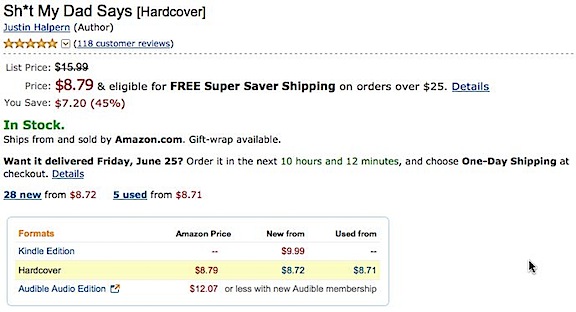

While I realize that the difference in pricing is minor — less than $2 in each example — it’s still roughly 10% cheaper to buy the hardcover, printed book than the ebook.
What’s the difference between the two editions of each of these books? The content is certainly the same — the same words by the same author. The less expensive book has substance. I can carry it around, put it on my shelf, thumb through it, write in it, show it to a friend, loan it out, give it away, or resell it on eBay or at a garage sale. This print book is certainly in a flexible format with ongoing future value. The more expensive ebook exists as a digital file that I can only view in one format on one kind of reader. Sure, I can read it on my iPad, my BlackBerry, and my Mac. But I can’t lend it out, give it away, or resell it.
In other words, the more expensive book has more restrictions on how I can use it.
Is that fair? Of course not.
Why would I pay more money for a book with more restrictions on its use?
I wouldn’t. And neither would the majority of ebook readers.
So what happens? Suppose I want to buy one of these books. I don’t want to buy yet another print book for my bookshelf — I’m trying to downsize. I’m not willing to pay a premium for an ebook edition. So I’ll either not read the book or I’ll pick up a copy at my local library. Does Amazon.com benefit from this? No. Does the publisher? No. The only one who benefits is me, because although I have to deal with the inconvenience of two visits to my local library, I’ll save a few bucks on the cost of a book. I’ll also achieve my personal downsizing goal by not adding more books to my library shelves.
The Magic Price
In addition to being less costly than the printed version of the book, to gain wide acceptance, the book needs to be priced to sell. This is where things get tricky. How can the publisher/distributor determine the price of an ebook?
Consider the “magic price” of consumers. What’s the maximum amount a reader is willing to pay for an ebook? For me, that price is $10 for a relatively new book with the price going down depending on the age of the book. I’d expect to pay more for a new book on the New York Times Bestseller list (but not more than its printed counterpart). I’d expect to pay far less for a 5-year-old book by the same author, even if it also once had bestseller list status.
That corresponds with the “agency pricing” model discussed earlier. But what doesn’t correspond is the starting price (as high as $14.99!) and the length of time before the price drops. I think the price should start much lower, perhaps at paperback book pricing levels. If it doesn’t start that low, it should definitely drop more quickly — within three to six months. Or, in the case, of a bestseller, when it falls off the bestseller list.
You might argue that if a reader knows the price of a book will drop, he’ll merely wait until the drop to buy. For a strong title, it shouldn’t matter. Readers will buy at their magic price. Some people won’t want to wait for some titles and will pay the premium. Others who are more price-sensitive will wait and save.
Pure Profit?
Publishers need to understand that the industry is changing. Information is widely available at low-cost or free. People with access to the internet can get plenty of reading material that’s just as good — if not better — than what they can find on bookstore shelves. This is taking a huge toll on the publishing industry.
As all this is going on, however, the publishers are handed a golden opportunity to sell a product with an extremely high profit margin: ebooks.
What the publisher needs to remember is its main goals, which are, in order:
- recoup fixed publishing costs
- earn a profit on books sold
Once the fixed costs of publishing (again, covered in detail in Part I of this series) are covered, the unit costs (primarily the author’s and retailer’s cuts) are relatively small. The result is a high profit margin product. Publishers should be doing everything they can to sell as many ebooks as the market will consume. Lowering the price is a good first step, as it will make ebooks more attractive to more readers.
As Charlie Stross points out, this is all part of the price elasticity of demand, an economics term that describes the relationship between price and units sold. Generally speaking, as price drops, more units are sold. That means that with proper pricing, the seller can sell more units and, even if the margins are lower, may be able to make as much — or more — money.
With a product like ebooks, which have a low cost to produce once fixed publishing costs are recouped, every ebook unit sold is profit. The more ebooks a publisher sells, the more money they make. So why wouldn’t they want to price ebooks so they sell more?
Who knows?
Short-Sightedness
The main problem I see with publishers is that they’re typically short-sighted. They know print publishing — they’ve been doing it for years. That formula worked for a very long time. But times change and technology marches on.
No one can deny the convenience of having a dozen or a hundred (or more!) books on a handheld device (or computer or cell phone) for instant access at any time. I don’t know about you, but the last time I took a get-away-from-it-all vacation, I lugged four books with me and still ran out of reading material before the end of the week. (I read fast.) I look forward to my next vacation when I can put all those books on my iPad.
Just as computers replaced typewriters, CDs and MP3 files replaced vinyl LPs, and cell phones are replacing land lines, ebooks will replace printed books. It’s inevitable. (Sure, there will still be books out there, far into the future. But they’ll be special books, like the coffee table books with designs and images that don’t translate well into electronic format — yet.)
Why are publishers fighting it? Why don’t they embrace the ebook revolution by hooking us on ebooks with the lure of practicality and cost savings? Get us addicted, make us demand books in this format. Why are they sticking to a pricing model that makes smart consumers feel like idiots for paying more for less?
We finally have three good ebook reader devices — although I believe two will go the way of the dinosaur when more iPad-like devices start appearing — so there’s no hardware excuse. The only thing holding ebooks back is the inflexibility of publishers regarding pricing and format and the limited availability of ebook titles.
Author and Reader
I’m writing this post from two points of view: as an author and as a reader.
As an author, I want to make as much money as I can. It’s my livelihood. You’d think, therefore, that I’d like the idea of high pricing. But I also like to consider what’s fair and I simply don’t believe that it’s fair to charge more for an ebook than a printed book. I also think more books could be sold if the price were lower, thus earning me the same amount of royalties — if not more.
As an author, I’ve had this discussion with one of my long-time publishers. I’ve pushed to create different ebook formats that take advantage of the display capabilities of computers with more attractive pricing. My reward for this: I’m labeled a troublemaker, a whiner, an annoyance. Whatever. It’ll be interesting to see how certain publishers survive the revolution.
As a reader, I want to be able to save money while increasing the convenience of reading. My iPad has given me, by far, the most pleasant book reading experience I’ve ever had. Clear, bright screen, adjustable type size, one-handed operation, the ability to read in low-light conditions. I never thought it would be this good. But I absolutely refuse to pay more for an ebook than its printed counterpart when there are so many limitations on what I can do with an ebook (beyond reading it) once I’ve got it.
What do you think? As author or reader or publisher, I’d love to get your comments.
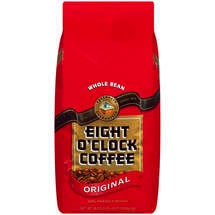 I like Eight O’Clock Coffee. It’s an Arabica bean with a light roast. It’s more robust than Dunkin’ Donuts coffee, which I liked before I left New Jersey and could no longer get here in Arizona. (It’s now available in Arizona; I tried it again and was disappointed.) But it’s mellower than Starbucks or any of the other boutique coffee brands — although I’ll take Starbucks Breakfast Blend in a pinch. I buy it as whole beans and grind it at home as part of my coffee-making ritual. Nothing like a good cup of coffee first thing in the morning, huh?
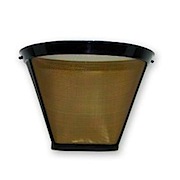 My coffee maker comes with one of those “gold” filters. It’s a washable thing that’s supposedly better for brewing coffee because it helps the oils of the beans meld together or some such bull. Whatever. What I find is that using the reusable filter guarantees bitter bean residue at the bottom of my cup. I’ll stick to paper filters. The coffee maker takes a #2 cone filter. I don’t buy Melita brand or unbleached or any such nonsense. I buy the cheapest ones I can find — they do the job perfect well. My supermarket sells them in packs of 50 or 100. At my rate of 2+ cups per day, that’s enough filters for one or two months. But over the past summer, I discovered that Wal-Mart sells off-brand paper filters like the ones I use in packs of 250 for less than what I pay for 100 at my local supermarket. So when I go to Wal-Mart — which isn’t very often, thank heaven — I buy two or three packs. Stock up and save.
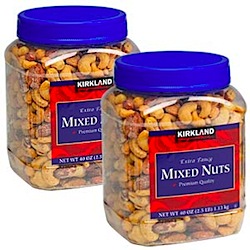 My husband — well, he’s still sucked in. He buys cases of canned corn and canned chicken broth. He buys huge plastic jars of nuts and garlic powder and peppercorns. He buys buffet plates full of smoked salmon and styrofoam trays of flank steaks. He buys a lot of junk we don’t need. He freezes things that are better not frozen. We eventually do eat or use most of what he buys, but we also throw some of it out. I don’t like that.