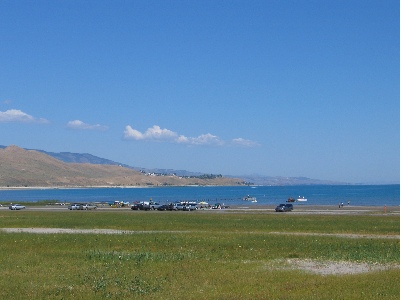
I fly over 7 hours, doing weird stuff with my helicopter.
No doubt about it: this was the weirdest weekend of flying I’d ever had.
Weird Flying 1: The Camping Trip
It started with the camping trip drop off on Saturday.
Jason and his girlfriend, Becky, had planned a trip to Red Creek, a tiny dirt airstrip on the Verde River. Jason flies a Citabria and has flown and out of there many times. Becky has come with him on several trips, but this was the first overnight trip they’d planned.
They arrived at the airport, where I was out on the ramp cleaning dust out of the inside of Zero-Mike-Lima. I hopped in my golf cart and rode over to Jason’s hangar to say hello. Becky was excited about the trip. She talked animatedly to me while Jason loaded their camping gear. I told them that I was planning a flight out that way, too. I was just waiting for someone to show up at the airport to come with me. I told her I’d rather fly with someone else than alone. She suggested that I stop by their campsite for a visit. “There’s horseshoes there, you know.”
I should mention here that even though Red Creek’s airstrip is extremely difficult to get to by wheeled vehicle, over the years, pilots and others have added amenities like a horseshoe pit, picnic table, fire pit with grills, lawn chairs, water jugs, etc. You can find all that near the strip on top of a small mesa overlooking the river. But my favorite camping amenity is found closer to the river itself: shade.
I agreed that I’d come visit and I hopped in my cart and put it away in my hangar. Then I went back to cleaning dust out of my helicopter.
A while later, I heard an airplane engine start. It may have sounded rough — I don’t know. To me, all airplane engines sound a little rough. It ran for about three minutes, then shut down. A minute or two later, it ran for another minute. Then silence.
I was wiping dust off the inside of the cowl near the hydraulic fluid reservoir when I heard my name called. It was Becky.
“Jason’s plane isn’t running right,” she told me. “The needle is going up and down. He says it might be the spark plugs. So I was wondering, could we charter you to take us to Red Creek?”
I thought for about two seconds. “Sure,” I told her. “It would be fun.”
We loaded all their gear into the helicopter. It fit under the seats and on one of the rear passenger seats. We put Jason up front because he’s tall and his long legs wouldn’t have fit comfortably in the back. I started up, warmed up, and took off. It was Becky’s first helicopter ride and she let out multiple squeals of delight as I climbed up over route 60 and back toward the east. I showed them my house from the air and continued toward Red Creek, adjusting my course slightly to overfly a waypoint north of Cave Creek that I’d already programmed in.
We talked the whole time. I showed them the abandoned mansion overlooking Lake Pleasant and they were surprised to see it — like most local pilots who understand the joy of flying low and slow, they’d explored quite a bit of the area in Jason’s Citabria. I was going to show them the ruins on Indian Mesa, but they’d already seen them. So we continued over the Agua Fria Arm of Lake Pleasant, climbing as I flew over I-17 in preparation for the high mesas ahead.
I saw a mesa that seemed broken off from the main mesa and pointed at it. Jason said, “Yeah.” In the back, Becky was fiddling with my iPod.
We were nearly up to this mesa when I said, “Wow. Doesn’t that mesa look like an island in the sky?”
“Yeah,” Jason agreed. When Becky didn’t reply, he added, “Look, Becky. Doesn’t that mesa look kind of cool?”
She looked. “Yeah,” she agreed. But she didn’t sound very interested.
“I bet the views from up there are great,” I said, starting to slow down. The mesa offered excellent views of Phoenix, Scottsdale, Cave Creek, Carefree, and Deer Valley to the south. “The lights at night must be incredible.”
“Yeah, this is a really great spot,” Jason said. “I think we should camp here.
That got Becky’s attention. “Here?”
“Yes. What do you think, Becky? Should we camp here?”
By this time I was circling, looking for a good landing zone.
“No!” Becky yelled, sounding a bit frantic at the thought.
I almost laughed into my microphone.
“Red Creek is better. It has horseshoes.”
This time I did laugh.
“We can go to Red Creek anytime,” Jason said.
“That’s right,” I said. “But you can’t land a plane here.”
“But…”
“I want to camp here,” Jason said firmly. His tone of voice suggested that when he really wanted something badly enough, Becky usually gave in.
“It’s a really nice spot,” I added. “And the views are great.”
“Well, if we’re going to camp here, then maybe we can find Skeleton Ridge and camp there,” Becky said. “Or someplace where there’s indian ruins. Let’s find someplace with ruins.”
“We can’t tie up Maria all day,” Jason said.
By this time, I’d found a spot to land and was just waiting for the cue to start my approach. Becky gave it.”Okay,” she said.
I made my approach to a spot near the middle of the mesa. When I set down, I was less than 100 feet from the waypoint I’d programmed into my GPS that morning.
They unloaded their gear. Becky wanted me to shut down and hang out with them, but I’d been experiencing intermittent starter problems and did not want to get stranded on top of Black Mesa with them. So I left the engine running and held the controls while they unloaded. I told Jason to stand back when I took off, wished him luck, and lifted off.
Of course, I was in on the whole thing. Jason had called a month before to reserve the drop off and pick up dates with me. He’d sent me GPS coordinates, a map, and this photo only days before. He was planning to propose and to make the event more memorable, he thought a helicopter drop off and pick up at a remote location where no one would bother them would be ideal.

Who says men can’t be romantic?
From Black Mesa, I headed up to Prescott. Oddly enough both the folks at Guidance Helicopters and I had golf ball drops on Sunday: we were hired to drop golf balls out of a helicopter onto a target. The closest golf ball(s) win a prize. Its a fund-raising event. Theirs was for Special Olympics. Mine was for Wickenburg Youth Football. At Prescott Airport, I got a chance to see the device the Guidance folks had rigged up for the drop. It was very impressive. Guidance never does things halfway. Of course, it was not the kind of thing Mike and I could whip up in two days. We’d have to come up with a different solution.
While I was up there, I hopped in my old Toyota MR-2 and took it to the malls. As usual, that little car started right up and seemed eager to roll. I hit a few pet store places, bought a coffee pot for my Braun coffee machine (which I’d broken the morning of a dinner party, forcing me to buy a piece of crap coffee maker in Wickenburg to make coffee for my guests), and bought a bunch of fish for my big fish tank, which I’m just getting restocked after the fish from hell ate all his companions. I came back to the helicopter, loaded all my purchases under the seats, and buzzed back to Wickenburg.
I left the helicopter out on the ramp overnight. I had to fly it the next day.
On Sunday, the first order of business was to pick up Jason and Becky. I was late getting to the airport, primarily because I had to stop at my office and pick up a few things I’d need later on. Although my fuel level was lower than I wanted, I decided to pick up Jason and Becky first and get fuel afterward. I didn’t want them waiting on top of that mesa in the sun, wondering when I was going to get there, when they were expecting me at nine.
I made excellent time flying right to the mesa. At first, I didn’t see them. But then I spotted them on the north end of the mesa, right where it narrows to join the larger mesas to the north. There was an excellent landing zone nearby: level and rock-free. The only catch was that there was only about 10 feet of mesa in front of me and thirty feet behind me — beyond that were sheer, 500+ foot cliffs. A real pinnacle landing. I made it without trouble and was comforted by how firmly the helicopter sat on the ground. I frictioned-up the controls and got out to help them load. Becky showed me her engagement ring. Not only was Jason romantic, but he was generous and had excellent taste. The ring was a real beauty.
I asked them if they minded going to Deer Valley for fuel before I took them up to Peeples Valley. No problem. I lifted up, added forward cyclic, and gave us all the incredibly unsettling feeling of falling off a cliff. (For sheer thrills, a helicopter flight off the edge of a cliff can’t be beat. Unlike amusement park rides, it’s real and passengers must wonder whether they’re going to come out of it alive.)
Deer Valley wasn’t busy but the folks at Cutter were. They were terribly slow. I bought 15 gallons at $4.06/gallon. It took nearly 20 minutes to get and pay for it. Then we were on our way, first west per the controller’s instructions and then north toward Peeples Valley.
It was a pleasant flight: nice and smooth. I showed Jason how my traffic reporting system works. I also told them about how the helicopter works. Jason wants to learn, but not unless he could buy a helicopter. “That’s the tricky part,” I told him. “Anyone with time and money can learn to fly a helicopter. But to buy one isn’t quite as easy.”I showed them the canyon where the Weaver cabins are. We couldn’t see them from the air. Then we hopped over the top of East Antelope Peak and the town of Peeples Valley was before us. I descended down to the runway Jason had carved into a pasture at Becky’s house and landed. Becky’s parents came out. I told Becky to give her mother the news while I helped Jason unload.
It was a happy scene and it felt great to be part of it.
Weird Flying 2: The Golf Ball Drop
From Peeples Valley, I flew back to Wickenburg, where I topped off the tanks. Mike and I rolled the helicopter back into the hangar so we could work on it. We still needed a golf ball dropping solution. But Mike wanted lunch first and I needed to run home to get the golf balls we had for experimenting. We wasted about an hour on all that. Mike took the fairing off the pilot side front skid leg so it wouldn’t get damaged when we dropped the balls. But we couldn’t come up with a solution. In the end, we decided to use whatever bag or box the group provided.
We did take off and drop a bunch of balls out in the desert. I wanted to make sure that the balls wouldn’t bounce up if they hit the skid. They didn’t.
We flew back to Wickenburg and landed at the golf course, right on the fairway near the green where we’d be dropping the balls. Mike got out to watch my tail while I cooled down and shut down. It was a good thing he did. Three young boys came running toward the helicopter’s tail while it was still spinning. Mike’s loud whistle and hand motions stopped them in their tracks and got them into a retreat.
Up at the event, things weren’t nearly as busy as I’d expected. Christie, who I was working with, greeted us and showed us the duffle bag the balls were in. We decided that we’d put the bag on Mike’s lap, strap them both in, and let Mike just dump the balls out. We had some iced tea while we waited. Then, at 1:50, we went down, put the Mike and the balls in, and started up. A few moments later, I was airborne, moving into position about 200 feet above the green where they’d marked a silly little target.
We did the drop. I circled around. We’d hit the green but pretty much missed the target. When I landed to give back the bag, they asked me to do another drop. Mike said no, but I said okay. All the kids who had been watching sprung into motion to gather up the balls. Within two minutes, all 1,000 of them were back in the bag. A man helped Mike load the balls back into the helicopter on his lap. Then I took off again. This time, a bunch of the balls were inside the target. Enough to award prizes. We dropped off the bag and left.
Weird Flying 3: Follow that Car!
Back at the airport, we put on the helicopter’s doors. I didn’t even bother shutting down. We were due at a proving grounds an hour away at 3:30 PM for my last weird gig of the weekend. It was already 2:20 PM. I punched a waypoint into my GPS and we took off.
My flight path took me over Glendale Airport. The controller there was cranky. We listened to him scold a pilot before calling in. He instructed me to cross over the airport at 2600 feet. Nosebleed territory for me. I obeyed, wondering whether I’d be punching into the bottom of the Phoenix Class B airspace. As soon as I was clear of Glendale’s space, I dropped back down, closer to earth.
We passed over the proving grounds on our way to a nearby airport for fuel. They were spraying water alongside a road for a landing zone. I waved to the folks who looked up and continued to the airport.
After refueling, we landed on a road at the proving grounds. That’s when the really weird assignment began.
I’d been hired by a carmaker to take a photographer around to video a car on the track. That’s not so weird. Yet.
The video crew was not from this country and spoke very little English. Since I had four seats, they wanted to fill them all. But I’d been told that there would be only one cameraman and I’d topped off the tanks, so I couldn’t take three passengers, especially when I may need all the power available to me. So they settled on the director and the cameraman. They wore harnesses and we strapped them in with the cameraman behind me and the director beside me. All doors were off. The cameraman’s camera was rigged to a viewer that the director held in his hands, so he could see everything the cameraman saw. The director also wore two headsets: mine and his. Mine was attached to the voice activated intercom system and his was attached to a radio in his pocket. He held a push to talk switch for that so he could talk to the driver. One headset’s ear cup was on one ear and the other’s was on the other. But every time he talked to the driver, I could hear him because of the mouthpiece on my headset. That didn’t matter much because he was speaking their language and I couldn’t understand a word of it anyway.
I took off and began flying in formation with…well, a car. It was a bright blue car that’ll probably never be sold in this country. I don’t know much about it and even if I did, I couldn’t tell you. Mike signed a nondisclosure form for me and I’ll accept that as binding. It doesn’t really matter anyway.
First the car drove clockwise around the track. Since the cameraman was behind me, I flew on the outside of the track, following him. The entire time I flew, I heard words, commands, and conversations in that other language with the occasional “faster,” “slower,” “higher,” “lower” thrown in for me. The track was easy to follow, but there were some obstructions: a tower on the one corner was the first concern. Later, as I flew lower and lower for them, I worried about telephone poles with wires and other larger obstructions. I surprised myself with the amount of flying skill I had. We did flybys and other shots that amazed me. My favorite was this. I’d hover about 3 feet off the track while the blue car raced towards us. Then, when it was about 20 yards away, I’d pull pitch and rise 20 feet straight up. The car would pass beneath us.”Beautiful!” the director would exclaim.
So this is what the helicopter pilots who flew movies did. Cool. I could do this.
The cameraman only puked once. He was obviously very experienced at this. He puked right out the helicopter and didn’t get a drop of it inside.
This went on for over an hour. My right wrist was getting sore from the deadman’s grip I had on the cyclic. And I think I built new muscles in my left arm from manipulating the collective as much as I did.
The director called for a break and I went back to the landing zone where I shut down. The crew guzzled Diet Coke. I drank water.
We put three of the doors on, leaving the front passenger door off for the cameraman. The director sat in back. The director wanted to put a third person in again but I said no. With the kind of flying they were asking me to do, less was better than more. Then we took off to do the dusty part of the filming. The car would drive on an inner dirt track.
It was more of the same with a bit of out of ground effect hovering thrown in for good measure. No playing chicken this time; there was too much dust.
The sun got lower in the sky. I told the director it would set in less than 20 minutes. They got a few shots from the east with the sun shining through the dust churned up by the blue car. Then the sun was down. Now we chased the car around the track, videoing its red taillights in the dust.
I think we would have done that all night if I didn’t pull the plug. “I can’t see the wires anymore,” I told the director. That was a lie, but I knew I wouldn’t be able to see them in another 15 minutes. And I wasn’t looking forward to flying back to Wickenburg at night, without a moon to light the way.
I landed and they got out. I calculated the charges for this extravaganza. Over $1400. My contact, who spoke perfect English, gave me a credit card.
Everyone was happy. Even I was happy, although I was exhausted.
It was about 40 minutes past sunset when Mike and I took off. We had plenty of light for the first dark part of the flight but it was pretty dark by the time we got to Glendale. It was 7 PM by then and the cranky controller had gone home. I overflew at 2000 feet, turning the pilot controlled lighting runway lights on just to watch them light up as I flew over. When the last light of the city passed beneath us, I shifted to the east to follow the lights of Grand Avenue the rest of the way to Wickenburg. I set down on the pad, locked up, and went home.
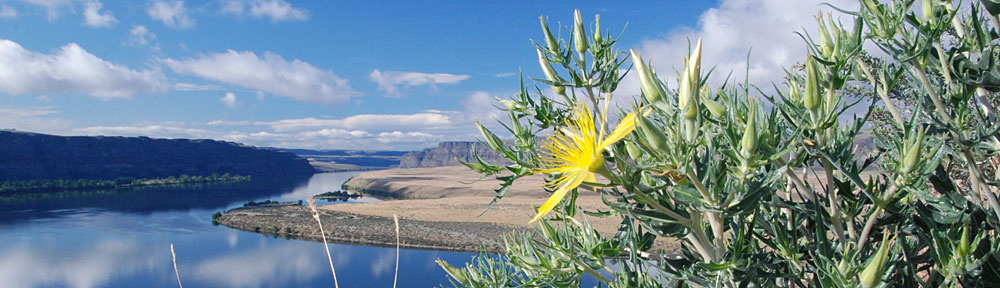
 We had no problem with that. I repositioned my helicopter to the north end of the ramp and set it down beside the two F-16s.
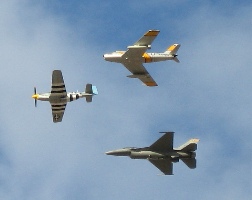 The airport closed at 3 PM and the Air Boss took over. A bunch of the performers took turns practicing their routines. It was mostly aerobatic stuff. The kind of flying that makes you wonder why people think helicopter pilots are crazy. These guys, purposely inverting their aircraft and letting it go out of control in tumbling dives are the ones who are crazy. But it was pretty cool to watch, as long as you didn’t try to think yourself into the cockpit. There was also a bunch of tight formation flying, including a flight with the F-16 and two other fighters: the Heritage Flight. (Not a bad shot with my new camera, huh?)
 Then the sun set and the balloon pilots started setting up for the big evening event: the desert glow. By 6:30, 19 balloons were floating right over the taxiway, using their burners to light up the night. The ramp was open to the public and thousands of people were wandering around right beneath the massive envelopes. It was magic.
 I started flying at 7 AM, when the balloons were just lifting off. They drifted to the west-northwest, toward Luke Air Force Base. My pattern was a bit more north, so although I flew between a few of them, most of them were to my south. The view on the return part of our loop was incredible — dozens of balloons hanging in the early morning sky.
 This morning, I put the stickers on the cart, as shown here. (The Blackfly sticker is on front.) I used a Sharpie to change “This Car Climbed Mt. Washington” to “This Cart Climbed Mt. Washington.” (John and Lorna’s idea, not mine.)(Mt. Washington, to you west-side-of-the-Rockies people, is a “mountain” on the east coast. Although I’ve never been up there, it’s evidently a big deal to drive up the road to the top. (I can’t imagine it being such a big deal, having climbed Pike’s Peak — over 10,000 feet — in a rental car.) There are lots of cars on the east coast with these bumper stickers.) Of course, I had some other personalization options in mind. Gus, the Fuel Manager, had gotten an orange and white checkered flag for his golf cart. It’s the standard airport “Follow Me” type flag. I decided I needed a flag, too. But I wanted something different, something that said something about me. I got that in Maine, too. A Jolly Roger.
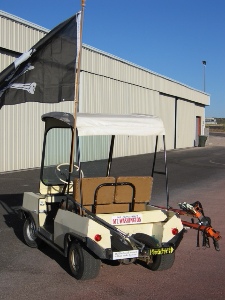 So now my cart is starting to look like something special, something I’m proud to drive around the airport. But I need more bumper stickers! Do you have a bumper sticker you think would make a unique addition to my cart? If so, send it! If it’s appropriate, I’ll stick it on and take a new picture here for this bLog. Please don’t send anything crude, tasteless, or politically incorrect. I may not be the most popular person at the airport, but I don’t want to be universally hated, either.