Snowbirding 2020 Postcards: Another Colorado River Sunset

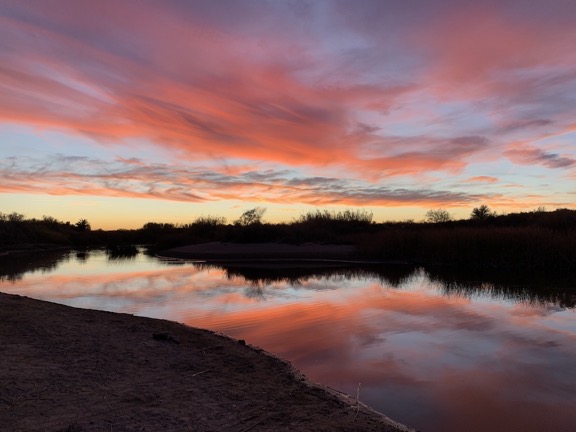
Another gorgeous sunset as seen from our campsite.

I’m going to try very hard not to share photos of every single beautiful sunset we’re seeing from our Colorado River campsite, but this one was too good not to share. With just enough clouds and smooth water to reflect them, Thursday’s sunset was the best I’d watched in a very long time.

Sunset 12/12/19
What a light show!

Snowbirding 2020: More Power!

Adding more solar power to my camping setup.

Why I don’t have solar at home.

A lot of people ask me why I don’t have solar panels on my enormous roof — it’s about 3000 square feet — at home. After all, central Washington state is dry and desert-like, with sunshine at least 300 days a year.

What a lot of people don’t know, however, is that Chelan County, where I live, is completely dialed in with renewable energy from wind and hydroelectric power. We have extremely cheap power — 3.22¢/kWh, which is 72.9% less than the national average rate of 11.88¢/kWh (per ElectricityLocal.com) — and my monthly electric bills seldom rise above $50 in any month, no matter how much heating or cooling I use in my all-electric home. It would take decades for me to recoup the cost of any solar setup at home. And, because the power I get is mostly from renewable sources, it’s pretty much guilt free.

I have always been a huge proponent of solar power for off-the-grid camping (and life in general). To that end, I’ve invested in solar panels for most of the RV’s I’ve owned, including my current truck camper, “T2.”

When I had my previous truck camper, “the Turtleback”, I thought a portable panel was the way to go. Zamp made foldable panels with a tightly fitting semi-hard case for safe transit and, back in 2016 (I think), I bought a 160 watt setup and had a simple plug socket installed on the outside of the Turtleback’s battery compartment for easy hookup. It worked like a charm.

What I wasn’t thinking about was the fact that the panels were large and heavy and had to be stowed someplace in transit. After I downsized from the Turtleback to T2 (which I also had that handy plug socket installed on), I decided to install 200 watts of solar on T2’s roof. No more dragging around those big panels.

Of course, I didn’t sell them. I keep everything. 🙄

How I Use Solar

I should make it clear here that my solar setup has always been solely to keep my camper’s batteries fully charged when I’m not hooked up to a power source. I do a lot of off-the-grid “dry camping” and if I don’t charge the batteries I will eventually run out of power. (Duh.) I don’t have an inverter to provide alternating current (AC) power for device like my camper’s microwave or even my laptop charger. Everything runs off direct current (DC) power or propane.

I should also mention that I’m not a complete idiot and I also travel with a 2KW generator that does provide AC power. Unlike a lot of other off-the-grid campers, however, I don’t like to run it because I don’t like to listen to it. It’s a Honda and it’s quiet, but it’s a lot more quiet when it’s turned off. I wish other RVers would turn off their f*cking televisions (and generators) and enjoy the outdoors. If they want to spend their time watching television, they could stay home or park in a KOA.

Don’t get me started.

Another Solar Setup?

Time went on. My needs changed. This year, I’m traveling with a cargo trailer — “Lily Rose” (long story) — that I’ve got set up as a mobile jewelry shop. The trailer has a lockable toolbox on the front near the hitch and I thought that would be perfect for installing a few batteries, keeping them charged with the Zamp panels, and connecting them to an inverter I could use to get AC power into the trailer or for use with T2. So when I packed Lily Rose for my trip south, I packed the Zamp panels. I figured I’d get price quotes at the two Quartzsite solar dealers when I got there.

I wound up visiting just one of the two dealers. His price quote was enough to convince me that my setup was wishful thinking. Sure, they could build me a system with 4 6-volt lithium batteries, a 2kw pure sine wave inverter, and the receptacle for my existing Zamp solar panels. All it would cost would be about $4,500.

Ouch! That’s more than I spent to buy Lily Rose! My budget was about 1/4 of that so it just wasn’t going to happen. No sense in getting another quote; it probably wouldn’t be much less — if it was less.

Use What You’ve Got

So there I was in Arizona with an extra solar panel setup. What was I to do?

Use it, of course. I’m at my campsite for more than two weeks. I found a mostly sunny spot and hooked up the Zamp to T2. Despite the short winter days and increased shade in our tight campsite, I’m keeping my batteries fully charged every day.

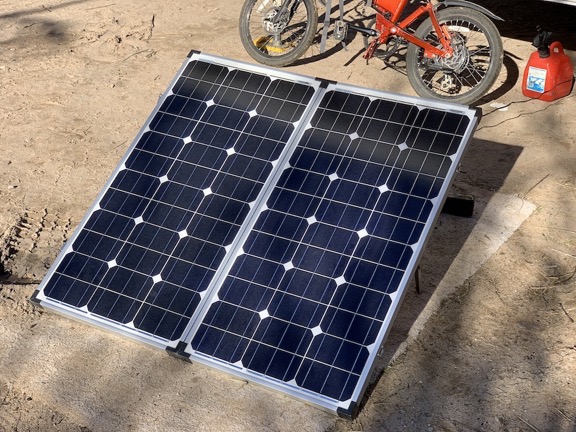
Zamp Solar Panels
My Zamp solar panels. They fold in half; the solar controller is built into a panel that hangs behind it. The legs to angle it toward the sun are attached. It’s a nice setup. Also in the photo: my electric assist bike and a 2 gallon fuel container for my generator. Our site is surrounded by 15+ foot tall bamboo which limits the amount of direct sunlight we get; you can see the shadows, too.

No sense in not taking advantage of every resource I have to collect power.

Snowbirding 2020 Postcards: “Camping” in Las Vegas

I make my last on-the-grid stop count.

I spent my second night on the road at the Sam’s Town KOA Kampground in Las Vegas. This has become a bit of a tradition for me. Since this is usually the last night I have an opportunity to plug in, get water, and dump my tanks before spending two more more weeks camped out in the desert with friends, I always opt for a full hookup campsite. This particular campground is convenient and usually — but not on this trip — cheap. This time, they hit me up for a very long drive-thru campsite that was a lot bigger than I needed, claiming shorter sites weren’t available. That turned out to be bullshit so I’ll probably look for a different destination on future trips south. $60 is a bit rich for an overnight stop.

I should say up front that I hate KOA-style “camping.” It’s not camping at all. It’s parking with a connection to water, electricity, cable television, and a sewer hookup. The sites are so close together I don’t know why they even bother with the narrow island of dirt and trees between sites that face each other. People who claim to be “camping” at a KOA are deluding themselves.

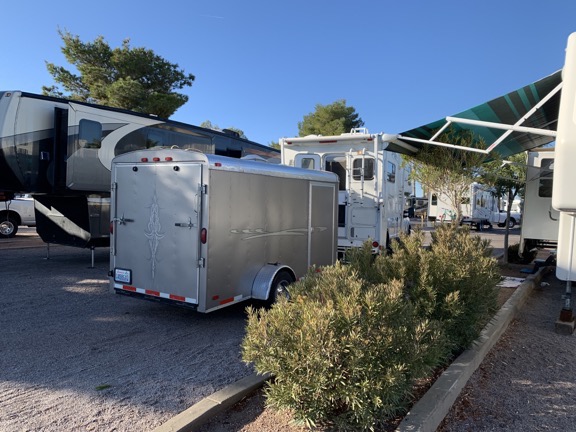
KOA
Here’s my rig parked between two others at the KOA. My space was over 70 feet long; all I needed was about 40.

But my site was about what I expected and it met my needs. I arrived long before sunset and got a chance to glimpse the sky’s changing colors through the field of RVs around me.

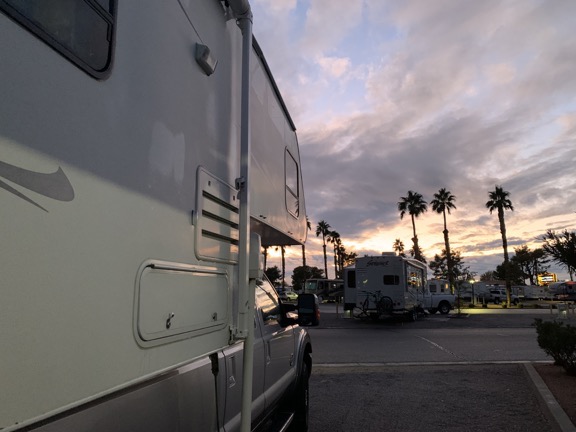
Sunset
As you can see in this photo, the weather cleared that afternoon and evening in Las Vegas. It was nice to see blue sky for the first time since my departure from home.

After taking Penny for a walk — her first since departing Glenns Ferry that morning — I hooked up power, sewer, and water and went in for the night. My nose had begun running earlier in the day and it was becoming apparent that I’d caught a cold. Although I did toy with the idea of going into Sam’s to look at their Holiday light show and maybe get some dinner, I recalled how sick I’d gotten after the last meal I had in their steakhouse. I decided to stay in for the night and was dead asleep before 8 AM.

In the morning, I felt rested but no better. I made and ate breakfast, walked Penny, took a hot shower in the otherwise empty shower building, put on clean clothes, and took my time about packing up. By 8:30 AM, with waste tanks empty and fresh water tank filled, I was ready to hit the road again for the last day of my drive.

Snowbirding 2020: The Drive Plan

Another trip down an all-too-familiar route.

Posts in this series:
The Big Plan
The Drive Plan

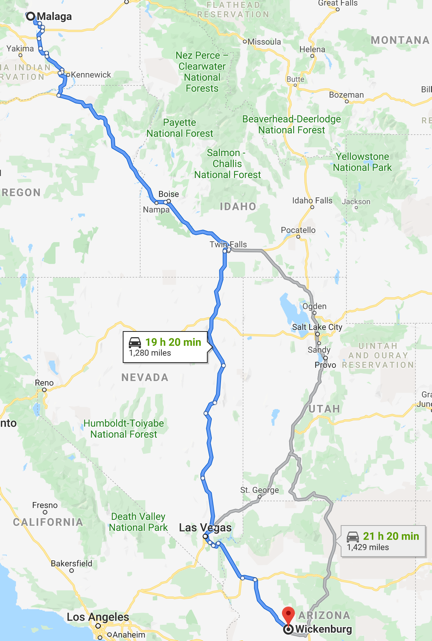
On Tuesday, I plan to start by drive to — of all places — Wickenburg, AZ. It’s a drive I’ve taken many times. After all, I started spending my summers up here in Washington in 2008, the year I got my first cherry drying gig. Back in those days, I’d make two drives north in the spring — one in my helicopter and a second in a truck pulling a trailer to live in. Then, at the end of the season, I’d make two drives home to get everything back to my Wickenburg hangar.

The Preferred Route

During those years, I tried all kinds of routes north or south and I discovered the one truth about the drive: the shortest route involves route 93 between Wickenburg and Twin Falls, ID and I-84 between Twin Falls and the Tri-Cities area of Washington. Ask Google Maps — it’ll tell you. And even if you don’t believe it, I can confirm in. I’ve driven just about every other possible route.

Map of Route
Google Maps knows the fastest routes. This map even shows the route 6 shortcut.

I-84 is a freeway that goes from Portland to Salt Lake City, leaving the relatively flat land of eastern Washington to climb the Green Mountains east of Pendleton, OR (of blanket fame) before descending southeast bound into the Boise, ID area and crossing rolling prairie land. The terrain climbs and descends again and again as I head south on the two-lane route 93 from Twin Falls, which I mostly stick to, taking advantage of a shortcut on route 6 between Ely and Crystal Springs, NV.

Route 93 is one of those remote roads that frighten city people. Towns aren’t much more than a handful of homes — if that. Gas stations are few and far between. If you miss a fuel stop you could be in serious trouble, waiting hours for the AAA guy to bring you five gallons. I’ve never run out of fuel on this route, but I’ve had more than a few close calls. If diesel wasn’t so damn stinky, I’d bring along a spare 5 gallons just in case.

Once I get to I-15, I’m back on the freeway and in very familiar area just outside of Las Vegas. Then, near Boulder City, NV, I leave freeways behind again for the long drive down route 93 to Kingman, a short stint on I-40, and more route 93 all the way down to Wickenburg. It’s 1,280 miles and should take about 20 hours with fuel stops if I stick to the speed limit — which I do when I’m towing these days. I used to be able to do it all in two days, with Jackpot, NV on Idaho’s border as my preferred overnight stop. That’s where I’d sleep in my RV in the truck parking lot outside of Cactus Pete’s casino. When the trip north stretched to three days due to weather or a late start or, in one case, illness, I’d try other overnight stops including a lakeside campsite at Pahranagat National Wildlife Refuge just south of Alamo, NV; a casino parking lot in West Wendover, NV; a campsite at Farewell Bend State Recreation area near Huntington, OR; or a state park campground somewhere in the Green Mountains. I’m not opposed to overnighting in a Walmart parking lot, but I’d prefer not to.

The Challenge of Driving When Days are Short

Driving south in late autumn is a whole different story. I can’t do it in two days mostly because I prefer not to travel in the dark. That means it’s always three days and I need two stops along the way. So not only do I have to plan my route around the weather, but I should have a damn good idea of where I’m going to stop along the way to make cold weather camping bearable.

And that’s the challenge. My truck camper is not winterized and I don’t want its pipes to freeze. I also don’t want to worry about running out of battery power at night when the heater would likely run nonstop to keep the poorly insulated camper warm enough for me to sleep. The answer is to find a campground with a power hookup that’s right on my route, close enough to reach before it gets dark.

I found such a place last year: the tiny Three Island Crossing State Park in Glenns Ferry, ID. Although the water is turned off in this campground and the bathrooms are closed and locked, the power is still turned on and available. I can pull into a campsite, plug in, and use my quiet electric heater to keep the camper warm all night. I get the added benefit of being able to use my microwave to heat up some dinner and my electric coffee maker to make coffee in the morning. The forecast says Tuesday night’s low will be 25°F so I really will appreciate that electric hookup.

Three Island Crossing is 491 miles from Malaga and will take about 8 hours to get to with one fuel stop along the way. That means that if I leave here at 7 AM sharp, I’ll get there by 4 PM local time. Sunset there will be around 5 PM. I arrived after dark last year and left in the morning before sunrise so I never got a chance to actually see the place. It would be nice to see it this year. I plan on hitting the road long before the 8 AM sunrise the next morning.

The Las Vegas Stop

My next stop is a no-brainer of sorts: Las Vegas, NV. If you think it’s weird camping in Las Vegas, you’re right. It is.

I stay at the KOA at Sam’s Town. In general, I dislike KOAs — they’re glorified parking lots. But this isn’t a camping trip. It’s an overnight stop before I’ll be spending weeks off the grid. I found the KOA years ago and have been staying there every trip south since. I get a full hookup site, plug in, and get a good night’s sleep. In the morning, I use the clean, warm, completely underutilized shower facilities to get a good, long, hot shower. Then I top off my water tanks and dump my black and gray water. If I need propane, I buy it there and the attendant helps me load it back into the compartment where the tanks go. There’s Sam’s Town next door if I want a good dinner or breakfast that I don’t have to cook. There’s a Walmart across the street if I want to stock up on anything I might have trouble finding in the weeks to come. And if I get there early enough, I can take a free shuttle or an Uber out to the strip to see what’s changed since my last visit. I admit that the chances of that happening are minimal; the 555 mile drive will take about 9 hours with fuel stops and I’ll likely be exhausted after two full days on the road.

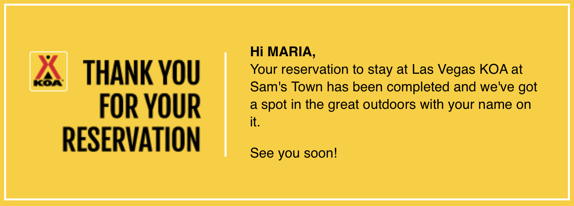
KOA Great Outdoors
This screenshot from an email confirmation is what prompted this blog post. I love the way KOA refers to a campground in Las Vegas as “the great outdoors.” 🙄

This particular stop — especially this year — will be my most expensive overnight stop this year, coming in at just about $55 for the night. Ouch. The reason it’s so costly: it’s not just my truck camper this year. I’ll be pulling my cargo trailer, which makes my rig a lot longer than it normally would be and really encourages me to find a pull-through spot. (Backing a trailer is hard enough when you can see it but it’s nearly impossible when a truck camper hides it from view.) Because most of the folks who stay at that KOA are driving big rigs — hence the underutilized shower facilities — all of the smaller pull-throughs are taken. The only one available was a 72-foot long spot. I shouldn’t have any trouble fitting my roughly 40-foot total length rig into it, but it’ll cost me. Big spots cost big money.

The high cost also encourages me to stay just one night when I might have stayed two. I haven’t really enjoyed a trip to Vegas in a while. I suppose I’ll have to wait for the next time HeliExpo comes to town.

The Home Stretch

The rest of the drive is very familiar. As I write this, I’m planning a stop in Wickenburg where I might be participating in a holiday art show. It’s still unclear on whether they have room for me; I applied late (as usual). If I’m in, I go to Wickenburg. If I’m not in, I might go straight down to our usual camping area on the Colorado River. That means taking route 95 south from Vegas, all the way into California at I-10 or possibly crossing the river at I-40 and heading south from Lake Havasu. I’ve gone both ways and they both work.

Either way, it’s a short travel day with less than 300 miles to cover so I’ll definitely get to my destination.

And by that time, I should be back in t-shirt weather with very few worries about keeping my camper from freezing overnight.

That’s the plan. Stay tuned to see if I stick to it.
Snowbirding 2020: The Big Plan

I prepare for my annual migration south, this time with a mission.

Posts in this series:
The Big Plan
The Drive Plan

This week I’m busy packing for my annual 3-month journey to points south. That means not only packing my truck and camper for the 1200-mile drive to central Arizona, but prepping my new used 12-foot cargo trailer to haul gear and work as my mobile jewelry shop. If I do everything right — and can fit everything I need into my limited storage space — I’ll have a comfortable and productive trip where I can enjoy warm weather and abundant sunshine and get to see a lot of old friends.

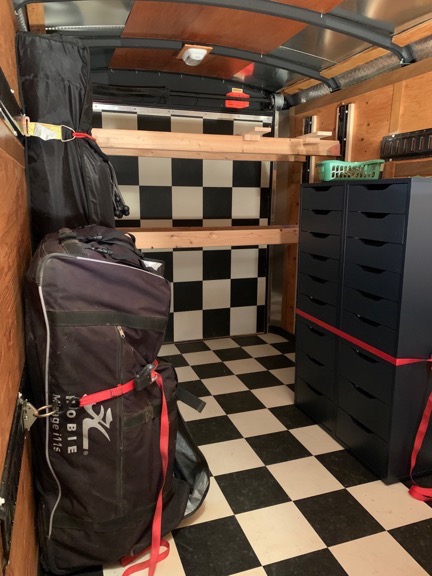
Trailer Inside
Here’s the inside of my trailer as I pack it. The drawers will hold materials and tools for making jewelry. The shelves in back are for my display tables, solar panels, and other necessities.

This year is different from other years, though. This year I have a mission — I plan on seeing if I can do well enough selling my jewelry at art shows to continue doing art shows. It’s a sort of make-or-break run at what could be my fourth career.

And no — despite the rumors being spread around by one of my friends (who I really do need to talk to) — I have no intention of giving up flying any time soon. But let’s be real: I can’t fly forever. It would be nice to have another career to fall back on when the time comes that I can’t make a living as a pilot anymore. If you look back, you’ll realize that I set up my flying career long before my writing career faded — and that was a very fortunate thing for me. And I didn’t exactly dive into my writing career before setting the stage during my finance career.

The Shows

So my goal this winter is to see how many shows I can do and how much money I can net doing them.

That said, I applied for ten shows covering a total of 31 days from late November through February. I was accepted to eight of them covering a total of 28 days. Of those, I accepted seven for the same 28 days. (It’s pretty common to apply to multiple shows at the same time in case you don’t get into one; I actually got accepted to two on the same weekend.) Although most of the shows are on weekends, two of them are 10 days each; for one of those shows, I’ll actually be spending 3 days at another show. Sounds confusing? It is. You can see my schedule here.

I also applied for another show in February and two more in March; I haven’t heard whether I’m in or out of any of them. I’m hoping I get the two March shows, which are both in California. It’ll give me an excuse to visit some folks I know there on my way home. If I don’t get them, I’ll apply for another show in Washington, much closer to home.

My two long January shows are weird. They’re in Quartzsite at a venue where vendors camp with their booths. I have a tiny space there to keep my costs low and I’m not quite sure that everything will fit. But the benefit is that I won’t have to move for nearly four weeks and I’ll have a full hookup for my RV that whole time. I don’t expect to sell much there — did I mention that it was a weird venue? — but I’ll be staying near friends and close to where I can stock up on stones and other supplies. Oddly, I like Quartzsite in January.

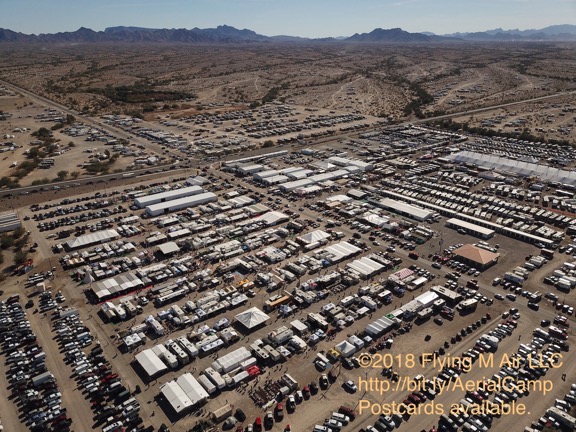
Tyson Wells and RV Show
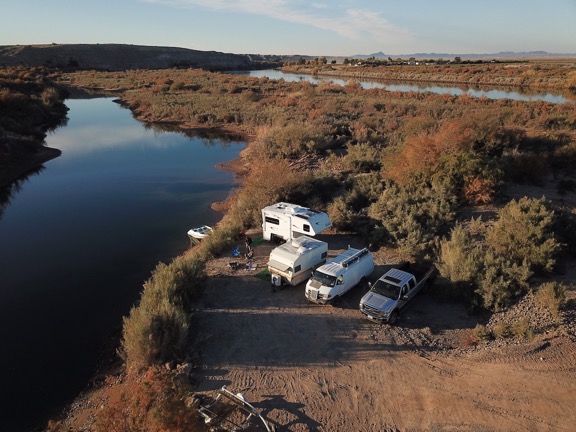
Here’s a 2018 drone shot of Tyson Wells and the RV show across the street. I’ll be one of the vendors camped out this year for about four weeks.

Some R&R

Of course, the first half of the trip will have lots of leisure time. Although I may start with a short show in Wickenburg, I’ll be heading out to the River after that. My friend Janet and I camp out there every December and it seems that we’re getting an earlier start every year. I’m hoping to get a good site where we can camp right on the river. My kayak and fishing pole are already packed.

Campsite
This is the campsite Janet and I shared in 2017 — the year I brought my boat with me. We were there just two weeks.

I do have a mid-December show in Phoenix to attend; I’m planning on leaving my rig at the campsite with Janet and spend the weekend at a friend’s place in Gilbert. I might even coax him out to the river for a few days. We’ll see.

And I have to admit that I’m not a 9 to 5 vendor in Quartzsite, either. Although I’m open on weekends, I tend to goof off during the week, going out on photo or shopping trips in the morning and opening my booth around lunchtime. I’m sure Janet and I will play hooky at least once for a trip out to the river, too.

The Tucson Trip

After January in Quartzsite — and another show in Gilbert that I might or might not get into — I’ll go down to Tucson for about a week. I’ve signed up for four jewelry making courses with Vivi Magoo. I’m very interested in learning new things that can expand my capabilities. The classes I signed up for should do that.

I was in Tucson for just three days last year and wound up parking with my camper in casino parking lots at night. This time, I booked a week in a campground in town. I’m looking forward to being able to drop my camper while I take my classes, check out the rock shows that will be all over the city, and maybe do one or two day trips to Saguaro National Monument and the Pima Air Museum.

This is the second vacation portion of my trip, but I plan to keep pretty darn busy.

Finishing Up

The second half of February has me in two weekend-long shows in the Phoenix area. I’ve done both shows before and they were both worthwhile for me.

And that’s all I’ve got booked.

I did apply for two California shows — one in Palm Springs and the other in Borrego Springs. I applied kind of late for the Borrego Spring show last year and didn’t get in. My friend Janet did, however, and since I’d promised her I’d go there with her, we spent a few days before the show hiking among the flowers in a truly amazing superbloom. This year, with luck, we’ll both participate in the show and then I’ll head home up California’s Central Valley.

If I don’t get into either of the California shows, I might make my way home by way of Salt Lake City where I have friends I’d like to visit. Or Reno where I have other friends to visit. I can always find someplace to go or someone to see on my way home.

Prepping for the Trip

So now I’m home with just a few days left to finish packing up for my long trip. I’ll be selling jewelry locally at Pybus Public Market this weekend, so I can’t pack everything yet. But I can pack what I don’t need for that show, which is quite a few things.

Meanwhile, I’m also cleaning my house. My house sitter will be here on Monday and I like to start him off with a sparkling clean place so he rewards me with a sparkling clean place on my return. Whether I return in the beginning of March or the middle of the month depends on whether I get into those two California shows and how much I goof off on my way home. He’s prepared to stay until March month-end if necessary.

And I think that’s what I like most about my life these days. With the exception of about three months in the summer when I’m stuck at home for cherry season, I can make up the rest of the year as I go along. What’s not to like about that?