On Solo Travel

I reflect on traveling alone after two weeks traveling with a companion.

After traveling with my friend Bill for two weeks and finding myself on my own again, I started thinking about traveling alone vs. traveling with a companion. I began by tracing back the time when I had begun doing the majority of my travel alone.

My History of Solo Travel

My first instinct was to place my solo travel start date in 2012, when my crazy divorce began, but that wasn’t right. I’d been traveling alone to Washington state for work every summer since 2008. I’d even gone to Alaska for a few days in early 2008 for a pair of job interviews. I’d also made plenty of work-related trips to Ventura, CA, and Boulder, CO, in the years leading up to the inevitable split.

And what about the 19-day road trip I took alone in 2005? What a trip! I piloted my then-nearly-new Honda S2000 (which is sitting in my garage at this moment) through Arizona, Nevada, California, Oregon, Washington, Idaho, Montana, Wyoming, and Utah with no plans or reservations — just a bunch of AAA maps and a credit card.

And how about the weeks I’d gone alone to northern Arizona in 2004 when I worked as a tour pilot at the Grand Canyon? Or the dozens of solo cross-country flights with overnight stays that I’d taken alone in my R22 and later my R44 to points as far away from my Arizona base as northern California and the western slopes of the Rockies in Colorado?

And during the rise of my writing career, when I’d traveled to work for training gigs, editor meetings, conferences, and speaking engagements? Heck, I still remember the month when I traveled to six or seven different cities, often bouncing from one to another on airlines before spending a few days at home. Ten airline legs and a round-trip train ride.

And before that, when I worked in corporate America and spent at least 40% of my time traveling to company offices all over the country for work?

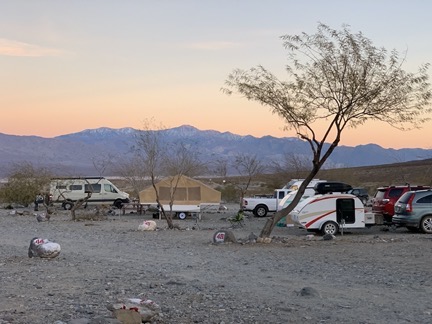
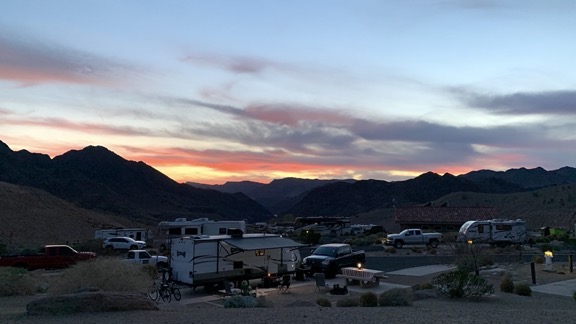
Panamint Springs Campground
Here’s the Panamint Springs Campground from my camper just before dawn.

As I sit here in my camper in a very dark, sparsely populated campground in Panamint Springs, CA, I remember that very first solo business trip, which may have been the first time I ever traveled on my own by airliner for more than a night away from home. I’d gone to Lenexa, KS. I’d packed my brand new and very unpractical (as I’d learn) luggage and had been subjected to a number of airline delays to Kansas City that put me in the hotel parking lot sometime after midnight. I was on the second floor of a hotel that apparently didn’t have an elevator and I struggled to get my bag up the stairs. In the morning, I couldn’t remember what my rental car looked like or where I’d parked it. I don’t remember much of the trip after that, aside from finding some excellent barbecue (the real deal) and bringing a bunch of sauce home. Could that really have been my first solo trip? Seems like it to me.

Admittedly, not all of these trips were 100% solo. My early work-related travel was sometimes shared with a coworker who would travel with me to the destination and hang out with me after work. I remember one particular trip where I went with two other female coworkers to the Buena Park, CA, location of our company for a three-week audit. On one of the off weekends, we hopped on a plane and went to Tahoe for two nights so they could get some skiing in. On another trip to the same California office, my coworker and I drove down to La Jolla for the weekend. Still, it’s not quite the same as sharing a trip with a life partner.

Of course, I first realized that much of the travel in my life has been alone years ago when I wrote a blog post titled “About the Header Images.” In that post, I go through the exercise of reviewing every single image that appears in the random rotation atop the pages of this blog, providing a short summary of what each one is about. While I may have added and removed a few images since then, there are plenty in that blog post that still appear here; if you’ve ever wondered what a specific shot is, grab a cup of your favorite beverage and scroll through that post. You might catch something in the tone of my comments; I suspect I wrote it when I was still bitter about how my divorce played out and before I realized what a great gift my wasband had given me by leaving.

The Pros and Cons of Shared Memories

Early on in my friendship with Bill, I mentioned that the thing that bugged me most about being completely estranged from a person I’d had a very long relationship with — in this case, my wasband — was that I couldn’t discuss shared memories with him.

You know what I mean. You go someplace or do something especially memorable with a person and you say to that person “remember when we…” and follow that up with a nice chat or maybe even a good laugh about the experience.

In these cases, the experience is usually shared by just the two of you. The memory doesn’t require any backstory to share together, as it might when sharing it with someone who wasn’t there.

For example, I could remind my wasband of the time we managed to get the two drive wheels of our rental car off the ground when he drove off the road and hit a cattle guard post. If I told you about it, I’d have to tell you about the dirt road out in desert between Tombstone and Tubac, about how he was probably driving too fast, about how the road looked like it curved one way but actually curved the other, about how he tried to correct the turn and the car went out of control. I’d have to tell you about the comedy of me holding the equivalent of a 7/11 Big Gulp and having it fly up into the air and soak into my clothes and the car seat. About getting out of the compact car and finding it teetering on the mostly rotted, broken 4×4 post. About trying a variety of things to get it off until he finally stood behind the car and held the tail end in the up position, like Superman, while I got enough traction on the front wheels to drive it off the post. About how we started laughing about five minutes after we resumed travel and didn’t stop for quite a while.

All I have to say is “Remember when we got the rental car stuck on a cattle guard leaving Tombstone?” And then we could laugh over the details of the memory.

That’s the kind of thing I miss.

Of course, I didn’t only travel with my wasband over the years. I’ve got some good trips in with my friend Janet — especially the one where we helped out a friend with a motorcycle camping business in the southwest and followed him around with my Jeep, doing a good amount of exploring in our off hours. (Yes, I’ve done some rock crawling in a stock Jeep in Moab. It’s all about tire placement.) I’ve done trips with my sister and my brother. I can even still recall memorable experiences of early family vacations — especially the time in Maine when I got my first helicopter ride or the trips to Virginia when I learned to catch blue claw crabs with a piece of sting, a chicken bone, and a net.

So yes, I do have plenty of travel experiences to recall with other people who aren’t as pigheadedly stupid as my wasband is.

I think the ability to share and recall experiences with other people help keep relationships and memories alive. I think they’re important parts of our mental well-being, especially as we age and memory starts failing.

As you might imagine, I’m very glad to have “remember when…?” experiences with someone new.

The Benefits of Solo Travel

My friend Bill travels alone just about all of the time. He likes it. And by talking with him about it, I realized that I like it, too.

If you can put aside any desire to create “remember when…?” experiences or unfounded fears of being by yourself — seriously, get over that shit — the benefits of traveling alone are easy to see.

The main benefit, of course, is decision making. When you travel alone, you make all of the decisions — and have the freedom to change your mind as often as you like. Want to turn left enroute because the sign you didn’t expect to see says there’s a waterfall down that road? Do it. Want to spend three nights instead of one at a lakeside campsite you’ve found because it’s way better than you expected it to be? No problem. Want to completely skip that side trip to the coast because you’ve heard about an interesting spot inland with dark night skies and miles of hiking trails through forests? Go for it!

(My biggest pet peeve of traveling with my wasband was trying to make a plan change and hearing him say, “But I thought we were going to…” Pardon me, but fuck that bullshit. I’m so glad I never need to hear those words again.)

Another benefit that not many take advantage of is the opportunity to talk to strangers. I’m not sure why it’s so easy for me to strike up a conversation with someone I don’t know — maybe my background growing up in the New York metro area? Maybe I inherited it from my grandmother, who talked to everyone? — but it serves me well to this day. I talk to strangers all the time, whether I’m waiting in line at the check out counter of a supermarket, standing at a trailhead map, or passing someone in a campground with an usually cool camper.

My favorite story of the benefit of talking to strangers is from 1995, when I was spending the winter (mostly alone) in Yarnell, AZ, trying to escape the winter cold of my New Jersey home. (I guess I forgot to mention that solo three-month trip in my list above or the 10-day trip a few months before it when I searched for and found my winter lodging. I really have done most traveling alone for most of my life.) My brother had flown out for a visit and we decided to take a trip up to the Grand Canyon for a few days. We were waiting in line for breakfast at El Tovar, the historic hotel at the South Rim, which used to have a really excellent restaurant. A guy traveling alone was standing in line behind us. We struck up a conversation and eventually asked him to join us so he didn’t have to eat alone. He did. During our breakfast conversation, we talked about places we’d traveled to and he mentioned a hot spring at the very south end of Big Bend National Park in Texas. The way he described it, it sounded really nice. A month or so later, when my future wasband joined me for the drive back to New Jersey, we detoured down there to check it out. It was everything he’d told me and so much more. It created yet another “Remember when…?” experience for us.

It’s by talking to others that we learn about new things and places that they have experienced and some of those things and places might be things we want to experience, too. Why consult a guidebook about tourist-worn destinations when you can chat up someone camping a half mile away from you while on a morning walk and learn about other campsites in remote areas of the desert southwest? Why search the web for the same old crowded hot springs options when you can pick the brains of a couple from Canada at a hot spring in Holtville, CA to learn about a remote spring along the Colorado River in western Arizona? Why, for Pete’s sake, would you even consider consulting Yelp to get the real low-down on a restaurant or shop when you can ask someone who’s actually been there and can give you his take on it?

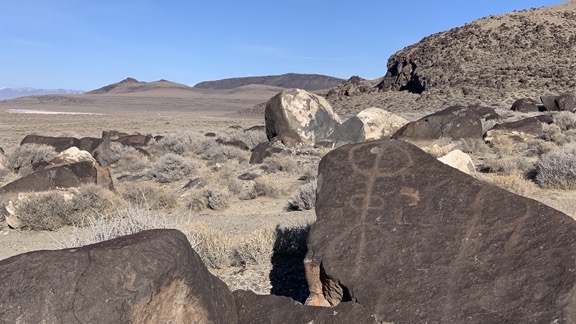
Grimes Point
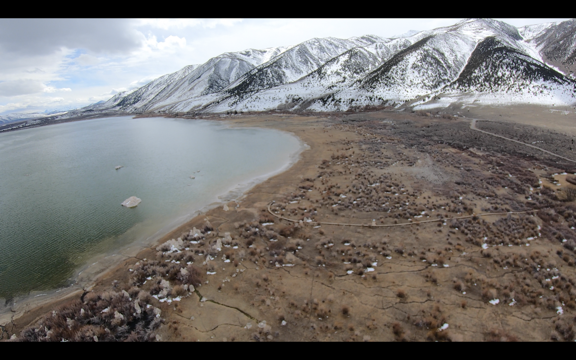
I learned about the petroglyphs at Grimes Point by talking to a stranger yesterday.

And yes, I know you can talk to strangers when you’re traveling with someone else. I usually do. But I’ve also found that your opportunities to talk to strangers may seem limited when you are already talking to the person standing next to you. It’s the alone time that makes it easy to strike up a conversation with someone else. And the freedom to talk for as long as you like — without a companion reminding you of your next destination — that makes it so much more beneficial.

Oddly, Bill makes this moot. Like me, he also likes to talk to strangers and does it whether i’m standing next to him or not. (Like I did at the Grand Canyon 26 years ago with my brother standing next to me.) And because we weren’t joined at the hip during the two weeks we traveled together, we both had plenty of opportunities to chat with others — and learn new things.

Back to Solo Travel

It’s the day after I began writing this blog post at near the western edge of Death Valley National Park. Since then, I’ve descended down into the Owens Lake area, stopped for an Internet fix, and uploaded my blog post about traveling with my new friend, Bill. And I made a series of solo decisions for a three-day drive the rest of the way home.

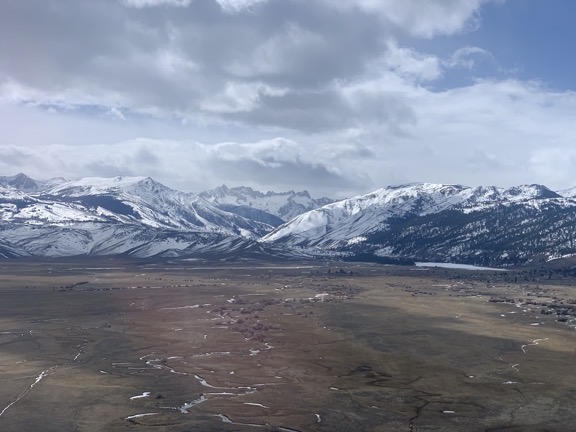
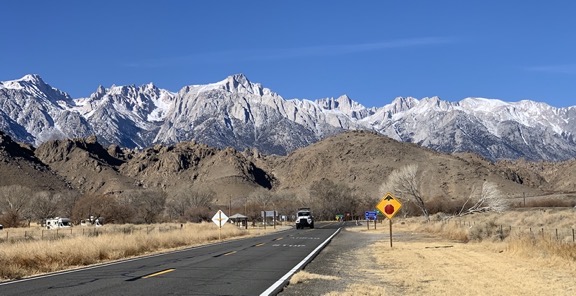
Sierras
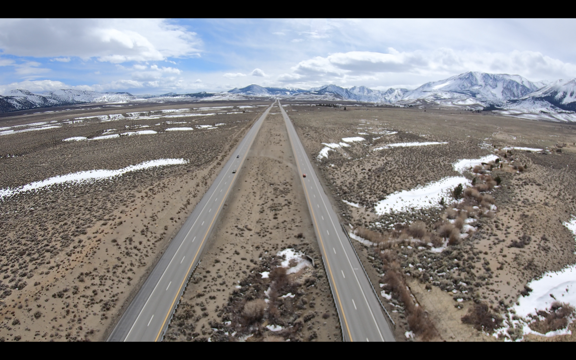
Here’s a view of the Sierra Nevada Mountains from the intersection of Route 136 (out of Death Valley) and Route 395. I watched those mountains grow ever closer as I descended out of the park.

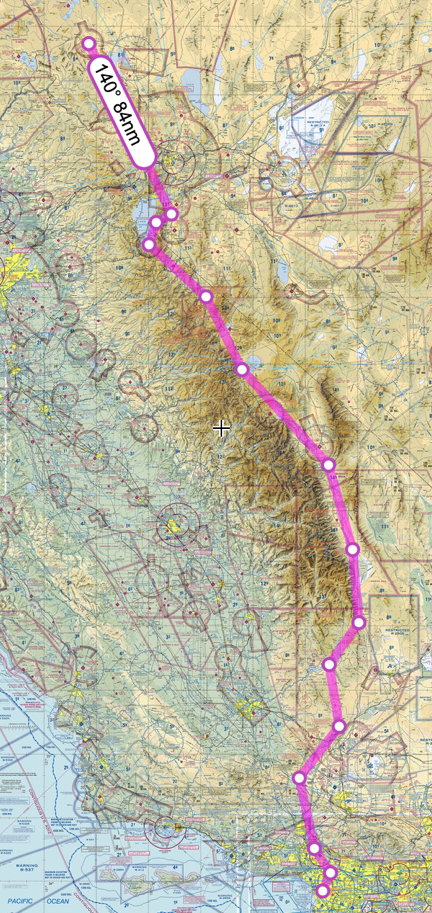
What did I do? Well, I followed a series of numbered routes from Panamint Springs, CA to my eventual overnight camp near Lovelock, NV: 136, 395, 6, 360 (which I have dubbed Wild Burro Way), 95, and I-80. All of these roads were either one or two lanes in each direction with speed limits ranging from 55 to 70 and only the last one was an interstate highway with a speed limit of 80. There’s no reason to hurtle down the blacktop to your next destination when you can take back roads that move you along at a decent pace and give you something more interesting to look at than the occasional truck stop. (While I don’t mind getting on an interstate highway once in a while, Bill absolutely abhors them. I know other drivers who never take the back roads; they have no idea what they’re missing.)

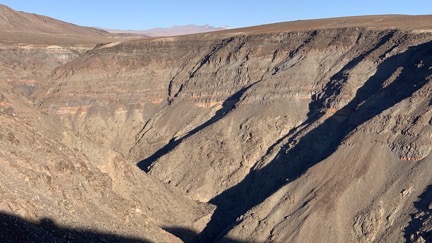
Father Crowley Point
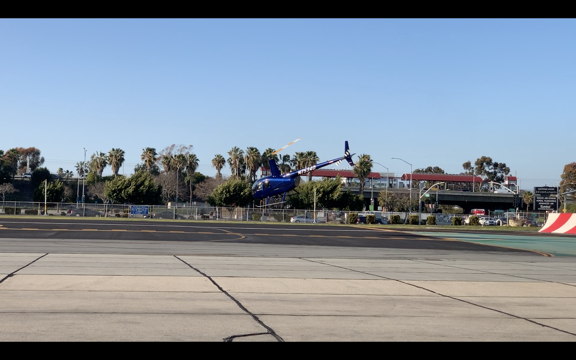
Early morning light in Rainbow Canyon from Father Crowley View Point. Can you imagine being here when a fighter jet screams through? I witnessed it once years ago.

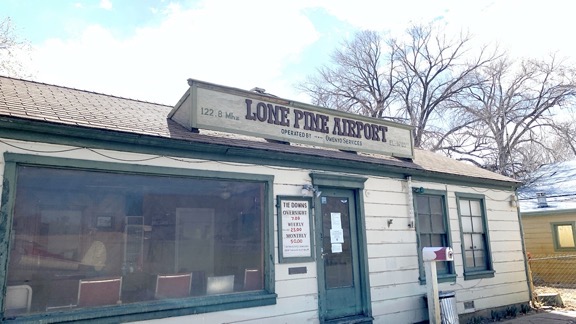
Along the way, I stopped to make breakfast at Father Crowley View Point, a scenic view on the west side of Death Valley that’s known for the low-flying fighter jets that practice there; i was disappointed that none appeared early that morning — it was about 7:30 AM, after all — while I made and ate a hot breakfast in my camper, did the dishes, and took my pups for a walk. Once I was within a cell signal reception area near Owens Lake, I stopped to check email, Twitter, texts, and phone messages and to upload the blog post I’d finished the day before. Then I stopped for gas in Lone Pine, for early lunch at a place Bill recommended in Bishop, and a Ford dealer in Bishop where I had some annoying warning lights turned off. (When I got my oil changed earlier in the month, the guys who had done it had failed to reset the reminder and it was also nagging me about a fuel filter.) I had plotted my route north to stop at rock shops along the way and, after passing two that looked permanently closed, found one that answered my phone call and let me in. I bought 6 pounds of Fallon Wonderstone rough — exactly what I had been hoping for since seeing some near Tecopa — for a lot less than I thought I’d have to spend. The woman who sold them to me told me about where she and her husband had dug them up, not far from an archeological park called Grimes Point. I headed there next and took a short walk with my pups to look at the petroglyphs. (Sorry, I can’t recommend this sone when I’ve seen so many others that are so much better.) I almost parked for the night in the desert near there — I’d actually stopped the truck and climbed into the camper with the girls — but it was only 3:30 PM and I was getting bad vibes about the place. So I consulted an app I have that lists various camping areas and found Humboldt WMA near Lovelock; about an hour and a half later, I was navigating down a muddy road to a nice campsite on what looks like a canal. I had the whole place to myself; it was dead quiet and dark overnight.

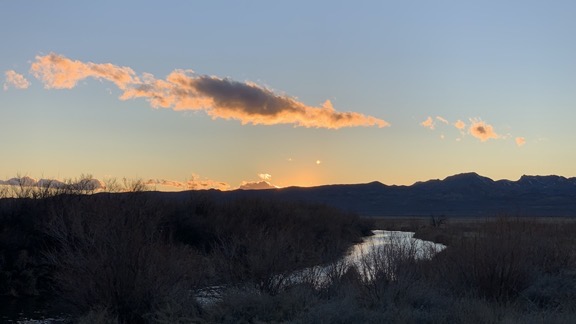
Humboldt Sunset
It was cold and windy when I parked for the night at the Humboldt Wildlife Management Area, but I did get to see the sun set.

I admit that I drove by at least two places I would have turned in if I weren’t so focused on getting home. I don’t know why it’s pulling me forward the way it is, but I suspect it has a lot to do with being away for three months and just wanting to enjoy the conveniences of living in a house instead of a truck camper.

After being with a travel companion for two weeks, it did feel a bit weird, at first, to continue traveling on my own. But I got over that quickly. After all, so much of the traveling in my life has been solo, so it really is second nature at this point.

And I do enjoy it.

Snowbirding 2021: My Travels with Bill

I make a new friend who is a real pleasure to travel with.

How many people have told me that I’ll meet someone interesting when I least expect it? Too many to count. And all of them were right.

I was camped along the Colorado River south of Ehrenberg, AZ, with my friend Janet in November when an ATV with two men on it rolled into camp. They asked who owned the truck — pointing at my truck — and I stepped forward. It seemed that one of them had gotten his Mercedes Sprinter van stuck in the sand not far from our site. Could I use my 4WD pickup to pull him out?

And that’s how I met Bill, a retired pilot who spends much of his time bumming around the west in his van. He climbed into my truck and rode back to his van with me, where I surveyed the situation. One of his back wheels was deep in the sand.

We chatted, unable to do anything without a tow strap or chain. (I’ve since bought one.) That’s when I learned he was a pilot and, like me, had his eye on a tug-style boat for cruising Puget Sound and beyond. Those were only two of many similarities between us, as I’d learn in the weeks and months to come.

The owner of the ATV, Dean, camps frequently along the river. While we were chatting, he drove around some more until he found someone with a tow chain. He brought a few supervisors with a long, thick chain back to where Bill’s van was stuck. I put my truck into 4L, locked the hubs, and backed into where he was stuck, stopping when I was close enough for the guys to hook up the chains. Bill climbed into his van and backed up out of the sand with my truck tugging him most of the way. Mission accomplished.

I waited while they loosened the chain, invited Bill to join us for our nightly campfire, and climbed back into my truck for a return to camp.

-o-

Bill didn’t show up for the campfire, but he did stop by in the morning. We chatted for a while. He kept saying he was on his way to Los Angeles and couldn’t stay long, but we kept chatting. Finally, he left us for his trip west, telling me that he’d try to come back in December, after taking care of an early Christmas and a bunch of family stuff in Oregon.

Over the next month or so, we occasionally exchanged texts.

He returned to my camp the day after Christmas. Janet had left that morning and I’d reconfigured my camp to bring my mobile workshop closer to my camper. Bill pulled in late in the afternoon, with groceries for dinner. We chatted the rest of the afternoon, though dinner, and then around the campfire.

In the morning, he joined me and my pups for our morning walk. We chatted the rest of the day away. I was floored by how much we had in common. Hell, he even had the same immersion coffee maker I have and use for camping. I don’t know anyone else who has one of those.

We walked again the next morning. And then he left.

-o-

About a week later, after exchanging a few text messages, I met up with him in California for a day trip to Salton Sea and Slab City in my truck.

Bombay Beach
How can I not like someone who will accompany me to a weird place like Bombay Beach on the Salton Sea?

The following week, he was back in my camp for two more nights. The first day, we drove out in my truck to a campground he likes in California and did some hiking out there. On the way back, we stopped so I could capture some video footage of a helicopter delivering men and equipment to power line towers; it was a real pleasure not to be rushed. The second day, we went to Cibola National Wildlife Preserve so I could show him the sandhill cranes out there. Along the way, we explored some potential camping areas.

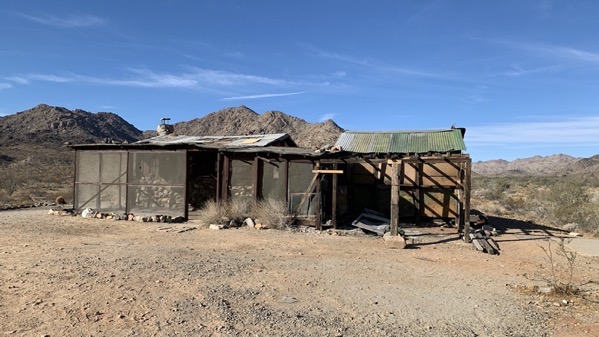
Deserted Cabin
We did some hiking out by Cottonwood Springs, a campground he likes south of Desert Center, CA. Along the way, we found this deserted cabin which was obviously being maintained by a local group of people who care about historic buildings.

Then he was gone again.

-o-

Around the end of January, I finally packed up my campsite and headed out. I had some visiting to do before I made my way back home.

Up until that point, it had been a remarkably mild winter at home and, with my only scheduled art show cancelled due to COVID, I didn’t have much of a reason to stay in Arizona. After two and a half months living in a dusty environment, hauling my own water, and having to drive on 8 miles of gravel to buy a quart of milk, I was starting to think long and hard about a soak in my bathtub and the luxury of my dishwasher, washer, and dryer — none of which required a water transfer pump to use.

Clean Rig
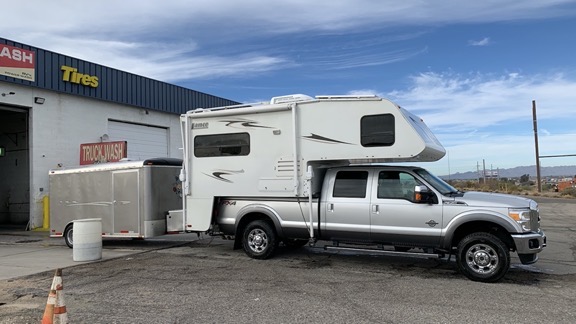
Here’s my traveling rig, emerging from the truck wash where I got everything washed before hitting the road.

I spent one night in a 55+ RV park in Brenda, AZ, mostly so I could dump my tanks, fill up with fresh water, do some laundry, and take a good, hot shower. Then I dropped off my utility trailer with a friend in Wickenburg and headed south to Laveen to visit some friends there. From there, I went to Gilbert to stay with some other friends, enjoying the luxury of a king size bed and super fast Internet in their guest room. I’d had plans to try to find new wholesale accounts for my jewelry in the Phoenix area, but didn’t do any of that. Instead, I hung out with my friends, got my pups groomed, dyed my hair, did some shopping, and relaxed.

On Thursday, February 4, I had my annual flight physical and eye exam scheduled in North Phoenix. I said goodbye to my friends in Gilbert and headed north for those appointments. I spent that night in the desert just north of Lake Pleasant.

Lake Pleasant View
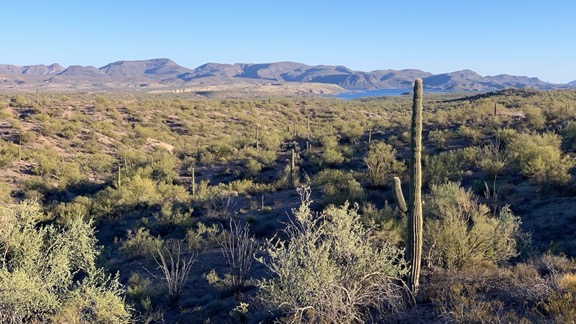
Here’s the view from my camper for the one night I spent north of Lake Pleasant.

I thought long and hard about my travel plans there. The weather at home was turning cold with snow in the forecast. I wasn’t in a hurry to get home anymore, but I didn’t feel like going up to Sedona and Prescott as I’d originally planned. I decided to go back to Wickenburg, fetch my utility trailer, spend a few days at Vulture Peak, and then head north. Death Valley might make a good interim destination.

-o-

But while I’d been traveling around, I’d also been texting back and forth with Bill. I’d told him about the hot spring north of Willow Beach on the Colorado River and he was interested in going to see it with me. We’d meet up somewhere, camp overnight at Willow Beach, and split the cost of a boat rental for a day at the hot springs.

The plan came together quickly after that.

He showed up at Vulture Peak. We spent two nights there, hiking part of Vulture Peak Trail in the middle day and enjoying campfires at night.

Vulture Peak Camp
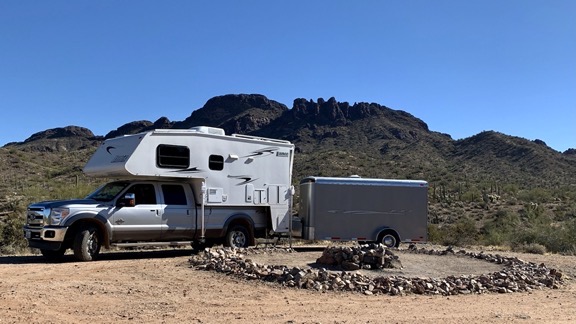
I got my usual campsite at Vulture Peak and Bill pulled in right behind my trailer for the two nights we were there. For some reason, however — maybe the weekend? — the campsite had a lot of foot traffic wandering through, which made it a lot less pleasant than usual. I was glad to leave on Sunday.

We left Wickenburg on Super Bowl Sunday, heading north to Kingman for the night so Bill could lock in some fast Internet for the game. We spent the night parked side-by-side in a Cracker Barrel parking lot. (Beats Walmart.)

On Monday, morning, we left Kingman with a stop at the Kingman Turquoise shop along the way. I went in and spent way too much money on way more turquoise stones and beads than I should have. I have a design idea for a really interesting piece…

Kingman Turquoise
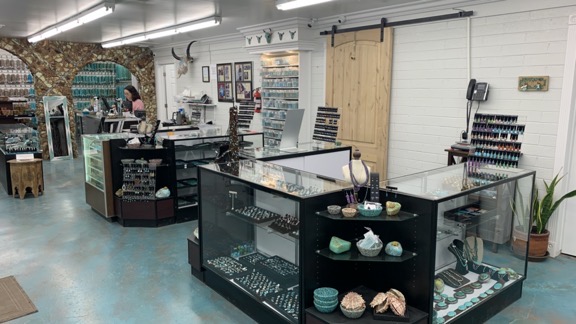
The Kingman Turquoise shop just north of Kingman, AZ, is like a candy store for jewelry makers who use turquoise. Bring your credit card.

He followed me from there to Willow Beach on the Colorado River, where we parked my trailer in a lot and then squeezed into a shared campsite, taking advantage of the discount he got with his lifetime National Parks pass.

Sunset at Willow Beach
Willow Beach’s sunset did not disappoint us.

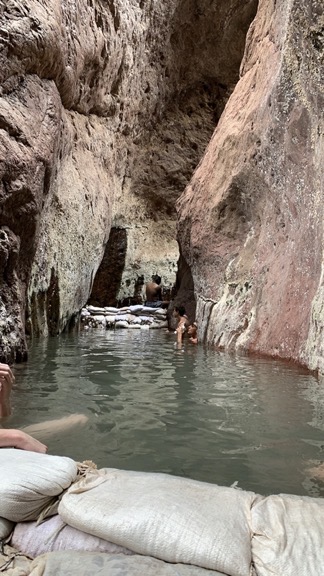
Hot Springs
Tuesday morning at the hot spring. It was more crowded later in the day. I blogged about this hot spring here.

In the morning, we picked up a small motorboat and, with my pups, headed up the river. We spent at least four hours at the hot springs, dipping and soaking in the various tubs while other hikers came and went.

That evening, Bill led the way to a campsite he knew of up in the Eldorado Mountains south of Boulder City. It was a cool spot off a seldom-used road. I had great views down at the lights in Boulder City and Railroad Pass, with the glow of Las Vegas far in the distance.

In the morning, we climbed into his van for a trip farther down the road to visit the ghost town of Nelson. The two of us spent nearly an hour walking around the remains of old cars and equipment in the desert, snapping pictures everywhere.

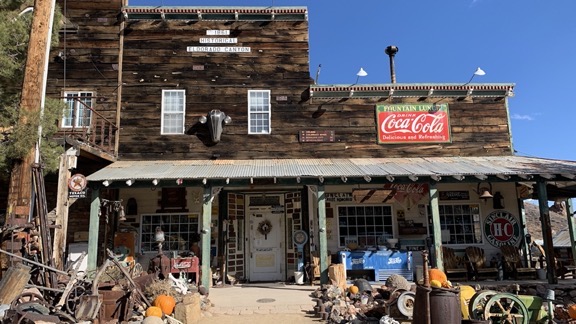
Nelson
Here’s the museum/gift shop in the ghost town of Nelson. For just $1/person, you can wander around and shoot photos of the multitude of old cars and equipment parked around the yard.

On Wednesday, we went into Las Vegas to visit an old friend of mine from Wickenburg. I was glad to see Jim as active as ever at age 81, still working at the company he built years ago when I first met him, still coming up with unique solutions for new customers. Jim and Bill really hit it off; Bill grilled him about batteries and Jim had all the answers.

From Vegas, we continued on to Tecopa, where Bill wanted to show me a hot springs resort he knew. We originally signed up for two campsites for two nights but wound up taking advantage of a couple’s special that gave us sites for two for a week for only $250. We stayed six nights. I slid my camper off my truck while we were there so we could get around without taking one of our “houses” with us.

It was a great week. On most days, we soaked in a private tub in the morning before breakfast, then again in the afternoon before dinner and again in the evening before bed. The water was hot and soft and made my skin feel great. During the day, we’d choose a destination: Ibex Dunes and Sarasota Springs in Death Valley for two hikes, Shohone for a hike, China Date Ranch (twice) for hikes, Pahrump for a propane refill and some shopping. We spent one windy day in my rig just taking it easy, enjoying each other’s company.

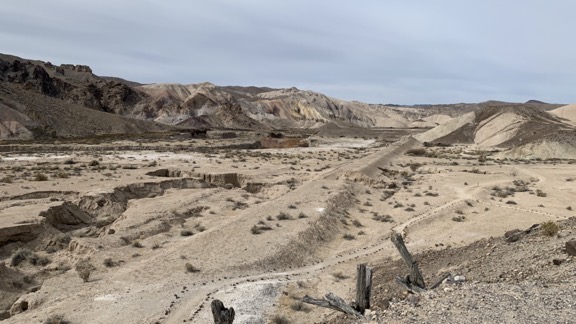
China Date Ranch
The Amaragosa Trail hike from China Date Ranch takes you into the riverbed, where you can still see traces of the railroad that ran there years ago.

At Badwater
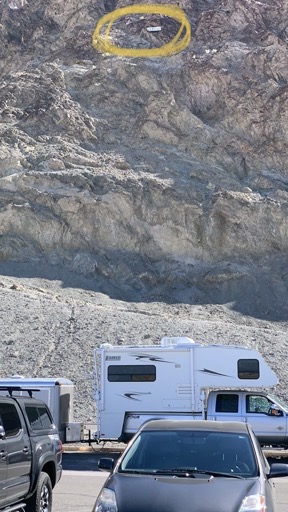
Here’s a real tourist shot at Badwater; Bill pointed out the Sea Level sign high on the cliff face beyond my rig.

From Tecopa, we headed into Death Valley, coming in through the Shoshone entrance and driving up the length of the park from the Ashford Mills ruins — which I’d last seen surrounded by yellow wildflowers during a super bloom a few years ago — and past Badwater, with a quick stop in Furnace Creek before driving the rest of the way up to Mesquite Springs. Bill had never been that far north in the park and was pleased by the dark, quiet night sky and uncrowded campground.

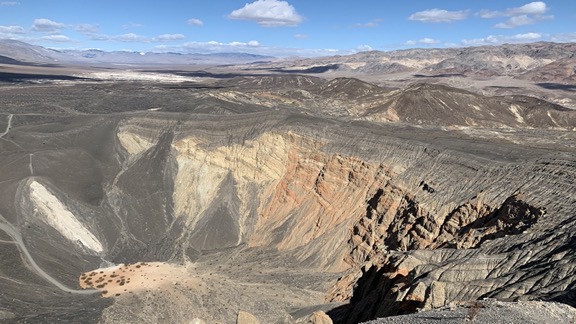
The next morning, Wednesday, we hiked around Ubehebe Crater in a howling wind. It was only a mile and a half, but there was a considerable climb early in the hike and lots of places to stop and look into smaller craters nearby. Back at camp, we took the rest of the day off.

Ubehebe Crater
Here’s a shot of Ubehebe Crater from the highest point on its rim. Normally, this hike might be very pleasant, but with a stiff wind, I was glad I’d bundled up.

On Thursday, the day I’m writing this, we decided to move on. Bill wanted to visit some friends in Los Angeles before he headed back to Oregon to take care of some family things. I had developed a sore toe that made long hikes painful. And although I had no idea what the weather was at home, I knew I should be on my way.

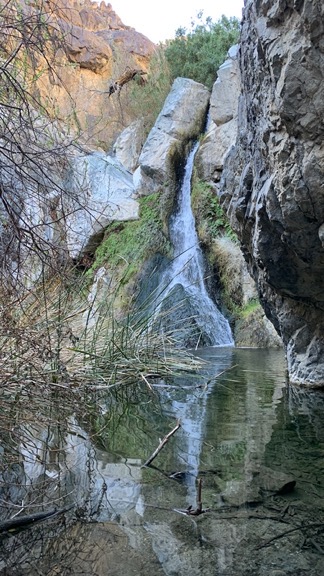
Darwin Falls
Darwin Falls is a surprising sight in the desert — and just a mile from the trailhead on a relatively easy path.

But rather than just part company, we decided on one more hike: a walk to Darwin Falls, a little-known spring-fed waterfall in Death Valley. I parked my rig at the Panamint Springs campground and he drove us to the trailhead in his van. We did the two-mile round-trip hike in about 90 minutes, stopping for about 20 minutes in the cool shade of the slot canyon at the falls before coming back.

Afterward, Bill drove me back to Panamint Springs and spent a little more time with me and my pups before saying goodbye and heading out. I was sad to see him go — I really had enjoyed our time together — but he’s already promised to come visit me at home. I’m looking forward to that.

-o-

Throughout all of our time together, I continued to be amazed at how much we thought alike and how compatible we were. I suspect he was, too.

We talked about everything — and I really do mean everything — and pretty much agreed on most of it. Better yet, he treated me like an intelligent adult. He was kind and generous and really seemed to want to hear my opinion of the things we talked about. It was a real intellectual treat for me. Like me, he knows a little about a lot of things and a lot about a few. Like me, he has a natural curiosity about things he hears about. I could — and did! — learn from him and he could — and did? — learn from me.

There’s more, but I won’t go into it here. After all, I don’t share every aspect of my life, despite what readers may think.

Anyway, the two weeks I spent with Bill will give me plenty to think about as I begin to gear up for the upcoming cherry season and start to plan my retirement. I’ve had other plans in the works for a while and he’s given me the push I need to start making things happen to reach new goals.

Meanwhile, I’m looking forward to more travels with Bill in the future.
Helicopter Power Line Work

A video from the Flying M Air YouTube channel.

The title and narration pretty much says it all. We were driving across the desert and spotted some helicopter activity near some power lines. We found a road that took us right to the action. (BTW, This is the kind of thing you can see when you shut off the TV/video game/Internet and get out a little.)

I found this work fascinating and I think that if I were alone I would have captured hours of footage. But I think this taste from two angles is more than enough.

Anyone know what those line guys make? I sure hope it’s a lot!

I do know the name of the company performing this work, but have decided not to release it. Why? Well although I’m sure they were following all safety precautions and their pilots were properly trained for the work — you don’t get a job like this by being a fly-by-night operator — there’s always ONE viewer who finds something to complain about and I’m not going to help them cause trouble for these folks. Can’t you just sit back, watch, and be amazed at the things we can do?

Comments? Leave them below. I hope you enjoyed this; I’ll try to release other new content soon.

Snowbirding 2021: A Visit to Slab City

I finally get to see a place I’ve heard about numerous times and always wondered about.

I can’t remember exactly when I heard about Slab City, CA. I suspect it was about five years ago when I started visiting the Holtville Hot Springs and listening to the other RVers talk there about free places to camp.

Slab City on Wikipedia

Per Wikipedia, Slab City,

also called The Slabs, is an unincorporated, off-the-grid squatter community consisting largely of snowbirds in the Salton Trough area of the Sonoran Desert, in Imperial County, California. It took its name from concrete slabs that remained after the World War II Marine Corps Camp Dunlap training camp was torn down. Slab city is known for lifestyle that contradicts ordinary civilized lifestyle.

The rest of the Wikipedia entry is extremely informative (and I encourage you to read it), but appears to have been written mostly around 1990 and then edited to add information in 2020. (The editor in me would love to go into that entry and clean it up, but I’ll let experts tackle it.) There are photos, but I suspected that none would do it justice and I wound up being right.

The Trip

I’ve been wanting to check it out for myself for a few years. I decided to make it one of my goals for this year. But I wasn’t interested in dragging all my RVing gear out there, possibly to find a place where I wouldn’t want to camp. I wanted to make it a day trip from my campsite on the Arizona side of the Colorado River. It would be a roughly 2-1/2 hour drive each way.

Sometimes the only thing that prevents me from doing something I genuinely do want to do is motivation. I lacked motivation until this week. That’s when I happened to mention it to a new friend of mine, Bill, who is a full-time RVer. He very unexpectedly said he was interested in checking it out, too. And since he was camped out nearly halfway between my site and Slab City, it made sense for me to pick him up along the way if we did it before he moved on.

I set the date for Wednesday, which was the day after we spoke about it. There was a big holiday weekend coming up and I wanted to stick around near camp. A lot of crazies come out here with their off-road vehicles and I just felt the need to stay where I could keep an eye on things. I’m not a big fan of going out on weekends anyway, mostly because of the greater potential for crowds at my destination. One of the great things about my lifestyle is that I can go places midweek, when there are fewer people around.

That’s why I was in my truck at 8 AM on Wednesday morning with my pups, headed away from camp. I wanted to fill my truck with fuel before going into California — diesel (and other fuel, I guess) is about $1 cheaper per gallon in Arizona than California and with a 30 gallon tank that was about half full, that difference quickly turned into lunch money. I drove up to my favorite cheap gas station on my side of the river, topped off the tank, bought a pack of Oreos with a pint of milk, and set off westbound on I-10.

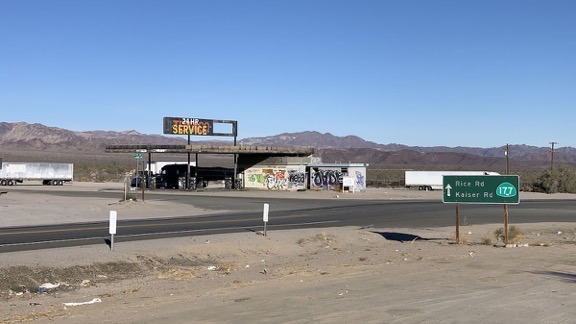
I was meeting Bill at Desert Center, a little over an hour west of the Colorado River. There was very little traffic, and I could cruise at or around the speed limit of 70 MPH. The stretch of I-10 between Blythe, CA on the Colorado River and Desert Center is pretty dull. A lot of empty desert, some of which has been recently filled in with huge solar energy farms. I listened to an audio book along the way and the time passed quickly. I got off the exit and rolled into the armpit of California that is the town of Desert Center.

Desert Center
Shot from a trash-strewn vacant lot near the I-10 freeway exit, this view of Desert Center, CA is what greets folks who go there.

I cannot begin to describe how trashy the place is. It’s mostly empty lots and deserted, vandalized, graffiti-painted buildings. There’s trash and broken glass everywhere. A few semis with trailers were parked in various places, engines running; I guess this is an overnight stop for some truckers. I didn’t see any sign of current habitation, which is probably a good thing. I couldn’t imagine anyone actually living there.

I arrived early, of course, and had to wait for Bill, which I didn’t mind. I let the pups out to walk around the sandy lot I’d parked in and had to follow them around to make sure they didn’t step in or try to eat anything disgusting. We wound up waiting in the truck, windows open on the warm morning. But the more I looked around, I the less I liked the idea of Bill parking his custom Mercedes Sprinter van anywhere in the area for the day.

I told him that when he arrived. He looked around and agreed. He told me it had been broken into before and it was very upsetting.

I suggested Chiriaco Summit, a busier exit on the freeway that actually had businesses in operation. It was 19 miles farther in the direction we had to go anyway. He agreed and followed me.

I knew Chiriaco Summit from flying into its tiny airport, visiting the Patton Tank Museum there, and stopping for a bite to eat at Foster’s Freeze. As I pulled in, I realized that the little “town” had grown. There were additional restaurants and a handful of other businesses. Foster’s was now inside the big gas station. There was plenty of parking that would be out of the way yet close enough to activity to not draw attention. The town was all business and neat — a huge difference from Desert Center.

He parked, we went inside the gas station to use the restroom, and Bill bought a cup of coffee for the road. Then we were on our way.

I missed the exit for Box Canyon Road mostly because I was looking north. I was distracted by the Cottonwood Springs Road entrance into Joshua Tree National Park, with lots of RVs camping out in the desert, likely just outside of park boundaries. I never realized there was a road that went south there until I’d passed the exit. Duh. The next exit was six miles west and I made my U-turn there, thus adding 12 miles to the drive.

Box Canyon Road is a great drive on a decently paved road down a wide canyon that I would not want to be stuck in during heavy rain. There were a few folks camped out in there and a few others driving the same direction we were. After a while coasting downhill on the gently curving road, we got a glimpse of the Salton Sea stretched out before us in the distance. Then the winding canyon road leveled out and opened into blocks of farmland.

We saw some very neglected grape vines, lemon trees, pepper plants ready to be harvested, and a bunch of other veggies we couldn’t easily identify. GoogleMaps directed us to make a few turns before dumping us on Route 111, Grapefruit Boulevard. It should have been called Palm Highway there because it was mostly lined with date palms for a while. Then those ended abruptly and we were in the mostly barren desert on the east shore of Salton Sea.

This is not an attractive area of desert. There isn’t much vegetation and anything that was planted and neglected — think mostly palm trees — are dead or dying. Yes, the Salton Sea sparkles just off to the west and there are snow-capped mountains beyond Palm Springs even farther west than that. But the terrain is mostly a light tan color with the occasional tiny settlement, park, or abandoned, vandalized, and grafittied building hinting at past when the area had something to brag about.

Bombay Beach

Slab City turned out to be a lot farther south than I thought. Along the way we passed the Salton Sea State Park and its campgrounds, which turned out to be closed for COVID, and a settlement boasting hot springs off to the east.

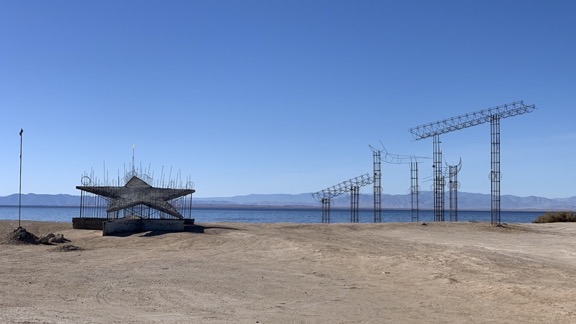
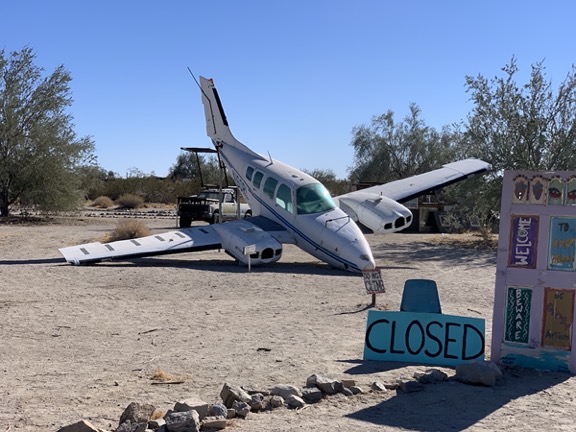
Bombay Beach Art
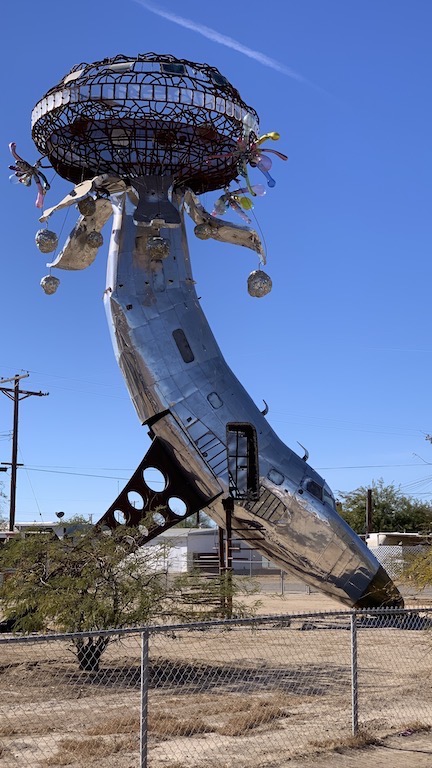
Is this the “Cessna Art” I was supposed to find at Bombay Beach? Is this a Cessna?

We eventually reached Bombay Beach, 223 feet below sea level, with a population 415. I’d been there before and hadn’t been impressed, but a Twitter friend urged me to revisit it, telling me there was some sort of Cessna artwork I needed to see. We drove through, spending a brief time on the sea side of the dike wall before completing a circle of the town. This sentence from Wikipedia sums it up perfectly:

A visitor in 2019 wrote that there were many “discarded homes and trailers long-since abandoned” and that many of the buildings were “windowless husks blanketed in graffiti, surrounded by broken furniture and rubble.”

Basically, the place looks like the ruins of a very poor community, long since vandalized, with a handful of occupied homes and a mildly interesting collection of very large artwork made mostly from junk. It’s a depressing place and I honestly can’t imagine what it must be like to live there.

We got back on the road and continued south.

Slab City

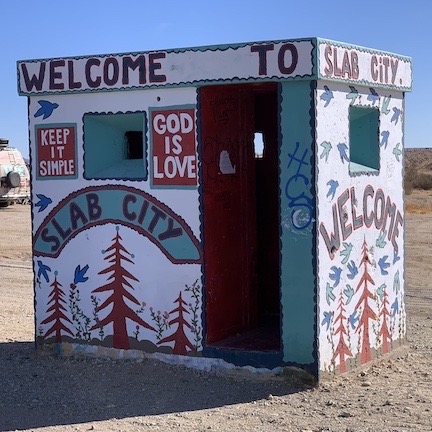
Welcome to Slab City
The obligatory photo of the Slab City Welcome sign.

The turn for Slab City was the Main Street for Niland, CA. Although I’d expected it to be a sort of remote place up in the foothills of the mountains beyond, it was actually spread out just a few miles from town. The absolute junkiness of the place hit me immediately. There were all kinds of broken and abandoned RVs and other vehicles, as well as broken and occupied RVs and other vehicles. The more we drove the more trash and decrepitude we saw.

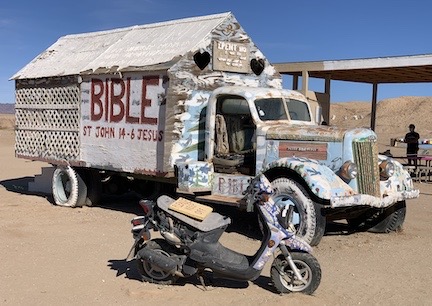
Truck at Salvation Mountain
Part of the art (or “art”) installation at Salvation Mountain.

Salvation Mountain, a man-made hill painted with latex paint which had been the life’s work of a deceased resident, was the first of the art installations. Other art was more like “art.” I drove slowly through the area on what seemed like a main road while we stared at the mess around us. Yes, people lived there. There were RVs and mobile homes and shacks and even a few decent buildings. There were street signs and house numbers. There were campgrounds, one of which was hosting one of those mega-motorhomes that sell for about $750K. There was a library that was closed. There was a business at East Jesus that was closed. There was a property that used the burned out shells of RVs as a sort of fence line. The farther we got from the main area of the community, the more trash there was scattered out in the desert.

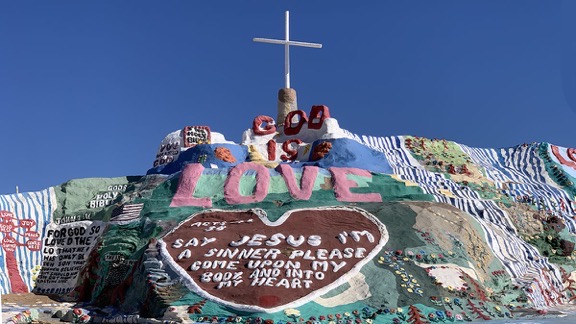
Salvation Mountain
Salvation Mountain is the primary point of interest in Slab City. Read about it on Wikipedia.

East Jesus Plane Art
A business at the end of the road to East Jesus was closed due to COVID.

I said I’d take pictures, but I took very few. The above shots are about it. Honestly, there wasn’t much I wanted a picture of.

We followed a sign for Slab LOW, not knowing what it was, and eventually arrived there. It looked like a camping area with a few buildings. Signs said they welcomed members of WIN, LOW, and Escapees — three RVer clubs. (I belong to WIN, Bill belongs to Escapees.) I stopped the truck and we got out to stretch our legs and let the pups run around. There was a single motorhome parked there and while we gave the dogs water — Rosie had puked in the truck; she still gets carsick once in a while — a man came out. Soon we were chatting with him. He lived there full time. He said the place we were at was closing and relocating elsewhere. He told us where but we never found it. Did it matter? No.

There were actually quite a few people living in the area — even if just temporarily. It looked to me as if you could camp for any length of time just about anywhere. But the vibe was about the same — at least to me — as it was at Bombay Beach. It was the ruins of something and no amount of art or “art” could hide it. Squatting on land that no one cared about was a cheap and easy way to live, but I know I could never live like that. Honestly, I’d have trouble even spending a day or two there. Too much trash. A cleanup crew could spend a year filling 30-gallon trash bags and no one would know the difference.

We didn’t stay long. And I have to admit that although Slab City sort of met my expectations, I was disappointed. I was hoping it was something better. Something more interesting. Something I’d like to stay and explore. It wasn’t. It was just a squatter community out in the desert, surrounded by decades of trash.

Lunch, the Fountain of Youth, and a Walk on the Beach

We stopped for lunch in Niland. I’d wanted very badly to go to the Oasis Date Ranch for one of their excellent hamburgers with dates on it but their cafe was closed due to COVID. The Buckshot Cafe in Niland served Mexican and American food. The restaurant itself was closed, but they were taking to-go orders through one of the front windows. We each ordered a chicken torta and wound up eating it in the back of my truck, feeding the dogs nacho chips and french fries.

Back on the road, we turned in at the sign for the Fountain of Youth RV Resort and Spa. The WIN RV group I belong to had camped there for a week in early November, before I headed south. I wanted to see what it was like. It was a typical middle-of-the-desert RV park, filled with mobile homes, park models, and regular RVs. There was a pool, a hot spring fed spa, shuffleboard, a restaurant, and more. Everyone we saw was older than we were except the kid at the gate. The campsites were close together and there were a lot of vacancies. No Canadians this year.

We checked out another RV resort with spa nearby. It was a lot smaller, more casual, and cheaper. Bill was disappointed that although they offered day use options for the spa facilities, clothing was required.

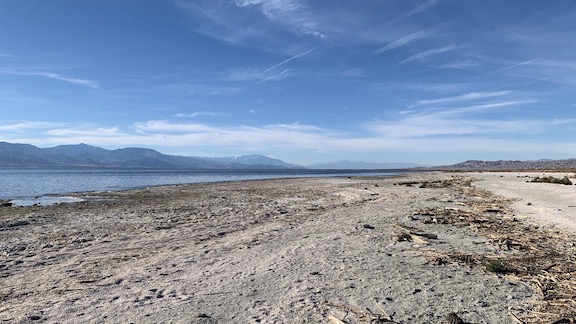
Our last stop in the valley was at a campground along the shore of Salton Sea. I’d stayed there about four years before. I wanted to show Bill the beach, which had been covered with giant barnacles and dead fish back then. The campground was closed, but we parked across the road and walked over. We climbed down an embankment and walked right up to the short. The barnacles were smaller and there were no dead fish.

Salton Sea Beach
The beach at Salton Sea. Palm Springs lies at the base of the snow-capped mountain dead center in this shot.

The Drive Back to Camp

Bill used a map app on his phone to guide me back to Box Canyon Road and we climbed up the wide canyon to the I-10 freeway. From there, it was a short drive to Chiriaco Summit. I took my pups for a quick walk with Bill. Then we said our goodbyes and he left to go to camp while I went into Foster’s Freeze for a hot fudge sundae.

I passed Bill on the road right before reaching Desert Center. He’d told me his campsite south of there was dead quiet and pitch black dark. Sounded good to me. My site would not be quiet with all the yahoos in from Phoenix with their ATVs for the long weekend, but I had a good, private camp and wasn’t ready to move. Yet.

I finished listening to the recorded book I’d been listening to along the way. I got back to camp just as the sun set over California.

If I had a bucket list, I could cross off Slab City.

Snowbirding 2021: Life at the Backwaters Camp

We settle into a routine that includes activity, work, and rest.

I set up my own camp at our campsite with my camper on one side of the boat ramp and my utility trailer on the other. I was expecting my friend Janet to join me and I thought it was a good idea to leave room for her in the “living” side of the campsite by putting my utility trailer on the “working” side of the campsite.

About the Campsite

One of the nice things about the campsite — other than the fact it has easy access to a mile-long strip of backwaters channel — is that it’s mostly level. That makes it easy to park RVs without having to deal with a lot of leveling blocks. My truck camper, of course, has its four motorized legs that can be used to fine-tune leveling. But I need a relatively level place to begin with so I can safely raise the camper off my truck and drive the truck away.

The campsite is off the main road and surrounded by a lot of desert vegetation — mostly salt cedar, mesquite, and a type of shrub I’d always known as arrow wood (but Google doesn’t agree). This vegetation, although not very attractive, does give the campsite some privacy and filter away the dust that can come off the road when the four-wheelers are out in force. None of the trees are tall enough to cause an issue for a well-placed solar panel — especially if it’s on a camper’s roof (as mine are). I suspect that the site would be miserably hot in the summer months, but in the winter, all that sun is usually quite welcome.

The site is actually split into two logical halves with the boat ramp between them. One side is larger and could easily fit four good-sized campers without any of them parking in the deeper sand beyond. The other side is considerably smaller but features a few clearings in the vegetation where tents could be set up with a degree of privacy.

The ground (other than the gravel boat ramp) is mostly a sandy dusty dirt mixed with decades of campfire ash. It is not the kind of place you leave things on the ground if you expect them to stay clean. But dust is a part of life when camping out in the desert and I knew exactly what to expect when I chose the site.

I parked at the edge of the larger camping area, right beside where the land sloped down sharply to the boat ramp. I backed in (of course) so my back and main side window faced east, out over the backwaters. From my dining table window, I can watch the sun rise every morning and see glimpses of water birds like egrets and herons. I like a campsite with a view and this suits me just fine.

Setting up camp wasn’t difficult and I had it mostly done by the end of the day when I arrived. Other than removing my camper from my truck, I did a few extra things that I usually do if I’m going to be in a spot for more than a few days:

  • I set up a pair of portable sawhorses, each good for 1600 pounds of weight, under the body of my camper. This takes some of the weight off the legs and gives it a more solid feeling. It’s a little step that isn’t required, but will help keep the camper in good condition as it continues to age. (It’s a 2007 model and in great shape; I plan to keep it that way.)
  • I attached a vinyl “skirt” around the front end of the camper. This creates a little sheltered storage room where I can secure things I want to protect from the weather or keep out of sight. My bicycle, for example, is under there. So is my 2KW Honda generator, which is locked to one of the camper legs. I had the skirt custom made a few years ago and although I don’t use it often, it comes in very handy when I do use it.
  • I set up a table with my BBQ grill. I use a little propane fueled portable grill. I like to grill meats (and sometimes vegetables) and having the grill set up and ready to go right by my door makes it convenient.
  • I deployed my rear awning. My camper actually has two awnings, but I rarely use the one on the side. Instead, I put out the back one, mostly because it was so darn hot when I arrived in mid November. The sun would come up and shine into the back of my camper, making it unpleasantly hot within minutes. The awning kept it cooler. Even when temperatures dropped, however, I left the awning out with its various wind toys attached. With a mat nailed down to the ground beneath it, it gave me the illusion of an outdoor room, tripling the size of my living space. I staked it down securely so that even though it flopped around a bit when it got windy, it stayed secure.
  • Meade 8
    Here’s my telescope, set up in camp. I have a cover to protect it during the day and have been able to keep it dust-free. I haven’t used it nearly as much as I wanted to, mostly because I was having trouble getting it to align before I swapped out the batteries.

    I set up my 8″ Meade LX200GPS telescope. I bought the telescope last year and used it at a few campsites late in the season. The area where I was camped had amazing dark skies and with a big conjunction between Jupiter and Saturn coming up in December, I was eager to use it. The telescope, which lives in a Pelican-style hard-sided rolling case, is no fun to haul around, but once it was set up, I could cover it with a reflective cover to protect it from dust, sun, and wind.

  • I unpacked and inflated my Hobie kayak. I’d bought this two — or is it three? — years before in Lake Havasu City on my way south as a Christmas present to myself. Although it can be paddled like any sit-atop kayak, it has a pedal drive that makes it a real pleasure to pilot around the backwater channels — as long as the water is at least a foot deep.

    Paddling
    Here I am with my pups on a recent pedal/paddle/float down the Colorado River.

Camper Setup
Here’s my truck camper, set up for a long stay at camp. I put up my wind toys, deployed my rear awning, and even put on the custom skirt to create a sheltered “garage” under the front end of the camper. While the camper’s legs hold the bulk of its 3200 pounds, I also set up portable sawhorses underneath to take some of the weight off the legs and make the rig more solid on the ground.

My friend Janet arrived four days later. She came with her truck, “Blue,” pulling her 20-foot travel trailer, “Joey.” (For the record, although my truck doesn’t have a name, my camper and utility trailer do: T2 and Daisy (formerly Lily; long story) respectively.) She backed Joey into a spot against a tree with its door facing my camper and the fire pit. Later, her significant other, Steve, arrived with her studio/workshop trailer, “the Vega,” and parked it nearby so she could share her generator between the two of them.

The Routine

Our lives at camp quickly settled into a routine.

We start the day in our own campers with coffee (me) or tea (Janet) and maybe a small breakfast. I wake up at all times, from as early as 4 AM to as late as 7 AM. I let my pups out (supervised) for their early morning numbers (1 and 2) and give them breakfast. I drink my coffee, catch up on Twitter, update my Etsy site, or wade through incoming email. I use my iPad, which seems to get the best connection here when it’s placed on my pillow on my bed, as a wifi hotspot.

Maria and Dogs
One of my Twitter friends wanted a picture of the dogs at camp. The only way I could get a shot of them all was to grab mine while Janet’s stood nearby. This is one morning after our walk.

When the sun comes up, we’d go for a brisk walk in the desert. When we got here, we’d go as early as 7:30, but as it gets colder and colder and the sun rises later and later, we now go as late as 9 AM. We have four different walks. Three of them are about 2 1/2 miles long while the fourth is about 3 1/2 miles long. I admit that I shy away from that long walk early in the morning because a good portion of it is in the shade of a hillside and it’s really cold. And the walk that’s a loop around our backwater channel is especially tiresome because a good portion of it is in sand.

After the walk, we do our own thing most days. I usually do my dishes and/or shower. I like to run my water pump in the morning so the onboard batteries have the whole day to recover power from the 200 watts of solar on the roof. I really don’t like running my generator; I hate the noise. Although I’ll run my pump at any time of the day or night, dishes and showers run it long enough to take a toll on the batteries and mine are starting to show their age. (I actually had them replaced yesterday after writing the first draft of this post.)

I might also have a real breakfast of something cooked. I usually make the same thing I make at home: veggies cooked with some sort of breakfast meat and topped with an egg. I’m still trying to use up the potatoes and onions from my garden that I brought with me.

Then I go to work in my utility trailer. (More on that in a moment.) I generally work most of the day, with breaks whenever Rosie, the more vocal of my two pups, decides there’s something she needs to bark at. I leave the girls loose during the day, but with predators like coyotes around (mostly early and late in the day, as well as overnight), I try hard to keep tabs on them. Rosie likes to bark at imagined threats so I get lots of stand time during the day. (Apple Watch owners should know what I’m talking about.)

By around 4 PM, Janet and I are both finishing up for the day. One of us will set up paper trash and kindling in the fire pit. One or both of us will cook all or part of a shared dinner. We’ll light the fire and feed it wood we’ve gathered or brought along. My pups will go into the camper — they don’t seem to like being outside after dusk and that’s fine with me.

We’ll eat dinner by the fire. We’ll chat.

Thanksgiving Dinner
We eat well here. This was Thanksgiving dinner on my plate. Janet made almost everything you see; I made the stuffing, which I really love to make (and eat). We’ve had grilled NY strip steak, salmon (that I caught over the summer), and bacon-wrapped scallops, as well as chicken enchiladas, chicken and vegetable masala, tacos, and all kinds of homemade food. Janet even made a loaf of challah bread from scratch yesterday, which was a bit of a challenge to bake in her tiny oven.

Jupiter with Moons
I took this photo of Jupiter and its four largest moons by holding my iPhone’s lens against the eyepiece of my telescope one night.

We’ll watch the stars come out, marvel on how close Saturn is getting to Jupiter, and count satellites that pass overhead. A few times, I fired up the telescope for a closer look at Jupiter, Saturn, the moon, mars, and a few other points of interest in the sky. The Milky Way’s glow was nearly always bright above us.

Then, when the fire turns to a bed of coals, we’ll call it a night. Janet will retreat into her camper with her big dog Dually. I’ll bring my pups out for a pee and then go back inside for the night.

Depending on what time it is, I’ll do some work on my laptop or read or just straighten up my rig. Eventually, I’ll climb up into bed to read, watch videos on my iPad, or do a crossword puzzle. Then I’ll sleep.

The next day is pretty much the same.

Occasionally, we’ll break routine for a morning of chores or goofing off or weather that makes us want to stay indoors. But those days are few and far between.

Chores

Of course, we eventually have to do chores like laundry, grocery shopping, fetching water or propane, or visiting the post office. Because the road to get to camp is so long and bumpy, I try not to leave camp more than once or twice a week.

We do grocery shopping once a week in Blythe, CA where there’s a Smart and Final and an Albertsons. Although last year we favored Smart and Final, which tends to be cheaper, it soon became apparent that they often lacked the things we needed, requiring us to hit Albertsons as well. So this year we’re mostly just going to Albertsons.

We do laundry every other week, also in Blythe, and coordinate it with a trip to the Ace hardware store and Albertsons. It works like this: go to the laundromat and put our laundry into washers. That gives us 24 minutes to drive to Ace, shop, and get back. Move all the laundry into dryers and feed the dryers enough coins to dry to 40 to 50 minutes. Then go to Albertsons and shop. Go back to the laundromat, arriving just in time for the dryers to be done. Fold laundry, put it into the truck and head back to camp. We did this two days ago again and it worked like a charm.

Sometimes, on those trips to Blythe, we’ll bring an empty propane tank or two. My rig takes 5 gallon tanks and has two of them. I’m going through about one tank a week to run my refrigerator, heat water, fuel my stove, and run my heater, which I definitely need for at least part of the night.

We get water at the “Resort Store” in Ehrenberg, which is near the end of the gravel road between pavement and camp. For $2 we can fill as many water jugs as we have. I have four; Janet has at least four. We both have battery powered transfer pumps to lift the water from the 6 1/2-gallon jugs to our campers’ water tank fill ports. 26 gallons of water can last me about a week if I try hard to conserve. I don’t drink that water; it’s solely for washing. I buy bottled spring water by the gallon when shop for groceries and use that for drinking and cooking.

The Resort Store is also where we take our trash. There’s a big dumpster there. We weed out the aluminum cans and plastic bottles that can get cash refunds in California, which is only a mile away, and leave them in a box or bag beside the dumpster so folks who scavenge for cans don’t need to dumpster dive for ours. There is no recycle bin, but we burn most of our paper and cardboard waste when we start our evening campfire.

The Resort Store isn’t far from the post office where I rent a box every year. This enables me to get USPS, UPS, and FedEx packages. Whenever we get water, we visit the post office, too.

Occasionally, we’ll go into Quartzsite, AZ, which is about 30 miles east. I’ve written extensively about Quartzsite in this blog so I won’t go into detail here. It’s pretty dead in November and early December; it should start getting busy around Christmas time. If we go to Q (as we call it), we’ll get propane there; it’s a lot cheaper than in California. I also got a new battery and inverter setup for my utility trailer in Q; I’ll blog about that elsewhere.

Quartzsite is also where we dump our blackwater tanks, which is a chore I did just yesterday. Through various means of conservation, I can go a whole month between blackwater dumps — and no, it doesn’t smell.

Struck Truck
That back wheel was so dug in that the truck was sitting on the sand on its rear transfer case. I could turn the wheel by hand! Jacking up the truck and putting leveling blocks under that wheel was instrumental in getting it out.

We also occasionally go out into the desert to collect firewood. There are a lot of dead salt cedar and mesquite trees and Janet has a little battery-powered chainsaw that can cut through medium sized branches to make little logs. One day we used my truck to haul the wood out and I managed to get it stuck deep in the sand. After being told by a tow company that they needed a Jeep with a winch to get me out — at a cost of $500 — Steve and I managed to get it out with some jacking, digging, and a tug with a tow strap. Locking the hubs on the truck’s 4WD in 4-Low helped, too. (Duh.) Less than a week later, I used my truck to pull a Sprinter van out of another sandy spot nearby.

Getting Work Done

Janet is an artist who paints on feathers. (Her work is amazing; check out her Etsy shop and her website.) I’m a part-time jewelry artist. (My work is pretty good, too. Check it out in my Etsy shop and on my website.) Both of us planned to get work done while at camp. That’s why I’d set up my utility trailer with a jewelry shop and she brought along her studio trailer.

Our studios contain at least 90% of the materials and equipment we need to create. It’s just a matter of “unstowing” everything and setting up to work. Her studio is a converted travel trailer and has quite a bit of space. My utility trailer is small and relatively cramped, so part of my setup include erecting my show tent and setting up a table inside it do do soldering work. (I have a 6-minute video tour of my setup, but with the dismal connectivity I have out here in the desert, it would likely take all day to upload it.)

Janet and I mostly sell our work at art shows, although I also have relationships with a few galleries and we also both sell on Etsy. Unfortunately, COVID-19 has pretty much shut down the show circuit. The last show we did together was at White Tanks Regional Park in the Phoenix area at the end of last February; we were all set to do the Borrego Springs show in mid-March when they canceled it the day before setup. (We had already made the long drive there and weren’t happy about the last minute cancellation. I was especially unhappy because I was ready to go home at the end of February and that last show was the only thing keeping me in the area.) I did a few shows in Leavenworth, WA in July, September, and October. Janet did one in Fountain Hills, AZ in November, just before joining me in camp. Because her summer had been filled with other work (and play), she was low on some inventory. And because I’d shipped out a bunch of jewelry pieces to galleries in November, I was very low on inventory. We both needed to work.

And we do. I’d say we spend at least four hours a day at least five days a week in our shops getting new items made and ready to sell. I’ve started posting each week’s production on my jewelry website, with links back to my Etsy shop.

We also process incoming orders from Etsy. We each have printers to print labels and packing materials to package up and ship our products. I actually fill orders more quickly from here than I do from home. Go figure.

Playing

We also make time to play.

Because we have easy access to the backwater channel, we often go for a pedal/paddle (me) or row (Janet) in our boats. Janet, who likes to fish, will sometimes throw in a line. The other day, we took our boats and cameras up to the channel we camped on last year and pedaled/paddled/rowed there. I got some nice shots of egrets, herons, ospreys, and vultures. We even watched an osprey dive down into the water and take off with a fish.

Egret
I had my Nikon and 300mm lens with me on my most recent pedal/paddle and got a few nice shots of birds, like this egret.

One day when neither of us felt like working, we took a drive down the gravel road that goes past our camp all the way down to the Cibola Wildlife Refuge, which I’d visited a few years before. It’s where sandhill cranes spend the winter and there were certainly enough of them there. We also explored other possible camping areas, like a BLM campground on the California side that might be nice for a day or two.

We also goof off in Q. We took the bicycles in one day and rode around the town after picking up a few odds and ends from vendors that were set up early. Around Christmas time, Janet will be moving to Q for about a month to do a show there; I’m skipping it this year but may move out to the desert nearby for a few days during the height of the season there.

Side Trips

I did make time to visit some friends and go flying in the Mesa area near Phoenix earlier this month.

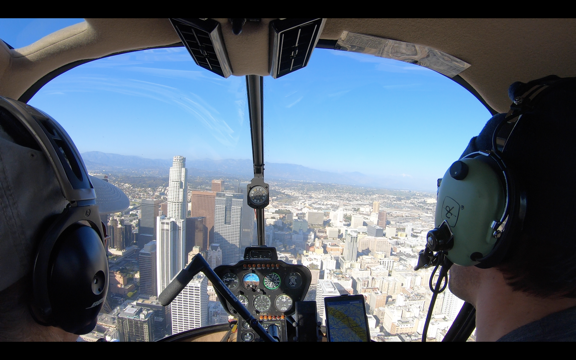
My friends own a flight school and offered me a reasonable deal on renting their R44. I was eager to get some video footage for the FlyingMAir YouTube channel. I did two flights over two days and spent two nights in my friends’ very comfortable guest room.

I’ll go back again later in the season, when I’m done camping in this area and begin a more nomadic phase of my winter travels. It’s a long drive from here to Mesa — nearly 3 hours. I did (finally) visit a Trader Joe’s on my way back. I also picked up a few things I needed to better secure items in my utility trailer when I’m in transit.

A Month Already!

That basically sums up the first month of my snowbirding activities for the 2020/2021 season.

Although Janet will likely leave in about a week, I’ll remain here for a while longer. I’ll probably walk less and work more, with fewer campfires and more writing. Maybe I’ll even get around to editing some of the video I captured on my two flights earlier this month.

I’m hoping that someone we met earlier this month will return from his holiday travels and share the camp with me for a few days. We need to talk boats. ‘Nuff said.

I’ll try to upload “Postcards” as I did last year. No promises. I’m keeping pretty busy — maybe too busy to blog? — and like it!