Why Writers Write

Some thoughts on what drives us.

I’ve been a writer since I was 13. I always had a story inside me trying to get out. I started with college-ruled notebooks, writing on just one side of the paper in my printed handwriting, just to keep it neat. As the computer age began, I moved to word processing.

Somewhere along the line, I went pro and began being paid for what I wrote. But it wasn’t the stories that earned me money. It was the technical non-fiction, the prose that explained how to perform tasks with computers. With no formal training in the computer field — after all, it was in its infancy when I graduated from college in 1982 — I had become a computer “expert” (whatever that is) and I churned out books at an alarming rate. Sixteen years after getting my first check for a writing assignment, I now have 70 books and literally hundreds of articles under my belt. (And no, I don’t I don’t think that explains my current weight problem.)

A number of conversations with people within the past few days has made me think about writing and why writers need to write. I thought I’d set my thoughts down here. And the timing couldn’t be better, with National Novel Writing Month (NaNoWriMo) starting today.

Kinds of Writers

The way I see it, there are different kinds of writers:

  • Born writers are people who just feel an overwhelming need to write. Obviously, no one is “born” to write. They’re born with the equipment to get the job done — a good brain, etc. — and are molded by experience and education in such a way that they enjoy writing. They may not be good at it, but they like it and they do it. Whether they can successfully turn it into a career depends on their personality, willingness to learn and improve, ability to meet editors’/publishers’ needs, and business sense.
  • Made writers are people who, through circumstance, find themselves writing a lot. Most of these people do it for a living or derive at least some part of their income from writing. This might be someone who steps into a management job that requires writing a lot of reports. Or someone in marketing who writes a lot of ad copy.

The Need to Write

Born writers often need to write. They have these ideas rolling around in their heads and they need to get them down on paper (or pixels). Sometimes just getting them out there is enough. Other times, they need to work the words, to fine tune them, to perfect them. Some people write prose, others write poetry. Some of it is very good, some of it is crap. It doesn’t matter to them. They write because they need to get those words out.

I’m pretty sure that I’m one of these people. I feel a need to write something every day. That’s why you’ll find a new blog entry here most (but not all) mornings. Throughout the day, I think about things going on in the world and in my life. During quiet times — while driving, flying, showering, or doing other “automatic” or mindless tasks — my brain shifts into high gear and really thinks things through. That’s when I get ideas. It’s also when I accumulate enough conclusions about something to begin writing about it, often for the next day’s blog entry.

If I go several days without writing, I get cranky. It’s like going through withdrawal.

Blogging — which I’ve been doing for four full years now — really helps me get those words out. From the very start, I looked at my blog as a journal of my life. It’s only within the past two or so years that I combined my personal blog with entries and information to support my books. My life is multi-dimensional; shouldn’t my blog be the same?

But the more I blog, the less I work on the fiction that got me started as a writer all those years ago. Earlier this year, when I lost the manuscript for a novel I was working on (read “Death of a Manuscript“), I simply stopped writing fiction. I don’t feel the need as much, if at all. I think the blogging I do fulfills my need to write.

Insight from a Professional Writer

Years ago, before I went pro, I was friends with a professional copywriter. He wrote mostly advertising copy — the kind of text you’d find describing products or services in a full-page magazine ad. He also did some technical writing. He made a very good living.

I was young and foolish then. I thought he’d be interested in critiquing my fiction. I sent him a story. He critiqued it. Like most wannabe writers, I wasn’t happy with his comments. (Have you ever met a wannabe writer who actually likes honest criticism?) I don’t recall all of his comments, but I do know that he had an issue with my use of the word pretty as a modifier, as in, “It’s pretty cold outside.” He claimed that it wasn’t professional. I think I used it in dialog, where it could be an indication of a character’s background, maturity, etc. But he didn’t know dialog. He was a copywriter. He was looking for high quality, polished prose. I didn’t deliver it.

He did tell me that I had some talent — that I knew how to write. This was enough praise and encouragement for me.

But the biggest thing I learned from him was that there was more to writing than writing fiction. While writing fiction could be enjoyable and a nice way to spend my evenings, writing non-fiction could earn a living and pay my bills. And while wannabe novelists could look down at a technical writer as a “hack” or someone who had “sold out” and no longer practiced the “art” of writing, professional writers know better.

Every word I write — whether it’s a how-to article for using Microsoft Word or the opening paragraphs of a novel — makes me a better writer. So isn’t it better to have someone pay me for all that practice?

Writing for Money

The other day, I had a conversation with my friend, Pete. We were talking about the writing I do and he wanted to know how advances and royalties — he called them residuals — worked. I explained it. (I also explained it on this blog in “Royalty Statements.”) Pete said something like, “That sounds like a good deal. I’d like to write a book.”

I explained to him that it wasn’t such a sweet deal if your books were about timely topics and had short shelf lives — like mine. It isn’t as if every author can write Gone with the Wind and collect royalties for the rest of his or her life. But we did agree that it was nice to get quarterly checks.

I reported this conversation to my husband by saying something like this: “Pete wants to write a book. He likes the idea of royalty checks.”

“That’s stupid,” my husband replied. “That’s not the right reason to write a book.”

What?

That, of course, almost started an argument. I asked him why he thinks I write books. I reminded him that writing about computers isn’t exactly the most engaging or creative thing a person could do. I asked him if he thought I’d keep writing computer books if no one would pay me to do it. At first, he didn’t get it. But then he did. And he wisely backed off.

A Conversation with a NaNoWriMo Participant

And that brings to me to a “conversation” I had with a fellow Twitter user yesterday. She was pushing NaNoWriMo, which I wrote about in “NaNoWriMo ‘€˜05” and “NaNoWriMo Expanded.” (If you follow those links, be sure to follow both of them for both sides of my opinion.) I followed a few of the links in her posts and was pretty turned off by what I found. Maybe it’s because I’m cynical and hard-minded about writing, probably because I’ve seen too many wannabes waste their time. So I tweeted:

Dare I ask it? Do any of the novels actually completed each November ever get published? Or am I missing the point?

The response came back immediately:

Yes, there is a whole list of published authors from NaNoWriMo on the site — €”will go fetch URL. I’m talking w/several agents now.:-)

Ok, the list of published NaNoWriMo authors is at: http://urltea.com/1y4e Scroll down on media kit page.

I looked at the list and found 17 novelists listed with their NaNoWriMo books. One of them was Water for Elephants by Sara Gruen, which was hot last year. It was good to see something published, but I admit I wasn’t convinced that these were NaNoWriMo works. (I really am a cynic.) And, frankly, with hundreds of thousands of writers participating since 1999, 17 published works wasn’t a very impressive result.

Now you can rightly argue that publication isn’t everyone’s goal. To which I can argue that any idiot can type 50,000 words in a month. Publication is one of the true measures of the value of those words when taken as a whole. That’s the way I look at it, anyway.

But I tweeted back:

Thanks for this. I’ve written 70 books since 1990 but still don’t have a novel out there. One of these days…

Was I bragging? Probably. (I can be such a jerk sometimes.) But I’m proud of that number, proud to be a published and paid professional writer. And I want to make sure that people don’t confuse me with the wannabes. I’ve got my medals and war stories to prove I’m beyond that.

The response:

You’ve written SEVENTY BOOKS since 1990? :-O OMG, you could teach the rest of us! It sounds like your year to write that novel!

No, I couldn’t teach the rest of them. I’ve realized that I have a knack for what I do and that a “born writer” couldn’t learn it from me. And although I’d like to write that novel, I’m pretty busy this month.

I replied:

It sounds a lot more impressive than it is. I think NEXT year will be my novel year. Hold me to that, will you?

I was hoping she’d agree and remind me a few times next year. But instead, she replied:

Everyone says “next year will be my novel year.” That’s why THIS year is when we encourage you to Just Do It, ala Nike.;-)

And I think that’s what separates me from the NaNoWriMo crowd. “Just do it” isn’t a battle cry I apply to something as important as writing a novel. I know I can write 50,000 words in a month. I don’t need to prove it to myself. I’ve already proved it. I wrote my third book, which was 300 pages, in ten days. I routinely plow through revisions of 400+ page books in less than a month.

And yes, I realize that a novel is different. But how different is it? Start with an outline (like I do for all my books) and character notes and write the damn story. I was 100 pages into the novel I lost when my hard disk ground to a halt. I’d done all that in less than a week. But that wasn’t what was holding me back from taking the NanoWriMo challenge…

I replied:

It’s a lot easier to write a book when you know there’s a check (and an impatient editor) waiting for you when it’s done.

And that says all. I finish writing projects because I’m paid to.

Her reply:

Deadlines and a check are motivation to be sure. What I love about NaNo is rediscovering my inner motivation to just love writing.

I don’t think that being forced to write 50,000 words in a month is a good “inner motivation to just love writing.” But I didn’t say this. Instead, I said:

I think that’s what my blog does for me. Since losing a novel manuscript to a hard disk crash, it’s hard to get started again.

She replied:

Ooh, that’s every writer’s nightmare, a reminder to all of us to keep backing up our novels. I can understand why it’s hard then.

On the other hand, it might be fun for you to start a completely different novel and see where that goes.

Fun? Hmm. I’m not sure about that. Another thing holding me back is what I do at my desk all day: I write. Do you think I want to spend my evenings doing the same thing?

I will write that novel. But not not this month. Sometime when I have a clear head and no work stacked up on my plate. If that day ever comes.

Why Do You Write?

Are you a writer? Why do you write? What motivates you? Inspires you? I’m always looking for input from readers (and writers) as food for thought. Use the Comments link or form for this post.

And if you’ve ever participated in NaNoWriMo, I’d love to hear your honest feedback about it. Did you achieve your goal? Did it provide “inner motivation”? Would you do it again? My Twitter friend showed me another side of the NaNoWriMo scene. What do you have to add? Comments are always welcome.
A Tale of Three Meals — Not!

My software ate my blog entry.

Yesterday morning, I spent about an hour writing a blog post about three very different meals I had while down in the Casa Grande, AZ area for the Copperstate Fly-In. The entry was finished and about to be posted when the software I use to compose my blog entires — ecto — started acting weird. I saved the blog entry — I know I did — and quit the software to clear out memory. When I restarted the software, the blog entry was gone.

I really hate when that happens.

Although the entry included my usual long and rambling stories and descriptions, I can summarize it in three bullet points:

  • Kai, the restaurant at the Wild Horse Pass Resort and Spa, offers possibly the best service I’ve ever received in a restaurant. And the food is good, too. It was an incredible and very memorable dining experience. But the cost? Well, let’s just say we won’t be eating there too often.
  • Mr. K’s Food & Spirits at the Casa Grande Holiday Inn had absolutely terrible service and inedible food. I wouldn’t eat there if I was paid to eat there — primarily because I couldn’t eat what they put in front of me. It’s also difficult to eat without silverware, which is apparently only provided on request.
  • Chili’s, a nationwide chain restaurant, reminded me why people go to chain restaurants: because they know exactly what they’re going to get. No surprises or ruined meals a la Mr. K’s. Although I generally don’t like to eat in chain restaurants — I like to support the independents — it’s good to have some level of confidence when you go to a restaurant, especially when the previous night’s experience was such a disaster.

You’re not likely to read the whole story of our experiences here. It’s difficult for me to rewrite something from scratch. And once I’ve written something, it’s filed away as far as my brain is concerned.

But let’s face it: do you need to read yet another blog post with one of my long and rambling tales?

Maybe you should just consider yourself lucky that ecto sent the post to digital heaven before it got online.

Web Site Redesign: Fitting in My Photos

With 90+ photos appearing randomly in my old site’s header, I wasn’t about to leave them behind.

CutlineOne of the reasons I chose the Cutline 3 Column Right theme for my site’s redesign is because I wanted a three column layout that was wider than my old site. Studies — including stats from all of the sites/blogs I operate — showed that the vast majority of Web site visitors have their screen resolutions set to 1024×768 or wider. I even use that setting on my little 12″ PowerBook. So the old site’s redesign was throwing away 200+ pixels of screen real estate that could be better used providing content or navigation features.

How Do I Use Those Images?

The problem I faced was the header image. Since I built my blog in WordPress nearly two years ago, I had been displaying images that I’d taken during my travels. The images had to be cropped and fit into pre-established format. I used the Random Header plugin to randomize the display. Over 18 months, I’d added nearly 100 images to the header image collection. I’d even begun writing about them in the About the Photos topic. They had become an integral part of my site and I didn’t want to lose them.

So while I continued working on my Leopard book during the day, this little problem was in the back of my mind. For days. One option was to rework the CSS and change the header image so it only took up a portion of the width and use the space beside it for a Web site description. Unfortunately, I don’t know enough CSS to do this successfully without spending hours on trial and error. With a deadline approaching, I couldn’t afford to waste time experimenting. I had to have an answer and be ready to implement it.

About the Photos Images

Then I remembered the smaller images I use in About the Photos to show the images I’m discussing. What if I put three of them side by side and displayed them with some sort of randomizer? Would they fit? What would they look like?

Example ImageThe images in question were 324 pixels wide. The space I had to work with was 970 pixels. 3 x 324 = 972. My luck, sometimes.

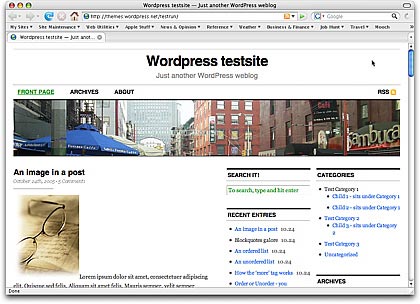
I reduced the size of three images to 322 wide and began some quick experiments to replace the existing header image (the street scene you see in the screenshot above) with the three images. I could get them to fit and they didn’t look bad. But I couldn’t get the spacing between them just righ. And I didn’t like the way they fit right up against each other.

A Short Film History Lesson

Then I came up with the film sprocket idea.

For those of you who began using a camera in the digital age and aren’t familiar with 35mm film, let me explain. Before everyone started using digital cameras, serious photographers used 35mm film. The film comes on rolls and has tiny holes along each side. A camera has gears that line up with the holes. You feed the film into the camera and it grabs the holes with its gears. A mechanical lever pulls the next blank piece of film from the film canister to the place in front of the shutter for the next photo. When the roll was finished, the photographer (or his camera) would roll the film back into the canister and the photographer would drop it off for processing. When he picked it up, he’d get prints and negatives. The negatives are the actual film, with inverse (or negative) images on them.

If a photographer had his own darkroom, he’d likely make a contact sheet. This was created by putting the negatives right against a sheet of photographic paper in the dark, then exposing the paper to light for a short time and developing it. The resulting images were tiny (at least they were from 35mm film) and clearly displayed rows of black boxes on either side of the image with black lines between them — like you see here in the header of my redesigned site.

So anyone who has worked with film should recognize these little holes. Of course, my images are considerably larger and wider, so they’re not exact representations of contact strip images. They’re just borrowing the idea.

When I modified the three images to include the borders and fake sprocket holes, I liked what I saw. I created a Photoshop action to modify the 89 remaining images so they were smaller and included the tiny black boxes and borders.

Randomizing

On my old site, the random header image was randomized with a WordPress plugin named Random Header. But since I had three images to show in my header, I needed a different solution. So I turned to the software I used on Flying M Air’s Web site to randomize some of the images there: Random File.

Random File enables you to display random files anywhere on a template. (If you use a plugin like Exec-PHP, you can even display them within posts.) What’s neat about it is that you can tell it how many random files — well, in my case, images — to display and it will display that quantity without repeating them.

After some fiddling around with the CSS used in header.php — remember, I’m no expert — I added the following code in place of the existing header image code:

< ?php $files = array(); for ($i=1;$i<=3;$i++) { $file = c2c_random_file('/wp-content/foldername/foldername/', 'jpg png gif', 'url', $files);
echo 'Random image #' . $i . '';
$files[] = $file;
}
?>

The result is what you see here.

The Hard Part Was Done

With the tough design decision done, I was ready to put the new theme into place. I did that on Saturday, taking most of the day to get it 90% functional. I’m pleased with the results.

Comments? Questions? Use the Comments link or form for this post.

January 3, 2009 Update: I’ve since updated my site’s Web design again and adopted a new theme that does not include photos in the header. So although this information may still be useful to WordPress users, there’s no live example for you to see what it looks like. Sorry.

An Eclectic Mind

The site gets a new name, too.

After months of thinking about a new name for my personal blog and book support site, I finally took the plunge. The new name is An Eclectic Mind.

Why Eclectic?

The name comes, in part, from a regular visitor here, Thomas Fucili. He read my post “What’s in a Name?” and responded using the Contact form with a suggestion: Eclectic Pronouncements. I liked eclectic, but didn’t like pronouncements. He came up with a replacement word and I thought deeply about it but made no decision.

ec•lec•tic |iˈklektik|
adjective
1 deriving ideas, style, or taste from a broad and diverse range of sources : her musical tastes are eclectic.
2 (Eclectic) Philosophy of, denoting, or belonging to a class of ancient philosophers who did not belong to or found any recognized school of thought but selected such doctrines as they wished from various schools.

I liked the word eclectic because it seemed to suit the site’s content. As anyone who visits the site regularly knows, I write about widely varied topics. In the world of “pro blogging,” that’s a big no-no. But I’m not blogging to make money, so I don’t really care if the site’s not focused enough to build a high volume of regular visitors and feed subscribers. I write about what interests me, while providing support for the folks who buy and read my books.

The second definition seemed to suit me, too. I don’t think inside the box and can’t be easily labeled. I listen to a lot of theories and opinions and choose the ones that make sense to me — even if they don’t usually co-exist in other people’s belief systems. I’m not a philosopher (although sometimes I do feel ancient) but I’m a strong believer in independent thought.

Eclectic seemed a perfect fit.

The Domain Name Challenge

One of the challenges I faced was coming up with a name that was somewhat (at least) original and still had the domain name available. Although I don’t expect to formally change the domain name for the site, I did want new visitors to be able to find the site by clicking in the domain name with a dot-com at the end. I came up with a few twists on the word eclectic but couldn’t secure the domain names for any of them.

And then, one day, I just came up with An Eclectic Mind. The domain name was available and I bought it. Without really realizing it, I’d settled on a new name.

That was a few weeks ago.

A Day of Changes

I wanted to tie in the site name change to a complete site redesign. So I spent some time looking for the right theme. I found Cutline, which I’ll probably discuss in some detail in future blog posts. I also wanted to [finally] upgrade to the current version of WordPress (2.2.2 as I write this). I knew from experience that the upgrade would break some of my plugins and my current theme. So it made a lot of sense to take a whole day and just do the name change, upgrade, and new theme.

That day was today.

The site’s not done yet — I’m still adding in a few features that my old site used to have — but I expect to be finishing it up over the next few weeks. I’d love to hear your comments about it; use the Comments link or form at the bottom of this post to share your thoughts.

But for now, I just want to thank Thomas for his suggestion. I couldn’t have come up with the new name without his help.

Under Reconstruction

Today’s the big day.

Today is the day I’ve decided to upgrade this blog to WordPress 2.2 (finally). I figured that while I was at it, I’d change the blog’s theme — I’m rather bored with this one — and change it’s name.

So throughout today, this blog will be looking and acting weird. I hope it doesn’t get too weird for me to fix in one day. If all goes well, the blog will be at least 95% fully functional by day’s end, with some features gone and others added little by little over the coming weeks. I’m also hoping to add some new features.

The theme I’ve chosen, a version of Cutline by Chris Pearson, features two sidebars and a wider fixed-width page. This will fill the width of most folks screens and make it possible for me to have more before the “fold.” The second sidebar column will make it possible to display offsite links and advertising separate from internal navigation features. The look is clean and polished, the font is larger, and the theme is more far advanced than what I’m accustomed to, so I’ll have plenty of room to grow and learn.

I’ll tell you more about the blog’s new name and plans for the future when I get the hard stuff done. Stay tuned.

And please have patience if you tune in and see a big mess — or, worse yet — some PHP errors here.