The Big Sandy Shoot, Take 2

I return for a weekend-long rides gig.

Last year, I wrote extensively about the Big Sandy Shoot, an event held north of Wikieup, AZ by MG Shooters, Inc. I’d gone to the event at the urging of my friend Ryan, and although I did some helicopter rides, it wasn’t a terribly good gig for me. But it certainly was a fascinating experience.

A few months ago, the MG Shooters folks contacted me, asking me to come to this spring’s shoot. The rich guy with the helicopter who’d shown up last year and had given free rides had sold his helicopter. I wouldn’t have to compete with him. I checked my calendar, saw that Mike and I had the weekend free, and decided we’d try again. I didn’t expect to do many rides, but I thought it would be a nice opportunity to test out our camper in a real off-the-grid situation. We’d leave Jack the Dog and Alex the Bird at home with a house-sitter and just get away for a weekend. If I did rides, great. If not, I’d brought along a book to read and Mike could study for his helicopter check ride, which is later this week.

Getting There

The weather was bad on Thursday and Friday, with heavy rain throughout most of the day. This was good and bad. Good because the shooters would be able to use tracer rounds during the night shoots without worrying much about starting fires out in the otherwise dry desert. Bad because the shoot location is about 5 miles from pavement on the other side of the Big Sandy River. The Big Sandy River does not have a bridge at the crossing, so you have to drive across the river in whatever water is flowing. And the dirt roads often get a top layer the consistency of snot when they get wet.

Of course, I didn’t have to deal with this. I was flying in. What I had to deal with was the weather itself: clouds, rain, wind, etc. We waited until [too] late in the day to make our go decision. Mike pulled out with the camper in tow at about 5 PM and I went to the airport.

In Wickenburg, the sky was partly cloudy and the winds were no more than breezes. I’d checked the weather along the route 93 corridor where I’d be flying, all the way up to Wikieup and Kingman. It didn’t seem bad, but it certainly didn’t seem good. As any pilot who flies in remote areas can tell you, weather forecasting isn’t exactly perfect for areas where there aren’t any airports or cities. So although my destination was 60 miles from Wickenburg, I couldn’t get any solid weather information for it. I had to extrapolate based on what I was experiencing in Wickenburg and what was going on in Kingman, another 30 miles northwest of Wikieup. The radar images helped. And just looking out the window in the direction I had to fly helped.

The plan was for me to fly up there and scout out the river situation from the air. If the river was flowing too swiftly to drive across, I’d call Mike on the aviation radio he had with him and tell him. We’d set up camp at the Burro Creek campground about 30 miles south on route 93 for the night. I wasn’t sure how they’d feel about a helicopter landing down there, but was willing to find out if I had to. (Obviously, I wouldn’t land in the campground itself.)

Because a straight-line route would have put me in the mountains east of route 93, I decided to follow route 93 itself. (IFR: I follow roads.) There were two benefits for that. First, if weather closed in, I could land near a paved road where I could meet up with Mike or get a ride with someone else if I had to. Second, I could check out Burro Creek campground from the air to make sure there were potential landing zones and open camping spaces.

It was an uneventful flight. The winds were not much more than light breezes. Although there were a significant number of clouds at my altitude, none of them were near my flight path. Instead, they obscured the mountain tops on either side of the valleys I flew up. I never got within a mile or two of any of them.

I passed Burro Creek and saw that the campground was about 80% full. I also noted that they’d never painted the second bridge over the canyon there. (I’d taken a photographer from Utah to shoot the bridges from the air as the second one was being completed at least a year before.) I climbed over the mountains there and dropped down into the valley where the Big Sandy River flowed. It wasn’t flowing much at all. In some places, the riverbed was dry, in other places, there was about a foot of water flowing. It was a lot like the Hassayampa River, which flows mostly underground through Wickenburg. I overflew Wikieup, then concentrated on my GPS to locate the shoot site.

It was a good thing I had the waypoint programmed into my GPS. The shoot was quite a bit farther north and east than I remembered. It was in the foothills of the Aquarius Mountains. A line of clouds at my altitude hid the mountaintops from view. The shoot site was about 1/2 mile from the clouds. A bunch of people were set up on the flattened out ridge top with campers and shade structures.

Now, I’d been told that they’d put in two helipads since the previous year. And try as I might, I just couldn’t find them. I circled once, coming quite close to that cloud bank, then decided to land, shut down, and get directions from the ground. I used my cell phone to call Mike and leave him a message about the river conditions — I knew he was too far out for the radio — then landed on the southwest edge of the ridge.

Zero Mike Lima on its helipadTurns out that the helipads were nothing more than just flattened out areas on the north side of the ridge. Someone had decided that the closer helipad would make a great campsite and had set up a ton of camping gear on it. Ed, the guy who runs the place, suggested that he move, but the guy camped out there wasn’t interested in that. He tried to say that it was muddier there than anywhere else. That simply wasn’t true, although the mud leading up to that spot was terrible. So Ed and I found another place on the east side of the ridge. It was higher and dryer and although it hadn’t been cleared for helicopter use, I had no trouble landing there. Best of all, it was closer to where the shooters and spectators would be hanging out, so I was more likely to get people coming over to me.

With the helicopter settled in and the light fading quickly, my thoughts turned to Mike. Last year, he’d gotten lost on his way in from route 93. I didn’t want him getting lost in the dark. So I found someone with a truck who was willing to take me down to the main road and guide him in. That’s when I saw how muddy the road was. It was almost frightening — especially one steep hill covered in reddish brown snotty mud.

We literally almost ran into Mike. He didn’t know I was in the truck, so he didn’t stop. My driver, Ron (I think), made a U-turn and tried to catch up with him. We were more than halfway back when Mike finally stopped and I switched vehicles. We followed Ron the rest of the way up, checked in at the registration area, then climbed to the ridge and parked the camper near the helicopter.

Night Shoot

We were just finishing the camper setup — which included parking its right wheels on five leveling blocks and using large stones to prevent it from rolling away — when the night shoot began.
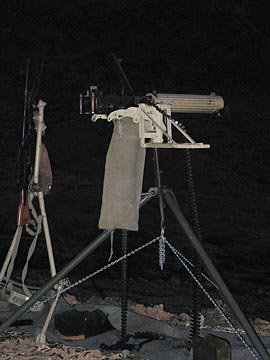
A big gun. At night.If you’ve never been to a machine gun shoot, you’re missing a really outrageous event. These guys have the same kinds of guns the military has/had for warfare and I think they have more ammo than the military issues to its soldiers. And they’re not afraid to shoot it. At night they use tracer rounds that clearly show the path of the bullets as streaks of red or green light. The sound of fire is deafening and every once in a while, it would be punctuated by the loud boom of a reactive target (i.e., stick of dynamite) going off.

At 10 PM, the shooting stopped. By that time, Mike and I were already in the camper, getting ready for bed. It started raining lightly outside. It got quiet and we slept pretty well.

The Big Day

In the morning, the low clouds were back, but never really drifted into our area. The big camp slowly came to life as shooters woke. The local 4H club was serving breakfast and the bacon smelled excellent. After breakfast in the camper, I went out with some rags to dry the dew off my helicopter. We hung a sign that said, “Helicopter Rides $35” on the back of the camper, which faced the rest of the camp. At 8 AM, I had my first passengers.

I flew much of the day. It wasn’t nonstop, but it wasn’t stop-and-go, either. Generally, I’d get three or four flights in between shutdowns. Then I’d get out and grab something to drink or take a pee or do something in the camper before the next few passengers showed up. Most flights had just two people on board — most of these guys were pretty “healthy” — and I made the flights a bit longer than I needed to. The later flights were a bit shorter — after all, I wanted to make money on this event — and included a view of the little waterfall in the foothills about a mile east of the camp.
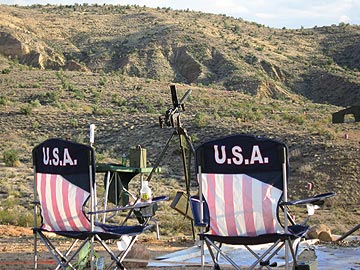
U.S. Firepower in WikieupMeanwhile, the shooters were shooting. They started up at about 9:30 AM and stopped at noon for lunch. Then 1:00 PM to 5:00 PM when they stopped for dinner. They kicked off the 1 PM shoot with the detonation of a pig statue packed with explosives. I was in the air when they did it, but my passengers and I saw the smoke out in the target area. Mike said that the car alarms for all the cars and trucks had gone off.

We used our new fuel transfer tank to refuel the helicopter. It didn’t work quite as expected. Mike got tired of cranking after about 2/3 of the fuel had been pumped and made the fatal error of stopping. The fuel drained out of the hose and we couldn’t get the damn pump primed again. So the remaining 1/3 tank (about 8 gallons) remained in the transfer tank. Later, I made a fuel run to Kingman which took about 5 minutes longer than it needed to when I parked the helicopter about 3 feet farther away from the pumps than the hose would reach and had to start up to move it. (I hate when that happens.)

The weather threatened rain to the east and west of the site most of the day. On a few flights into the mountains on the east, I got drizzled on. We saw rainbows, too. But the clouds broke up around sunset. I stopped flying at 6 PM after taking at least 40 people for rides.

We made dinner in the camper and opened a bottle of wine. Outside, everyone was preparing for the night shoot. It got dark and people started shooting off flares. They’d shoot into the air like a fireworks rocket, then explode. A red light would glide to earth at the end of a small parachute, lighting up the range. Occasionally, one would land before it went out, setting a small bush on fire. But the earth was so wet that the fire soon went out.

The night shoot began loudly. Mike and I walked down the back of the firing line, past the shooters, taking photos and videos as we went. Thank heaven for ear plugs.

The Last Day

By morning, the folks who hadn’t left the night before were packing up to leave. There was another shoot scheduled, but only the hard-core shooters seemed interested. I flew another 10 or so passengers. The waterfall was drier and harder to spot in the canyon. Between flights, Mike and I packed up the camper.

I was on the ground when one of the shooters, a man who had made a canon out of a fire extinguisher, shot a red bowling ball over the range. That thing climbed at least 300 feet, with the wind whistling through its finger holes, before crashing to earth. He’d been shooting the bowling balls all weekend, but I always seemed to miss them. Seeing it was a treat.

Mike and I had lunch, hooked up the camper, and prepared to leave. I took Mike on a quick flight up in the mountains before dropping him off at the landing zone. I flew home the direct route, detouring only to peek into Bagdad Mine on my way back. Total flight time for the weekend: 6.2 hours. When I later tallied up the money, I discovered that I did a little better than breaking even. (Should have made the rides a little shorter.) But it was enough to come back.

Slot Canyons

Another helicopter outing.

I was coming into Wickenburg Municipal Airport after a tour I’d done down in Scottsdale when I spotted a helicopter sitting idle at the fuel island. Ray’s or Dave’s — I couldn’t tell from that distance. Then Dave’s voice came over the radio, announcing that he was two miles north, landing at the fuel island. Since I was headed for the same place, all three of Wickenburg’s privately owned helicopters would be at the airport at once.

“Hey, Dave. Where are you going?” I asked.

The Unicom frequency at Wickenburg was otherwise dead and local pilots aren’t shy about brief conversations over the airwaves when necessary.

“Hey, Maria. We’re going out to take a look at some slot canyons Ray found. Want to come?”

“Maybe.”

I landed on the 100LL side of the fuel island. Ray saw Dave coming in and moved the helicopter, which was parked on its dolly, so Dave could land there. Ray had his two young sons with him. A man I didn’t know was waiting at the fuel island for Dave.

I shut down as the FBO guy came out to fuel my helicopter. Soon Dave’s helicopter was sucking down JetA.

Both Dave and Ray fly Hughes 500s. Ray has a 1982 Hughes 500D utility ship and Dave has a 1969 (I think) Hughes 500C “executive” model. Both guys bought their helicopters after taking an “E-ticket” ride up the Hassayampa with Jim, who owns a 1973 Hughes 500C exec. All three of these helicopters are in excellent condition. Jim has since moved (at least temporarily) to San Diego. Dave flies his helicopter to work in Scottsdale almost every day. And Ray uses his mostly for exploring, although he’s building time so he can qualify for training with his ship’s utility hook.

I’m the poor kid on the block — at least in their eyes — with a piston helicopter. I like to remind them that I bought mine brand new.

Spur of the moment day trips like these aren’t anything unusual for Wickenburg’s helicopter pilots. What is unusual is that I should be invited. The last time they invited me on an outing, it was Ray and Jim flying their helicopters into a canyon near Burro Creek. I orbited overhead with Mike while they landed on a ridge so narrow that their skids just fit and their tailcones hung out over an abyss. “Come on down,” Jim, the guy known for trimming treetops with his main rotor blades, urged over the radio. “I don’t think so,” I replied. “Have fun.” And Mike and I headed to Prescott for lunch with pavement under my skids. Since then, Ray and Jim were convinced that I didn’t like off-airport landings. (Ah, if they only knew.) The invitations stopped. But today, I happened to be in the right place at the right time for a new invitation.

Unfortunately, I was waiting for Mike to meet me at the airport. We’d planned to wash the helicopter. Mike had taken a motorcycle ride up to Prescott to clear his mind a bit and wasn’t expected back for another 20 to 30 minutes.

Ray told me he’d overflown the place a bunch of times and had landed there with his wife recently to check it out. He said there were at least three slot canyons. One was about 6 feet wide, 100 feet deep, and 3/4 mile long. He described where the place was located in terms of landmarks: go to the Wayside Inn, then head over the north side of the lake and you’ll find it just past the first set of low mountains.

Ray probably has a GPS, but I don’t think he believes in using it. He never has coordinates for anything. But he does have the uncanny ability to re-find a place after being there just once. He’s found and returned to all kinds of things out in the desert — abandoned homesteads, waterfalls, plane wrecks, mines — you name it. If it’s out in the desert within a 50 mile radius of Wickenburg, Ray can take you there.

I know the area that Ray was describing and I know that there are lots of low mountains there. If I didn’t follow them, I wouldn’t find it. But I had to wait for Mike. They waited long enough for me to change my shirt and shoes. But when Mike still didn’t appear, they were done waiting. Dave and his friend started up first and took off with enough downwash to knock over all the extra JetA fueling equipment stored at the fuel island. He orbited the industrial park while Ray and his boys started up and warmed up. Soon they were lifting off. Then they were a pair of dark spots heading west.

Mike rolled in 10 minutes later. I told him what was up, then went to start up the helicopter while he parked his motorcycle. I managed to raise Dave on the radio and told him I’d be taking off in two minutes.

I had the Wayside Inn (home of the Hamburger in the Middle of Nowhere) programmed into my GPS, so I punched it in as a direct-to and we headed west bearing 286°. After a few moments, I heard Ray and Dave chatting on the frequency, so I told them we were airborne. They weren’t in any hurry — in fact, it seemed they were interest in overflying the remains of a trailer-based meth lab out in the desert — so I had a decent chance of catching up with them. Dave had doors off, which would slow him down and it was only Mike and I on board, so I was able to get a 115-knot cruise speed at my allowable continuous power setting of 22.5 inches of manifold pressure (30°C at 2,000 feet). I’d flown with Jim many times and he seldom topped 100 knots.

We switched frequency to 122.725 so we wouldn’t bother other pilots while we chatted. I reported our progress each time I crossed a landmark: Route 71, the unpaved Alamo Road, the Wayside Inn. When I got to the Inn, they were already across the lake. Fortunately, Ray had to poke around a bit to find a good landing zone. I reached the west side of the lake just as Dave set down on a ridge. I didn’t see either of them — at least at first. Then I caught sight of a flash of light: A strobe about 2 miles away.

“I have you in sight,” Dave said at almost the same moment. “I’m at your one o’clock.”

That’s where I saw the strobe. I homed in on it.

Ray was still listening in as he cooled down his engine. “There’s a good landing zone right behind me,” he said. “I can guide you in if you want.”

I circled around Dave’s helicopter, which was still spinning up on the ridge. Ray was on a low arm of the mountain. The slot canyon was just to the left of his helicopter. There was plenty of room behind him — even for a helicopter 38-1/2 feet long — between palo verde trees, cactus, and shrubs.

“I got it,” I told him. I made my approach and set down in the longest clear area I could find. The top branches of a palo verde tree on my left were about a foot beneath my unloaded spinning blades.

I cooled off my engine, which had been running hotter than usual during our high speed pursuit (summer is almost here in Arizona), and shut down. The blades were just coasting to a stop on their own when Dave and his friend reached us. Ray and his boys were waiting patiently for us.

We didn’t waste any time scrambling down the side of the steep canyon wall just 10 feet from Ray’s helicopter. I was wearing Keds, which were the only shoes I had at the airport (other than my loafers) and they didn’t offer any traction at all. I had to do the last little bit on my butt. Then we were in at the mouth of a narrow canyon that cut into the rock wall in front of us.

Ray led the way, followed closely by his boys. “Keep an eye out for snakes,” he warned.

We slipped into the canyon. The rock walls were a conglomeration of rocks laid down when Arizona was under water. You could see where different layers of rock had been deposited in the sand of a sea bed, cemented there by pressure and time. The sea receded, leaving Arizona dry with many flat valleys between mountain ranges. Over thousands (if not millions?) of years, water had cut through this particular piece of rock, digging deeper with every storm. The slot canyon was narrow — even narrower than Antelope Canyon — but the walls were rough, lined with the rocks that had been deposited there millions of years ago.

Natural Bridge Deep in Slot CanyonThe canyon twisted and turned on a gentle downward slope, with an occasional drop of 2 to 4 feet where we had to scramble over boulder deposits. Inside, the air was cooler and, as the walls climbed on either side of us, cooler breezes blew past us. Sunlight didn’t get to the canyon floor this time of year, so the rock walls hadn’t heated. A side canyon entered suddenly from the left with a natural bridge of rock over it. As we continued down, a few other steep canyons joined in less dramatically. Then the canyon opened abruptly to a much wider canyon with steep walls and tire tracks on its sandy floor.

We all agreed that the canyon had been pretty cool. Ray led the way to the next one, which was a few hundred yards downstream in the big canyon. We walked up the canyon, but it was much shorter and ended with a 15-foot vertical wall. We retraced our footsteps out to the main canyon.

“There’s another one about a quarter mile away,” Ray told us. “Want to see that, too?”

Slot CanyonWe did, so we started walking. I think Ray’s estimation of distance was a little off. It had to be at least a half mile. The sun was still shining into the wide canyon, and it was warm. I’m out of shape and didn’t walk easily on the sandy canyon floor. But after passing a much narrower canyon that one of the boys explored on his own, we finally reached the third slot canyon. Like the others, it cut through the solid conglomeration of rocks with cool breezes along the way. And like the first canyon, it was long, stretching back into the mountain as it climbed. Mike and I and one of Ray’s boys went quite a distance, hoping we’d be able to climb out and see where the helicopters were parked. But it soon became apparent that we’d have at least a mile hike ahead of us — and we still might not see them. None of us wanted to walk that far, so we went back.

We retraced our steps back to the first canyon, chatting about all kinds of things on the way. Ray and Dave continued walking past its mouth, which was hidden behind a large palo verde tree. I don’t know if they really didn’t see it or if they were trying to fool us into walking past it. I wasn’t being fooled — at least not by that ploy. They had plenty of other gags to fool me with — Ray has a real talent for delivering pure bull with a straight face and Dave is the perfect straight man: normally trustworthy so you always believe what he says. (I know better now.)

Dave's and Ray's HelicoptersBack at the helicopters, we went straight for our cooler bag with its supply of water, Gatorade, cheese, and salami. We re-hydrated and snacked. Dave and his friend had to walk all the way back up the ridge to get their drinks and they didn’t come back. When we heard Dave start his engine, we knew it was time to leave.

I was just climbing into my helicopter when Dave took off and zoomed past us. Ray and I were ready to go at the same time. (It’s good helicopter outing etiquette to make sure no helicopter is left behind and Ray and I were watching out for each other.) Ray left first, popping off the ground like a champagne cork. I tried to be a bit more graceful but didn’t do much better. I followed the slot canyon — a narrow crack in the rock — down to the main canyon as I climbed. Ray was at my four o’clock. Dave was completely out of sight.

Jim might be slow, but Ray isn’t. He and I were flying neck and neck as we crossed the lake, but he inched his way past me as we climbed the flat valley east toward Wickenburg. By the Wayside Inn, he was a half mile ahead of me. He’d beat me back to Wickenburg by at least 3 minutes; the only reason it was that short a time was that I took a more direct route back, following my GPS’s advice. Dave had let his passenger off at the airport and was just getting ready to leave when I came in. He took off and I set down.

The sun was just setting.

It had been a nice little outing, one I really needed to do. Lately, the only time I fly is to take paying passengers on tours and charters or to go to or from a passenger pickup point. I’ve flown down to the Phoenix area so many times the past few months. After a while, it just isn’t fun. But outings like this — with friends in remote places, seeing cool things — is a better reason to fly. Even if someone else isn’t picking up the tab.

Heli-Shopping

The latest craze? I wish!

You’ve probably heard of heli-skiing, where they take you to the mountaintop in the ultimate “lift”: a helicopter. And heli-hiking, where they take you by helicopter to a remote trailhead and pick you up someplace equally remote. Well, thanks to one of my regular passengers, I’ve now started doing heli-shopping trips.

Here’s the deal.

Wickenburg has serious limitations on its shopping opportunities. Sure, there’s a great supermarket (which even has a Starbucks now, if you can imagine that) and there are a handful of shops down and around town for buying souvenirs, items for your home, and gifts. And even a little boutique.

But for hard-core shoppers, that might not be enough. For these people, it’s Scottsdale or bust.

Scottsdale, by car, is a good 90-minutes from Wickenburg. And that’s if you don’t hit any traffic and push the speed limit a bit. But by helicopter, it’s only 30 minutes away. The obvious benefit for the shopper: less time in the car, more time in the shops.

Last year, a couple who flies with me every time they come to stay at one of Wickenburg’s guest ranches, drove down to Scottsdale for a shopping day. The weather was awful and rainy and since people who live in Arizona don’t know how to drive on wet roads, the traffic was terrible. When they got to the shops, she got right down to business while he tried, in vain, to get a seat at one of the mall restaurants for lunch and a few hours of reading time. But the mall was packed and he couldn’t get a seat, so he wound up in their rental car in the covered parking garage, reading by the car’s dome light. Then, when she was finished shopping, they had another long, miserable drive back to Wickenburg.

This unhappy memory stuck with them. So this year, when they came to visit, they asked me if I could simply fly her down to Scottsdale, while he did something in Wickenburg that he enjoyed: a round of golf.

I’m never one to turn down a good charter, so yesterday at 10:30 AM, I was winding up Three-Niner-Lima with my eager passenger on board. We had an uneventful flight down to Scottsdale, landed, and locked up the helicopter on the ramp. Then, since I had only one passenger and my Scottsdale airport car is a two-seater, I drove her down to the Scottsdale Fashion Mall and let her loose by herself for four hours. Then I spent the time doing some errands, having a nice lunch, and doing a bit of shopping on my own.

I picked up my passenger at 3:30 and drove back up to Scottsdale Airport. I put the car away and we carried our bags back to the helicopter. I stowed everything under the seats and, a few minutes later, we were heading north for a slightly different route back to Wickenburg that would include an overflight of Lake Pleasant and Castle Hot Springs. We were back on the ramp at Wickenburg in time for cocktail hour at the ranch.

Mission accomplished. In style.

Heli-shopping isn’t for everyone. For one thing, it ain’t cheap, so potential heli-shoppers have to be really serious about their shopping time. And shoppers simply have to say no to that great deal on an end table at Restoration Hardware — or anything else that won’t fit in the helicopter.

But heli-shopping is more than just transportation to the shops awaiting your discretionary spending dollars. It’s a scenic flight from one world (the sleepy retirement community of Wickenburg) to another (the busy city of Scottsdale). The transition from town to open, empty desert to suburbs to city is something to see. And you won’t believe the kinds of things you can see from the air that are simply invisible from the road.

Heli-shopping takes shopping to new highs. Pun intended.

A Search…

…but no rescue required.

I was sitting down at my desk, getting ready to start working on Chapter 6 of my Excel 2007 book (for the third time), when my phone rang. It was someone I knew from here in Wickenburg. He was wondering if I was available for a helicopter flight that day. It seemed that his son and his wife and young child had gone hiking and hadn’t come back.

Jeez!

Yes, I was available. I asked a bunch of questions, like whether the authorities were involved. He told me the police knew but hadn’t started looking yet. But he wanted to start looking right away. He thought they might be in the Granite Mountain area. That’s near Prescott, about 40 NM away.

I warned him that it could be expensive to search by helicopter. He said he didn’t care. I told him I could have the helicopter ready to fly in 30 minutes. I told him to give me a call if he wanted to go out. And we hung up.

He called back ten minutes later, just when I was warming up my Dell PC. He would meet me at the airport.

I dropped everything, threw on some jeans and practical shoes, grabbed my handheld GPS to track our search area, hopped in my Jeep, and drove off to the airport.

His mom, who I already knew, arrived at the airport as I was pulling the helicopter to the fuel island. I talked with her after I fueled up. Weather was closing in — an unusual thing here in Arizona — and the ceilings were dropping. Rain was a certainty. And to the north, where I needed to fly, the tops of the mountains were obscured by clouds. I’d checked the weather by computer before leaving home and things in Prescott looked okay for at least the next two hours. But I wanted to get up there as soon as possible.

Doug and his wife arrived a short while later. I gave them a preflight briefing, loaded them on board, and attempted to start the helicopter. For the first time ever, it took five tries to start. I’d flooded the engine while priming it.

We crossed the Weaver Mountains north of Wickenburg to the east northwest of Yarnell. We were flying right below cloud level up there. But ahead, at Granite Mountain, the sky was only partly cloudy.

We reached the mountain 20 minutes after leaving Wickenburg. It’s a one-hour drive. We circled around the west side to the north, had some trouble getting permission from Prescott tower to skirt their airspace as we flew around the mountain, and then started looking for the missing people’s truck.

Of course, there are a few things that made this a less-than-perfect search. First and foremost is that they weren’t sure that the missing people had come to Granite Mountain. They might have gone to some trail that ran from I-17 to the Verde River — which was at least 40 miles away. Second, the wind was howling up at Prescott, with gust spreads of 10 miles per hour or more. As the wind came over the arms of Granite Mountain, it bounced us around something fierce. Doug was getting airsick. My barf bags were under his seat.

We did a good amount of searching, but with thoughts of puke on my leather seats, I suggested we land at the airport and check in with other people who were monitoring the phones. I don’t think Doug was happy, but he didn’t argue. Five minutes later, we were on the ramp at Prescott airport, near the terminal and restaurant, and Doug was heading toward the buildings while I shut down.

In the restaurant, while Doug drank Sprite and his wife and I enjoyed other beverages, Doug checked in. The missing people’s truck had been found. At the Cave Creek trailhead, wherever that was. He didn’t get the coordinates. We hurried back to the helicopter, started up, and headed south.

The weather to the south wasn’t good. We hit rain right away. I joked about how the rain took the bugs off the main rotor blades. I didn’t mention that it also took the paint off.

It was a good 20-minute flight down the east side of the Bradshaw Mountains, which were completely socked in. It was really beautiful, seeing those clouds mingling with the mountains. You have to understand — clouds are not a usual feature here in Arizona. And when there are so many and they’re layered among the mountains, it’s really a sight to see.

Past Black Canyon City, I headed southeast, hoping to hook up with the road that runs from Cave Creek/Carefree to the lakes on the Verde River. That’s where Doug thought the trailhead might be. The wind was blowing, the rain was falling. And then I caught sight of a DPS (Department of Public Services) helicopter flying northbound. I tuned into the helicopter air-to-air frequency (123.025) and made a call.

“Police Helicopter north of Cave Creek, are you on one-two-three-point-two?”

“This is Ranger 42, north of Cave Creek.”

I told him who I was and who I had on board. I asked if he was searching for the missing people. He said he was and that he was heading toward the trailhead where their car had been found. He offered to give me the coordinates. I told him we’d just follow him.

Now keep in mind that I was flying a Robinson R44 helicopter. He was flying something else, something turbine with lots of rotor blades. I don’t know what it was. But I took off after him and tried like hell to keep up. We lost sight of him three times among the mountains we were crossing, but we finally caught sight of him in a low orbit around a parking area. The missing people’s truck was parked down there.

Ranger 42 told us he’d search to the west and suggested we take the east. Okay with us. So we followed a few roads in the area for about 15 minutes. Then we heard the media helicopters coming in. Channel 3 with Scott at the controls. Channel 10. Channel 15? I don’t know. All I know is that they were coming. And no matter how big the sky was, it would be a lot smaller with three more helicopters.

Doug suggested that I land in the parking area, let him off, and let his nephew, who had found the truck, on board. Then he proceeded to puke repeatedly into the barf bags I’d had the foresight to remove from under his seat before we left Prescott. In the back, his wife was fine.

We landed. Doug got out. His nephew climbed in. I gave him a safety briefing, made sure he fastened his seat belt, told him not to get sick because we were out of barf bags, and took off.

We spent the next 30 minutes searching to the northeast of the parking area. Ranger 42 and two other helicopters that had shown up had landed to coordinate the search efforts. They graciously offered to leave room down in the parking area for me, but I preferred to stay out of their way. So we followed trails and roads up and down mountains and canyons.

After searching to the east, we crossed over and went west. I watched my fuel levels. I had about 1/4 tanks when we got back to the landing zone and found one of the police helicopters spinning up. I reported in.

“Ranger 42 is departing the area,” the pilot told me. “The missing people have been found.”

The missing guy’s mom, who was sitting behind me, was thrilled. We listened to the media helicopters talking to the police helicopters. It seems they’d gotten lost the evening before just as it was getting dark and had simply pitched a tent and spent the night in it. In the morning, they’d stumbled upon someone’s home and the woman who had lived there had driven them back to the parking area. Found.

Approaching the landing zone from the north, I watched the three helicopters there take off. I lined up for landing and settled down in the space they’d just vacated. My two passengers got out. I caught sight of a restroom in the parking area and decided to make use of it. Two minutes later, the engine was shut down and the blades were stopped and I was making a beeline for the toilet.

There were cops all over the place down there. One of them had approached me as I was shutting down and I said, “Please don’t give me a ticket.” After all, I’d landed in a parking lot for a trailhead. He laughed.

Everything was okay. Happy ending. Doug decided to drive back with someone else. I think he had enough of the helicopter. But his wife stuck with me. We climbed back on board, started the engine, and took off. The media helicopters were circling above us like vultures. I just followed the canyon south, climbing up out of their way while they jockeyed for position to land and interview the found people.

I headed southwest toward Deer Valley. I needed fuel to make it back to Wickenburg. But I hit a wall of rain that was just falling too hard for me to fly through with a passenger on board. I turned around and headed east. Things were clearer over the Verde River. When I cleared the canyon, I was able to turn back to the southwest.

The media helicopters weren’t far behind me. I heard them debate whether or not I had the found people on board with me. Apparently, the vehicles in the landing zone had driven off just as the first helicopter landed there. Doug’s wife and I had a good laugh.

We landed at Deer Valley and I arranged for fuel. Once fueled up, we took off to the northwest to return to Wickenburg. It was raining most of the way and we skirted below the clouds almost all the way to Wickenburg.

I showed my passenger her house from the air before we landed.

Time logged, 2.9 hours. And yes, I was paid for my time.

Hopi Tea

A soothing beverage from the Rez.

My first visit to the Hopi reservation was about 6 years ago. I was traveling in my Jeep with two friends. Our main destination was the annual Navajo Nation Fair in Window Rock, AZ, but my friend Shorty wanted to drive through the Hopi Reservation and visit Old Orabi, which is the oldest continually occupied village in North America. Shorty wanted to mail a letter to a friend with the Old Orabi (or possibly Hotevilla) postmark.

The Book of the HopiThe Hopi tribe, unlike many other Native American tribes in the Southwest, is working hard to hold onto its culture and heritage and keep it from being commercialized by outsiders. This is probably why so few people know anything about the Hopi people. Their ceremonies are usually closed to the public — as are entire villages sometimes — and photography is not allowed. The reservation is completely surrounded by the Navajo Reservation in northeastern Arizona and only a few paved roads go through it. There aren’t many shops or restaurants and there are no casinos. The place isn’t very tourist-friendly because they don’t want tourists around. (This may be changing as the Hopi tribe realizes the importance of tourist dollars for the tribe’s economy. I just hope they don’t lose their identity in the process.) You can read more about the Hopi people on the Tribe’s Web site or in The Book of the Hopi by Frank Waters.

With all this in mind, we drove into the reservation and found Old Orabi. I don’t remember much about it. The Hopi tribe are pueblo indians and they built their homes on the edge of the three Hopi mesas: First, Second, and Third Mesa. I remember walking around one of the villages, past ancient stone homes, some of which were still occupied.

Eventually, we got to the post office, which I think was in Hotevilla. I remember this a bit better. It was a standard tiny-town post office with a bulletin board in the outer vestibule, where all the mailboxes were. Shorty spotted an “ad” for blue corn meal. We made a call from a pay phone and were soon on our way to a Hopi home.

It was a more modern home than the stone structures in the old villages. We were invited inside and I remember being surprised at how remarkably “normal” it was. (I don’t know what I was expecting.) We sat on a sofa while kittens played around us. The Hopi woman we’d met there had a big galvanized metal trash can that was absolutely filled with finely ground corn meal. She measured out quantities of the stuff with a round, flat pan not unlike a cake pan and stuffed it into a Blue Bird Flour bag. She told us how the cornmeal had been ground as part of a wedding ceremony. This was the leftover cornmeal from that celebration. When the bag was full, Shorty handed over some money and took the bag. (I wound up buying about half of the cornmeal from Shorty and still have some in stock.)

The conversation turned to dance shawls. A friend of the woman’s made them and had some for sale. Were we interested in seeing them? Shorty was. So we hopped into the Jeep and followed the woman to her friend’s house. The shawls were pretty — square or rectangular with really long fringe — but the colors were too bright and gaudy for my taste. Shorty bought one or two, possibly to be polite. And then we got on our way.

This whole experience really made the visit to the Hopi reservation special to me.

From there, we stopped at the Hopi Cultural Center for a bite to eat. Unlike my companions, I had a traditional Hopi dish that included lamb. This was before the vendors started setting up stalls outside, so after lunch we continued on our way.

As we were leaving Second Mesa, we passed a shop on the left called Tsakurshovi. (Don’t ask me to say that.) We stopped in. It was a small shop that caters primarily to the Hopi people, offering the materials they need to conduct their ceremonies. There were dozens of traditional-style Hopi kachinas — figures carved to represent Hopi religious and ceremonial people — furs, herbs, and more. The shop had two small rooms and a friendly young Hopi man behind the counter.

Turns out, this shop is owned by the Days — Janice and Joe. Janice is Hopi, Joe is not Native American. And it was mentioned in a recent story on NPR, which interviewed Joe’s son, Jonathan. Jonathan grew up spending his summers on the Reservation and the rest of the year in Boston with his mother. He now lives in Flagstaff where he runs a shop that I suspect is very similar to his father’s.

Traditional Hopi Kachinas: A New Generation of CarversI don’t remember why I bought the hopi tea. Perhaps Shorty bought some. Perhaps I asked the guy behind the counter what the bundles of sticks in a Ziplok bag were all about. In any case, I bought a bag of three bundles of sticks for $4.

I also bought a copy of Jonathan Day’s book, Traditional Hopi Kachinas: A New Generation of Carvers, which I had autographed on the spot by the guy behind the counter, Wallace Hyeoma, who happened to be one of the featured artists (page 47). (A year later, I would return to the shop and buy several traditional style Kachinas, one of which was carved by Wallace’s uncle.)

We continued on our way, leaving the Hopi Reservation. Our next stop was at the Hubbell Trading Post, where I wound up buying a Navajo rug. But that’s another story.

Much later, when I returned home, I found the bundles of sticks in my luggage. I boiled some water, broke off a few sticks and leaves, and dropped them in. In minutes, I had a hot cup of some of the most soothing tea I’d ever tasted. Clean, fresh, and simply delicious. No need for sugar or milk or lemon. This tea, like green or jasmine tea, is perfect straight. Now I commonly drink it on cold, lazy afternoons, when I feel a cold coming on, or when I’m feeling blue. To me, it’s like a comfort food beverage.

Those three bundles of sticks lasted a long time. A few years ago, I was back on the Hopi reservation and bought more. But today, waking up with a head cold, I decided to forego my usual morning coffee in favor of the clean flavor of Hopi tea. As I brewed up a cup, I realized two things: (1) the long story of how I’d discovered Hopi tea might be interesting to at least a few blog readers and (2) I was running low again.

I did some research for this blog entry. I discovered that Hopi tea is from a plant commonly known as greenthread and scientifically known as Thelesperma filifolium. You can see some photos of it as a plant and stick bundles, learn how to brew it, and read about its medicinal values on the New Mexico State University’s Medicinal plant Web site. I learned that it grows in abundance in the Navajo, Hopi, and Zuni reservations of the Four Corners area. I also found an online source for purchasing Hopi tea online, High Desert Farmers. High Desert is a small scale grower which sells Hopi tea as traditional bundles (they call it “bulk”), loose, and as tea bags. Since the bundles weren’t available, I bought bags and loose. It cost me $14.50 (including shipping), but saved me a 200+ mile trip to the Hopi reservation.

If you like plain, soothing hot teas like green tea, you’ll probably like Hopi tea. If you ever see some in your travels, I recommend it. And I hope you story of first acquisition is as memorable to you as mine is to me.