Mesa to Sedona by Helicopter, Part 2

Another video from the FlyingMAir YouTube channel.

Join me and fellow helicopter pilot Dave as we fly from Falcon Field in Mesa, AZ (FFZ) to Sedona, AZ (SEZ) along the Salt and Verde Rivers and through the Verde River Valley. I’ve cut this hour+ flight into multiple parts, each highlighting a specific area of our flight. In this video, we begin just north of the confluence of the Salt and Verde Rivers and detour for a close look at the fountain at Fountain Hills. From there, it’s over Rio Verde and back along the river for a low-level flight over the autumn colors and Bartlett Dam. The video ends over Bartlett Reservoir, where we’re continuing along the lake and river beyond. Along the way, you’ll hear our in-cockpit conversation about what we’re seeing and more.

Dave is an airline pilot who is working through his helicopter ratings. At the time of this flight, he was a private helicopter pilot; he got his commercial helicopter rating a few weeks later. Dave and I split the cost of this flight; I flew to Sedona and he flew back.

Many, many thanks to channel members and Patreon patrons. It’s your membership dollars that made this flight in Arizona possible.

NOTE: This is the 1080 HD version of this video. A 4K UHD version without the Member Wall is available to channel members at the Sponsor and Funder levels.

Mesa to Sedona by Helicopter, Part 1

Another video from the FlyingMAir YouTube channel.

Join me and fellow helicopter pilot Dave as we fly from Falcon Field in Mesa, AZ (FFZ) to Sedona, AZ (SEZ) along the Salt and Verde Rivers and through the Verde River Valley. I’ve cut this hour+ flight into multiple parts, each highlighting a specific area of our flight. In this flight, we begin on the ground at Falcon field, make a Gecko 2 departure across the runway, and hookup with the Salt River, where I drop altitude and point out numerous wild horses in the river. Along the way, you’ll hear radio communications with Falcon tower, our in-cockpit conversation, and us working through an intercom issue. At the end of this video, we’ve just turned up the Verde River and are making a detour to take a closer look at the fountain at Fountain Hills.

Dave is an airline pilot who is working through his helicopter ratings. At the time of this flight, he was a private helicopter pilot; he got his commercial helicopter rating a few weeks later. Dave and I split the cost of this flight; I flew to Sedona and he flew back.

Many, many thanks to channel members and Patreon patrons. It’s your membership dollars that made this flight in Arizona possible.

NOTE: This is the 1080 HD version of this video. A 4K UHD version without the Member Wall is available to channel members at the Supporter and Funder levels.

Helicopter Flight Up the Salt River

A video from the Flying M Air YouTube channel.

Here’s a cockpit POV view looking out the front window between me and my buddy Woody as we flew from Falcon Field (FFZ) in Mesa, AZ all the way up the Salt River to Roosevelt Lake. The cockpit intercom audio did not record [insert eye roll emoji here] so I wound up narrating it in the editing process.

I want to give a HUGE shout out to the channel members and Patreon patrons who made this flight possible — I had to rent this helicopter to do the flight and make the video.

You can see Woody in a tour of a King Air airplane in this video: https://youtu.be/1cylLFqhnzg

Snowbirding 2021: My Travels with Bill

I make a new friend who is a real pleasure to travel with.

How many people have told me that I’ll meet someone interesting when I least expect it? Too many to count. And all of them were right.

I was camped along the Colorado River south of Ehrenberg, AZ, with my friend Janet in November when an ATV with two men on it rolled into camp. They asked who owned the truck — pointing at my truck — and I stepped forward. It seemed that one of them had gotten his Mercedes Sprinter van stuck in the sand not far from our site. Could I use my 4WD pickup to pull him out?

And that’s how I met Bill, a retired pilot who spends much of his time bumming around the west in his van. He climbed into my truck and rode back to his van with me, where I surveyed the situation. One of his back wheels was deep in the sand.

We chatted, unable to do anything without a tow strap or chain. (I’ve since bought one.) That’s when I learned he was a pilot and, like me, had his eye on a tug-style boat for cruising Puget Sound and beyond. Those were only two of many similarities between us, as I’d learn in the weeks and months to come.

The owner of the ATV, Dean, camps frequently along the river. While we were chatting, he drove around some more until he found someone with a tow chain. He brought a few supervisors with a long, thick chain back to where Bill’s van was stuck. I put my truck into 4L, locked the hubs, and backed into where he was stuck, stopping when I was close enough for the guys to hook up the chains. Bill climbed into his van and backed up out of the sand with my truck tugging him most of the way. Mission accomplished.

I waited while they loosened the chain, invited Bill to join us for our nightly campfire, and climbed back into my truck for a return to camp.

-o-

Bill didn’t show up for the campfire, but he did stop by in the morning. We chatted for a while. He kept saying he was on his way to Los Angeles and couldn’t stay long, but we kept chatting. Finally, he left us for his trip west, telling me that he’d try to come back in December, after taking care of an early Christmas and a bunch of family stuff in Oregon.

Over the next month or so, we occasionally exchanged texts.

He returned to my camp the day after Christmas. Janet had left that morning and I’d reconfigured my camp to bring my mobile workshop closer to my camper. Bill pulled in late in the afternoon, with groceries for dinner. We chatted the rest of the afternoon, though dinner, and then around the campfire.

In the morning, he joined me and my pups for our morning walk. We chatted the rest of the day away. I was floored by how much we had in common. Hell, he even had the same immersion coffee maker I have and use for camping. I don’t know anyone else who has one of those.

We walked again the next morning. And then he left.

-o-

About a week later, after exchanging a few text messages, I met up with him in California for a day trip to Salton Sea and Slab City in my truck.

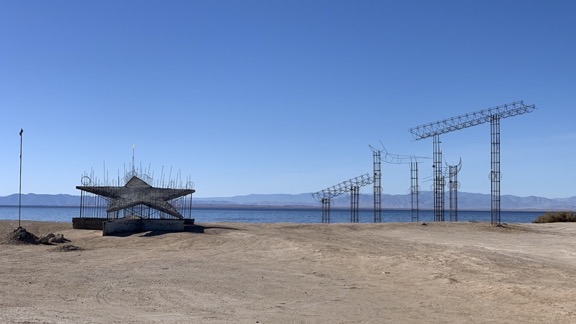
Bombay Beach
How can I not like someone who will accompany me to a weird place like Bombay Beach on the Salton Sea?

The following week, he was back in my camp for two more nights. The first day, we drove out in my truck to a campground he likes in California and did some hiking out there. On the way back, we stopped so I could capture some video footage of a helicopter delivering men and equipment to power line towers; it was a real pleasure not to be rushed. The second day, we went to Cibola National Wildlife Preserve so I could show him the sandhill cranes out there. Along the way, we explored some potential camping areas.

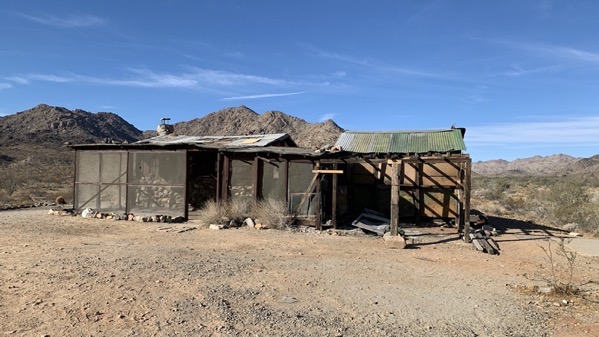
Deserted Cabin
We did some hiking out by Cottonwood Springs, a campground he likes south of Desert Center, CA. Along the way, we found this deserted cabin which was obviously being maintained by a local group of people who care about historic buildings.

Then he was gone again.

-o-

Around the end of January, I finally packed up my campsite and headed out. I had some visiting to do before I made my way back home.

Up until that point, it had been a remarkably mild winter at home and, with my only scheduled art show cancelled due to COVID, I didn’t have much of a reason to stay in Arizona. After two and a half months living in a dusty environment, hauling my own water, and having to drive on 8 miles of gravel to buy a quart of milk, I was starting to think long and hard about a soak in my bathtub and the luxury of my dishwasher, washer, and dryer — none of which required a water transfer pump to use.

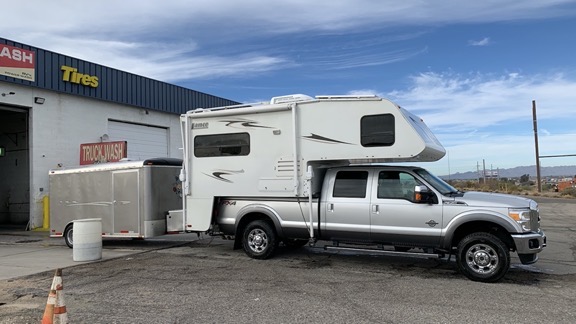
Clean Rig
Here’s my traveling rig, emerging from the truck wash where I got everything washed before hitting the road.

I spent one night in a 55+ RV park in Brenda, AZ, mostly so I could dump my tanks, fill up with fresh water, do some laundry, and take a good, hot shower. Then I dropped off my utility trailer with a friend in Wickenburg and headed south to Laveen to visit some friends there. From there, I went to Gilbert to stay with some other friends, enjoying the luxury of a king size bed and super fast Internet in their guest room. I’d had plans to try to find new wholesale accounts for my jewelry in the Phoenix area, but didn’t do any of that. Instead, I hung out with my friends, got my pups groomed, dyed my hair, did some shopping, and relaxed.

On Thursday, February 4, I had my annual flight physical and eye exam scheduled in North Phoenix. I said goodbye to my friends in Gilbert and headed north for those appointments. I spent that night in the desert just north of Lake Pleasant.

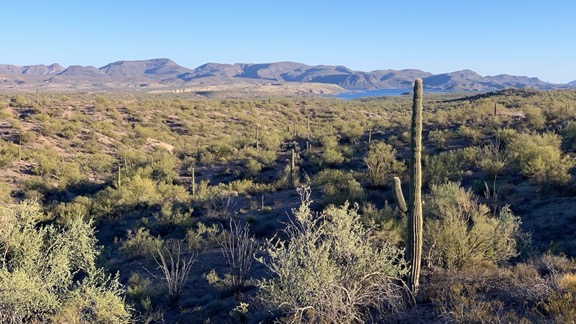
Lake Pleasant View
Here’s the view from my camper for the one night I spent north of Lake Pleasant.

I thought long and hard about my travel plans there. The weather at home was turning cold with snow in the forecast. I wasn’t in a hurry to get home anymore, but I didn’t feel like going up to Sedona and Prescott as I’d originally planned. I decided to go back to Wickenburg, fetch my utility trailer, spend a few days at Vulture Peak, and then head north. Death Valley might make a good interim destination.

-o-

But while I’d been traveling around, I’d also been texting back and forth with Bill. I’d told him about the hot spring north of Willow Beach on the Colorado River and he was interested in going to see it with me. We’d meet up somewhere, camp overnight at Willow Beach, and split the cost of a boat rental for a day at the hot springs.

The plan came together quickly after that.

He showed up at Vulture Peak. We spent two nights there, hiking part of Vulture Peak Trail in the middle day and enjoying campfires at night.

Vulture Peak Camp
I got my usual campsite at Vulture Peak and Bill pulled in right behind my trailer for the two nights we were there. For some reason, however — maybe the weekend? — the campsite had a lot of foot traffic wandering through, which made it a lot less pleasant than usual. I was glad to leave on Sunday.

We left Wickenburg on Super Bowl Sunday, heading north to Kingman for the night so Bill could lock in some fast Internet for the game. We spent the night parked side-by-side in a Cracker Barrel parking lot. (Beats Walmart.)

On Monday, morning, we left Kingman with a stop at the Kingman Turquoise shop along the way. I went in and spent way too much money on way more turquoise stones and beads than I should have. I have a design idea for a really interesting piece…

Kingman Turquoise
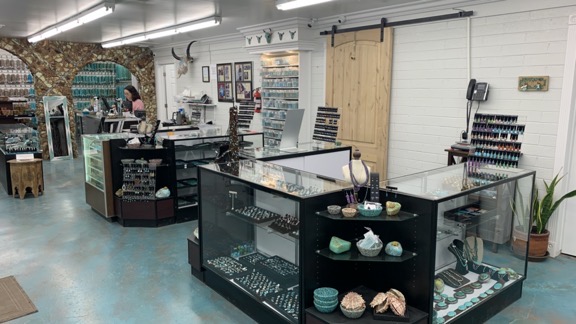
The Kingman Turquoise shop just north of Kingman, AZ, is like a candy store for jewelry makers who use turquoise. Bring your credit card.

He followed me from there to Willow Beach on the Colorado River, where we parked my trailer in a lot and then squeezed into a shared campsite, taking advantage of the discount he got with his lifetime National Parks pass.

Sunset at Willow Beach
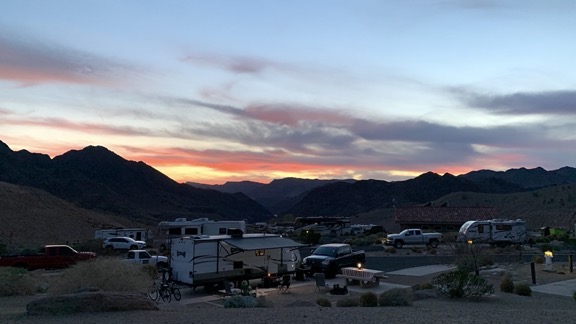
Willow Beach’s sunset did not disappoint us.

Hot Springs
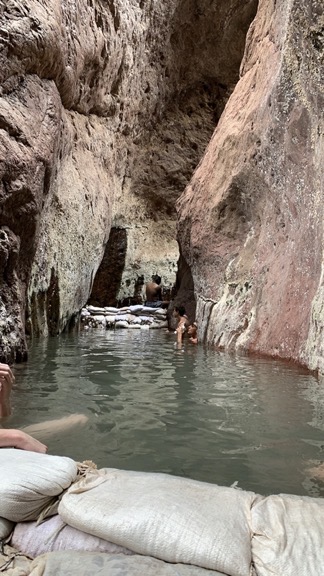
Tuesday morning at the hot spring. It was more crowded later in the day. I blogged about this hot spring here.

In the morning, we picked up a small motorboat and, with my pups, headed up the river. We spent at least four hours at the hot springs, dipping and soaking in the various tubs while other hikers came and went.

That evening, Bill led the way to a campsite he knew of up in the Eldorado Mountains south of Boulder City. It was a cool spot off a seldom-used road. I had great views down at the lights in Boulder City and Railroad Pass, with the glow of Las Vegas far in the distance.

In the morning, we climbed into his van for a trip farther down the road to visit the ghost town of Nelson. The two of us spent nearly an hour walking around the remains of old cars and equipment in the desert, snapping pictures everywhere.

Nelson
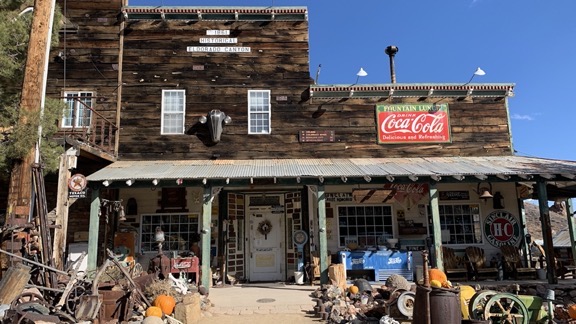
Here’s the museum/gift shop in the ghost town of Nelson. For just $1/person, you can wander around and shoot photos of the multitude of old cars and equipment parked around the yard.

On Wednesday, we went into Las Vegas to visit an old friend of mine from Wickenburg. I was glad to see Jim as active as ever at age 81, still working at the company he built years ago when I first met him, still coming up with unique solutions for new customers. Jim and Bill really hit it off; Bill grilled him about batteries and Jim had all the answers.

From Vegas, we continued on to Tecopa, where Bill wanted to show me a hot springs resort he knew. We originally signed up for two campsites for two nights but wound up taking advantage of a couple’s special that gave us sites for two for a week for only $250. We stayed six nights. I slid my camper off my truck while we were there so we could get around without taking one of our “houses” with us.

It was a great week. On most days, we soaked in a private tub in the morning before breakfast, then again in the afternoon before dinner and again in the evening before bed. The water was hot and soft and made my skin feel great. During the day, we’d choose a destination: Ibex Dunes and Sarasota Springs in Death Valley for two hikes, Shohone for a hike, China Date Ranch (twice) for hikes, Pahrump for a propane refill and some shopping. We spent one windy day in my rig just taking it easy, enjoying each other’s company.

China Date Ranch
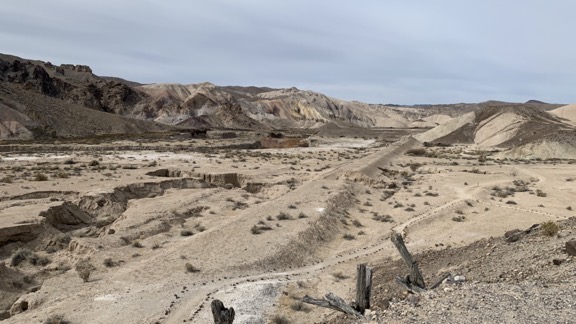
The Amaragosa Trail hike from China Date Ranch takes you into the riverbed, where you can still see traces of the railroad that ran there years ago.

At Badwater
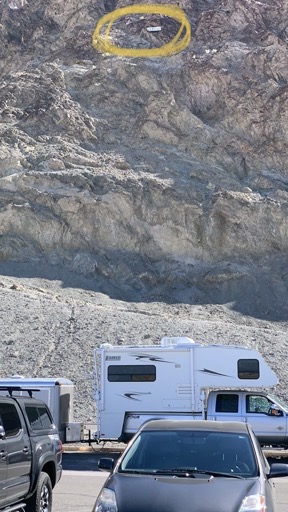
Here’s a real tourist shot at Badwater; Bill pointed out the Sea Level sign high on the cliff face beyond my rig.

From Tecopa, we headed into Death Valley, coming in through the Shoshone entrance and driving up the length of the park from the Ashford Mills ruins — which I’d last seen surrounded by yellow wildflowers during a super bloom a few years ago — and past Badwater, with a quick stop in Furnace Creek before driving the rest of the way up to Mesquite Springs. Bill had never been that far north in the park and was pleased by the dark, quiet night sky and uncrowded campground.

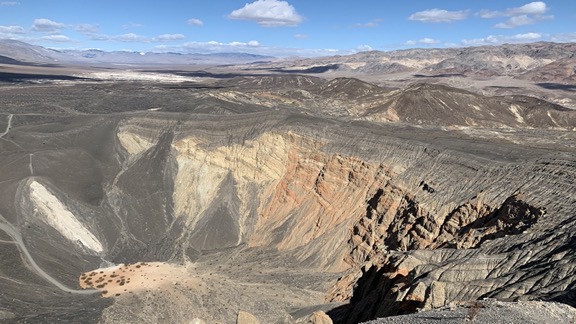
The next morning, Wednesday, we hiked around Ubehebe Crater in a howling wind. It was only a mile and a half, but there was a considerable climb early in the hike and lots of places to stop and look into smaller craters nearby. Back at camp, we took the rest of the day off.

Ubehebe Crater
Here’s a shot of Ubehebe Crater from the highest point on its rim. Normally, this hike might be very pleasant, but with a stiff wind, I was glad I’d bundled up.

On Thursday, the day I’m writing this, we decided to move on. Bill wanted to visit some friends in Los Angeles before he headed back to Oregon to take care of some family things. I had developed a sore toe that made long hikes painful. And although I had no idea what the weather was at home, I knew I should be on my way.

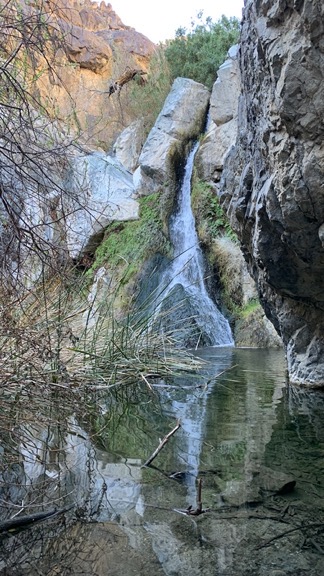
Darwin Falls
Darwin Falls is a surprising sight in the desert — and just a mile from the trailhead on a relatively easy path.

But rather than just part company, we decided on one more hike: a walk to Darwin Falls, a little-known spring-fed waterfall in Death Valley. I parked my rig at the Panamint Springs campground and he drove us to the trailhead in his van. We did the two-mile round-trip hike in about 90 minutes, stopping for about 20 minutes in the cool shade of the slot canyon at the falls before coming back.

Afterward, Bill drove me back to Panamint Springs and spent a little more time with me and my pups before saying goodbye and heading out. I was sad to see him go — I really had enjoyed our time together — but he’s already promised to come visit me at home. I’m looking forward to that.

-o-

Throughout all of our time together, I continued to be amazed at how much we thought alike and how compatible we were. I suspect he was, too.

We talked about everything — and I really do mean everything — and pretty much agreed on most of it. Better yet, he treated me like an intelligent adult. He was kind and generous and really seemed to want to hear my opinion of the things we talked about. It was a real intellectual treat for me. Like me, he knows a little about a lot of things and a lot about a few. Like me, he has a natural curiosity about things he hears about. I could — and did! — learn from him and he could — and did? — learn from me.

There’s more, but I won’t go into it here. After all, I don’t share every aspect of my life, despite what readers may think.

Anyway, the two weeks I spent with Bill will give me plenty to think about as I begin to gear up for the upcoming cherry season and start to plan my retirement. I’ve had other plans in the works for a while and he’s given me the push I need to start making things happen to reach new goals.

Meanwhile, I’m looking forward to more travels with Bill in the future.
Adding Power to My Utility Trailer

I splurge on batteries and an inverter for my utility trailer/mobile jewelry shop.

For the past five winters, I’ve been traveling south in my truck with a slide in truck camper on the back. It started with “the Turtleback” in 2016/17. That was a very large and rather deluxe Lance model with all the bells and whistles, including an onboard generator and a slide-out to expand living space when parked. Then I downgraded to a smaller, newer rig, “T2,” which was roughly the same length, not quite as deluxe, and lacked both the slide and generator. What I gained in the swap was a 400-pound weight loss and a lot more inside storage space.

Why a Utility Trailer?

Over time, however, I started bringing more additional items south than I could fit inside the camper or truck. Normally, I’d have my portable Honda generator in the truck, along with my bicycle and wrangle my plastic kayak onto the roof of the camper. In 2017, I brought my little jet boat south with me and loaded it up with extras, including that kayak, for the trip south. It was nice to be able to store extra stuff in a trailer.

In 2018, on my way to my first camp, I stopped in Lake Havasu and bought an inflatable Hobie pedal/paddle kayak. Sure, the 11-foot boat deflated and fit into a bag with wheels, but that bag was both bulky and heavy. I shoved it into the entranceway of my camper for the rest of the drive to camp, but quickly realized that dealing with it in transit was going to be a royal pain in the ass.

My Rig
Here’s my truck, camper, and original utility trailer not long after I bought it. Note the dent in the upper corner.

So I got on Craig’s list and bought a 12-foot cargo trailer. It was a bit “rough,” as I blogged not long after acquiring it. I hooked that up to the back of my rig and stowed all the extras I’d crammed into my truck and camper. It had two axles, but I had trouble getting the tow ball height just right to distribute weight evenly on both of them. It was also a bit rickety and had me worried about long distance driving with it. But it made it back to Washington intact. I wasted no time selling it to a friend who was looking for a tool trailer that could be parked on job sites.

Truck and Trailer
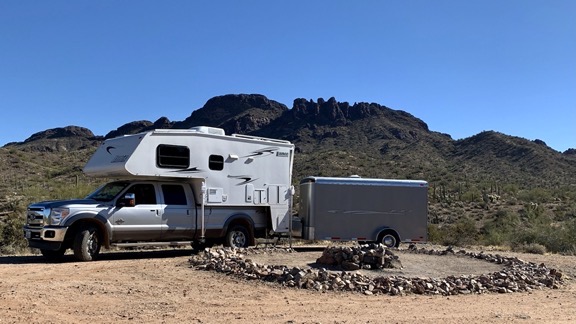
Here’s my current rig. The newer trailer is in much better condition than the original one and includes a toolbox on the tow hitch.

I went hunting for a new one. Literally new. My search brought me down to Yakima, where I stopped in at the Lance dealer for a part I needed for my camper. I mentioned that I was going to look at some utility trailers at a dealer down the road. Mike, the co-owner, mentioned offhand that he and his partner brother had a utility trailer that they never used and would consider selling. I took a look. It was almost exactly what I wanted. I looked at the new ones, then called Mike back and started negotiating for his. About a month later, at the tail end of a trip to Tacoma, I picked it up.

I started customizing the interior almost immediately, adding E-track to the walls so I could secure various items to it. The goal was to turn it into a sort of mobile jewelry shop that could also haul the things I needed to do jewelry shows and camp. I loaded it up and secured everything, but wasn’t very happy about its setup as a shop — I had to take out too many things and set up a workstation on folding tables and then be sure to stow everything before moving. Boxes were big and piled up and difficult to access. The IKEA drawer units I’d put in had limited storage space for the weight they added to the rig. It was uncomfortable and inconvenient and it just didn’t work out the way I’d imagined it would.

So this year I built the tables and shelves I needed to make a real shop area in the front of the trailer, leaving the back wide open for show equipment and camping stuff.


Here’s a brief video I shot the other day that shows off my mobile studio space while I’m parked. It also includes a glimpse of my new inverter. And did you know that I maintain a YouTube channel for ML Jewelry Designs? Find it here.

My Power Needs

Before I discuss my needs, I need to make it clear that I camp off-the-grid. I’m usually not in a campground, but if I am, that campground usually does not have any utilities running to the site. That means I need to be self-sufficient with power (as well as water and sewer). I rely primarily on solar power but also travel with a 2kw Honda generator, just in case I have cloudy weather or unusually high power needs in my camper.

What I’m discussing here is my jewelry-making power needs.

My primary jewelry-making tool is a flex-shaft. The popular brand name is Foredom and that has become a bit of a generic term for that kind of tool, but mine is a Eurotool brand. It’s basically a hanging drill motor attached with a flexible shaft to a hand piece that can accept Dremel sized tools. You turn it on and off with a foot pedal that controls the speed of the motor. Because this tool requires AC power and the only way I can get continuous AC power while camping off the grid is to run my generator (which I don’t like running because of the noise), I didn’t bring it. Instead, I brought my battery operated Dremel, with its spare battery and charger.

I also use a small rotary tumbler quite a bit, as I discuss in this blog post. That also requires AC power, but it only needs 36 watts. Unfortunately, sometimes I need to run it for hours at a time. I was able to run it with a portable 150 watt inverter attached to the power port in my truck or in a battery pack I’d bought primarily to run my telescope. I quickly ran down the battery pack and had trouble getting it charged back up. And the idea of draining my truck batteries to run a tumbler was not very pleasing.

I also found myself with lots of other little batteries that needed charging. My camper does not have an inverter; due to limited space, it only has two 12v batteries. (Higher capacity 6v batteries will not fit in the storage cabinet — I’ve already looked into it.) On short winter days with a low sun angle, the 200 watts of solar flat-mounted on the roof can basically keep those batteries charged and let me use DC power ports to charge my phone, watch, and iPad but not much more.

The Solution

Last year, I’d looked into getting a solar charged battery power system installed into the cargo trailer. The trailer has a metal toolbox on the hitch bars and I figured it would make a good place to put the batteries. I already had a Zamp portable solar panel that I could attach to my camper. Why not use that to power a 2kw system on the utility trailer? But the estimate I’d gotten — more than $3,000! — gave me pause. A whole year’s worth of pause

This year I went forward with a less ambitious setup that included just two 6v batteries and a 1kw inverter. I had it installed in Quartzsite, AZ, where there are numerous solar power dealers who work on RVs. (I went to Solar Bill’s, but Discount Solar is another dealer there.) It still wound up costing about $1200. But if I kept the batteries charged, I would have all the power I needed to run my tumbler and charge just about any device that needed charging.

Solar Panels PM
Here are my solar panels in my current setup location. The original location had the panels in full sun from around 9 AM to 5 PM; in this new spot, they get sun at 8 AM but start falling into shade around 3:30 PM. The cable for the panels is only 12 feet long and the plug for it is at the front of the trailer. Poor parking planning on my part, but it’s all good.

Plug and Outlet for Solar Panels
Here’s where the panels plug into the side of the toolbox where the batteries are.

Batteries for Solar Setup
Here are the batteries inside the toolbox. There’s a vent hole behind them. I lost about half the box capacity to store things; I can’t put anything on top of them.

1000 Watt Inverter
Here’s the inverter, mounted in the front corner of my trailer just under one of the shelves. I’ll likely use the area around it as a charging station for various batteries in the future.

I brought it all back to camp, set up the solar panel in a good spot, and let the system do its thing. It was a bit iffy at first. Although the batteries were charged when I got them, I don’t think they were at 100%. My immediate use brought their power levels down a lot more than I expected. But after a few days with bright sun on those panels — including days when I didn’t use the power in the trailer at all — I soon had the batteries fully charged and able to share that power with any device I plugged in without a considerable power droop. I even managed to charge that big battery pack overnight without draining the system batteries.

I’ve since set up a little portable table near the inverter where I’ve parked various battery chargers — for my Dremel, my Ryobi tools/lights, my drone, and even my laptop. It has become the go-to place for charging things and it does a remarkable job. In the future, I’ll probably just use the shelf beside the inverter to set up a charging station.

Since moving my cargo trailer closer to my camper, I’ve also moved those portable panels closer. That means that if the utility trailer batteries are charged up and I don’t need them, I can attach another 160 watts of solar to my camper to bring those batteries up to full.

And yes, I did look into putting 200 watts of solar on the utility trailer’s roof. It would have cost me an extra $1400 for the panels, controller (which is built-into my portable panels), wiring, and labor. Not worth it — at least not yet.

Long Term Benefits

I know I won’t be traveling like this every winter forever. In fact, I’m starting to think the this might be my last year at Arizona’s Colorado River backwaters, where I’ve been coming since 2014. I’m starting to feel as if I’m stuck in a rut and and after living too many years in someone else’s rut, there’s nothing I hate more than that.

I’ve been thinking of making some major changes in my life that includes shifting focus on how I spend my free time. There will come a point when I don’t need that utility trailer at all. It seems a shame when I’ve spent so much time and money customizing it.

But the way I see it, the improvements I’ve made to the trailer make it even more flexible for me or a future owner. I can see converting it into a small living space for rugged camping — there are quite a few people camping in converted utility trailers out here in the desert. My jewelry workbench illustrates how easy it is to build removable structures onto the E-Track I’ve installed. Where I’ve put in a workbench, someone else could easily make a platform for a cot or other sleeping space. The storage shelves in the nose of the camper aren’t pretty, but they do make it possible to store lots of things in a way that can be easily secured in transit. And the power makes it even more attractive for off-the-grid use. All it takes is a need and a little imagination.

Until then, I’m enjoying the upgrade.