Snowbirding 2020 Postcards: Traffic

I experience Phoenix rush hour traffic in my truck.

On Friday morning, I had to drive to Phoenix for the first day of a three-day art show. I had a setup window that required me to be there by about 7:30 AM. Because I’m camped out in the desert more than 100 miles west of there, I had to leave my camp at 5 AM.

I don’t like driving at night, but the moon was just past full and it illuminated the desert around me with a faint monochrome glow. There were few vehicles on I-10 at that hour — mostly semis — and I was able to easily maintain the 75 mph speed limit most of the way.

Google Maps
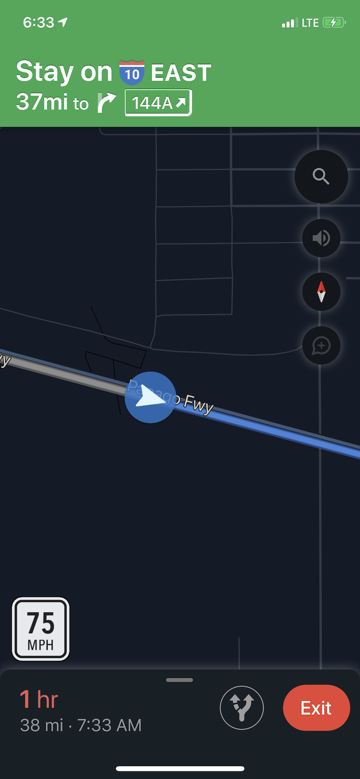
Here’s what I saw on Google Maps when I realized there was something wrong with the math.

I watched the readout on Google Maps on my iPhone as I got closer and closer to Phoenix. At one point, I noticed that the math didn’t seem right: I was moving along at 75 miles per hour and had only 38 miles to go, yet Google said it would take a full hour. How could that be? Even when I slowed down when the speed limit dropped to 65 and probably 55 in the city, I should still be able to make it in much less than an hour. Like maybe even 30 minutes.

What I hadn’t accounted for, of course, was rush hour traffic, which I experienced firsthand about 15 minutes later. Stop and go — just like I used to deal with when I had a “real job” in corporate America. I realized that it had been years since I’d been stuck in traffic like that — the kind of traffic where it takes you 15 minutes to go 3 miles. But this was traffic on steroids: at certain points, there were five lanes of vehicles completely stopped.

What was cool, however, was sitting up high in my big truck, being able to look over the tops of the sedans and compact cars ahead of me. I had never realized how much taller my truck was than the average passenger vehicle. There were few semis on this part of the road — I suspect the drivers were smart enough to exit for a truck stop breakfast instead of dealing with the mess. Instead, most vehicles were commuters with just one person per car, leaving the HOV lane pretty much open. And, as I could easily see, the red taillights went on for miles ahead of me.

I did make it to my destination on time. When I’d left camp at 4:57 AM, Google told me I’d arrive at 7:34 AM. I arrived at 7:35. That’s pretty amazing.

Snowbirding 2020 Postcards: Another Colorado River Sunset

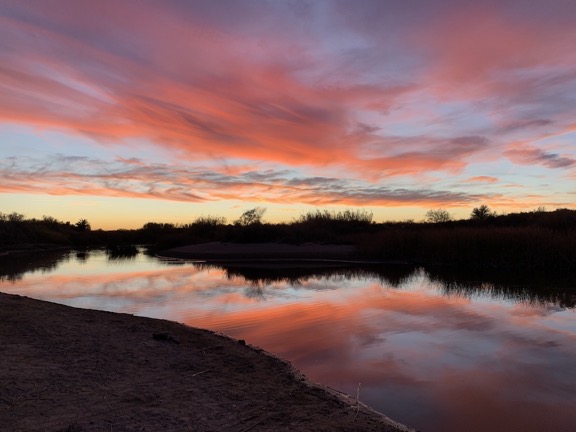
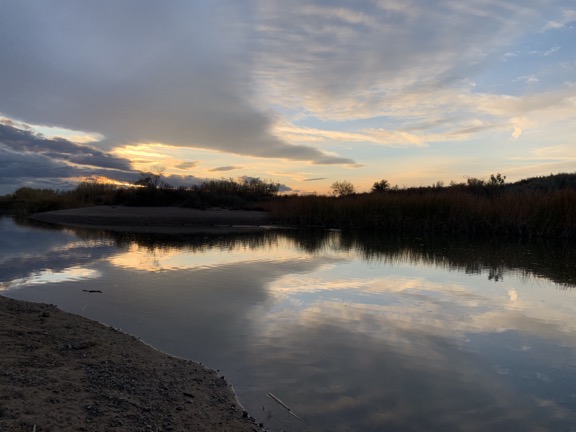
Another gorgeous sunset as seen from our campsite.

I’m going to try very hard not to share photos of every single beautiful sunset we’re seeing from our Colorado River campsite, but this one was too good not to share. With just enough clouds and smooth water to reflect them, Thursday’s sunset was the best I’d watched in a very long time.

Sunset 12/12/19
What a light show!

Snowbirding 2020 Postcards: The Cotton Field

A closer look at a nearby cotton field.

From Wikipedia’s Cotton entry:

Cotton is a soft, fluffy staple fiber that grows in a boll, or protective case, around the seeds of the cotton plants of the genus Gossypium in the mallow family Malvaceae. The fiber is almost pure cellulose. Under natural conditions, the cotton bolls will increase the dispersal of the seeds.

We’re camped in BLM land a few miles south of I-10 in western Arizona. On our way to or from the campsite, we pass a cotton field (and an alfalfa field) that’s ready for harvest when we arrive. This year, for the first time ever, I stopped alongside it for a closer look before harvest.

It looks to me as if they either cut the water supply or apply a herbicide (as they do to potatoes) after the cotton bolls have formed. As you can see in the first photo, the plants are pretty much dead, although there was some green at the bases of some plants.

Cotton Field, Close Up
A close view of a cotton field.

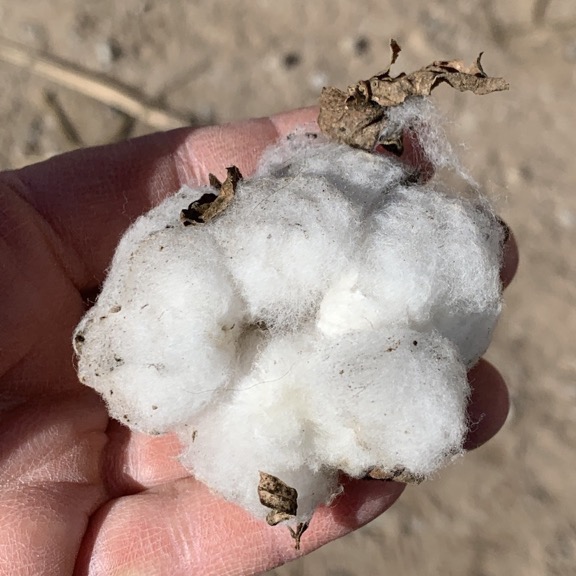
I stepped into the field and grabbed a cotton boll for a closer look and to share online. I remember seeing cotton bolls like this packaged as souvenirs in tourist shops in the southeast. The cotton felt soft, like a cotton ball. (I don’t know why I found that surprising, but I did.) I knew that deep inside the boll were seeds that had to be removed to use the cotton, but I didn’t tear it apart to find them. I liked its natural look.

Cotton Boll
A closer look at a cotton boll. I found a tiny yellow spider in the middle of the boll.

I’ll try to get photos of the harvest, but it all depends on if I happen to be driving by when they’re working. I know this field is completely cleared by Christmas every year.

You can learn more about cotton production in the United States, which has a history closely tied with slavery, on Wikipedia.

Snowbirding 2020: More Power!

Adding more solar power to my camping setup.

Why I don’t have solar at home.

A lot of people ask me why I don’t have solar panels on my enormous roof — it’s about 3000 square feet — at home. After all, central Washington state is dry and desert-like, with sunshine at least 300 days a year.

What a lot of people don’t know, however, is that Chelan County, where I live, is completely dialed in with renewable energy from wind and hydroelectric power. We have extremely cheap power — 3.22¢/kWh, which is 72.9% less than the national average rate of 11.88¢/kWh (per ElectricityLocal.com) — and my monthly electric bills seldom rise above $50 in any month, no matter how much heating or cooling I use in my all-electric home. It would take decades for me to recoup the cost of any solar setup at home. And, because the power I get is mostly from renewable sources, it’s pretty much guilt free.

I have always been a huge proponent of solar power for off-the-grid camping (and life in general). To that end, I’ve invested in solar panels for most of the RV’s I’ve owned, including my current truck camper, “T2.”

When I had my previous truck camper, “the Turtleback”, I thought a portable panel was the way to go. Zamp made foldable panels with a tightly fitting semi-hard case for safe transit and, back in 2016 (I think), I bought a 160 watt setup and had a simple plug socket installed on the outside of the Turtleback’s battery compartment for easy hookup. It worked like a charm.

What I wasn’t thinking about was the fact that the panels were large and heavy and had to be stowed someplace in transit. After I downsized from the Turtleback to T2 (which I also had that handy plug socket installed on), I decided to install 200 watts of solar on T2’s roof. No more dragging around those big panels.

Of course, I didn’t sell them. I keep everything. 🙄

How I Use Solar

I should make it clear here that my solar setup has always been solely to keep my camper’s batteries fully charged when I’m not hooked up to a power source. I do a lot of off-the-grid “dry camping” and if I don’t charge the batteries I will eventually run out of power. (Duh.) I don’t have an inverter to provide alternating current (AC) power for device like my camper’s microwave or even my laptop charger. Everything runs off direct current (DC) power or propane.

I should also mention that I’m not a complete idiot and I also travel with a 2KW generator that does provide AC power. Unlike a lot of other off-the-grid campers, however, I don’t like to run it because I don’t like to listen to it. It’s a Honda and it’s quiet, but it’s a lot more quiet when it’s turned off. I wish other RVers would turn off their f*cking televisions (and generators) and enjoy the outdoors. If they want to spend their time watching television, they could stay home or park in a KOA.

Don’t get me started.

Another Solar Setup?

Time went on. My needs changed. This year, I’m traveling with a cargo trailer — “Lily Rose” (long story) — that I’ve got set up as a mobile jewelry shop. The trailer has a lockable toolbox on the front near the hitch and I thought that would be perfect for installing a few batteries, keeping them charged with the Zamp panels, and connecting them to an inverter I could use to get AC power into the trailer or for use with T2. So when I packed Lily Rose for my trip south, I packed the Zamp panels. I figured I’d get price quotes at the two Quartzsite solar dealers when I got there.

I wound up visiting just one of the two dealers. His price quote was enough to convince me that my setup was wishful thinking. Sure, they could build me a system with 4 6-volt lithium batteries, a 2kw pure sine wave inverter, and the receptacle for my existing Zamp solar panels. All it would cost would be about $4,500.

Ouch! That’s more than I spent to buy Lily Rose! My budget was about 1/4 of that so it just wasn’t going to happen. No sense in getting another quote; it probably wouldn’t be much less — if it was less.

Use What You’ve Got

So there I was in Arizona with an extra solar panel setup. What was I to do?

Use it, of course. I’m at my campsite for more than two weeks. I found a mostly sunny spot and hooked up the Zamp to T2. Despite the short winter days and increased shade in our tight campsite, I’m keeping my batteries fully charged every day.

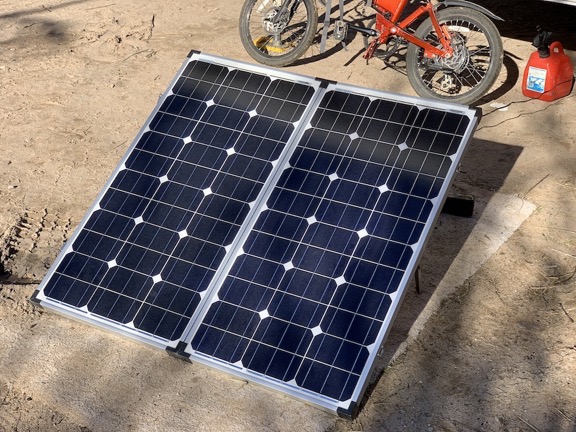
Zamp Solar Panels
My Zamp solar panels. They fold in half; the solar controller is built into a panel that hangs behind it. The legs to angle it toward the sun are attached. It’s a nice setup. Also in the photo: my electric assist bike and a 2 gallon fuel container for my generator. Our site is surrounded by 15+ foot tall bamboo which limits the amount of direct sunlight we get; you can see the shadows, too.

No sense in not taking advantage of every resource I have to collect power.
Snowbirding 2020 Postcards: Colorado River Sunset

A late afternoon photo from this year’s campsite.

I managed to get an excellent campsite right along the Colorado River backwaters for this year’s December vacation with a friend. I must have arrived within a short while of the previous occupants’ departure — the tire tracks leading out were still fresh when I arrived. This is the site I’d been hoping to get; I can launch my kayak right from the site.

Backwaters Sunset
This is what Sunday’s sunset looked like from our campsite. The body of water is one of the longer backwater channels along the Colorado River; the water level rises and falls with water releases from the Parker Dam 50+ miles upriver.