Seven Weird Things

I think about my job as a Grand Canyon Tour Pilot and come up with seven things I think are strange about it and the people I meet.

No doubt about it. Being a Grand Canyon helicopter tour pilot exposes you to all kinds of weird things. Here are a few of the weird things I’ve witnessed lately, in no particular order.

A front seat passenger riding with her eyes closed. This happened today, so it’s pretty fresh in my mind. She was from England, an older woman probably in her early sixties. She said something to me as her friends climbed on board in the back, but I couldn’t hear/understand what she was saying. But when I asked if it was her first helicopter flight, she said it wasn’t. On takeoff, she held onto her seat bottom and the door frame. She leaned toward me when I banked left and away from me when I banked right. When we broke out over the rim on the tour, with the Grand Canyon and all its splendor spread out before us, she was holding on tight. When I looked at her face, I noticed her eyes were tightly closed. Okay, so she opened them after a few minutes and seemed calm enough. But for a while, I thought she’d do the whole tour with her eyes closed. Talk about a waste of money!

A passenger who made herself sick. I call her Captain Video. She was an American of Indian descent and that camcorder was turned on from the moment she sat down. Her eyeball was in the viewfinder nonstop for the first twenty minutes of the flight. Then she hurriedly reached for a barf bag and puked into it. It wasn’t the turbulence. It was incredibly calm that morning and there was no reason to be sick. Unless, of course, you were enjoying the view through a camcorder viewfinder. After having a good puke, she put the camera up to her face again. Five minutes later, puke. She did this for the rest of the flight. I think she must have puked seven or eight times. She even started a second barf bag. If she’d only keep the camera away from her face, she’d be fine. Heck, it was calm!

A woman who decided she was going to be sick before we even took off. While we’re on the subject of puke, I better do this one, too. She sat in the front seat and as soon as her husband got into his seat behind her, a hand came forward with a barf bag in it. She took the bag (we have them in the front, too) and turned to me. “I always get sick,” she told me. And sure enough, she did. About two thirds of the way through the short flight, she calmly opened the bag and made a deposit. And no, it wasn’t turbulent. Oddly, she did this the same day Captain Video rode with me. My first two barfs in one day.

People who remind me that they don’t speak English. Okay, so it’s always French people. Always. No one else has ever told me that they don’t speak English. It’s just French people and always women. What’s that about? The manifest I get tells me where everyone comes from and what language I should play the narrative in. I don’t speak French. I can only do my preflight briefing in English. And they seem to doubt that they’ll hear any French during the tour. But when I start up Disc 1 Track 9 and that French voice comes on, they nod, satisfied. You don’t think this is strange? That’s it’s just French people?

Working with people who are, on average, ten years younger than me. Wow. Was I like that when I was in my twenties and thirties? I don’t think so. I feel a little like a den mother. In the break room, they make bathroom jokes and watch surfing and skateboarding on television. They make rude noises to each other over the Canyon air-to-air frequency while we’re flying. They have nicknames like Clogger (think bathroom) and Crispy (I don’t know what to think). They make me feel old and out of place and rather glad that I built my life before I learned to fly.

Spending the entire day doing just two different tours in all kinds of weather. Talk about tedious. There’s the 25-minute tour and the 50-minute tour. You can make more money doing just the 25-minute tour, but I just can’t handle doing the same thing over and over all day long. Doing two different things all day long makes it marginally more interesting. The weather, however, is what keeps you awake. Springtime is full of winds gusting to 40 knots or more. (They call it quits when it hits 50 knots.) Summer is full of isolated showers and thunderstorms that keep you wondering whether you’ll find your way back to the heliport at the end of a tour. (They call it quits when visibility drops to zero, hail exceeds the size of a pea, or lightning strikes nearby make it impossible to refuel safely.) Who knows what autumn will bring?

Living in or near a tourist town. Although I don’t live in Tusayan, working here gives me a good taste of what it must be like to live here. A constant flow of people, most of whom do not speak English. High prices in every store (and discounts for locals in most, if you know the secret password). Limited nightlife, limited shopping, unlimited tee shirts, unlimited collector’s spoons. Overpriced, substandard housing. And some of the world’s most beautiful scenery, right in your backyard. But the weirdest part? Come September, the area’s population will shrivel up to a bare minimum — the year-rounders who actually do this all the time.

There you have it. Seven things. If I come up with more — which I’m sure I will — I’ll report them here.

Wind Gone, Thunderstorms Arrive

My lessons on learning to fly in weather continue on a new track.

It’s monsoon season here in Arizona.

Monsoon season is the time of year when there’s a seasonal wind shift that brings moisture off the Gulf of Mexico up and into New Mexico and Arizona. (It may get as far north as Colorado and Utah, but I think we get most of it.) Most days start off sunny and pretty clear, with just a few friendly clouds floating low in the sky. But then the sun kicks in and puts those clouds to work. Convective activity builds them into towering cumulus clouds that move in an east to west flow (sometimes southeast to northwest; sometimes northeast to southwest). The clouds build very quickly and, after a while, gang up to form storm cells. The rain from the biggest of these clouds can start as early as lunchtime. But if they’re still around and still building in the afternoon, they turn into ugly cumulonimbus and start throwing lightning bolts and, on occasion, hail.

Fortunately, these storms are extremely localized and easy to see. Pilots flying at our altitudes (i.e., 300-500 feet above the ground) can usually fly around them. We can even get pretty close to them if we have to.

On Wednesday, my first day back to work, I got my first t-storm lesson. I was a spare pilot, flying someone else’s ship for lunch. I was returning from a tour, about 3 miles out, when a lightning bolt came out of an innocent looking cloud and struck the ground about a half mile away from me. I immediately saw smoke in the trees near where it had struck. Shit. I hurried back. When I made my 2-out call and they told me my next flight, I told them about the lightning, sure that they’d put on a weather hold. Silly me. I was told I’d better get used to it.

Later, the Chief Pilot told me that I was actually safer in the air than spinning on the pad when there was lightning around. Lightning wanted to hit the ground, not something in the air. I found his words comforting. (If they’re not correct, please don’t tell me. I’d prefer blissful ignorance on this topic.)Yesterday, I got a better lesson. I was the top priority pilot, which meant that I was going to be flying all day. That was fine with me. I’d rather fly a helicopter than waste time in the break room. The storms built up magnificently throughout the morning and by lunchtime were raining down in various places on the North Rim and far to the east. I had a lunch break and returned to fly at 1:20 PM. The storms had built up and were darker than before. I did a few flights and had no trouble staying clear — the storms weren’t on our route.

But then I did an Imperial Tour, which took me to the east. A storm I’d spied out that way seemed very close to Grandview Ridge. The tower had even commented on it. When I got out to Grandview, it was raining heavily on us, but we were on the storm’s northern edge. The lightning was still about 2 miles to our south. The temperature had dropped considerably — enough for me to close both vents — but the air was still smooth, with no heavy winds, updrafts, or downdrafts. I made a pirep to our company frequency, telling them about the storm and that it was still good to fly on the east side. Then we broke out of the cloudy area and were treated to views of a sun-drenched painted desert and the spectacle of the Little Colorado River’s flood flow turning the Colorado River brown at the confluence.

I was at the Split when I heard some chatter on our FM frequency. It appears that the storm we’d skirted had come straight to the airport. It was dumping “quarter-inch hail” on the helipad. Chuck’s voice sounded unusually perturbed as he reported all this to everyone. Visibility was zero-zero. He told the pilots on their way back to stay clear. To land near the ponds. No, the storm was moving that way fast. Land near the triangle.

What followed was chatter between the pilots in that area, deciding what they were going to do. By that time, I was over the North Rim and had a clear view to the south. Although I could see the South Rim, anything beyond it was lost in a dark gray cloud. With lightning. I got on the FM frequency and told them where I was. Should I double back and return the way I’d come so I could come in behind the storm? I was advised to continue. Although I doubted the wisdom of that, I followed orders. These guys had far more experience with canyon storm systems than I did.

The chatter started up again. AirStar, another helicopter company, had flown south to Red Butte and was able to come in from there. The pilots about to land (or landed, perhaps) decided to circumvent the storm system by flying around its western edge to the south. One by one, they made their way home and were told to shut down. Soon, I was one of only two pilots still in the canyon, now in the Dragon Corridor. The other pilot, Tyler, was about 15 minutes behind me, doing the same tour I was.

At first, it didn’t look good. There was definitely a storm system in front of me. But by the time I got to Dragon’s Head, I realized that it was two separate storms. Dripping Springs, where I had to fly, was remarkably clear, with a storm on either side. I reported this to Tyler when he asked. He sounded nervous. (But that could be his voice; he often sounds like that.) When I got to Dripping Springs, I got a good look at the storm that had hit the airport. It was a monster, right on my usual flight path, a wall of gray that completely blocked out everything. No flying through that. But I could clearly see Red Butte in the distance. I reported all this to Tyler. Someone got on the FM radio and started giving me detailed instructions how how to get it. But I didn’t need them. It was pretty obvious where I had to go. I made my call to the Tower. I told the controller where I was and what I planned — to skirt the western edge of the storm and come in from there. The controller read me the ATIS info, I thanked him, and continued in.

HailA moment later, I could see the tower. The airport looked clear. I reported this to Tyler, too. By this time, he was at Tower of Ra, still about 3 minutes from the Rim. It would be close for him, especially if the two storms decided to merge. I called our tower about three miles out and was assigned a pad. Then I called Grand Canyon tower and was given permission to cross the runway. It was raining lightly there but my landing was uneventful. All the other helicopters were already there, tied down. There was hail on the ground, making the scene look more like something out of a Christmas card than mid-summer. Here’s a photo I took later of the hail on the ground. I included my shoe to give you an idea of size. The smallest of the ice pellets was about the size of a pea. Some were about twice that size. Amazingly, there were still piles of the stuff at the bottom of gutter drainpipes at the Papillon hangar midday, the next day.
Tyler came in just as I was tying down my blades.

When it Rains, It Pours

Monsoon season arrives and foils some travel plans.

Monsoon season started the other day. Although it didn’t seem very serious about raining at first, it soon got right down to business.

I was supposed to start work at 6:55 AM this morning at the Grand Canyon. The plan was to fly up from Wickenburg at 5:00 AM. Even with mild headwinds, I would still get to work on time.

Yesterday evening, we prepared by rolling out Three-Niner-Lima, topping off its fuel, putting some of my luggage on board, tying down its blades, and putting its cockpit cover on. I’d drive to the airport first thing in the morning, stow my car in the hangar, do a quick preflight, and take off.

I knew it was monsoon season. And I knew that thunderstorms were possible any afternoon. But I’d be leaving in the morning. And we hardly ever got thunderstorms in the morning.

The lightning woke me at 1 AM. Out to the south. I got up and peered out the french doors in our bedroom though half-asleep eyes. There was a storm to the south. I went to the den and peered out the windows that looked north. Nothing. It was still early. Whatever storm was raging would have plenty of time to wear itself out by the time I had to leave.

I slept fitfully for the rest of the night. When my alarm went off at 4 AM, I was already half awake.

And there was still lightning to the south.

I watched the Weather Channel. It showed a storm morning northwest. But those darn maps don’t have enough detail to really see where the storm is.

I hopped into the shower. An enormous boom thundered over my head as I rinsed off. I knew where the map was showing the storm.

It was unnaturally dark at 4:30 AM when I came downstairs. I was pretty sure I was going to have to drive. And be about an hour late for work. I called and left messages for the bosses. Mike had already made my coffee and I drank it, listening to the thunder and lightning and pouring rain. At one point, the storm seemed to be fading. I opened the front door and looked out to the north. A bolt of lightning shot from the sky about two miles away. It seemed to say: “Are you crazy? Of course you can’t fly.”

So I drove. I took the Honda, which is a pleasure to drive. I had to stop at the airport to pick up some of my luggage (in the rain) and then fill up with gas. But by 5:00 AM, I was on the road, heading north while the rain pelted the car, washing off weeks of accumulated dust.

As an Arizona driver, I have a problem every monsoon season: I find that I have to reacquaint myself with the controls for my windshield wipers. Although I’d purchased the Honda back in August 2003, I’d only driven it in the rain once or twice. It had less than 5,000 miles on it. That morning, it was dark when I tried to figure the wipers out. I finally learned enough to turn them on and off. Later in the drive, I’d get fancy with the different speeds and the washer fluid.

It rained hard with lightning in every direction all the way through Wickenburg to Congress. I got stuck behind a slow car on 89 and passed him without problem. There weren’t many other cars on the road. The skies stayed dark as I wound my way up Yarnell Hill and through Yarnell. The rain had stopped up there, but the pavement was wet. And before I could even turn off my wipers, the rain started all over again — with a vengeance. And that’s when I made a discovery about the roads in Arizona: they’re not crowned.

If you’re not sure what I’m talking about, think of the roads in a place like New York or New Jersey, where it’s common to get rain at least once a week. (Sheesh. I can’t even remember what that’s like!) The roads are taller in the middle — right around where the dividing line is — than on the edges. When it rains, the water hits the hump and rolls off either side. The result: the roads aren’t likely to get flooded.

In Arizona, the roads appear to be flat. Of course, that asphalt gets pretty hot every day at least half the year. People drive on it and their tires go in the same two ruts on either side of the dividing line. The result: the road has a pair of ruts in each lane. When it rains, the water fills the ruts.

I don’t think I’m exaggerating when I say that the ruts are probably about 1-3 inches deep and about 2 feet wide. And my little car, driving 10 mph below the legal limit of 65, could not handle all that water. It began to hydroplane. That required me to cut speed to 50 mph or less. Not a good idea when I was already going to be at least an hour late for work. So I improvised. I drove with one wheel on the line and the other on the hump between the two ruts. Because there weren’t many other cars on the road that early in the morning, I was able to drive without danger of scaring an oncoming car off the road. And I could keep up my speed.

By Kirkland Junction, the rain had stopped again. By Kirkland, it was starting to get light. After Skull Valley, I was able to turn off my headlights. The sun was rising behind the Mingus Mountains as I drove into Prescott. There were still plenty of clouds up there, but the ceilings were high. If only I lived there! Then I could have flown.

I stopped for breakfast at McDonald’s in Chino Valley. What’s another 5 minutes when you’re already an hour late?

I debated taking the top down, but decided not not. It was quite cool outside and I didn’t want to have to stop to put it back up if I ran into more rain.

I was on I-40 between Ash Fork and Williams when 6:55 AM came and went. I imagined the other pilots outside, preflighting their helicopters. I wondered if my bosses were pissed off and decided that it really didn’t matter.

I rolled into Tusayan at 7:45. By the time I got up to the break room and logged in, it was 7:55. An hour late. The priority board showed that I’d been made a spare. I wound up flying a total of only 1.5 hours all day.

I couldn’t tell if my boss was pissed. He has a way about him that sometimes makes him impossible to read. I told him that it wouldn’t happen again. That from now on, I’d fly or drive up the afternoon before I had to start work.

Of course, that’s when it normally rains this time of year.

On Stuck Valves

How I recognize an engine problem — and resolve it — on top of a mesa.

I’d flown Three-Niner-Lima up to Howard Mesa on my birthday, June 30. I was due to work at the Grand Canyon the next day and was looking forward to commuting to and from work daily in my helicopter.

The next day, I climbed aboard, all dressed for work. I started the engine and immediately noticed that it sounded louder and vibrated more than usual. At first, I convinced myself that the louder sound was my imagination, due to spending the night in the absolute silence of Howard Mesa. (It’s amazing how your hearing gets more sensitive when there’s nothing for it to listen to.) The vibration was due to me parking on level but uneven ground.

The blades, however, took longer than usual to start turning. There was no logical explanation to that.

And when I got it up to warm-up RPM (75%), I realize that the manifold pressure gauge read 18 inches. 18 inches is what I need to hover when I fly solo. I didn’t know what it was at warm-up RPM, but I was pretty sure it wasn’t 18 inches.

I applied carb heat, thinking that perhaps there was some icing (not likely but possible). I immediately lost about 10% of my RPM. I normally lose about 2-4%.

The lightbulb over my head came on. I had an engine problem.

I disengaged the clutch and pulled the mixture. The engine cut out gratefully. I checked my watch. It was 6:15 AM. If I didn’t hop in the Jeep soon, I’d be late for work.

I stopped the blades, tied them down, and climbed into the Jeep. It started right up and I started on my way. Of course, I did get a flat tire about 1 mile from pavement that made me late for work anyway, but that’s another story, covered in another blog entry.

I called my R22 mechanic in Prescott, Cody, and talked to him about what I’d experienced. He suggested a few things: sticky valve, fouled plugs, bad magneto (I hadn’t even gotten to the mag check). We came up with a plan of action that included checking the plugs and possibly doing a mag check.

Mike joined me at Howard Mesa a few days later. He pulled the plugs and cleaned one of them. I assumed that was the problem and didn’t bother starting up again. Until it was time to go home. And guess what? The problem was still there, if not worse. I was now pulling 18 inches of manifold pressure at 55% RPM.

We tied down the blades, covered the cockpit, and went home.

I called Paul, my old mechanic in Chandler. Although I’m not allowed to bring my helicopter to him for repairs, he’s told me time and time again that I can call him any time I have a problem. He had the same opinion as Cody about the problem, but added that if it were a stuck valve, we could easily check for bent push rods by pulling off the valve covers. Easy for him.

Cody was leaving town for Montana and would be gone for a while. And I had a feeling his boss, John, wouldn’t be too receptive to a field trip. John had a trailer that we could use to bring the helicopter to Prescott. But I could only imagine what he’d charge for its use. I was pretty financially tapped out (heck, I just put a $25,000 deposit down on a new helicopter I wouldn’t see until January 2005) and didn’t want to spend $1,000 moving my helicopter off a mountain top, just so a mechanic could spend 10 hours repairing it (at $100 per hour).

But Ed, our local mechanic, knew all about Lycoming engines, even though he wasn’t a helicopter guy. I called him and told him my problem. He agreed to make a field trip with us. We drove up yesterday with a bunch of Ed’s tools and lots of water and Gatorade.

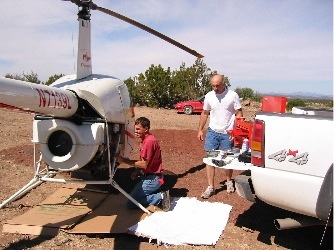
Repairs at Howard MesaWe spread out some cardboard and throw rugs and Ed got right to work. He and Mike found another fouled plug. Then they did a compression check, with me cranking the engine. The results were pretty conclusive: Cylinder #4 was not producing any power. Zero.

The reason became apparent when Ed pulled off the valve cover. The exhaust valve was stuck. Really stuck.

He and Mike worked on it for 30 minutes and couldn’t get it to budge. It looked like they’d have to pull the cylinder and drop it off at a repair place in Prescott. Ed looked at the engine cover and all the other things attached to the engine. It looked like a lot of work. I called Paul again and told him the problem. I asked him if there were any shortcuts to getting the cylinder out. Then I turned the phone over to Ed. From Ed’s side of the conversation, I could tell it would not be a fun job.

Stuck ValveEd hung up and told us that it would be best to continue trying to free up the valve. So he and Mike went back to work. With a hammer. A big hammer.

I left to get us lunch. I was gone about 90 minutes. (It’s a half hour drive to Williams and the woman at Safeway was the slowest sandwich maker I’ve ever seen.) When I got back, they were putting things back together. They’d freed the value and had reamed it. It was now smoother than ever. I’d be able to fly.

We had lunch then cleaned up. I climbed on board while Mike and Ed stood outside, looking for leaks. When I started up, my idle manifold pressure was 8 inches. No leaks so Ed climbed on board. (It’s always reassuring to have your mechanic fly with you right after a repair he’s done.) Warm-up manifold pressure was only 12 inches. That’s more like it! Everything sounded good, the unusual vibrations were gone. (The usual vibrations, alas, were still there.) I pulled power and got into a hover at 21 inches of manifold pressure. Great. I pointed it toward the road and we took off.

I took Ed home a scenic route: over Prescott and down the Hassayampa River. He’d never been over the river in that area before and I think he really enjoyed it.

When we got back, he presented the bill. $312. And that included my oil change the previous month. I paid it with pleasure.

Oh, one more thing. Consultation of the engine log books revealed that this was the FIFTH time we’d had to ream the #4 exhaust valve. Hmmm….let’s hope it holds out until January.

The Declaration of Independence

I listen to a reading of our country’s founding document and think about what brought about our independence from Great Britain 228 years ago.

When I’m at Howard Mesa, I listen to the radio every morning. I listen to NPR, National Public Radio. There are actually three NPR frequencies I can get here: on from Phoenix that is repeated by Prescott, one from Flagstaff, and another from somewhere else.

This morning, during Morning Edition, I heard some familiar words: “When in the course of human events…” I soon realized that the radio staff was reading the Declaration of Independence.

It was a moving reading — if such a reading could ever be considered moving. The radio staff took turns reading paragraphs from the document. They each put emotion into what they read, as if they were the people making these claims, the people injured. I’ve read the Declaration several times, but I believe this is the first time I really understood it.

Imagine the east coast of the United States as thirteen colonies under the power of a King far away. Communication between the colonies and the King took weeks (if not months) in those days. The people of the colonies feel that they are being mistreated by the King. They write a document that clearly argues their point, listing dozens of offenses committed by the King against them. That’s the Declaration of Independence.

I can only imagine how that document must have pissed off King George III when he finally read it.

Reading the Declaration gives you a unique view of life in the American Colonies in the early 1770s. It was a time when people truly cared about freedom — because their freedom was limited. It was a time when people considered taxation without representation — because it simply wasn’t fair. It was a time when people who cared about what was right and wrong actually stood up and did something about the injustices they saw.

A bit different from today, when people care more about what celebrities are wearing than what’s being voted on in Congress.

Anyway, this morning, when I spoke to Mike, I mentioned that I’d heard the Declaration on NPR. Do you know what he said? “I heard it, too. It was great, wasn’t it?”

Looks like I picked the right guy after all.