Say Cheese!

My love for cheese has me shopping online.

I love cheese. Not the kind you buy in the supermarket’s deli counter: American, Swiss, cheddar, etc. Not really even the kind you buy at the supermarket’s cheese display: brie, Gouda, Havarti, Fontina, etc. (Although I admit I’m fond of Saga, which is available in one of Wickenburg’s supermarkets.) I like the kind of cheese available in cheese or gourmet shops, the kind imported from all over the world, the kind with complex flavors and interesting histories. The cheese that’s very difficult to get when you live in a small town on the edge of nowhere.

Oddly enough, Wickenburg’s Safeway store — the better of the two supermarkets in town — has a big cheese display and a rather impressive assortment of supermarket-type cheeses. It’s there that I can find the pseudo-fresh mozzarella that goes so good with tomatoes and fresh basil, the Saga that’s so nice on a crispy cracker, the double-creme brie that’s wonderful melted onto a slice of toasted French bread, and the goat cheese that tastes so nice melted on a Boboli crusted topped with olive-oil sauteed eggplant and garlic. That cheese display can meet most of my cheese needs, but not my cheese desires. I like to eat cheese as a meal itself and after a while, the supermarket cheese selections get about as boring as the supermarket meat department selections.

When we were out in California for the New Year, we stumbled into a cheese shop at La Jolla Shores. The shop had lost its original purpose. Although named “Cheese Shop,” it had clearly turned into a combination gourmet grocery store and deli. There were very few cheeses to choose from. In fact, I think Safeway has far more. But among the selections was a cheese called Morbier. We bought some, I ate some, and I remembered how much I liked cheese.

When we got home, I searched the yellow pages listings online to find a cheese shop in Phoenix. The closest I could find was A.J.’s supermarket. A.J.’s does indeed have a more expansive selection of cheeses than Safeway, but it doesn’t satisfy my cheese desires. Besides, A.J.’s prices tend to be outrageous. The Saga you buy there costs about twice the price of the Saga in Safeway. And it’s the same stuff. So how much is that other stuff overpriced?

Not to say that I shop for cheese based on price. Price doesn’t stop me from buying a cheese I really want, but it does prevent me from buying a lot of it.

Not satisfied with the Yellow Pages results, I went online with Google to search for cheese shops. I found a place called DiBruno Brothers, based in New York. Of course, I couldn’t remember what Morbier was called, but I remember what it looked like. (It has a very distinctive appearance.) And I remembered that its name began with an “M.” So I browsed DiBruno’s Web site until I found Morbier and clicked the Add to Cart button. Then I shopped around and bought a few more cheeses based on their description and checked out.

Shipping for my order was supposed to be $9, which I thought was very reasonable. But the next day I got an e-mail from DiBruno telling me that they had to charge me $10 more for shipping. I don’t like “bait and switch” tactics — which this appeared to be — so I cancelled my order. No Morbier for me.

That was about two weeks ago.

igourmet.comYesterday, after munching on some Saga and longing for something different, I tried again. I found a Web site called Cheeses.com, which has all kinds of information about cheese. From there, I followed a link to iGourmet.com. I searched for Morbier, found it cheaper than DiBruno’s, and clicked the Add to Cart button. More cheese went into my digital shopping cart before I checked out. Shipping via FedEx is a reasonable $12.45, so the whole thing didn’t cost a fortune. Well, it did cost more than steak dinner for two at Charlie’s, but I’m sure I’ll enjoy it a lot more.

I wish there was a cheese shop locally, one where I could buy the cheeses and other unusual “gourmet” items I like to eat without leaving town. But if Phoenix and Scottsdale can’t support a cheese shop, I can’t very well expect Wickenburg to. Especially when the most affluent businesses Wickenburg can attract these days are Dollar Stores and Check Cashing Places.

Back in the Saddle

I spend a morning flying and it feels good.

Yesterday morning, I went flying. And boy, did it feel good to be back in the air, just tooling around, again.

I needed to go out to Robson’s. I’m doing helicopter rides at their big anniversary celebration on Saturday. I wanted to check out my landing zone and drop off a few signs and flyers for Rebecca, who is organizing the whole thing.

Jim Wurth wanted to get some stick time in an R44. I owe it to him. He’s taken me out a few time in his Hughes 500c. Since the dual controls are always installed in his ship, I always get at least a little stick time. I’m not too crazy about the feel of his ship. It doesn’t have hydraulics, so the cyclic and collective are very stiff. I feel uncomfortable pushing it around because you have to push so much harder than in a Robinson to get it to do anything. I worry I’ll push too hard and I’ll do something sloppy which will make me look like a bad pilot. So when I fly his ship, I fly it very conservatively, almost to the point of being boring. Of course, he notices that and just thinks I’m a boring pilot.

Which brings up the old aviation saying, “There are old pilots and bold pilots, but no old, bold pilots.”

So yesterday morning, I put the dual controls in Zero-Mike-Lima, did a thorough preflight with the assistance of a new ladder (that mast is tall!), towed it out to the fuel island, filled it up, and positioned it in a parking space for departure. After disconnecting all the bothersome tow stuff, I did a final walk-around (a good habit I picked up at Papillon) and climbed on board.

It took a long time for the engine to warm up in the early morning cold. It was about 10:00 AM and the winter sun was shining but hadn’t gone to work yet. I think it was still having its morning coffee. I picked up and felt the odd sensation of having all that full helicopter behind me with no one in front with me to balance the weight. I was still in CG, of course — it’s damn near impossible to load an R44 out of CG — but the front end of the helicopter came off the ground about ten minutes before the rear end (okay, so it just seemed like ten minutes). I wondered if I would scratch the bottom of the back of the skids on the pavement. Like that matters much.

Jim’s house is exactly 2 nautical miles away from Wickenburg Airport. It took about a minute and a half to get there. And once again, the R44 showed me how well it floats. I had to dump all my power to get it to descend to Jim’s helipad.

Why not just fly lower for that two miles? Well, there’s some idiot who keeps coming to Airport Commission meetings to complain about helicopter noise. I know he isn’t complaining about me because I haven’t flown in over two months. It’s LifeNet, which is now based at the hospital, and probably Ray, who flew low to do some aerial survey work on a housing project near town one day. And the flight schools that come up from Scottsdale and Glendale. But I don’t want him complaining about me so I’m not going to give him anything to complain about.

When I got to Jim’s he was taking pictures of my arrival. I set Zero-Mike-Lima down gently in the middle of his pad. He gave me the shut down signal and I complied. A few moments later, I was out on the pad, showing off Zero-Mike-Lima to Jim and his wife Judith.

Jim and I both climbed aboard a few minutes later. I narrated the startup sequence for him. In the few minutes the ship had been shut down, it had cooled considerably. It took a few minutes to warm back up. Then I took off on Jim’s usual departure path, heading northwest.

We followed the train tracks, then took a detour over Moreton Field. Doug Moreton had just sold the remaining lots in his partially-developed air park to a developer. Jim pointed out the homes and hangars of a few people we knew. Jim told me he was thinking of buying a lot there. I couldn’t understand why. He lives on 40 acres just outside of Wickenburg and has his own hangar and helipad. Why move?From there, we buzzed straight toward Robson’s. I let Jim fly. He immediately commented on how sensitive the controls were. He kept drifting to the right. After a few minutes, he got the hang of it, though, and we zipped over the desert at about 110 knots. Jim said he never cruises that fast. But, like me, I think he was having trouble getting it to go slow. The Raven II just wants to go.

He gave back the controls for the landing at Robson’s. I landed in a space between several saguaros, a long, skinny (at the bottom) landing zone that gave me plenty of room for my tail. I think I was roughly in the same place I’d landed the year before. We shut down, got the signs out of the back, and went into Robson’s. We dropped it all off in the restaurant. I had to walk back to the helicopter to get the flyers, which I’d forgotten under my seat. While I was taking care of that, Jim used my Pilot Operating Handbook to research a problem I’d been having with the Aux Fuel Pump.

We took off a while later. Jim wanted me to fly up a canyon behind Robson’s where there are some Indian ruins and petroglyphs. He said I should fly through there on Saturday with passengers. I told him I didn’t want to because there would be people hiking in there and I didn’t want to ruin their hiking experience.

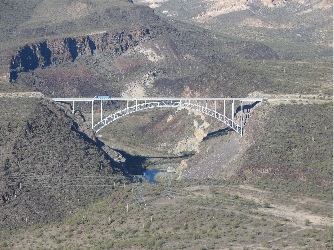
Burro Creek BridgeFrom there, we buzzed out over the desert toward the Santa Maria River. We followed the river east to 93, then headed up 93 to the bridge at Burro Creek (shown here in a photo I took several years ago). ADOT is doing construction in that area, building another two lanes on the bridge. We made a right turn and flew up Burro Creek, dropping into the canyon to get a better look at the things we flew over. Jim wanted to show me a few mining sites he and Ray had spotted on another trip. He thinks I can do tours to these places and let passengers off to explore. I know I need to track down ownership and get permissions. (I’m in the process of doing that with BLM for Swansea Townsite and it’s a lengthy process.) I’m always interested in seeing new places.

It turns out that the first place he wanted to show me was one I’d already seen and considered before. It was a definite possibility. I marked it on my GPS while he took the controls and flew. We got to an intersection of three canyons and he flew up the middle one looking for the second mine site. We flew about five miles before he gave up. He pulled up over the left wall of the canyon and dropped into the next canyon over. We continued flying up canyon. Water was flowing down there and it was beautiful. I saw more than a few waterfalls — some of them spectacular. I also saw two abandoned ranch homes that looked to be in good condition. I’d return to explore on foot one day and, if they’d make good sites for heli-camping, I’d track down the owners and get permission.

We flew up the canyon, climbing at a stead rate of about 200 feet per minute as the canyon floor climbed. We must have flown about 10 miles up that canyon. It was a really beautiful flight. I’d never seen the desert so green. It looked almost lush. Almost.

Jim finally gave up and climbed out of the canyon, this time to the right. The first canyon we’d been in had ended. We were up at about 6000 feet now and there was ice on the mesa tops beneath us. The outside air temperature was 50°F. In the distance, we could see the mountains with snow on them.

We flew southwest for a while, then dropped into another canyon. This canyon quickly dumped us out in the canyon where I’d spotted the ranch houses. After a while, we spotted the Bagdad Mine’s tailings piles ahead of us. And there was the mine site Jim had been looking for, almost in Bagdad Mine’s backyard.

We flew over the Bagdad Mine, which was very active that day. Lot’s of huge dump trucks driving up and down the ramps. The only way you could see how big they were was to see the men or normal sized vehicles bedside them. The bottom of the mine was filled with water and water was gushing into it from a hole in one side of the hill. I assumed they were pumping the water out as quickly as it was gushing in. If not, they’d have a problem in a few days.

Next, Jim wanted to show me some Indian ruins on a hilltop near Skull Valley. We headed toward Kirkland, buzzing along at about 100 knots. There was so much water down in the desert. I saw a ranch that had lost its access road in a flood that was still flowing.

The ruins were interesting, but not the kind of thing I like to explore. I guess you can say that I like “white man’s ruins.” Although the ruins he showed me were probably 1,000 years old, I’d rather walk around in 100-year-old ghost towns. I think it’s because I can identify with what I’m seeing. Indian ruins tend to be nothing more than rock piles. It’s hard to imagine them as buildings when they’re seldom taller than two feet.

I took the controls and brought Jim over to one of my favorite sites in the Weaver Mountains. There are some cabins there and if you approach it just right, you can see them from the air. I didn’t approach just right because even I couldn’t see them — and I know where to look.

We came over the Weaver Mountains and dropped into the valley where Stanton is. I flew relatively low over this ghost town turned trailer park. If I had gotten my helicopter two weeks earlier, I could have had a very lucrative gig among the amateur miners there.

We were only about 400 feet off the ground, near the ghost town of Octave, heading toward the Hassayampa River, when I pointed out some cows running through the desert. I wondered, for a moment, what had spooked them — I was too high to be the culprit. Then I saw the R22 down below me, about 15 feet off the ground, herding the cattle. I swung around to get a better look, trying to raise the pilot on the radio. No answer. I wondered if he’d seen me. He headed back toward Congress and I continued on my way to the Hassayampa.

The river is flowing big right now and it’s a neat thing to see from the air. The slot canyon, where I’ve driven my Jeep numerous times, is wall-to-wall brown water. The water spreads out past Box Canyon and heads into town. The river has been running for more than a week now. I remember the first year we lived in Arizona. It had been an El Niño winter and the river flowed for three months straight. Cool.

I made a nicer approach into Jim’s helipad, although I may have been a little close to one of his neighbor’s houses. I let him off and took off right away. I buzzed past Vulture Peak before I landed. There were two hikers up top and they waved enthusiastically as I went past.

I landed, feeling invigorated. We’d logged 1.8 hobbs hours. I fueled up for Saturday and put the helicopter away. It was 2 PM.

On Popping Circuit Breakers

I learn about a Raven II’s Fuel System While Troubleshooting a Pesky Circuit Breaker

Starting a Raven II is a weird process. You turn on the master battery switch, push the mixture full rich, then turn the key to prime and count 5. Behind you, you can hear the sound of the auxiliary fuel pump priming the engine. Then you position the key to Both, pull the mixture knob out to engine cutoff (full lean), and push a starter button. When you hear the engine catch, you push the mixture knob back in to full rich and put the guard over it. Throttle up to 50%-60% RPM, engage the clutch, the strobe, and the alternator. The blades start spinning within five seconds, usually with the sound of new drive belts slipping (at first) on the sheave. Then, as the belts tighten, the sounds all sound good and it’s a matter of waiting until the clutch light goes out before finishing the startup procedure.

The very first time I started Zero-Mike-Lima, at the Robinson factory last Thursday, the engine caught right away. That was easy, I remember thinking to myself. Since then, I’ve had mixed results. I just have to get the hang of it, I guess. First time was luck.

Zero-Mike-Lima has already shown me a potential problem. Nothing major, thankfully. When it’s cold out on start — like it was on the morning of day two of my ferry flight and again yesterday morning — the auxiliary fuel pump circuit breaker pops right after startup. Fortunately, I was still on the ground, so the first time, so I didn’t worry much about it. I just pulled out the Pilot’s Operating Handbook and consulted Section 4 for information about what to do if the Aux Fuel light comes on. It said that if the engine continued to operate normally, I should land as soon as practicable (as opposed to land as soon as possible). I was already landed, so that wasn’t a big deal. I pushed the circuit breaker in, the light went out, and I continued my startup process. It didn’t pop again and the light didn’t go on. A fluke, I decided the first time. The new helicopter is just shaking out a few little bugs.

On Friday evening, I pulled out my Maintenance Manual and looked up the fuel system. I soon became an expert (of sorts) in how the Raven II’s fuel system is designed. There are two fuel pumps: an engine-driven pump and an electric (aux) pump. Either pump provides more fuel to the engine than it will ever need. So the system is designed for redundancy. If the engine-driven pump dies, the aux pump, which is running whenever the engine is running, will take up the slack. The excess fuel that these pumps provide is pumped into the auxiliary fuel tank (the smaller of the two fuel tanks) which helps with fuel cooling.

I flew it on Saturday several times — starting it at least four times in the process — and the Aux Fuel problem never happened again. This further confirmed that the problem was a fluke. But yesterday, when I started it at about 10:00 AM, when it was only about 40°F outside, it did it again.

Time to call Robinson.

When I called the factory, I spoke to a guy named Ray who took the information about the problem and said he’d call back. He did — much later in the day — and left a voicemail message on my cell phone. He told me to look for pinched or shorted wires in the vicinity of the Aux Fuel Pump. He also told me to check the anemometer (gee, I hope I spelled that right) while starting up to see if there’s a power fluctuation before the breaker pops. So today I’ll have Ed look things over back there. Hopefully, it’s just a bad wire. But it could be a bad fuel pump, one that needs too much power to go to work on a cold day. I’ll keep an eye on the situation to see. I certainly won’t fly with that light on.

Of course, I did start it three times yesterday and the problem only occurred on the first start. So it definitely has to do with things being cold. That’s what I think, anyway.

But then again, what do I know? I’m just a pilot.

Time to Get to Work

Now that I have Zero-Mike-Lima, it’s time to put it to work.

The thing that bothered me most about the last three weeks I waited for my new helicopter, N630ML (or Zero-Mike-Lima, for short), to be ready for delivery is the number of requests for rides I had to turn down. For a while, I was getting them every day. There was the man who wanted to take his grandkids for a ride and the other man who wanted to take his son for a ride. There was the man who’d lost his dune buggy out in the desert near Aguila and the other man who’d lost his dog. There was the man from England who wanted to take photographs of his newly acquired property at Grantham Ranch and the paving company that wanted to take photos of a number of jobs throughout town and the woman who wanted a photo of her house off Scenic Loop. Saying “I can’t do it right now because my helicopter hasn’t been delivered yet” was killing me, one syllable at a time.

It all came to a head on the week of delivery. They said it would be ready sometime during the first week in January, but when I requested a Thursday delivery, they told me to come on Friday. Friday was the same day that a 5-day storm was expected to descend on LA. And I’d scheduled a little event at Wickenburg Airport for Saturday. I lost my patience, in true New Yorker style, and put my foot down. (I also did a lot of begging.) I arrived at the factory on Thursday just 20 minutes after my money did (a long story) and waited while they pulled all the paperwork together. It was about 4 PM local time when we high-tailed it out of the LA area. We got as far as Bermuda Dunes (east of Palm Springs) that night, then flew the rest of the way home early the next morning. By 11 AM on Friday, Zero-Mike-Lima was in its new home in my hangar.

Of course, LA wasn’t the only place out west to get bad weather. Saturday, the day of my event, was overcast and a bit chilly. But when I got to the airport, people were already waiting for rides. I took about a dozen people up that morning and Zero-Mike-Lima began earning its keep.

I have a big event lined up for this coming Saturday. Robson’s Mining World is having their anniversary celebration. Robson’s is a neat place out in the desert near Aguila, that has an incredible collection of old mining and farming equipment among its other turn-of-the-last-century displays. I wrote about it in an article for wickenburg-az.com. I flew for Robson’s last year with Tristan’s R44, but because I came relatively late (around noon, if I recall) and it wasn’t very well publicized (I was a last-minute add-on), I only took about 20 people up for rides. This time around, I’ll arrive around 8:30 and be all ready to go by 9 AM. My ground crew will consist of Mike, John, and Lorna — the same crew that helped out at Robson’s and an event at Stanton last year. We also have T-shirts for sale to help generate a bit more revenue.

Today, I’m going to pick up Jim Wurth at his house and buzz over to Robson’s to check my landing zone and drop off a few signs and flyers. I’m hoping to use the same LZ I used last year, or perhaps one a bit closer to the road. I’m also hoping all this rain hasn’t softened up the ground too much. I haven’t done any off-airport landings with Zero-Mike-Lima yet (heck, there’s less than 10 hours on the hobbs!), so this should be good practice.

After Robson’s Jim is taking me up to the Burro Creek area, where he says there are a few interesting mine sites I might want to visit for one of my Part 135 tours. For those of you who aren’t familiar with the Federal Aviation Regulations (FARs), I need to have an FAA Part 135 certificate to land and discharge passengers for hire. I’m working on getting that valuable piece of paper. In fact, yesterday my FAA contact called to tell me that we were getting close to wrapping the whole thing up. So I should be ready for longer tours and charters by month-end.

Today I may also be doing that flight for the paving company. They called yesterday and set up a tentative time for 2 PM. That would be extremely convenient for me, since that’s when I need to drop Jim off.

I’ve also placed an ad in a movie-industry directory, offering Flying M Air’s services to movie/video makers. I did some research and learned that I could put something called a “Tyler mount” on my helicopter so a camera could be gyro-stablized on the helicopter for smooth filming. The mount is available for rent in California and I may have to fly out there to have it installed. The client, of course, would pay all costs for that, plus a per-hour fee for flight time. One good job would pay for the ad, so I have my fingers crossed. My R44 is a lot less costly to operate than turbine helicopters, so I should attract budget-conscious movie/video makers who want to work in the Phoenix area.

I also spent much of money working on getting out-of-town gigs for the spring. I put out a lot of feelers. Next Monday, I’ll follow up. The one I’m most interested in right now is Quartzsite. With the help of the local police chief, I tracked down a property owner who might let me use his land for operations. Next week is the big RV show week in Quartzsite, the week when its population peaks. According to Ivan, who did a whole season there with a Hiller years ago, Quartzsite can be a very lucrative gig. We’ll see.

One thing is for sure: Zero-Mike-Lima has to work for a living. And it’s my job to make sure it does.

Macworld Expo, My History

Recollections on Macworld Expo.

For years, I religiously attended Macworld Expo in San Francisco and Boston (and later New York). In fact, I recently found Macworld Expo programs dating as far back as 1992. (Anyone want to buy these collector’s items? E-mail me.) I even had a few programs from Macworld Toronto, when I was persuaded to speak there in the 1990s.

In the Macintosh heydays — mid 90s, I guess — Macworld Expo was an incredible experience. The halls were jammed with exhibits and people crammed the aisles to get a good look at the latest and greatest. I remember such innovations as the Digital Toaster (I believe that’s what it was called), which used an Atari box for live advanced video effects; Morph, which converted one image to another as an animation; and PageMill, the first WYSIWYG Web authoring tool. Companies like Aldus, Claris, and countless others that no longer exist erected booths that competed for the attention of conference-goers. Certain Mac gurus — like Guy Kawasaki and Kai Krauss — achieved celebrity status and were occasionally mobbed by the Mac faithful.

I was a conference speaker in those days, a member of the Macworld Expo faculty. The speaker room was like a clubhouse, a place where the folks who made their livings with Macs gathered and chatted, exchanged hugs, bragged, and showed off their latest hardware acquisition. The person with the best PowerBook wins, was the theme in those days. I didn’t play, although I do remember showing off a photo of my helicopter one year as an explanation for why I didn’t come with a PowerBook.

And then there were the parties. After the show floor closed, the parties began. The best parties required invitations to get inside, but certain people could gain access to even the most selective parties without a ticket. I remember being part of the Bob Levitus entourage one evening in San Francisco, when we went party hopping from one incredible party to another. Chris Isaac was the entertainment at one party while the Jefferson Starship (or what remained of it) was the entertainment at another. Claris and Apple always had great parties, but the ones at the Exploratorium were incredible, too. Limos bearing MacWEEK or MacUser magnets on their doors criss-crossed the city. I don’t remember drinking much (maybe I drank too much), but I don’t think I needed alcohol to get high. There was excitement in the air and you could get high just breathing it.

Then, in the late 90s, the good ship Apple started to sink. Macworld Expo suffered for it. (It also suffered, in my opinion, from switching management from Peggy Killburn’s group to IDG.) The speaker room filled with strangers, networking and graphic arts gurus I’d never heard of. I stopped speaking at the shows, but still attended, primarily to put in an appearance at the Peachpit booth. The parties were non-events in those dark days. Instead of spending three days at the show, I’d often come by for just a day. I remember one year when I flew in in the morning and flew out that evening. No reason to stick around.

When Steve Jobs took over and Apple started to thrive again, I half expected those Macworld Expo heydays to return. But they didn’t. The booths got ever smaller and some companies — Quark comes to mind — didn’t even show up half the time. The show floor still filled with people — an interesting mix of Apple loyalists sporting user group labeled clothing and high tech graphics geeks — but there was no rush to see a newly introduced piece of hardware or software. The only highlight was Steve Jobs’ keynote address, which he performed to a packed house every single show. I often watched the keynote via Webcast while I worked, playing it in a QuickTime window on one computer while I worked on another. I took notes on what interested me and ignored the rest.

This year, I’m skipping Macworld Expo again. I have work to do on my Tiger book, as well as an eBook I owe Spiderworks. And there’s a QuickBooks book lined up behind those. I’ve already lost too much time getting my new helicopter settled in my hangar and trying to figure out ways to make money with it. (I would have flown it to the bay area, but I have a paying gig in Aguila on Saturday and I was worried that weather would keep me stranded in California.) I hoped to watch the keynote today, but I just learned that Apple isn’t doing a Webcast. So I’ll be in the dark until the keynote is over and Apple magically transforms its Web site to provide information about all the announced products. As you may have guessed, I don’t read Apple rumor Web pages. I’d rather wait and get the real story.

So as Macworld Expo climaxes today, I’ll be in my office, writing about Mac OS X 10.4 Tiger, glad that it’s raining outside so I won’t want to fly.