Declaring RSS Feed Bankruptcy

When there are just too many posts to read.

When I started subscribing to feeds about a year or so ago, I only subscribed to a handful and quickly read through the new posts each day. In fact, I recall asking other readers for suggestions on feeds I should subscribe to.

Things change. I began accumulating feeds. I use endo, an offline feed aggregator, and I’m very pleased with it. It sucks down my feeds each morning when the computer starts up and presents them to me as I’ve organized them, so I can read them at my leisure.

Unfortunately, I started subscribing to a number of feeds that put out 5 to 10 new posts a day. And there were more than a few days that I didn’t read any new posts. And then days when I felt rushed and put aside certain feeds for another day. And another day.

The problem got serious. At one point, I had over 2,000 unread posts in endo. Not acceptable. I killed off a bunch of feeds that were just too heavy with a low percentage of content that actually interested me.

But today I decided to take drastic steps. I went into endo and deleted any unread post that hit the Web before August 1. That brought 1300 unread posts down to 124. A much more reasonable number.

Did I miss great content? Possibly. But one of the things I’ve noticed — especially in blogs about blogging — is that the same basic topics come up over and over again. If you missed the “5 Ways to Energize Feeds” this week, you’ll catch the “7 Ways to Make Your Feed Pop!” next month. You get the idea. Same old, same old. You can read this stuff for two months before it starts to recycle with very little content that’s really new.

Hmmm…I feel a new topic coming on. I’ll have to put this on my list of things to write about here.

After I’ve gone through those 124 posts waiting for me in endo.

Blog Post Length

Is there a “right” length?

RulerI’ve recently been involved in a discussion with another blogger — we’ll call him Tom — about blog post length. Tom has instituted an “aside” feature in WordPress that applies different formatting to very short posts that he’s identified as “asides.” But the length of his “short” posts is still longer than the length of other bloggers’ average posts.

And while the different formatting of asides comes through on Tom’s site, there’s no differentiation on his blog’s RSS feed, which is how I normally read his blog. So to me, Tom’s blog just suddenly started getting posts that were short, along with the other ones that were relatively lengthy.

Anyone who’s been reading this blog for a while knows that my blog posts range from a single bullet items for a “This Just In…” link (which, by the way, is created automatically by del.icio.us) to 2,000+ word ramblings. That’s why I didn’t think it mattered how long a post was. It doesn’t really matter to me.

But Tom had made a distinction between his shorter posts — perhaps 150-200 words in length — and his longer ones — which probably approached 1,000 words. And that got me thinking (which is always a dangerous thing): what’s the “right” length for a blog post?

The Argument for Long Blog Posts

A long blog post, one can argue, shows that a lot of thought and effort has gone into the topic. The blogger started with an idea, perhaps jotted down some notes about points he wanted to cover, did some research that resulted in useful links, and wrote up the post.

This is [supposedly] what we browse the Web for. Anyone can grab a few links and call it a blog post. But how many people can actually write something original based on an idea and references on other sites and blogs? Surely fresh content backed up with links to references has good value. And that’s what serious bloggers should be striving to create.

The Argument for Short Posts

Short posts can have a certain wham-bam-thank-you-ma’am quality to them. You get a thought, you share it, and you move on to the next thing, leaving the reader to think the rest out for himself. If what you’re sharing is compelling enough, the reader might follow whatever links are included to learn more or do some other research or thinking on their own.

While that might be good for readers who like to think for themselves, I’m not convinced that all of them do. They want the blogger to do the brainwork and report the results. After all, if they wanted to do their own serious thinking and research about a topic, they’d likely become bloggers themselves.

Again, this all depends on the blogger. Some bloggers can, in a short post, put a new spin on a topic that’s been explored by others. Those blog posts are a real pleasure to read.

Other bloggers seem to simply rehash the thoughts of others. You know. Soandso says this and whosewhatsit said that. Here are the links.

Oddly enough, a blogger’s success does not appear to be tied into how well he can come up with original content. Many popular bloggers fill their blogs primarily with links or brief commentaries about other bloggers’ conclusions, without adding much food for thought. Yet they continue to gain a following, for reasons I can’t quite comprehend.

My Argument

My argument is that it doesn’t really matter how long a post is, as long as it provides something of real value to the reader. Does it make him think? Does it give him fresh information? A new way to look a topic?

If the answer is yes to any or all of those things, what difference does it make how long the post is?

My Problem (or one of them, anyway)

But Tom got me thinking hard about post length. And although he’s worried that his asides are too short to be considered posts, I’m worried that my posts might be too long.

My problem is that my blog posts are often a bit too original, based on my own personal experiences. Although they tend to be peppered with appropriate links — when I find them — if you’re looking for a blog post based on someone else’s post or one that’s heavily cross-referenced to others, you’ve definitely come to the wrong place. I’m on another planet sometimes — planet Maria, perhaps — and I draw from the well of useless (or sometimes useful) information that’s in the atmosphere there.

To further complicate matters, my blog posts tend to be very long at times, almost to the point of becoming pointless ramblings. (Yes, I do know this. Sorry. I can’t help it.) If I get an audience for the title, how many members last through the whole post? Even I don’t have the patience to read blog posts as long as some of the ones I write. So clearly, there’s a limit on length.

My Solution (to this problem, anyway)

My solution to the problem is to break up long posts into shorter, multi-part series posts. I’ve already done this with my post about Copyright for Writers and Bloggers. And the other day, I actually went back and broke up my post about Copy Editing, which was insanely long and rambling.

There are two benefits to this:

  • My long posts get broken up into more easily digestible pieces. Now I don’t have to worry about keeping my audience’s attention for 2,000+ words.
  • I can schedule parts to appear in the future. This is a great WordPress feature. Although I usually write multi-part posts in one sitting, they don’t have to appear all at once. That means I might even get a day off from blogging.
  • On the off-chance that I’ve interested a new visitor in the topic of a multi-part post, he may just come back to read the remaining parts. Or, better yet, subscribe to my feed to have them delivered to his reader.

Did I say two benefits? I obviously meant three.

That’s Enough!

And on that note, I think I’ll draw this post to a close. After all, if I keep typing, I’ll just have to chop it into multiple parts.

Why I Use a Test Mule

One good reason not to load beta operating system software on a computer with real data on it.

Today, while working with a certain beta operating system, I managed to lock myself out of my user account.

Well, I didn’t do the locking. The computer did. An error occurred as I was logging in, right after disabling its heavy-duty file security feature. It decided it didn’t like my password, and although it liked the master password I entered for the computer, it didn’t like the idea of me changing mine to one that would work.

Result: I couldn’t log in as an administrator, so I couldn’t do much of anything with the operating system — including accessing my files.

This brought my entire workday grinding to a halt. Thank heaven I pulled those screenshots off before I clicked that button. They’d be goners.

Now if this were my main production machine, I’d be going bonkers right about now. I’d be freaking out. I’d be so glad I’ve been faithfully backing up all my important files all over the place. But I’d be really POed that I had to reinstall everything from scratch.

But it isn’t so bad when you’re dealing with a test mule. That’s a computer that exists solely to run software in a test environment.

Like beta operating system software.

The computer has hardly anything on it, so losing the hard disk contents isn’t a big deal. Just reformat and reinstall. I’ve already installed betas three times for this book and I’m sure I’ll be doing it again before the software is finalized. Not a big deal.

As I write this, the installation DVD is starting up the computer. I had to fool it into booting from that disc, since I’d normally need to enter my password to restart with the boot disk inserted. (I got to use that Option key trick I wrote about earlier today in an emergency situation.) I figure that just before bedtime, the installation will be complete.

Tomorrow, I’ll pick up where I left off.

Copy Editing – Part II: My Experience with Copy Editors

My experiences with copy editors.

This is the second installment of my series about copy editing. As I discuss in Part I, part of this series is a rant based on 15 years of accumulated frustration. This Part is where I blow steam.

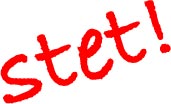
Stet!Copy Editors and My Work

I have to start out by saying that my work is usually not very heavily edited. I take that to mean that one or more of the following are true (or is that is true? I never said my grammar was perfect.):

  • I know how to write. Seems funny to even make that statement. It’s pretty obvious that I know how to write when I’ve been doing it for a living for so long.
  • My publishers have a limited budget for copy editing. This might be true with my “packaged” books — those are the ones I write, lay out, and submit as InDesign files, TIFFs, and PDFs. But I don’t think that’s the case with my more traditionally produced books.
  • The copy editors I get don’t know what they’re doing. For the most part, I don’t believe this is true. How can they be copy editors when they don’t know what they’re doing?

So I tend to believe it’s the first reason more than the others.

But the reason doesn’t really matter. Any writer can tell you that they’d rather see their work lightly copy edited than heavily copy edited. The reason: the percentage of original words, sentences, and paragraphs that “survive” the editing process. Light editing means more of the author’s original work remains intact. Heavy editing means that less of the author’s original work remains intact. It’s as simple as that.

[I need to make a disclosure here. I am guilty of being a heavy-handed editor. I’ve worked with co-authors on three occasions. On two of them, I had final say over the text that would become the content. In both cases, I tried to change the co-author’s “voice” to match mine. Voice is a sort of writing style that comes across in sentence construction, etc. In one case, the co-author didn’t give a hoot; he was just glad that someone was going through the text and making the style consistent. In the other case, the co-author was rather upset and offended. In both cases, I did what I did to make the book better. Or at least better in my opinion. Whether I made it better or worse is something we’ll never know. In any case, I’ve decided that it’s probably best if I stay away from the co-author role.]

Ten Editions, Ten Experiences

I just completed the tenth edition of one of my books. Each revision begins with the previous edition’s text and edits it so it covers the current software product. Some years, less than 5% of the book’s content changes. Yet for the first few years, the book was sprinkled with copy edits — I could see them because we use Microsoft Word to prepare the manuscript and the revision feature is turned on throughout.

Every year’s editor — because there have been 8 of them over 10 editions — had a different “pet change.” For example, one editor didn’t like where I put words like “only” and would invariably move them to another part of the sentence. I’d read the sentence both ways and either way worked for me — although it obviously sounded more natural to me the way I’d originally written it. Another editor liked to add commas. That didn’t matter much, because the next year’s editor liked to remove commas. One year’s editor decided that all the names of menu commands, dialogs, and options within the software should be in title case, no matter how it was presented in the software. So the Show color for Background image check box would become the Show Color For Background Image check box. One editor rolled up her sleeves and rewrote a bunch sentences that the previous editions’ editors had either fiddled with themselves or left as is. The most recent editor decided to introduce italics to some text that had never had it before.

How I Felt about It

Each year — the book is revised annually, every summer — my attitude toward the copy edits changed.

At first I didn’t mind so much, although I got seriously peeved when the production editor for the first edition started making changes to content that we’d all already agreed on. (That’s another story and not a happy one, although I did get the last laugh.)

Then, as I saw the current year editor change things that the previous year’s editor had changed so it was what I’d originally written (or pretty close to it), I started complaining. I could do that since the book’s very first edition had become a bestseller and the publisher wanted to keep me happy. (Don’t try this for your first book, kids.) The copy editor on that edition tuned things down a notch.

But the following year it was back to what I consider “changes for the sake of making changes.” I got fed up, blew a gasket, and decided that I didn’t care about the changes. I’d just rubber-stamp everything. And I did for two or three years.

But then I started caring again, right around the time I got a good editor two years in a row. (Where is she now? Come back!)

Last year’s editor wasn’t bad, although he did ask a lot of questions that seemed designed to point out errors in my text rather than just fix them. For example, “The art shows that the dialog is called Colors, not Color as you have indicated here. You also called it Colors in five other places. Should I make the change here?” Uh, yeah. Isn’t that what you’re here for? Of course, I didn’t say that. I just thought it. Loudly, in my head. If he would have just made the change, I would have seen it with the revision marks and would have checked it and would have realized his edit was correct.

This Year

This year’s copy editor absolutely wigged me out. Her orders were supposed to be to edit the text that has changed. Remember, the majority of the book is exactly the same as it was the previous year. This year, about 20% of the text changed. That means she only had to look at 20% of the manuscript — the part with all the colored revision marks. Yet she insisted on copy editing the whole thing. She inserted a bunch of commas, which I really don’t care about. (Next year’s editor will pull them back out and I won’t care about that, either.)

But she also decided that all occurrences of Web should be web and that some terms, menu commands, feature names, and dialog options should be italicized. The problem with this is consistency — there wasn’t any. A command name on one page would be in normal type and the same command name on the next page might be in italics.

I freaked and I complained to the project editor. The formatting was wrong and inconsistent, I’d have to undo every wrong change she’d made while reviewing the edits. It was annoying and time-consuming and I had another (dare I say it?) more important book lined up after this one to write.

The PE clarified the instructions to the CE. The CE continued to make the same changes. I freaked again. I couldn’t get the PE on the phone, so I wrote a nasty e-mail to the CE. (I’d thrown my back out the day before and was in incredible pain, but still had to work on the book to meet the deadline, so I was pretty cranky. I wrote the e-mail just before heading out to the chiropractor.) I got scolded by the PE. I defended my complaints. The PE talked to the CE again. And then the CE stopped reviewing anything except the edits (as she should have been from the start). And guess what? In three of the remaining 12 chapters, she had absolutely no changes.

Now tell me, what does that say to you?

More to Come…

In Part III of this series, I’ll tell you what that said to me. Until then, if you want to share copy editor horror stories, the Comments link or form is a good place to do it.

Copyright for Writers and Bloggers – Part III: Fair Use and Public Domain

What’s fair? Use common sense.

In the first article of this series (Part I: Why Copyright is Important), I discussed the importance of copyrights to authors. In the second article (Part II: Creative Commons), I tell you about the Creative Commons license I use to protect the work on this site.

In this last article of the series, I explain the concept of fair use — or attempt to, anyway — and how it enables you to quote copyrighted works for certain purposes.

CopyrightFair Use

Now here’s a good question. What if you want to use one of my articles on your AdSense-supported Web site? Obviously, that’s in violation of my Creative Commons license. But what if you’re satisfied using only a part of it?

That’s where Fair Use comes into play. Fair use allows you to take a portion of copyright-protected material and use it provided the use meets the definition of “fair” as set forth by the Copyright Act of 1976:

…the fair use of a copyrighted work, including such use by reproduction in copies or phonorecords or by any other means specified by that section, for purposes such as criticism, comment, news reporting, teaching (including multiple copies for classroom use), scholarship, or research, is not an infringement of copyright. In determining whether the use made of a work in any particular case is a fair use the factors to be considered shall include—

  1. the purpose and character of the use, including whether such use is of a commercial nature or is for nonprofit educational purposes;
  2. the nature of the copyrighted work;
  3. the amount and substantiality of the portion used in relation to the copyrighted work as a whole; and
  4. the effect of the use upon the potential market for or value of the copyrighted work.

You can read more about this on Wikipedia.

Fair Use is Common Sense

Fair use, of course, is ruled upon by judges when copyright infringement cases get to court. But you can keep yourself out of court — and be a good member of the blogging community — by using common sense and thinking through the use you have in mind.

For example, suppose you want to use portions of this article as part of a college course you’re teaching about copyright in the Internet age. You could print the article and share it as a handout with your students. Of course, you should also credit me as the author. That’s common courtesy in the writing world.

Or suppose you want to blog about this article as part of your own opinion piece about copyright. You could take a quote from my article and use it to make one of your points — or to present one of my points that you want to argue. (Be gentle, please.) For fair use, you’d have to limit the amount of material you used so it’s only a portion of the entire piece. You should also include my byline and a link back to my article — that’s common courtesy in the blogging world.

Both of these uses would be considered fair. What’s not fair is using a work in a way that would reduce demand or marketability for it — like reproducing it in whole on your Web site without a link back to the original. Or using it to make money by providing content on a site that exists primarily to generate advertising revenue.

Public Domain

There’s one more thing I want to mention here.

If you don’t care about how people use your work, you can release it into the public domain. This essentially means that you’re giving up all rights to it and people can do with it what they want.

If you find a work that’s in the public domain — including classic novels that are out-of-copyright — you can use them pretty much anyway you like. But let your conscience be your guide. Do you really want to claim that that passage from Mark Twain’s Roughing It was really penned by you?

Just remember, there’s nothing in this blog — or in most others — that’s in the public domain. Respect the author’s copyrights, whether they’re a standard copyright “All Rights Reserved” notice, a Creative Common’s license, or something less formal. It’s not just courtesy. It’s the law.

What Do You Think?

Got something to say about this? Use the Comments link or form for this post to get it off your chest.