Here’s a video blog entry from my camper. In it, I explain my big temporary move to Brewster.
June 25 2008 Update
Comment

Here’s a video blog entry from my camper. In it, I explain my big temporary move to Brewster.
My contract ends and I get another.
My first round of cherry drying contracts went…well, I guess it went well. They were two-week contracts. It rained only two days, but not enough to launch me. So I spent 12 out of 14 days just hanging around and exploring the area. I only spent 2 days prepping the helicopter and remaining on “active” standby. Still, I collected standby pay for all 14 days.
I feel only a little bit guilty for collecting money without doing any real work. After all, because I was required to be in the area with the helicopter, I couldn’t do any other paying work with it. So the compensation is partially for possible work lost. The rest is to cover my expenses, some of which are quite substantial — think insurance and travel costs and that damn fuel tank and the helmet I have yet to wear while flying.
But the first round of contracts ended at sundown on Monday. And my next round of contracts wasn’t due to begin until July 8. That meant I had two full weeks with no potential income and a lot of time on my hands.
It was like being unemployed.
I made a few phone calls yesterday and today. I got a few back. And one of them was an offer for a new contract that would run from June 26 (Thursday) through July 7. A fill-in contract. I jumped on it. So I’d enjoy my unemployment for a total of two days.
The new contract is up in Brewster, WA. That’s about 100 road miles from here but only 50 nautical air miles from here. I can get there in 30 minutes by helicopter, according to Duats flight planning.
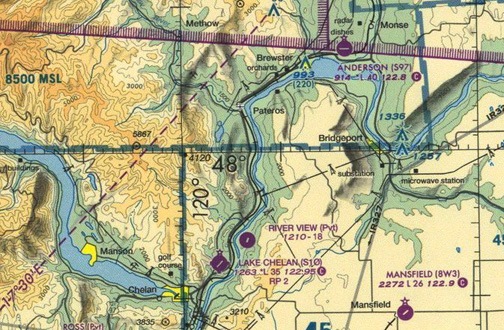
But I’m not moving my camper from Quincy. After all, I have to return for that July 8 contract. My camper is all settled in and the campsite and Internet are paid for. The campground’s full hookup sites are all filled and I know that if I move my camper, someone else will steal my site, despite the fact that it’s paid for. Besides, this area is due for a heat wave starting on Saturday. I’d much rather suffer through that in a motel than in the camper. The camper’s air conditioning works fine, but it makes a hell of a racket.
The motel I’m going to is in Pateros. It’s right on the Columbia River and all the rooms look out that way. They allow pets, so Alex the Bird won’t need to be hidden — although he will cost me an extra $10/day. There’s even a pool. And, if you can believe this, they’ll let me park my helicopter on the grass to the east of the building.
Mike is flying up on Friday. He made his plans yesterday, when we both thought I’d be down here in Quincy, twiddling my thumbs for two weeks. His timing couldn’t be better. He’ll drive the truck up for me on Saturday morning, with Alex the Bird and his rather bulky cage.
Then, on July 7, when Mike is gone, I’ll have to figure out how to get everything back to Quincy for the next three week gig.
An update to a recent post.
Less than 12 hours after the unhappy Internet guy set me up with service in my camper at the golf course (as reported here), that service was disabled.
By the irrigation guy.
Here’s the strange but true story.
Since the Golf Course folks were paying for the Internet installation, it made sense for them to have an Internet connection at at least one of their computers. For simplicity’s sake, they decided to use the computer closest to the router. Although it looked like a regular desktop PC, it was actually a PC dedicated to the operation of the golf course’s irrigation system. A complex Toro software/hardware system enabled the golf course staff to activate any of its sprinklers by radio from anywhere on the course.
 The PC in question was connected to a simple antenna on the roof that was about 18 inches from the antenna the Internet guy installed. You can just about see it in this picture; It’s the white pole behind the pizza box antenna.
Well, as soon as the Internet was connected to that computer, the otherwise bored golf course employees decided it was time to go surfing. I don’t even think the Internet guy was gone before Explorer was launched and at least one employee was checking out YouTube.
I knew this was going on, but it didn’t really register that it could be a problem. I was oblivious, just happy to have my connection.
Around 9 PM, there was a knock on my trailer door. It was still light out — the sun doesn’t set until about 9 here this time of year — but I was in my pajamas, lounging in bed with a book. I threw on a pair of shorts and came to the door. It was the irrigation guy. I’ll call him Carl, even though that’s not his name.
“The Internet guy screwed up my computer,” he fumed. “I can’t get the sprinklers to come on. It’s all screwed up.” I could tell he was pretty angry. “Do you have his phone number?”
I handed over Pete’s card. He stormed away with it.
I didn’t think anything more about it.
Until the next day. My Internet connection still worked for a while, but the signal wasn’t very strong. Some rain on the camper sent me to the airport to pull the helicopter out, just in case I had to fly. When I returned at about 9 AM to keep myself busy until I got a launch call, the Internet was down. In fact, my computer couldn’t even find the wireless network.
I went into the golf course office. The router was gone. I later found it in a pile of wires and cables and transformer boxes on another desk.
I asked the guy at the desk what had happened.
“Carl couldn’t get the Internet guy on the phone and his sprinklers weren’t working. So he called his daughter out here and they disconnected the Internet.”
I later found Carl. He was still fuming. “That computer is for the irrigation system only,” he said. “If you touch anything on it, the system goes down. They shouldn’t have put the Internet on it. The Internet guy didn’t call and I had to do something so we disconnected it. I had to do a restore from last Tuesday. I think I got it working again.
I should clarify here. The only way “the Internet” was connected to his computer was via a single Ethernet cable from the router. That’s it. The computer was not doing anything to keep the Internet connection alive — although for all I know, Pete may have used its browser to configure the router the previous day. All Carl had to do was disconnect that Ethernet cable. But he’d pulled it all out.
All except the power to the Internet antenna.
I discovered this on Monday when I attempted to reconnect everything — except the irrigation computer, of course. I had Pete on the phone and he gave me a physical description of the box between the antenna and the router. Carl hadn’t disconnected it, so the antenna was still powered and operating.
I got the system all back up and running, then asked Carl to test his system. He went outside with a radio and tried it. “It won’t work,” he said.
I powered down the router and asked him to try it again. It still wouldn’t work, even though it was basically the same as it had been all weekend when it did work.
I unplugged the little box and asked him to try again. He said it still wouldn’t work. But now nothing was connected. When I pointed that out, he looked at his radio and said, “Well, maybe the radio isn’t charged up. It’s acting like it’s not charged.”
Patience, Maria. Patience.
“How about if you charge it all up and we try again later?” I suggested. “Maybe after lunch?”
He agreed. He put the radio in its charging station and I left everything unplugged.
Later, he came by my camper. “The antenna is too close,” he told me. “I called the irrigation support people and they told me the Internet antenna was conflicting with my system.”
I’d already explored this possibility with Pete. He didn’t think it was likely, but since we didn’t know the frequency of the irrigation system’s radio, we couldn’t be sure. Carl didn’t know the frequency.
After he’d driven off to look at something out on the golf course, I slipped into the office. A mousepad provided by Toro listed support phone numbers. I dialed one of them. Moments later, I was explaining the situation to a support guy. I asked him the frequency of the radio system. He said it was in the “400 range.” I had no idea what that meant, but figured Pete would. I asked him if he’d ever heard of the system conflicting with an Internet setup. He said he hadn’t. I also discovered, during the phone call, that Carl had not called their support number since the beginning of June. So that means that either Carl was lying or someone else had told him the two systems would conflict. Sheesh.
I spoke to Pete. We agreed that there was no conflict. But he promised to come by on Tuesday (today) to move the antenna farther down the roofline.
With luck, I’ll have my network backup by this afternoon.
Are you as sick as I am of the media spinning what it wants to turn into issues?
I’ll admit it: I listen to NPR. (That’s National Public Radio, for those of you who spend more time in front of a boob tube than looking outside your own windows.) Not only do I listen, but I’m now a member of two NPR stations: KJZZ in Phoenix and Northwest Public Radio in Washington State.
Yes, I know NPR leans to the left. So do I. But I think it’s far more thought-provoking than just about every other media outlet out there. And it spends more airtime talking about what’s important in today’s world — world politics, the economy, etc. — than any other media outlet.
Let’s face it: does it really matter to you whether Britney has custody of her kids? Or who won American Idol? Or what happened on last night’s episode of [fill-in-the-blank mindless television show]? And do you really need to know about the fire that leveled an apartment building or the drug-related killing in the city?
This morning, I was pleased to hear two essays on NPR that echoed my sentiments about certain issues almost exactly. I’d like to share them with you as examples of how listening to something with substance can help peel away the bullshit doled out by many other media outlets.
“Michelle Obama Endures Public Scrutiny” is an essay by Diane Roberts. In it, she discusses the controversy surrounding Barack Obama’s wife — a controversy which has been manufactured entirely by the right-wing media (i.e., the Fox network) and other media outlets who apparently have nothing better to talk about.
Ms. Roberts uses sarcasm to poke fun at this controversy, but she states the truth when she points out:
Where Laura Bush is all pastels and soft-focus, Michelle Obama is strong lines and high def. Where Cindy McCain is a frat boy’s dream girl — a blond beer heiress from the golden West — Michelle Obama is a tall, clever Ivy League lawyer from the South Side of Chicago.
So why is the media so dead-set against her? I think they feel threatened. Michelle Obama is apparently too real, modern, and smart for their tastes. So what do they do? They cast doubt on her character by spreading rumors and interpreting words and actions out of context and in a way that supports their claims.
Frankly, I like what I’ve seen of Michelle Obama. She’s a breath of fresh air — not a phony, old-fashioned “help-mate” living in the shadow of her husband. If Hillary Clinton had been more like Michelle Obama when she was First Lady, I think she would have earned a lot more respect — and more votes — in the primary season.
I’ll go a step further. I believe Michelle Obama is an excellent role model for girls and young women. Sadly, I can’t say the same about either Laura Bush, who can barely read a speech in public, or Cindy McCain, who seems like she’s just along for the ride. While I’m sure she does have her faults — we all do, don’t we? — she certainly doesn’t deserve the abuse she’s getting from the media.
It’s unfortunate that someone as well educated and intelligent as Michelle Obama has to play games to make herself seem worthy to doubters. I think she probably has a lot better things to do with her time than appear on a talk show like The View.
Daniel Schorr is NPR Weekend Edition’s senior news analyst. He shares his commentary on NPR every Sunday morning, as well as other times.
Today’s commentary touched on something that has been bothering me: the acceptance by the Midwest’s residents that the recent flooding was an “act of God.” I was especially bothered by an interview earlier in the week during Talk of the Nation. In that interview, an Iowa farmer with 640 of her 800 acres of farmland under 15 feet of water insinuated that the flood was God’s will. She then turned her interview into a preaching session, telling listeners how good God was because he’d sacrificed his only son for our salvation.
Give me a break. She could have made much better use her time on a nationally syndicated radio show to explain what the rest of the country could do to help folks in situations like hers.
This, of course, came on the heels of still-President Bush’s comment last Sunday where he said,
I know there’s a lot of people hurting right now and I hope they’re able to find some strength in knowing that there is love from a higher being.
(I blogged about that comment because it bothered me so much.)
Daniel Schorr, in “Why Are There So Many Natural Disasters?” pointed out research and public statements by scientists who have studied the effects of man’s impact on the earth. These men have found that the flooding was caused, in part, by the land having been “radically re-engineered by human beings.” Farmland is getting ever closer to water sources, removing the buffers between creeks and rivers and farm fields. If the Iowa land were left undeveloped, it would be covered with perennial grasses that have deep roots to absorb water.
I can confirm how man’s changes to the landscape can affect flood waters. As I reported in my blog, my neighbor’s removal of naturally growing trees, bushes, and other plants from the floodplain near our homes changed the course of the wash that flows through it, causing extensive damage to his property — and mine. The lesson to be learned from this: don’t mess with the floodplain!
But in the midwest — and elsewhere in our country — cities are built in known flood plains. The residents depend on levees to hold back floodwaters in the event of a flood. They bandy around terms like “400-year flood” to give people the idea these floods only occur ever 400 years. Yet some towns can tell you that they’ve had several of these floods over the past 20 years. When the water can’t soak into the ground and is funneled through a series of levees, there comes a point when the levees simply can’t handle floodwater volumes. The result: levees break, towns and cities built in the floodplains flood.
Is this God’s will? Did God remove natural vegetation buffers around streams and rivers and replace it with plowed farmland? Did God build towns and cities in the floodplain? Did God build the levees that failed?
Daniel Schorr doesn’t think so. And neither do I.
Is it too much to ask for people to think? To consider all the information that’s out there and form conclusions based on the evidence?
Or will you simply believe the hate messages and excuses you hear on network television and read in viral e-mail messages?
A report from my summer camp.
 Crop dusters work the area every morning if the wind is calm. I can hear the zooming around. It reminds me of the airplane scene in North by Northwest.
The planes are usually small one-seaters, although I did see a biplane the other day. I took this photo this morning from the grassy yard of my campsite as the plane was making a turn for another pass over the field across the road. I’ll try to get better photos of them in the future.