
Flying through a mountain pass in marginal conditions.
Louis and I flew from Wenatchee (EAT) to Seattle’s Boeing Field (BFI) yesterday afternoon. The flight required us to cross the Cascade Mountains. There are two passes to choose from: Snoqualmie, which I-90 goes through and Stevens, which State Route 2 goes through. I’d wanted to take Stevens — I’d already traveled Snoqualmie once and wanted a change — but the decision would not be mine.
It was a weather issue, of course. After weeks of picture-perfect weather here on the east side of the Cascades, a cold front had moved in. Rain clouds were coming over the Cascades. It even drizzled in Quincy.
As I flew out of Quincy Airport for the last time this season, I took a good look at the ridge between Ellensburg and the Columbia River, where all those windmills are lined up. The sky was dark out that way, with thick gray clouds. Although the windmills were clearly visible, I could also see the vertical streaks of falling rain. It looked as if a flight up I-90 was out of the question.
But the picture was worse when I reached the Wenatchee area and could see out toward Stevens pass. The sharp, rocky mountains are closer there and the clouds clung to them like cotton balls rubbed across coarse sandpaper: lots of wisps in an 8 to 10 knot breeze. The clouds were definitely lower; the pass was definitely higher.
It looked as if scud-running would be in my near future.
If you’re not a pilot, or you’re a very new pilot, you might not know the term scud-running as it pertains to aviation (or anything else, for that matter). I define scud-running as flying in variable visibility conditions, when you have steer around low clouds or fog enroute to get to your destination. Scud-running is never a good idea. In fact, it’s usually a bad idea. More than a few pilot have met their end hitting a “granite cloud” while attempting to run the scud.
Helicopters, however, are uniquely suited for scud-running. We normally fly low, so the clouds have to be really low to affect our flight. We can travel at a wide range of speeds, from 0 to (in my case) 115 knots, so we can take our time and really look at what’s around us before committing to a path. And if that path turns bad, we can make a 180° turn to get out of it in a very narrow space. Best of all, if things get really out of hand, we can always land in a field or parking lot and wait out the problem.
Don’t get me wrong: I’m not recommending scud running to any pilot. It’s dangerous. I’m just saying that if you’re flying a helicopter and the clouds start to close in, you’re more likely to live to tell about it — if you handle it right — than someone flying a plane.
In Wenatchee, I checked the weather. I used Duats to get conditions in Stampede Pass, which is just south of Snowqualmie pass, and every other place along the way on both routes. There was no information handy for Stevens Pass, but my eyes had told me enough. Stampede pass had ceilings of 6000 feet. That was more than enough for me. Then I checked the radar in motion to see which way the rain I’d spotted near the windmills was going. It was driving northeast. We were north of the rain; it would pass to the south of us if we flew direct to Ellensburg or Cle Elum. It was cloudy and raining on the other side of the cascades, with 4,000 foot ceilings. Wind was light everywhere, so turbulence wouldn’t be an issue.
I decided to take Snowqualmie Pass.
We started up and I took off on a steep, 1,000 foot per minute climb from Wenatchee Airport. We had to cross the river and then cross the high ridge on the other side. To our left, the rainclouds were moving east. To our right, the low clouds were stuck on mountain peaks. The ridge was clear; the clouds were at least 1,000 feet above it. I aimed slightly to the south of the GPS’s direct-to Ellensburg, pointing the helicopter at the friendliest piece of sky.
I gave Louis the controls when we reached the ridge. He continued the climb, but adjusted our route to intercept with Ellensburg. We climbed closer to the clouds. I thought for a while about how I use a GPS for en route navigation — as a sort of general guide. Louis was putting us on the GPS track. Whatever.
We topped the ridge and the land dropped down toward Ellensburg on the other side. We stayed pretty high. Didn’t seem any reason to descend to a 500-foot cruise altitude when we’d just have to climb again. I set Cle Elum as the next go to waypoint in the GPS. Louis adjusted course to head west.
Ahead of us, the mountains closed in. I-90 threaded its way through them in one narrow valley after another. Although we still had at least 2,000 feet of cloudless sky right above us, the clouds dropped up ahead. The entrance to the mountainous area looked shrouded in a white haze. It didn’t look good.
I dialed in the Stampede Pass ASOS. It assured us that the ceilings were 1700 feet. Plenty of space for us. But we weren’t going through Stampede Pass. We were going through Snowqualmie Pass. They were very close, but would they have the same conditions?
We continued on. I paid close attention to the high-tension power lines that ran along the side of the road. If we had to descend and turn, I wanted to make sure I knew exactly where those wires were.
The road climbed into the mountains. We stayed at pretty much the same altitude until we were about 500 feet above the road. Then we climbed with it. We slipped into the white haze, which turned out to be a light mist. Tiny raindrops covered the helicopter’s cockpit bubble. Visibility was still okay, but there wasn’t enough moisture to bead up and run off the window, so we had to look through all those little droplets. Still, so far, so good.
We passed the two little airports at Cle Elum and I punched the next airport into the GPS: Easton State. If I have to make a precautionary landing, I like to do it at an airport, so I like to keep an airport dialed into the GPS. Sure, we could land in a big parking lot or field, but that’s a good way to get unwanted attention in these little towns.
Meanwhile, the clouds continued to come down. My internal alarm systems came to life when we started flying between low-hanging wisps of clouds. The last time I’d done that, I’d flown into one I hadn’t seen. That produced about 2 seconds of terror before I made a descending 180° turn to get out. I didn’t want to be there again. I told Louis, who was still flying, about my experience.
We passed Easton State. The next airport was Bandera, on the other side of the pass. I punched it in. We were now flying in a deep canyon, about 400 feet over a lake and I-90. The wires were not an issue anymore. At the west end of the lake, the highway made a sharp turn to the left into what looked like a cloud bank.

I listened to the Stampede Pass ASOS again. Now the ceilings were 1400 feet — still not bad. We weren’t far from there. We continued to the end of the lake, where we could see into the next canyon. Visibility was still okay, so we went in. This was the narrowest part of the canyon with very little room to maneuver. The clouds stayed high enough. The misty rainfall continued. We were okay, but I knew it could turn bad at any time.
Then we were through the pass and the road started to descend. The clouds went down with it. So did we. We’d made it through the pass but I still wasn’t sure whether we’d have a clear enough shot out of the mountains. We could never see more than a few miles ahead of us because of the mist and the twisty turns of the canyon.
But by the time we passed Bandera, it was obvious that we wouldn’t have to turn back or land. As the road continued to descend, the clouds stayed put. I tuned in the ATIS for Boeing Field and heard 10 miles visibility with 4000 foot ceilings. We landed there about 20 minutes later.
Here’s our entire route, laid out on a sectional chart;

I wouldn’t call this experience scud running, but it was about as close as you could get. I don’t think too many airplanes would have made this flight successfully without getting into the clouds — granite or otherwise. Although something small and slow like a Piper Cub could have handled the altitude and airspeed, the uncertainty of what lay ahead, coupled with the extremely narrow spaces that would make it impossible for an airplane to turn around, would make this a very dangerous flight for any plane.
I’ve been in worse weather situations than this one, but I don’t think I entered into this one lightly. The entire time we were in the mountains with low clouds, I kept thinking about escape routes, landing zones, obstacles to turning, and what could happen if we let it. In Arizona, I don’t get much practice flying weather. While I think that what we experienced yesterday was marginal VFR at best, other pilots more accustomed to weather flying might think I was taking the whole thing too seriously.
But it’s when you let your guard down that Mother Nature sometimes steps forward to slap you in the face.


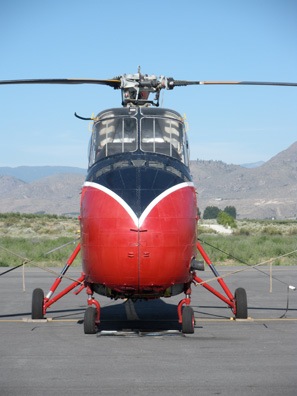 This is the ship I’d most like to fly. It’s a Sikorsky and I think it’s an S55. It has a radial engine and, a few days later, I had the pleasure of watching it start up and fly away while I was waiting on the ramp in my helicopter for my dispatcher to send me to an orchard.
 This is another Sikorsky. Not quite as pretty, but also used for agricultural work. They dry cherries with these. I saw this one in flight, hovering about 50 feet over an orchard. I think there’s so much downwash that they can just hover in one place and dry the whole orchard. (Which is a good thing, because they cost a fortune to fly.)
 Were you looking for a Huey? How about this one?
 Here’s another helicopter you don’t see every day: a Hiller. This is one of two Hillers that supposedly came down from Canada to dry cherries.
  Here’s the other Hiller in an artsy head-on shot. I love the old helicopters with the big glass bubbles — but I sure wouldn’t want to fly one in the Arizona sun. A buddy of mine in Arizona has one and I think he’s nuts.
 And here’s the pair of them, parked side by side.