Almost Scud-Running

Flying through a mountain pass in marginal conditions.

Louis and I flew from Wenatchee (EAT) to Seattle’s Boeing Field (BFI) yesterday afternoon. The flight required us to cross the Cascade Mountains. There are two passes to choose from: Snoqualmie, which I-90 goes through and Stevens, which State Route 2 goes through. I’d wanted to take Stevens — I’d already traveled Snoqualmie once and wanted a change — but the decision would not be mine.

It was a weather issue, of course. After weeks of picture-perfect weather here on the east side of the Cascades, a cold front had moved in. Rain clouds were coming over the Cascades. It even drizzled in Quincy.

As I flew out of Quincy Airport for the last time this season, I took a good look at the ridge between Ellensburg and the Columbia River, where all those windmills are lined up. The sky was dark out that way, with thick gray clouds. Although the windmills were clearly visible, I could also see the vertical streaks of falling rain. It looked as if a flight up I-90 was out of the question.

But the picture was worse when I reached the Wenatchee area and could see out toward Stevens pass. The sharp, rocky mountains are closer there and the clouds clung to them like cotton balls rubbed across coarse sandpaper: lots of wisps in an 8 to 10 knot breeze. The clouds were definitely lower; the pass was definitely higher.

It looked as if scud-running would be in my near future.

If you’re not a pilot, or you’re a very new pilot, you might not know the term scud-running as it pertains to aviation (or anything else, for that matter). I define scud-running as flying in variable visibility conditions, when you have steer around low clouds or fog enroute to get to your destination. Scud-running is never a good idea. In fact, it’s usually a bad idea. More than a few pilot have met their end hitting a “granite cloud” while attempting to run the scud.

Helicopters, however, are uniquely suited for scud-running. We normally fly low, so the clouds have to be really low to affect our flight. We can travel at a wide range of speeds, from 0 to (in my case) 115 knots, so we can take our time and really look at what’s around us before committing to a path. And if that path turns bad, we can make a 180° turn to get out of it in a very narrow space. Best of all, if things get really out of hand, we can always land in a field or parking lot and wait out the problem.

Don’t get me wrong: I’m not recommending scud running to any pilot. It’s dangerous. I’m just saying that if you’re flying a helicopter and the clouds start to close in, you’re more likely to live to tell about it — if you handle it right — than someone flying a plane.

In Wenatchee, I checked the weather. I used Duats to get conditions in Stampede Pass, which is just south of Snowqualmie pass, and every other place along the way on both routes. There was no information handy for Stevens Pass, but my eyes had told me enough. Stampede pass had ceilings of 6000 feet. That was more than enough for me. Then I checked the radar in motion to see which way the rain I’d spotted near the windmills was going. It was driving northeast. We were north of the rain; it would pass to the south of us if we flew direct to Ellensburg or Cle Elum. It was cloudy and raining on the other side of the cascades, with 4,000 foot ceilings. Wind was light everywhere, so turbulence wouldn’t be an issue.

I decided to take Snowqualmie Pass.

We started up and I took off on a steep, 1,000 foot per minute climb from Wenatchee Airport. We had to cross the river and then cross the high ridge on the other side. To our left, the rainclouds were moving east. To our right, the low clouds were stuck on mountain peaks. The ridge was clear; the clouds were at least 1,000 feet above it. I aimed slightly to the south of the GPS’s direct-to Ellensburg, pointing the helicopter at the friendliest piece of sky.

I gave Louis the controls when we reached the ridge. He continued the climb, but adjusted our route to intercept with Ellensburg. We climbed closer to the clouds. I thought for a while about how I use a GPS for en route navigation — as a sort of general guide. Louis was putting us on the GPS track. Whatever.

We topped the ridge and the land dropped down toward Ellensburg on the other side. We stayed pretty high. Didn’t seem any reason to descend to a 500-foot cruise altitude when we’d just have to climb again. I set Cle Elum as the next go to waypoint in the GPS. Louis adjusted course to head west.

Ahead of us, the mountains closed in. I-90 threaded its way through them in one narrow valley after another. Although we still had at least 2,000 feet of cloudless sky right above us, the clouds dropped up ahead. The entrance to the mountainous area looked shrouded in a white haze. It didn’t look good.

I dialed in the Stampede Pass ASOS. It assured us that the ceilings were 1700 feet. Plenty of space for us. But we weren’t going through Stampede Pass. We were going through Snowqualmie Pass. They were very close, but would they have the same conditions?

We continued on. I paid close attention to the high-tension power lines that ran along the side of the road. If we had to descend and turn, I wanted to make sure I knew exactly where those wires were.

The road climbed into the mountains. We stayed at pretty much the same altitude until we were about 500 feet above the road. Then we climbed with it. We slipped into the white haze, which turned out to be a light mist. Tiny raindrops covered the helicopter’s cockpit bubble. Visibility was still okay, but there wasn’t enough moisture to bead up and run off the window, so we had to look through all those little droplets. Still, so far, so good.

We passed the two little airports at Cle Elum and I punched the next airport into the GPS: Easton State. If I have to make a precautionary landing, I like to do it at an airport, so I like to keep an airport dialed into the GPS. Sure, we could land in a big parking lot or field, but that’s a good way to get unwanted attention in these little towns.

Meanwhile, the clouds continued to come down. My internal alarm systems came to life when we started flying between low-hanging wisps of clouds. The last time I’d done that, I’d flown into one I hadn’t seen. That produced about 2 seconds of terror before I made a descending 180° turn to get out. I didn’t want to be there again. I told Louis, who was still flying, about my experience.

We passed Easton State. The next airport was Bandera, on the other side of the pass. I punched it in. We were now flying in a deep canyon, about 400 feet over a lake and I-90. The wires were not an issue anymore. At the west end of the lake, the highway made a sharp turn to the left into what looked like a cloud bank.

Crossing the Mountains

I listened to the Stampede Pass ASOS again. Now the ceilings were 1400 feet — still not bad. We weren’t far from there. We continued to the end of the lake, where we could see into the next canyon. Visibility was still okay, so we went in. This was the narrowest part of the canyon with very little room to maneuver. The clouds stayed high enough. The misty rainfall continued. We were okay, but I knew it could turn bad at any time.

Then we were through the pass and the road started to descend. The clouds went down with it. So did we. We’d made it through the pass but I still wasn’t sure whether we’d have a clear enough shot out of the mountains. We could never see more than a few miles ahead of us because of the mist and the twisty turns of the canyon.

But by the time we passed Bandera, it was obvious that we wouldn’t have to turn back or land. As the road continued to descend, the clouds stayed put. I tuned in the ATIS for Boeing Field and heard 10 miles visibility with 4000 foot ceilings. We landed there about 20 minutes later.

Here’s our entire route, laid out on a sectional chart;

EAT to BFI via Snowqualmie Pass

I wouldn’t call this experience scud running, but it was about as close as you could get. I don’t think too many airplanes would have made this flight successfully without getting into the clouds — granite or otherwise. Although something small and slow like a Piper Cub could have handled the altitude and airspeed, the uncertainty of what lay ahead, coupled with the extremely narrow spaces that would make it impossible for an airplane to turn around, would make this a very dangerous flight for any plane.

I’ve been in worse weather situations than this one, but I don’t think I entered into this one lightly. The entire time we were in the mountains with low clouds, I kept thinking about escape routes, landing zones, obstacles to turning, and what could happen if we let it. In Arizona, I don’t get much practice flying weather. While I think that what we experienced yesterday was marginal VFR at best, other pilots more accustomed to weather flying might think I was taking the whole thing too seriously.

But it’s when you let your guard down that Mother Nature sometimes steps forward to slap you in the face.

Airport Codes: SBP

Landing at San Luis Obispo.

For my first Airport Codes meme entry, I thought I’d cover one that’s relatively fresh in my mind: San Luis Obispo (SBP).

SBP was a fuel and lunch stop on a flight from Wickenburg, AZ (E25) to Boeing Field (BFI) in Seattle, WA in May 2008. I was flying with Louis, a CFI who wanted to build time in an R44. Or maybe I should say Louis was flying with me, since he was acting as PIC.

Our arrangement was for Louis to fly and me to handle radio communications. We’d come in from the east, passing over Grapevine and climbing up trough the wide valley west of there. About 30 miles out, we broke away from the road and made a beeline to the airport.

Chart to SBP

I tuned in the radio, listened to the ATIS recording, and waited until we were closer to make my call. The female controller was issuing instructions to other aircraft. The airport wasn’t very busy for a late Saturday morning, but the radio was full of sound. The controller was chatty, which is extremely unusual for a controller of either gender. Either she liked to give instructions or she assumed the pilots were dumb enough to need as much information as she could provide. When I made the call about seven miles out, I made myself a target for her communications.

Oddly enough, I happen to have video for this flight. I had the POV.1 camera on the nose of the helicopter and although I didn’t realize it, it had been turned on since just past Grapevine. So you can see and hear the landing — including the chatty controller — for yourself.

In reviewing this video, I really think the controller had a bit too much to say. When a controller talks too much, he or she makes it difficult for pilots to make contact with the tower. Imagine, for a moment, that you were inbound to SBP and needed to establish communication with this Class Delta tower. There aren’t too many opportunities to talk during the 6 or so minutes from the time I first called in to the time we landed. This makes it tough, especially for new pilots who may already struggle with communications.

Anyway, we landed in the No Parking zone as instructed, cooled down, and shut down. Then we went up to the terminal area where there was a restaurant. After being completely ignored for about 10 minutes, we finally got an apologetic waiter. Lunch was good.

While we sat there, four airliners came or went. Let’s see if I can remember…American, US Air, United, and Delta? All of them were turboprops except United, which came in with a small jet.

After lunch, we went down to the ramp. Our choices for fuel were full serve, right where we were parked (A on the diagram below), or self-serve, on the other side of the airport (B on the diagram below). Self serve was 50¢/gallon cheaper. I made the wrong decision: I decided to air taxi to the other side of the airport and fill up at self serve.

Taxi Diagram for SBP

In a perfect world, this would not have been a bad decision. In a perfect world, we would have started up, got immediate clearance to cross the runway, landed in front of the pump, shut down, fueled, started back up, and got immediate clearance to depart to the northwest.

But there was no perfect world at SBP that day. As we prepared to reposition, a flight of three or four Howards called in on approach. The controller, now a man, was having trouble keeping track of them, probably because they called in individually and they were all Howards. (Eventually, he just told half of them to stay clear of Class Delta.) With the other traffic part of the equation, the controller was overwhelmed. He wouldn’t clear us to cross the runway. So we sat there, spinning and sweating, waiting for the clearance. When we finally got it, I scooted us across. I was hot and cranky. I fueled up quickly and we climbed back aboard. I started up and we waited again. I called the tower three times and was ignored on the first two. On the third, the controller said, “Helicopter Zero-Mike-Lima, I hear you. Stand by.” Nasty.

By the time we left, I’d burned enough fuel to eat up any savings in fuel price. Lesson learned at SBP.

Read other posts in this series:

Cutting Off Their Noses to Spite Their Faces

I still can’t understand it.

The other day, one of my editors told me that the book I’m currently writing will be laid out in India. As a matter of fact, last year’s edition of the same book was also laid out in India.

She went on to tell me that the production department for the company had been downsized from 168 people to less than 20, with the majority of those jobs going to India.

What followed was a discussion of what the company could possibly be saving by making such a change. Sure, the Indian workforce is probably making a lot less per hour. And there’s a huge reduction in other payroll costs for things like vacation pay and health care and employer taxes.

But don’t they consider the cost to the U.S. Economy of putting 148+ people out of work? People who may not get jobs? People who may contribute to the home mortgage crisis by failing to pay their mortgages? Who may need to burden the country by requiring economic assistance to live and get healthcare? People who are a lot less likely to spend disposable income on things like books simply because they don’t have disposable income?

148 people, you say. That’s nothing. How is that going to affect the U.S. economy?

Well, it’s not just one company shipping jobs overseas. It’s hundreds or thousands of them. That equates to thousands of people out of work, many of whom may become unable to afford the goods or services offered by the companies that let them go.

How ironic. By acting in such an idiotic, short-sighted way, these companies are actually reducing their customer base. So while their costs are lower, their sales are likely to be lower, too. Net effect? Zero change in the bottom line!

When I was a kid, we called that “cutting off your nose to spite your face.” Wikipedia has this to say about this particular phrase: “Cutting off the nose to spite the face is an expression used to describe a needlessly self-destructive overreaction to a problem.” Although it usually refers to an act of revenge, I think it could apply to this situation, too.

How can companies reduce their bottom line without shipping jobs overseas? It’s pretty simple: use freelancers.

One of my other publishers has a very small in-house production staff. But it also utilizes a number of freelance production people all over the U.S. When the in-house staff is busy putting books together, it turns to its freelancers and assigns books to them. They get the job done right in a timely manner. They have to — if they don’t do the job satisfactorily, there’s another freelancer waiting in line behind them to do that job or the next one.

Freelancers might get a higher wage than in-house people, and they surely get a higher hourly wage than overseas workers, but they only get paid when they work. So you’re not paying them to hang around the office during slow spells, when there’s no work to do. And, if you pay by the job, rather than by the hour, you only pay for the work done — not time hanging around the water cooler or spending a few extra minutes at lunch.

Employers don’t have to pay taxes for contract labor like freelancers. They also don’t have to offer benefits like vacation time or healthcare. There’s no need to send them for training or to maintain a big human resources department to keep track of them.

And since many freelancers work from their homes, they’re not commuting to and from work. That means they don’t contribute to traffic, pollution, or greenhouse gases.

And since they do work and they do get paid, they have disposable income to buy consumer goods and services. (I’ve been freelance for 18 years now and I can assure you that I’m quite a consumer of goods.)

So my question is this: why don’t more companies explore the possibilities of using freelancers instead of shipping jobs overseas?

Comments? Use the Comments link or form for this post to share your thoughts.

The End is Near

The end of my cherry drying contracts, that is.

I came to Washington State in the beginning of June to start a pair of cherry drying contracts. I was fortunate enough to get a third contract wedged in between the first two, giving me almost seven solid weeks of work.

Well, “work” is not quite an accurate term. I was on standby for all three contracts, but only flew 5.2 hours on two days during one contract.

Thank heaven I was getting standby pay. Without it, I would have taken a heavy loss this summer. But with it, and thanks to the availability of a pilot willing to share ferry costs on both 10+ hour flights between Washington and Arizona, I’ll stay in the black.

My third contract officially ends on Monday, July 28 at nightfall. Unless the weather looks threatening, they’ll likely cut me loose a few hours earlier. It doesn’t matter. I’m not leaving until Tuesday.

But in the meantime, I figured it might be a good idea to drive my orchards, just to see if there was still fruit on the trees. I was in Wenatchee today, so I drove past the one near Wenatchee Airport. There are two cherry orchards across the street from each other. I’m not sure which one is mine. (Heck, it’s hard to tell from the ground when all the photos I have are from the air!) One of them still had plenty of cherries, the other had none. I continued on to Quincy and visited two of my three orchards there. Both were heavy with cherries. One of them is likely to be picked soon — fruit boxes had been laid out neatly in the rows between the trees.

As long as there’s fruit on the trees, there’s a slight chance they’ll ask me to stay on. Although I don’t mind staying an extra day or two, I really don’t want to stay longer than that. I feel done with this place, if you know what I mean.

My trip home will be completed in multiple steps:

  • Tuesday: Fly the helicopter from Quincy to Seattle. Then take Horizon back to Wenatchee and drive back to Quincy. I hope to get all that done on Tuesday, but might have to take an early morning flight on Wednesday to get back to Quincy.
  • Wednesday: Drive the trailer to Walla Walla. That Washington town consistently comes up as a top choice when I go through the quiz on the Find Your Spot Web site. I was there in 2006 during my Midlife Crisis Road Trip and I liked what I saw. But I was only there long enough to do my laundry and visit a downtown independent bookstore. This time, I’ll stay two nights and check it out.
  • Friday: Drive the trailer from Walla Walla to Salt Lake City. I’ll be staying with the family of one of my editors, Megg. She’s going to take me hiking on Saturday.
  • Saturday: Drive the trailer from Salt Lake City to Page, AZ. If I get a late start from SLC, I’ll spend the night on the road and get in sometime on Sunday.
  • Monday: Fly in Mike’s plane from Page, AZ to Wickenburg. I need to get Alex the Bird home.
  • Friday: Fly with Mike on US Air from Phoenix to Seattle.
  • Saturday-Sunday: Fly with Mike and another pilot from Seattle to Page, AZ. I’m hoping to spend the night in the Reading area, where a buddy of mine is on a fire contract. I think we’d all get a lot out of seeing how a fire operation works.

I still have four chapters of a book revision to finish. I goofed off in Wenatchee most of today, but I expect to finish up over the weekend. There’s another book right after it, but I’ll get that started when I get back to Wickenburg and finish it when I settle down in Page.

The Helicopters of Brewster Airport

A few photos of a few classic helicopters.

I took these photos a few weeks ago. Mike and I were taking a drive and passed by the Brewster, WA airport. I couldn’t believe how many helicopters were parked on the ramp. We pulled in, parked the truck, and got out for a closer look. I had my junky little Nikon CoolPix with me, but it did a fine job, as you can see.

SikorskyThis is the ship I’d most like to fly. It’s a Sikorsky and I think it’s an S55. It has a radial engine and, a few days later, I had the pleasure of watching it start up and fly away while I was waiting on the ramp in my helicopter for my dispatcher to send me to an orchard.

This ship is in pristine condition, with seating for 7 on the lower level. What an excellent air-taxi ship this would make. Imagine flying into Scottsdale with this one? It would sure turn a few heads.

Another SikorskyThis is another Sikorsky. Not quite as pretty, but also used for agricultural work. They dry cherries with these. I saw this one in flight, hovering about 50 feet over an orchard. I think there’s so much downwash that they can just hover in one place and dry the whole orchard. (Which is a good thing, because they cost a fortune to fly.)

HueyWere you looking for a Huey? How about this one?

This pretty blue Huey is also being used for agricultural work, although I didn’t see it in flight.

HillerHere’s another helicopter you don’t see every day: a Hiller. This is one of two Hillers that supposedly came down from Canada to dry cherries.

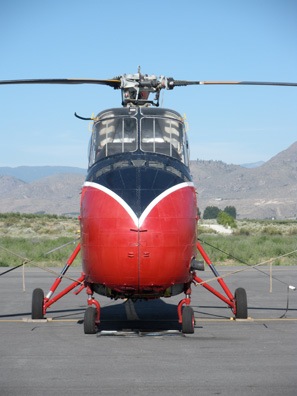
Head On HillerHere’s the other Hiller in an artsy head-on shot. I love the old helicopters with the big glass bubbles — but I sure wouldn’t want to fly one in the Arizona sun. A buddy of mine in Arizona has one and I think he’s nuts.

Two HillersAnd here’s the pair of them, parked side by side.

There was a JetRanger there, too, but I didn’t take pictures of it. After all, you can see a JetRanger anywhere.

As cherry drying season is winding down to an end, most of these helicopters might be gone. I know the Sikorskys are based there. If you’re in the area, why not see for yourself? You can find them at Brewster Airport in Brewster, WA.

Now Read This: If do you stop by for a visit, remember to keep your hands and other body parts off the helicopters. They’re not toys and they’re not for you or your kids to climb on. It’s a Federal offense to mess with any aircraft — really! Remember that airport property is for authorized personnel; if you’re asked to leave, please do.

And if you like looking at aviation-related photos, I hope you’ll check out my Aviation photo gallery.