On Volunteering

Twenty hours this weekend.

This weekend, I spent a total of about 20 hours as a volunteer on the annual Land of the Sun Endurance Ride in Wickenburg, AZ. This was my fifth or sixth year as a volunteer — I’ve lost count — and it’s one of the feel-good things I do for my community.

The event, which is sponsored by the Wickenburg Horsemen’s Association, depends upon volunteers to be a success. There are countless jobs to be done, from marking and grooming the 50 miles of horse trails to marking numbers on the butts of horses. There are folks who handle registration paperwork for this AERC-sanctioned event, folks who order t-shirts and sweatshirts and prizes, folks who handle special requests and complaints. There are folks who buy or prepare the food for attendees, put it out on long tables, and clean up after every meal. There are folks who put out hay and bran and carrots for the horses, folks who fill the water troughs at vet checks, and folks who stand ready with clipboards while paid veterinarians call out horse vital signs. There are folks who check off the numbers of riders as they leave and as they return, and folks who track down riders who haven’t come in yet. There are folks who pick up injured — or just plain tired — riders and horses who are dropping out of the event, using trucks and horse trailers. And there are even folks just hanging around every 3 or 4 miles out on the desert trails, handing out water bottles to riders as they pass. These are just some of the jobs. There are doubtlessly many others I don’t even know about.

What I like about volunteering at the endurance ride is that I’m truly needed and appreciated as a volunteer. I come in and do my job(s). I’m not micromanaged or criticized. And I really get a charge out of the thanks I get from participants just for doing what I’m supposed to.

Each year I generally perform two or three tasks:

  • Make my famous (around here, anyway) vegetarian bean soup. A bunch of volunteers make soup, stew, or chili, but I seem to be the only one who makes a vegetarian dish. It’s actually gotten a few people to think I’m a vegetarian. I’m not. But I recognize that many of the riders are. And when the weather is less than perfect, it’s nice to be able to have a hot and hearty meal on the hour-long break between 25-mile ride segments or at the end of the 25-mile ride. This year, the weather was pretty good and I took home 1/3 crock pot of soup. I’ll freeze it and enjoy it the rest of the winter.
  • Marking Horse ButtsUse large crayon-like markers to write horse entry numbers on the butt ends of horses. It’s not usually a difficult task — most horses have been through this more times than I have and have no problem with strangers marking up their butts. But a few horses are real dancers that make the job difficult. And every once in a while, I’ll encounter a kicker. Their riders get the crayon to mark them. I usually do this from 2 to 6 PM the day before the race.
  • Record the numbers and times of 50-mile riders who return to the main base after their first 25-miles. I do this with another one or two volunteers. My job is usually to write the entry number and time on a blue ticket that I hand to each 50-miler as he or she crosses the 25-mile finish. The rider then takes care of his or her horse and visits a vet to be pulsed down. (There are lots of vets on this ride; no horse is allowed to leave a vet check if it can’t meet certain health requirements.) I usually work with someone who sits at a table and records this same information on a master sheet and another person a bit up the road who uses a radio to tell us who is on the way.
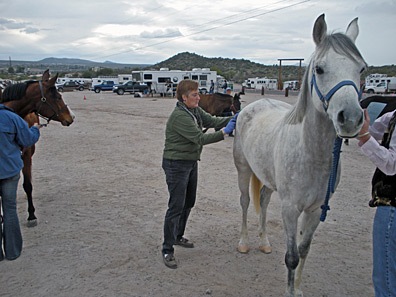
This year, I did all three tasks. I also stuck around to record the 25-milers finish and the 50-miler finish. When I left at 6:30 PM — which was well after sunset — all of the riders had returned except one. She’d refused a lift from a horse trailer and had insisted on finishing the race in the dark. She was riding with the “drag riders” — folks whose volunteer job was to ride portions of the trail, remove marking ribbons, pick up lost items, and make sure no one was left behind. A vet and three volunteers were left to wait for her; everyone else had gone to the award dinner in town.

Endurance RidersIt was a long day for me. I started at 6:30 AM, in the dark, to help put out breakfast and tidy up the departure area after the 50-milers left at 7 AM and the 25-milers left at 8 AM. I also set up a few feed stations with hay and carrots not far from the huge water trough there. I noticed a definite scarcity of volunteers — surely there were more at the rodeo grounds in previous years. The woman who was supposed to help me record the incoming riders never showed up, so a spare volunteer was put to the task. And although I’d told Nancy, who runs the whole shebang, that I’d record the in-times for all riders rather than just the first loop for the 50-milers, I stupidly didn’t realize that I’d have to record the 50-milers again after their second loop. That’s why my day was so long. It wasn’t a big deal — and it was certainly made quite pleasant by the few hours I spent chatting with one of the other volunteers as we called in arriving horses — but it was a very long day for me. I’m not accustomed to being on my feet that long.

One of the things the other volunteer and I discussed was the shortage of volunteers at the rodeo grounds. It seems that each year, there’s a group of core volunteers who show up to perform their tasks. Then there are a number of “volunteers” who show up to watch the goings-on at the rodeo grounds and help themselves to breakfast or lunch before disappearing. These same people often have their hand out for the dinner coupon that volunteers get so they can join in the evening’s festivities after the event. And many of them are sure to walk away with a volunteer t-shirt or sweatshirt.

While I certainly don’t expect association members to volunteer 12-hour days for the event, I don’t see why more of them couldn’t give 3 or 4 hours of their time. The timing in, which I do every year (except the one year I was sick), is usually done in shifts; this year, the same three people worked the finish line from the first arrival at 9:40 AM to nearly the last arrival at 5:30 PM. I really feel bad for the spare volunteer who had to fill in for the woman who didn’t show up — surely she got more than she bargained for. There were likely other volunteer stations that could have benefitted from multiple shifts of volunteers. Where were these people? The event is sponsored by the association. Any net proceeds from the event go to the organization. They all benefit from the hard work of a handful of people.

I’m sure this isn’t an uncommon thing in clubs and other groups. It’s just unfortunate that the weight of an entire organization has to be borne by a small portion of its members.

And, truth be told, some of us aren’t even members anymore.

Anyway, the event was a huge success, judging from the comments of riders I spoke to as they crossed the finish line. The trails were well marked and it was a beautiful day for riding. Of the 136 original entries, only about 12 were pulled due to horse or rider problems. It seemed as if the event went off without a hitch, which is great for Nancy.

I do want to take the opportunity here to complement and congratulate Nancy for another job well done. Nancy is a local business owner with her own responsibilities, yet she takes on the task of managing this ride every year. I can’t imagine the stress of it all. She does an amazing job and it’s a real honor and pleasure to do my part to help her out.

And yes, I’ll be back to make soup, mark butts, and time in riders next January.

No Flying this Weekend

It could be worse.

Robinson Mixture ControlThe other day, I reported a mechanical problem with my helicopter. In summary, the mixture control had been kind of stiff and it made a weird noise when I pulled it out. When my mechanic attempted to lubricate it, the mixture cable snapped.

The photo here shows a Robinson Raven II instrument panel very similar to mine. I’ve circled the mixture control. Remember: push in to allow fuel flow, pull out to stop fuel flow. Airplanes have similar controls. Airplane pilots adjust this in flight — that’s called leaning the engine. Helicopter pilots generally do not do this. It’s either in and the engine is running or out and the engine is stopped.

I didn’t make a big deal out of it then because it seemed to be a simple enough fix. We ordered the replacement cable from the factory and I figured that Ed, my local mechanic, would get that sucker installed not long after it arrived.

The more amazing thing to me — at least at the time — is that I’d proactively found and set about resolving a minor mechanical problem before it got me stranded somewhere inconvenient. The timing couldn’t have been better. The day before, I’d written an article for HeliNews about that exact topic. I was pleased that I’d learned a lesson.

Mixture Control SchematicWell, things are never as easy as they should be. Ed got the cable and went to work installing it. He soon ran into problems. The cable wouldn’t move smoothly. It wouldn’t go in all the way. He’s pretty sure we’ll have to order the entire cable assembly today. (This image, taken from Robinson SB-55, shows where the mixture cable attaches to the fuel mixture control. I highlighted the cable and its sheath in red. We ordered just the cable and it is apparently having trouble moving in the original sheath.)

Today is Friday. Although they could overnight the part for Saturday delivery, Ed doesn’t normally work on Saturdays. So I’ll save a few bucks on shipping and get it delivered Monday. With luck, it’ll be just what Ed needs and he can install it then.

Until it’s installed, there’s no flying for me.

But that doesn’t seem to matter much. I have no flights scheduled for this week and I have plenty of writing work to do. (I’m developing my third course for Lynda.com and have an open request for short how-to articles to fill for one of my publishers.) This weekend, I’m volunteering at the annual Land of the Sun Endurance Ride by marking horse butts with numbers, making my famous vegetarian bean soup, and timing in the 50-milers at the 25-mile manditory break. It’s almost a good thing that the helicopter is down for maintenance; less of a distraction for me.

I do want it running soon, though. Murphy’s Law of helicopter charter operations states that the most calls for your service will come in when you’re least able to meet customer needs. It must be a sign of the economy that my phone hasn’t started ringing off the hook yet.

Welcome to Macintosh

A movie review.

Welcome to MacintoshThe other night, I watched Welcome to Macintosh, a new documentary by filmmakers Robert Baca and Josh RIzzo.

Here’s the review I just entered on Netflix, where I gave it 3 out of 5 stars:

I’m one of the “Mac faithful” and have been for years. I found this documentary mildly interesting — especially parts discussing trivia, such as how startup tones came about. In general, however, I found it to be a rather amateurish production, with far too much time spent on various collections of old Macs. The cutaway scenes with Mac models decorating the landscape was reminiscent of the “How It’s Made” television series and rather silly. I would like to have seen more interviews with Mac users, movers, and shakers, as well as some of those old Macs running some of the software from the early days.

This movie will appeal to any Mac fan interested in Apple’s history. But Apple haters will hate this movie; it comes across as real Apple “fanboy” material.

You can read another take on the movie from its premier on the Unofficial Apple Weblog: “TUAW On Scene: from the premiere of Welcome to Macintosh.”

A Flying Kind of Day

And proof that I apparently can learn a lesson.

I flew to Prescott, AZ today. I had to get my transponder’s biennial check and my annual medical exam done. Both my avionics shop and AME are based at the field.

How to Start an R44 Raven II

The first indication that I’d have a less than perfect day came when I started up the helicopter on the ramp at Wickenburg. The main part of the startup procedure on an R44 Raven II goes like this:

  1. Turn on the master switch. This provides electrical power to the aircraft.
  2. Push in the mixture to full rich. This enables fuel flow to the engine.
  3. Turn the key to Prime and count off the seconds. This uses the auxiliary fuel pump to prime the engine. The number of seconds depends on conditions such as outside temperature (cold means more priming) and engine temperature (already warm means less priming). This is something you get a feel for when you fly the same aircraft in all kinds of conditions.
  4. Turn the key to Both. This turns on both magnetos.
  5. Pull the mixture completely out. This cuts fuel flow to the engine.
  6. Push the starter button while slowly pushing in the mixture. The idea is that when the engine catches, the mixture should be full rich. This can be tricky, but most pilots get the hang of it pretty quickly.

When these steps are completed, the engine should be running. You then follow up with a bunch of other stuff to get the blades spinning and everything else working.

This morning, when I pushed in the mixture (step 2), it felt different — like it was scraping on something. It felt okay when I pulled it out again (step 5). Then it felt weird when I pushed it back in (step 6). The engine didn’t catch, so I repeated steps 2 through 6 again with a bit more priming. (It was cold out.) The mixture still felt weird when I pushed it in.

I debated whether I should shut down and talk to my local mechanic, Ed, about it. But then I convinced myself that the stiffness of the mixture cable was probably due to the cold. I finished my warmup and departed to the north.

Flight to Prescott

E25 to PRCPrescott is 30 minutes north of Wickenburg. It’s a “mile high” city, with an airport at 5,000 feet elevation. The airport is home to Embry Riddle Aeronautical University, as well as two helicopter flight schools. It’s a busy place, with three runways and a tower that occasionally splits radio coverage to two frequencies to handle the traffic load.

I’ve flown to Prescott more times than I can count over the past nine years. This morning, I planned a direct route. I departed from the ramp at Wickenburg and crossed the runway low level, heading 017°. Then I began my climb toward the first of two mountain ranges I had to cross: the Weavers. I had about 15 miles to climb from 2400 feet at Wickenburg to the 5,500 feet (minimum) I’d need to cross the mountains just east of the flat-topped Antelope Peak.

I was past Wickenburg within minutes, climbing at nearly 500 feet per minute at 100 knots. It was just after 8 AM and the sun was still low in the sky, casting deep shadows on the cactus-studded Sonoran desert below me. I listened to my iPod, catching up on Future Tense podcasts. The miles passed quickly. Soon I was crossing the Weavers and leveling off at 6,000 feet.

Now I was over the high desert, passing Yarnell, Peeples Valley, Kirkland Junction, and Wilhoit. I began another climb, to 7500 feet, to cross over the Sierra Prieta Mountains. There was snow on the north sides of the hills in the mountains below me. Ahead of me was the town of Prescott and the wide, flat areas of the Chino and Prescott Valleys.

I tuned into Prescott’s ATIS and used its altimeter reading to set my altimeter. Then I keyed the mic to call the tower. “Prescott Tower, Helicopter Six-Three-Zero-Mike-Lima is nine to the south with Zulu, request landing at Mile High Avionics.”

“Helicopter Six-Three-Zero-Mike-Lima, Prescott Tower, proceed inbound for landing on the numbers of Runway Three-Zero. Report two miles out.”

I read back the instructions and modified my course to come in from the southeast, pushing down the collective to begin my descent. I was cruising at 120 knots, descending at about 300 feet per minute. My course took me over the south end of Watson Lake and the Granite Dells. I was three miles out and had both the tower and runway end in sight when the tower came back on the radio.

“Helicopter Zero-Mike-Lima, cleared to land on the numbers of Runway three-zero. You can then taxi down the runway to exit at echo-three and taxi to Mile High.”

I read back the important parts of the instructions, wondering whether echo-three was prominently marked. Helicopter pilots rarely deal with taxiway exits, so we don’t usually study airport diagrams to learn them.

I exited at the right intersection and taxied over to the big ramp on the back side of Mile High Avionics’ hangar. I cooled down and shut down. The blades were still spinning as the big accordion doors opened. A short while later, we had the ground handling wheels on the helicopter and were pushing it into the hangar.

Errands in Prescott

It was 8:45 AM and the avionics guys were ready to get to work on my helicopter. My doctor’s appointment was at 10:00 AM right across runway 30. The only way to get there was to make a five-mile drive around the airport.

The avionics guys very kindly gave me a pickup truck to use while they worked on the helicopter. I headed over to the doctor’s office to see if I could get my medical exam taken care of early. It was a good thing I did. The doctor took ill not long after my exam. As I was leaving with my new medical certificate, an ambulance was arriving to take him away.

I’d like to think that taking my blood pressure and having me read an eye chart didn’t give him a heart attack.

I took the pickup to a hardware store in Chino Valley, where I picked up some weed pre-emergent. I have a gravel “helipad” at our Howard Mesa property and we’ve had some serious problems with tumbleweeds there. I wanted to get the problem under control this year.

Then I went to breakfast at the airport restaurant. Bacon, egg, and cheese on an English muffin. Yum.

I was back at the avionics shop by 10:30 AM. The helicopter was done. I paid up and the avionics guys helped me pull the helicopter back outside.

Next Stop, Howard Mesa

When I started up the helicopter, the mixture problem was just as bad as it had been that morning in Wickenburg. But now it wasn’t cold. There was no excuse for it. I was getting concerned.

PRC to Howard MesaThe tower cleared me to depart to the southwest, parallel to Runway 21, which the planes were using. A plane had just taken off and was climbing out. The controller had me switch to the north tower frequency and that controller instructed me to make my right turn, staying low level to depart to the north. I was at 5300 feet, about two miles north of the airport, when the controller asked what my altitude was. I told him and he replied with “Frequency change approved. Have a good day.”

I thanked him and wished him a good day, thinking that that last exchange had been a little weird.

I listened to an episode of Skeptoid on my iPod as I flew north, over Chino Valley and Paulden. I was heading toward the west side of Bill Williams Mountain and would have to climb to about 7500 feet to get up onto the Colorado Plateau. I was abeam Williams’ Clark Memorial AIrport before I saw it. I was already on frequency and made a courtesy call to the empty airspace.

There was a lot of snow on the ground. I started wondering whether there would be snow on my landing zone. And whether it was wise to spread pre-emergent when I might blow it away when I took off. And whether there was something wrong with my mixture control that would prevent me from starting up when I was ready to leave.

This last thought was weighing heavily on my mind. I didn’t want to get stranded at Howard Mesa. Sure, I could always start up the heat in the shed and wait for Mike to rescue me, but I wasn’t interested in a repeat of my 2004 mesa-top helicopter repair.

I began to slow down and descend when I was still two or three miles out from Howard Mesa. By the time I flew over my place, I was only about 200 feet off the ground. I was surprised to see the windsock hanging almost limp. There were patches of snow on the ground and a series of partially melted animal tracks across the snow-covered driveway. I swung around, made a tight turn to the right, and came in for a final approach from the north. I set down behind the shed, pushed the collective full down, and opened my door to see how my skids were set in the snow and ground. I didn’t want to sink into any muck (again). It looked solid enough.

And then I made a radical decision: I wasn’t going to shut down. Instead, I cooled down the engine and throttled it down to idle RPM. I tightened the cyclic and collective friction. And I stepped out to take care of my chores, leaving the helicopter running.

Now before you other pilots start scolding me, remember this: there was almost no wind and I was on private property in the middle of nowhere with no one around. The cyclic and collective friction on my helicopter do what they’re supposed to; neither control moves when they’re tightened up. The blades had enough spin to keep them from drooping. I was facing where I needed to go, so there was no reason to walk behind the helicopter. There really was no danger. Really.

I offloaded the pre-emergent and brought it into the shed. Then I fetched the two small pieces of furniture I’d come to get. I put one on each of the rear seats, fastening them down with the seatbelts. I climbed back in, double-checked the doors, and fastened my seatbelt. I think I was out of my seat for about four minutes.

I loosened the frictions and spun up. Then I very slowly and carefully lifted the collective, just in case some of that mud was trying to suck me down. The helicopter lifted straight up. I pulled more pitch, pushed the cyclic forward, and took off between two trees.

Mixture Problems Back in Wickenburg

Howard Mesa to E25I flew a direct route back to Wickenburg, detouring only a tiny bit around Granite Mountain. I listened to NPR’s Wait Wait…Don’t Tell Me! podcast.

There were three planes in the pattern when I arrived — all flight training planes doing touch and goes on Runway 5. I came in behind the last one and set down on one of the helipads on the west end. When I shut down, I recorded a total of 2.2 hours of flight time for the day.

I fetched my cart and towbar and brought the helicopter back to the hangar. As I was getting ready to back it in, I noticed that oil had been leaking on my muffler. I got down on the ground and took a closer look. Oil was dripping in the vicinity of the starter motor. A leak somewhere. That could explain why I’d been using more oil than usual later. I decided to see if Ed wanted to look at it.

He came over with me. While he was checking that out, I told him about my mixture control. We backed the helicopter into the hangar and he looked underneath while I pulled the control knob in and out. It made a weird kind of squeaking noise when I pulled it out.

Let me explain how the mixture works. It’s a knob that’s attached to a long cable. The knob is in the cockpit. You pull it toward you to cut fuel; you push it in to add fuel. AIrplane pilots know mixture controls very well, since they often have to “lean” the mixture in flight. Robinson pilots don’t do that. It’s either full mixture while flying or pulled mixture when the engine is shut down.

Ed also had a service bulletin to take care of for me. Since he didn’t have any planes to work on, we figured it would be a good time for him to take care of the SB, lubricate the mixture cable, and see if he could find the oil leak.

I spent some time updating my log book, then drove off to get my hair cut. When I got back, Ed shared some bad news. He’d been working on the mixture and, when he pulled it, the cable broke.

With a broken mixture cable, my helicopter wasn’t going anywhere.

A Lesson Learned

I took the news well. You see, I’d spent a good part of the day before writing an article about how inconvenient some mechanical problems can be. I’d concluded that preventative maintenance could have saved me a lot of bother.

In this instance, I’d identified a potential problem with the mixture control. Even though it still worked, I’d asked my mechanic to take a look at it at the first opportunity. Sure, he’d broken it, but if he hadn’t, I probably would have.

And maybe that break would have been on top of a mesa.

Or when taking charter clients to Sedona or the Grand Canyon.

Any mechanical problem that occurs anywhere other than at home base with a mechanic around is a mechanical problem you want to avoid. Writing that article had reminded me of that simple fact.

And I managed to remember it for a full day.

Anyway, we ordered the cable. It should arrive on Thursday. Ed will fix it then. In the meantime, I hope he tracks down that leak.

HeliNews

A magazine for helicopter pilots and operators.

One of the things that has always bothered me about being a helicopter pilot — rather than an airplane pilot — is the dearth of good reading material about flying helicopters. The standard flying magazines here in the U.S. — Flying, Plane & Pilot, AOPA Pilot, Flight Training, etc. — rarely have an article written specifically about helicopters, for helicopter pilots, or by a helicopter pilot.

Sure, sometimes they throw us a bone, but it’s always with a catch. For example, in 2003 Flying magazine did a review of the Robinson R44 Raven II, but it had to share its pages with a review of a Porsche Cayenne. (You can read the article here.) It’s more common for them to put one of their airplane pilot/writers in a helicopter for a flight to write a “gee whiz, that’s cool” piece about helicopters, often fraught with technical errors. I remember one piece I read in a magazine where the author claimed that you must never let go of the collective, but you could let go of the cyclic. That author has obviously never flown a Robinson or Long Ranger — both of which I’ve flown extensively. I assume they’re representative of most helicopters: they have a pilot-friendly collective but a cyclic that’ll have the aircraft doing aerobatics if you let go of it.

What’s Out There

In the U.S., there are several helicopter-specific magazines. Rotor & Wing is the granddaddy, a monthly magazine with industry-specific content. Like most print publications, its page count has dwindled considerably in recent years. Content seems geared toward the heavy hitters of the industry, with articles about helicopter sales, new developments in helicopter technology and avionics, and reports from the North Seas and military operations. While I realize that it’s an important source of information for the industry’s heavy hitters, it can be pretty dry reading sometimes — especially for a small desert-based piston pilot like me.

Rotor, the magazine of the Helicopter Association International (HAI) is a quarterly publication. HAI is the helicopter industry’s big association. I was a member for about 2-1/2 years but soon realized that they really didn’t give a damn about operators with fewer than five helicopters. Everything they do is for the “big guys.” Their magazine isn’t worth the paper it’s printed on if you’re interested in anything other than HAI’s internal operations and the big operators they service. And their Web site is ugly, difficult to navigate, has many non-functioning links and “features,” and contains little content of value to non-members. (One of these days, I’ll have to write more about my experiences with HAI.)

Vertical MagazineVertical magazine is a slick publication from Canada. Of all the aviation magazines that arrive on my mailbox regularly, it’s the one I prefer. It’s got more content geared toward helicopter operators and pilots. It regularly covers issues such as flight training and does profiles of specific helicopter operators and operations. The photography is outstanding. And while I feel that they still gear content toward the big operators, there’s enough in each issue to satisfy the reading needs of little owner/operators like me.

HeliNews

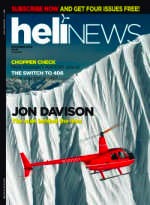
HeliNewsApparently, however, the best helicopter-specific magazine comes from down under. Australia-based HeliNews is a magazine any helicopter owner or pilot can really sink his or her teeth into. It combines photography that’s almost as good as what you’d find in Vertical with articles written by helicopter pilots for helicopter pilots.

I recently received two sample issues of the magazine. The May 2008 issue has articles covering the following topics:

  • Profile of a corporate CEO who does mustering (cattle herding) with an R44
  • A day in the life of a New Zealand contract pilot in Scotland
  • Australian Navy – U.S. Coast Guard pilot exchange program.
  • Australian Federal Police helicopter operations
  • Helicopters in the movies (just part one in this issue; I don’t have part two!)
  • Military helicopter air show team
  • Practicing autorotations to grass
  • How ADS-B works
  • Switching from Robinson R22 to turbine helicopters and back

All this in addition to the usual collection of columns, editorials, and news about the helicopter industry.

My question: Why can’t a North American publication give us more content like this? Rotor & Wing? Vertical? Are you listening?

Me? Writing for HeliNews?

You might be wondering why I have two copies of this magazine. After all, I don’t think it’s widely available — or perhaps available at all — in the United States.

Well, I’ve been asked to submit an article for the magazine and, if I don’t drop the ball by procrastinating and I submit something worthy of publication, I’ll be a HeliNews author. At least once.

There’s nothing more pleasing to me than to have some of my work published in a high quality magazine.

So if you’ll excuse me, I need to get to work.