Light Matters

Two shots prove it.

We spent Monday night camped out along the east shore of the Snake River in Hell’s Gate State Park, just south of Lewiston, ID. The river is held back by a dam downstream to form a long, meandering lake that has plenty of boat traffic, including the “jet boats” that take people upriver through Hell’s Canyon. All that traffic makes for rough water, but I reasoned that early in the morning, around dawn, the water could be pretty calm. With first light on the gold-colored hills across the river from our campsite, I might be able to photograph some interesting reflections without a lot of effort.

While the idea of waking before dawn to take a few photos might seem like a chore to some folks, it isn’t usually a big deal to me. I’m usually awake by 6 AM anyway, and that was certainly the case on Tuesday morning. So I threw on some clothes, grabbed my camera and tripod, and went out along the path behind the camper to see what I could shoot.

What I ended up with was a great example of how the quality and color of light can change a photo.

Before the Sun

This first shot reveals an interesting scene in gray light. Photo details: 1/50 sec, f4.8, ISO 200, 35mm

I set up and framed my shot. The reflections were as good as I’d hoped and the shots achieved the almost mirror-like look of land reflected on water. But the light wasn’t quite right for the first bunch of shots. Even after the sun rose, it failed to cast its rays on the scene before me. For a while, it was the high hills behind me, to the east, that kept the sunlight off my scene. Then it was a cloud. The light was gray and colorless.

After the Sun

This shot was taken a minute later, when the cloud had moved away, revealing the sun. Photo details: 1/80 sec, f4.8, ISO 200, 35mm

Then, suddenly, the cloud slipped away and the low sun shone directly on the scene before me. It lit up with a golden glow and I snapped another photo. This shot was taken exactly one minute after the previous one. Rather than slowly creep down the scene to illuminate it, the sun shined full on the scene, all at once.

It wasn’t until I reviewed these two shots in quick succession in my camera that I noticed the dramatic difference you see here. These images were not manipulated in any way in an image editing program other than to downsize them for the Web. I think they speak for themselves as they are.

I’ve read a lot about photography, especially in the past year or so. One of the things I read recently was a “tip” by a photographer who basically said not to bother shooting in bad light. These two photos do a pretty good job of explaining why light is so important. And while I won’t tell anyone not to shoot in bad light, I hope these photos help them understand how light can make a difference in their photography.

Leaving Wenatchee

Nine weeks was enough.

On Saturday, we left Wenatchee. I’d been in the area — Quincy and Wenatchee, WA — since June 8 and was really ready to go. But there were a few things that needed doing before we could go.

A Day in Seattle

First I had to meet up with my husband. He’ll be joining me for our return drive to the Phoenix area. He flew up from Phoenix to Seattle on Alaska Airlines with some luggage, his bicycle, and Alex the Dog. His flight was scheduled to arrive at 9:30 AM Thursday, so at 6 AM that morning, I was in the truck, driving west to meet him. We had a nice reunion at baggage claim carousel 14, where Jack was very surprised to see me waiting for him when they rolled in his new travel crate.

SR-71

SR-71 on display at the Museum of Flight in Seattle, WA.

Not to waste a day in Seattle, we had breakfast at 13 Coins near the airport and then headed over to Boeing Field for a visit to the Museum of Flight. We spent a few hours there, enjoying the exhibits. It’s a great aviation museum with something of interest to people of all ages.

Afterward, we went to Mike’s cousin’s house in the northern part of Seattle, not far from the University of Washington. Mike’s cousin Rick and his friend Lisa live in a tall, narrow house on a quiet residential street. We went for dinner at a nearby Italian restaurant, where were were joined by my friend, Tom, who I hadn’t seen in about 15 years. Tom, who lives in Vermont, was in the Seattle area on business and we managed to plan our day in Seattle for the same day Tom had some free time. It was great to see him.

Afterwards, we drove back to Wenatchee along scenic Route 2. Unfortunately, we left too late in the day to see anything; it was dark long before we reached the pass. It was also a bit foggy. I’d love to drive this route on a nice day. I flew it in June with my Twitter friend, @Jodene, and it was incredible.

Moving the Helicopter

The idea was to fly the helicopter back that way the next day. I’d booked tickets for Mike and me on Horizon from Seattle to Wenatchee on Friday’s 4 PM flight. The plan was to spend Friday morning moving the trailer from where it was parked in a Wenatchee Heights orchard back down to Wenatchee, where we’d get one of its tires replaced. Then we’d fly the helicopter to Boeing Field, where one of my mechanics is based. Then we’d catch that 4 PM flight back to Wenatchee, finish packing up, and be out of the area by Saturday morning.

The weather didn’t cooperate. It had been almost rain-free all summer, but it poured like hell on Friday in Wenatchee. The storm came from the north and moved slowly to the southeast. We managed to stay on schedule to fetch the trailer and get its tire changed, but when we were ready to take the helicopter to Seattle, a thick blanket of clouds clogged both mountain passes — Snoqualmie (I-90) and Stevens (Route 2). There would be no flight that day.

It was unfortunate because, as Seinfeld’s Kramer might say: in my mind, I was already gone.

The next day, I was awake at 6 AM. It was a beautiful, clear, sunny morning. If we could get our act together quickly, we could fly to Seattle and catch the 9:55 flight back to Wenatchee. Otherwise, we’d have to wait until 4 PM. After checking the weather as well as I could, I decided to go for it.

We were airborne by 7 AM. I climbed out with a direct-to Cle Elum on my GPS, requiring a 500-800 fpm climb rate for the first 5 minutes of the flight to clear the mountains. As we climbed, we could see the tops of clouds out in the mountains in the distance ahead of us. I was hoping that those cloud tops were for a shallow band of clouds and that there would be room beneath them for us to fly over the highway through Snoqualmie Pass.

We descended over Cle Elem and hooked up with I-90. Soon we were flying under the cloud bank with plenty of space between us and both the ground and the clouds. But as the terrain rose toward the pass, the clouds descended. We passed Easton and things began to get uncertain. Just short of the pass, we realized that the clouds came right down to the ground. There was no safe way through.

I turned around and headed back toward the edge of the cloud bank. There were plenty of tempting holes in the clouds where I could have passed through to fly above them. But I don’t like flying atop a bank of clouds. Eventually, you have to come back down, and if there’s no hole on the other end, you’re stuck up there. I did not want to put myself into that situation.

Mt. Rainier

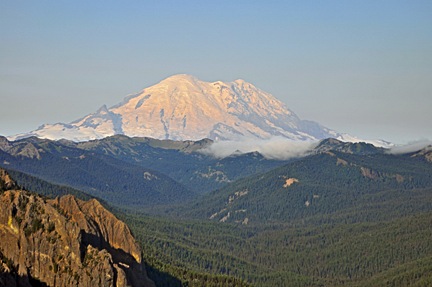
Mike took this shot as we approached Mt. Rainier. You can see a little bit of the cloud cover around its base.

We reached the edge of the cloud bank and turned to the south. We climbed and were soon above the level of the clouds. Mt. Rainier was poking out of the top of the cloud bank, but there was plenty of clear, cloud-free space around its base. We headed that way. Beneath us, several deep valleys were full of cottony clouds, as if stuffed by some well-meaning giant. Ahead of us, Mt. Rainier rose tall and proud and snow-covered out of the rocky terrain. Grassy slopes of its foothhills glowed bright green with thick grass, speckled with tall pines and granite outcroppings. The views were incredible.

Unfortunately, I was too concerned with our flight path to enjoy the view. I needed to get under the clouds in a valley that sloped downward toward Seattle. I needed to do that without actually flying through any clouds. My first instinct was to find a road, since most roads lead to a pass. But some roads climb, descend, and climb again. Any of the climbs could take the road into the clouds. I soon realized that a mountain stream or river would be better.

We found just the one we needed on the northwest side of Rainier. I descended at 2,000 fpm at the edge of the cloud bank, ducking under it with plenty of room to spare over the riverbed. We followed it closely, winding back and forth, keeping an eye out for wires. Finally, the canyon opened up and we could see homes and towns in front of us. A while later, the skyline came into view on a typically gloomy Seattle day. We touched down at Boeing Field at about 8:45 AM. We’d logged 1.6 hours of Hobbs time on a flight that should have taken 45 minutes.

You can see our entire flight path on the chart here:

Our Flight Path

But the bigger miracle was that we caught a cab to SeaTac and were sitting on the Wenatchee-bound plane less than an hour later. By 10:30 AM, we were on the ground in Wenatchee.

By 3 PM, we were packed up and on the road, headed for Walla Walla. But that’s another part of the story.

Food for Thought for American Conservatives

More good content floating around the Web.

This morning, @derekcbart tweeted a link to a site with the below-quoted content. I’m trying to find the source and the closest I seem to get is this post on reddit.

The author of this put a lot of thought into it. Although his grammar leaves a bit to be desired, and his original title is sure to turn off anyone who actually is a conservative (which is why I edited it), he’s 100% correct in his statements. I’m reposting it here as some food for thought. (If you are the author of this post and would like it removed or would like attribution, please contact me.)

I AM AN AMERICAN CONSERVATIVE [REDACTED]

this morning I was awoken by my alarm clock powered by electricity generated by the public power monopoly regulated by the US department of energy. I then took a shower in the clean water provided by the municipal water utility. After that, I turned on the TV to one of the FCC regulated channels to see what the national weather service of the national oceanographic and atmospheric administration determined the weather was going to be like using satellites designed, built, and launched by the national aeronautics and space administration. I watched this while eating my breakfast of US department of agriculture inspected food and taking the drugs which have been determined as safe by the food and drug administration.

At the appropriate time as regulated by the US congress and kept accurate by the national institute of standards and technology and the US naval observatory, I get into my national highway traffic safety administration approved automobile and set out to work on the roads build by the local, state, and federal departments of transportation, possibly stopping to purchase additional fuel of a quality level determined by the environmental protection agency, using legal tender issed by the federal reserve bank. On the way out the door I deposit any mail I have to be sent out via the US postal service and drop the kids off at the public school.

After spending another day not being maimed or killed at work thanks to the workplace regulations imposed by the department of labor and the occupational safety and health administration, enjoying another two meals which again do not kill me because of the USDA, I drive my NHTSA car back home on the DOT roads, to ny house which has not burned down in my absence because of the state and local building codes and fire marshal’s inspection, and which has not been plundered of all it’s valuables thanks to the local police department.

I then log on to the internet which was developed by the defense advanced research projects administration and post on freerepublic.com and fox news forums about how SOCIALISM in medicine is BAD because the government can’t do anything right.

As an American with empathy for those struggling against the odds to survive in financial hard times, I think health care reform will provide relief to many, many people. Please understand that the reform proposed by the Obama administration is nothing like the socialized medicine the NeoCons want you to think it is.

And if anyone knows the real source of this passage, please use the comments to share it. Do not use the comments to share untruths meant to scare the public; they will not appear on this blog.

Lazy Shopping…For a Helicopter?

Some people are willing to pay strangers to help them make a huge purchase decision.

A while back, I read a blog post on Pilot Mike’s Weblog titled “Purchase vs. Rent Robinson R22?.” In it, Mike discussed his thoughts about buying an R22 to do his training in.

While I didn’t buy a helicopter to do my primary training, I did buy one for my commercial training. It would have saved me a lot of money if my flight school didn’t charge $75/hour for the CFI to train me. (Yes, they ripped me off. Yes, I know it now and suspected it then. There were extenuating circumstances. I no longer do business with that organization or recommend them to anyone else. I’m not the only one they’ve burned like this. ‘Nuff said.) As it was, I probably saved $25/hour on dual time and $100 hour on solo time. Of course, I used the money save to actually pay for the helicopter and its related expenses, so you can easily argue that I didn’t save anything at all. Still, I wound up with my own helicopter, which I could use as I liked 24/7/356. That’s got to be worth something.

I made a comment on the blog post back in late May 2009 with some of this information. In it, I mentioned my old R22, which is for sale again. I also subscribed to the comment so I could be notified if there were any follow-up comments. (This is a great thing to do if you’re interested in a topic and want to stay involved.) Yesterday, I got an e-mail message from the blog with the contents of the first follow-up comment:

My brother is buying a R22…
I would like to contact Maria

Since the comment included the e-mail address of the commenter, I replied directly to it. After all, there’s no reason why our personal conversation should appear on Mike’s blog. So I wrote:

I should probably start out by clarifying — I’m not selling my old R22. I don’t own it. The guy who bought it from me is selling it. It’s listed on Trade-a-Plane.

If there’s anything else you have question about, let me know. Just keep in mind that I haven’t owned or flown an R22 since 2004, so I might not be able to answer your questions.

He replied quickly in an e-mail I received on my BlackBerry while out for a bike ride. Apparently, he had more than just a question:

Thank you so much for replying.
I have 0 (zero) knowledge about it, and my brother is going to ask me to buy a new one probably next week. I would like to pay for a trusted help/advise OUTSIDE dealers or any other info from a seller.

There is so much wrong with his statement that I don’t even know where to start.

First of all, he must be a good brother to simply buy a helicopter when his brother asks him to. I know what my helicopters cost and I know what even the least expensive ones are going for on Trade-A-Plane. He’s not going to touch anything worth flying for less than $75K. A “new” one — if he really means new — will cost $200,000 or more.

Second, who the hell spends that kind of money without doing their homework? And no, hiring someone to do the homework for you isn’t the same as doing it yourself.

Third, he doesn’t even know me! I could be some Internet con artist, trying to pass myself off as a helicopter expert to lure people like him to an inventory controlled by me or an associate.

Fourth, what makes him think I want to be part of his purchase decision…and possibly be held liable if he buys a lemon? By taking money to give him advice, I’m setting myself up for liability if things don’t go right. I don’t want any part of that.

So I wrote back from my BlackBerry:

I’m sorry. I can’t help you.

This morning, from my computer, I added:

I also want to add that anyone who has zero knowledge about an aircraft should not be buying it. Do your homework, don’t pay someone you don’t even know to do it for you.

I haven’t heard back from him. And that’s got me wondering….maybe he was trying to scam me? Maybe the next step was to ask me for my bank information so he could wire me payment before I started consulting with him?

Or maybe he’s just an idiot who is too damn lazy to do his own research.

Airplanes and Helicopters Don’t Mix

Accidents happen.

As the New York Times reports in  “Tourist Helicopter and Small Plane Collide Over Hudson River“:

A small private plane carrying three people and a New York tourist helicopter carrying six collided in midair and plunged into the Hudson River off the West Side of Manhattan just after noon on Saturday. At least two people were confirmed dead, the authorities said, and a search was on for the others.

One of the reasons helicopters tend to fly lower than airplanes is to do something that’s drummed into our heads: avoid the flow of fixed wing traffic. This accident is tragic on so many levels, but it would not have occurred if the plane was flying at the altitude it should have been at.

Indeed, this isn’t the first time an airplane and helicopter have collided. On June 18, 1986, a DeHaviland DHC-6 collided with a Bell 206B helicopter over the Grand Canyon, killing 25 people. Both aircraft were conducting tours over the canyon. As a result of this accident, tour routes were established with separate altitudes for airplanes (8,000 feet MSL) and helicopters (7,500 feet MSL) over the Grand Canyon.

There’s some talk that the airplane in the New York City accident today might have been in some distress and perhaps it was losing altitude. Hopefully, investigators will gather information about how it happened. I can understand how the helicopter pilot may not have seen the airplane at his altitude, especially if he had just taken off and was still at low level, just climbing out. A helicopter pilot doesn’t expect to see airplanes at low level. But that’s no excuse to see and avoid other traffic.