To Migrate or Not to Migrate?

That is the question every damn year.

It’s that time of year again: the time when the days start getting crazy short and the nights start getting crazy long. The days when, because of geographic features near my home — namely, the 1000 foot cliff less than a quarter mile south of my property — direct sunlight reaches my home for fewer and fewer hours. The days when the leaves start turning brilliant autumn colors in preparation for the one big freeze that’ll turn them brown before colors actually peak and the one stiff wind that’ll blow them all away.
Gray Day
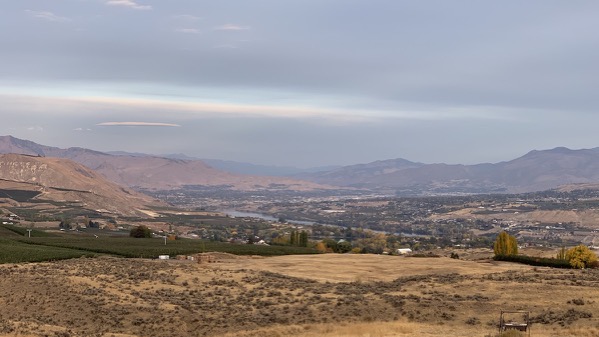
Today is a gray day at the aerie. Although the orchards haven’t started turning autumn colors yet, other trees have. It’s just a matter of time before the trees are bare and gray is the predominant color.

In other words, pre-winter.

Every winter since I moved here “full time” in 2013 I’ve spent at least part of the winter south of here in an RV. In the early years, it was the big fifth wheel I’d owned since 2010; later it was the big truck camper I bought to replace it, and, more recently, it’s been the slightly smaller big truck camper I bought to replace that. I leave my home in the able hands of a house-sitter (or two or three) in November or early December, and drive south until it’s warm enough to sleep in my camper at night without being plugged into a power source. I stay south until just past the point where I’m ready to come home, which is usually in February or March.

But before that, every year I have the same debate with myself: do I stay home this winter or migrate south?

The Argument for Staying Home

The best argument for staying home is that home is comfortable.

Although it gets cold outside — sometimes into the single digits at night — my home’s heat works fine. Because local power is renewable and so damn cheap, I have no qualms about cranking up the heat as high as I like to stay warm. My garage isn’t heated, but my jewelry shop down in the garage is insulated and the portable heater I use down there keeps it warm enough to work in comfort.

At home, I have everything I need to do anything I need to do. Want to cook a meal in a big oven or Insta-Pot? No problem. Need to store something large in the fridge or freezer? I’ve got space. Want to edit a bunch of video and upload it to YouTube? I can use a desktop computer with two monitors and upload via a super fast fiber connection to the Internet. Feeling under the weather? I can lounge in a comfy bed or on a sofa in front of a TV with a book close at hand. Want to explore new jewelry designs or techniques? The shop is already set up with any equipment I might need.

Staying home is easy.

The Difficulty of Travel

Traveling, on the other hand, is not. While moving from place to place in my truck/camper rig is not difficult — heck it’s as easy to drive and park as my truck is — finding a good overnight or multi-day spot can be. My problem is that I’m picky and a bit cheap. I don’t want to pull into a campground, hook up, and pay $40 per night for the privilege of having neighbors 15 feet away out my windows on all sides. I don’t care if that campground has full hookups, a laundry room, a heated pool, and a dog run. Places like that are like suburbia (or worse). I don’t live like that at home and I certainly don’t want to live like that when I travel.

I want to live out in the desert or in the mountains or at a lake or river or in the forest with the same kind of privacy I have at home. I want to let my dogs out by simply opening the door and letting them out — just as I do at home. I don’t want to hear a stranger’s voice or vehicle or generator or barking dog. I want to experience sunrises and sunsets without seeing them through wires or around buildings or over the tops of other RVs. I want to hear the wind and rain and see wildlife.

Last Year

Last year I camped at a site I knew well along the Colorado River south of I-10 in Arizona. It’s BLM land and, technically, you’re only supposed to stay there for 14 days before moving on. I stayed considerably longer. My friend Janet was with me for about half that time; she moved on to Quartzsite as she normally does in January.

I was set up with a little compound that included my camper and the cargo trailer I’d dragged down there. My mobile shop, I told myself. I later realized that it was a sort of anchor, limiting my travel possibilities. Because of it — and because the spot I’d set up in was so damn comfortable — I didn’t travel much at all last year once I’d parked and set up. It wasn’t until I hooked up with my friend Bill that I actually travelled.
Camper Setup
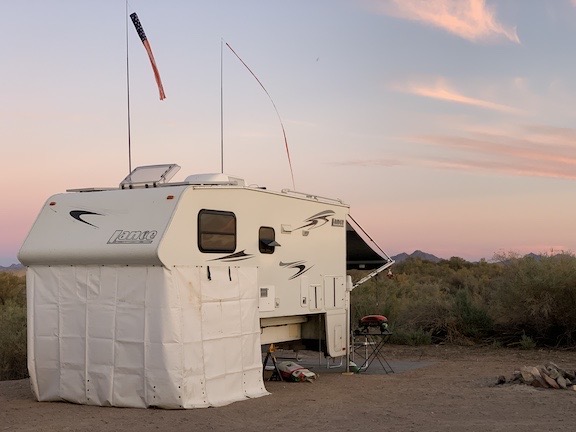
Here’s my truck camper, set up for a long stay at camp last year. You can read more about life at camp last year here.

My biggest fear in that spot was that some yahoo with loud equipment — generators, ATVS, radios, etc. — would pull into the area — it was big enough for multiple rigs, after all — and set up camp nearby, totally spoiling the peace and quiet I was able to enjoy. Yes, the spot did have visitors — there was a boat ramp there that saw some activity from fishermen — but no one (other than friends) spent the night. The fear of being intruded on by someone loud and obnoxious made my stay a little less enjoyable. And the knowledge that I was wasting time on a piece of desert when I could have been exploring new places convinced me not to spend more than a week at that spot again.

The realization that my cargo trailer was limiting my travel capabilities convinced me to leave it home in the future.

The Prospect of Traveling Light

Of course, not having the cargo trailer along would limit my comfort on the road. I couldn’t easily take the things I might “need” with me. After all, my truck’s huge cargo bed was full of my camper. My camper had some storage space, but not for large items. The back seat area of my truck was limited and there were some things I really needed to bring, including my generator and my bicycle (which folds).

It would also limit my ability to participate in art shows while traveling. I was all prepared to do shows last winter — I had all of my show equipment stowed in my cargo trailer — but COVID canceled most shows and the few that remained lacked the precautions that would have made me comfortable participating in them. (So yes, I lugged all that stuff all over the southwest for no reason.) Without the cargo trailer, would I be able to bring the tent, tables, displays, and other items I needed to do shows? I doubted it.

That meant that the trip would be strictly a vacation with no income-earning potential — and that didn’t jive with other plans I had for my life.

But This Is How It Works

I go through versions of this same debate every single year around this time. Lately, in the end, I make the same decision: stay home.

It’s a great idea. I can be comfortable and get work done. I can write, edit videos, and make jewelry — all of which have revenue potential for me. I can spend holidays with friends. I can go cross-country skiing for Christmas on some of the best groomed ski trails in the country. (And I do mean that literally; look up Methow Valley skiing.) I can spend the winter without worrying about where to camp, where to dump RV tanks, where to get water, and whether there’s enough solar power to top off my batteries before nightfall. Sounds great!

And then something happens that gets me packing my RV for the trip south: we change the clocks.

Suddenly, instead of the sun setting here at 5:46 PM, it sets at 4:34 PM. By December 5 of this year, it’ll be setting at 4:10 PM.

As someone whose life is governed by an internal clock powered by sunlight, I’m mentally ready for bed at 6 PM. And I can assure you that waking up at 2 AM after a full 8 hours of sleep is not optimal.

But before that, on around December 1, the Shadow Time will have begun here. And, most likely, the inversions will have started, shrouding the Wenatchee Valley in low clouds or fog that, because of my elevation, I’m often seeing directly out my windows. I remember being here one December or January when for three days in a row, when I looked out any of my windows, all I saw beyond the deck was white. I was living in a fog bank.
Truck at Home
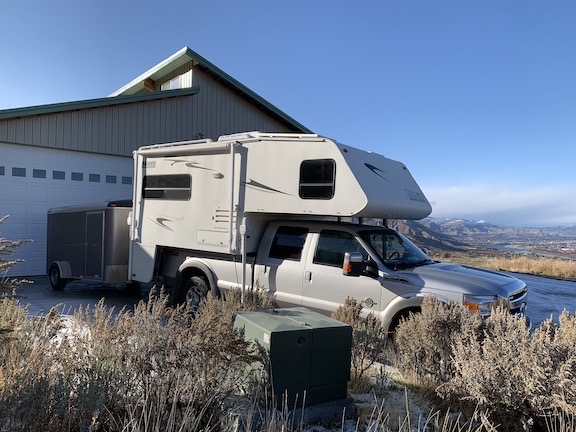
Last year, I left home early, on November 15. With a cold snap and snow already on the ground, I couldn’t wait to get out of here. The trailer stays home this year.

This Year

I that’s where I stand today: I would like to stay home this winter but I know that as soon as we change the clocks, I’ll be eager to get out of here.

I have house-sitters all lined up and I know it would be disappointing to them if I told them I wasn’t leaving. So I’ll keep my current mindset to myself, knowing that it will change on the evening of November 7.

In the meantime, I have two Christmas art shows to attend in Washington State this November: one in Pasco on November 5-7 and one in Spokane on November 19-21. I’ll be taking my truck camper to both of them and I MUST be able to get all of my show gear on board. I’ve also started looking for shows in Oregon, California, and Arizona for December. If I can successfully pack for Pasco, I’ll head south right after Spokane.

Another winter south of the 45th parallel? You can bet money on it.
Please Don’t Expect Me to Teach You for Free

Why do strangers expect me to share my time and knowledge with them for free?

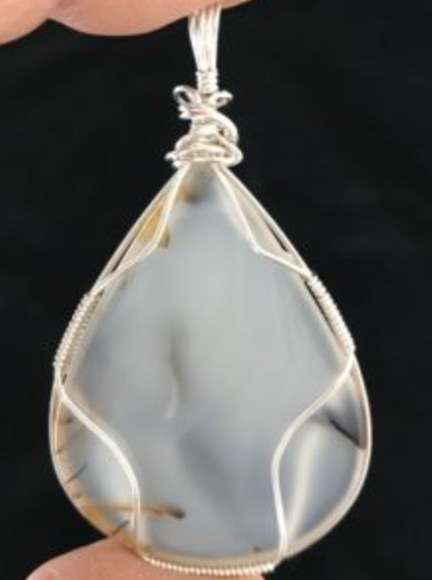
I’ve been making jewelry for a bunch of years now and have expanded my skillset from the wire-framed cabochon pendants I began with to all kinds of silversmithing work. Along the way, I developed my skills by watching videos, attending hands-on classes, and practicing what I’ve learned. I’ve also invested literally thousands of dollars in equipment and materials.

This is not a “side gig,” as someone once suggested. It’s a real business with income and expenses. I was on track to be profitable (after all that training and equipment) in 2020 — until COVID hit. I’ll likely turn a profit this year.

Understand that I am self employed with several sources of income. Jewelry making is one of them. Making YouTube videos is another. Flying helicopters during the summer months is yet another. So when someone expects me to share my hard-earned skills with them without compensation, I bristle.

Getting My Skills

My jewelry making skillset began through watching a few videos about wire-wrapping stones. In hindsight, I realize that those videos did more harm than good. One of them actually recommended using hardware store pliers, which have ridges for gripping that seriously scratch metal. The finished pieces I created looked just as amateurish as the pieces in the videos. I fooled myself into being satisfied with them.

Montana Agate first Piece
The first true wire-framed pendant I made in sterling silver. Many thanks to Dorothy for sharing her knowledge with me.

But I was lucky in that I had a friend who did much nicer work and volunteered to teach me. We sat down together and I made my first piece in real silver using her technique. I remember that day as if it were yesterday. We were in Quartzsite and she was renting a far-less-than-perfect single-wide mobile home in a trailer park while working for a lapidary who was set up at Desert Gardens. We did it at the kitchen table one evening with a lamp brought over to provide the light we needed. She was very patient. That first pendant took two hours to make.

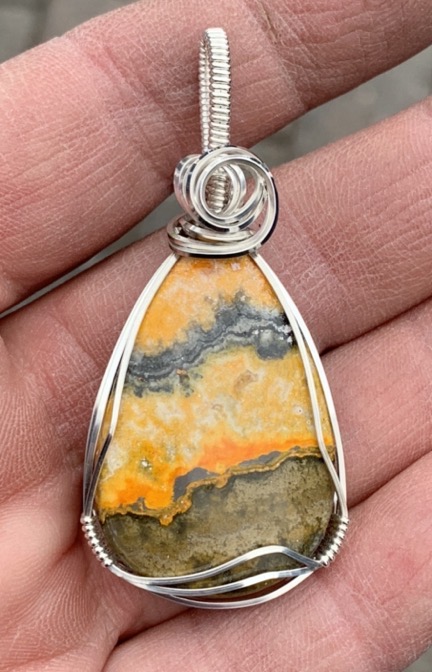
Bumble Bee Jasper
I made this Bumble Bee Jasper pendant this past weekend while sitting in my booth at the art show; it sold the same day. I can now make a pendant like this in about 30 minutes if I’m not interrupted.

I was happy with my first effort, but looking at it now reminds me of how far I’ve come. My style has changed significantly over the years. I now wrap all of my bails for a cleaner (in my opinion) look and work hard to cover the stone as little as possible. I’ve made (and sold) hundreds of these pendants over the past three and a half years and I’ve since moved on to other things.

I should make something very clear here. I never asked Dorothy to teach me how to make pendants. She offered to do it. She wouldn’t take my money, either — even though she’d provided the sterling silver for that first pendant. But I wasn’t satisfied to let it rest. I called up Rio Grande, the jewelry supply company she introduced me to, and asked them to put $50 on her account for her to use the next time she bought something. A sort of gift certificate. Months later, she found that credit and thanked me for it. But the way I see it, I still owe her.

The trouble with wire work is that it’s seen as an inferior form of jewelry making. I’m not sure why. While some wire work — like what I’d started doing on my own — can be pretty crappy, there’s other work that is far more polished and professional. Still, when you apply for a juried art show and the only thing you’ve got to show is wire work, prejudices keep you out, no matter how polished it looks. I needed to take my jewelry making to the next step.

That said, I signed up for a 3-day intensive metalworking class at the Tacoma Metal Arts Center. This was not a cheap undertaking. The class itself cost $375 and I had to get myself over to Tacoma, which is about a 4-hour drive. I also had to get lodging for myself; I lucked out there because they let me park my truck camper in their back parking area every night. I’ve since taken two other classes through TMAC, including a blacksmithing class in Eatonville.

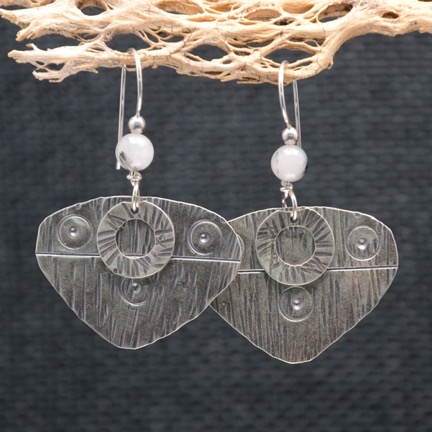
Hammered Earrings
These silver earrings are entirely handmade, right up to the ear wire. (Only the beads are purchased.) I started with silver sheet metal and cut the earring and “washer” shapes. Next came hammering and stamping the texture. Then I applied a patina and used various tools to rub it off the high points. Finally, I created the ear wire with the quartz and silver beads.

I learned a ton there although few of the skills were polished enough to use right afterwards. I had to practice. I started producing different styles of earrings, using the metal forming skills I learned. Soldering, at first, was a stumbling block, but I (mostly) got past it. I began making tab-mounted, then prong mounted, and finally bezel set cabochon pendants.

I also decided to take the deep dive into jewelry making by investing in equipment. A flex shaft. A rolling mill. A table-top metal shear. Hammers and dapping sets. Mandrels. A vice. A grinder. Bench blocks. Finishing tools. Soldering station equipment. The list — and the related costs — go on and on. But if there’s one smart thing my wasband ever said (again and again), it’s “Every job is easy when you have the right tools.” I invested in the tools I needed to explore my design ideas and get the job done.

And I took more classes. In January/February 2020, before COVID hit hard, I signed up for 5 Vivi Magoo classes at the Tucson Gem and Mineral Show. That meant an investment in close to $2,000 on just skills. And $250 for a site in a campground nearby — rather than the $250/night cost of a room at the hotel where the classes were being held. I learned more advanced techniques by actually doing them. The skills I brought home enabled me to come up with new designs and take my work to the next level. I was able to get into most of the juried art shows I applied to — the ones in Palm Springs remain elusive — and to sell my work at shows and in galleries.

Still, I continue to this day to take classes — I just signed up for one in Tucson this coming February — and to hone my skills with new designs.

Sharing My Knowledge

About two years ago, before COVID hit, I did some one-on-one and classroom training. In most cases, it was project based: I’d teach people how to make something I made, including wire-framed pendants, chain bracelets and necklaces, and a variety of metal formed earrings.

Understand that I’ve always been paid to share my knowledge with others. Whether I did one-on-one training at Pybus Market when I sold pendants there or taught small groups at a booth in Quartzsite, AZ in the winter or did classroom training at Gallery One in Ellensburg, I was compensated for my time and the materials I provided to class attendees.

The only exception is when one of my neighbors wanted a copper cuff bracelet like the ones I make out of copper pipe. I invited her over to my shop and the two of us hammered out a pair of bracelets. She is my friend and she takes care of my cats and chickens when I travel. It was a pleasure to be able to teach her how to make her own bracelet and I think she values it more than if I just gave her one. There’s something special about having a hand in making something you wear.

A Stranger Emails

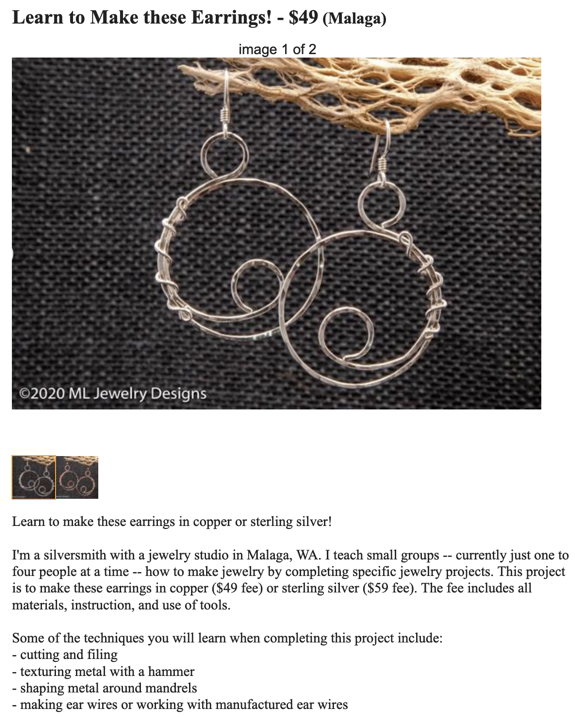
In an effort to generate some off-season revenue before I head south for the winter — as I normally do — I placed a few Craig’s List ads offering my services as a jewelry maker to teach people how to make some of the things I make and sell. The ads go under the heading of “Learn to Make these Earrings!” etc. They basically show a photo or two of the project item and skills they’ll learn while making it. There’s a cost with a discount if more than one person attends. I’d link to them, but chances are they will have expired by the time most people read this. Here’s a screen shot of the start of one:

Learn to Make Earrings
This is the first pair of earrings I designed and made; ironically, they remain one of my most popular styles.

I also have an ad for general jewelry making where I offer to teach anything I know using any of my equipment for $50/hour/person with a 2-hour minimum. This is for someone who has an idea of what they want to learn but doesn’t necessarily want to do one of my projects.

On Thursday, I got an email forwarded by Craigs List, referring to one of my project-based ads:

Hi:

Saw your post on CL, and I watched your YT video, nice shop.

I am semi-retired and live in [redacted] and process roughs from a local source. I would like to learn how to make jewelry, and I also interested in perhaps contracting with you for some consulting.

In my garage/shop, I have a commercial grade vibratory tumbler, and 3 large rotary tumblers, a 6-inch Hi-Tech saw, and flat lap, a Gryphon router, and the necessary tools, and most of the supplies for making jewelry. Oh yeah, and about 400 lbs of roughs, and about 200 lbs of finished stones (I’ve been tumbling since 2016).

I also had a professional website built in January of 2021 but I have not really given it the focus it needs, in part because I want to add jewelry to the product line.
[redacted]

While I am a life-long (closet) artist, my devotion has been to pencil & paper, otherwise I was a [redacted] in [redacted] for [redacted].

I want help organizing my shop, so that I can make jewelry here in [redacted]. I have also been toying with the idea of hiring a part-time employee to make jewelry from my processed stones, and would enjoy a second opinion.

Best regards,

[redacted name and phone number]

(By the way, here’s the shop video he’s referring to. It gives you some idea of my investment in equipment.)

I have redacted some identifying information because it’s not my purpose to identify and/or shame this person. It doesn’t really matter who it is, does it? I’ll just point out here that, like me, his primary career was not in any way related to art or jewelry making. This is something pretty new for him.

I looked at his website. It was very pretty. It had a lot of pictures of tumbled stones and a lot of the usual nonsense about spirituality and vibrations and the meanings of rocks. It did not seem to actually sell anything.

I re-read his message. He is basically a rock tumbler — he polishes rough stones by putting them in a barrel with different grits and letting the barrel run for weeks on end. Anyone can tumble rocks — hell, Amazon sells a kit that’ll get a 10-year-old kid started in no time for just $59. The only thing that impressed me about his equipment was that he was set up to tumble a lot of rocks.

(Maybe I should mention here that you can buy tumbled rocks by the handful or little bagful from a lot of gift shops out west for $5. Here’s 2 pounds of the stuff with a book about rocks for $20.)

I don’t use tumbled rocks in my work. The only stones I use are cabochons, which require different equipment and a lot more time and effort to make. Cabochons have flat backs and domed fronts. They’re often in regular shapes, like ovals and teardrops, but can be more randomly shaped, depending on the skills and artistic ideas of the lapidary who makes them.

I thought for a while about how I would answer this guy’s message. I even toyed with the idea of hooking him up with someone who did the kind of wire wrap work I started with. But in the end I decided to give him what he seemed to be asking for: advice.

I’m sorry it took me so long to respond. I was busy this weekend selling my work at Art in the Park in Leavenworth.

I don’t think I can help you. I don’t use tumbled stones in my work at all. I use cabochons, which are best for the kind of stone setting I do.

As for an opinion: if you hired someone to make jewelry for you, the money you pay that person would have to be added to the cost of the jewelry, along with the materials used to make the jewelry.

You have to consider how much you could sell the jewelry for. Have you visited shops selling the kind of jewelry you want to make? Have you seen the prices on that jewelry? Can you discern whether it’s actually selling at those prices?

As you may have already surmised, having a “professional website” does not mean you’ll be able to sell a lot of product. Everyone has a website these days. You’d do better attending art or craft shows or setting up wholesale or consignment accounts. All that costs money, too. And, after spending a total of 30 hours in Leavenworth this weekend, with six hours of commuting and the cost of the booth fee, my tent, and display equipment to factor in, I can assure you that shows take a lot of time, energy, and money to sell at. Wholesale accounts expect to pay 50% of retail; consignment these days wants 35% to 40% of the selling price. Selling costs are real and need to be figured into any calculation.

Is the selling price minus cost of sales and cost of creation worthwhile for you?

These are the things you need to think objectively about. I hope this has been helpful to you.

Apparently, I misunderstood what he wanted. He didn’t want “a second opinion,” which I read as advice. He replied within 24 hours:

Thank you for your response. The business part I understand, the mechanics of jewelry making is my present interest.

Like yourself, I also do shows. I’ll be at the [redacted] Farmers Market this [redacted]. I do it because it’s a great chance to interact with the community, and I am test-marketing new products, some of which I purchase from Amazon, and resell.

I do have a rock saw, a sander and dop station, and can make cabochons myself.

However to speed things up, I’m in the process of determining whether I want a Cab King or a 6-inch Covington combo unit. I realize the lead times on these are significant but I am not deterred.

So, with that said, would consider teaching me how to make jewelry?

Regards,

[redacted]

Whoa. There was a lot to unpack there.

I bristled big time when I read, “like yourself, I do shows.” (And it wasn’t the grammar that got me.) He has no fucking idea what “doing shows” is all about if he’s limited to a 4-hour local farmer’s market. Has he carted a tent, leg weights, tables, table coverings, displays, etc. all over the southwest, spending hours to set up and tear down booths at venues in three (so far) different states? Has he dealt with trying to sell inside a tent in the cold or heat or rain? Having to go to the bathroom when there’s no one around to watch your merchandise while you wait in line at a port-a-potty? Has he even dealt with the jurying process, paying a fee just to see if his work is good enough to get into a show?

Okay, fine. But then there’s the farmers’ market itself. I’d been talking to a customer about that particular farmers’ market over the weekend. The customer suggested it to me. I tried to kindly explain why I wasn’t interested, focusing on the fact that setting up my booth for a 4-hour event was just not practical. The real reason was the fact that most farmers’ markets are not juried — that means there’s no assurance that I’d be showing my work with other people selling real art. You might think that’s a good thing, but when you’re trying to sell silver and gemstone pendants for $59 each and sterling silver earrings for $39 a pair, it really isn’t good to be among people selling junk jewelry for a lot less money.

And then there was his admission that he buys stuff on Amazon and sells it at the farmers’ market. Holy shit. That is a mortal sin in the world of art shows. I guess it’s okay if you just want to turn a few bucks, but if you want to be and represent yourself as an artist? My opinion of him dropped a few levels when I read that.

And I became very glad I didn’t waste my time at that farmers’ market.

As for buying a Cab King (which I own) or Covington Combo Unit and thinking you can make great cabochons cost effectively right out of the gate, I can tell you from experience that it just isn’t going to happen. When I make my own cabochons — which I occasionally do — I spend roughly an hour or more of time on every single one of them. I have come to realize that my time is worth a lot more than I could get for it by making cabochons, so I’ve decided to simply buy most of the cabochons I use. My collection is quite extensive at this point, with over 800 stones from all over the world, and I have no trouble selling them for considerably more than their cost on the rare instances when someone wants to buy one. My art is in the jewelry I make — not the raw materials I make it with.

Anyway, I was able to answer his request with a much shorter email. After all, it seemed that he wanted me to teach him how to make jewelry. Sure, I could do that:

Yes, I have a Craig’s List ad that offers that service.
https://wenatchee.craigslist.org/art/d/malaga-learn-to-make-fine-jewelry/7383971485.html

I can basically teach how to make almost anything that I make.

Maria

The link would take him to my ad about teaching jewelry making for $50/hour with a 2-hour minimum. If he wanted me to teach him how to make jewelry, he, like almost everyone else I’d taught over the past few years, would have to open his wallet and pay me for my time, knowledge, and equipment.

That was three days ago. I’m still waiting for his response.

Isn’t It Worth Something?

This is the same crap I’ve been dealing with for years in all of my freelance work: writing books and articles, flying helicopters, editing video, making jewelry. I have skills and equipment — sometimes very costly equipment — do you know what costs to buy and maintain a helicopter? — and someone expects me to share these things for free.

These are the tools I use to make a living. Any job I do requires my skills and equipment and the most valuable thing I have to offer: my time. Why the hell should I be expected to give this stuff away? To a stranger, no less?

In hindsight, I’m sorry I spent so much time answering his original email message. I gave him information based on my experience and I used my time to share it with him. What the hell is wrong with me? Why didn’t I realize from the get-go that he was just another person trying to squeeze something of value out of me, likely for free?

Anyway, I don’t expect to hear from him again, unless he’s going to try to trade me training time for some of his rocks.

I bet you can guess how that suggestion would go with me.

Differences in Cruising Styles

There’s more than one way to get around on a boat — and more than one organization to support your travels.

I’m not sure if this blog post should go here or in my Great Loop blog, so I’ll put it here. I think I prefer to keep that blog about specific Great Loop and other boating trips. This blog is a good place for some thoughts about my travels and experiences.

That said, I’d like to discuss the various ways cruising can be done when covering a long distance.

Great Loop Completion Fever

The American Great Loop Cruiser’s Association (AGLCA), which I shared thoughts about here, is a huge supporter of the goal to complete the Great Loop. They have members only and fee-based video webinars — think narrated slide shows you can watch for $25 a pop — and fee-based rendezvous events with seminars to help you learn everything you need to know to complete the Great Loop. They also have forums which, as we all should know by now, is the modern way for organizations to accumulate free content under the guise of sharing knowledge. As I discovered last week, the AGLCA’s forums are heavily moderated and a member’s comment can be deleted or edited at the whim of the moderator, even when no stated rule is broken. (So much for a free exchange of ideas.) When you start planning or doing your Great Loop trip, you can buy a burgee to hang on your boat; when you complete it, you can buy a different colored burgee to hang on your boat. And if you complete it more than once, open you wallet and buy yet another colored burgee to hang on your boat. And yes, you can save a few bucks on all of the burgees and a few other things if you are a member; discounts are a benefit for AGLCA members.

One of the things I learned on my ill-fated journey aboard Nano is that some people do the Great Loop cruise just so they can say they’ve finished the Great Loop, or “crossed their wake.” It’s not all about the journey — all those places they can stop and visit along the way — as much as it’s the destination — crossing their wake to complete the journey.

I learned this early on in a discussion with Dianne, the other crew member. It had to be the first week when she stated, as a matter of fact, “The only reason people do the Great Loop is to be able to say they’ve done the Great Loop.” I told her I doubted that but she did not agree. (Surprise, surprise.) I told her that I saw the Great Loop as a way to explore the eastern waterways without having to backtrack to a starting point. (I suspect she thought I was full of shit.)

Doing a trip like this just to able to tell people I’d completed the Great Loop was silly because where I live, no one knows what the Great Loop is. In fact, when you leave the eastern part of the country and its boating communities, very few people know what the Great Loop is. It’s no fun to brag about something when you have to explain it every time you try. In fact, as if to prove my point, every time we stopped at a marina and there was another boater there that she could talk to, she made a point of telling them we were doing the Great Loop and having to explain to half of them what the Great Loop was.

I was naïve when I started the trip. I thought other people thought the way I did — they were in it for the journey. But I was ignoring facts: primarily, the rough travel plan. Capt Paul had planned the trip with the first half at a very fast pace — 30 or more miles a day — but had assured me that it was a general plan and would change. It didn’t change, however, until Day 10, when I suggested Newark instead of Lyons for an overnight stop. As things turned out, we needed to go as far as Newark that night, but I still wonder whether we would have been stuck at a crappy marina nowhere near the town of Lyons if lock closures hadn’t forced us to keep going.

It wasn’t until we got out into the Great Lakes that I realized the trip was really all about completing the Loop. Capt Paul had already started the Loop from Stuart, FL past New York City to Portland, ME a few years before. So he had the east coast portion done. This trip was all about completing the Loop. When he got to Stuart in November, he would be done.

Because of this, we were prepared to simply motor from one point to the next almost every day, with few shore days. We had no ground transportation — for example, bicycles — and didn’t even have a dinghy set up and ready to use. Few planned stops on the trip had points of interest or even grocery shopping opportunities within walking distance. We passed up many potentially interesting spots along the way. Yes, we did spend multiple days in several cities — Buffalo, Cleveland, and the outskirts of Detroit — and we did visit more boating related museums than I was aware existed. But we did no exploration on the water and very little hiking/biking/touring on land. Other than breakfast, we ate most of our meals in whatever restaurants we could find.

It reminded me of long road trips I’d done in the past, like from New Jersey to Arizona. The goal is to get there so you don’t make many stops along the way. You just motor and stop for fuel, food, and a place to spend the night. But on the boat, there was only one stop per day and that had to cover everything you needed.

I don’t know why I expected otherwise. I did have that plan and I had programmed it into Aqua Map so I knew exactly where we were supposed to stop. I guess when Capt Paul told me that it was just a rough plan and could change, I thought it could really change. I didn’t realize that the changes would only come much later, when we were on the Great Lakes and lake conditions might control when we cruised. In a way, that made it worse. Although it was the part of the journey that we could easily skip stops — the planned stops were sometimes laughably close together, for example just 20 miles between Port Huron and Lexington, MI? — many of those stops had nothing of use or interest to us. Getting stuck somewhere because weather was bad made it necessary to skip stops on subsequent days to “stay on schedule.” The only hard point in the schedule was Chicago, where I was supposed to disembark and another crew member was supposed to board in my place. I’d originally built 8 extra days into my Chicago departure date in case we were delayed; I don’t know if the other crew member had flexible travel plans.

I guess my point is this: I had naïvely and irrationally expected the trip to give me opportunities to explore interesting points of interest along the way and, in most cases, it didn’t. Both Capt Paul and Dianne were doing the trip to say they’d completed the Great Loop. (Dianne still has to find someone to take her from Florida to New York to complete her loop.)

I should add a few things here:

  • The Great Loop, as it’s laid out, is logically completed over the course of a year. You do the southern part in the winter months and the northern part in the summer months. You travel south from Chicago in Autumn and north from Florida in spring.
  • Many people will do the trip at a leisurely pace and park the boat for occasional trips home while enroute.
  • Capt Paul planned to do 4,000 miles of the trip — that’s 2/3 of the total Loop mileage — in four months. That’s 1,000 miles per month in a boat that cruises at 10 to 12 knots.
  • In the book I read about a woman doing the Loop solo, Crossing the Wake, she completed the entire loop in about 6 months. She was definitely one of those folks whose only concern was “doing the Loop.”

My point: although the mostly retired folks who do the Loop take their time about it, not everyone does.

Enjoying the Journey

The other extreme is someone who does the loop at a slow cruising speed with lots of multiple-day stops and dinghy trips to explore smaller adjacent waterways.

I was contacted by such a person recently. We’ll call him “Joe,” because I don’t see any reason to identify him. Joe’s boat is down for maintenance right now on the east coast’s Intracoastal Waterway (ICW) and he’s home, but he’s thinking about his next leg. He told me a little, in an email, about how he cruises:

As far as how I travel, I’ve had 300 or so boat days of which about 100 have been travel days. Before I began I estimated that I would average 10 miles per day and that has pretty well happened, as well as my estimate of 1 travel day in each 3 day period. I have stayed in some spots for 7 days and alternatively have gone 80 miles some other days when there was nothing in between points. I’ve anchored out probably 10 times and would like to do more, especially now that I have solar panels. Some of the Georgia anchorages have been the most tranquil days I have experienced. I like to explore—have done museums, famous BBQ places, historic districts, biking through nature preserves, interpretive kayaking tours, popular Florida beaches by car when removed from the ICW, cities…all depends where we are. And now that the inflatable and outboard are repaired/replaced, I’d like to do some dinghy exploring if the opportunity arises. I like the social aspects of marinas and have traveled alone and with buddy boats. My travel is almost always at trawler speeds even though the boat is capable of more. I have stayed within the ICW when I had a choice, preferring not to have to find an inlet quickly should a situation require it, and also seeing the (more interesting and varied, I think) scenery from up close instead from a few miles offshore.

This is music to my ears (or eyes, technically, since I’m reading it and not hearing it). Here’s a person who is interested in the voyage more than the destination. All the activities Joe mentions are the kinds of things I’ve been dreaming about. I was really hoping to do some anchoring out on our trip and we did none — in fact, we were docked with a power connection every single night. (No roughing it!) I plan on doing a lot of anchoring out in my boat so I’m eager to experience it to see if it’s what I expected.

I’m also interested in the social aspects of marinas, which is one thing we mostly missed. Because most folks do the trip at a more leisurely pace than we did and just about all of them want to be to Chicago by Labor Day weekend because of potential weather issues on Lake Michigan in September, most long distance cruisers, including Loopers, were ahead of us. (We were in Detroit with a full month of cruising ahead of us on Labor Day weekend.) It was only when we reached Harrisville, MI on Lake Huron that we started catching up with them — or a handful of late Loopers caught up with us. Even then, stuck at a marina with them for an extra night due to a small craft advisory on the Lake, we did not socialize other than quick conversations. I was looking forward to more socialization with others, especially since my onboard socializations were so limited. It’s by chatting with other Loopers (without the fear of message editing/deletion by an overzealous moderator) that we learn about other things along the way, whether they’re great, good, disappointing, or to be avoided at all cost.

And finally, his comment about seeing the sights close up really hit home with me. There is nothing more boring than being “out to sea” on one of the Great Lakes for hours on end, miles away from anything that might be interesting onshore. Add rough water tossing you around like a cork in a blender and you’ve got a miserable travel day that really didn’t need to be so bad.

I suspect Joe plans his trips as he does them, making plans a few days ahead of his current location but being willing to change if he needs/wants to. That capability comes with the flexibility inherent in being more interested in the journey than the destination and deadlines. While it’s important to have some sort of plan with some sort of deadline — I don’t think anyone would deny that — I think a flexible plan is preferable to one created months in advance and almost set in stone.

My Preference for Cruising — and Planning

I think that when my time comes to plan my voyage along the Great Loop, I’ll take it more like Joe does. In fact, I have to admit that I’m not all that interested in “doing the Loop” anymore. I want to cruise along the Loop but it really isn’t that important to finish it.

Right now, I’m extremely interested in two parts of the loop:

  • For winter, the Florida Keys and ICW. This is a (mostly) heavily populated area with lots of people and facilities — very different from my usual travel. Maybe I need something different in my life? And I’ve always been interested in the ICW as a sort of slow-speed water highway up the east coast. How cool would it be to explore that and the rivers that feed into it?
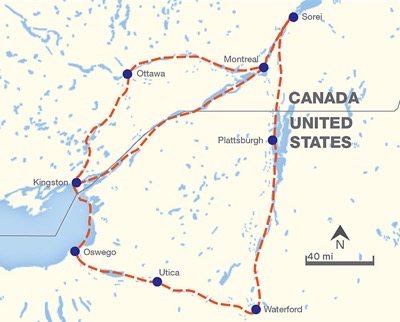
  • Triangle Loop Map
    The Triangle Loop. In reality, there are a lot more options in that part of New York State.

    For summer, the New York State canal system. I had a taste of it on my trip but it wasn’t enough. I could easily spend an entire summer cruising the Erie and Canadian canals and the lakes they go through. Boat US had a great article about the mini loops that are available to explore; some version of the Triangle Loop looks good to me.

Why bother with the Loop at all? Well, as I told Dianne, it’s a way to explore a lot of territory without doubling back to return to a starting point. But what’s more impressive to me is the sheer volume of information available to Loopers about navigation, points of interest, and facilities. This makes it very easy to plan trips.

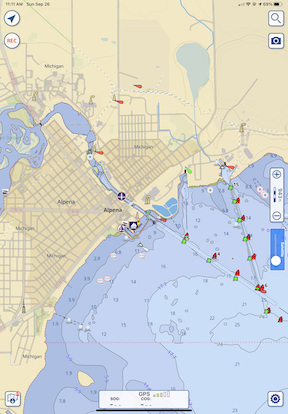
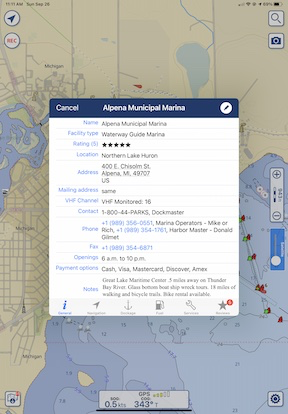
Most of the hard data about the Loop is available on services like Waterway Guide on their website and in their printed publications. (I’m not sold on their app; it needs a lot of improvement before I could recommend it.) The marine navigation app I like is Aqua Map, which offers the option of overlaying Waterway Guide data on the chart. So I can see a charted marina or bridge or lock or hazard and tap an icon to get more information about it right from Waterway Guide. I can’t tell you how useful this was for planning along the way. (It’s how I found Newark NY as a much better overnight alternative to Lyons NY on the one opportunity my input into an overnight destination was actually used.)

Alpena Map Alpena Marina
Here are two images from Aqua Map showing the Aqua Map chart with Waterway Guide icon for a marina (left) and the Waterway Guide info window that appears when you tap the marina icon (right). All the information you need, at your fingertips.

As far as supportive organizations go, there are alternatives to the AGLCA. The Marine Trawlers Owners Association (MTOA) was recommended to me by a AGLCA member who was appalled by my forum messages being tampered with. He told me that MTOA’s forums are not so strictly moderated so you can share opinions and information that a moderator might not like. Capt Paul is a member and hangs their burgee at the front of his boat.

For Ranger Tug owners, there’s TugNuts, a group of Ranger Tug owners. If I do buy a Ranger, I will definitely participate in their forums. As I discuss in the Day 27 post of my Great Loop Blog, their existing forum posts were helpful in troubleshooting a weird electrical issue we had in Detroit.

Those are just two examples. I guess my point is this: you don’t need to join the AGLCA and deal with their heavy-handed forum moderation to learn about the Great Loop and related matters.

Going Forward

While my first Great Loop adventure didn’t go as well as I wanted and ended before it was supposed to, I’m not discouraged. I know now that there are other cruisers who are more interested in the journey than the destination — as I am. Maybe I can even hitch a ride with one of them and learn firsthand about their style of cruising.

September 27, 2021 Update:
I have to add here that I’ve been contacted directly by several AGLCA members who claim that the management of AGLCA has driven friends of theirs from the organization. Clearly, there are problems and clearly AGLCA values the people who pay dues and keep quiet over those who question their operations or decisions. Is that the kind of organization anyone wants to be a member of? I don’t.

I’m also encouraged by the supporting messages and emails I’ve received from AGLCA members who were bothered by the heavy-handed moderation that caused some of my messages to be deleted or edited. (I can’t decide which is worse, honestly.) Thanks, folks! As we all know, it was the AGLCA’s moderator who blew the whole thing up and made it an issue. I now know better than to waste my time and energy participating in a forum where my comments can be discarded at the whim of a moderator.

The Toilet Repair

Why yes, I CAN “overhaul” my toilet tank — and here’s the video to prove it.

My toilet’s has been acting funky for the past 6 months or so. The main symptom was that I had to hold the flusher down for at least 3 seconds for a full flush. I got used to it. But when I returned from my trip, I found that the tank would not refill unless I opened the tank lid and poked at one of the parts so it dropped. That got old fast. I decided I needed to repair it.

I bought a Korky complete toilet repair kit which contained the complete guts of a toilet tank. They recommended that I watch a video on the installation and I did. It was helpful because although it was not narrated, it did cover all of the steps so I knew in advance what I’d be doing.

Do you like livestreams of cool things? Well, I’ve been wanting to do livestreams on my personal YouTube channel while I’m out and about in orchards, at airports, in boats, etc., but YouTube won’t let me stream from a mobile device unless I have at least 1,000 subscribers. I’m currently 45 subscribers short. How about going to my YouTube channel and clicking the Subscribe button? Thanks.

I should mention here — in case you don’t watch the narrated video below — that I knew I’d be doing this sooner or later. In an effort to reduce the accumulation of minerals inside the toilet, I’d been using bleach tablets in the tank. I was warned multiple times that it would eventually corrode the tank’s workings but I used them anyway — and will likely continue to do so. I think that the corrosion I found was a combination of those tablets putting bleach in my tank and the actual minerals in the water, which really screw up certain fixtures, like my shower head and sink sprays. The only way to resolve this issue is to install a water softener and, frankly, I don’t want to do that.

Anyway, I set to work at around 2 PM on Friday afternoon and was done by 3:30 PM. I think I spent more time fetching tools than actually doing work. I set up one of my GoPros to create a “hyperlapse” timelapse movie of the process so I could put it in this blog post. I then edited it in iMovie to make a simple, narrated video. Here it is:

The toilet works fine now and, somehow, it’s quieter — not that that really matters much to me. It’s nice to have done this on my own, considering a plumber would charge $75 just to come to my house.

Some Thoughts on Self-Awareness

I give some thought to the meaning of self-awareness after a discussion with a friend.

If you’ve been following this blog, you know that I ended my big Great Loop boat trip three weeks early because of a personality conflict with the other crew member. You can read about the trip on the blog I created for all of my Great Loop endeavors; this post gives you a list in date order of each daily blog post from the trip. If you don’t feel like reading a ton, read the posts for Day 34 and Day 35, which sum up the situation once it came to a head. (I won’t go into a lot of detail about the actual problem here since that’s not the purpose of this post.)

Sharing the Problem

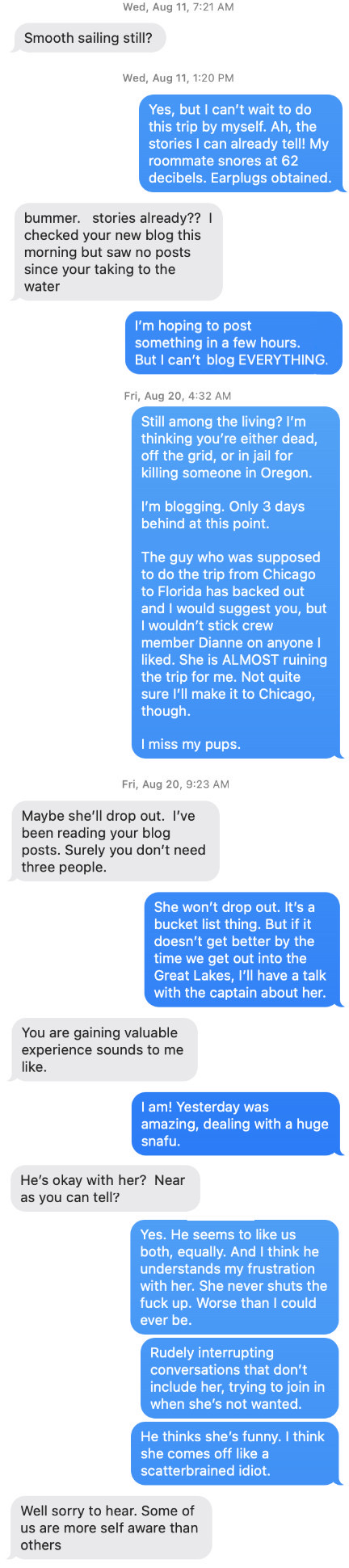
Conversation
A text discussion I had with a good friend back in August, not long after I started my trip. (To my knowledge, he did not kill anyone in Oregon. And yes, I used a decibel meter on my phone to see exactly how loud my roommate’s snoring was.)

In general, I wrote very little in the blog about the problem as it was developing. I didn’t want to sound to readers like a whiner. I wanted the blog to be a useful tool for others contemplating their own trip on the Great Loop. I wanted to provide valuable information about navigation, stops, and facilities along the way. I wanted to share data that might be useful in trip planning — and to remind me what we did right, what we did wrong, and what I might want to do on my own journey.

But I did write quite a bit about the problem in texts to friends as it was happening. And one of those text conversations stuck in my mind because of something my friend said. He used the phrase self-awareness and I realized that I’d never really given that concept much thought. So on Wednesday afternoon, when I realized I wasn’t going to get any more real work done in my garage, I dug through my messages and found the conversation. I’ve shared it here so you can see the discussion in context.

(Do I care if the problem crew member reads this? Not one damn bit. The way I see it, it could help her learn something about herself to make her less of a problem in the future. But I seriously doubt she’s able to take any criticism at all. She’s more likely to throw a tantrum when she reads this than objectively consider anything I’ve written.)

What I find amazing here is how early on the problem with the other crew member manifested itself. I joined the crew on August 10 and by the end of the next day I was already griping a bit about the woman I had to share a very small space with. Nine days later, I had recognized that I had a real problem on my hands and even mentioned the possibility of dropping out. I proceeded to list a few things that were bothering me then — the list got longer as time went on, but I don’t need to discuss that here — and that’s when my friend replied, “Some of us are more self aware than others.”

And that got me thinking about self-awareness.

Self-Awareness, Defined

My first (admittedly paranoid) thought after reading his comment was, is he also talking about me?

I can be quite the gabber. I think that’s because I live alone, work from home, and have few opportunities to converse with others. I also think a lot about all kinds of things. There’s a lot of crap that accumulates in my head and when I get with someone who might be the least bit interested, a lot of it comes out. I had already talked this friend’s ear off about some of the weird stuff that happened during my crazy divorce and although I’d gotten all of that off my chest, I know I still tended to talk a lot when we were together. I was working on it, though, and making some headway.

Yet here I was, ironically complaining about someone who “never shuts the fuck up.” Was he hinting that I lacked self-awareness?

To answer that question, I needed to better understand what self-awareness was. I worked my Google skills and came up with a bunch of results from what I believe are reputable sources.

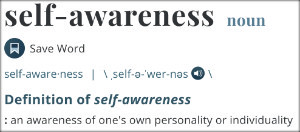
An article on the Positive Psychology website titled “What Is Self-Awareness and Why Is It Important? [+5 Ways to Increase It]” wins the award for the simplest definition:

Self-awareness is the ability to see yourself clearly and objectively through reflection and introspection.

While it may not be possible to attain total objectivity about oneself (that’s a debate that has continued to rage throughout the history of philosophy), there are certainly degrees of self-awareness. It exists on a spectrum.

This is what my friend was saying. “Some of us are more self aware than others.” It’s a spectrum. We should all have some level of self-awareness, but some have a higher level than others. I believe he was suggesting that she (or I?) ranked low on the spectrum.

The article then goes on to discuss self awareness theory:

Self-awareness theory is based on the idea that you are not your thoughts, but the entity observing your thoughts; you are the thinker, separate and apart from your thoughts (Duval & Wicklund, 1972).

We can go about our day without giving our inner self any extra thought, merely thinking and feeling and acting as we will; however, we also can focus our attention on that inner self, an ability that Duval and Wicklund (1972) termed “self-evaluation.”

When we engage in self-evaluation, we can give some thought to whether we are thinking and feeling and acting as we “should” or following our standards and values. This is referred to as comparing against our standards of correctness. We do this daily, using these standards as a way to judge the rightness of our thoughts and behaviors.

Using these standards is a major component of practicing self-control, as we evaluate and determine whether we are making the right choices to achieve our goals.

The article contains a lot more and I highly recommend it if you’re interested in this area of psychology, whether it’s to understand yourself or others better.

In my situation, I don’t think the crew member I had problems with did any sort of self-evaluation. I’m not even sure whether she was aware of her own standards and values. I honestly don’t think she gave much of that any consideration at all. I believe that she used the same methods of communication with us that she used with everyone else and flat-out failed to see how she was often being rude or a nuisance. She came across as selfish and immature. I don’t think either of those traits are compatible with self-awareness.

As for myself, I am aware that I run off at the mouth a lot and that I can annoy some people. I have theories on why I annoy some people and those theories vary with the person. (I think what tends to annoy a lot of women is that I’m not a typical woman, I have very little in common with women (I have no kids or grandkids and did not have a traditional married life), I know a lot things that are beyond their realm of experience, and I share a lot of interests with men. I honestly believe some women feel threatened by that.) I think that bothering to develop theories at all is a part of being self-aware or performing self-evaluation.

But the one thing I try hard to do — really! — is change my behavior when I’m dealing with someone who obviously doesn’t like me. I try to be aware of how my interactions with others are seen by others. Whether I succeed or fail miserably is the big question.

One thing I don’t do: let other people dominate me. (I think that bothers women, too, since so many of them are so accustomed to playing second fiddle to someone else. And yes, I’m putting that kindly.)

Do I actively engage in self-evaluation on a regular basis? I don’t think so. But I think I should.

After all, how can we understand other people if we don’t understand ourselves?

Other Resources

Of course, I found and read more than just one article on the topic. Here are two more that you might find interesting.

An article in the Harvard Business Review titled “What Self-Awareness Really Is (and How to Cultivate It)” approaches the topic, as you might imagine, from the business and productivity point of view. The summary states:

Although most people believe that they are self-aware, true self-awareness is a rare quality. In this piece, the author describes a recent large-scale investigation that shed light on some of the biggest roadblocks, myths, and truths about what self-awareness really is — and what it takes to cultivate it. Specifically, the study found that there are actually two distinct types of self-awareness, that experience and power can hinder self-awareness, and that introspection doesn’t always make you more self-aware. Understanding these key points can help leaders learn to see themselves more clearly.

The article goes into a lot of detail about the study and its results. Along the way, it presents a 2 x 2 grid identifying “Four Self-Awareness Archetypes” and how each affects things like leadership, success, and relationships. I won’t reproduce it here. Go check out the article for yourself.

Another article, on the NBC News site, is titled “What is self-awareness? And how can you cultivate it?.” It talks about recognizing and managing emotions. It quotes psychologist John Duffy:

In effect, self-awareness is the recognition of one’s own emotional state at any given point in time. The argument suggests that we are, far too often, wholly unaware of the emotional state we are currently in, and the degree to which that state influences our behavior and thought process. To the degree that we can manage our emotional states, we are better able to manage these other elements of our lives as well.

This is yet another way to look at this topic. I think it hearkens back to the concept of self-evaluation discussed above. How can you be aware of your emotional state if you’re not constantly evaluating yourself? Maybe we all need to just count to ten and think periodically thoughout the day, especially when we might feel as if our emotions are controlling our words and actions.

Me?

I came to the conclusion that my friend was not commenting on me and maybe not even the bothersome crew member. I believe he was making a general statement that applies to all of us.

But it got me thinking — and realizing how important the trait of self-awareness and the act of self-evaluation are in becoming a well-rounded person.