Yes, Most Helicopter Operations ARE VFR

And I always assumed most helicopter magazine editors-in-chief were helicopter pilots.

Batten down the hatches and prepare for another rant. Not a big one, but one that needs to be shared with my fellow helicopter pilots.

Rotor & WingYesterday, I got around to reading the February 2010 issue of Rotor & Wing. Rotor & Wing used to be the premier helicopter industry magazine. Somewhere along the way, it turned into a monthly collection of press releases, advertisements, and columns about narrow segments of the helicopter population: North Sea, Military, etc. It improved a bit under the editorial guidance of Ernie Stephens, who added a Helicopter Training column and made some design changes. Now there’s some information of interest to mere mortal commercial operators like me who have absolutely no interest in the politics of the North Sea or unmanned reconnoissance aircraft.

When I read a magazine, I always start with the editor’s page up front. This one, by Editor-in-Chief Joy Finnegan, really stuck in my craw. Titled “Stay Proficient,” it wasn’t about practicing emergency procedures, flying with a CFI, or even staying current with night flight. Instead, it zeroed in on an accident that had been caused by a pilot’s attempt to fly VFR at night into IMC conditions. In other words, a stupid pilot trick.

That didn’t bother me. It’s always good to analyze the mistakes of other pilots and use their situations and decisions as learning tools to avoid the same mistakes in the future. I have done so on several occasions in this blog. (For examples, read “Not Ready for Solo?,” “What if You Crashed a Helicopter and Didn’t Tell Anyone?,” and “Chasing Race Cars Isn’t For Every Pilot.”)

What bothered me were the few revealing statements about her own experience that Ms. Finnegan made, starting with:

I was shocked to learn that many helicopter pilots not only rarely fly IFR, they don’t even bother to keep current.

Hello? Ms. Finnegan? I’d venture to guess that half the helicopter pilots out there — many of which are flying tour, charter, air-taxi, survey, and utility work — don’t even have instrument ratings. I can think of at least a dozen helicopter pilots I know personally who don’t — including me.

She goes on to relate how every flight she did as a commercial airplane pilot was flown IFR, regardless of the weather. She then goes on to make what I consider an insulting statement:

VFR was for amateurs, weekend puddle-jumper jockeys who were out for their $100 hamburger flight.

Nice attitude about your fellow pilots, Ms. Finnegan.

But here’s the paragraph that made me wonder why this woman is Editor-in-Chief of what may still be the best known and most widely read helicopter industry magazine:

But I understand that it’s just the opposite for helicopter operators and that the vast majority of flights conducted in helicopters are VFR. I have also heard that some operators even discourage operations under IFR (again I’m talking flight rules not IMC). This is so very contrary to the way the fixed-wing world works that I had to call around and make sure I understood the situation correctly. After many calls and e-mails, I’m still having difficulty with the concept.

Then why the hell are you editing a helicopter magazine?

I don’t know about the rest of the helicopter pilots out there, but when I turn to a magazine about helicopters and helicopter flight, I want the person responsible for the magazine’s content to be a helicopter pilot. I want that person to know at least what I know about flying helicopters, but preferably more.

And taking two paragraphs to share her own stupid airplane pilot trick — perhaps to show off her ability to follow the instructions of ATC or brag about her coolness in a tough situation — really doesn’t make me feel any better about her experience, capabilities, or connection to the helicopter world.

Instead, I’m left angry by being fed advice by someone who obviously doesn’t have a clue about what helicopter operations are all about.


This is the Kind of Stuff I Get in E-Mail

Come on folks! Get a clue!

I found this message in my spam folder this afternoon:

I have xp, I have been using microsft exscel 2007 with no problems until today
the spread sheet prints with wavy lines
cells are wavy, it is not the printer because when I go back and print old spread sheets it is fine
thank you for your help

I have not edited this other than to remove the sender’s name. I had never before been in contact with the sender.

Yes, I know I’ve written books about Excel, including Excel 2007. But does that make me the go-to person for all Excel questions? Like I have nothing better to do than sit at my desk and wait for Excel user questions to come in so I can answer them?

My Contact page clearly indicates that I do not answer questions about my books via e-mail. But this isn’t even a question about my books. This is a technical support question about a printing problem. How am I supposed to know what this person — who is borderline illiterate — did in Excel to get wavy cell lines?

This message is good for one thing, however: it gave me fodder for a rant about the kind of crap I find in my e-mail in box.

Sheesh.

Apple is a Corporation, NOT a Cause

A post by former MacWEEK editor, Rick LePage, really hits the nail on the head.

Yesterday, while having lunch in my hangar at Wickenburg, I checked ÜberTwitter to see what was going on in TwitterLand. Along the way, I followed a link shared by @BWJones to a blog post by Rick LePage.

Rick LePage was the editor-in-chief of MacWeek magazine, a weekly tabloid-sized publication that covered all things Macintosh. Back in the 1990s, not long after I began my writing career, I wrote occasionally for MacWEEK. Not only did the magazine pay well, but it was highly respected. Writing for MacWEEK likely helped my writing career get off the ground — although I never really pursued magazine writing, preferring to author books instead.

So there I was, munching a bacon cheese burger and tater tots while sitting on the back seat of my golf cart at the airport, reading Rick’s blog post on my BlackBerry Storm. One thing I hate about the Storm is its Web browser. I don’t surf on the Storm. I’d lose my mind. But this blog post really sucked me in. It explained what was going on at MacWEEK when Apple was in its “state of confusion” before Steve Jobs came back. It admitted that MacWEEK had gone beyond reporting and had been trying to push its own agenda to sway user opinion on what Apple was doing. (I can’t help but think about FoxNews and its political slant here.) I was so sucked in that I forgot I was reading microscopic print on a cell phone.

And then that cell phone rang. I was called into action doing something else. I put the phone away, cleaned up my lunch mess, and got back to work.

But I didn’t forget the blog post. It had impressed me that much. I figured I was only halfway finished with it and I wanted to read it to the end. I can’t tell you how seldom that happens these days.

So this morning, I looked it up and finished reading it. I discovered that I’d nearly finished. But the best was at the end, in the last paragraph. It started with these sentences that really hit home for me:

I don’t think Apple is a better or worse company than most others. I still love the stuff they turn out, and would much rather be pushing a Mac than a Windows box. But, for all of you who think that the Mac—or Apple, or the iPhone—is a Cause, and that somehow Apple cares about you, wake up.

It was as if Rick had written this based on what was in my mind.

I like most Apple products, and have bought many of them. I prefer a Mac over a Windows PC — to me, there’s no comparison worth making. I own numerous Mac computers, including a desktop Mac and three laptops.

But I’m not a blind follower to everything Apple. I’m not a member of the Apple cult. I make my product decisions based on design and functionality, not logo. I don’t hang on Apple rumors. I don’t push Apple products to my friends and family members. I don’t surf the Web looking for all things Apple. And I certainly don’t get into bullshit platform wars in forums and blog comments. Hell, I have a life beyond the computer I chose to get work done.

I don’t like all Apple products — I still can’t see the real point of an AppleTV and prefer my BlackBerry over an iPhone. (I don’t want to surf the Web and run countless pointless applications on my phone.) My days of buying in and adopting early ended not long after I bought a Newton.

I realized years ago — probably around the time iTunes made its debut — that Apple is not putting the customer first. As Rick points out in his piece, Apple is a company with the need to make a profit and stockholders (like me, I might add) who want to see it succeed. Apple has a huge cult-like following — there must be something hypnotic about Steve Jobs at a keynote intoning, “Isn’t this incredible?” — and it’s cashing in on it. More power to ’em!

The sentences I quoted above should be a reality check for everyone. Apple is not a cause. It’s a corporation. Its goal isn’t to make you feel good or solve all your problems. Its goal is to get you to buy its products so it can make a big, fat profit.

Wake up, folks. Look beyond the logo and pretty white packaging and think about what you’re buying. If you still want to evangelize the “Apple cause” — well, it’s your life.

And now lets see how many people completely misunderstand the point of this post and come to Apple’s rescue in Comments.

Why I’m Watermarking All of My “Good” Photos

And why other serious photographers should, too.

Bowman Lake
This photo of Bowman Lake at Glacier National Park appears in my photo gallery, Flying M Photos.

The watermark / copyright notice argument goes back and forth all the time.

On one side are the bloggers and readers of Web content who have created and seen more crap online than the rest of the human race combined. These people claim that copyright notices on photos are tacky and make the photos look ugly. They go on to say — and there is definitely some truth to this — that the average photo on the Web is so poor in quality that the photographer has no need to worry about it being stolen.

On the other side are the serious — or possibly professional — photographers who want to show off their work online but protect it from theft. These people are tired of seeing the results of their hard work and investment in costly equipment appearing on someone else’s Flickr account or in blog posts. Or, as in my case, in an e-mail postcard sent to me.

Why People Steal Photographs and other Web Content

Joshua Tree Bouquet
I clearly recall lying on my stomach on cold rock to get the right angle for this shot. Photographed at Joshua Tree National Park.

There are two reasons why people steal photographs and other content they find on the Web:

  • They mistakenly believe that anything that appears on the Web is in the public domain. This is not true. Most Web content is protected by the same copyright law as the most recent Dan Brown masterpiece of fiction (yes, I’m being sarcastic) or Black Eyed Peas single (do they still call them that?) or Pixar animated feature film. When these people honestly don’t know any better, they’re making an honest mistake. But when they’re told they’re infringing someone’s copyright and they refuse to believe it, they’re being downright stupid and putting themselves in the next group of people.
  • They simply don’t care about the rights of content creators. These people know that what they’re doing is wrong but they simply don’t care. Perhaps they think they’ll get away with it. Or that since everyone does it, the content creator won’t bother trying to stop them. They’re wrong. Many bloggers, photographers, and other content creators actively pursue copyright infringers — and win in court.

I follow many photographers on Twitter and have seen more than one of them complain about their work being used elsewhere without their permission. In many cases, a bunch of us will “gang up” on a copyright infringer to attack him/her for his actions in blog or photo comments. This usually gets some kind of result. A properly prepared DMCA Takedown Notice usually does a better job.

Just Say No to Flickr

In one blatant case I recall on Flickr, a woman was stealing photos from photographers all over the Web and passing them off as her own. If she really had such a huge, diverse library of quality photos, she’d be famous. But all she had was a big, diverse collection of quality photos she’d stolen from other photographers, removing any copyright notices she found along the way. It was quite easy to convince the powers that be at Flickr that she was a thief. Flickr closed down her account. Has she learned her lesson? Who knows?

The worst thing about Flickr is that if someone steals a photo and puts it on his/her Flickr account under a Creative Comments Attribution License, anyone else is free to use the image if they give the Flickr user credit. That means that not only is he/she making a photographer’s work “legal” to reproduce, but he/she will get credit instead of the photographer!

As you can imagine, I don’t use Flickr. It simply makes content theft too easy.

Why I’m Watermarking

I’ll be the first to agree that watermarking photos — putting a visible copyright notice on the face of a photo — can be downright ugly. Depending on how it’s done, it can really detract from the aesthetics of the photograph as a whole. That’s why I’ve avoided them for so long.

But the other day, I got an e-mail from one of Flying M Air‘s aerial photography clients. He’d given me permission to include some of his images on Flying M Air’s Client Photos page (since removed). Flying M Air has an unusual photo format. Each photo is brought into Photoshop, given a yellow background, white border, and drop shadow. It’s then tilted 2° or 3° to give it the feel of a photo album. I purposely use small images, not only to offer more room for text but to make the photos less useful to a thief. Unfortunately, one of his photos had been stolen and it appeared in a Flickr photo stream. The photographer was certain it had come from my site. He said that he’d given me permission to reproduce them, but only if I watermarked them. (I honestly don’t remember the watermark requirement.) To avoid problems in the future, I simply removed his photos from my site. If he experiences any more theft, it won’t come from me.

But the whole thing got me thinking. Here was a professional photographer whose work was being lifted from a third party site and being displayed on yet another site. He’d relied on me to watermark his work. Wouldn’t it have been better if he simply watermarked it himself?

And wouldn’t it be better if I simply watermarked my best work myself?

You might be asking why: what’s the purpose?

The purpose is education. While a watermark probably won’t deter a content thief who simply doesn’t care that he’s stealing from me, it might educate the person who thinks all content on the Web is free to take and use as desired. Or it might protect my work from the person who thinks that only those photos with a copyright notice are protected.

My client issued a takedown notice to the person who stole his photo from my site. The photo was immediately removed. I like to think that the person who stole it simply didn’t know any better. Now he does.

Zenfolio

I should mention here that in addition to my photoblog, I also maintain a library of images at a custom Zenfolio site. Zenfolio is a photo sharing site that offers a number of features a service like Flickr doesn’t offer. For example:

  • I can have my own domain name (www.FlyingMPhotos.com).
  • I can sell photos using format I specify — and actually profit from a sale.
  • I can create custom watermarks that are automatically placed on each image for display.
  • I can limit the sizes of photos that can be displayed.
  • I can customize the appearance of my photo gallery pages.

Wildflowers
I photographed these wildflowers near a mine site last February.

The list goes on and on.

Yes, I do pay an annual fee for this service. But I think it’s worth $100 a year to have control over how my photos are displayed and offered for sale. And I like the fact that my Zenfolio portfolio is completely separate from all others. On services like Flickr and Red Bubble (which I used to use), your photos are simply part of a much larger portfolio of diverse and often quality-challenged work. People who visit my portfolio aren’t exposed to that — unless they want to be.

I like the way Zenfolio places watermarks on images. They’re visible yet don’t need to jump out of the photo at you. I chose the same method for my photo blog; you can see it on all the images on this post. I used Photoshop to create the notice, applied an Emboss filter, saved it as a PNG with transparent background, and then applied it to photos with 20% to 50% opacity. Done.

What Do You Think?

I’d be very interested in hearing what other serious and professional photographers think about watermarking images. I’d also like to see examples of what photographers think are successfully applied watermarks. Use the comments link or form for this post to share your thoughts, horror stories, and links to one or two of your watermarked images.

I’m not interested in hearing from Internet trolls who want to criticize concerned photographers for wanting to protect their work. Or people who want to argue that Internet content is not copyrighted — get with the program already, folks.

Annual Inspection Blues

It might not just be cosmetic.

My helicopter’s annual inspection was started yesterday. My old Robinson mechanic from Prescott came down with a knowledgeable assistant to do the job in my Wickenburg hangar.

Just for fun, I set up my old Canon G5 camera on a tripod with my Pclix timer and created a time-lapse movie of the job. The shots were taken 30 seconds apart and then compiled into a movie at 6 frames per second. Here’s the resulting movie:

Kind of fun, huh?

For those who aren’t familiar with the inspection requirements for aircraft in the U.S., here’s a quick summary:

  • Every year, the aircraft is required to have an annual inspection. This inspection requires an A&P mechanic to remove various panels and inspect parts normally hidden from view. It also includes an oil change, various filter changes, and a bunch of other stuff. It’s a calendar-based inspection.
  • Commercially operated aircraft are also required to have 100-hour inspections. These are virtually the same as annual inspections — in fact, its common for aircraft owners to substitute an annual inspection for a 100-hour inspection if it doesn’t appear that they will fly another 100 hours before the annual inspection is due. My helicopters have always been operated commercially, so I’ve always gotten these inspections.
  • Other time-based inspections or maintenance. These are things like oil changes (every 25 or 50 hours), magneto inspections/rebuilds (every 300 hours), gearbox oil changes, belt changes, avionics tests, etc.

The cost of an inspection or maintenance item varies depending on the age and condition of the aircraft, the type of inspection, and the mechanic’s knowledge and ability to get the job done quickly but thoroughly. The cost of an inspection can also rise considerably if the mechanic actually finds something that needs attention.

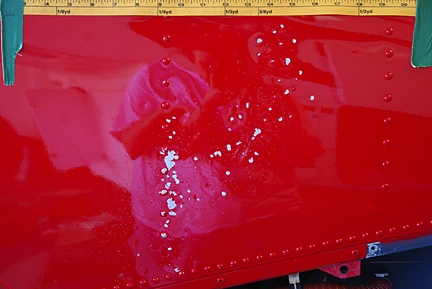
Dented TankIf you read about my trip to the Parker 425 this year, you may recall a certain incident involving an unbuckled seatbelt. I thought the problem was simply cosmetic — a job for a paint shop. But my mechanic believes it might be beyond just cosmetic. He thinks a few of the tiny dents may have compromised the integrity of the fuel tank behind those dents.

Keep in mind that I’ve flown the helicopter at least 6 hours since the event. No fuel leaks, no indication of a problem. The fuel tanks are nearly full right now — and have been full three times since then. No leaks.

But that doesn’t mean the dinged tank might not develop a crack or a leak. At least that’s what I’ve been told.

A new one from the factory will cost $3,700. Plus paint. Plus installation.

Take my advice: be a pilot but not an owner.