Home ownership — gained and lost.
Back in January 1986, I purchased my first home with the man I’d later marry. We scraped together the 20% downpayment we needed on the $164,000 house on a small lot in a northern New Jersey “bedroom community.” I contributed the remaining $10K or so of an inheritance from my grandparents; that required the approval of my father, since I hadn’t yet reached the age of 25 when I would be able to make my own decisions about the money. The man I loved and wanted to make my home with contributed the rest — more than half, as I’m sure he’ll point out to a judge later this month. As if a 27-year-old inequity gives him some sort of additional rights in the war he’s current waging against me.
But I’m getting ahead of myself here.
The “Bomb Shelter”
Back then, the only way we could afford the house was with a 30-year amortization. Even then, the mortgage payments, which included high property taxes and insurance, were upward of $1500/month. We split the cost 50-50. It was difficult for me at first, but as my first career progressed and I moved up the ladder of success, it became easier. Then difficult again as I launched my second career. And finally easier once again.
The house was built in 1926 and was only about 1,200 square feet. It was made of poured concrete — walls, floors, ceilings, basement, attic — and had small rooms and lots of windows. Our neighbors joked that they’d come stay with us in the event of a nuclear war. The lot was only 73 wide by 135 deep and Conrail trains ran a stone’s throw from the back door at any time of the day or night. There were lots of trees and the kind of canopied street you don’t see very often. Autumn was beautiful but the fallen leaves were a serious chore. Summers were nice but winters were cold and gray.
In 1994, there was a terrible snowstorm that dumped 20 inches of snow on us. I remember not being able to get the front door open. I also remember the snow staying around, gray and dirty, for months.
We’d been out west several times by then and I decided that I didn’t want to spend another winter in New Jersey. So in November 1994, I went out west to find a place to spend the winter. I drove all over, from Vegas to Tucson, and wound up with a basement apartment in Yarnell, AZ. I drove out in my little Toyota MR-2, weighed down with a roof rack full of suitcases, right after Christmas 1994.
I stayed for three months: January, February, and March 1995. My brother visited. My future husband visited. I worked on books. I went to the Grand Canyon and Los Angeles. My future husband drove back with me in March via Big Bend National Park, where we soaked in the hot tubs along the Rio Grande, watching wild horses across the river in Mexico. We stopped in Florida where I spoke at a writer’s convention. I drove home along the Blue Ridge Parkway and Skyline Drive.
The Move
I stayed home for the winter of 1996. We had more severe winter weather. I decided that between the weather and the high cost of living in the area, I was ready to move. My future husband seemed to agree. We put the house on the market. When it didn’t sell by Christmas, I packed up half the furniture and moved into an apartment in Wickenburg, AZ. I remember wearing a T-shirt as I walked across the parking lot of a Home Depot on New Year’s Day. Back home in New Jersey, it was freezing.
Removing half the furniture made the house look bigger and more appealing. It sold.
But about that 30-year amortization? Despite paying an average of $1400/month for 11 years, we’d only paid off $11,000 of the loan balance. Did that ever teach me a lesson!
By May, we packed up the rest of the furniture and headed west. We rented a second apartment in the same complex to use as offices; I got one bedroom, my future husband got the other. We stored our boxes in the living room. We commuted by walking down the sidewalk between the two apartments.
And we started looking for our next home.
The Ranchette
Although we were living in Wickenburg, we didn’t necessarily want to buy a home there. We needed someplace close enough to Phoenix’s big airport. My future husband would be flying back east once a month for work. He’d telecommute from home the other three weeks each month. I just needed a place that had Internet and overnight courier service.
We found a house in New River that we really liked, although I admit it wasn’t perfect. Then we found out that Del Webb would soon be building a huge community near there: Anthem. We had no interest in living anywhere near a place like that so we began concentrating on Wickenburg.
It was a long, hot summer. I think we saw every single house that was for sale. Our Realtor was giving up on us.
Finally, we found two homes we liked. My future husband liked one on the east side of town; I liked one on the west side of town. We were tired of looking. The houses were both listing for about the same amount. It was time to make an offer. He was in New Jersey for work when he told me to pick one and make the offer.
I picked the one he liked and made the offer. The owned rejected it and didn’t counter. So we made the same offer on the one I liked. And the owner countered close enough for us to accept.
It was brand new construction, a “spec house” that wasn’t quite finished but occupied by the builder and his family. 2400 square feet, three bedrooms, 2 baths, a huge kitchen with Jenn-Air appliances throughout. All sitting on 2-1/2 acres of horse property with great views out the front and back and huge windows to see them. Best of all: quiet and private.

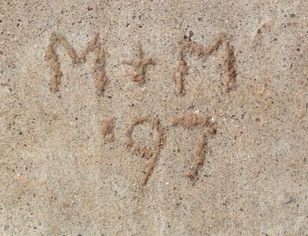
Does he remember carving our initials into the wet concrete that October day? And will he sandblast them away when I’m gone?
We paid extra to have the driveway paved. The cement was still wet when we carved our initials and the year into it: M + M ’97.
We moved out of our apartments and into our new home, each of us taking one of the downstairs bedrooms for an office.
That was in October 1997.
Our Home
Over the next 15 years, we worked together and separately to make this house our home. We bought furniture and linens. I made curtains to match the kitchen chair upholstery and the guest room linens. I worked with a friend to add color to the plain white walls. We arranged souvenirs of our lives together — handmade objects from vacations in Mexico and elsewhere, photos, rocks and pine cones and sticks — in various places throughout the house.
After a delay due to paperwork not being quite right, we began work in the empty yard. We laid in a flagstone walk and irrigation system. We planted pieces of cactus and young agave that have since grown to be as tall as us. We nursed seedlings that had taken root naturally, protecting them and watering them so they’d grow to mature trees. We planted fast-growing eucalyptus trees for shade. He put out his Pawley’s Island Hammock. I put out birdseed blocks and hummingbird feeders. And I put in garden beds out back, working with a level and bricks to get them just right on the slope, filling the beds with topsoil and manure. I remember growing so much zucchini one year that I never wanted to eat zucchini again.
Howard Mesa
We bought 40 acres of “ranch land” at Howard Mesa back around 2000. For years, we went there on weekends, mostly in the summer, staying in a pop-up camper that I’d bought. It was rough living and it was fun. I got pretty good with a dutch oven, cooking great meals at our huge fire pit. We’d bring the horses and go riding during the day. Later, we stayed in a horse trailer with living quarters that I’d bought, and still later, we fixed up a wooden shed as a sort of primitive camping cabin. Once that was done, we had a year-round place to stay and often went up on holidays — I remember spending at least one Thanksgiving and one Christmas there. I wanted to put a real house up there, but he claimed it was too remote. Eventually, we both lost interest in the place; he’s since told people that it’s my “white elephant.” I guess it’s easy for him to forget the good times we had there. Sadly, I’ll never forget.
For the first ten years I lived in the house year-round. My future husband got an apartment in New Jersey where he’d spend at least one week a month. It was a little lonely at home by myself, but I got used to it. I had plenty of writing work to do, a dog, and horses to care for. I still had friends in town — they hadn’t all moved away yet — and the time went by quickly.
When he was home, we spent all our time together, often going for a horseback ride in the afternoon (when it was cool) or in the morning (when it was hot). He used to joke that all his friends back east told him that we lived on vacation.
It was a great life.
Somewhere along the line, I decided to move our offices out of the house and into a condo I owned downtown. I’d had a series of bad tenants and was tired of dealing with them. I liked the idea of an office in a separate place. So we moved our offices there. I got new office furniture and took the living room for my office. He took the master bedroom for his.
He eventually gave up his apartment in New Jersey, although he continued to go back periodically to spend time with his family and he still worked for that company part time. He tried to start a consulting business but didn’t get anywhere with it. I gave him a job at the airport but he quit after a short time. After a while he went out and got a regular job for a company south of Phoenix — 70 miles away.
By then, I was building my flying business. I spent every other week in 2004 at the Grand Canyon, flying for a tour operator. I’d had a great career as a writer and had invested wisely in real estate. I sold off one of my properties and bought a larger helicopter. It was time to get serious in my third career.
We got married and I think that’s when things started unraveling.
The Condo
It was a long drive for him to go from Wickenburg to Tempe every day. When the real estate market tanked, he bought a condo down in Phoenix.
Although he involved me in the purchase decision, he didn’t buy the unit I liked — a bright and airy second-floor condo with a big patio overlooking a park and tree-lined streets. Instead, he bought a cave-like apartment on a busy street nearby. I wasn’t happy about it, but it was his investment — he’d never said anything about mine.
I started moving things in, preparing to make it our second home. But my husband decided to get a roommate to help cover the cost of living there — indeed, it was more costly per month than our house. They moved my office furniture out of the second bedroom and a friend of ours who lived in Williams AZ and worked in northern Phoenix moved in.
It wasn’t long before I felt unwelcome.
My Home is in Wickenburg
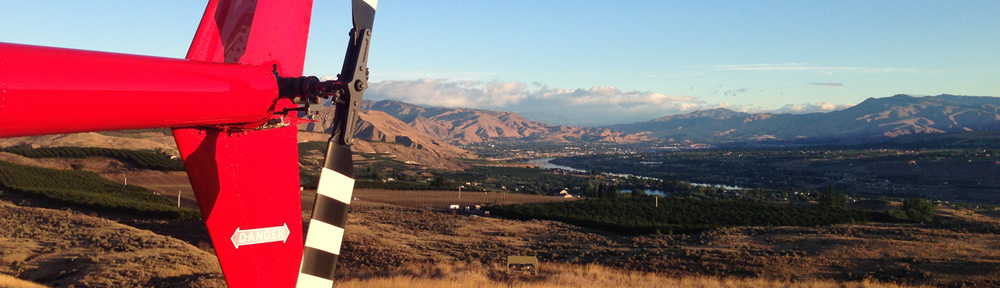
That’s right around the time I started doing agricultural work in Washington for the summer — the work that would finally make my flying company profitable. I was away for June and July in 2008 and managed to extend my season each year after that.
But when I was home the rest of the year, I lived in Wickenburg. That’s where my things were. That’s where I felt comfortable. That’s where I spent most of my time. Even though my husband spent four days a week in Phoenix, I usually spent all seven in Wickenburg.
That all changed in 2011. When I got home from my seasonal work, my husband’s roommate was gone. I moved my office back into the second bedroom of the condo. We got new living room and bedroom furniture there. We bought new blinds for all the sliding glass doors. I added a wine rack. I put up framed photos. I began making the condo into the second home I thought it was going to be.
But it wasn’t the same. It wasn’t home. It was dark and noisy and depressing and there was no privacy. Although I enjoyed taking our dog Charlie out to the stores or the farmer’s market or the dog park as part of my day, I didn’t like the traffic and crowds.
To make matters worse, I could never adjust to the schedule my husband wanted to keep: four days in Phoenix and three in Wickenburg. I felt that every time I got settled into one place, it was time to go back to the other. I was tired of carrying the same things back and forth every week, of keeping two refrigerators and pantries and trying to remember what was in each.
And I only had one office; when I had to work, I had to work in Phoenix. He often went back to Wickenburg without me. That made no sense — I was stuck in a “home” I didn’t even like just so I could be with him and he wasn’t even around all the time.
And although my husband had told me he wanted me there with him, once I was there, he didn’t seem very happy. As I’ve mentioned elsewhere, I thought it had something to do with his latest job, which he’d grown to hate by then. But I was apparently wrong.
Becoming Real Home Owners
Back around the time we got married in 2006, my husband told me that when he turned 50 (which would be in 2011), he’d join me on the road when I traveled with the helicopter. He even got his helicopter rating so that he wouldn’t be stuck driving the RV all the time.
I figured that he’d go into a sort of semi-retirement and finally pursue some of the things he claimed he wanted to do: become a flight instructor, open a bicycle shop, do solar consulting. I even found detailed notes in his desk from when he’d brainstormed for ideas on what he could do to make money when we traveled. I had ideas, too — ideas of things we could do together that would be fun.
I realized that there was a possibility that we’d have to rely on just one income — mine — when that time came. And with my writing income fading quickly as traditional print publishing entered its death spiral, we’d be relying mostly on my flying income, which could be iffy, at best. I realized that the best way to face a situation with reduced income was to reduce our living expenses. And one of the best ways to do that was to pay off the house so we’d no longer have to worry about mortgage payments.
I remember discussing this with him many times. I used to say that there are only three things a person absolutely needs: a roof over his head, food, and medical care. Paying off the mortgage would guarantee that we always had a nice place to live. We’d certainly have enough money for food and medical insurance. And when we got old enough, Social Security and Medicare would kick in. Combined with our retirement savings, we’d be fine — as long as we owned the house.
So I did what I could to accelerate the mortgage payoff. We had a joint checking account and every time there was a decent surplus, I’d put it toward the mortgage. We’d already refinanced and had a good rate. Through this extra effort, we were able to pay off the mortgage more than two years early: by February 2012.
I was proud of myself. At the age of 50, I co-owned a home outright.
I finally had the financial security I’d always dreamed of. When my helicopter would be paid off the following January, I’d be completely debt-free.
Locked Out
I left for my fifth summer season in Washington at the last day of April 2012. I was hoping to get some early cherry drying work in Mattawa, but that never materialized. Instead, I picked up an excellent charter client who soon had me flying for him twice a week. May was more profitable than ever.
I started talking to my husband about spending the summer in Washington with me. He’d just gotten a new job that would allow him to work from home again. I saw it as the job that would make everything right with us.
I was wrong.
He asked for a divorce on my birthday at the end of June. He came to see me in Washington three weeks later. I showed him a wonderful piece of property I hoped we could buy and make a summer home on. By then, I was earning 90% of my income during the summer in that area so living there half the year made real sense. It was beautiful and cool with plenty of recreational opportunities. I was hoping he’d finally sell the condo, which he no longer needed, so he could get out from under its financial burden. We’d sell our property in northern Arizona, too. But he clearly wasn’t interested in the property or any plans I might have.
Meanwhile, I continued paying my half of the house expenses by contributing to our joint checking account. I paid the bills as I always had from that account.
I found out about the other woman in August.
By that time, he’d stopped returning my calls or emails or texts. I had no idea what was going on at home — my only home. I was stuck in Washington until nearly the end of August, a frantic bundle of nerves the entire time.
On Saturday, September 15, knowing that he’d be out of state for his mother’s birthday party in New York, I flew home with my dog. My friend Janet met me at the airport — I suspected I’d need her moral support and I wasn’t wrong. We rented a car and drove home.
The locks on my house had been changed.
I went to my hangar, where my car had been stored for the summer. There was a garage door opener in it. But my hangar lock had been changed, too.
I was locked out of my home and hangar — locked away from almost everything I owned.
I broke into the house — my house — the house I had every right to be in.
The next day, I had a locksmith change the locks on the house so I could secure it but still gain access. He cut the padlock off my hangar and I put a new one on. Since it wasn’t ethical for me to lock my husband away from his airplane, I had it moved out onto the ramp and tied down. That’s how he found out I was back. Someone called him to ask him why his airplane was out.
He came on Wednesday with a police escort. He wouldn’t make eye contact as he quickly walked through the house. I tried to talk to him, but he mostly ignored me. At one point, I blurted out: “You locked me out of the house!”
He replied coldly: “You weren’t supposed to be back until October.”
“And what would you have done then?” I asked. “Would you have been waiting with a welcoming committee to keep me out?”
He didn’t reply.
He had the nerve to show up at Wickenburg Airport with his girlfriend one Sunday morning. I felt that he was flaunting her in front of our mutual friends, showing them that his wife didn’t matter anymore — this new woman did. I was enraged. I dragged every single item of his out of the hangar and left it on the pavement in front of it. I put a note on his car, telling him that he and his new helper could take it away.
Even though he was living with his girlfriend in her Scottsdale house and he still had the condo in Phoenix (which also had its locks changed), at the temporary orders hearing a few days later, he fought me for exclusive use of the house and the hangar I had been leasing for my business for eleven years. He lied in court, saying that he could have changed the locks back (impossible because he’d had the lock cylinder changed in the hardware store) and that my company was based in Deer Valley and not Wickenburg (when the FAA clearly had Wickenburg as my base of operations) and that he’d “built a helipad” for me at our vacation property in northern Arizona (when he hadn’t “built” a damn thing up there). He also had the nerve to tell the judge that I’d abandoned him and sputter something nearly unintelligible about me preventing him from buying a business years ago. He was delusional and, after knowing him for more than 29 years, it was frightening to see him like that.
Fortunately, the judge is not a stupid man. He ruled in my favor on the house and hangar but allowed my husband to keep our dog, Charlie.
I wonder how often my replacement takes Charlie to the stores or the farmers market or the dog park or throws balls for him to catch in midair.
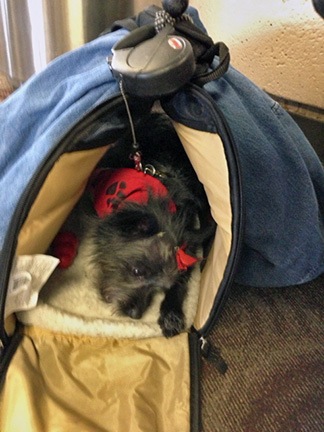
And I wish I could see Charlie play with my little dog Penny just one time.
Losing My Home
So I’ve been living in my home — my only home — since my return in September. And I’ll live here until the court tells me I have to leave.
After presenting me with an absurd settlement offer that would ruin me financially and then refusing to negotiate, my husband had the nerve to offer to pay for half the expenses if I lived in his condo until the divorce was finalized. I responded: “Why would I pay you to live in a condo I always hated when I could live in my own home for free?”
But it’s extremely difficult to live here. Every day, I’m faced with reminders of the man I spent more than half of my life with, a man who betrayed my trust and cruelly discarded me for someone else. The souvenirs on the fireplace mantle, the ashes of two of our dogs, the tail of the horse I bought him so we could ride together, photos of us together and separately at home or on vacation as our lives went by, entwined in a partnership I thought would never end. I cook the same meals I made for him but I eat them alone, day after day until the leftovers are gone. I sit on my lounge chair on the upstairs patio, scanning the sky, always amazed by the number of stars, seeing high-flying satellites or shooting stars but having no one to share them with. I lie on my side of the bed with his pillow beside mine and I know that he’s lying elsewhere, beside another woman that now he loves more than me. Even the remaining cape honeysuckle bushes we planted together that last spring remind me of a life that’s gone forever, torn from me by the man I loved.
And I cry, like I’m crying now, wondering how it could happen, wondering how he could forget these things.
Right now, I’m sitting at his desk, looking out on a windy gray day. If there wasn’t so much blowing dust, I’d be able to see the mountains off in the distance. His desk in the upstairs den has the best view in the house and I’m glad I moved my laptop up here.

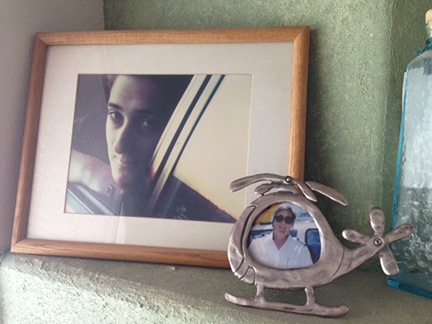
Two photos on the ledge beside my husband’s desk. They were face down when I got home.
Beside me is the photo of me that he shot way back in the early 1980s, not long after we met. My skin is young and fresh — not yet aged as it is today — and my eyes look at the camera, smiling ever so slightly, as if I have a secret that I’m willing to share with just the photographer. He always had that photo of me beside his desk, but when I got home in September, it was face down. Perhaps he saw that face and eyes as if they were accusing him of his lies and infidelity. Perhaps they stoke the guilt he must feel at what he’s been doing to me since last May when he started shopping for my replacement. I righted the photo and I look at it now and then. I remember how young I was and how I spent more than half my life with the man who made it and enlarged it and framed it for the place beside his desk.
I’ve been traveling a lot — I’m only here about two thirds of the time — but even that’s more time that he spent here since buying that damn condo. I’ve been on at least one trip a month — Penny is becoming quite the frequent flyer! I’ve been to see friends in California and Washington and Utah. I’ve spent time with my family in Florida. And I’ve gone on business and pleasure trips to Lake Powell, Las Vegas, Washington, and California. Traveling is my relief; it keeps me away from the memories and helps me look to my future.
When I’m not traveling, I’m sorting and packing or discarding my things, then storing them in a safe place for the day I can move to my new home.
Because I will have a new home — that’s for sure. Despite the fact that my husband’s company offered to move him to Tampa, he apparently still wants our house.
None of my friends or family members can understand how it could be so easy for him to move his girlfriend into a home he made with another woman. But I guess if you have no conscience and can push aside memories like the ones haunting me, it might be easy.
I just wonder whether she’ll make a good companion on the upstairs patio on a star-filled night. And whether she’ll cut fresh napolitos from the prickly pear cactus for him to grill up with a steak. Or if she’ll be able to make him yorkshire pudding with a rack of lamb for dinner. Or if she’ll keep bird feeders filled and spend winter afternoons on the back patio watching the birds come.
I doubt it.
Our divorce trial is in less than three weeks. Although his lawyer claimed just the other day that they wanted to try mediation again, they backed down when I insisted that we meet face to face. I know why and I’m sure he does, too.
The outcome of the court trial uncertain. I could lose a portion of everything I’ve worked hard for my whole life. The law is supposed to be fair, but it isn’t always. I’ll see just how fair it is by the middle of May.
I know the outcome will be better for me than the absurdly damaging deal he pressured me to settle for by harassing me month after month all winter. But after the judge makes his decision and my lawyers are paid, where will I be?
Homeless.
The one thing I could control to ensure my financial future — the paid-for roof over my head — will be gone.
I only hope I’m left with enough money to get a decent start on my new life. That 10 acres of view property in Washington is waiting for me and I have big plans for it.
Keep your fingers crossed for me, huh?
 I just finished reading Stephen King’s
  Baked brie is one of my favorite appetizers — and something I like to make for guests when having a dinner or cocktail party. I made it the other night for dinner at a friend’s house; I did all the prep at home and baked it in her oven. It was the second time she’d had it and she asked me to write down the recipe. I thought it would be easiest to just share it here. As you’ll see, it’s very easy.
 1 package Pillsbury Crusty French Loaf (or similar). You should be able to find this in the refrigerator section of your supermarket.