My Helicopter is NOT a Birdhouse

Or is it?

Like I did the past four summers, this May I parked my helicopter outdoors at an ag strip — a simple runway used by crop-dusters — near the RV park where I begin my summer work season in Quincy, WA. (My first season here, in 2008, I managed to get a hangar at Quincy Airport.) My “helipad” is a concrete tie-down pad, created long ago when the ag strip was busier and was home to more airplanes.

These days, the strip is home to just one crop-duster, a yellow turbine biplane that barely fits inside a big hangar on the strip. That airplane’s predecessor was parked, partially disassembled, on the concrete pad in front of mine, tied down with frayed ropes. Its big radial engine had bled out its oil reserve years ago, leaving a grimy patch on the pavement that had absorbed dust and dirt and small pebbles throughout the years. Last year, part of its tail section was taken away. What remained was broken and forlorn, a sad reminder of what might have been a glorious past, its bright yellow paint faded and dirty from a long spell in purgatory outdoors.

Parking at the Ag Strip

Over time, birds had built nests inside its wings. They’d done this long before I arrived in 2009; I saw them come and go right from the first day I was there. Bits and pieces of straw stuck out of odd places. A bird would perch on a strut or cowling, then disappear into the airframe. I watched them while I was warming up my aircraft for a flight, or when cooling down at the conclusion of one.

The plane was still there when I arrived this May. But a few days later, I saw a flatbed trailer working near it. And then, one day, it was gone.

I hoped it was going to a new home, someplace where it would be rebuilt and would return to the sky.

Birds in the Fan Scroll

I was in Phoenix later that month, dealing with personal business, when my phone rang. It was the owner of the ag strip, Randy, who also flew the turbine crop-duster in the hangar. He’d never called me before. I didn’t even know he had my number.

“What’s up?” I asked him after we exchanged greetings.

“I’ll let Dalton explain,” he said.

I think my blood pressure must have jumped up a few points. Dalton was Randy’s ground guy. He spent a lot of time tearing around the strip on an ATV, running between the hangar and the refueling area and chemical loading area. I imagined him having some kind of mishap that involved the helicopter.

“I saw some birds flying in and out of the back of your helicopter,” Dalton told me. “When I looked in there, it looked like they were building a nest. I covered it up so they couldn’t get back in,” he finished.

Okay. A bird nest. Not something I wanted to deal with, but at least it wasn’t some sort of accident that involved the helicopter’s airframe. I thanked him for keeping an eye on things for me and for covering it up. I told him I’d be back in a few days and we hung up.

It made sense, when I thought about it. With the big biplane gone, a lot of birds were homeless. They moved to the closest replacement — my helicopter.

Nest in the Fan ScrollWhen I returned, I found the fan scroll cowl covered with cloth that turned out to be two old coveralls. I pulled them off to find a mess in the back end of the helicopter. Birds had flown between the fins on the fan scroll cowl (consult photo above) and had brought all kinds of hay and twigs. They’d left nesting materials inside the cowl and inside the fan itself. And there was a ton of bird poop.

What a mess!

I returned to my RV to fetch my battery powered screw driver, some hot water, and some rags. Then I got to work. First I removed the two screws holding in one of the fan cowl fins and attempted to remove all the material by reaching in. It soon became obvious that that simply wouldn’t work. So I removed the entire cowl — which involved removing about 20 screws — and began scooping out the junk I found. It took quite a while; there was an amazing quantity of the stuff. I wiped up as best as I could with the water and rags.

By then, Randy and Dalton had come by to chat. They told me to use the hose in the hangar. So I carried the filthy cowl into the hangar and cleaned it as well as I could with the hose and a brush.

Plastic over Fan CowlWhen I was satisfied all the nesting material was out and the cowl was as clean as I’d get it, I put it all back together. Then I used plastic bags to cover up the fins so birds couldn’t fly back in there. That would have to protect it until I flew again.

I should mention here that I opened all the inspection doors and looked carefully throughout the interior of the cowling to make sure that was the only nest they’d built. I admit that I was surprised that they hadn’t built anything in the main inspection area, near the upper sheave, beneath the hydraulic reservoir, or under the main rotor gearbox. I tapped on the mast cowling and tailcone in an attempt to scare out any birds that might be in there. Nothing. Not any other trace of birds anywhere.

What a relief.

Flying an Aging Aircraft

I started doing a lot of flying a few days later — charter flights, mostly. I removed the plastic bags, preflighted thoroughly, and saw no other sign of birds. When I flew, everything seemed fine.

Well, I did notice that the engine seemed to run a little warmer than usual.

The cylinder head temperature gauge has a little tick mark about 2/3 from the top. In the 8 years and 1600 hours I’ve flown the helicopter, temperature in flight is usually right around this line. It might be slightly to the left (cooler) on a cool day and slightly to the right (warmer) on a hot Arizona day. I’d never seen it to the right of the line in Washington state — it simply didn’t get hot enough. Yet that spring the temperature consistently reached and edged slightly past that line.

The engine was running warm.

At the same time, I noticed that the engine was warming up a bit quicker than usual. I figure it was because outside temperatures were pretty warm. That would also explain why it took a bit longer to cool down.

I also noticed a slight decrease in performance — I simply couldn’t maintain the 110 knots cruise speed I’d usually gotten when flying light. That could have something to do with the accumulation of dust and bird poop on the top of the main rotor blades. I cleared it off as best as I could as often as I could. I also figured that the performance issues might have something to do with engine compression; I’d learn more at its next 100 hour inspection.

Hell, my helicopter was getting old. Little changes like this were bound to happen.

Overall, however, the helicopter ran smoothly without any problems. I did numerous charter flights and numerous cherry drying flights without any problems whatsoever.

I did also notice some fresh bird poop on the fan scroll cowling, but regular examination of the area failed to show any trace of bird habitation. I figured that the birds just liked perching and pooping there with their old biplane home gone.

I should have known better.

The 50-Hour Inspection

I dried 73 acres of cherry trees yesterday morning. Afterwards, I landed at Wenatchee Airport, waiting for more expected weather to move in. I had just 2 hours left on my Hobbs meter before I’d need a 50-hour inspection. A 50-hour consists of an oil change with a filter change plus the removal of the spark plugs for inspection and cleaning.

When it became obvious that weather wasn’t moving in anytime soon, I figured I’d get the 50-hour inspection taken care of while I was there; more rain was expected the next day and I didn’t want to overrun the inspection time. I ran up the engine and repositioned the helicopter in front of Alpine Aviation’s hangar. While I was driving down into Wenatchee to fetch a case of oil, the excellent mechanics there would drain the helicopter’s oil and start working on the plugs.

Bird NesI was gone about 45 minutes. (I admit I also stopped at Dairy Queen for a chocolate shake.) When I returned with the oil, I saw a bird nest, complete with pale blue eggs, on the floor in the hangar.

I put the case of oil down and looked up at the ceiling. “Did this blow off the roof or something?” I asked Mike, who was working nearby.

“No,” he replied. “Cass pulled that out of your helicopter.”

I stared at him. “You’re kidding.”

But Mike wasn’t kidding. “He’s got quite a mess to clean up.”

I went outside to take a look. The left side panel was off and the panel that normally hid the top half of the engine was also off. Cass was pulling bits and pieces of straw off the engine’s cooling fins.
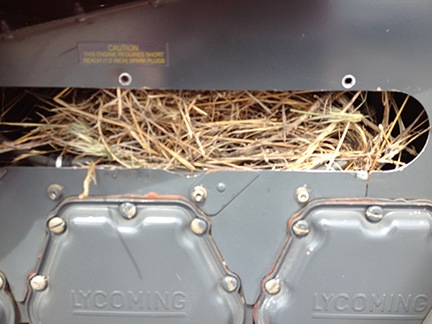
Nest on my Engine“I got a picture of it,” he told me. On his phone, he showed me a photo of the engine with hay stuffed into the area on top of it.

“Both sides?” I asked.

“Mostly this side,” he assured me. “But it’s in the oil cooler, too.”

He spent an extra half hour with a shop vac and compressed air, cleaning the nest out of the engine compartment. Mike waited until he’d gotten most of it out before pulling the plugs on that side.

As you might imagine, I was troubled by this. A preflight inspection should find problems like this. But mine hadn’t. The nest had obviously been in there for some time — perhaps a month or more. It was probably causing the warm operating temperatures I’d noticed. (With luck) it could be causing the dip in performance, too.

Fortunately, it hadn’t caused a fire.

I talked to Cass about it. He assured me that there was no way I would have spotted it on a preflight. He had to remove two panels — both of which were secured with screwdrivers — to see the nest. This is not something that’s done on any kind of standard preflight inspection. And since the temperature and performance issues I’d noticed were not substantial, there was no reason to go beyond a standard preflight inspection.

Lessons Learned

A few lessons can be learned from this experience:

  • If an aircraft is left outdoors, in an area known for bird nesting activity, a preflight inspection should include a search for any bird activity at all. Poop is a good indication of bird activity.
  • If an aircraft you’ve been flying for years suddenly shows any change in gauge readings or performance, it could indicate an issue that needs to be found. Look beyond a preflight inspection; think about what could have changed since you noticed the different readings.
  • A preflight inspection cannot uncover all problems with an aircraft. It’s limited by what you have access to when you make the inspection.

Knowing all this, would I do anything different? Yes. The next time I see a change in the helicopter’s gauges or performance, I’ll follow up with a mechanic. I may have been lucky this time; I might not be so lucky next time.

Twitter and Writing

Some thoughts on a New Yorker essay.

Twitter LogoI read an interesting essay on the New Yorker magazine’s website yesterday: “The Ongoing Story: Twitter and Writing.” It was one of those pieces that, as you read it, you realize that you and the author are sharing the same thoughts about something that you thought you were alone in thinking. As I read through the piece, I found myself wanting to highlight different passages of it — the parts of it where the author put into words what I’d been thinking or feeling for a long time.

So I figured I’d blog a little about it to store those thoughts here.

For example, the author of the piece, Thomas Beller, writes:

Most great writers could, if they wanted to, be very good at Twitter, because it is a medium of words and also of form. Its built-in limitation corresponds to the sense of rhythm and proportion that writers apply to each line.

And that’s the challenge of Twitter. Sharing a complete thought in 140 characters. I wrote about that back in October 2010 (was it really that long ago?) in my blog post titled “How Twitter Can Help You Become a More Concise Writer.” After all, anyone can write a string of tweets to tell a story. But how many people can convey that story in just 140 characters? How many people can be interesting, funny, provocative, witty, sarcastic, ironic, or insightful?

Yes, it’s true: I do tweet photos of some of my meals. (Don’t we all?) But occasionally I get more serious. Occasionally I dig deeper and come up with something witty or profound, something that other people find worthy of retweeting or, better yet, favoriting.

(Ever wonder how the word favorite became a verb? I did, too. Then I asked all-knowing Google and it pointed me to this article that explains it. It shouldn’t surprise you that Twitter is involved. But once again, I digress.)

And sometimes — just sometimes — I can paint a visual picture with those 140 characters that’s as clear as a glacial stream on a spring day.

Two more passages touch upon why and how I use Twitter:

Does a piece of writing that is never seen by anyone other than its author even exist? Does a thought need to be shared to exist? What happens to the stray thought that drifts into view, is pondered, and then drifts away? Perhaps you jot it down in a note before it vanishes, so that you can mull it over in the future. It’s like a seed that, when you return to it, may have grown into something visible. Or perhaps you put it in a tweet, making the note public. But does the fact that it is public diminish the chances that it will grow into something sturdy and lasting? Does articulating a thought in public freeze it in place somehow, making it not part of a thought process but rather a tiny little finished sculpture? Is tweeting the same as publishing?

And:

I had always thought of Twitter as being a good place to work out ideas: a place to mull things over in public, and a way of documenting a thought to make it more likely that I would remember it. But is it like a conversation or is it “talking it out?” Is it a note to oneself that everyone can see, or is it, like iPhone photos, an attempt to offload the responsibilities of memory onto an apparatus that feels like an extension of ourselves because it is always in our hands? I sometimes wonder if I might ever be accused of stealing my own idea.

And that’s how I use Twitter: as a sort of running list of my thoughts and the things going on in my life. (That might explain why I’ve tweeted more than 44,000 times since I joined Twitter back in 2007. I think a lot and keep pretty busy.) It’s easy to whip out my phone or iPad and tweet something that’s on my mind — or to save a picture of what’s in front of me in a place where it’ll be forever (or at least a long time). It is an offloading of information so I don’t have to remember things.

Mr Beller wonders whether articulating a thought in public freezes it in place somehow. It does. It freezes it in the Twitter archive, which I can download for my account and search at any time. (How do you think it was so easy for me to come up with the tweets you see here? Imagine that archive in the hands of a paranoid and delusional stalker!) That makes it possible for me to go back in time, to see what I was thinking and doing on a specific date since my first tweet in March 2007.

I can’t think of any easier way to make life notes. Stray thoughts can be captured before they drift away, to be pondered at my leisure. And sometimes — just sometimes — they become the seeds for blog posts or conversations with friends.

Twitter was introduced as a “microblogging” service and that’s exactly how I use it. I assume other writers do the same.

But is tweeting the same as publishing? I don’t think so. It’s more like standing on a soapbox in a crowded park, making random remarks. Some folks who know you’re there and find you interesting might be there to listen. But otherwise, your words go mostly unheard. You can argue that the same can be said for publishing, but publishing seems to be a more legitimate form of communication. Or maybe that’s just old-fashioned thinking on my part.

Managing the anxiety of composition is an essential part of writing. One must master the process of shepherding the private into public. There are bound to be false starts, excursions that turn out to be dead ends. But these ephemera—notes, journals, drafts—are all composed in a kind of psychic antechamber whose main feature is a sense of aloneness. They are the literary equivalent of muttering to yourself in a state of melancholy, or of dancing in front of the mirror with music blasting when you are alone in your room. Both of these are best done when no one is home.

I’ve never found it difficult to write; there is no anxiety for me. That’s not to say that I don’t have false starts and wander down to dead ends. Or, more often than I’d like to admit, write crap.

There is an aloneness to all writing, including Twitter. And yes, tweets are like talking to yourself, but with the very real possibility that (in my case) 1600+ people are listening and may respond. No one is home here except me — I’ve been alone for a long time, even when I supposedly wasn’t.

Almost everybody who is a writer these days gets, at some point, a lecture on the necessity of being “on” Twitter and Facebook. It’s a tool of selling and career building. It is, for writers of all ages and stages, not so much required reading as required writing.

I also got this lecture from one of my publishers. I didn’t need to be sold on Twitter — I took to that like a bird takes to the sky. It was Facebook that I avoided for as long as I could. So long, in fact, that I lost a contract because I wasn’t involved enough in social media. Imagine that! An early adopter of Twitter with tens of thousands of tweets not being involved enough in social media.

Twitter gives writers the ability to put ourselves out there for the world to see. Does it help my writing career? Perhaps — to a point. It certainly helps attract blog readers and give me a steady stream of intelligent people to communicate with.

After five years and more than 44,000 tweets, I know one thing for certain: Twitter has become a part of my writing life.

Courage

I never thought I’d quote Oprah, but here it is.

I was wasting time yesterday, surfing the web for interesting things, when I came upon an NPR piece about one-liners. In it was a one-liner from Oprah Winfrey:

Having the courage to stand up and pursue your dreams will give you life’s greatest reward and life’s greatest adventure.

And I truly believe this. To me, life is continuous quest to do and learn and see new things. To pursue my dreams.

The Status Quo Trap

It’s easy to sit back and settle in for the long haul in a comfortable home with a comfortable job, doing the same things every day with the same people around you. You know what every day will bring; there are no surprises. Easy, no?

But maybe you dream of doing other things. Maybe you’ve dreamed about some of these things for your entire life, things like starting a business based on one of your hobbies or interests, patenting the inventions of your creativity and imagination, or even just learning a new but difficult skill. Everyone has dreams.

But pursuing these dreams takes courage — the courage to work hard and smart, the courage to face difficult challenges, the courage to accept that the only alternative to success is failure.

So you sit back and relax in your comfy status quo, letting your life slip away with every day, month, and year, letting your dreams slip away with them.

That’s the way a lot of people think. I know — I was married to one of them.

Step Out of Your Comfort Zone and Live

But I don’t think that way.

To me, there’s nothing to life without challenges. There’s always something new to do, something new to learn, something new to see. I’m smart enough to understand that I can’t make these things part of my life without leaving my comfort zone to go after them. And I’m brave enough to do it.

The past year has been a challenge for me — one I did not choose and did not want to face. But I faced it and I got through it. And I’ve emerged on the other side, a better, stronger, and freer person with more self esteem and better health.

And now I face new challenges — some a result of my husband’s betrayal and others of my own choosing. I have the courage to face them. I have the strength to persevere.

As for the events of the past year, well, I look at them as a setback. I expect to be back on track for the semi-retired life with fun and travel that I’d planned (that was well within reach last summer) within a few years. Best of all, I won’t have to drag around the dead weight that was holding me back in recent years.

Oprah is right. I know from experience that pursuing and achieving my dreams is life’s greatest reward. And my life will be an adventure until the end.

How about yours?

Me and My Traeger

I enjoy my first rack of ribs, smoked to perfection on my new grill.

Grilling has been a part of my life for the past 30 or so years. I had a grill in Queens (New York), New Jersey, and Arizona. Even when I lived just three months in Yarnell, AZ back in 1995, I bought a little hibachi and used it almost every evening to grill up some meat and vegetables over charcoals for dinner. My old RV had a built-in gas grill and when I got my new RV, the “mobile mansion” back in 2010, I bought a small gas grill to satisfy my craving for grilled food.

I grill year-round, several times a week.

About 10 years ago, I attended a cookout at Prescott’s Love Field airport. My host was cooking on a Traeger Grill. The benefit of the grill was clear: it was fed wood pellets — not gas or charcoal — and it automatically maintained any temperature you set it at. The fact that it was also capable of smoking meat made it something I wanted. Badly.

Time passed. I wasn’t in charge of procuring grills for my home. Someone else was. And he liked gas.

Whatever.

I did have a smoker for a while. I got it from a friend about eight to ten years ago, right before she moved to Colorado. I traded an old bird perch — she has a parrot, too — for it. It was a good-sized traditional smoker with an external firebox and smokestack. It worked well — on the few instances I took the time to use it. Smoking, you see, was all about time — time preparing the wood, time starting the fire, time getting it up to temperature, time checking the temperature, time adding the wood, time checking the temperature, time adding the wood, time checking the temperature — well, you get the idea. When I smoked something, I had to hang around and tend to the smoker. Getting a remote thermometer helped — at least I could monitor the temperature without going outside. But it was still a pain in the butt.

I gave away the smoker. I traded it for a new heating element installed on my hot tub. (Ironically, I gave away the hot tub, too. I traded it for some help moving furniture out of my house last month.)

I’m living in my RV again this summer, prepping to build a custom home on 10 acres of view property in Malaga, WA. That home is going to need a new grill. And this time, I’m in charge.

My Traeger GrillSo I bought the grill I’ve been wanting for the past 10 years. A Traeger.

I bought the “Junior.” It’s the second smallest model and it now comes with the same digital LED thermostat previously available only on the larger, more costly models. Not that the grill was cheap — it wasn’t. But the $50 rebate did help convince me to buy now.

After all, why the hell not?

I bought it at Stan’s Merry Mart in Wenatchee. (I love that store. It’s so funky-weird. Hell, just look at its sign.) Just the day before, a young sales guy had almost talked me into it. I left, thought about it some more, and came back to buy it. They loaded it into the back of my truck with a big bag of mesquite pellets and I drove it back to the Mobile Mansion.

The next day, I assembled it. (If you watch the time-lapse video here, see if you can see the mistake I made and fixed.) But I couldn’t use it that day — I was going to Wenatchee to meet someone new and watch him play softball. Over dinner, I told my new friend about my new grill. I invited him over for the christening celebration: two racks of ribs, smoked. We’d go for a helicopter ride while we waited for the ribs to finish cooking.

And that’s what we did.

Before he came, I prepped the meat by covering it with a mesquite rub. I prepped the Traeger by doing its initial start and seasoning the porcelain grill. Then I turned the thermostat to 250, which brought the cooking chamber up to around 225 — the recommended temperature. I put the ribs on the grill, closed the lid, and went about my business without having to check the temperature or add fuel even once.

Amazing RibsWhen we got back from our flight, the ribs were nearly done. They looked amazing. I made us some salad and corn on the cob, then brushed the smaller of the two racks with BBQ sauce and threw it on my old grill, set to high, to caramelize the sauce onto them.

The finished product was perfect.

What’s next? I’ve been thinking about salmon…

In Defense of Text Messaging

It does serve a real purpose.

The other day, one of my Twitter/Facebook friends linked to an article in the New York Times titled “How Not to Be Alone.” In his words, it was “highly recommended.” So I read it.

The piece started out with a story about seeing a 15-year-old girl crying into a cell phone during a discussion with her mother. The story went on for four paragraphs, with the author, Jonathan Safran Foer, using his fifth paragraph to discuss his moral dilemma: talk to this stranger to try to comfort her or “respect the boundaries” between them. He never does say what he chose to do.

From there, the article launches into a discussion of how modern day methods of communication are dividing us, weakening our relationships, reducing our ability to articulately communicate, and making it easier to “avoid the emotional work of being present” to communicate. He argues that by diminishing our communication with others, we diminish ourselves.

He says:

We often use technology to save time, but increasingly, it either takes the saved time along with it, or makes the saved time less present, intimate and rich. I worry that the closer the world gets to our fingertips, the further it gets from our hearts. It’s not an either/or — being “anti-technology” is perhaps the only thing more foolish than being unquestioningly “pro-technology” — but a question of balance that our lives hang upon.

I read through the article twice without coming away with a one-line summary of what he was trying to say. Apparently, I wasn’t the only one having trouble with it because another Twitter friend replied to me and someone else with the simple — thank you, Twitter! — summary:

Don’t write when you can call. Don’t call when you can visit.

Simple enough. And I can certainly agree.

But it got me thinking about text messaging and the way it seemed to be painted, in the Times piece, as something that’s destroying society. And that bugged me.

Because I just don’t think it’s true.

Text Messaging for Work

You see, I use text messaging extensively for work. It gives me the ability to communicate instantly with clients and colleagues about things that they might want to know about right now. The key word there is might. If they must know about it now, I call their cell phone. But why bother them with a call when they might or might not be interested with the information I have to share? Or if I need an answer to a question but I don’t need it immediately — and know I will likely forget to ask if I do make a call later?

Here’s an example. My summer work requires me to be on call to fly over cherry orchards after it rains. The other day, there was rain in the area. I watched it move through on radar on my iPad. I saw it approaching an area where one of my clients has an orchard. I know he doesn’t live near there. I wanted to make sure he knew I was monitoring the weather and had some concerns about his orchard. So I texted:

Do you have someone at Malaga?

That was at 4:30 PM. His response came at 5:34 PM, after the weather had moved through:

Yeah. We made it through another close afternoon.

Communication accomplished. I didn’t have to call him to pester him with my question. He’s been growing cherries a lot longer than I’ve been drying them with a helicopter. I’m sure he had a handle on it. But by sending that quick text message, I communicated that I was aware of the situation and would be ready if he needed me. The fact that he didn’t respond for over an hour was okay with me. For all I know, he might not have even looked at his phone for an hour. He might have been busy watching the weather.

Do I communicate by text with all of my clients? No. Only the ones who have shown that they use text messaging to communicate by texting me first. When a client texts me, he’s telling me that texting is an acceptable or maybe even preferred means of communication. I’m okay with that.

I’m Not Alone

The title of the piece suggests that modern communication is making us more alone. I disagree wholeheartedly. If anything, text messaging has brought me closer to friends.

This morning, for example, while I was still in bed at 4:15 AM, I texted a friend on the east coast — where it was 7:15 — with a question. If he saw it immediately, great. If not, that was okay, too. He’d eventually see it and respond. But he was there at his desk and we had a text “conversation” about a bunch of things.

You might argue that when I realized he was available I should have picked up the phone and called him. But my friend works from home and uses his phone extensively for work. Chances are, our conversation would have been interrupted one or more times by incoming phone calls. Was our texted conversation important enough to disrupt his work day? No.

Although texting suggests a sort of immediacy to the conversation, it also makes it possible to put down and resume a conversation over time. Indeed, I’ve had texted “conversations” with people that have gone on for hours or days or even weeks. Could I accomplish this with phone calls? No — not without becoming a nuisance.

I can’t tell you how many friendships — including very old friendships — I have been able to maintain via text messaging and email. Sometimes it’s the best option.

The Trouble with Phone Calls

The problem with using the phone is that when you call someone, you’re saying, in effect, that it’s okay for you to bother him/her when it’s convenient for you. After all, you don’t usually call someone when it isn’t convenient for you, do you?

Of course, you can always schedule a phone call. Some of my publishing contacts do that. It makes sense. Take a meeting, on the phone.

But calling out of the blue? When someone might be busy? Just to chat?

I guess it depends on the kind of relationship you have with that person. I have plenty of friends who I feel comfortable calling to chat — at certain times of the day or evening. But if I don’t know a person very well, I think it’s rude to bother him/her with a phone call just to say hello.

Is that making me more alone? Not when I can fire off a quick text that might lead to a phone call when it’s convenient for both of us. Indeed, sometimes I’ll send a text message that says,

Are you around? Okay if I call?

Even if I don’t get a response, I get an answer to those questions: No.

Of course, this is assuming the person I want to reach lives with his/her cellphone at arm’s length all day every day. But that’s the kind of people I’m most likely to text anyway.

I’m not texting my mother or sister or a friend who keeps his cell phone packed away in a little backpack he uses as a manly man purse. (You know who you are!) I’m just texting the same people who text me.

In Person Meetings

When I was a kid, I’d go to my Aunt’s house in a nearby town. It aways amazed me how we’d be sitting around in the kitchen — the focal point for any Italian-American household — and one of her neighbors would walk right in. Often without even knocking on the door!

I’d love to live somewhere with all my friends nearby and be able to keep my doors unlocked at all times so they could walk right in and visit me. But that’s not my reality these days. Is it yours?

My world is bigger — my friends can be found all over the globe. They’ve chosen to live where they live just as I’ve chosen to live where I live. That doesn’t mean I won’t have super friendly neighbors when I finally build my new home. But I don’t really expect anyone to just “drop in” like we did in the old days.

Does that make me alone? I don’t think so. It makes me more likely to get out and about to get the social interaction I need with a wider variety of people in a wider variety of places.

So rather than sit around the kitchen table and wait for the same handful of visitors my Aunt’s family got, I’m getting out and expanding my world.

In Defense of Text Messaging

I’m not a kid. I’m in my 50s.

When I was a kid, we had three options for communication: face to face, telephone (which could be expensive if calling out of your immediate area), and mail (which took 2-3 days each way).

Today, we still have all of these things. Telephone use has become cheaper, mail has become more expensive. But we also have several free (or arguably low-cost) means of communication: fax (which is now, thankfully, almost dead), email, text messaging, and video conferencing. (And don’t get me started on self-publishing options — like social networking, blogging, print on demand, and ebooks — that make communication to the masses amazingly easy and cost effective.)

I can now communicate instantly for next to nothing with my friends and colleagues all over the world. I couldn’t do that when I was a kid.

I don’t understand how someone can argue that having and using more methods of communication — especially instantaneous, real-time methods — makes us more alone. If anything, it helps us connect better.

And text messaging is just one tool for doing that.

Your thoughts? Put ’em in comments so we can discuss.