
Working out the kinks.
One of the improvements I made on my old RV was to add a solar panel to the roof. It was connected to a battery charger which, in turn, was connected to the camper’s batteries. When the sun was out — which is during most daylight hours here in Arizona — the batteries were charged. This made the camper extremely useful for off-the-grid camping. My husband and I did a lot of that last year on our way back from Washington to Arizona. We never ran low on power, which was a good thing because we didn’t have a generator.
There are a few things that won’t work in an RV without a connection to A/C power:
- A/C power outlets. This means you can’t plug in and use any device with a standard plug.
- Certain light fixtures. Some lights are A/C while some are D/C. A/C fixtures won’t work without an A/C connection.
- Microwave. Even if it’s standard equipment on an RV, it’s plugged into an A/C outlet.
- Air Conditioning. It’s A/C and it sucks a ton of power when it is plugged in and running. That means that even if you have a generator, you need a pretty powerful one to run the A/C when you’re not hooked up to campground or city power.
There are a few things that will run on propane or battery (D/C) power if you’re camping off-the-grid:
- Refrigerator. Setting the refrigerator on “Auto” tells it to look for A/C power first; if that’s not available, it uses propane from the onboard tanks (assuming the valves have been opened).
- Stove/Oven. Obviously, they’re propane. It would be dumb to put an electric stove in an RV.
- Water pump. If you’re not connected to a pressurized water line, a D/C pump activates when you run the water to pump the water from the onboard fresh water tanks.
- D/C devices. Some RVs include D/C outlets — think of power ports or cigarette lighters on a car. My old RV had one and I added a second; my new RV had three and I added a fourth. These are handy for charging cell phones or plugging in low wattage inverters to plug in low wattage A/C devices like laptops.
Other appliances use D/C power all the time, but if you’re plugged in, your battery is being charged all the time, so it’s no big deal. The heater, stereo, and certain light fixtures are good examples.
As you can see, RVs are pretty much designed to be self-sufficient when you’re off-the-grid. There’s a limit, of course, to how long you can live in an RV without a hookup, though. The solar power (or a generator) helps take care of electrical needs. Eventually, however, you’ll run out of water or fill up your black water sewer tank. There are ways to get around these issues — for example, minimize toilet use by using public toilets whenever possible, carry extra water in external tanks, etc. — so two people can easily live in a well-equipped RV off-the-grid for several weeks if they need to.
Oddly, however, most RV owners do not live in the RV off-the-grid. Instead, many of them tend to pull their RVs from one parking lot-like RV park to the next, cram them into narrow spaces between other RVs, hook up power, water, and sewer lines, and retreat inside their luxury boxes to watch television.
I’m not like most RV owners.
Before trading in the old camper, I pulled the 135-watt solar panel off the roof. This past week, I had it installed, with a new battery charger and controller, on the roof of my new RV.
This weekend, my husband and I are out in the desert about 25 miles west of our Wickenburg home, testing the trailer’s off-the-grid setup. I’m out in Aguila, at a private “resort” where my clients are testing some wireless networking equipment. The test requires me to fly their equipment around in the helicopter to see how well it works with ground-based mobile and stationary equipment. There’s more to it than that, but for the sake of my client’s privacy, that’s really all I’m willing to say.
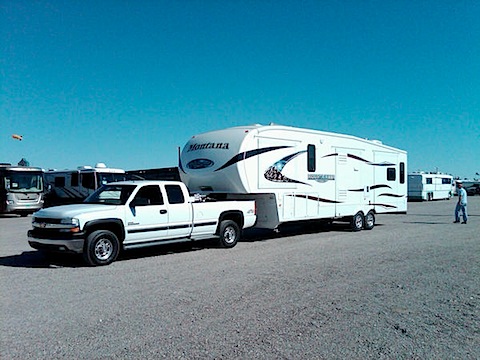
 The job has a lot of down time — time when I’m just waiting around for them to be ready to fly. It made sense to bring the RV out here for the weekend. It gives Mike and I a chance to get away and relax away from home and we can bring along Jack the Dog and Alex the Bird. And, of course, we can test the off-the-grid setup of the RV close enough to home so that if there’s a serious problem, we’re not suffering. So the RV is currently parked about 100 yards from the helicopter’s landing zone out in the desert.
We’ve discovered a few things:
- When the refrigerator works off propane, it makes a noise that sounds like a fan running inside it. We’re not sure if it should be doing that. It seems to work fine and the fan noise does stop when the refrigerator reaches the correct temperature. But my last two RVs had silent refrigerators, so we’re a bit concerned.
- The fresh water in the tanks smells like shit. I do mean that literally. We’re not drinking it, but we are washing with it. It’s making the RV stink a bit on the inside, so we have a lot of windows open to keep the air cleared out. This is our fault. We should have flushed out the system before using it. We’ll do that after this trip and likely run at least one tankful of clean water through it, too.
- The new solar setup works great. It had the batteries fully charged before 10 AM. While it was doing that, we were using the lights, stereo, cell phone chargers (all D/C) and a 300-watt A/C inverter to charge my MacBook Pro and some aviation radios.
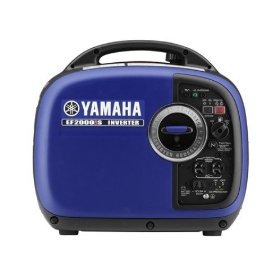
- The 2000-watt Honda generator I bought so I could run A/C devices if I wanted to works great. It’s easy to start and can be very quiet. We gave it a good test on Saturday night when we ran it to see if we could watch a DVD (Up) on the 32-inch (or thereabouts) flat screen TV the RV came with. It ran hard when we first started it — likely to recharge the batteries we’d run down a bit after sunset while giving us A/C power — then settled down to a lower, quieter power setting. I don’t think I’d run it in the future just to watch TV, though.
Everything else works exactly as expected.
At this point, I consider this second test a success. It proves to me that the new RV can be at least as comfortable — more so, of course — than the old one when camping off-the-grid. Even though I didn’t get the solar power system I wanted, I think my less expensive solution — one solar panel to charge the batteries and a portable generator for more power when needed — will work fine.
One thing’s for sure: having a portable house along on these weekend long gigs is very nice indeed — even if I’m not plugged in.


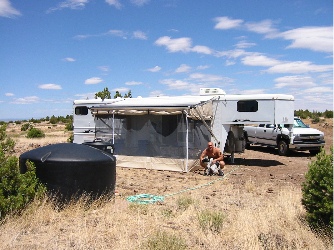 But then we got the horses and decided we wanted to be able to go camping with them. So I bought a 35-foot horse trailer with living quarters. For those of you who aren’t familiar with the concept, the trailer has stalls for the horses in back — mine held three. It also had a sort of closet for storing saddles and other tack. The other half of its length was dedicated to living space for people. It had a queen sized bed, sofa, sink, two-burner stove, good-sized refrigerator, and full (although tiny) bathroom. All this stuff was crammed into a very small space. We added a screened-in room to expand our living space. This photo shows what it looked like parked on our Howard Mesa property with the screen room attached. I lived in this space every other week in the summer of 2004 when I flew at the Grand Canyon. Sadly, we rarely used the camper as it was designed — to take our horses camping with us.
 In 2006, I sold the horse trailer and purchased a Starcraft Antiqua hybrid camper. To me, this was the best of both worlds: a hard-sided camper with the usual amenities (kitchen, bathroom, dining area, sitting area, bedroom) plus the outdoorsy feeling of tent camping. I bought this primarily because I thought we were going to go “on the road” with the helicopter in the summer of 2007. I’d do
  Floor plan. The layout of the RV is likely to determine what amenities it has. If you’ve never shopped for an RV — or haven’t done it lately — you will be amazed at what they can cram into a space. For example, the RV I selected is 36 feet long and 8 feet wide. Yet it has a private bedroom, private bathroom, kitchen, dining area, living area with sofa and recliners, and desk. In many cases, it does this with slide outs. You drive along, park, and push a button to expand your living space.
 Being the picky person I am, certain elements of the floor plan were very important to me. I wanted to be able to access the refrigerator and bathroom without having to expand all the slides. For example, suppose I’m cruising down the road in the middle of nowhere and need/want a cold drink. I can pull over, climb into the RV, and grab one out of the fridge. And even take a leak in a bathroom I know is clean. I also wanted what’s called a “side aisle bath” — a bathroom with all components in the same little room. Other floor plans actually put the bathroom sink in the bedroom. I didn’t want that. And finally, I wanted working space that wasn’t the same place I ate. That means I needed a desk or space for a desk. An RV with a good desk is hard to find and I was perfectly willing to pull out a recliner or even a sofa to put in my own desk. But the model I wound up with actually had a good, usable desk and even had drawers (see photo below). So as far as floor plan is concerned, what I bought is pretty darn close to “perfect” — for me.
 Features and Amenities. Every RV manufacturer and design has its own set of features and amenities. For example, a toy hauler includes a garage-like space in the back. A family model RV might include a separate bedroom — and even an additional half bathroom! — with bunks for the kids. Many luxury RVs have surround sound entertainment systems with wide screen televisions that rise out of a panel or fill an entire wall space. Some units have electric fireplaces. You can find kitchens with two refrigerators and bathrooms with bathtubs. Dining can be in a booth or table and chairs. Sofas can become second beds. Bedrooms can have televisions, closets can be cedar-lined, cabinets can have washer/dryer hookups. The list goes on and on. Just when you think you’ve seen it all, you walk into an RV with yet another feature you didn’t think you’d ever see in an RV.
 For us, less was more — on the inside, anyway. All the RV dealers in the world can assure us that an electric fireplace is a good feature because it gives off heat using the campground’s electricity rather than onboard propane. I can remind them all that we do a lot of off-the-grid camping where there is no campground electricity. A fireplace was a feature we simply didn’t want — yet it appeared in more than half the RVs we looked at! I was extremely pleased, therefore, when we found the unit I’d buy and saw that instead of a fireplace (see photo of typical configuration), there was an empty cabinet.
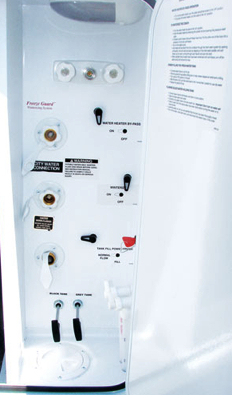 On the outside, however, I wanted some of the newer modern features that were not available in the 2009 model I almost bought. At the top of the list was an electric awning — something I could roll out or back in with the push of a button. (If you’d manually rolled in an awning in your pajamas in the middle of the night when the wind kicked up as many times as I have, you’d understand why.) A remote control to deploy the slide outs was also useful when setting up the RV by myself, as I’m likely to do this summer. Ditto for electric stabilizer jacks and “landing gear.” And it seemed to make a lot more sense to have all hookups (except electricity) and sewer dump/flush controls in one place rather than scattered all over the side of the RV. These features were the primary reason I went with the 2010 model rather than the 2009 (which actually had more cabinet space in the kitchen).
 Quality and Price. Quality and price really do go hand in hand. You get what you pay for. A low-end fifth wheel that you might be able to pick up for $25K is simply not going to be as sturdy or well-built as a top-of-the-line fifth wheel that’ll cost you nearly $100K.
 In my case, I wanted good quality but knew I couldn’t afford — or, more accurately, were not willing to spend enough for — the best. So the very first part of my search was to determine which brands were below my quality needs or above my budget. This should be the first step in anyone’s search for an RV; you can waste a huge amount of time looking at units that simply won’t work for you because of insufficient quality or expensive price. I also cut from the mix any manufacturer what was in bankruptcy or had gone out of the business. 2008/09 killed a lot of them. That limited us to about ten different brands by three different manufacturers. Mountaineer is a mid-range Keystone product. Montana by Keystone is one step above it and I could have made that step if I found one I liked. Heartland’s Big Horn and Big Country were also in the running.
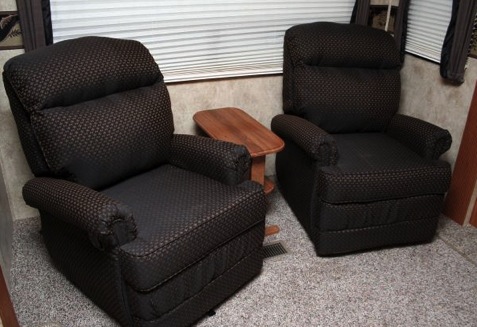 The Mountaineer I bought won on all three factors:
 I started calling some of the RV dealers I’d met with over the past few months — I kept all their cards — to see if they had the same model available. One, in Quartzsite, said he had a 2010. I told him I’d consider driving out to take a look if we could agree to a price over the phone. I told him about the 2009 I were prepared to buy. He asked me to make an offer. I did. He came back with a slightly higher offer that was still below retail. We were there by 2 pm and I had all the papers signed by 4:30 PM.