My Barn Cats

Low maintenance rodent control.

Rodents are a fact of life in rural areas. They were in the garage — and sometimes in the house! — when I lived in Arizona. They were in my hangar there, got into my RVs, and made nests in my cars and motorcycles. Here in Washington, they’ve gotten into my RV and Jeep. I’ve never seen evidence of them in my shed or big garage, but they must be there. After all, rodents are a fact of life.

When I say rodents, I’m mostly talking about mice. Sometimes they’re adorable little mice the size of my thumb. I’d catch them live and release them far away. Until I started catching multiple mice each day. The novelty wore off and I resorted to traditional snap traps. Can’t use poison because I can’t worry about Penny eating it or poisoned mice. And the sticky traps are downright cruel.

Vole
Image of a vole from Wikipedia by user Soebe.

Here in Malaga, we also have voles. They dig up the ground and, if they get into your garden, can kill your plants from the roots. That’s one of the reasons my planters have chicken wire bottoms — to keep the damn things from getting in from below. Penny successfully caught and killed one last year and I suspect she’ll do it again this year.

While I normally wouldn’t mind rodents outdoors — after all, they are part of the ecosystem — they tend to attract snakes. And while I don’t mind non-venomous snakes like bull snakes, I do mind rattlesnakes. I killed three of them in my immediate yard last year. It’s unfortunate, because I really don’t like to kill anything, but I don’t want to worry about Penny or my chickens — or me, for that matter — getting bit.

That’s where the idea of “barn cats” comes in. The Wenatchee Valley Humane Society (WVHS) has what it calls a Barn Buddy Program. They capture feral cats, find homes for them, spay or neuter the cats, and hand them over to their new owners. The cats are strictly outdoor cats and owners are not expected to do much more than give them safe shelter and a steady supply of food and water.

The way I saw it, if I had cats to reduce the rodent population I might be able to reduce the number of snakes that come around in the summer months.

And it was a nice way to help out some cats that would likely be euthanized if not taken. Indeed, the WVHS does not go through the expense of neutering a cat unless an owner is already lined up for it. The reason: they only keep these cats, which are otherwise unadoptable, for about a week. Once a home is lined up for a cat, the WVHS sends it off to be neutered prior to handing it over to its new owner. It’s important to note that in the wild, if not neutered and given a safe home, these cats are only expected to live a few years.

I got my cats around Christmas time. Note that I said cats — plural. The WVHS prefers that you take at least two because they are more likely to stick around if they have company. The cats I got were a 1-1/2 year old black cat I named Black Bart and a 6 month old tabby I creatively named Kitty. I picked them up from the vet in large plastic kennels, set them up in my shed with a heater, food, water, and litter box (as instructed) and let them roam free inside for the required 3 week acclimation period.

My shed is small — just 6 x 8 feet. It’s full of garden and beekeeping equipment. There are shelves on one wall. There’s a hollow overhang over the door. The cats quickly learned to climb up onto the shelves or overhang when they heard me coming. Not only was it safer for them (in their minds) but it was also warmer since heat rises.
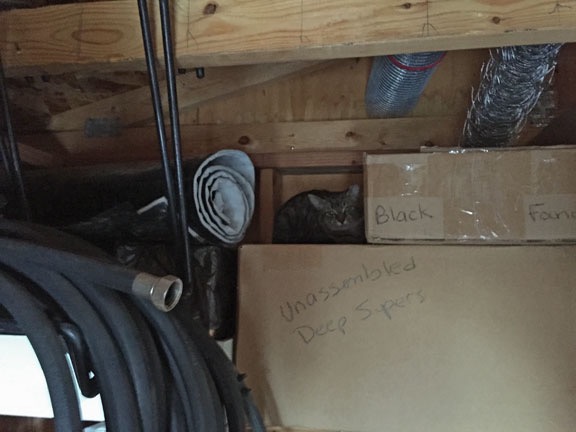
Kitty on a Shelf
Here’s Kitty, up on the top shelf in my shed.

After three weeks — and a few weeks before I went away for a vacation in Arizona — I installed a cat door on the shed. This would give them the ability to go in and out at will. When I knew they were using the door — cat paw prints in fresh snow was a dead giveaway — I removed their kennels and returned them to the WVHS for someone else to use. I also bought a feeder that would hold 10 pounds of dry food and a water dispenser that would hold a gallon of water.

It wasn’t long before I realized that they were spending a lot of time under the shed. Penny is actually the one who discovered this. I heard her barking from inside the shed and opened the door to let her out — but she wasn’t in there. It took a moment to realize that she wasn’t in the shed but under it, likely barking at one or both cats. I got her to come out and I think she hurt herself doing it because she was sore for a few days afterward. Since then, she often goes to the cat’s entrance to their undershed domain but doesn’t try to go in.

I’d occasionally see Kitty inside the shed, up on a shelf — especially when I still had the heater in there. But I didn’t see Black Bart at all and I worried a bit about him.

Understand that these are still completely feral cats. If they see me, they run away. They don’t know their names and, even if they did, they definitely wouldn’t come if I called. Although I suppose I could make some effort to tame them, I prefer not to. There are many predators in this area — coyotes, eagles, owls — and although they have the shed for safe shelter, I don’t expect them to live very long. For that reason, I’d prefer not to get attached to them.

Still, the water was drunk and the food was eaten so I knew they were around somewhere. While I was in Arizona, the litter box got quite disgusting, but I think that was actually a good thing. When I returned, dumped it, and refilled it, I soon realized that they were hardly using it at all. When the weather gets a little better, I’ll take it outside and eventually do away with it. They did their business outdoors before they were captured, they can do it outdoors again when the litter box is gone.

Based on Penny’s behavior, I knew at least one of them was living mostly under the shed. I assumed they came out to hunt at night.

Lately, however, I’ve been spending a lot more time up in my living space over the garage as I finish up construction. I often take a break in a chair by the window and look out over my property and the Wenatchee Valley beyond. Over the past two days, I’ve caught sight of both cats wandering around near the shed. On Friday, Kitty explored the inside of the cabinet installers’ cargo trailer. On Saturday afternoon, Black Bart sat sphinx-like on the concrete “porch” of the shed while Kitty wandered around the weeds nearby.
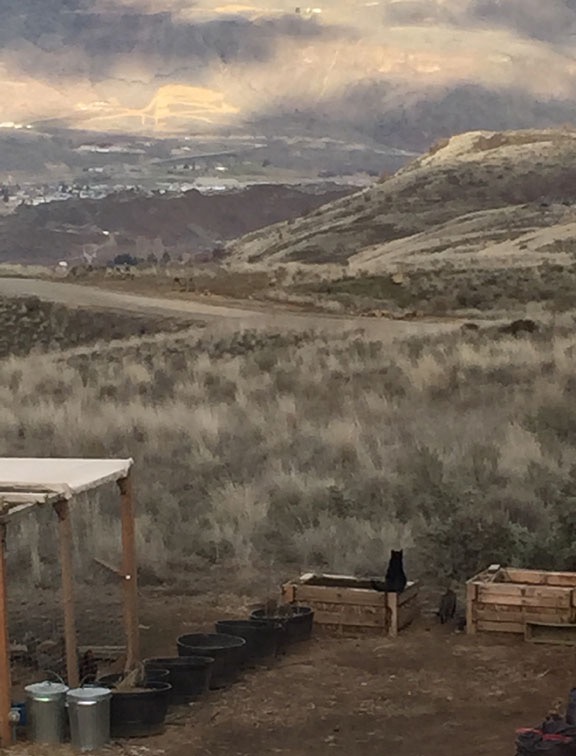
My Barn Cats
I shot this photo of my two barn cats out in my garden from my living room window only a few hours after writing this blog post.

It was rather comforting to see my barn cats out and about on a nice day — especially since they’d obviously become a pair and were roaming, at least part time, together. It was a sort of reminder of the success of the program. I admit that I’m tempted to get another two cats and set them up in my garage, but I’d rather wait until I’ve moved my furniture and boxes into my new home upstairs. Then I’ll give it some thought. (I don’t want people to think I’ve become a cat lady.)

As for rodent control, it’s too early to see what kind of difference they’re making. It’s still winter here and the temperatures have been getting down into the low 30s and high 20s lately. The ground is hard and the voles aren’t coming up to the surface. Or maybe they have been — just long enough to make a tasty snack for a barn cat?

Washington Healthplanfinder FAIL

When automatic payments go seriously wrong.

I usually get email while traveling and generally keep up with anything important. Although I wasn’t surprised to get an email from Washington Healthplanfinder, my health insurance agent here in Washington State, to say that my monthly payment had been automatically withdrawn from my account, I was surprised at the amount:

Withdrawal Confirmation

Note the amount: $1,116.15. My monthly premium is $375.14.

I immediately called Washington Healthcarefinder. After pressing numbers to navigate through four different menus — just to ask a billing question — and waiting five minutes on hold, a typical script-reading customer service representative answered. I told her about the problem. After asking for various information to assure I was who I said I was, she read a script that told me that emails had gone out in error. She asked if my bank had processed the withdrawal.

I admitted I hadn’t checked, and whipped out my iPad to check with my bank’s app while she was still on the phone. The transaction had not been processed.

She read another script that assured me that it wouldn’t be processed. That it was just the email that was an error. I suggested that if this was a widespread problem that an email should go out to notify subscribers of the error. She didn’t have a script for that so she didn’t have anything to say. I hung up.

Two days later, on Wednesday, I got an email from my bank confirming a withdrawal from Washington Healthcare Finder:

Withdrawal Confirmation

Note the amount: $1,116.15.

I just about went ballistic. I called the bank to have the charge reversed and was told that I’d have to fill out a series of forms to get the process started.

Washington Healthcare Finder’s offices were still closed that early, but later in the day, I managed to get yet another idiotic, script-reading customer service representative on the phone. I was not kind, especially when her script informed me that the process could take several days while their accounting department researched the problem. There was lots of time wasted on hold, which further pissed me off. When she got back on the phone, I told her that their error had cost me more than an hour of my time with two calls to them and one to my bank. I asked if I would be getting compensated for my time. She said they wouldn’t compensate me for my time, but they’d “compensate me for the overcharge.”

“That’s not compensation,” I roared over the phone. “That’s a refund for your freaking error!”

Because she obviously didn’t understand the difference, she had nothing to say. I hung up.

But not before I demanded that she turn off automatic payments for my account.

Later yesterday morning — yes, two days after the initial email about the incorrect amount went out, I got this:

Notice of Error

Is there any way they could have screwed this up more?

I’m fortunate in that I had enough money in my account to cover this unexpected withdrawal. Other people who routinely carry smaller checking account balances would likely bounce checks to other payees, setting up a nighmarish experience of explaining the problem for every bounced check and getting overdraft fees reversed. Hours of a person’s time could be wasted on this.

I recently set up automatic withdrawals for a number of organizations I do business with. It should make it easy to pay on time without any additional effort. But I’m going to re-think that strategy and make my payments through my bank’s billpay feature. This puts absolute control in my hands and would certainly prevent something like this from happening again.

Hiking with the Dogs

As strange as this may seem, I have more stamina than two young golden retrievers.

I’m dog sitting for some friends in Arizona. In my charge are two golden retrievers: 1-1/2 year old Birdie and 6 month old Don Don. Of course, Penny the Tiny Dog, my 6-1/2 pound chihuahua terrier mix, is also with me.

I’m a huge believer in off-leash walking. Why would anyone put their animal on a leash if it can safely run free without bothering others or endangering local wildlife? In the Arizona desert, that means choosing a path on just about any back country trail or dry wash. Since the house I’m staying at is on a huge dry wash and Don Don is next to impossible to get into the car, it made sense to simply walk from the back yard out into the desert and down the wash.

Desert Wash
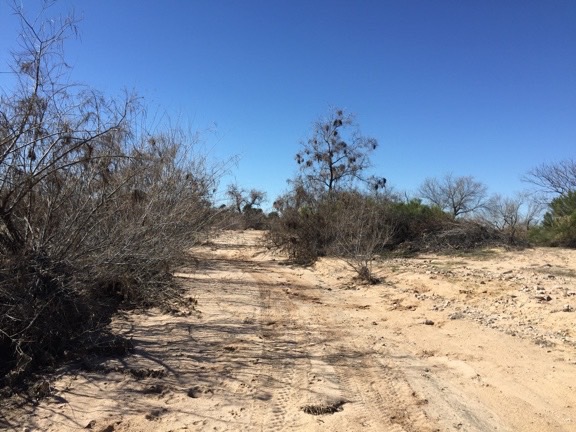
Although it’s not the most scenic place for a hike, a “wash” — or flash flood runoff channel — is a fine place to let dogs run off-leash and do some fast-paced hiking.

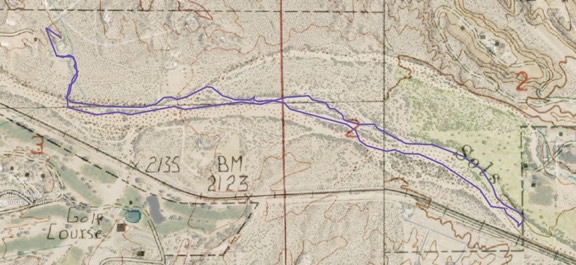
Trip ComputerI’d done the walk last week when my friend Janet was in town with her dog. We’d walked about three miles — almost all the way into town and back. Today, I did almost the same walk alone with the dogs. Total trip was 2.58 miles in under an hour. My Gaia GPS trip computer shows the details. You can see the steady but gentle downhill walk and the climb back. Elevation change was only 74 feet — no big deal. You can also see where I rested along the way back.
I had three goals:

  • Get some exercise. I’ve been slacking off this week, not doing nearly as much walking as I should. I kept up a quick pace, aiming for 3.5 miles per hour moving average. (I achieved 3.2.)
  • Get some color back into my skin. For the first time since 2012, my skin has returned to the sickly white color it had when I spend most of my time indoors, often in a cavelike Phoenix condo. Fortunately, it was sunny — for the eighth consecutive day in a row — and in the 70s. I put on a tank top and shorts for maximum exposure and put my hair up in a high pony tail to prevent it from shading the back of my neck.
  • Get the retrievers tired. These dogs have a lot of energy to burn off. Getting them worn out would be a great way to ensure a peaceful afternoon.

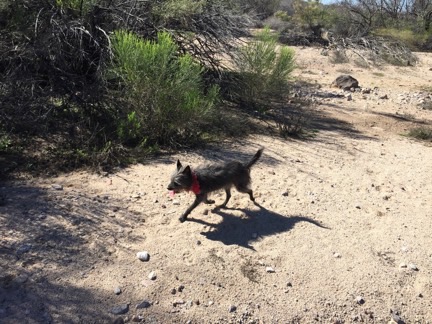
The dogs were a funny group. Birdie pretty much stayed near me for most of the walk. Don Don wanted to explore, but because he’s still a puppy, he’s afraid to go out on his own. Penny is fearless and loves to explore, especially if there’s birds or rabbits to smell or chase. So Penny took the lead and Don Don sort of blundered after her. Once in a while, Birdie would explore with them — especially when she saw Don Don getting good sniff of something on the ground.

I kept walking as fast as I could on the sand. And it was sand — sometimes deep sand. Fortunately, the rain that fell here the week before last was sufficient enough to form a sort of crust on much of the wash surface. It was broken only by a week’s worth of 4WD traffic and the footprints of others. In addition to the tracks Janet and I had made with the dogs the previous week, I saw tracks from horses, deer, and dogs or coyotes. I kept to the hard, crusty sand as much as possible. It was easier to walk on and I was able to keep up that good pace I wanted.

As I walked, the dogs would disappear from view. Every once in a while, I’d call out, “Penny, Don Don, Birdie, Penny, let’s go.” One by one they’d come back into view — usually Birdie, then Don Don, and usually Penny. Penny was always last. She had far more important things to do than come when I called her to make an appearance. But she always came so I didn’t bother putting her on the leash I’d brought along in case I had to tie them up.

Penny did a lot of running under the low bushes and trees that grew in and along the wash. Don Don often tried to follow her but was simply too big.

It was warm with a nice breeze on the walk out. The sun was ahead of me, to my right. The temperature was perfect for my tank top. And although the sun felt strong, I didn’t feel as if I was getting burned. (And indeed, I did not get burned. My skin seems to remember the sun very well.)

We walked as far as a set of power lines strung across the wash. I turned around and started back, consulting the trip computer to see how far we’d gone: 1.25 miles. Perfect.

It was warmer on the way back. I was now walking with that gentle breeze, so I didn’t feel it. The sun was at my back left side. As I walked, I began working up a light sweat.

Penny the Tiny Desert Dog
Penny kept motoring along.

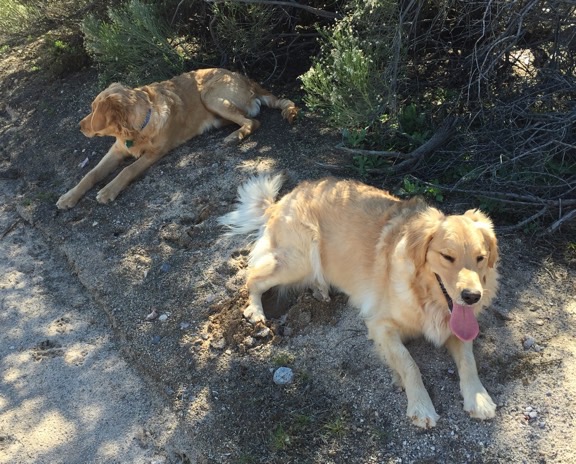
The dogs, in the meantime, were definitely tiring out. Well, the big dogs were, anyway — Penny kept her fast pace, never stopping once. The retrievers now stuck together. They’d walk a bit ahead of me, then drop down to the ground in the shade and look up at me as I passed as if asking me to take a break with them. I kept walking and they’d eventually get up, catch up, and repeat the same process. Birdie was panting hard and it was easy to see why — she has a very heavy coat of fur.

Tired Dogs
These were some seriously tired dogs after less than a mile and a half of walking.

I stopped twice along the way for a total of less than 6 minutes non-moving time. The second time was in the scant shade of a large mesquite tree. The two big dogs rested, panting hard, while Penny explored the underbrush. Then we were off again, more than halfway home.

We didn’t pass a soul, either in a vehicle or on foot, in either direction. The only other animals I saw were quail and rabbits, including a rather large jackrabbit.

Our Track
Here’s our track, presented by Gaia GPS on a hybrid topo/satellite map.

I admit I was glad when I found the spot we’d entered the wash 50 minutes before. I was hot and tired and a little worried about the two big dogs.

When we got inside, they went right to their water dishes. I had to coax them out of the nice cool house and into the backyard. Then I got them over to a hose, turned it on, and hosed them off a little. Birdie seemed to like not only getting hosed down but drinking out of the hose. Don Don wasn’t as enthusiastic but did let me get him a little wet. And Penny, of course, wanted nothing to do with it.

Back down at the guest house, I filled a big water dish for them and set it down outside my door. Birdie and Don Don stretched out in the shade while Penny and I went inside. Penny drank and finished her breakfast. I had some lunch.

Within an hour, all four of us were dozing.

How Do They Stay in Business?

A minor rant.

Did you ever get such stupid service from a business that you wonder how they survive?

I had that happen to me last night. I was with some friends in Chelan watching an outdoor concert at the “Main Stage” for the big Winterfest 2015 festival going on this month. It had been snowing all day and it was cold. I spent much of my time on the fringe of the crowd where a fire was burning in a small fire pit remarkably like mine.

I was hungry and when my friend Pam said she was hungry, too, we looked around for a restaurant. There was a teriyaki place across the street and we decided to try that first. Although it was a tiny place with fewer than a dozen tables, we’d timed it right and a table was open for us. We sat right down.

It was about 10 minutes before the waitress showed up with menus. She started off by telling us what beverages were available at no cost. She never told us about any other kind of beverage that might be available, either non-alcoholic or alcoholic. Kind of weird, but okay. The hot tea sounded good so that’s what I ordered. Pam ordered water.

The waitress came back another 10 minutes later to take our order. We wanted to split a large tofu vegetable teriyaki dish with chicken added. It wasn’t because we were trying to be cheap. It was because neither of us wanted to eat very much and we didn’t plan on carrying take-home boxes when we went back outside for more live music. The waitress wrote it down and disappeared. She didn’t try to upsell with an appetizer or anything else.

She was back in 5 minutes. Apparently, the kitchen was too busy for “special orders.”

I looked around the restaurant. Yes, every table and the small bar was filled. About half the people were eating. No one was waiting. It didn’t seem that busy to me.

Ordered a small chicken teriyaki. Pam ordered a small tofu and vegetables. And then we sat back to chat and wait.

And wait.

And wait.

Pam’s husband came in a few times. He sat with us for a while, used the bathroom, sat with us some more, and then went back outside.

We continued to wait.

And wait.

And wait.

I didn’t mind the waiting so much. I was comfortable. The place was warm. My clothes were dry. We could see the concert right through the restaurant windows. We could see all those people shivering in the snow by the ice bar, drinking overpriced alcohol while crowding around propane space heaters. When the door opened, we could hear the band. I figured we were a lot better off inside than outside.

I could use some more tea, but in the ninety minutes we waited for our food, the waitress came by only twice. I hit her up for tea both times.

The food finally came. It was about as I expected: neither bad nor great. It was hot, though, and fresh. So I guess that’s something.

Pam’s husband came back in and shared some of our food.

I picked up the check, which came pretty quickly after the food had been consumed. We’d been in the restaurant a total of about two hours when it arrived. The total, with tip, came to $28.87.

And that’s my question: how can a restaurant stay in business when it allows its tables to be used as low-cost rest zones for cold, wet concert-goers? If the average spent by each person in the restaurant was $15 and each person was there for two hours, how could they possibly be making any money?

Let me make it clear: we did not hang around because we wanted to. We hung around because we were waiting for our food. The delay came entirely from the restaurant staff. We weren’t hogging up the table. They were just providing exceedingly slow service.

How does a business that operates like this stay in the black?

The Return of the Sun

The one drawback of having those magnificent basalt cliffs out behind my home is the Shadow Time.

I live on a shelf of land at the base of some 1000+ feet tall basalt cliffs. My home faces the big views to the north, toward East Wenatchee, the Columbia River, and the Wenatchee Valley. My entrance faces my driveway, which comes up from the east. Those cliffs are to the south and begin less than 1/4 mile from my home.

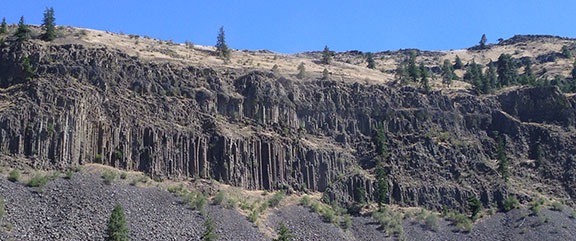
The cliffs are beautiful, with layers of tall basalt columns, tumbled rock making up talus slopes, and ponderosa pine trees. On summer mornings and late afternoons, the brown rock glows with warm golden hour light. Bighorn sheep jump from rock to rock up there and I can often hear the tiny landslides of rocks they set tumbling down the cliffs. Once in a while, they’ll come down as far as my neighbor’s yard to graze in his grass. I haven’t seen them across the road at my place. Yet.

Cliffs
Here’s a shot of the cliffs behind my home, taken last summer from my driveway. The talus slopes go almost all the way down to my neighbors’ homes on that side of the road. In fact, my neighbors’ lots actually include the cliff faces. (Not exactly usable land.)

Lay of the Land
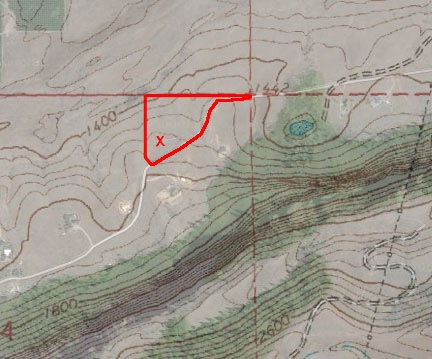
I threw together this hybrid topo/satellite map to show the lay of the land. The odd shaped red box is my 10 acre parcel; the south property line follows the road — hence the odd shape. The X is my homesite. If you know how to read topo maps, you know that closely spaced lines indicate steep hills. In this case, the cliffs behind my home rise in two steep steps about 1,000 feet above me.

Of course, living so far north means that the angle of the sun is low during the winter months. While the whole area has long nights and short days, the folks on my road have another winter issue to contend with: living in the shadows. You see, for a period ranging from weeks (in my case) to months (in some neighbors’ cases) straddling the winter solstice, the sun does not rise high enough above the cliffs to clear them and shine on our homes.

I call this the Shadow Time.

I knew this was going to be an issue when I bought my place. It had me so concerned that in the winter of 2013, when I was still living in Arizona, I took a week-long trip up to Washington state to see for myself. It had been a very long time since I’d lived in a four-season place with a snowy winter. I wanted to experience it firsthand so I knew what I was getting into by buying here. Every day during that week, I drove the rental car — a minivan — up into the hills to look at my place. I wanted to see what the light was like. I wanted to see how much shadow there was.

That was my first exposure to January’s fog, which engulfs the valley 25% to 50% of the time — my place can be above, below, or in it. And the snowy roads. And the shadow.

But I didn’t think it was so bad. Besides, I expected to travel during the winter each year and probably wouldn’t experience it at all. So I went forward with my plans and bought the place in July 2013. I don’t regret it one damn bit.

This is my first full winter living up here. It’s hard to tell with the variable weather we get here in the winter time — it’s mostly sunny most of the year — but it seems to me that the Shadow Time starts in the first week of December and ends in the second week of January. I marked my calendar with January 15 so I could remember to pay close attention.

But as this past week whizzed by, the weather was not cooperative. There’s that January fog to contend with. Even the sunny days had some clouds to the south or southwest. It might be blazing sun down in the valley with brightness up here. Was that the sun trying to get through the clouds? Or was it still back behind the cliffs?

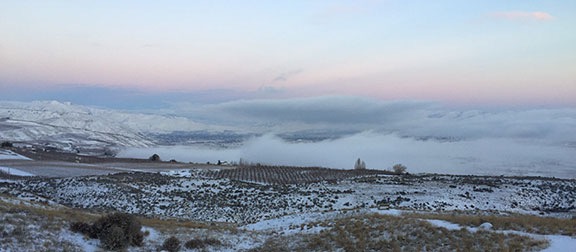
Yesterday dawned bright and clear, with just a few clouds scattered about. It had snowed overnight and I measured 3 inches of fresh snow on my concrete driveway apron. A low fog settled over the river; it would clear once the sun hit it.

Low Fog
A low fog settled over the river and Wenatchee just as the sun was rising. This was shot from the deck outside my bedroom door; my elevation is about 800 feet above the river. If you look closely, you can see my Lookout Point bench.

I went about my day, watching the shadows get shorter and shorter, seeing how the direct sunlight came closer and closer to my shelf. The insulation guys were hard at work, stuffing the space between studs with brown batting. Downstairs, in one of my garage bays, the framing guy was boxing around my plumbing so the drywall work could meet building codes for fire safety requirements. I had ribs on the Traeger and, at about 2 PM, we all took a break upstairs for lunch.

And that’s when I noticed the sun shining on my Lookout Point bench. As we ate ribs and salad and chatted about the view and construction and other things, I watched the shadow retreat to the south. Then the sun was shining through my high windows and my west side bedroom window. Outside, I could see the shadow of my building and the tall pole with its multicolored wind streamers.

The sun was back. Shadow Time was over.

Bragging
I bragged to my neighbor that the sun was back and I think she was envious.

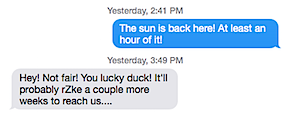
I had at least an hour of direct sun yesterday — possibly more. It didn’t start until about 2 PM and it was still full on my place at about 2:40 PM when I drove away for a doctor’s appointment. I stopped to take a photo and texted my next door neighbor, whose home is higher up but tucked back closer into the hillside. Her response an hour later showed a bit of envy.

The Sun is Back!
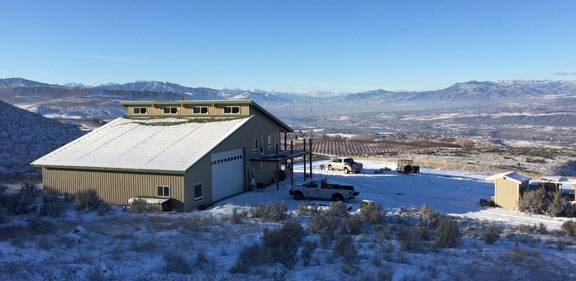
I shot this photo from the road behind my home as I drove into town for an appointment. Those high windows really catch the winter sun.

I suspect that the Shadow Time really ended a few days ago but I couldn’t tell because of the cloudy weather. That’s okay. I’ll get more and more sun every day now — probably 15-30 minutes, depending on the sun’s arc in the sky and the shape of the cliffs it has to clear. The cliffs get lower and farther away to the southwest — that’s why I get afternoon sun first.

In about a month — or maybe sooner — I’ll start getting sun on the east side of my building as early as 10 or 11 AM. I’m hoping to have my front deck done by the time the dawn sun hits it so I can drink my coffee out there as each new day is born.

I’ll admit that I’m disappointed that I don’t get full sun all year like the folks farther north of the cliffs. But, at the same time, it was never my intention to live here year-round.

This year I have a job to do: finish my home. Next year I’ll go south, likely before Christmas or perhaps right after my annual Christmas ski trip. I’ll miss the January fog and much of the Shadow Time, returning in late February or early march to fully enjoy the orchard blooms and get my garden started.

For now, I’m just happy Shadow Time is over and look forward to more sunny winter days ahead.