I play around with my new fisheye lens.
With my helicopter in the shop for some routine maintenance — can you believe I flew 100 hours in the past three months? — Mike and I decided to spend the weekend at our vacation place at Howard Mesa. The shed needed to be winterized and Mike wanted to replace the PVC plumbing (which cracked twice last winter) with real copper pipes.
When I wasn’t holding pipes so Mike could solder them (or driving down to Williams to pick up the fitting he’d forgotten to buy), I played. I’d brought along my Nikon D80 and the two new wide angle lenses I bought for it, including the 10.5mm fisheye (equivalent to a 16mm lens on a 35mm camera). I’d gotten the fisheye lens last week and didn’t have time to try it out.
A fisheye lens offers a 180° view of whatever you point it at. This introduces all kinds of distortions into the image. It also poses special challenges to the photographer, not the least of which is to keep herself out of the photos.
I played with it a tiny bit at home, where I got confirmation of what the lens’s instruction booklet said: the built-in flash would cause vignetting.
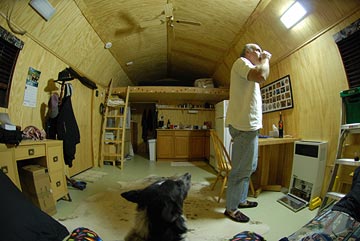 So when I tried it in the shed last night, I turned the flash off. I held the camera steady for the 1/4 second shutter speed that captured this image, which shows my husband, Mike, taking a quick drink before trying to fix the furnace. In the lower part of the photo, you can see my knees (clad in my wild chili pepper pants) and the sofa I sat on. Jack the Dog was sitting between my legs, watching Mike. The shot shows 90% of the shed’s main room.
(Mike was not successful fixing the furnace last night. It got down to 55°F in the shed. In the morning, he took the darn thing apart and pulled a mouse nest out of its innards. It now works fine.)
In the morning, I went out to photograph the horses. We’d brought them with us, primarily because it’s easier to bring them along than to find someone to feed them while we’re away. It got down into the low 40s last night, but they have thick winter coats. (In fact, they feel quite cuddly and very huggable.) At about 9 AM, they were standing together in the sun, in a spot out of the mesa’s incessant wind. Jake, who is about 25, had led Cherokee to the spot. Cherokee probably didn’t know why they were standing there, but he always follows Jake’s lead. Occasionally, he’d nibble on some of the dried grass that grew in clumps all around him.
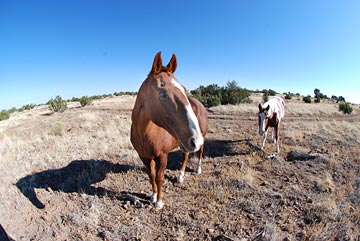 I brought out two apple pieces, which was a bad idea. As soon as they realized I had food, they wouldn’t leave me alone. They kept nosing my camera bag and shirt and it was all I could do to keep the camera out of their reach. But finally they realized that I wasn’t an apple tree and left me alone. Then it got tough to photograph them. They wouldn’t stand still. I managed to capture this shot of Jake with Cherokee in the background.
This was a good experiment. First, the challenge was to keep my shadow out of the photo. I couldn’t shoot with the sun at my back, like I normally would. My long shadow would have made it into the photo. I had to shoot at about a 90° angle to the sun. You can see the horses’ long shadows. I think the shadow in the lower left corner might be part of mine.
Also, from this shot you’d think I was standing quite a distance from Jake. I wasn’t. He was about a foot away. And Cherokee couldn’t have been more than 2 feet from him. The lens really exaggerates distances.
And check out the horizon. It should be flat. But the closer a straight line is to the edge of the image, the more curved it is. So a relatively flat horizon becomes an exaggerated curve. Kind of cool, no?
The next thing I tried was a duplicate of one of the shots you might see among the images that appear in the Header of this site: a dead tree with my windsock in the background.
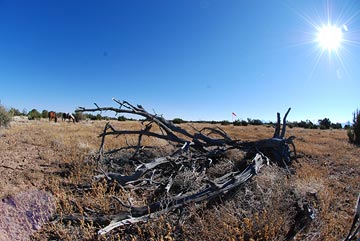 This first shot was taken from about 2 feet from one end of the log. There’s not much curvature at all. And yes, that’s the sun. With the fisheye lens, it’s hard to keep the sun out of photos.
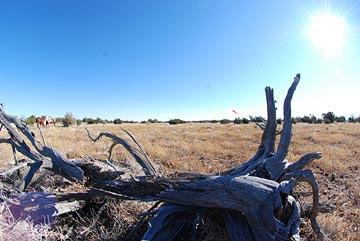 This second shot was taken about a foot and a half from the middle of the log. It’s a bad exposure; I’m not quite sure what I did wrong here. Still not much curvature.
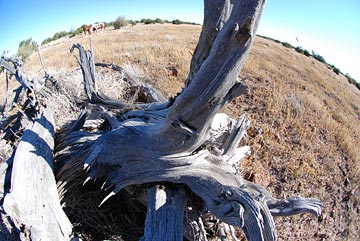 This third shot was taken 6 to 12 inches from the end of the log. I focused on the log, but because there was so much light, there’s a decent amount of depth of field. You can really see the curvature of the horizon, but can still clearly identify the horses and windsock.
Okay, so it’s not art. But it is interesting. And it’s helping me to learn how this lens “sees” my subjects.
This evening I’ll do some panoramas of the western sky right after sunset. It was outrageously beautiful last night when we arrived up here. I’m also hoping to do a long exposure of the night sky, which should be star-filled. (No clouds in sight again today.) Tomorrow, I might go down to the local “four corners” intersection and do some 360° panoramas of the view from there.
Comments? Tips? Use the Comments link or form for this post to share them.
 A lot of the photographers I’ve been working with —
  Although lens collection includes a 28-85 mm zoom lens, I only recently discovered that a 28 mm lens for a film camera doesn’t give you a 28 mm focal length on a digital camera. There’s a conversion factor, which I looked up for my camera: 1.5. That means the focal length of my lens is 1.5 times whatever the lens is labeled. So, for example, a 28 mm lens is resulting in a 42 mm focal length. (Please, someone, correct me if I’m getting this wrong. This is my understanding and I’m not an optics expert.)
 So I did some research and found that Nikon makes a 18-55 mm lens. I saw the retail price and decided to see if I could do better on eBay. I did. I bought a used lens in pretty good (but not “mint,” as advertised) condition on eBay for $81 including shipping. I got to play with it on Sunday when we were goofing off at the local airport. The photos you see with this post are examples. I didn’t have much to work with in the way of subject matter, so I took a few shots of my car (parked in front of my hangar) and a cool little airplane sitting out on the ramp.
 I sucked the data off the GPS in Mac OS with a one-trick pony program called
  Anyway, there is a side benefit to this. I also ran the KML version of the file though
 This photo is of the patio between the Bright Angel Lodge’s main building and the Grand Canyon’s South Rim at the Grand Canyon.
 This is the entrance to two of the cabin rooms at Bright Angel Lodge at the Grand Canyon. The cabins are small buildings, each of which house two or four guest rooms. They’re located right on the rim and some of them even have views into the Grand Canyon.
 Lookout Studio is perched on the rim of the Grand Canyon. I’m not quite sure of its original purpose at the canyon, but it now houses a gift shop that seems to specialize in t-shirts, rocks, and postcards. It has a wonderful balcony and a series of lower terraces.
 I took this photo from the balcony of my room at the Lake Powell Resort. The marina is in the foreground; the Navajo Power Plant is in the background, almost floating in the blackness of the empty desert around it.
 Here’s a close-up of the power plant. I used a 210 mm lens to get a this shot of the plant, which is about four to five miles from here.
 This is a boat dock with a fueling station at the Wahweap Marina. It looked cool from my room and even better in the photo.