In Denali National Park.
While in Denali National Park in June 2007, we took one of the shuttle buses 20 or 30 miles into the park. The shuttle bus service is very unusual — at least as far as my experience goes. It’s a glorified school bus, painted an earthy color — oddly, I can’t remember if it was beige or green! — that traveled down the park’s single dirt road, making a few bathroom/view stops along the way. But that’s not all the stopping it did. It also stopped every time we say some wildlife, whether it was a raven’s nest or a bear family. At that point, everyone on the side of the bus where the wildlife could be seen would lower their windows so we could all get shots of the wildlife.
You can read more about our day in Denali here.
I have mixed feelings about the experience. First of all, it was great to see wildlife in such a convenient way. It was especially good for folks with limited mobility — like the many older folks in the park as part of a cruise ship package. The bus made it possible for them to get the “Denali Experience” which they’d otherwise miss.
But I have a problem with limited access tourism. I believe that it has made it acceptable for us to visit natural wonders and see them through the window of a vehicle rather than to get out and experience them close-up.
You want an example? When I flew helicopters at the Grand Canyon, a good percentage of our passengers only saw the Grand Canyon from the window of a helicopter. While that’s certainly an incredible way to see the canyon, it’s certain not the only way — or, dare I say it, the best. A walk along the rim of the park is easy enough and will expose you to wildlife, the sound of the wind in the trees, the smell of the pines, the feel of the heat or cold coming out of the canyon. In other words. you use more senses than just sight. A hike or mule ride into the canyon will bring the canyon around you and make you part of its immensity. A raft trip down the Colorado River will let you experience one of the powers that carved the canyon and is still carving it today.
But this entry isn’t about the Grand Canyon. It’s about Denali and the wildlife I captured with my camera from the bus. You’ll see these photos in the header for this blog.
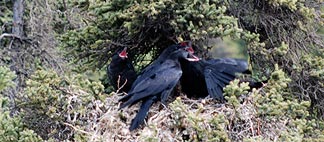 The raven’s nest was the first wildlife we saw. The nest was in a tree not far from the road. I was fortunate enough to snap this photo of one of the raven parents returning to the nest with food for its young.
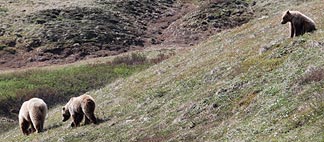 The bear family — mom and the two cubs — was a big hit. They were right near the road and we stopped for a while to watch them. Later, on another bus, we stopped to watch them again. Lots of photo ops. Unfortunately, the driver of the second bus was extremely rude and admonished anyone who had the guts to whisper when we were in the area. Too much noise, he said. As if big buses driving up and down the road all day didn’t make too much noise.
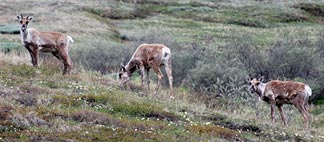 We saw some caribou along the way. At one stop, there were several of them and a bear in sight. I snapped this photo on the return trip.
I took more photos that appear in the header in Denali. I’ll discuss them in other entries.
 In June 2007, we made our first-ever trip to Alaska. The first part of the trip was a short stay with friends in Anchorage, followed by a train ride to Denali National Park. The much-touted train ride was long with plenty of scenic bits. The highlight was this view of Mt. McKinley, which I snapped from our train car seat.
 Monument Valley is on the Navajo Reservation, which is the largest of all Native American Reservations in the country. Access to the rock formations we know as monuments is controlled through the entrance of the Navajo Tribal Park. There are reasonable fees for entering and driving your own vehicle into the park. But for an additional fee, you can go with a Navajo Guide who will take you places you’re not allowed to go on your own. If you have the time, I recommend this, as it’s likely to be your only opportunity to step inside a traditional Navajo hogan.
 I normally fly to the park from Page along the southeastern side of Lake Powell. There’s a landing strip at
  Of course, to learn whether the tour would be good, I had to take one. I’ve actually taken the tour three times. I took this photo on the most recent trip. It shows two of the most famous monuments: the Mittens. They got the name because they look like those woolly things you might have worn in the winter as a kid. They’re formally called East Mitten Butte and West Mitten Butte. They stand hundreds of feet off the desert floor, towers of red sandstone that are still eroding in the high winds and summer storms of northern Arizona.
 The bird took off and I caught him in flight.
 I took this shot on the first glacier. It’s a huge boulder — probably 8 feet long by 6 feet wide by 3 feet tall — and it’s being held horizontally off the surface of the glacier by a column of ice. The ice, of course, is melting — not from global warming but by summer warmth — and I suspect this boulder is now lying elsewhere on the surface of the glacier, a bit downstream as it moves with the flow of the ice. Perhaps it’s sitting in a similarly awkward position and another tourist has snapped a shot of it — maybe with his wife or kid sitting or standing on it! That’s the weird thing about glaciers: they’re always changing, always moving. The rocks and boulders on their surface are just along for the ride.