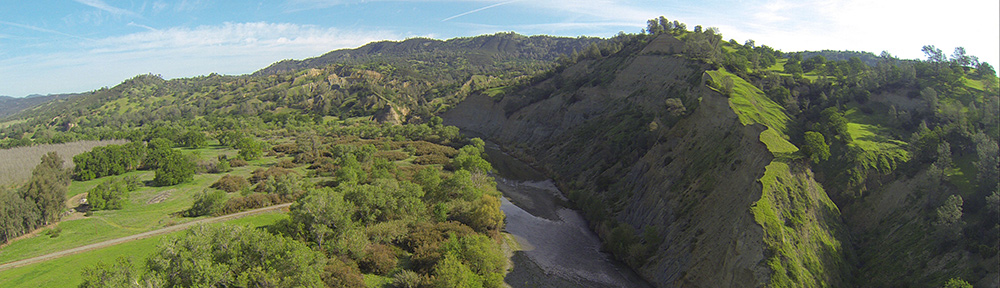
And Oregon is, too.
[When we last left our intrepid traveler, she was making herself at home in a 21-foot travel trailer parked in a casion parking lot in West Wendover, NV. You can read about the events leading up to this point here.]
I went into the casino at 5:30 AM in search of a cup of coffee. The espresso stand looked open, but it wasn’t. I asked a person who worked there what time it opened and she said 7 AM. I was about to freak out when I realized that my watch was on Mountain Standard Time and the casino was on Mountain Daylight Time. It was really 6:30 AM. I only had to wait 30 minutes.
After a peek across the street to see if there were another option — there wasn’t, unless you count McDonald’s, which is evidently getting high marks from some folks on their coffee; I’m not that brave — I went back to the camper. I busied myself finishing up the blog entry for the previous day’s drive. I’d just connected to the Internet with my Treo to upload the post when the phone rang, cutting off my connection. It was Mike. He has a real knack for calling when I’m using dial-up networking. By the time we finished chatting, my computer’s battery was nearly dead and the inverter I’d bought to power it in the camper wasn’t working. So the post didn’t get posted.
I went back into the casino, where I spent $5.08 for a 16-ounce “latte” with an extra shot of “espresso.” Note the quotes. I’m putting these terms in quotes because that’s what the casino called this stuff. It’s not what I received. In fact, it was barely drinkable.
 I went back to the camper and packed up my bedding. The camper’s two queen-sized beds fold out the front and back of the camper and resemble pop-up camper beds. Although it’s not difficult to set these up, it really wasn’t worth it for a night of sleep in a parking lot. So I left the beds folded up and opened the sofa to a bed. This wouldn’t have been bad if the bed were long enough for my 5’8″ height. I’m thinking it’s about 5 feet long. I slept diagonally with my legs curled up. (This photo, taken with my funky fisheye lens, makes the camper’s interior look a lot bigger than it is. But it’s roomy enough for me. In this shot, the slide-out is fully extended; I usually only put it out halfway for overnight stays. You can see the closed-up front bed in the middle of the shot.) I didn’t have a good night’s sleep, but it really wasn’t bad, given the short bed and the fact that the parking lot’s lights made it bright as day outside all night long. Even the blinds couldn’t keep the light out. In the morning, when I woke up, I had to actually look out the window to see if it was daytime.
I got Alex back into his travel box — he spent the night in his cage — and loaded him into the car. A while later, after topping off both fuel tanks, we headed out. Oddly enough, it was exactly 7:05 AM. The same time I’d left Wickenburg the day before.
My route that morning took me west on I-80 to Wells. The 58 miles took about 90 minutes, mostly because of all the high elevation climbing we had to do. You see, the mountain ranges in Nevada generally stretch from north to south. When you drive north, as I did most of the day before, you’re driving on gentle slopes in valleys. But when you drive west, you have to climb over the mountain ranges in whatever mountain passes are on the way. That morning, there were three mountain ranges to cross. On one of them, the truck actually downshifted to first gear with my foot on the floor, unable to give me more than 35 miles per hour. Fortunately, I did better downhill.
The day was cloudy and it drizzled. When I approached Wells — which may have provided a decent place to spend the previous night after all — I saw that the mountains to the south were covered with fresh snow. In fact, it may have still been snowing.
I headed north on U.S. 93 again. The terrain was changing subtly. By the time I got to Jackpot, NV, on the border of Idaho, it was hilly and green and rather pleasant. I stopped at Cactus Pete’s Casino for breakfast, putting Alex in the camper while I went inside. It had a nice breakfast burrito with a cup of truly undrinkable coffee.
It was unfortunate I didn’t get all the way to Jackpot the night before. As my friend Stan had told me, Jackpot was a very RV-friendly place. It would have been a pleasant overnight stop.
Another refueling, then back on the road. I crossed into Idaho. Soon I was driving through farm country. At Twin Falls, I screwed up and followed U.S. 30 instead of 93. Although 30 was more direct, 93 would have gotten me to the Interstate a lot quicker. But the last 10 or so miles before I finally got on the Interstate was actually quite pleasant, winding alongside a river with lots of little waterfalls. (Maybe that’s what that “Thousand Springs” on the map was all about.)
Meanwhile, the weather remained variable: mostly cloudy with scattered rain showers. By 11:30 AM, I was feeling as if I needed a nap. That’s not a good thing when you still have about 400 miles to drive. I started thinking about maybe not getting all the way to Quincy by nightfall. Maybe an overnight stay in a nice campground would be better. Someplace with an electric hookup and WiFi.
By the time I got to Boise, it was pouring. I kept going. When I reached Nampa, I got off the highway and fairly stumbled into a Wal-Mart parking lot. I wanted to stop at a Wal-Mart or a Target to buy a cheap vacuum cleaner for the camper. You know, the kind on a stick. My mother used to call them “electric brooms.” I figured a walk around Wal-Mart might wake me up a bit. And maybe it would stop raining while I was in there.
I turned out to be a Super Wal-Mart, with groceries. I thought I’d take the opportunity to pick up some food for the camper, just in case my overnight stop wasn’t anywhere near shopping or dining. I bought some soup and eggs and orange juice and cereal. That kind of stuff. Then wiper blades for the truck and the vacuum. I brought it all out to the camper and stowed it away. Then I studied the map and came up with a plan — I’d press on and see how I felt by 5 PM. If I wanted to stop for the night, there were a handful of state park campgrounds I could try.
So I fueled up again and headed back out on I-84. It was about 2:30 PM and the rain had let up considerably.
A while later, I passed into Oregon.
I don’t know if it was my tiredness or my lack of enthusiasm for Nevada’s dull scenery or the changeable weather, but the ride into Oregon on I-84 was beautiful. Rolling green hills, farmland, irrigation canals, streams, rivers, snow-capped mountains, trees, rock formations. The interstate twisted through all this, with the inevitable climbs to slow me down so I could get a good look. Unfortunately, the rain came down very hard sometimes, making for bad visibility and tricky driving. It was also making me tired.
I pulled off the highway at Baker City and consulted the map. There was a state park with a campground about 50 miles farther up the highway. I got back on the road and homed in on it.
Hilgard Junction State Park is a tiny sliver of land alongside a creek just off the freeway. It offers primitive camping that includes a paved parking spot, picnic table, and fire pit. There’s a water faucet every 3 or 4 sites and a garbage pail every 2 sites. There’s also a restroom with cold running water. A campground host watches over all this. The fee: just $8/night.
 I drove in to check the place out. The campsites were right on the creek. I drove down the little road toward the turnaround loop at the end. The sites were not pull-throughs, so I’d have to back in. The hell with that, I thought. I found one with a nice, long driveway and pulled in head first, parking the truck’s nose facing down the creek. This pointed the camper’s front door right up the creek. I just fit in the space. Works for me.
There’s one major drawback to the campground. I cannot get a steady cell signal. This almost caused me to leave — if I didn’t check in with Mike, he’d worry and I’d get scolded. But as I walked toward the self-pay station and tried unsuccessfully to telephone him, I managed to get a few text messages out and get one in return. It seemed the signal would hold just long enough for sporadic text messaging. I’d succeeded in communicating with him so he wouldn’t worry and I could stay.
A while later, Alex and I were settled into the camper. I perked a small pot of coffee — of course I have a percolator! — and made some soup. I enjoyed both while sitting on the camper step, looking out over the creek. My closest neighbors, two sites away, made their dinner on the fire and retired into their Minnie Winnebago with their two dachshunds. I made my sofa bed with an extra blanket on it, did the dishes, and fished out the 300 watt inverter to charge up my laptop. I even ran the heat for a while to get the dampness out of the camper.
As I finish writing this, rain is falling gently on the camper roof. Alex, in his cage, seems to be settled in for the night. I’m less than 200 miles from Quincy. While I probably could have made it there if I drove hard, this one last night on the road is like a little vacation before I get to work.
 I rolled into West Wendover around 7 PM. It was exactly as I’d imagined it. Bigger, in fact. I homed in on the casino with the brightest lights and biggest parking lot. I pulled into a spot at the far end of the parking lot and used Google Maps in my Treo to look up the casino’s phone number. Minutes later, I had the security department’s permission to park there rather than in the truck parking lot across the street. This shot was taken with my Treo a while later, after dinner in the casino’s steakhouse.
 Our course took us quite close to
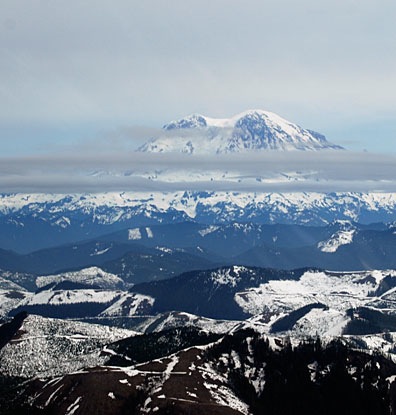 I punched Boeing Field (BFI) into the GPS and we got back on course. We passed far to the west of Mount Rainier, then headed inbound. Louis had done much of his training at Boeing Field, which is squeezed into a tight area north of Seattle-Tacoma International (SEA) and Renton (RNT), I so I turned all navigation and communication over to him.
 The morning was cool with a very gentle breeze as we headed north. We were at the northern end of Sonoma Valley, where it narrowed. We climbed into the hills.
 As we climbed, the landscape changed. There were tall pine trees, rocky outcroppings, and rushing rivers below us. At one point, we crossed over a new bridge under construction. Louis circled it at my request so I could get a decent picture of it.
 We continued up route 101 until it dumped us into a valley at Eureka. In the distance, beyond numerous farm fields, we could see the ocean with a marine layer moving it. It appeared that we’d have the same coastal clouds we’d had the day before, farther south. I wasn’t interested in flying over the tops of clouds along unfamiliar coastal terrain. I wanted to go inland. But with fuel at half tanks, I also wanted to top off fuel before we changed course. According to the chart, Murray Field at Eureka had fuel. So we headed in and landed at the field.
 By this time, the wind was coming off the ocean, bringing clouds inland with it. You could see wisps of clouds speeding east, over the airport. We were advised to head north along the coast until we got to Crescent City, then follow route 199 (I think) inland to Grant Pass. That’s where we could pick up I-5 north to Portland. I was doubtful; I really didn’t want to fly over the clouds for the 50 to 60 miles to Crescent City. But I decided to take a look. We said some quick goodbyes and started up. I took off, climbing steeply at 1000 feet per minute through a scattered 200-foot ceiling of clouds. From that vantage point, it was easy to see where the clouds ended and the land began. Sometimes the clouds would be out over the ocean. Other times they stretched inland into the mountains. I handed over the controls to Louis and we continued north along the edge of the cloud bank at about 1,500 feet.
 The cloud bank had shifted out a bit to the ocean by the time we reached Crescent City. It was very tempting to continue north along the coast. But when I looked out beyond the nearest clouds, it seemed to me that the clouds were thickening, climbing higher into the sky. I didn’t want to have to climb with them. And I certainly didn’t want to lose sight of the ground. So I decided to head inland, following the advice of the guy at the FBO. We turned east, found route 199, and followed it.
 About 20 miles south of Portland, I dialed in Portland Approach and told them where we were and where we wanted to go. Although we were landing at Portland, it wasn’t Portland International. It was Troutdale (TTD), which sits on the Columbia River just east of Portland. Neither Louis nor I knew the area, so I used the magic word: “unfamiliar.” We got a squawk code for our transponder and vectors toward Troutdale. When we got closer, we were handed off to Troutdale Tower. I told the controller we wanted to land at “TV Land” — which is what I’d been told — and he guided us in to a ramp near the east end of the runway. The grassy field I’d been told to park in was clearly visible and I told the controller we’d land there. Louis set us down and we shut down.