Gone to the Wind[mills]

A visit to Washington’s other source of alternative energy.

Washington state is widely known for its cheap, reliable electric power. One reason it’s cheap is because it’s hydroelectric — the Columbia and other rivers in Washington have been dammed up with numerous hydroelectric plants, many of them built as part of the New Deal in the 1930s. (An interesting side note here: we visited the Grand Coulee Dam and learned on the tour that power wasn’t one of the reasons the dam was originally built. The two primary reasons were irrigation and flood control. I really ought to write about that tour in another post.)

Anyway, Washington is also on the leading edge of renewable power generation from wind generators or windmills. Puget Sound Energy (PSE) has two facilities, one of which is on a series of ridges in Kittitas County, 18 miles east of Ellensburg. This Wild Horse Wind Facility is clearly visible from my camp just south of Quincy, about 20 air miles away. It’s also open to the public for tours. So on Saturday afternoon, feeling a dire need to get away from the book project I’m working on, I headed out to see the place close up.

It’s easy to get to. From I-90, take the exit for Vantage, which is on the west side of the Columbia River. After stopping for a burger at Blustery’s, head up the old Vantage Highway. You’ll get to the turn for Wild Horse about 12 miles up the road. It’s hard to miss — the road is clearly marked and you can see lots of windmills from the main road.
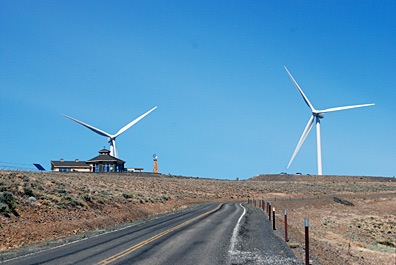
Wild Horse Wind FacilityFollow the entrance road about three miles as it winds up a hill. You’ll pass a bunch of windmills along the way — the road actually passes quite close to a few of them. Eventually, you’ll see the Visitor Center at the top of the site. Behind it are a few windmills that, when seen with the building in front, look absolutely enormous.

When I arrived, an all-girls camp group was there. The girls were in their early teens. I managed to latch on to one of their tours, which included a walk up eight or so steps into the tower at the bottom of one of the windmills. Afterward, I wandered around a bit, got technical information about the facility, and took plenty of photos.
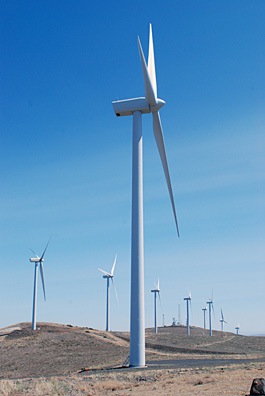
WindmillWant some stats? The facility is on a 9,000 acre site overlooking the Columbia River Basin. It was started up in December 2006 with 127 wind turbines. Each turbine is capable of producing up to 1.8 megawatts of power in 31 mph winds, for a total of 229 megawatts. The turbines start generating power at 9 mph of wind and are programmed to feather their blades and basically shut down when winds exceed 56 mph to avoid damage. Since the site is usually pretty windy, the facility does a pretty good job generating power.

Each turbine sits atop a 221-foot tall tower. (See the flight of steps at the very bottom of the tower in this photo? It has about 8 steps. That should give you an idea of scale.) The foundations go down 25 to 32 feet and each have 120 anchor bolts around the 13-foot wide tower base. The bolts are huge, as you might imagine.

The turbines, which are manufactured in Denmark, generate power at 690 volts. A transformer inside the turbine housing, steps up the power to 34.5 kilovolts. These turbines are atop the tower (of course) and are about the size of a typical RV or motorhome. They’re reached from a ladder inside the tower.
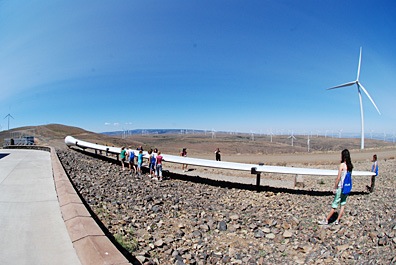
Windmill BladeThe blades are also huge. There was one on display outside the visitor center and I snapped a photo with my fisheye lens (which explains the distortion) of the girls gathered around it. Each of a windmill’s three blades is 129 feet long, 11.6 wide near the hub, and 1.6 feed wide at the tip. They’re made of composite materials, are hollow, and weigh 7 tons each. When you figure the length of the rotor blade into the total maximum height of the windmill, you get 351 feet.

It’s no wonder I can see them from 20 miles away.

We all know that the environmentalists are concerned about windmills and their impact on birds and bats. I asked about this. I was told that the facility averages 2 dead birds per turbine per year. I think more are killed being hit by cars. The folks at Wild Horse take the situation seriously and collect and bag all birds found. Bats are not an issue there.

For me, the most amazing part of visiting the windmills was the sound they made as they were spinning.

After my tour in the Visitor Center vicinity, I hopped on the truck and followed the dirt road around the facility. I was out to take photos and I got a few interesting ones.

If you’re in the area, I recommend a visit to the Wild Horse Wind Facility. Try calling 888-225-5773 if you need more info; I can’t seem to find the official Web site for the facility.

And if there’s a wind or other alternative energy facility open to the public for tours in your area, make it a point to visit with your kids. It’s a great way to learn about energy options.
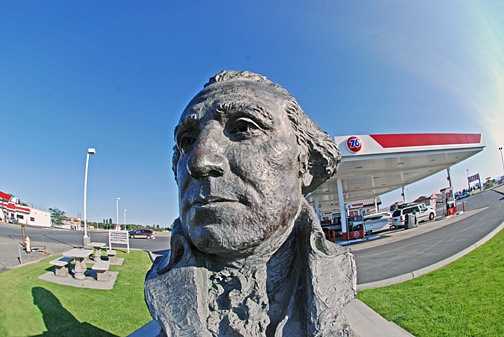
George Washington at the 76

Am I the only one who thinks this is funny?

On Saturday, on my way back from Ellensburg, I stopped off in George to buy a quart of milk. George is 5 miles south of my camper, and despite the fact that I’d driven past the town a half dozen times, I’d never stopped there.

The cleanest looking place in town to buy milk was the 76 gas station. I pulled in and parked. That’s when I spotted the bronze bust of George Washington. Moments later, I realized I was in George, Washington. (Duh-uh.) And then I realized that the 76 (as in 1776) sign was right behind George’s head.

So I took the photo.

George in Washington

Am I the only one who thinks this whole thing is funny?

Ginkgo Petrified Forest

Petrified logs, petroglyphs, and more.

On Saturday, I treated myself to an afternoon outing. My intended destination was the Wild Horse Wind Facility in Kittitas County. But I made a few stops along the way. One of them was the Interpretive Center for the Ginkgo Petrified Forest State Park near Vantage, WA, on the Columbia River.

I’m familiar with petrified wood. Arizona is home of the Petrified Forest National Monument (on I-40, east of Winslow) and I’ve been there a few times. But this forest was different. In Arizona, the wood was petrified as it became part of sedimentary rock. Here, the wood was encased in lava. But the results are similar: wood that’s been turned to rock.

I’ll admit I did the lazy tourist routine. I didn’t take a hike on the 3 miles of trails. It was hot and the trails were hilly. And I did have another destination. Instead, I stopped at the Interpretive Center about a mile north of Vantage. The small building offered sweeping views of the Columbia River from a cliffside perch, as well as many samples of polished petrified wood, scientific exhibits for all ages, and a small movie theater with visitor’s choice of informational movies about the area.

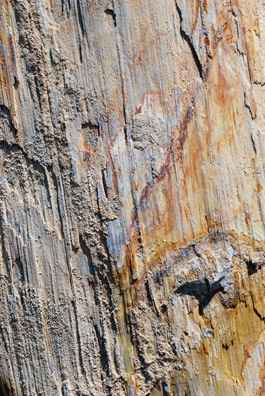
Petrified WoodAfter studying the various displays, I went outside. There we numerous petrified logs between the building and the parking area. I had my good camera with me and tried to get some shots of the textures of these logs. Here’s one of them. What I find most interesting about petrified wood is the colors. While I’m sure there’s a good chemical and geological explanation for all the colors, it would probably be lost on me. I don’t really care how they got the colors. I just like the colors.

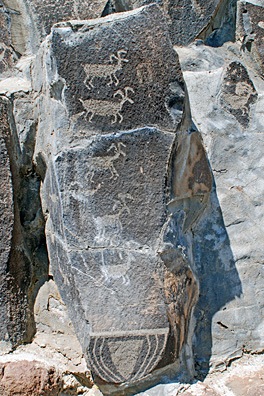
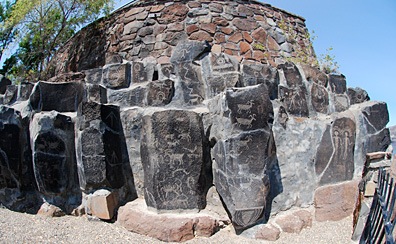
Ginkgo PetroglyphsAround the side of the building is a display, behind an iron fence, of some petroglyphs that were rescued from floodwaters when the Wanapum dam was completed downriver in 1963. But to understand why the rocks these drawing appear on look so uniform, I need to discuss the geology of the area a bit.
The entire area sits on layers of basalt from repeated lava flows in prehistoric times. With each flow, the land rose. Then, 15,000 to 13,000 years ago, a huge lake, Glacial Lake Missoula, formed in what is now Montana. It broke through the “dam” created by a finger of ice age glacier and quickly carved through the area. It did this at least 25 times over a period of 2,000 years, carving out canyons known as coulees. You can read more about the Missoula Floods on Wikipedia.

Because the basalt from lava flows forms as columns of rock — think Devils Tower (of Close Encounters of the Third Kind fame), which is similar — the force of the floodwaters carved away complete columns of rock, leaving behind other columns. The Columbia River flows in one of these canyons from Crescent Bar (west of Quincy and south of Wenatchee) to Vantage and beyond.

Ginkgo PetroglyphsFrom 1000 to 300 years ago, native people drew on these columns of dark rock near the river’s edge. There’s actually an impressive variety of petroglyph drawings. About 300 of them were physically moved from what would soon be Lake Wanapum to the side of the Interpretive Center at the park. That’s what I saw and what is pictured here. (And no, the building isn’t curved. I was using my silly fisheye lens in an effort to capture more petroglyphs in a tight space.)

I highly recommend a visit to the park, even if you’re just passing through the area. It’s not far from the Vantage exit on I-90, just west of the Columbia River. Vantage has fuel and a handful of restaurants. (I recommend a “Logger burger” at the burger joint on the corner closest to the highway.) There’s also camping in the area for RVs and tents. If you want to make it a quick stop, you can visit the Interpretive Center in less than an hour. But if you want a more in-depth look at the petrified logs and aren’t too lazy to walk, continue up the road to the park’s hiking trails. Be sure to bring plenty of water; I don’t think there’s much there.

For more info, check out the Ginkgo Petrified Forest/Wanapum Recreational Area Web site or give them a call at (509) 856-2700.

Hotwire Loses a Customer

Mike finally wises up.

My husband, Mike, is always looking for a travel deal. While there’s nothing wrong with that, what he usually winds up with is a prepaid travel deal with restrictions and other strings attached that make the trip a little less pleasant.

Hotels Deals?

His use of Hotwire, for example, has screwed us up more than once. He often uses it to book hotels. He claims he gets a better deal. What he usually gets, however, is a substandard room in the least desirable part of the hotel that doesn’t match his requests. I’m talking about the third-floor room in a high-rise that overlooks the air conditioning units on the roof of the hotel’s conference center. Or the one across the hall from the ice machine or elevator bank or housekeeping storage closet.

The request thing really bugs me. Hotwire — and most of those special deal booking services — include a field in the reservation form where you can enter requests, such as “quiet room” or “upper floor.” It usually also includes form fields for bed size (i.e., King, 2 Queens, etc.). The trouble is, the hotels either don’t see or don’t get these requests. While we’ve never been stuck in a smoking room after requesting nonsmoking, we seldom get our requested bed size (a single King or Queen). And the other requests regarding room type are usually ignored.

So what is your special deal getting you? Certainly not what you wanted.

And what kind of a deal is that?

While it really doesn’t matter on a one-night stay, getting a less-than-satisfactory room on a multi-night stay can really ruin the trip, especially if it’s supposed to be for pleasure.

The hotels, in the meantime, don’t give a shit about you. In their eyes, you’re paying $99 for a $199 room — or whatever your special deal is — and you’re at the very bottom of their list for service. They don’t care about you. They don’t want your kind in their hotel. The very fact that they have to take in Hotwire guests cheapens their establishment, in their eyes. So when you realize that your vacation is about to be ruined by your room’s view of the garbage dumpsters rather than the mountains or ocean on the other side of the building, and ask to get a different room, they respond that the hotel is full. They’re not even willing to do a deal with you for an upgrade. I think it’s because you pay Hotwire for the room — not the hotel itself — and making a change is likely to start an accounting nightmare for whoever’s at the desk.

This happened to us twice on trips Mike booked for the two of us. After the second time, I made him promise he’d never book a hotel through Hotwire for a trip I was going on with him. But Mike continues to use Hotwire for his solo trips, and for the trips he takes with his family members. Whatever.

Rental Car Reservations?

Well, Mike got bit bad by Hotwire this week. He’s flying to Seattle to visit me out in central Washington. I told him to fly into Wenatchee, which is 30 miles from where I was staying, but he was too cheap to pay the extra $220 airfare from Seattle to Wenatchee. He expected me to drive the 300 round trip miles twice to pick him up in Seattle and then take him back. When I explained that wasn’t happening in my 10 miles per gallon truck, he decided to rent a car. I had no problem with that because I figured that whatever he rented would be more comfortable and fuel-efficient than my 1994 Ford F150 redneck truck.

Now, I’ve rented cars too many times to count over the past 20 or so years. I don’t like doing it. There are too many different prices and options and add-on fees. I’ve found that the very best way to get a good deal is to check the Web sites or call the toll-free numbers for the top 3-5 car rental places that serve the market you’re going to and get quotes. Have your AAA or AOPA or whatever discount code ready. Unless you’re traveling with a lot of people, always ask for the smallest, cheapest car. Nine times out of 10, you’ll get upgraded for free. (I’ve been upgraded to convertibles, minivans, SUVs, and even sports cars.) The trick is to compare apples to apples to make sure each quote is for the complete and total amount. When you find the best price, book it through the car rental agency. They usually just ask for a name and phone number; they seldom ask for a credit card. You write down the confirmation number and present it at the rental counter when you arrive.

But Mike reserved through Hotwire. And not only did they charge him over $350 up front for the entire rental, but the “reservation” was non-refundable. So when I picked up a contract in the Chelan, WA area and needed my truck (and its miserable fuel transfer system) up there with me, he was unable to cancel the car reservation and make the plane reservation (as I’d originally requested — and yes, that’s an “I told you so”). As a result, he’s paying $350 to rent a car to drive himself from Seattle to Quincy and back again. For the rest of his stay, the car will be parked in front of my camper at the Quincy Golf Course.

After battling with a “supervisor” at Hotwire and the rental car agency and getting nowhere, he admitted that he’d learned his lesson: He will never book anything with Hotwire again.

The Moral of this Story

I guess the thing that bugs me most about this affair is the fact that you can really get screwed just trying to save a few bucks. And while it’s nice to save money when you can, there comes a point when saving $20 or $50 on a 10-day car rental isn’t worth the restrictions and headaches that go along with the savings. In this case, by booking his car rental through Hotwire a few days in advance of the trip, he forfeited all of his travel flexibility.

Moments ago, with 10 minutes of work, without any discount codes, I found a suitable car rental through Enterprise for $373.56 — less than $25 more. Is it worth $25 — less than 7% of the purchase price — to pay for something in advance without any chance of refund?

To add insult to injury, our financial situation does not make it vital to save the $25. It’s not like we’re broke. But that’s part of the big picture. And sometimes, for some people, it’s tough to see the forest for the trees.

Quincy Tales: Crop Dusters

A report from my summer camp.

Crop DusterCrop dusters work the area every morning if the wind is calm. I can hear the zooming around. It reminds me of the airplane scene in North by Northwest.

The planes are usually small one-seaters, although I did see a biplane the other day. I took this photo this morning from the grassy yard of my campsite as the plane was making a turn for another pass over the field across the road. I’ll try to get better photos of them in the future.