My Traveling Bees

If spring won’t come to the bees, the bees will go to spring.

I was very surprised, about a month ago, when a fellow helicopter operator offered me a 6-week (minimum) frost control contract in the Sacramento area. I’ll explain what frost control is in another post; for now, just understand that it required me to relocate with my helicopter to California for at least the 6 weeks of the contract.

Winter in Washington had been mild, with seasonal daytime temperatures around freezing but very little snow. All that changed about two weeks ago when the temperature dropped and then the snow started falling. Not a lot of snow, but enough to make it actually feel like winter for the first time. It was my first real winter since leaving New Jersey in 1996 or 1997 and although I didn’t exactly mind the cold weather, I was ready for spring. So I was very pleased to be offered an early escape from winter that would bring me back home in time for the local spring.

My bees, of course, were all set up for winter. I’d lost one of the three hives and wasn’t sure how the other two were doing. The cold weather was keeping them inside their hives where they’d cluster together around the queen to keep her and themselves warm. It wasn’t a good idea to open up the hives for a good look when it was cold out. I’d already had a peek in late January and had a good enough idea of the situation.

The Crazy Idea

Sometime in the last week before moving my RV out of Washington, I got this crazy idea: it was warm in California and the entire area would be full of blooming almond trees and then walnut trees. If I brought my bees with me, they could skip the last two months of winter and get an early start on spring. I might even be able to get a good start on honey production and do a hive split. And of course, with so many bees in the area for almond pollination, there was even a chance I’d be able to capture a swarm or two.

But could I bring my bees? While it’s true I was driving a full bed pickup truck, I was also pulling a fifth wheel RV. But that fifth wheel had a gooseneck hitch on it, greatly reducing the amount of space the hitch needed in the bed. Could I fit the hives in the pickup bed and still tow the trailer?

The two hives were set up differently. One, the weaker of the two hives, was a single deep hive body with a frame feeder in it to supplement the frames of honey. The other was a deep hive body with a medium body on top; that contained a top feeder. But I didn’t need that top box or feeder for the trip south. I could make that a single deep box high, too. That would fit in the truck bed beneath the fifth wheel.

In all honesty, it wasn’t until the day before I pulled out that I made the decision to give it a try. Even then, I decided that if I couldn’t get it to work out, I’d leave them behind. But late Wednesday morning, I was up at my property with the pickup parked in eight inches of relatively fresh snow near the hive shelter I’d built the previous autumn. And as the temperatures climbed into the high 30s, I was unwrapping the winter insulation from the hives, reconfiguring the taller hive, strapping the hive boxes between their covers and bases, and stuffing rags into the hive entrances. Then I lifted them into the back of the truck. I put the dead hive in there, too; I’d need its components for a hive split or swarm capture and may as well bring it along.

The Drive South

By 12:30 PM — a half hour after my planned departure time, I was at the airport where I’d parked my RV before the snow had come. (Good think I did!) It was all packed and ready to go. I just needed to hook it up to the truck.

When I backed into position, however, I realized that there were bees flying around the back of the truck. On closer inspection, I discovered that they were escaping through the bottom of the hive. You see, I’d replaced the solid hive bottoms with screened bottoms for mite control. While the weaker of the two hives had a Mann Lake screened hive bottom, the other one had a hive bottom made by a friend of mine. He’d used 1/4 inch mesh. As I pointed out to him, he really needed to use 1/8 inch mesh — the bees could squeeze through the larger openings. And indeed, that’s what they were doing. Some of them were coming out for cleansing flights. This would be a problem.

I went into my hangar and found some cardboard. I stuffed it under the hives. Then, for good measure, I stuffed an old saddle blanket I keep in the truck under the hive the bees were coming out of. That would have to do.
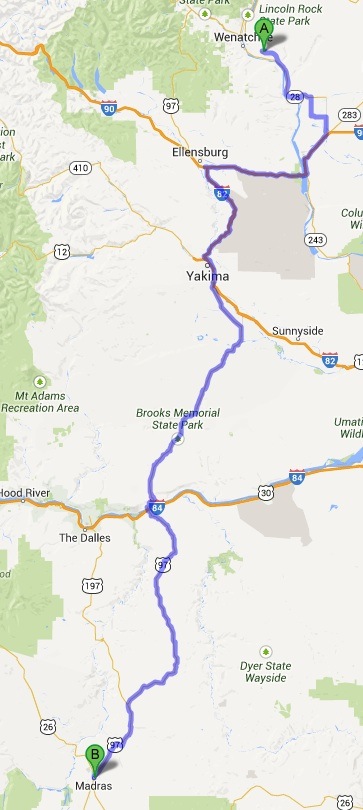
Day One
I covered 287 miles the first day of driving.

I hooked up the RV, did my walk around, climbed into the truck, and started off. It was 1 PM and I was hoping to cover about 450 miles that day all the way to a casino near Klamath Falls, OR.

The drive was long but pleasant, with lots of sun and scenery. I drove through Quincy and got on I-90 at George. Then onto Route 97 near Ellensburg. South through Yakima. Cross the Columbia River at Maryhill State Park. Diesel on the Oregon side. Then mile after miles of rolling Oregon farm and ranch land.

It got dark along the way. I don’t like driving in the dark. Weird shit happens.

I changed my destination from Klamath Falls to Bend and then to whatever outpost of civilization I could spend the night in.

I wound up in Madras, parked overnight at a Les Schwab tire dealer parking lot, with a coffee stand on one side of me and a Subway restaurant across the street. I’d driven 287 miles.

I checked the bees before going in for the night. The hives had shifted around a bit, but there were no bees outside the hive. That didn’t surprise me. It was too cold for them to want to come out.

Icy rain fell during the night. In the morning, on my way to the coffee stand at 6:15 AM, I nearly slipped on the ice that had formed in the parking lot.

No sign of life among the bees. But I honestly didn’t expect them to be out and about with temperatures around freezing.
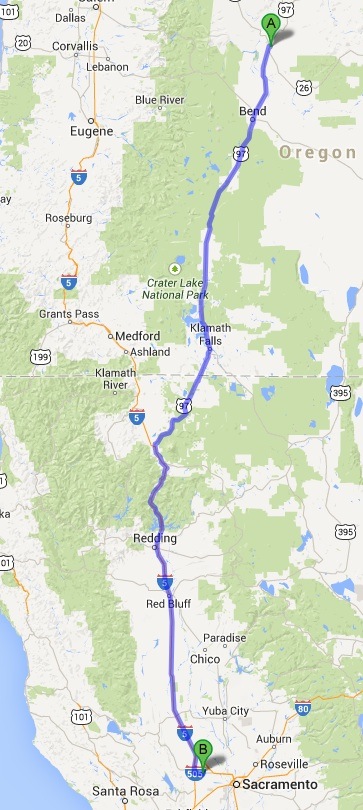
Day Two
I covered 461 miles on the second day of my trip.

I waited until 7:30 before continuing on my way. (Related: Subway, which opens at 7 AM, sells breakfast sandwiches.)

I continued along Route 97, passing through Bend and Klamath Falls. I was lucky to find a truck stop just before the border of Oregon and California where I fueled up for the second time on the trip. The truck was getting about 300 miles per tank of fuel. (It gets way better mileage than the Chevy I used to drive.) I realized that I might make it all the way to my destination without refueling again.

I followed a remarkably straight piece of road that had to be at least 50 miles long before climbing and descending in the foothills again.

At one point, I had an amazing view of Mount Shasta. Or at least the bottom half of Mount Shasta — the top was in a cloud.

Eventually, I reached Weed and joined up with I-5. The next 100 or so miles were mountainous, which wasn’t much fun in the rain. At least I didn’t have to worry about the bees wanting out.

Lake Shasta looked nearly empty. The water was at least 80 feet below the high water mark.

Finally, past Redding, the home stretch. It was great to see flowers on the almond trees I passed.

I got off the freeway at my exit and waited at the stop sign to make a left turn. That’s when I glanced up in the rearview mirror and saw about 200 bees flying around the back of my truck. As I’d driven, the weather had cleared and it had gotten warmer. The hives had shifted; the bees had begun to find their way out. With the truck stopped, they wanted out.
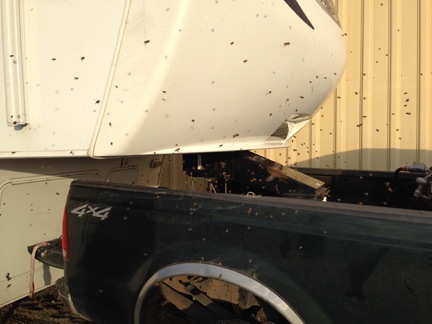
Bees
Hundreds of very unhappy bees buzzed around the back of my truck as I parked the RV.

I made my left turn and hurried the last 6 miles to my destination. By the time I was ready to back the RV into its space beside a hangar at the airport, it looked as if there was a swarm of bees in the back of my truck.

It was just after 4 PM and I’d covered 461 miles.

I had to put on my bee suit to unhook the RV. (Thank heaven no one was around to see that.)

I carried the two hives over to the side of the hangar about 25 feet in front of my RV and took the rags out. The bees from the strong hive immediately began flying out. The other hive remained quiet. I was beginning to think it was dead.

I went into town for a richly deserved dinner of chicken chow fun and Chinese ribs from my favorite Chinese restaurant West of the Mississippi. When I arrived at the restaurant, the bees that had been flying around the back of my truck were gone.

Parking the Bees

The next day, the airport manager told me to move the bees to the other end of the airport, in a rough grassy area where they tended to dump junk like old wood, tires, and fencing. We picked a place near the base of a tree. I dropped her off, donned my bee suit, and loaded the bees into the back of the truck. I had to move fast; it was getting warm quickly and the bees were eager to get outside.

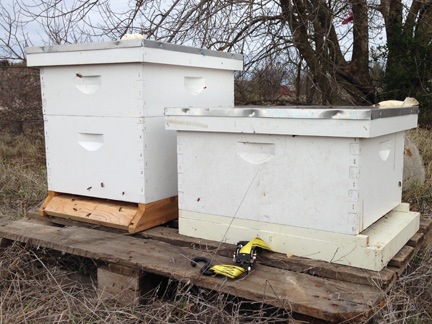
I found an old palette in the temporary bee yard and set it up as a base. Then I put the hives on it, one facing northeast and the other facing northwest.
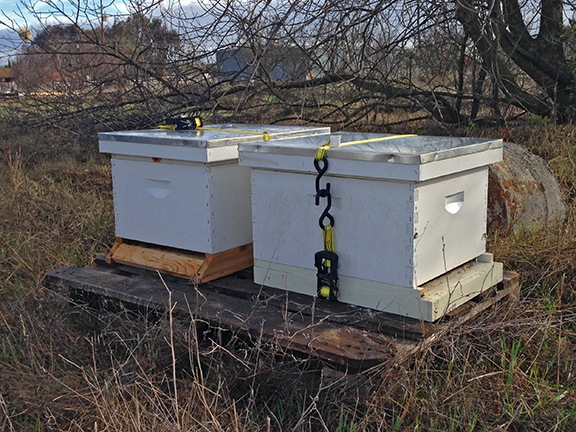
Bee Hives
The bees on arrival in their temporary home. (Can you see the hot air balloon in the corner of the photo?)

Later on, I returned with the dead hive and my beekeeping toolkit. I unstrapped the two hives and opened them up one at a time. I was shocked to see the number of bees in the healthier of the two hives. The population looked nearly as high as it did when I last looked inside that summer.

I pulled out and examined a few frames. I replaced empty honey frames with partially filled honey frames from the dead hive. I shuffled the frame around and put some brood frames from the dead hive near the center of the live one. The brood cells were empty, but there was plenty of honey in the cells around them. With luck, the queen would get right to work filling these cells with eggs. I also added a drone frame. (What the heck; why not?) Then I put a medium hive body on top of the deep and filled it with 10 medium frames. I kicked myself for leaving queen excluders at home; later, I’d buy one at the local Mann Lake store.

I closed up that hive — which was a good thing, because the bees were pretty pissed off by then — and moved on to the other one. I really didn’t expect to see anyone alive inside. But there was a clump of bees on two frames on one side of the box. They’d apparently eaten their way through the honey stores in the middle of the box. The clump wasn’t big — maybe 1,000-1,500 bees? I could only hope the queen was in the middle of the clump.
Bees
The two beehives after being configured for the next few weeks.

I did some major reorganizing. I removed some very old brood frames and replaced them with newer and cleaner brood frames from the dead hive. Then I added a honey frame filled with honey. I shuffled things around. I had to move the bees, of course — I used my bee brush to brush them into the frames in the center of the hive. Then I closed up the hive. I figure there’s a 50-50 chance of the bees surviving. If they make it through the next week and the queen is still alive, they’ll survive. I’ll examine the hive closely when I return from a trip to Santa Barbara this coming week. If I see the queen or eggs, I’ll know it’s all good. If I see neither, I’ll take action.

Either way, you can bet I’ll report on my progress here.

One more thing: it feels great to be working with my bees again.
Snowshoeing. Finally.

More like iceshoeing, if you ask me.

When I decided to spend the winter at my new home in Malaga, WA, I decided to embrace the winter. After all, it was the first real winter I would experience since leaving New Jersey for Arizona in 1997. And, from what I could see, the winter was likely to be about the same as the winters I’d experienced back east — perhaps a little milder but with a little more snow. Perfect for winter sports.

Embracing Winter Sports

Back in my New York and New Jersey days, I did some cross-country skiing — although not enough to ever get good at it. I discovered just how rusty and inexperienced I was when I went cross-country skiing up in the Methow Valley for Christmas. I had a great time, but also learned that I certainly need more practice.

Back in my east coast days, I also did some sledding, tobogganing, and ice skating — but very little of all three in my adult years. (I do vividly remember dislocating my shoulder on a Girl Scout skate outing — the troop leaders were convinced I’d broken my collarbone and the X-rays showed nothing because my shoulder had popped itself back into place before they could get me to the hospital.)

But snowshoeing? That was something that people back east just never did. In fact, whenever I conjured up an image of snowshoes, I saw wooden frames similar to the business end of a tennis racket strapped onto someone’s feet. Was that from cartoons or old movies?

When I moved out here, however, everyone was talking about snowshoeing and I soon realized that it was the winter version of hiking. I love to hike — it’s great exercise and a wonderful way to spend time outdoors with friends and my dog. Surely I’d love to go snowshoeing. I put snowshoes on my Christmas wish list and my brother sent them to me — thanks, Norb! I’d already outfitted myself with all the warm winter clothes I’d need to stay cozy while out in the snow.

But what snow? That was the problem.

Where’s the Snow?

This is my first winter in north central Washington state. I was here for a week last January, just to see what it was like. There was about 4-8 inches of snow on the ground, depending on where I was. No fresh snow fell during that time, but it stayed cold enough to keep the snow from melting.

Everyone told me that it usually starts snowing in December here and that it snows periodically through January and into February. They even said that April snowstorms aren’t unusual. Surely snow must be common — after all, there’s a ski resort right outside of town!

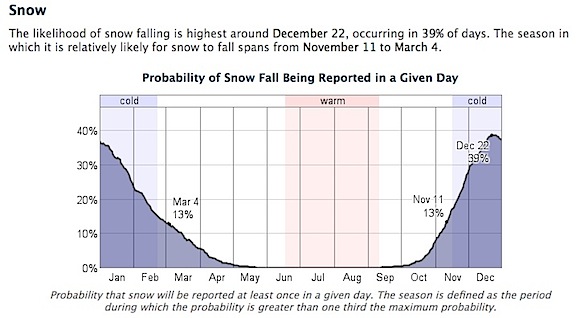
Weatherspark Snow
Here’s what Weatherspark has to say about snowfall averages in Wenatchee.

And things did start off promising. It snowed right around the time I moved into the house I’m caring for this winter — December 1 or thereabouts. There was about 2-3 inches on the ground — not quite enough to get the driveway plowed, but enough to see my truck’s tracks in the snow. I even bought a snow shovel, which I used to push the snow off the pathway so I wouldn’t track it in the house.

But that was it. It got warm enough over time to melt all that snow away. Then very cold and warm and cold and not so cold. It was always cold enough for it to snow out — daytime temperatures hovered around 30°F — there simply wasn’t any moisture in the air.

Or, actually, there was. But it came in the form of Wenatchee’s famous winter fog.

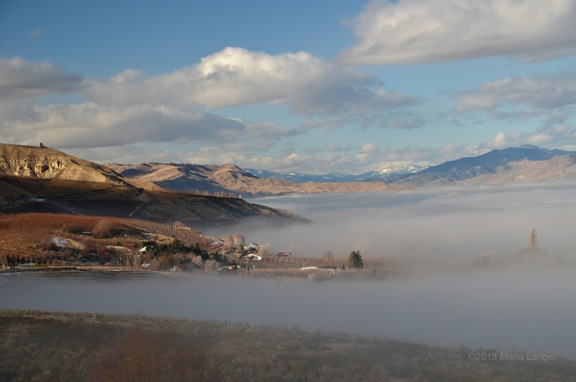
Understand that although I do live in Washington, I don’t live anywhere near Seattle or the ocean. This fog is a completely different from what you might expect in a coastal region. It apparently forms when there’s stagnant air — indeed, we’ve been under an air stagnation advisory for nearly two weeks now. That means no wind. None at all. Air quality isn’t affected — the air is crisp and clean. But a layer of clouds forms over the valley and sometimes dips quite low. More than once, the house I’m living in now (elevation 1200 feet) was in those clouds. Another time, it was above them.

Above the Clouds
The view out my window about a month ago. Have I already shared this? I really love this shot!

For some reason, this year we’re getting lots of that fog but none of the usual snow. And it’s not just Wenatchee, which sits at about 600 feet elevation. It’s also Leavenworth, which is the closest cross-country ski and snowshoeing area. There just isn’t any snow.

Showshoeing at the Fish Hatchery

I set up a snowshoeing outing for my favorite local Meetup group, the Wenatchee Social & Outdoor Adventure Group. It was a free outing at the Leavenworth Fish Hatchery, sponsored by Friends of Northwest Hatcheries. It included a 2-hour walk along hatchery trails, guided by naturalists. Snowshoes would be provided.

Of course, I brought my own. I went with my friend Tim — who seems to know everyone everywhere we go. We got there early and Tim wasted no time chatting with one of the guides while I went to check out the salmon fry in huge tanks in their indoor facility. (I could go into a lot of detail about what they do at this hatchery, but I’ll save it for another blog post — probably one after a springtime visit to the trails.) After a while, another four people joined us. Then a second guide arrived and we were ready to go.

Although there was no snow, our guides insisted that we bring and later put on snowshoes. The trouble was the ice — everywhere the snow had melted into pools had turned into patches of ice. Some of them were quite large. All of them were pretty slippery. One of the guides, Janet, said she didn’t want to be calling any ambulances today. Apparently she’d been calling them periodically over the past few weeks.

The three of the four later arrivals — all of whom traveled from Oregon for the weekend, I might add — came without snowshoes. We stopped at a shed along the way and Janet handed them out. Then we got on the trail along Icicle Creek. When the ice began covering too much of the trail to stay off it, we put on our snowshoes and continued on our way.

Maria on Snowshoes
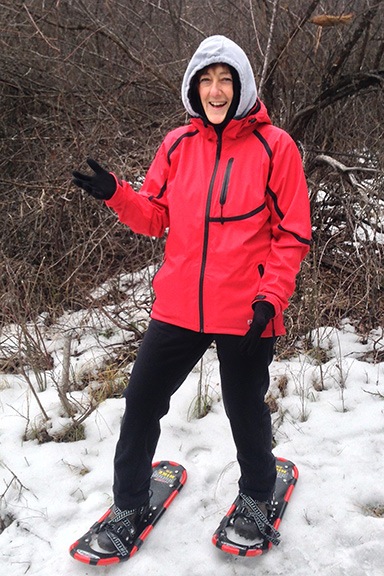
Tim took this picture of me in the snowiest spot we could find.

This was my first time wearing snowshoes. I didn’t have much trouble putting them on over my big Sorrel snow boots once I figured out how the straps worked. Soon I was crunch-crunch-crunching over the ice with my companions. The sound was deafening as the metal spikes at the bottom of the shoes stabbed through the ice, pushed down mercilessly by the weight of person above them. Whenever the guides wanted to tell us about something along the trail, we all had to stop and stand still just to hear them.

But what I liked most about them was that with them on my feet, I wasn’t going to slip one single inch.

We walked for about two hours stopping here and there along the trail. We learned about the various types of fir and other evergreen trees, including the incorrectly named Douglas Fir, which isn’t a fir at all. We saw tiny birds flittering about the trees over head, bear scratches on tree bark, beaver dams, and water-carved ice floes. We learned about various unusual local plants (like horsetail) and how they were originally used by the native people who once inhabited this area. I soon realized that we were on a very large and complex trail system that would be great to explore on foot in the spring, summer, or fall.

I would have taken pictures along the way, but I managed to leave my phone behind in the Jeep. That just gives me an excuse to come back with my Nikon, long lens, and monopod. Apparently the area is a prime site for bird watching, with plenty of viewing blinds along Icicle Creek. A springtime hike with Penny and my camera should be lots of fun, with plenty of photos to share.

We were back at the Visitor Center by 3 PM and heading back to Wenatchee a while later. I was glad to have had the chance to finally give my snowshoes a try. Tim tells me they’re a lot more fun when there’s a nice deep base of snow. Somehow, however, I suspect I’ll have to wait until next year to experience that.

The Hidden Lake Adventure

A short hike with a twist at the end.

I belong to several Meetup groups in the Wenatchee area, including the Weekly Hikes group — which doesn’t actually do hikes weekly. (As a matter of fact most of the Meetup groups I belong to in the Wenatchee area don’t do anything regularly, but I’m working on that in one group.) Len, a member of the Weekly Hikes group who lives up in the Leavenworth area, suggested a hike up to Hidden Lake, near Lake Wenatchee. I suggested it to my friend, Tim, who joined the group. The three of us did the hike on Saturday.

Tim and I drove up to the Park and Ride at “The Y” (where Route 97 breaks away from Route 2) with our two dogs in my Jeep. When Len arrived to meet us, he suggested going in his truck. I had no problem with that. Not only was it new and comfortable, but it would be a lot quieter than my Jeep. It also gave us the added benefit of getting to know each other before the hike. It would be at least a 30 minute drive to the trailhead. So we loaded our stuff and dogs into the truck and headed to Lake Wenatchee.

It was a nice drive with good conversation, mostly about Meetup groups and activities in the area. We all have one thing in common: we’re divorced and interested in meeting people to do things with — and form new, more intimate relationships. Our ages are pretty close, too, so we’re all on pretty much the same page. It was a pleasure to just chat with interesting people about things that matter to all of us.

One thing we talked about a lot was the snow — or lack of it. This is my first full winter in the Wenatchee area, so I really don’t know what to expect. But most folks have been telling me that there’s usually a lot more snow by this time of year, especially up near Leavenworth and Lake Wenatchee. Although we did pass the Tumwater Campground, which was closed for camping but open for cross-country skiing and we did see some people there on skis, conditions looked pretty bad and very icy.

The Wenatchee River, which we drove along for quite some time, looked great. Lots of water rushing through and around icy patches. It was still pretty cold that day — I don’t think it got above freezing in the shade — but I’m sure there was ice and snow melting in the sunlight somewhere upriver. As Len pointed out, we’re going to be in big trouble if we don’t get more snow on the mountains before spring. Yes, there’s a lot more water in Central Washington than there was in Arizona, but it still mostly comes from snowmelt. We don’t get the kind of rain they get on the coast.

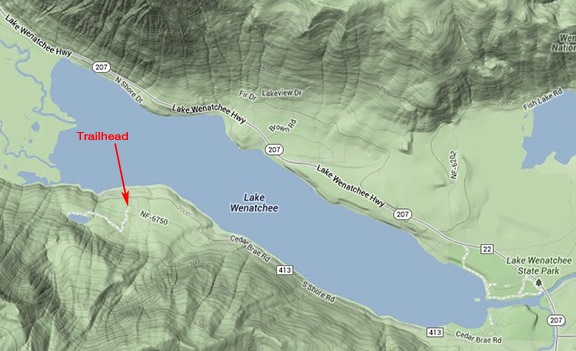
We made the turn off Route 2 toward Lake Wenatchee. We passed by several campgrounds that were closed and full of ice but had very little snow. We followed Cedar Brae Road, which wound up along the south shore of Lake Wenatchee. It was quiet and the glimpses I caught of the lake between the tall pine trees and vacation homes showed smooth, glassy water. The pavement ended and the gravel road that continued into the forest had icy patches. The road got narrower and narrower. Then Len made a left turn down a short drive and parked at the Hidden Lake Trailhead.

Hidden Lake Trailhead
Here’s where the trailhead is in relation to Lake Wenatchee. This Google Maps terrain image even shows the trail that winds up to the lake.

We got out and organized our gear. I was warmly dressed in my new Under Armor ColdGear shirt and leggings with a sweatshirt and water proof shell on top and a pair of Under Armor outer layer pants on bottom. I was also wearing thick wool socks and my new Sorel boots, which I’d only worn briefly once so far. And I had a pair of YakTrax Pros in my daypack, just in case I needed more traction. My Buff, which I’d worn as a neck cover, could be pulled up to make a balaclava — which is exactly what I wound up doing. I had some more clothes in my daypack, along with some snacks and my Nikon camera.

While the guys used the pit toilet, I put Penny’s parka on her. I had her boots in my daypack, but because there was no snow, I didn’t think she’d need them. My daypack had enough free space to put her in there if she got so cold that she needed to be carried.

There was no snow. None at all. It was weird. We were at about 2100 feet elevation and it was winter in the mountains but there was no snow.

There were lots of fallen trees, though. As we began the hike up the trail, Len told us about a hike he’d done earlier in the season on the other side of Lake Wenatchee, on Dirty Face Mountain. There had been some heavy wind and he heard a loud crack sound. A tree about 30 feet away broke in two halfway up and came crashing down near him. He said that it happened almost in slow motion so he didn’t really feel any danger, but it was still scary. The situation was serious enough to warrant an article in the Wenatchee World about the danger, especially after two people were killed when a falling tree fell on their vehicle near Stevens Pass.

Dirty Face Peak
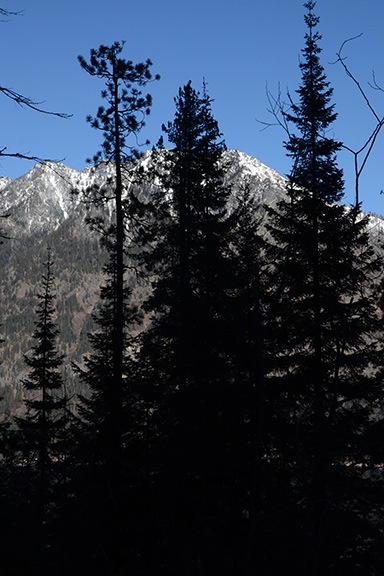
This is the best shot I could get of Dirty Face — there were just too many trees in the way!

The forest was full of huge pines that stretched straight up to the sky. The trail was clear — someone with a chainsaw had been busy cutting away any tree trucks that had blocked it. Although we were totally in the shade, the sun shone brightly on the granite rocks of Dirty Face, across the lake. It dominated the landscape on that side, with just enough snow to make it picture postcard perfect — if I could get a shot of it through the trees.

The trail was icy in places, but not icy enough to put on my YakTrax. Penny and Tim’s dog, Banjo, ran ahead of us on the trail, making occasional forays into the forest on either side of the trail. At one point, Banjo stood stubbornly at the base of a tree, looking up. There was a squirrel up there. I don’t think I’ve ever seen a squirrel out in the winter time.

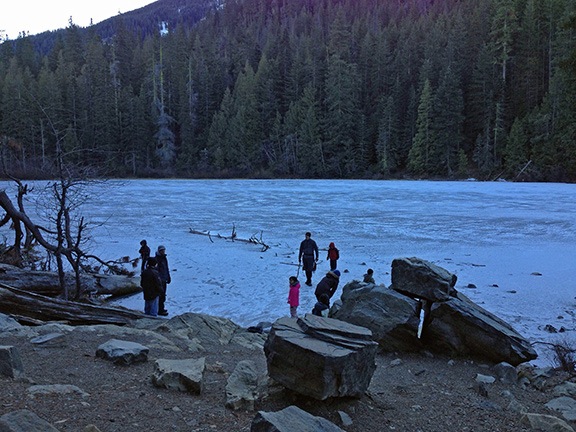
Hidden Lake was completely covered with thick ice. A big family with kids was standing near the shore. Banjo wasted no time bringing a stick for the kids to throw and they wasted no time throwing it. Banjo didn’t seem the least bit concerned about running on the ice, but Penny stayed clear — at least in the beginning.

Hidden Lake
Hidden Lake was frozen. Although it was a bright, sunny day, it was gray over the lake in the shadows of the mountains to the south. I doubt if the lake ever sees the sun this time of year.

Our group of three gathered at a huge fallen log, where Len set up a camp stove and boiled water for hot cocoa. We talked about camping and laughed about eating things while camping — like instant hot cocoa out of semi-clean cups — that we’d never dream of eating at home. The only thing I had to drink cocoa from was the collapsable water bowl I’d brought along for Penny. I gave it a quick rinse and mixed cocoa in it without a second thought. Later, I rinsed it again and filled it with cold water from my pack for Banjo and Penny.

We spent about an hour there at the lake. The family hiked around, then left back down the trail. A couple carrying a baby came up, walked around briefly, and left.

Gaia GPS Hidden Lake
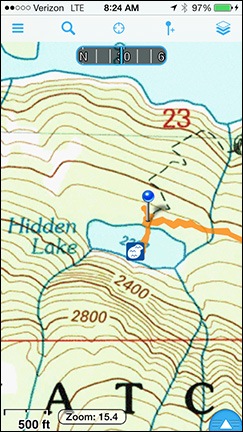
Here’s what Hidden Lake looked like on Gaia GPS with our track shown. This may have been the first time in my life that I walked across a frozen lake.

All the time we were there, we heard rushing water across the lake but had no idea where the sound was coming from. I had the Gaia GPS app on my phone and had loaded it in advance with topo maps of the area. It showed two streams across the lake, but we couldn’t see either one. There was no trail on the other side; the steep hill came right down to the water’s edge. With lots of footprints already on the lake’s icy surface, we decided to explore. Cautiously, at first, we ventured out onto the ice. It looked to be at least four to six inches thick. Slowly, we made our way across the ice, looking at the huge cracks that ran here and there across its surface. Finally, nearly on the other side, we saw the stream that was making all the noise. It wasn’t very big; it must have been the shape of the land around us that magnified the sound.

We packed up and headed back down the trail a little while later. The hike was pretty much uneventful.

At the truck, however, there was a problem: Len’s keyless entry fob would not work.

At first, we thought it might just have a cold battery. He warmed it up in his pocket and in his hand. No joy. It soon became clear that we’d need to summon help. Len has AAA and hiked down the road a bit to get a better cell phone signal so he could call.

Campfire
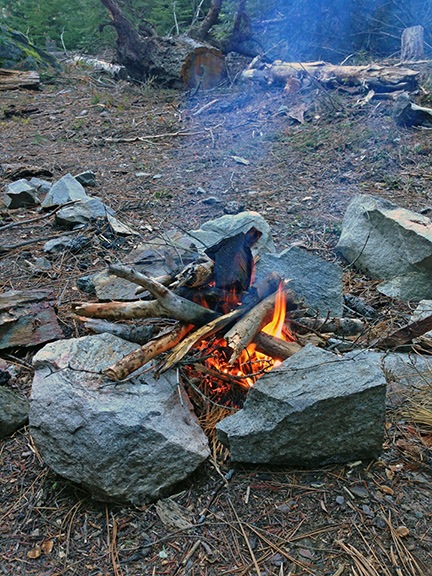
Len finally got this fire going. We would have made a better fire pit, but the rocks were frozen to the ground.

Although we weren’t cold — yet — Tim and I tried to start a fire for warmth. There was plenty of wood — why isn’t there this much wood when I go camping? Trouble was, it was all frosty wet. We couldn’t even get pine needles to catch. We tried a few times and pretty much gave up. I discovered along the way that my business cards are apparently fireproof. (Note to self: add waterproof matches and fire starter to emergency kit.)

Len to the rescue! When he got back from making his call, he gave it a try, using some toilet paper he had in a plastic bag in his pack as a starter. The dry paper did the trick. Although the fire got off to a slow start, by the time help arrived 90 minutes later, the fire was burning well enough for Penny and I to sit beside it for warmth.

The tow company guy used an inflatable pouch to open a crack in the window. He then inserted a wire device to grab the door lock and pull it up. (Seriously: when you see how easy it is to break into a vehicle with the right tools, you wonder why you bother to lock it at all.) The alarm sounded immediately, but Len shut it down quickly. A short while later, we were on the road, heading back toward Leavenworth and the Y.

The Three Hikers
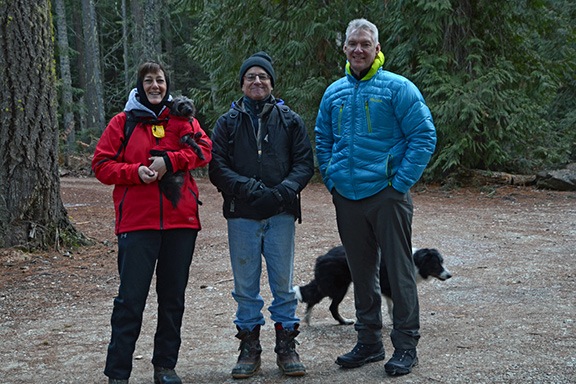
We posed for a picture before heading out. Left to right: me, Tim, Len. I’m holding Penny and Banjo is on the ground.

Len dropped us off, thanking us for our patience. It wasn’t a big deal to me. The bad key fob had turned a short hike into a little adventure. My gear kept me warm enough and I had plenty to snack on.

Tim and I got back into my Jeep with the dogs and our gear. We made one stop on the way back to Wenatchee: Country Boys BBQ in Cashmere. Great food!

It had been a nice day out with friends. Funny how I’d been afraid of winter when I first decided to spend the winter here. I’m not afraid anymore. With the right gear and friends to spend time with, it’s all good.

A Christmas Ski Trip, Day 3: Skiing and Wine Tasting

I finish up my three-day trip with some more skiing and a stop for some wine and lunch at a favorite winery.

(This story has three other parts: Prelude, Day 1, and Day 2.)

I would have slept better if I weren’t so darn sore. In cross-country skiing the day before, I’d used muscles I forgot I had. Overnight, they started complaining about that, leaving me with aches and pains in my upper arms, shoulders, hips, and lower legs.

Three ibuprofen with my morning coffee certainly helped. After letting Penny out to do her business, I breakfasted on the leftover meat plate from the day before, the remains of that 1-pound Honeycrisp apple, and yogurt.

I showered and packed up at a leisurely pace, putting my “street clothes” in my day pack so I could change somewhere before starting the drive home. I layered up in my ski clothes. Penny and I took a little walk around the area. We met up with our downstairs neighbor and his dog, a border collie and chatted for a while. Then I packed up the Jeep, locked the loft cabin, and headed out with Penny.

At Mazama

We took the same route we’d taken the day before to Mazama: Wolf Creek Road. I really liked the quiet drive through the snow-covered forest of tall pines. I felt as if I could have driven along that road all day. The words for the song “Sleigh Ride” kept coming to my mind. It was indeed a “wonderland of snow.” I honestly didn’t realize how much I missed the snow until I got an opportunity to spend so much time in it.

In Mazama, my first stop was the Mazama Store. I’d bought a fleece sweater there two days before and it was too big. Although I’d wanted it for skiing, my trip was nearly over so I figured I’d just return it and get my money back. If they’d been open the day before, I would have exchanged it for a smaller size. Their loss.

Next, I headed back to the Goats Beard Mountain Supplies shop to see if they had any post-Christmas specials. It was a nice shop with lots of winter and climbing gear — nearby Goat Wall is apparently a popular climbing spot in the summer. But as I expected in a small gear shop in a winter tourist destination, no deals were to be had.

Finally, I wandered over to the Mazama Country Inn for breakfast. (I got into the habit of having two breakfasts most mornings when I was dieting back in 2012. It’s pretty easy to do when you wake up as early as I often do.) Eggs over medium, thick bacon cooked to perfection, and a toasted whole wheat English muffin with orange marmalade. What else could I ask for.?

On the way out, I stopped in the ladies room. I realized it would be a perfect place to change my clothes before heading home.

A Little More Skiing

It was close to 11 AM when I drove the Jeep over to the parking area for the easy ski trails I’d practiced at the day before. I wanted to do a few miles just to work on my balance and get my muscles moving again. Because I was able to park in the sun and there were very few people around, I decided to leave Penny behind. She was curled up in her bed, wearing her winter parka. I left the Jeep unlocked; I figured someone would rescue her if there was a problem. I didn’t expect there to be one. It was much warmer that day than it had been the day before. I figured the Jeep would stay at least 40°F in the sun while I was gone.

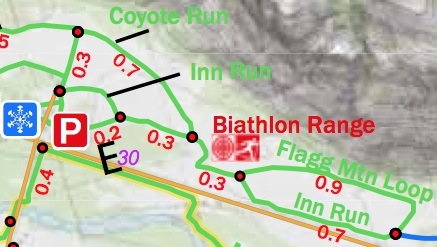
Map of Easy Trails
These trails are on mostly flat land near the base of Goat Wall in Mazama.

There were two men with a fire going in a portable fire pit at the trailhead. The fire pit was interesting; it had been built on a sled and even had a rope to pull it with. The menu were there to check ski passes, which I wore proudly. (Hell, how often do I get to wear a ski pass?) I put my skis on and took off in the freshly groomed tracks.

I did a little better without Penny on my back. I realize that the main challenge is feeling the edges of my skis and using them to push off better. Bending my knees more will likely help. I signed up for a three-session cross-country ski class at the local college in Wenatchee for January; I’m sure I’ll get much better after that. It’s a matter of building muscle memory, confidence, and balance. Two trips to Leavenworth with a group and instructor in January should give me plenty of practice.

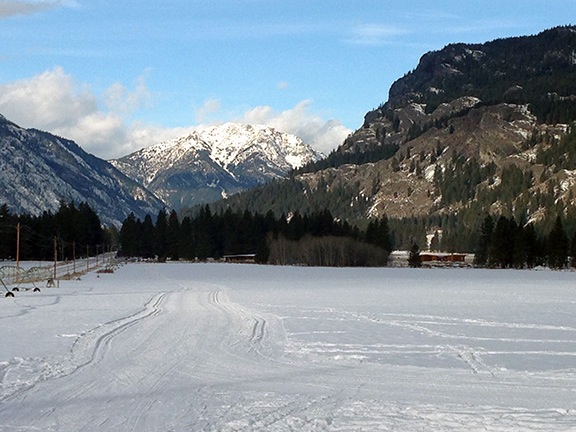
Ski Trails at Mazama
The easy trails go alongside a snow-covered farm field and offer spectacular views of the north Cascade Mountains. Click here to see a panorama of this spot.

I did about 2-1/2 miles in an hour. Not bad. I can still hike faster.

Back at the Jeep, I let Penny out. She ran around a little while I chatted with the guys at the fire pit and stowed my skis. Then we headed back to the Mazama Country Inn, where I changed my clothes for the drive back. A while later, we were on Route 20, heading back down the Methow Valley toward home.

The Drive Home, with Wine

The drive back down the valley wasn’t nearly as pleasant as the drive up two days before had been. It might have been the weather — it was mostly gray all the way. Or it could have been the fact that there were other cars on the road and they kicked up just enough melted ice and snow to keep my windshield wipers and washer fluid working overtime all the way.

I stopped in Twisp for fuel and to visit the bakery my friend had recommended. It was closed. Feeling like I wanted a snack, I went back into the health food store there and bought some lemon bars. Very rich. I got an eggnog latte — likely the last one of the season — from a drive-thru coffee shop on my way out of town.

It was clearer but still overcast when I reached the Columbia River. At least I could see the hills and mountains around me. The whole place had been socked in on my way north two days before.

By the time I got to Chelan, I was ready for lunch. I decided to stop at Tsillan Cellars Winery. In the summer, I take people there for wine tasting and lunch or dinner. But because I fly them in by helicopter, I can’t drink. Now I was driving. Why not have a wine tasting and follow that up with lunch at Sorrento’s? It would finally give me a chance to see what I’d been missing.

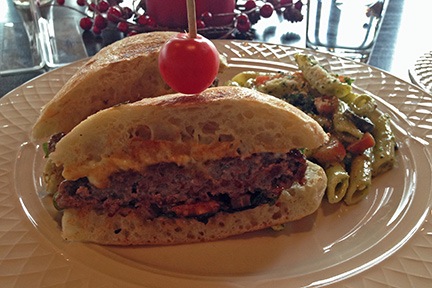
My Burger
It was a great lunch, but I could only eat half of it.

I left Penny in the Jeep and went inside. There was only one other person at the long bar and she kept wandering from the bar to a table near the fireplace in the big tasting room. I had the wine server all to myself. I tasted five red wines and would up buying three bottles. Then I headed over to the restaurant, which had just a few tables occupied. I ordered a blue cheese burger and wound up taking half of it to go. Those lemon bars had spoiled my appetite.

I let Penny out again — poor thing was getting too much downtime, although she didn’t seem to mind — before we headed out on the last leg of our trip.

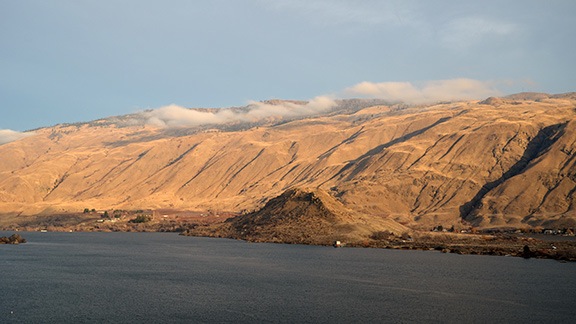
The weather cleared as we reached Route 97A after the tunnel and followed the Columbia River toward Wenatchee. The afternoon sun shined on the hillsides across the river while thin wisps of cloud drifted by. This is the foggy season in North Central Washington, with temperatures and dewpoints nearly matched almost every day. That afternoon was relatively clear, though and it made for a very pleasant final hour of driving.

River View
The afternoon sunlight really made the hillsides along the Columbia River glow.

I didn’t make any other stops on the way home. I pulled into the garage just as the sun was setting. Penny seemed very happy to be back on her home turf.

It had been a great little trip!

A Christmas Ski Trip, Day 2: Skiing and More Skiing

Shaking the rust off.

(This story starts with a Prelude and a summary (with photos) of Day 1.)

Snow and Moon
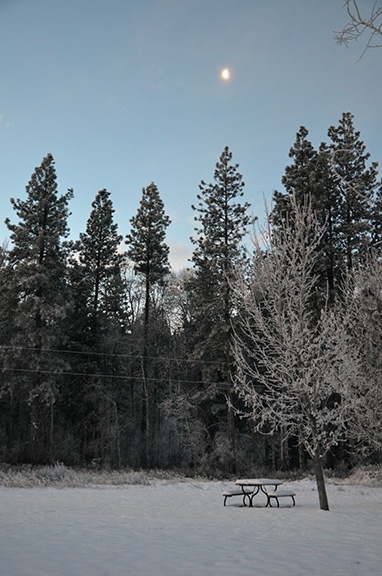
The sky was mostly clear in the morning, with a half moon hanging high.

Once I set the thermostat down to 60 — thus preventing the rather loud heater from turning on and off all night — I slept like a log. The room was plenty warm and the bed was cozy, with lots of blankets. Penny left her bed empty and, instead, made a sort of nest on the comforter next to me. It was very quiet. I left the curtains wide open so I could see the stars and moonlit terrain when I woke up.

In the morning, I took Penny out for a walk. The fog that had been drifting low over the snow-covered fields the night before was gone. The sky was mostly clear with the last quarter moon hanging high in the sky.

A good day for skiing.

Organic Bulgarian Yogurt
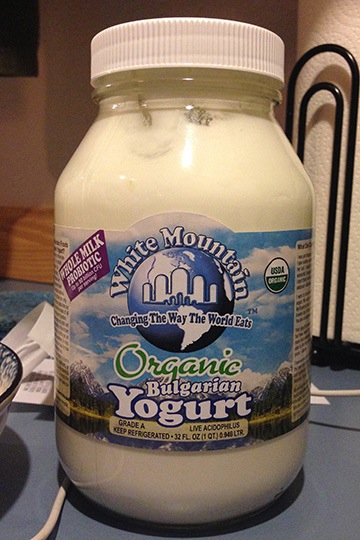
Yes, I bought organic Bulgarian yogurt. I don’t recommend it.

Back in our loft cabin, I made coffee and a breakfast of organic “Bulgarian” yogurt and granola that I’d brought from home. I don’t recommend Bulgarian yogurt; it’s extremely sour. I also cut up the huge Honeycrisp apple I’d bought the day before and stowed it away in my daypack with a bag of almonds for snacking later on.

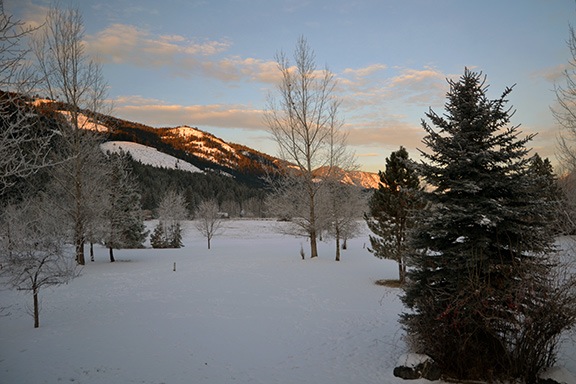
Outside, the sun’s first light was illuminating the snowy mountains that surrounded the Methow Valley. As I washed up, did the dishes, and waxed my new skis for the first time, I found myself really looking forward to the day ahead of me.

Sunrise
I never get tired of seeing the sun’s first light hit mountains and other landforms, bathing the highest points in a golden glow.

Suiting Up

At about 8:30 AM, Penny and I suited up with our winter gear.

For me, that meant skin-tight leggings made of a fabric that would wick sweat away from my body and what I can only call “snow pants” over them. If you’ve ever been a kid in a cold climate, you know what I’m talking about: nylon pants with a quilted filling. Mine were black with zip pockets, wide legs, and an inner liner near the bottom with elastic that closed around each of my legs. I also layered up on top with another tight wicking fabric undergarment, a fleece sweater, and my bright red waterproof shell. All of these things were new — I had no use for clothes like this when I lived in Arizona, since I seldom went north to the higher elevations where cold winters prevailed. On my feet I wore an ancient pair of thick wool socks — I’d fetched them out of storage before my trip — and a brand new pair of Sorel snow boots that I could also wear with the snowshoes my brother had gotten me for Christmas. I also had a scarf (of course) and a merino wool Buff that I wore as a sort of turtleneck, with the option of turning it into a hat or a balaclava. And thick red ski gloves — did I mention those?


Penny really has trouble with her boots.

Penny’s attire was simpler: she wore her red quilted parka with the fleece lining. I didn’t put on her boots because she can’t really walk in them. Besides, I had a feeling she wouldn’t be doing much walking in the snow anyway.

You might think I was overdressed and I probably was. But the truth of the matter is that I really don’t like to be cold. I made this one-time investment in cold weather gear so I’d be comfortable out on the trail. I was embracing the winter season the only way I knew how.

The Back Road to Mazama

On my way to Mazama on Route 20 the day before, I’d seen a left turn for Wolf Creek Road about halfway between Winthrop and Mazama. The place I was staying was on Wolf Creek Road, but I’d gotten there from Winthrop. Could the same road keep going past my place and eventually meet up with Route 20 on the way to Mazama?

I looked at the topo map I’d saved into Gaia GPS on my iPhone and iPad. It sure looked like it did. And since I’m the kind of person who’d rather explore “shortcuts” than drive the long way around on the beaten path, I decided to give it a try.

Snowy Forest Road
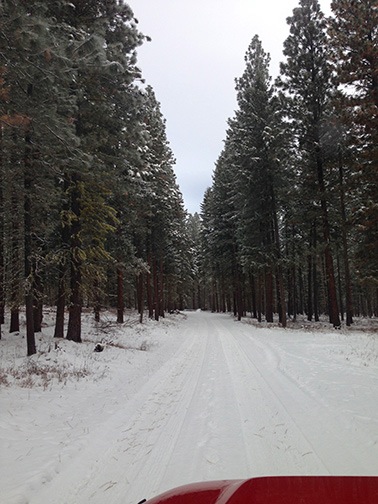
Paved or unpaved? Can you tell? Does it matter? It was a pleasant drive through the woods.

The drive turned out to be very pleasant. About a half mile down the road from where I was staying, a “Pavement Ends” sign announced the end of pavement — it didn’t matter because the roads hadn’t really been plowed in the first place. (In all honesty, I thought all of Wolf Creek Road had been unpaved.) The narrow road, which I could follow from the tire tracks of the few vehicles that had driven it before me, wound through a forest of tall pines, twisting and turning, climbing and descending. After a few slides, I threw the Jeep into four wheel drive and it stabilized. I drove at a steady 20 miles per hour, crunching over snow and long pine needles. Here and there were gated driveways and ungated forest roads turning off into the snowy woods. I realized that I’d need to come back when the snow was gone, possibly with a friend and some camping gear, to explore some of those roads. I really do love exploring back roads with my Jeep.

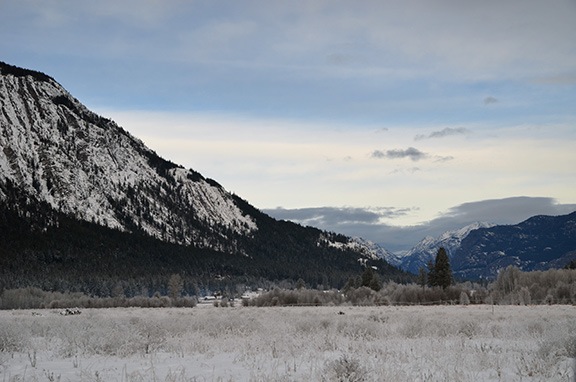
Within just a few miles, the forest opened up to some fields with homes and snow-covered farm equipment scattered here and there. The tall grass was covered with thick frost — a remnant of the previous evening’s low fog. In some places, I could see clear up the valley, to the towering mountains of the North Cascades.

Frosty Fields
Although the sky was mostly clear, the sun was hidden behind clouds to the southeast, leaving the valley in shadows.

The road turned sharply to the right. A moment later, I was back on Route 20. My morning back road adventure had been less than 5 miles long.

Ski Lesson

It’s important to note here that I’d been cross-country skiing before. Way back in the 1980s, when I first hooked up with the man I’d later marry, we took up cross-country skiing and did trips in the Catskill Mountains of New York State. I clearly remember going out one snowy day on trails near the Mohonk Mountain House near New Paltz. I remember the silence of that afternoon, with the thick wet snow packing up on the bottom of our skis as we cut new trails.

Back then there was only one kind of cross-country skiing — what they now call “classic” — and the skis and shoes were very basic. I still had my set but I left them behind in Arizona when I moved out of my Wickenburg home in May 2013. I didn’t miss them — they were junk — and the crappy plastic shoes had likely been ruined by the mice that often lived in our garage.

New technology had greatly improved both the skis and the boots. I bought a new setup in November. The only thing I miss from my old setup is the blue plastic clips that held the skis and poles together, making them easier to carry and store. I can’t seem to find a set of those anywhere, although I did get a set of ski bones that hold the skis together nicely.

So there I was, in the biggest cross-country ski area in the country, with a brand new cross-country ski setup. But I hadn’t been skiing in at least 20 years.

That’s why I signed up for a lesson.

I showed up early at the Methow Valley Ski School. While I waited for my instructor, I put on my ski boots (for the first time!) and put away my Sorels in the Jeep. Then I fetched Penny and my day pack and settled in to wait on a bench inside where it was nice and warm.

I can’t remember the ski instructor’s name. She was a Swiss woman with an accent very similar to my grandmother’s German accent and almost identical to that of a Swiss couple I was friends with in Wickenburg. The other student was a young Japanese man who didn’t speak English. He was staying with a couple around my age who chatted with me as they dropped him off for his lesson.

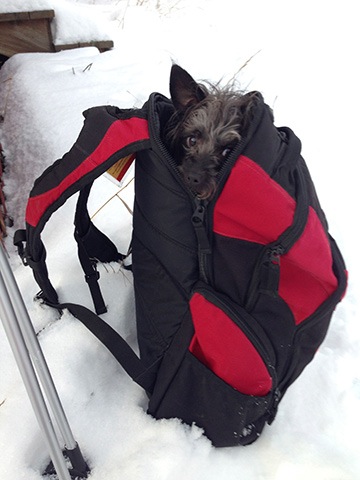
Packed Penny
At just 7 pounds, Penny is easily carried in a day pack. In fact, I had to pad the bottom so she could stick her head out.

Needless to say, the lesson was interesting, mostly because of the amount of miming the instructor had to do to communicate with the Japanese guy. We started indoors where we learned how to put on the skis. Even that was different from the old setup. Then I put Penny into the day pack, zipped it so just her head stuck out, slung it over my shoulder, and followed the others outside with my skis and poles. We spent the next hour practicing basic skills on the trails near the ski school shop.

The Japanese guy was pretty funny. He fell a lot and got lots of practice getting up. I only fell once, but I did it spectacularly. I lost my balance coming down a small hill. Because I didn’t want to fall backwards on top of Penny, I purposely fell forward. The backpack shifted up hard and Penny went flying over my head into the snow. We all had a good laugh and it took some time for me to get back up without taking the skis off. Then I got Penny back into the bag and the lesson went on.

One of the things that shocked and pleased me was what “groomed trails” meant. The trails were wide and smooth and had obviously been sort of “raked” over. On either side of the main trail were a pair of cross-country ski tracks, already laid out in the snow at the perfect width. Skiing in these tracks was a real breeze — and a real treat. In my previous cross-country skiing experience, the first person in our group would make the tracks and they were rarely evenly spaced. This alone made the ski pass worth the money I’d spent for it.

Lunch at Jack’s

It was 11:30 by the time the lesson was over and I was hungry for lunch. The ski school folks made some calls and found a cafe down the road, Jack’s Hut at the Freestone Inn, that was open for lunch. I drove over, leaving Penny in the Jeep. The owner was manning the place, which was more of a snack bar than a full-blown restaurant. I sat at the counter where I could watch him work. I had an excellent bowl of chili — probably from a can — with cheese and a chicken quesadilla he made while I looked on.

I was just starting on my quesadilla when the Japanese student and his two American hosts came in. Soon they were seated at the counter with me, enjoying the same food. We chatted a bit about the area, real estate, and skiing. We studied my map and they offered some suggestions for places to go skiing that afternoon.

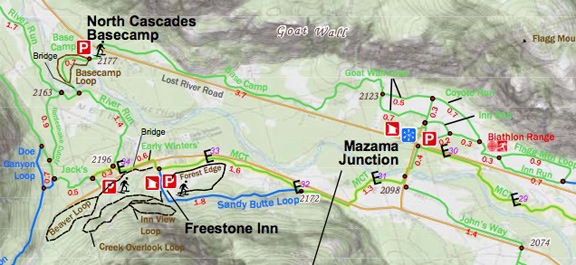
Mazama Area Map
Here’s a map of the area where I planned to ski. You can download the entire map here.

Then I was done eating and it was time to go. The sun sets early in Washington in the winter time and I was hoping to ski with the sun still on me.

Solo Skiing

Penny and I headed out to the North Cascades Basecamp parking area. I parked and opened my door while I got my things together. Some movement on my left caught my eye and I found myself looking almost eye-to-eye at the biggest black dog I’d ever seen.

The dog was friendly, of course, but quickly frustrated by Penny darting out at him from under the Jeep. I had to snatch her up and put her in the day pack so she’d leave him alone. He wandered off while I chatted with some other skiers who were just getting their skis on when I arrived.

A while later, I was on the Base Camp trail with Penny in the day pack on my back. This particular trail wound through the woods with gentle hills that proved to be quite a challenge for me. I had one fall along the way — fortunately, Penny wasn’t launched out this time. It did take me a minute or two to get back on my skis.

I wasn’t alone on the trail. There were plenty of other skiers, most of whom did not used the classic ski tracks. They were skating on skis. It was wonderful to watch and I was envious of their skill. I decided to visit the local skating rink back home to build up my general skating skills and balance.

Despite the cold — it was between 25°F and 30°F out on the trail — I worked up a nice sweat. Although I never felt uncomfortably warm, I certainly never felt cold, either. It was very pleasant to be outdoors in the winter time, keeping active enough to keep warm, enjoying the steady slush-slush-slush sound of my skies in the tracks as I wound through the woods.

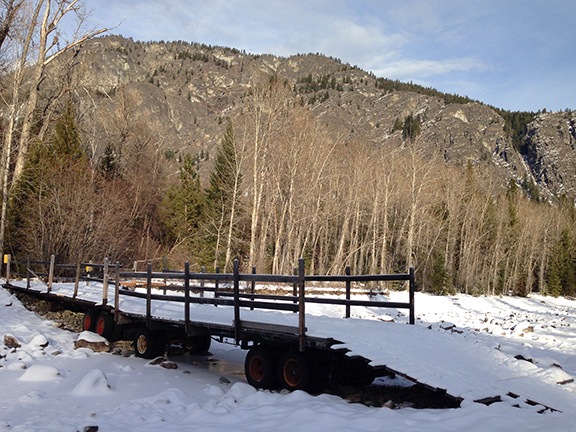
Eventually, the trail went down to a pair of portable bridges across a stream bed. The bridges were designed to be skied over and I had no trouble with the first one. But while I paused to take a photo, I decided that I wanted to practice on easier trails to really get the hang of skiing before I tackled the kind of hilly trail I was on. So after I shot the picture, I crossed back over the bridge and skied back to the Jeep.

Portable Bridge
This was the first time I’d ever seen a portable bridge. Click here for a large panorama of the area shot with my iPhone.

According to the GPS Track app on my phone, I’d skied about a mile and a half. Not very impressive.

I drove back to the place I’d started the day: the easy trails around the Mazama Store and Ski School. Once again, I got out with my skis and put Penny in the day pack. Then we were off down the trail. It was much later in the day and most of the other skiers were on their way back in. But there were other people going out. Although most of them passed me, I managed to pass someone even slower than I was.

I did another two miles in nearly an hour of skiing. I realized that I hiked faster than I skied. I needed practice!

Sun Mountain

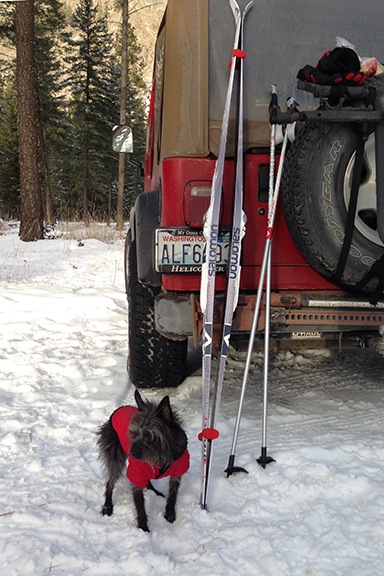
Penny in her Parka
Here’s Penny in her parka.

I let Penny out to take a quick walk before we climbed back into the Jeep with the skis. I steered us down Route 20.

Winthrop was completely deserted. Everything was closed and not a single car was parked in town.

I decided to check out Sun Mountain Lodge, which was about 10 miles from downtown Winthrop. I figured I’d see what the place was like and, if I was hungry later, I’d go back for dinner.

But as I drove us up the long and winding road, I started to rethink that. I’d had a long day; did I really want to make the 20 mile round trip twice in one night? It all depended on what I found at the end of the road.

Along the way, I passed Patterson Lake, a mile and a half long lake that was completely frozen over. There were numerous skaters out on the north end of the lake, including hockey players who were playing on a shoveled-out arena. There was even an ice fisherman sitting alone over a hole. As I drove alongside the lake I realized something I’d never thought about before: this area of Washington was a winter sport destination.

If you’re reading this and know winter sport destinations like those in Colorado and Vermont and Utah, you’re probably saying, “Duh.” But this is completely foreign to me. When I lived in New York and New Jersey, we had winters that were just as cold and often as snowy as the winters here. Back there, we had winter sports, but few people really took them seriously. Sure, the skating pond in town was a gathering place for skaters and some hilly areas had sledders. And many people grabbed their skis and headed to the slopes in the Poconos or Catskills. There was no snowshoeing and very little cross-country skiing or snowmobiling — mostly because there simply weren’t many established trails. These sports were just incidental to where we lived, simply because the weather got cold and snowy for a short time every year.

But in the Methow Valley, winter sports were taken very seriously. Why else would there be 200 km — that’s 160 miles, folks — of groomed cross-country ski trails, all mapped out on paper and signs and a Website and even an iPhone app? Why would there be a shooting range on a biathlon trail? Why else would there be snowshoe-only trails and snowmobile speed limit signs? Why else would ski rental and lesson places be open for business on Christmas day when it was tough to find a restaurant for lunch? Why else would there be dozens of people skating on a frozen lake in the middle of nowhere?

And realizing this made me feel really good about where I’d chosen to make my home. Because not only were they serious about winter sports, but they were equally serious about summer sports like hiking, biking, camping, boating, fishing, and so much more. There was no shortage of outdoor activities in north central Washington state with the perfect weather to enjoy it all.

The sun had gone down behind the mountains and clouds when I finally reached the Sun Mountain Lodge. It sits near the top of a mountain — Sun Mountain? — overlooking the Methow Valley. Ironically, the lodge is only 1-1/2 miles as the crow flies from where I was staying off Wolf Creek Road far below.

I left Penny in the Jeep and went inside. I was still wearing my skiing gear, right down to the boots. But when I got into the cocktail lounge for a hot beverage, I saw that I wasn’t the only one.

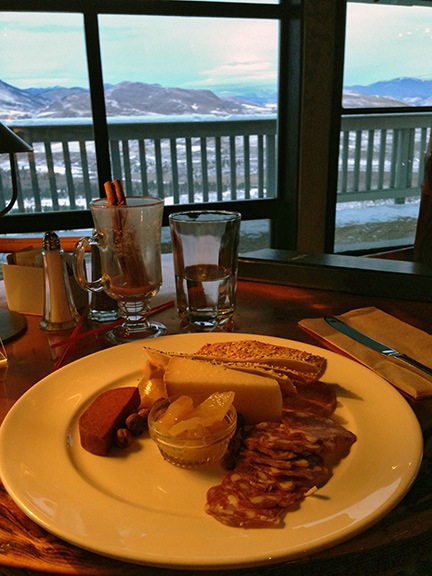
Meat Plate at Sun Mountain
The meat plate was enough to feed two as an appetizer. I took my time and enjoyed looking out over the view.

I sat near a window where I could look out over the valley. I had a Spanish Coffee, which I found a bit sweet, and ordered a meat plate that included various sliced meats, cheese, crackers, and very spicy stewed apples. The waiter served it with a knife but not a fork; when I asked for a fork, he brought it but explained that because a restaurant reviewer gave them a bad review for serving it with a fork, they no longer provided forks unless asked. I wondered how I was supposed to eat the stewed apples without a fork. I also wondered whether he was trying to insinuate that I should have known better than to ask for one.

When I finished the Spanish Coffee, I ordered an Irish Coffee, which is more to my taste. I only ate half the meat plate — I was still pretty full from lunch — and took the rest to go.

Day’s End

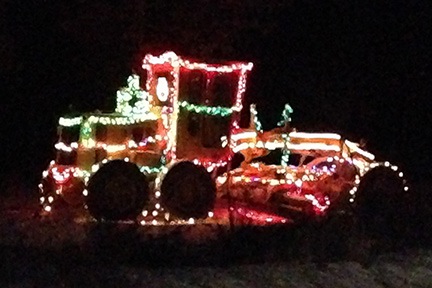
Christmas Road Grader
What else would you do with your road grader at Christmas time?

Penny was glad to see me when I got back. I let her out for a short walk, then loaded her back up and headed back down the hill.

The ice fisherman was the only one still out on the ice. I could see him clearly in the fading light from the light of his headlamp and another flashlight or lamp near his bucket.

By the time we got back to the main road, it was full dark. I drove slowly and carefully — there were signs all over the place about deer strikes and a friend back in Wenatchee had even warned me about deer at night. Sure enough, I saw one cross the road when I stopped to take a photo of a road grader decorated with Christmas lights.

Back at the loft cabin, I let Penny have a good run. Both of the downstairs units were brightly lit up with families celebrating Christmas away from home. Penny and I went upstairs, where I opened a bottle of wine and settled down with a book.

I was sound asleep by 8 PM.

(continued)