Four November days in the tropics.
Last week was my sister’s birthday. Because she was so incredibly supportive during my crazy divorce and while I was building my home, I decided to visit her in Florida.
And take her on a cruise to the Bahamas.
Regular blog readers may recall me writing about cruises just a month or so ago. They may have gotten the impression that I hated cruising. That isn’t true. My first cruise experience was amazing. My second was disappointing. I try to be open minded about these things. Maybe my second cruise was disappointing for reasons that had nothing to do with cruising. (Cruise companion, maybe? Just a thought.) I decided I needed to try it again to see if cruising was something I should embrace for future vacations or forget about.
Of course, I booked the cruise only a few weeks before the cruise date. And our dates were set — my sister had only certain days off from work. I needed a cruise that left from Florida and returned to the same place within the dates I had to work with. There were not many options, as you might imagine. I wound up going with the Norwegian Cruise Lines’ “4-Day” Bahamas cruise.
I put “4-day” in quotes because the cruise left on a Monday and returned on a Friday. Most tour companies would call that a 5-day cruise. But NCL is apparently not like most companies. We boarded at noon on Monday and disembarked at 9 AM on Friday. In my book, that’s almost five full days — even if most of Monday and Friday were spent in the Port of Miami.
Although I tried to keep the following short, there’s a lot to report and share. So grab a Bahama Mama and read on.
Day 0: Ft. Pierce and Miami Beach
We actually started in Elkton, FL, where my sister lives. That’s near St. Augustine in the far north of Florida. I waited until the last minute to tell her about the cruise. In fact, I waited until she asked me straight out where we were going. She’d guessed that we were going to Key West and I never told her whether we were or weren’t. I just replied that I liked Key West. But when she asked me on Saturday where we were going, I told her. Then I grabbed her passport and checked her in to stop the flood of email messages I was getting from the cruise ship company warning of dire consequences if we didn’t check in on time.
On Sunday, we drove down to Ft. Pierce. My 76-year-old dad is recovering from a motorcycle accident. Yes, he was the one on the motorcycle. A broken nose, 6 cracked vertebrae, 2 broken ribs, and 4 broken pelvis bones later, he’s got a lot of healing to do. Intensive care in the hospital followed by a week or two in rehab and now home with a hospital bed in the living room, wheel chair, and visiting physical therapist. It made sense that we should visit him on our way to Miami, so we did.

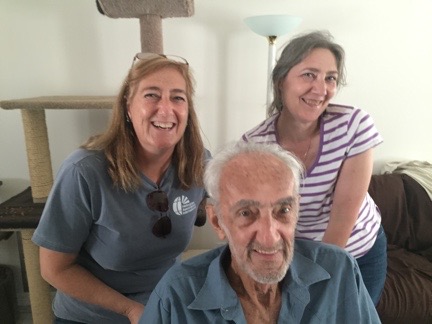
Three Langers: me, my sister Laura, and my daredevil dad.
He looks a lot better than I expected, but he’s lost a ton of weight. He never was very heavy (I didn’t get my fat genes from my father’s gene pool) and now he’s pretty bony. I hope he puts some weight back on soon.
But not before he can walk.
He knows his motorcycling days are over, but since he lives on the water, I think this is a perfect time for him to replace that old Honda with a WaveRunner. Hitting the water likely won’t break as many bones.

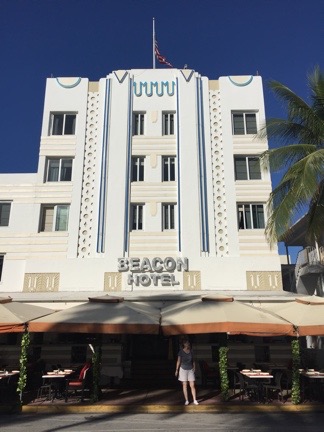
The Beacon Hotel on Monday morning. That’s Laura smoking in the shade out front.
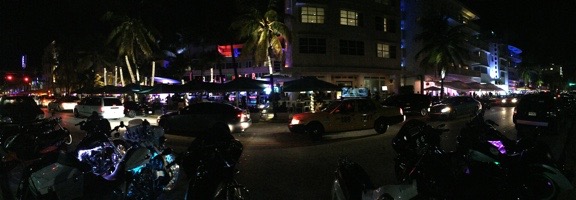
After a great lunch at a local fish place, my sister and I hit the road, continuing our journey south. I’d made reservations at The Beacon at Miami’s South Beach. It’s one of the many historic art deco hotels right on the ocean. We got in just after dark and the whole Ocean Drive strip was hopping with live music and people enjoying food and drink at the dozens of sidewalk restaurants. I was very glad to hand over the car to a valet.
I’d mentioned in my reservation that it was my sister’s birthday and was pleasantly surprised to find a bottle of champagne chilling on ice in our room when we arrived. As you might imagine, I wasted no time opening up that puppy. The two of us drank about three quarters of it before Laura dozed off. When it became clear that she wasn’t fit for partying, I changed into something more suitable and went out on my own. After an invigorating walk up and then back down Ocean Drive — with plenty of photos taken along the way — I found a restaurant with a menu I liked. My dinner consisted of white gazpacho, escargot (in the shell), and a vodka martini with four olives. The key lime pie I got for dessert satisfied my craving — and south Florida is the only place you can get a decent key lime pie. I’d tell you the name of the restaurant, but I can’t remember or figure out on Google Maps which one it is. (Remember, I started the evening with about a half bottle of champagne in me.) I do know it was between 6th and 7th Streets, with outdoor dining that spilled over onto the sidewalk as most South Beach restaurants do.

South Beach at night.
Needless to say, I finished off the rest of the champagne when I got back to the room.
Day 1: Port of Miami
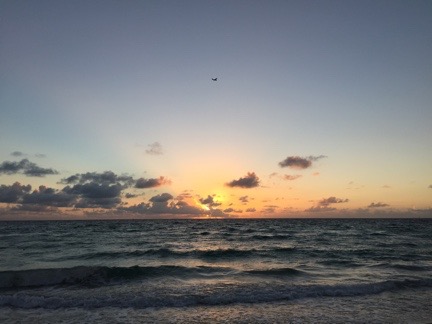
Sunrise at Miami Beach. I watched the sun rise on every single morning of my Bahamas trip.
The next morning, we were up before dawn and headed out to watch the sun rise over the ocean. I mean, why not, right? We saw a few cruise ships and a container ship come in. Then back to our hotel for our included breakfast. We called for the car, checked out, and loaded up for our real destination: the Port of Miami where the Norwegian Sky awaited.
There was a lot of traffic.
We were all checked in by 10:45 AM. Then the wait for boarding time. I didn’t realize that the check in time and boarding time could be as much as 2 hours apart. We had to wait until noon. Then we were in the first boarding group and on board the ship, checking out our cabin, by 12:15 PM.
A few things about the ship: Norwegian Sky is a smaller ship, built in 1999 but renovated most recently in 2013. It holds just over 2,000 passengers and just under 1,000 crew members. Passengers can access decks 3 through 12. There are three pools, 5 hot tubs, at least a dozen bars, 2 “freestyle” restaurants, a buffet, and 4 specialty restaurants. And a spa and a gym and some shops and a casino. You know — the usual cruise ship stuff. It was definitely not a deluxe ship, but it was in extremely good condition and immaculately clean.
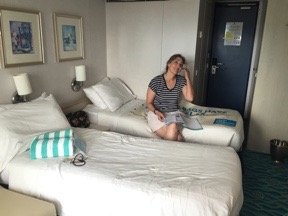
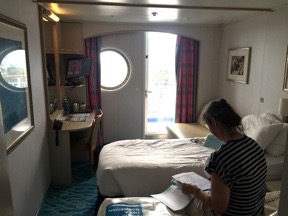
I’ve always cruised with a balcony cabin and I’m not about to downgrade now, so I got us a midship outside cabin on Deck 9’s port side. The cabin was small but had two narrow beds, a small sofa, and a desk with a chair. The bathroom was small but functional and the climate control system was absolutely silent. The balcony was private with enough space for two chairs and a table.

Our cabin on the Norwegian Sky.
I know that some folks say that a balcony room is a waste of money. How much time do you spend on the balcony? In my case, a lot of time. My problem is that I don’t like hanging around with loud, drunk strangers (and their kids, who really should be in school). Apparently that’s a good description of about 50% of a cruise ship’s passengers. So while they lounge around the pool getting drunk[er], make repeat trips to the buffet getting fat[ter], and do their best to emulate a frat party at a school where academic achievement is not high on anyone’s priority list, I’m doing my best to avoid them. A private balcony overlooking the Caribbean or a port city is perfect for this.
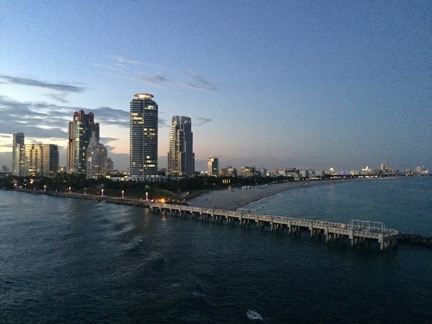
A view up Miami Beach from the comfort of our balcony as Norwegian Sky pulled out of port on Monday evening.
We spent much of the early afternoon wandering around the ship, getting to know it a little better. We found food and later found our bags as they were being delivered to our cabin. We unpacked. Later, we watched the ship pull out of port, which is something we’d do each day. Then we showered and dressed for dinner.
People who know me know that I’m a bit of a foodie. So when I booked the cruise and was offered a choice of beverage, dining, or $50 excursion voucher, you can bet I took the dining package. That entitled us to three meals at one of the specialty restaurants. These turned out to be rather impressive fine dining establishments with great food, wonderful service, and an atmosphere guaranteed to turn off most of the partiers. The regular price also played into who would dine at a specialty restaurant — they ranged in price from $19.99 to $29.99 extra per person. Of course, we didn’t have to pay this.
Lots of folks asked me if I got the beverage package. This would entitle me to all the alcohol I could drink every day. It also explains why so many people were perpetually drunk. But although I do enjoy wine with dinner and a nice vodka martini now and then, I’d much rather have good food every night than get shitfaced drunk every day. Does that honestly surprise anyone?
The first night, we had steaks at Cagney’s, the steakhouse on Deck 12. It was a great meal. At the end of the meal, they brought a third dessert and sang Happy Birthday to Laura.
The pool deck early in the evening, before things really started rocking.
We didn’t do much afterwards except walk around and marvel at the number of people crammed into the four hot tubs. I don’t know about you, but the idea of sharing a hot tub with up to a dozen drunk strangers grosses me out.
The party had begun.
The had boat started to roll a little in the offshore swells while we were at dinner. That brought back memories of my first cruise, when I’d battled seasickness one evening — formal night, of course — in rough seas. But things soon calmed down and it was smooth sailing by the time we went down to bed. The sea was kind to us for the rest of the trip.
Day 2: Freeport, Grand Bahama
We slept with the door to the balcony open. It was much warmer outside than inside, but with the air conditioner adjusted just right, it was very comfortable in the narrow but cozy bed. Best of all, we could hear the sound of the waves against the hull as the ship steered through the Straits of Florida on a dark, moonless night at about 8 knots.
How do I know we were moving at about 8 knots? The GPS on my phone. I am a geek.
I woke at about 3 AM and stepped outside. I could still see the glow from Miami far behind us, reflecting against some low clouds to the west. There were a handful of lights much closer and I used my binoculars to study them. Over the next few nights, I got the knack of distinguishing ships from lighted buoys and cruise ships from tankers and cargo ships.
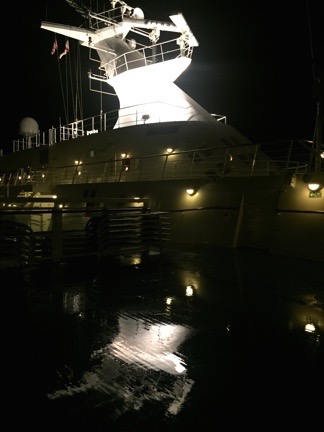
The communication tower at the front of the ship, shot from Deck 12. Note the reflection; the crew washed the decks pretty much every morning.
By 4 AM, I realized I wasn’t going to be going back to sleep. I slipped on a pair of lounge pants, grabbed my slippers and room key, and headed out in search of coffee. I’d been told the night before that coffee wasn’t available until 6:30 AM, but I suspected that wasn’t exactly true. I poked around a bit, wandering decks where crew members were busy cleaning up the previous night’s party. Two guys were hard at work power washing the wooden deck around the pool. I walked barefoot in the wet areas to keep my slippers dry and donned my slippers in the dry areas.
I discovered that the best place to see in front of us was the area outside the forward bar on Deck 11, where I could stand at the railing with the wind blowing through my hair and clothes. Upstairs, on Deck 12, the forward deck area had a high glass panel that blocked the wind and made photography sketchy.
Eventually, I made my way to the port side of Deck 11. Some crew members were working in the sport bar there and when I asked them about coffee, they guided me to a pair of urns — regular and decaf — positioned just outside the roped-off buffet area. I filled a cup while kitchen staff worked hard to stock the serving area with the cold and room temperature items we’d soon be eating: fruit, yogurt, jams, jellies, butter, dried fruit, granola, bread. The hot items would come later, just before the buffet opened. I was thrilled to get good, hot coffee before 5 AM.
Frankly, I think the cruise line is missing out on a revenue opportunity. If they kept the coffee bar on Deck 7 open 24 hours a day — instead of waiting until 11 AM to open (what’s up with that?) — they could be cleaning up on espresso and latte sales around the clock.
Coffee in hand, I went back to the cabin. Laura was still asleep. I drank coffee on the balcony, then got dressed, grabbed my binoculars, phone (camera), and journal and headed back out. I camped out on the aft area of Deck 11 with a fresh cup of coffee and wrote in my journal. My only complaint is that the music was too loud. Indeed, I’d later realize that there was music pretty much all over the boat almost 24 hours a day. So not only was our balcony the most private outdoor space, but it was also the quietest.
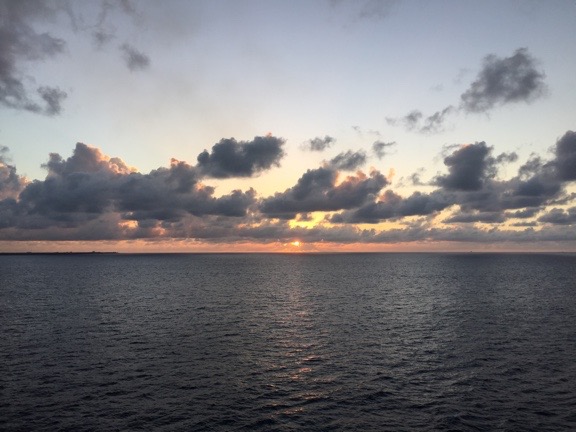
Laura found me a while later. We watched the sun rise as we came into Freeport Harbor.

Sunrise, on approach to Freeport Harbor.
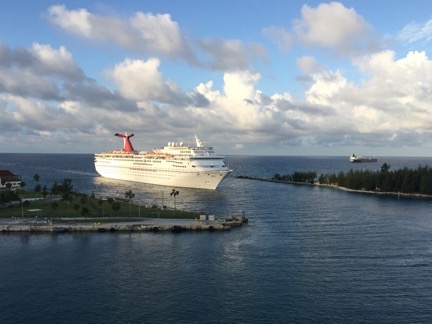
The Carnival Fantasy followed us into port.
Dock workers and crew men had almost finished tying up the ship when another ship crept into port. It was the Carnival Fantasy, a ship roughly the same size as ours, which we’d see again the next day. The port, which was dead quiet when we arrived, was soon very lively with shops and straw market booths. Things got even livelier as the ships began to disgorge passengers.
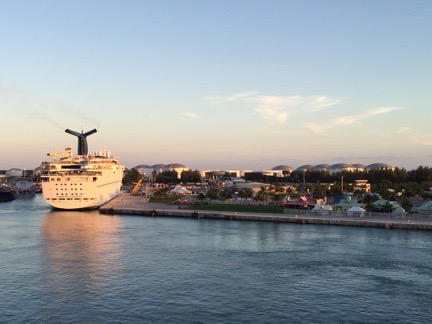
Here’s Freeport Harbor after our departure. The Carnival ship left not long after us. By the time we pulled out, the port area had already closed up for the night and was completely deserted.
The whole cruise ship thing is so weird to me. Take a community with a few thousand inhabitants and park two mobile cities, each with 3,000 or more people, in it. Let the people out to shop, drink, and dine. Then, at the end of the day, gather up the mobile cities’ inhabitants and move them out, leaving the people who live there to clean up, count their revenue, and share stories from the day. Repeat daily — or almost daily — for most of the year. It’s just too weird for words. Maybe that’s why so many of the cruise ship ports are so far from where people actually live. Maybe that’s why they’re artificial environments, designed to meet tourists’ expectations rather that reflect the actual culture and lifestyle of the people who live there. And in nearly all of the shops in all of the ports were the same “Bahamas” branded, brightly colored dresses, shirts, skirts, and tote bags the tourists apparently want to buy.
I think that’s what bothered me most about the Alaska cruise I did back in 2007. There’s so much native culture in the area, but it was hidden away beyond the often tacky, touristy port areas few passengers left.
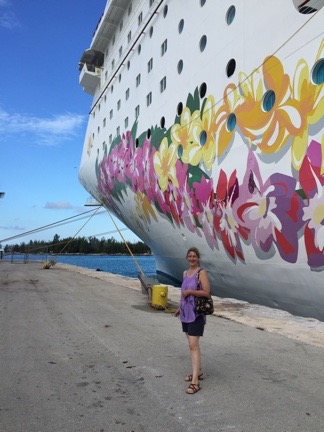
Laura posed beside the ship in Freeport.
Don’t get me wrong — I know these people need to make a living. And I’m glad, in a way, that I can help them do so. But it’s unfortunate that tourists care more about buying trinkets and taking packaged tours than learning more about the natural and cultural history of the place they’re visiting.
Meanwhile, we’d signed up for a sail and snorkel trip. Laura had never been snorkeling and I’m always up for a sailboat ride. We got on a line, signed a waiver, got on a charter bus, and then drove across the narrow island to Port Lucaya. There were about 40 people in our group. The bus driver was a very friendly guy — heck, everyone who lives in the Bahamas seems to be friendly — who did his best to make the 20 minute bus ride informative and enjoyable. He mixed tour guide patter with lots of information about the Bahamas and Grand Bahama island. I actually remembered quite a bit of it, which was funny when the driver on the way back tested us and I knew most of the answers. Of course, he does it all for tips and we obliged on our way out.
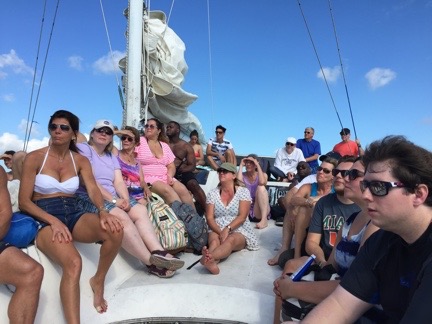
A shot back at my fellow passengers on the port side of the sailboat before the sails went up. Is it my imagination or do they look bored and a little unhappy?
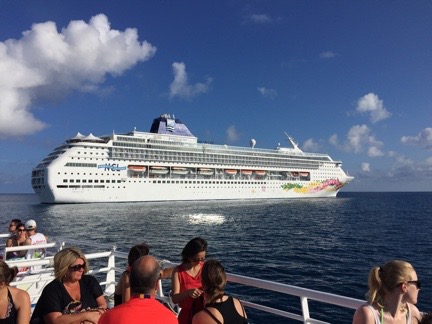
After giving us a safety briefing of sorts, they handed out swim fins, snorkel masks, and snorkel vests and put us on a large trimaran. For reasons I can’t quite comprehend, no one seemed interested in sitting on the netting between the hulls. Except me. I got myself a nice seat right up front. Laura hung back with our big bag of stuff. We headed out on engine power, navigating the harbor past other boats and businesses. Once we got out into open water, the crew — there was a captain with two crew members — hoisted up the two main sails. The breeze barely caught them, but the captain killed the engines anyway and we continued at a slow pace over shallow water, past parked dive boats and parasailing boats speeding by with parachutes in trail. After about 20 minutes of that, even the captain got impatient. He started the engine and we turned to the south, paralleling the beach and the reef we’d passed over. Then we turned east again, heading inland. When we got back over the reef, he killed the engine. The crew took down the sails and dropped anchor. We had arrived.
We snorkeled for a while. The water was a bit choppy but predictably warm. There were fish everywhere, but there wasn’t much variety or even color. The reef was below six to eight feet of water and showed signs of severe damage likely caused by storms, ship anchors, and uneducated tourists. I’d learned years before while snorkeling at John Pennekamp Coral Reef State Park at Key Largo that coral is extremely fragile to the point that simply touching it could damage it. Yet at no time were we warned not to touch the coral — except a certain kind that could cause pain or itching. (“Mustard color with white tip will surely ruin your snorkel trip.”) As a result, this frequently visited reef off the coast of Grand Bahama is a sad shadow of what it might once have been. I can only hope that there are lots of other coral reefs where they don’t take tourists every day. Still, I did see some nice coral specimens and some interesting fish. But not enough to keep me in the water. I was the first one back on the ship.
The trip back was direct and much quicker. They didn’t bother with the sails. My fellow passengers were much more relaxed and a few even joined Laura and I on the net area, although by that time I’d moved to the forward end of the port hull where I could dangle my feet over the water and get wet.
Freeport Food TipsIf you find yourself at Freeport or Port Lucaya, try these places for good food:
- Big Daddy’s. This is the kiosk at Port Lucaya where we bought our lunch. Unbelievably fresh conch and lobster. This place has a big following; Google it and see for yourself. Or learn more about conch and Big Daddy’s in this blog post.
- Bootleg Chocolates. Amazing chocolate made on the premises.
- Pier One Restaurant. We didn’t eat here but a man from Chicago on line at Big Daddy’s was raving about it. Don’t let its outside appearance spook you; we passed it as we came into port and it looks a bit funky.
Back at Port Lucaya, we had about an hour to kill until our bus ride back. We were hungry and went in search of food. A fellow snorkeler mentioned a conch kiosk near the dock and we made our way there. Inside was a big man with a big knife cutting up the ingredients for conch salad while a companion worked over a fryer. We ordered “fried conch with fritters” which turned out to be exactly that: fried conch with a side of conch fritters. The fried conch was tender and tasty; the fritters were also good but mostly bread.
After watching a fisherman remove a few freshly caught conchs from their shells, we found a spot in the shade in front of nearby Bootleg Chocolates to eat our lunch. An older woman also enjoying the shade urged us to get some chocolate before leaving. She told us a little about the owner of the shop. Since we’d used their shade, I thought a visit was in order. Besides, I love chocolate. We walked away with a 12-piece assortment and chocolate covered espresso beans, all of which was consumed before the end of our cruise.
We caught the bus back to Freeport and the ship. We walked around the shops for a while. We each bought small, brightly colored purses and I bought a dress. Then it was back to the ship to relax. Laura napped and I watched the latest Mission Impossible movie in the theater. (Wouldn’t you know it? They made the departure announcement just as the ticking time bomb scene came on screen so I never did hear what Ethan Hunt told the bad guy to get him to release the hostage.) The movie finished right as we left port and I hurried back upstairs to our cabin to watch Freeport drift away.
Dinner that night was at Le Bistro on Deck 5, another of the specialty restaurants. We enjoyed nicely prepared French food and great service. And when I couldn’t decide between two different desserts, they brought both of them.
This storm cloud reminded me uncomfortably of the smoke clouds I saw in Washington State this past summer.
We walked around the decks while the evening party was just getting started. I’d soon realize that every night they managed to squeeze more people into those hot tubs. After watching a storm to the east — possibly the remnants of Tropical Storm Kate — fade away into the night, we stopped at the Outrigger Lounge at the forward part of Deck 11. This was, by far, the most pleasant place on the ship for a drink. It was also almost always absolutely empty. We sat at the bar, where I ordered a Courvoisier VSOP, and we kept the bartender company. Later, on the beach at Grand Stirrup Cay, she’d remember us — a feat I consider remarkable.
Day 3: Nassau, New Providence
I woke early again the next morning and spent some time watching the stars, listening to the rush of the water from the balcony, and peering at the lights of other ships through my binoculars. Although our balcony light was out, our neighbors on either side had left theirs on and the light drifted into our space. A quick peek around the dividers showed that both cabins had their drapes closed tightly. Chances were that neither cabin’s occupants even knew their lights were on. Later that day, when I saw our cabin attendant, I asked him to shut the lights off when he cleaned the rooms. He had partial success; the occupants of the room to our left refused cabin service for the entire length of the trip. (Can you say dirty towels?)
I got dressed and went directly to coffee. Laura eventually joined me and we watched the ship pull into Nassau’s port where a Royal Caribbean ship was already waiting and two Carnival ships would join us.
By this time, we’d learned that early risers could get a quick, hot breakfast without any crowds at the Deck 11 buffet. I found the omelet station and had a freshly made omelet every morning, along with a pastry or bagel or muesli or fruit. By 7:30 AM, the place was a madhouse. But by then, we were already moving on to other things.
This wasn’t my first time to Nassau. I’d been there in 2011 with my wasband on a business trip. Back in those days, he sold AstroTurf — the real trademarked stuff — for a company based in the Deer Valley area of Phoenix. I’m pretty sure that the trip was a sales award. I do know that a coworker and his wife, Chris and Ruth, were also along, although I can’t remember if his idiot boss was. I also know that we stayed at the Atlantis resort and that I caught a nasty cold that pretty much ruined the trip for me. Although the cruise line’s excursions included several to Atlantis, I wasn’t that interested in going back, despite the fact that they have a real kick-ass water park with a mile-long lazy river.
Instead, we’d decided on a Segway tour. I’d been on a Segway twice and Laura had been on one once. I really like them — probably a lot more than I should. They are unbelievably unpractical to own but undeniably fun to ride.

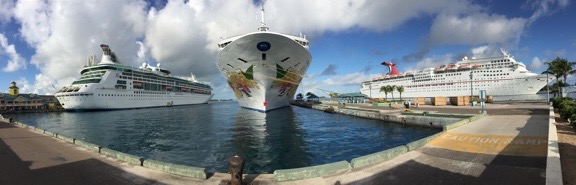
When we left the ship, I stopped at the bow of the Norwegian Sky to make this panoramic image. The fourth cruise ship, which docked to our right, had not yet arrived.
After waiting here, there, and everywhere, our guide loaded eight of us onto a taxi van and drove us to the Segway base at the local cricket club grounds. There, we were outfitted with helmets, elbow pads, and knee pads, signed the inevitable waiver, and got a lesson. Because Laura and I and two other people had already ridden Segways, our lessons were short and we were let loose in a practice area to do laps. The others got more intensive lessons before practice. Then we set off behind our guide in single file while a second guide followed and rode up and down our line to make sure we were all comfortable with what we were doing and keeping up. He also had a Stop sign on a post and occasionally used it to stop traffic on main roads so we could cross in a group.
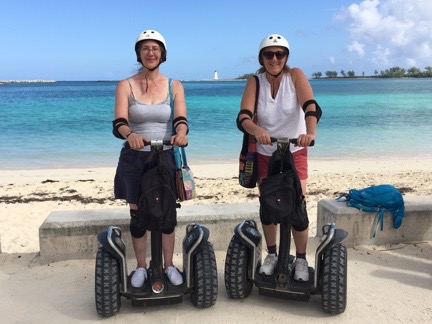
Do we look goofy enough in our protective gear on these off-road Segways?
I should mention here that Segways have two operating settings: beginner (or turtle) mode and standard mode. As you might have guessed, turtle mode is purposely slow, no more than 8 mph. Standard mode is faster, up to 12.5 mph. This particular tour company kept all of us in turtle mode for the duration of the tour. This was likely due to the rough terrain, which included grass, gravel, sand, cracked pavement, bumps, and tree roots. They used all-terrain model Segways, which featured larger, more heavily treaded tires.
We rode to Junkanoo Beach, where we stopped briefly and our guide gave us some background information about the area and took photos of us with our cameras. Then back on for a short while before another stop and more information. Then back toward our starting point with a third stop at the Fish Fry where we got a history lesson about the strip of restaurants in the area and lecture about the local food, beer, and drink. (I vaguely remember taking a limo ride to the Fish Fry from Atlantis on my previous visit to Nassau, although I can’t remember details. Cold medicine really hits me hard sometimes.) Although it was still early in the day, we all voted to stop into one of the restaurants, which were just opening, for a drink. Laura and I opted for a Bahama Mama. I figured I had to try one before the end of the trip and it must be a breakfast drink because it had juice in it. It was refreshing and I admit that it made the remainder of the morning a tiny bit more fun. Afterwards, it was back to the cricket club grounds for a race between riders on a slalom course set in the patchy grass. I was matched with one of the experienced German riders and I’m proud to say that I beat him, without knocking over a single cone, despite the rum I’d just consumed. (U-S-A! U-S-A!)
We parked the Segways and stripped off our protective gear. I spoke for a while with the woman who owned the business and got some interesting information from her. More on that another time.
We got a ride back into town where, after a short peek into a few shops, went back to the cabin for some rest. That’s when the fourth cruise ship showed up. It was quite a monster, with a huge, three-tubed water flume on top for the kids. It turned around in the harbor and backed into its parking spot right next to us. Seriously: watching ships park and depart was a huge source of entertainment for us.
We went back into town a while later. Although we thought we might try walking to the Fish Fry for a late lunch/early dinner, we never got quite that far. Instead, we walked around the straw market and shops. On the way back to the ship, I saw a guy selling conch shells and bought one as a souvenir, making him describe in detail how the conch is removed before I left with my purchase. He did better: he demonstrated with a hammer he had with him.
Once again, we watched the ship prepping for departure. Because the dock was under our balcony, we could watch the passengers return in groups. The Sky’s crew had laid out red carpets on the way to the gangway. As usual, there were tents set up with beverages and a crew member handing out cool, wet cloths for arriving passengers. That afternoon, two rows of crew members also danced to some loud local music blaring from a sound system. A woman wearing stilts danced along with them, and more than a few of the passengers danced their way on board. It was very festive and I can’t help thinking it was part of a show put on to show the Carnival passengers, whose ship was docked across from ours, how much more fun Norwegian was. They had no amenities other than an shade tent with chairs for returning passengers. It was kind of funny to see two of their passengers dancing down our red carpet with our crew members before leaving the carpet to join the others on their way to the Carnival ship.
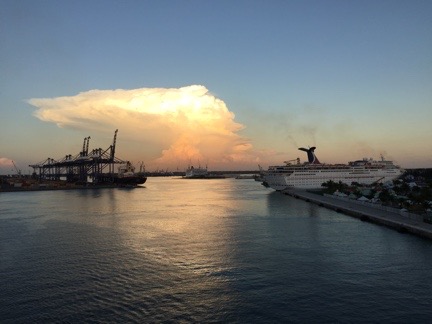
The Carnival Fantasy, which had come in just after us that morning, was the first to leave. It backed out into the open harbor area, made a 180° turn, and slipped out of the port. We did pretty much the same maneuver. It looked as if the larger Carnival ship went next, followed by the ship that had been first to arrive. But back on shore, Nassau was still partying. With all the hotels in the area, the city never really closes down. The last bit of entertainment came when the pilot boat rode alongside our ship and the pilot climbed out of a hatch and down a rope ladder to leave us.

Nassau was still partying as we sailed away after dark.
We took it easy for the rest of the evening. We had sushi for dinner at the Plantation Club on Deck 12. Although this was a specialty restaurant, we decided to save our last dinner, which we’d eat in the Italian restaurant, for the last night. Dinner wasn’t costly at all, which is kind of a good thing because the sushi wasn’t that good.
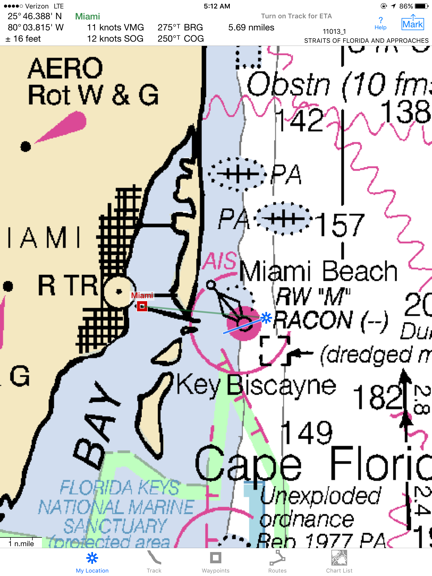
At sometime that day, I recalled that I’d bought iSailGPS, a nautical charting app for my iPad for use when I took my boat out in charted waters. I’d never installed it on my new iPad. So I splurged for an Internet connection on the ship, downloaded the app, and downloaded the NOAA chart for the Straits of Florida, which included the Bahamas. Before going to bed, I’d not only plotted our location on the chart via GPS but had found our next destination and calculated the distance. I really am a geek.
Day 4: Great Stirrup Cay, a Private Island
I didn’t sleep well on Wednesday night and was up multiple times during the night. Each time I woke up, I’d step out to the balcony with my binoculars to see what was out there. Once, I didn’t even have to step outside: I could see the Norwegian Escape cruise by in the opposite direction less than a mile away, right from my bed. But the thing that pleased me most: both of my neighbors’ balcony lights were turned off, giving me a nice, dark platform for star gazing.
I also consulted iSailGPS a few times so I knew how fast we were going — very slow — and where we were.
By 4 AM, I was up for the day so I dressed and went for coffee. I don’t know if I was imagining things, but it seemed as if there were more passengers awake earlier that day than usual.
A pair of double-decker tenders transported us between ship and shore.
Great Stirrup Cay is a private island owned by Norwegian Cruise Lines. It’s the northernmost island of the Berry Islands south of Grand Bahama Island. It sits in an area of very shallow water, so there’s no port. Instead, Norwegian ships drop anchor on the north side of the island and double-decker tender boats come out from the island to transport passengers. There isn’t even a dock on the island. Instead, they just lower a ramp and we walk off the boat, kind of like cattle arriving at a slaughter house. But with a more pleasant outcome, of course.
The island isn’t big — you can easily walk from one side to the other, as we did twice that day. The north side, facing the ship, has a series of beautiful sandy beaches all set up with lounge chairs facing the water. Most of the chairs in the back rows are paired up with clamshell shades that beach-goers can rent for $30/day. We rented one right away; neither of us wanted a full day of full sun. Farther up the island are cabanas that go for considerably more. There are restrooms, bars (of course), and buildings where you can rent snorkel gear, rafts, and floats; sign up for a WaveRunner, kayak, or snorkel tour; and get a buffet lunch between 11 AM and 2 PM. There’s a fee for everything except the sunny lounge chairs and the buffet and I suspect that Norwegian owns everything, so the private island must be quite revenue rich for them. But it was also beautiful, clean (at least when we arrived), and stress-free. Although there was a little straw market of shops with the same tourist merchandise we’d seen everywhere else, the people who worked there didn’t shout out to get you in the door or try to haggle with you to sell.
We went for a WaveRunner tour. Laura had never ridden one. I’d owned a pair of them for a few years starting back in around 2005 and had a lot of hours on them, mostly in Lake Pleasant north of Phoenix. (I love them and if I didn’t currently have a little jet boat, I’d have one again.) The tour folks offered single and double riding. In an effort to save a few bucks, we went double and Laura did the driving. There was about 20 people in our group and about half were riding double. They made us watch a video, then handed out life jackets and loaded us on board three-seated Yamaha WaveRunners very similar to one of the ones I’d owned.
Laura got off to a shaky start, but soon got the hang of it. We raced around water so clear and shallow that we could see the bottom most of the time. The guides were very good at keeping an eye on us without holding us back. We all spread out quite a bit, then gathered together and drifted in an area with very shallow water. The guides jumped in and emerged from the bottom with huge starfish that they passed around so we could feel their hard shell-like bodies. One by one, the guides tossed them back in and we watched them drift gently to the sea floor. When we left, I looked into the water and saw dozens of them as we raced by.
Even though I didn’t do any of the driving, I think that was the most fun excursion of the trip. Not quite sure what that says. I know it made me really wish I could take my boat out again soon. It also got me thinking that maybe I should drag my boat down to Arizona this winter.
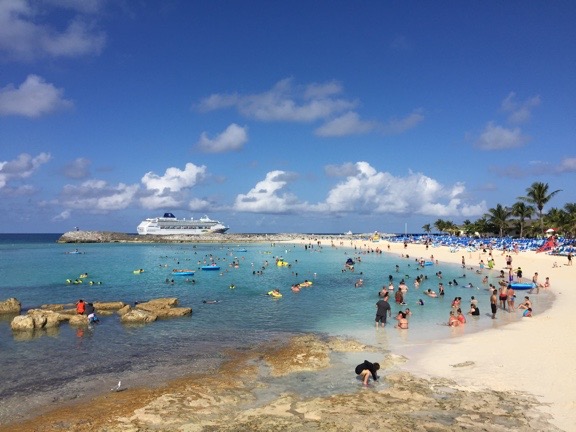
We grabbed lunch at the buffet and went back to our shady clamshell on the beach to enjoy it. Then we just relaxed for a while. Laura went back in the water to cool down while I opted for a fresh water shower on the beach. I visited the Bacardi bar for a so-so mojito — not quite sweet enough, even for me — and realized what a perfect viewpoint it was for a photo. Later, I came back with my camera and took the photo I consider my best of the trip.
No other image can say “Bahamas Cruise” better than this one.

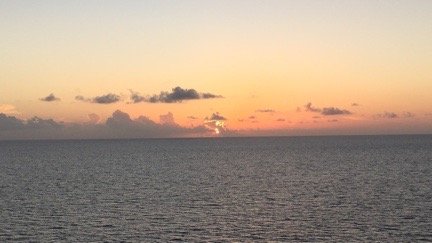
Just another Caribbean sunset.
We were back on board the ship by 3 PM, although the last tender wasn’t due to leave until 4:30. I napped for about an hour, woken by the glare of the sun through the open balcony door as the ship turned around to head northwest. We watched the sun set from our balcony.
I consulted iSailGPS for our course back. Although Miami was due west, the water on the direct path back was very shallow so we’d have to go north before going west. Still, I could tell the Captain was serious about getting home. He had the speed cranked up to 14 knots — the fastest we’d gone all week — and we could really hear the wake as he plowed through the water.
Dinner that night was in the last of the specialty restaurants, Il Adiago on Deck 11. Although the food was very good, the service was a problem. It all seemed centered around a member of the bus staff who apparently thought he was a waiter. He took orders for wine when it was obviously the waiter’s job. (He screwed it up, too, by ordering wine for both of us when only one of us wanted wine.) He took away plates for one of us before both of us were finished eating. And he committed the ultimate dining service sin: he asked us if we wanted anything else before I’d finished eating. I let him have it, letting my tone of voice say more than my words: “I’d like to finish my meal before I think about dessert.” He apologized and left, returning only when my plate was empty and letting the waiter take our dessert order. If language wasn’t such a barrier on board, I probably would have spoken to the woman who had seated us about it. But English was a second language for most crew members and it really didn’t seem worth the effort to offer my negative feedback. I just hope they get the guy some decent training before he ruins someone else’s meal.
While we wanted to enjoy some of the ship’s entertainment that night, we were completely wiped out from our day in the sun. So we spent the rest of the evening relaxing before turning in early.
Day 5: Port of Miami
It should come as no surprise that I was up early the next morning. It was dark and a bit foggy. Floodlights illuminated the lower half of the ship — I think it was the Captain’s effort to keep us very visible as we entered the deeper water shipping lanes between Miami and the Bahamas. I checked out the warning buoys we passed as we rounded the northernmost part of the Great Bahama Bank. Then, as we turned to the southwest, I started taking note of the ships that seemed to be on the same course for Miami.
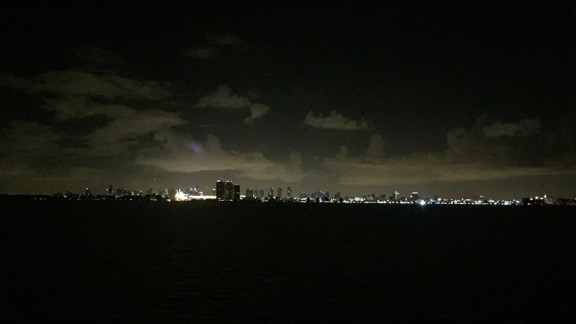
When we got closer, I got dressed, got some coffee, and went up to the wide open forward area of Deck 11. I monitored our progress on my iPad and soon saw the lights of Miami out in front of us.
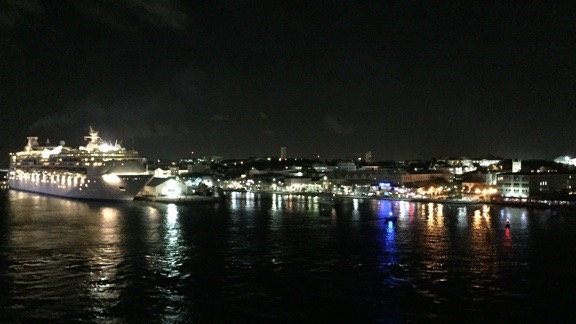
On approach to Miami. The lights really glow at night.

We were the blue asterisk with the line indicating direction as we approached the Port of Miami’s ship channel. I downloaded more detailed charts of the harbor as we got closer. Have I mentioned that I’m a geek?
It wasn’t long before I got a good cell signal. By the time we were in the channel, passing quickly between red- and green-lighted buoys, I was broadcasting on Periscope, sharing our arrival with anyone interested in tuning in. The broadcast went very long because I managed to keep quite an audience. I answered lots of questions and was very pleased when several viewers told me that they enjoyed my broadcasts. It got lighter and lighter as we came in past two parked cruise ships, including the AIDAvita, which looked like the perfectly sized cruise ship for the kind of cruising I’d like to do. (Unfortunately, I don’t speak German and their website isn’t in English. Likely a smart strategy for AIDA.) We got to the end of the cruise ship terminal area, made a 180° turn, and parked right where we’d left from on Monday evening.
It was about 6:30 AM.
There was no rush to get off the ship — we had until 9:30. Laura and I went down for breakfast. We tried one of the sit-down restaurants, but it was still closed so we wound up back at the buffet. As we walked back down to the room later to pack, we saw many passengers already on line with their luggage, waiting to get of the ship.
We packed leisurely and went through the room several times to make sure we hadn’t left anything behind. I’d managed to lose an earring that morning but it never showed up in lost-and-found before we finally departed.
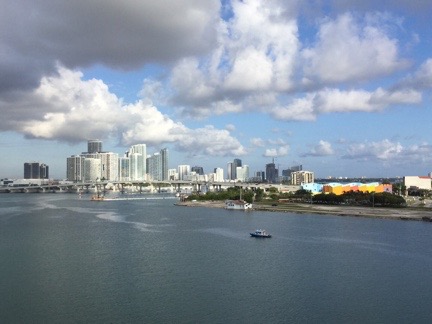
Back to reality: one last look at Miami Beach from the ship.
Exiting the ship went very quickly. Yes, there was a line to get off the ship and another at Customs, but the lines moved quickly. A woman at the start of the Customs line steered us to a line where a young agent was examining passports and customs forms. He wasn’t checking bags and he didn’t ask to check ours. He took our forms and compared our passport photos to our faces. He seemed to do a double-take when he looked at mine. I laughed. “I have longer hair now and I’m much happier,” I told him. “You look it,” he replied as he handed back the passports and sent us on our way.
We found the car, loaded up our bags, and paid for parking on the way out. After stopping for gas in Miami, we got on Route 95 and headed north, back to reality.
Closing Thoughts
This was the “tiebreaker cruise” — the one where I’d decide whether I ever wanted to cruise again. I went into it with very low expectations and a pretty small investment. The result: no disappointment, but no big thrill, either.
You have to look at a cruise for what it is. When you get on board, you’re checking into a resort where all the basics — food, a room, and some amenities like a pool — are included. Like any resort, it’s full of people who bring their own personalities, preferences, and expectations with them. Those might not match yours. The resort travels from place to place and you get the benefit of visiting all the places it stops at — without having to pack and unpack for each move.
While it is possible to do the cruise we did for as little as about $250/person including taxes and fees, that doesn’t buy you much. In fact, you won’t even have a window in your room. But where else can you get a 4-night stay at a resort with all meals and amenities for that kind of money? When I bought the cruise tickets, it was with the knowledge that a four-night trip to Key West would have cost at least what I spent if we stayed in a decent hotel and had good meals — but we wouldn’t get the daily change of scenery.
If you want to fully experience a cruise, however, you have to enjoy some for-fee services on the ship and port excursions. And those aren’t cheap. We spent nearly as much on our three excursions as we did for our balcony cabin. So while a cruise looks like it could be cheap, it could also be very costly.
Of course, excursions don’t need to be booked through the cruise ship. If you do your homework in advance, you can find local tour operators who might offer better, cheaper options. But I didn’t do any homework. I’m a lazy traveler sometimes and that’s who cruises are for.
So would I do this again? Yes, but only after I did some more research. I’d try harder to find a cruise that was a match for me. More sophisticated travelers. Smaller, newer cruise ship. More interesting destinations. More personalized service. No kids — is that possible? And yes, I know this would cost more. But for the right cruise — a cruise that will WOW me — I’m willing to pay more.
Just not for a few years. I honestly don’t think cruising is something I want to do very often, no matter how good it sounds.