Picking Up My New Old Trailer

I take delivery of a new used cargo trailer for my mobile jewelry shop.

My October trip to Tacoma, which I cover in another blog post, was the first half of a two-part trip. The second half was a stop in Yakima to pick up a trailer I’d seen there back in September. I’d told the owner, a guy named Mike who owned the local Lance dealership, that I’d be there around 11 AM on Monday. It was Sunday afternoon when I finished my business in Tacoma.

Researching the Trip

I’d originally planned to spend another night behind TMAC, but since there was nothing really appealing about the place as a campsite, I figured I get started on my way to Yakima that afternoon and camp along the way.

I did some homework. First, I checked out the most direct route which, I as expected, had me going through Chinook Pass near Mt. Rainier. Chinook is usually the first pass to close every winter. WADOT reported that it was still open with no restrictions. There was a slight chance of snow that day, so I knew I’d have to check again later.

Then I looked for a campsite. I have an app (Ultimate CG) that lists all public land camping areas. I didn’t want to be too close to the pass because I didn’t want to have to run the heater all night with the cooler temperatures at altitude. It took time — a surprising number of campgrounds were already closed for the season. I found a campground near Naches called Cottonwood that was open year-round and picked that as a destination.

After class, I walked Penny, secured loose items in the camper, and climbed into the truck. I checked Chinook Pass again; it was still clear with no restrictions. It was nearly 5 PM when I rolled out of the parking area and started on my trip to a destination 73 miles away.

The Trip to Yakima

It was freeway driving until I got off of Route 18 and headed toward Mt. Rainier. Eventually, I passed through the last town and started climbing on a two-lane road that wound through the forest. Although the weather was overcast and the light was disappointing, I enjoyed views of autumn colors all around me, especially the bright yellow larches. Unfortunately, the road was full of frost heave bumps that forced me to drive 5 to 10 miles below the speed limit. Google Maps kept adjusting my arrival time. When I still had cell service, I asked Siri what time sunset was at Yakima. 6:15, she reported. Google told me that I would not arrive until 6:45 PM.

I passed a few spots where I knew I could find a campsite in the National Forest. I was eager to get over the pass that day in case it snowed overnight. I didn’t want to have to start the next morning by backtracking to a different pass. So I kept going.

Clouds hid Mt. Rainier at a view point I passed. Soon I was climbing up into those clouds. The fog got thick on the narrow road. The pavement was wet. The outside temperature was only 39° then 37°. I slowed down even more. The guy in front of me speeded away and the guy behind me got closer, but there was nowhere to pull over to let him pass.

I didn’t realize I was near the pass until I saw the sign for the parking area for the little lake up there. I couldn’t see the lake or the mountain peaks I knew were beyond it. I couldn’t even see the parking area. Then I drove under the underpass right at the top of the pass. I knew there was a parking area to my right and I pulled into it so the guy behind me could pass. The air was already clearing; the clouds were mostly caught up on the west side of the mountains. The guy passed and I got back on the road, now able to see quite well.

But it was getting late; sunset was only minutes away. I still had 30 miles to go. As I came down the east side of the mountains, I began looking for an alternative place to spend the night. I passed a few closed campgrounds and then came upon an area where gravel roads led off to the left or right. There was a bridge over a creek and a road just before it. I slowed down but was going too fast to stop. It didn’t matter; there were people camping in there anyway. But on the other side of the creek was another turn. I stopped just past it, backed up a little, and drove in.

The Perfect Campsite

There was a flat area just off the road that would have been okay to camp in — if I didn’t mind being right next to the road. But beyond that was a short steep hill with an empty campsite beyond it. I got out to take a look. If I could get the truck up the hill, there was plenty of level space for me. I got back in and drove up the incline. It was no problem for my big 4WD truck. I spotted a perfectly flat area cleared of all forest debris that looked as if it had been occupied by a very large tent. I turned the truck around in the relatively tight space and backed in.

Perfect Campsite
This was, by far, one of the nicest just-off-the-road campsites I’d ever had the pleasure to spend the night in. Level, quiet, private.

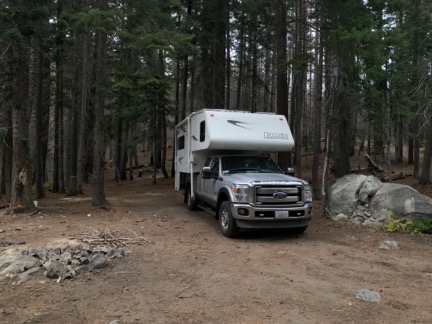
With nothing but forest out my back door and a rushing creek off to one side, I had found the perfect campsite. I shut down the truck and got out with Penny. I took a picture of my truck parked against the woods. It reminded me of why I’d bought a truck camper instead of a pull trailer and how glad I was that I did.

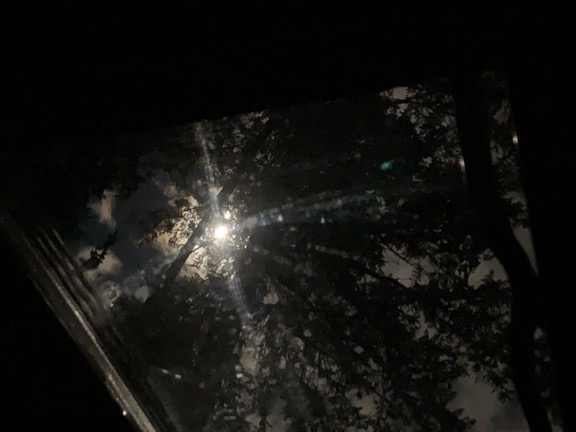
It was already getting dark, so we didn’t spend much time exploring. I was hungry and it was getting chilly. We went inside. I turned on the heat, gave Penny some more food, and made myself dinner. With absolutely no cell signal to distract me with web surfing, I spent most of the evening writing this blog post. Then I climbed into bed and read for a while on my iPad. I saw the moon rising through the trees through the window by my head. It was dead quiet.

Later that night, I woke up and spent some time listening to the sound of the rushing creek and watching, through my big plexiglas skylight, the full moon peeking down at me through the trees and clouds. It really was the perfect campsite.

Moonlight thru the Trees
I know it isn’t a great photo, but it was a great moment. The full moon as seen through my camper’s sunroof, poking through scattered clouds and evergreen trees.

Picking Up the Trailer

American River
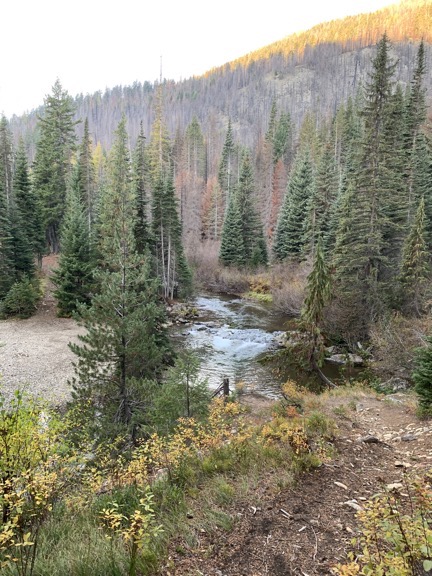
The American River separated my campsite from the one I’d seen the night before.

The next morning, I made coffee and spent some time at my table writing the first part of this blog post. It didn’t get light until around 7 AM. That’s when I let Penny out and made some breakfast. I took a photo of the creek next to my campsite — actually, the American River — before going back in to do the dishes, strip the bed, and secure loose items for the last day of my trip.

I had a minor “black ice” experience not long after getting on the road. It was about 31°F outside and the road was just wet enough to have a thin layer of ice on it. I was driving along at about the speed limit when I realized that I was sliding ever so slightly. I took my foot off the gas and complete control came back quickly. I drove slower until the temperature topped 35°F.

I had no internet connection so I couldn’t use Google to navigate. It wasn’t a big deal; I figured I could find Yakima easily enough. But I also wanted to check out Cottonwood Campground for future reference. I found it about 20 minutes after leaving the campsite. It was a nice little campground with a few campers in it. I stopped to dump my garbage. If they had a dumping station, I probably would have used that, too.

Internet came back with a flurry of text messages and notifications. I pulled over for a moment to see if I’d missed anything important. Mike had texted me to see if I was still coming that morning. I checked the time and realized I was right on schedule to arrive at 11 AM and texted him to let him know.

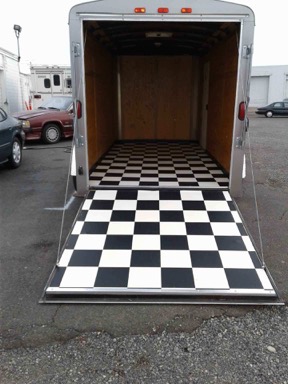
Eventually, I rolled up at the Lance dealership and pulled around in back. Mike greeted me and spent some time showing me the trailer again. The only other time I’d seen it, it had been parked in a fenced in area that made it impossible to get the back ramp down. We got the ramp down all the way. I was pleased to see that the door lock was not only there but it actually worked. So did the lock for the front toolbox. The lights inside even worked. It was spotlessly clean — he’d washed it inside and out. He’d even checked the tire pressures and the torque on the lug nuts.

Resized952019101295165139954891 Trailer Ramp
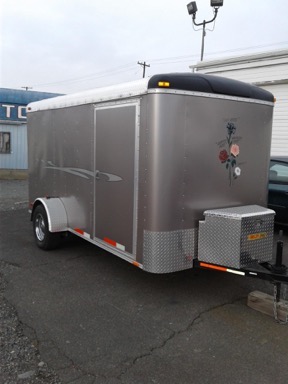
My new old cargo trailer. It’s a 2013 (I think) and in amazing condition. The names painted with the flowers on the front are the original owner’s dogs’ names. (I can’t make this stuff up.) I know it has only one axle and I know a lot of people think two axles is a lot better. But a one axle trailer is easier to maneuver for parking and that’s what I wanted. I also wanted the interior lights and ceiling vent. The only thing I didn’t want was the ramp door — I wanted barn doors in back — but I know ramps are better for resale. I don’t expect to own this more than a few years.

Mike spent a lot of time looking for a spare tire for it. He thought it had one but his co-owner brother said it didn’t. They’d owned the trailer for a long time; Mike had bought it for personal use and never actually used it. In the end, he didn’t find a spare. I was okay with that; I’d buy one at the local tire shop. I’d gotten a good deal and didn’t mind spending a little more to make it perfect. I knew I’d be spending about $300 to install E-Track in it within the next month or so anyway.

We did the paperwork and I gave him a check. Then he guided me to hook it up behind my truck with the camper on top and the extended tow hitch on back. After we had it all hooked up, he stood back to admire it. I think he was tickled that the color of the trailer kind of matched the color of my truck. “Nice looking setup,” he said.

I thanked him and got on my way.

The Trip Home

The trip home went smoothly. The trailer towed like it was nothing — probably because it was empty. My truck, which had been giving me some engine cooling issues on the way to the Seattle side a few days before, didn’t give me any trouble at all on the way home. Although I was really hungry and wanted badly to stop for lunch, I motored through, stopping in George for fuel.

At home, I played my parking game. I dropped the trailer in my gravel driveway and backed the truck and camper onto the concrete apron. Then I used the front tow hitch on my Jeep to move the trailer into position beside my truck. Eventually, everything went into my cavernous garage. That’s where I’d prep the trailer and camper for my winter trip.

If you’re a regular reader of this blog, you might recall that I bought a cargo trailer very much like this one in January. It was kind of beat up and I never really liked it for a variety of reasons so I sold it a month or two after getting home. I know I’m going to like this trailer a lot better, mostly because of how clean and new-looking it is. I hate buying old crap; this is not old crap. I’m looking forward to customizing it for my travels.

Two Jewelry Classes

I take the camper to Tacoma to learn more about making jewelry.

Note: I actually wrote this and much of the post after it about my new cargo trailer back in early October while I was still traveling. I can’t tell you how many blog posts I start writing and don’t finish. This one’s done. I’ll try to get the other one done this week, too.

Last September, I took a 3-day intensive beginner metalworking class at the Tacoma Metal Arts Center in Tacoma, WA. It was an amazing experience that really transformed the way I think of making jewelry. I learned a bunch of metal working skills and how to use new (to me) tools that would take me to the next level in my work: cutting, soldering, texturing, shaping, and polishing sheet metal using jeweler’s saws, shears, torches, flex shafts and attachments, dapping blocks and punches, rolling mills, texture plates, and burnishing tools. I left class with the basic tools I’d need to practice what I’d learned.

Getting Serious about Jewelry Making

Over the winter, I decided to get serious about making jewelry. I paid a contractor friend to frame in a 12 x 24 foot space in my absurdly large garage so we could make an insulated shop for me. That would give me a climate controlled space to work on jewelry projects. While I was in Arizona over the winter, I shopped for the tools and equipment I’d need to set up a full-blown annealing/soldering station and jeweler’s workbench. When I returned from Arizona, I ran the wiring in the new shop and my friend returned to put in the insulation and drywall while I fastened T1-11 paneling to the two outside walls facing into the garage. Then I painted the inside of the room and added some trim around the windows. I installed the two glass-paned doors last week with another friend. The room is large and bright from its two windows and four track light setups, with an 8-foot ceiling and 288 square feet of loft space above it that I’ll likely never use.

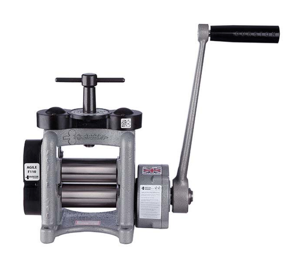
Durston Rolling Mill
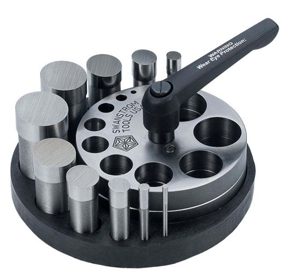
Swanstrom Disc Cutter
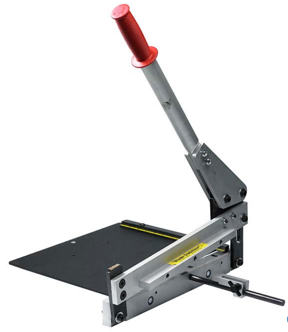
Bench Shear
Some shop tools purchased from Rio Grande earlier this year: a Durston Agile 110 Rolling Mill, a Swanstrom Round Disc Cutter, and a Precision 12″ Bench Shear. (Catalog photos not to scale; the disc cutter is actually quite small.)

With the help of the folks at Rio Grande — my primary supplier of metals — I purchased a few rather costly quality tools: a Durston rolling mill, a Swanstrom disc cutter, and a PepeTools ring bender. I also acquired a set of dapping blocks/punches and a metal shear almost as good as a true guillotine style cutter. I moved my jeweler’s bench into my new space, putting it right beneath one window where I’d get plenty of natural light. I built a solid workbench for the corner where I bolted down the rolling mill. Then I moved in the rolling storage cabinets I’d been collecting for years, set up one as my soldering station, another as my rock storage and jewelry photography studio, and a third as storage for the display and packaging equipment I’d accumulated. Half the room is set up as a jewelry studio while the other half is my regular workshop with the big workbench I built several years ago, my tool chest, and the rolling cart I’d converted into a storage and charging area for my power tools. My table saw, miter saw, tile saw, and Cabking cab making machine remain in the garage, on the other side of the wall. (The room is big, but not that big.)

Now, in addition to the sterling silver and/or copper framed gemstone cabochon pendants I’ve been making for a while, I also make textured and etched silver and copper earrings, soldered silver and copper stack rings, hammered bangle bracelets, silver plated “spoon rings,” and novelty keychains. This gives me a full range of products to offer customers when I show and sell my jewelry. I make these items in my shop and make my cabochon pendants when I go to shows.

This summer, however, I realized that I was ready for more.

Classes at the Tacoma Metal Arts Center

The Tacoma Metal Arts Center (TMAC) offers a variety of jewelry classes. Although I wanted to take the three-day course again with a different instructor to polish my skills and learn things from a different person, the dates and times it was offered did not work with cherry season, which requires me to be at home every day for three months — roughly June through August. There were a few one-day classes in September and October that looked interesting, but I wasn’t interested in coming to Tacoma for just one day. And then I saw the two one-day classes offered on the weekend of October 12 and 13: Molten Magic and Possibilities of Precious Metal Clay.

Molten Magic’s description was as follows:

Ruth [the instructor] will show you how to cut a shape from copper sheet for your project, then you will cover it with texture through the molten magic of melted silver! The result is a wonderfully rich surface texture of ridges and waves. Then, you will learn how to apply an iridescent patina with a torch by flame painting the surface.

Possibilities of Precious Metal Clay was described as:

PMC (aka Precious Metal Clay). Create fine silver jewelry from a clay: this material works like earthen clay so it can be shaped and formed, textured and refined and then fired. The result is precious metal in pure silver. Once it is finished into silver you can polish it or apply a patina for that vintage look.

These two seemed perfect for me. I was interested in taking my sheet metal work to the next level and fusing silver and copper sounded very interesting. As for PMC, I had actually bought some of the stuff and a bunch of tools to work with it but because of its cost, I was hesitant to get started. This would give me the information I needed to try it with confidence — or realize that it wasn’t really for me.

I signed up and planned to spend the weekend, camping out in their back parking lot in my truck camper as I had done the year before. Not only would I save on overnight lodging, but I could bring Penny the Tiny Dog along.

Molten Magic

Although I’d been hoping to get to Tacoma the evening before Saturday’s class, a big project at home kept me busy until 4 PM. By the time I prepped the camper, it was 6 PM and sunset was less than 30 minutes away. I try hard not to drive in unfamiliar places at night, so I didn’t depart until 5:30 AM the next day. Of course, I still had to drive in the dark over Blewett Pass, which I seldom drive. It wasn’t light until I got to Snowqualmie Pass.

Mushrooms
To give you an idea of the variety of food items Metropolitan Market offers, he’s a shot of some of the mushrooms they had for sale that day.

Traffic was light and I got there early. So I kept driving and stopped at Metropolitan Market, a supermarket that is so posh it makes Whole Foods look like a Smart and Final. I parked in the lot, got out to visit the restroom and buy some snacks, and then took Penny for a walk down the adjoining residential street. Then it was back to the TMAC, where I drove into the alley behind the place and backed the truck into the narrow parking area, trying (and failing) to use up only half the width of the space. The back gate was locked (as I knew it would be), so I got Penny set up in the camper with food and water, locked it up, and walked around front to the main entrance.

I was the first student to arrive. I met the instructor and chatted with her for a while. She must have thought I was a nut, talking to her as if I’d known her for years. I do that. The second of four students arrived before the 10 AM start time. The third arrived loudly 20 minutes late, after class had already begun. The fourth never arrived.

The instructor, Ruth, did not have a very structured teaching style. It was all very casual. There would be no specific project. Instead, she told us about the techniques we’d be using, handed out sheets of copper and scraps of sterling silver, and encouraged us to practice on the copper scraps in a bin near the rolling mill. Then she took us back to the polishing and soldering stations and demonstrated how to clean off the metal with wheels on three bench grinders there and then use heat from a torch to oxidize the copper enough to get different colors and patterns. She showed us how to melt silver onto the copper, including how to somewhat control how the silver melted by using heat to guide it across the copper.

Then she let us go to it.

There were three soldering stations and three of us so it worked out well that the fourth person hadn’t shown up. We each played with the sample copper for a while. One of the scrap sheets I’d taken had been run through the rolling mill and had a pattern on it. I managed to get shades of orange and pink on it. Later, I’d turn it into a pair of twisted metal earrings suitable for sale. (Yes, I can make jewelry out of scrap metal.) My silver melting wasn’t quite as interesting. I couldn’t come up with a suitable shape, so I’d traced a plastic spoon. No matter how I looked at it, it looked like a spoon. And I didn’t like the way I melted the silver on it.

Meanwhile, my two companions were working on nice projects. I felt uninspired. And disappointed. You see, I had already played with “fire painting” copper so it wasn’t new to me. The only thing I’d learned was that you could polish off the color to start over — I normally used “pickle,” which is an acid that removes oxidization — and that it was possible to melt sterling silver with the same little butane torch I used to solder and anneal.

Ruth spent a few minutes showing us how we could create a chain for a pendant using sterling silver wire and jump rings that she provided. I liked the chain on the sample piece she’d brought along, but it had been created with 14 gauge wire and she’d give us thinner 16 gauge wire. I played around with it for a while but didn’t like what I was doing.

File Painted Pendant
Here’s the pendant I made in class. I finished it with a leather necklace and added a pair of matching earrings. They sold as a set on the first day I displayed them in my booth.

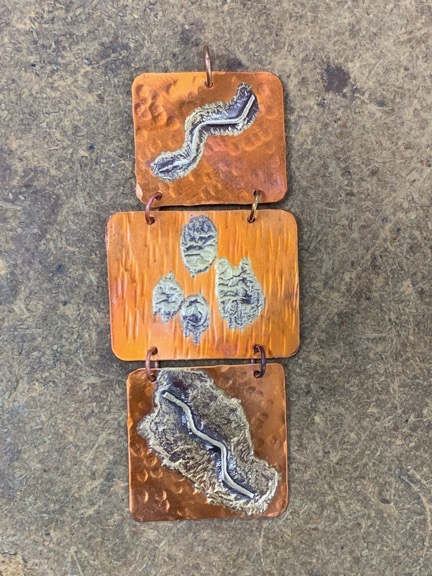
Then I got an idea for a pendant that would consist of three textured copper panels, each of which had silver wire melted on it. I’d join them together with jump rings. So I cut some of the copper sheet and went at it with two different hammers. Then I took some of the wire she’d given us to make a chain and made a zigzag pattern with it. I made tiny dots with more wire. I melted the wire to the copper without allowing the zigzags to get completely molten so they were fused onto the copper without losing their shape. I polished off the oxidation and then used the torch to apply just a tiny bit of color. I liked the result. I fetched some copper jump rings from my camper, colored them a bit with the torch, and put the whole thing together. Funky, but I liked it.

By this time, the day was pretty much over. Amy, the owner, came in to do some paperwork and she took photos of what we’d made. I felt that I made a respectable showing; everyone seemed to like the pendant and earrings. My companions had created more things than I had, but I didn’t mind. I had some ideas and that’s all I needed.

More at Metropolitan Market

After class, I went back to the camper — I’d checked on Penny at lunchtime — and put Penny on her leash. We walked the mile or so to Metropolitan Market. I parked Penny at the outside dog parking area where an Australian Shepherd was waiting for her human. I bought some things for dinner from their extensive prepared food area, remarking to the person behind the counter that if I lived nearby I’d be 300 pounds and flat broke.

Penny and I shared a gelato — I scooped some of mine out into the lid of the container for her — and walked back. Then we climbed into the truck and drove to a local U-Haul place that filled propane tanks. One of my tanks was completely empty and the other was only 1/4 full. I did not want to run out of gas overnight. That done, we returned to our parking spot and I backed all the way in so my back door was only a few feet from the back gate.

I heated my dinner in the camper’s oven — I wasn’t plugged into power and hadn’t brought along a generator so the microwave was useless — and worked on some earrings while I waited for it to finish heating. After dinner and another quick walk with Penny, I stretched out on my bed to read.

I slept well. During the night, I was treated to a rainstorm. The only thing I love more than hearing rain on my camper’s roof is hearing it on the metal roof of my home.

The Iliad and The Odyssey

I was up at 5:30 the next morning. I lounged in bed for a while, like I do at home, and then got up, threw on a pair of sweatpants, and made my coffee. I did a little web surfing at the table while I had my coffee. Before I knew it, it was 7:30. I made breakfast and ate it as Penny came down off the bed to let me know she was ready to go out.

I put the leash on her and we walked down the alley. There was a Bartell’s pharmacy about two blocks away and it looked like the kind of place that might have a refrigerator case. I really felt like having some orange juice. They had every sugar or alcohol drink in that case except real orange juice.

We crossed the road to a coffee shop. They didn’t have orange juice either. But they had a nice staff that let me bring Penny in so I bought a latte and caught up on Twitter at a table near the window while Penny ate a dog biscuit and a nearby dog watched her.

At one point, a young guy came over and complemented me on how well behaved my dog was. That got us into a conversation about dogs in public and how the owners really needed to keep them under control. I pointed to the other dog. “That’s a well-behaved dog,” I said.


This is the edition recommended by my friend.

I noticed that he was reading The Iliad and asked him if he was reading it for a class or if he was just reading it. He told me that he’d always wanted to read the classics and figured he’d start with the first one. (At that point, I found myself wishing he was about 20 to 30 years older and single — I felt the same way about reading the classics but needed a bit more motivation to actually do it.) I had recently explored reading a specific translation of The Odyssey that a friend had recommended. I told him about it and looked up the translator’s name for him. He said that was next on his list and he’d look for that version. I think he really will.

Possibilities of Precious Metal Clay

By that time, it was 9:45 and I was running the risk of being late for class. So Penny and I hurried back. I put her in the camper and went into class. I arrived at about the same time as one of the previous day’s students, Ellen. Two other students joined us. Again, there was a no-show.

This instructor, Meredith, had a more structured approach — but not much more. She spent some time talking about PMC — what it is, how it works, etc. She sent around examples of her own work — some of it with problems she pointed out as examples of what can go wrong. She handed out 9 gram packets of PMC3, bunches of 10 standard playing cards (which are used to gauge thickness for rolling), tiny pieces of plastic needlepoint grid (for a simple texture, a small sheet of foam (for creating our own textures), and long pins with masking tape flags on the end (for cutting clay). She seemed a bit disorganized; she’d forgotten to bring along work surfaces for us. Instead, we’d be rolling out the clay on the same teflon surfaces we’d use to dry it on. All the other tools were laid out in piles on unused benches and workspaces.

And then she let us go to it, again, without a specific project.

I guess wanting a specific thing to make is something that affected me more than my companions. I suspect that it’s because I’m pretty new to art — so new that I usually don’t provide a straight answer when people ask me how long I’ve been making jewelry.

Although I’m a visual person when it comes to learning, I’m not visually creative. (My creativity has always come with words; I have always been a writer.) Show me how to make something specific using a set group of techniques or skills and I’ll make it. Then, as I make it over and over, the creativity comes out. You can see that in my silver framed jewelry. Dorothy taught me how to make a pendant in her style using her materials and tools. The more pendants I make, the more my materials, tools, and final products differ from hers. I look at a stone and I think about how I could make an interesting pendant from it. The idea clicks and I make something creative and new. But when it all comes down to it, I’m just doing the same thing over and over, with minor twists that make something new.

Although Ruth had provided a project idea — the sample pendant she’d made for the course description — I hadn’t been interested in duplicating that. And Meredith did provide many examples of what we could do with PMC, but there were too many. I guess I was expecting her to walk us through the process of creating some of these things rather than giving us an overview of how to make them and then answering questions to help us complete our own personal products.

My problem was that I lacked ideas.

I made two textured pieces that could be earrings or charms. It took only minutes to do, even with the custom texture I created in the foam I’d been provided. I was interested in creating a bead and had picked out a small piece of cork clay to form a bead around. I had a few false starts — you have to surround the cork with clay before applying a texture (duh). My mistake was choosing such a small piece of cork; it meant that I was working with a very tiny object. But the damn clay is so expensive that I can’t imagine using it to make anything large. And we’d only been provided with 9 grams of the stuff so I was afraid to use too much right from the start.

Around lunchtime, Meredith set out a timeline for the rest of the class. All of the pieces had to be fired for about 45 minutes in a kiln. It took 30 minutes to ramp up the kiln to 1470°F. After that, we’d have to brush, tumble, and burnish our pieces, which would take at least another 15-30 minutes. With the class ending at 4 PM, that meant we’d need to get everything in the kiln by 2:30 at the latest.

I decided to use the rest of my clay to make a rectangular pendant with shapes adhered to it. This would enable me to practice “gluing” pieces together. What I made was ugly, but it did let me practice techniques. I worked and fine-tuned my pieces until 2:15 and laid them all out on the heating pad with the others to dry.

Compared to everyone else’s work, mine was pitiful. I didn’t even take a photo of them.

Meredith loaded the main kiln, which she’d brought along with her, and, while the kiln was coming up to temperature, talked to us a little about kilns. She’d brought along a smaller kiln designed for enameling that also worked with PNC and wound up firing that up for a few more pieces. Then we waited, asking questions and looking at more examples.

Finally, it was done. Meredith opened the kiln shortly after it was finished firing, opening and closing the door at short intervals to cool it slowly. She pulled out and quenched our pieces in a bowl of water. As I expected, they were all covered with a white film. She had us brush them off with a brass brush that put scratches in my pieces. I was pleased to see that none of them had any problems, although none of them had gotten any nicer.

Then she prepped the tumbler and dropped all of our pieces in. We cleaned up our workspaces while we waited. The owner, Amy, had come in and we shopped. TMAC is an excellent source of jewelry making tools and equipment at reasonable prices. I bought a small hand drill and two silver hallmarking stamps (.925 and .999FS).

Out of the tumbler, my pieces still had a lot of white residue on them. Meredith told us to burnish them with steel. I found a suitable tool and went to work on one of the pieces. The silver shine popped out. So now it was ugly and shiny.

Of course, I’m half joking here. Although my work wasn’t anything to be proud of, I had learned quite a bit about working with PMC and am no longer afraid to play with the 30 grams I bought earlier this year. I’m hoping to get my tiny desktop kiln running again; it’s the perfect size for this kind of work.

I just need some ideas.

After Class

Although I’d originally planned to spend the night in Tacoma, it was early enough to get a start for my next destination: Yakima. I needed to pick up a cargo trailer that I’d be converting into a mobile jewelry studio.

But I think you’ve read enough here. I’ll cover that in another blog post.

The San Juan Islands Photography Cruise

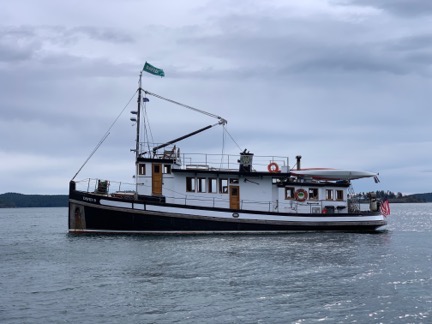
Another cruise on the Motor Vessel David B.

Twitter is my social media platform of choice and I follow so few people there because I actually try to read everything they tweet. That’s how I learned about the four-day photography cruise in the San Juan Islands on the Motor Vessel David B and the 50% discount they were offering to fill empty cabins.

David B
Here’s a photo of the David B at anchor on the last day of our trip.

I’d taken a 12-day cruise on the David B from Bellingham, WA to Ketchikan, AK back in April/May of this year. (I started to blog about it in some detail and put that aside. Sorry.) I knew all about the boat and what I could expect on board. Cruising on a small ship isn’t cheap and I honestly didn’t expect to be on the David B again. But 50% off made the four-day trip quite a deal. I put it to my Twitter friends — should I or shouldn’t I? — and was overwhelmingly told to go for it.

So I juggled some other responsibilities that weekend, booked my spot, arranged for my usual house sitter (who, on arrival, seemed a little too excited about my new TV), charged up the battery in my 2003 Honda S2000 (long story there), and packed for the trip. At 5 AM on Thursday morning, I loaded two carryon sized wheelie bags — one with clothes and the bigger one with camera equipment — into the trunk of the Honda and started on my way.

Getting There

The David B lives in Bellingham when it isn’t summering in Alaska. Bellingham is about four hours from my home. Boarding time was at 9 AM and I wanted to maximize my time on board. That’s the only reason I set off in the dark — I absolutely detest driving on unfamiliar roads at night.

After a quick stop at a Starbucks drive thru for one of their bacon and egg sandwiches (I had my own coffee in a travel mug) and another stop for gas in Leavenworth, I began the climb up into the mountains on Route 2. That’s right about the time the rain started. Great. Not only was I driving in the dark, but I was doing it in the rain.

Fortunately, I seemed to be one of very few people on the road. As the rain came down, cleaning all the garage and road dust off my car and reminding me again that I needed new wiper blades, I made the best pace I could without scaring myself. The car performed admirably — it always does — but it was still a relief to be on the other side of Stevens Pass in the valley beyond.

I stopped at the Sultan Bakery primarily to use their bathroom, but I also bought a nice cinnamon bun with no icing. I ate that in the car and kept driving. It was light by this point, but a dreary day with a heavy overcast. I wondered whether the whole weekend would be like that.

I arrived at Gate 5 of Bellingham’s Squalicum Harbor at about 9:05 AM. A short while later, I was wheeling my two bags up to the David B. On board, it was hugs for Christine and Jeffrey, the boat’s owners/captains. Jeffrey led me downstairs and, surprisingly, put me in the same cabin I’d had that spring. It felt like coming home.

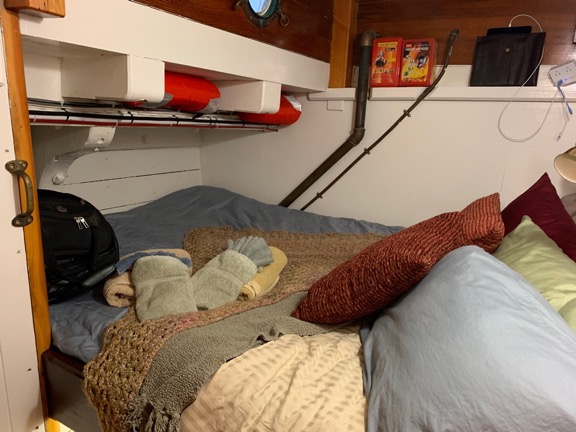
My Cabin
My cabin on the David B consisted of a comfy queen sized bed, space to stand/dress, and a tiny head (bathroom) with toilet and sink. I had the luxury of two portholes: one in the sleeping area and one in the head. There was only one shower on board and that was in a spacious shared head at the forward end of the cabin area.

My Fellow Passengers

Back upstairs, the other passengers had arrived and were settling in. There was Betsy from Port Townsend, who had also taken advantage of the last minute half-price offer. Then there were Jeffrey and Jane, from Oregon; Jeffrey — I’ll call him Jeff from this point on so we don’t confuse him with Captain Jeffrey — was the photographer. Al and John were the photographers leading the trip; Ilene was Al’s wife. The David B only has four passenger cabins so that meant John would be sleeping upstairs in the saloon.

Interestingly, we were all about the same age — mid 50s to mid 60s. We immediately hit it off. Our first lunch together, after getting underway, was a parry among passengers quoting lines from The Princess Bride. Lots of laughter. I soon realized that I was among brainy people who, for the most part, were up on current events. I was also very pleased when I realized that we were all on the same page politically. Conversations at meals got deep, especially on the last night when we talked a little about climate change and what to do about it.

Day 1

The weather cleared while we were settling in, with blue sky peeking out behind low, drifting clouds. The forecast called for a gale warning, but we saw no sign of that. The wind was relatively calm and the sea was smooth.

Bellingham Harbor
I shot this off the stern of the David B while we were still in the slip. It was turning into a beautiful day.

We started out between 10 and 11 AM on that first day. It was great to hear that old 3-cylinder engine’s familiar rhythmic beat! After squeezing out of the slip — a feat I was amazed by — Jeffrey took us out across Bellingham Bay and around the south end of Lummi Island. I had my nautical charting app running on my iPad with the tracking feature turned on, but it soon failed to track — I had neglected to delete tracks from my previous cruise and the app’s memory was full. Further confusing the matter was that Al and John did a little lecture enroute. That required them to darken the salon so they could use a projector and screen. With the windows curtained, it was impossible to track our progress through the islands.

The lecture was an introduction to photography with a concentration on themes, composition, and what makes a photo work. John showed some of his photos — mostly landscapes from Alaska and the American southwest — and Al showed some of his — mostly black and white images that showcased textures and patterns.

Somewhere along the way — it might not have been that first lecture — Al introduced Adobe Lightroom, which we were required to have installed on our laptops — and explained the benefits of shooting in RAW format (as opposed to JPEG). We all made sure we had RAW format enabled on our cameras; I set up mine to save RAW on one SD card and JPEG on the other.

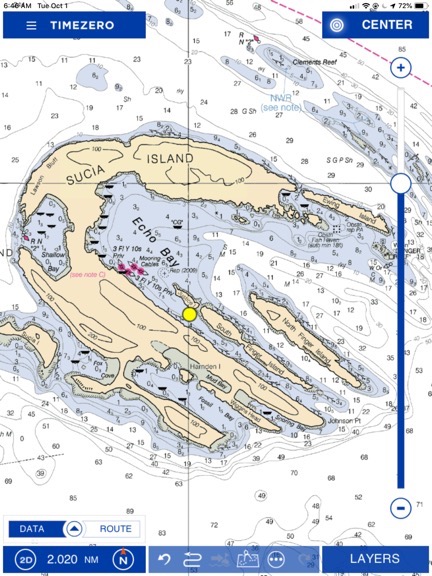
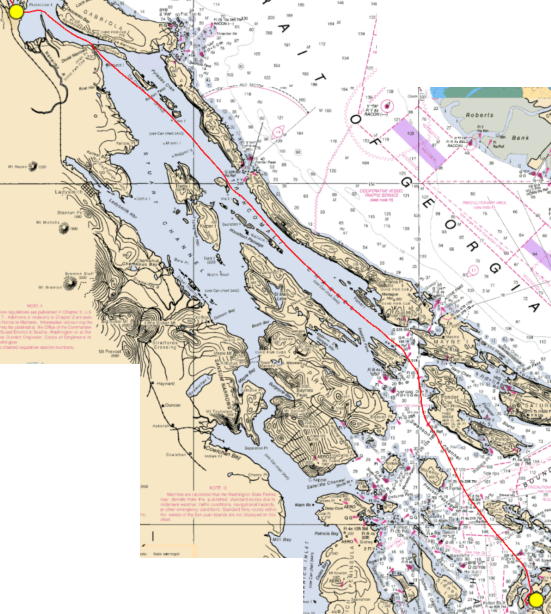
Sucia Island Chart
The nautical chart for the Sucia Islands. The yellow dot marks where we dropped anchor.

We reached our destination early afternoon: Sucia Islands. Jeffrey steered us into Echo Bay and then into the narrow channel between Sucia Island and Justice Island, right near the gap between Justice and South Finger Island. Christine dropped the anchor. There were a few other boats in the area — mostly in Echo Bay — and a small cruise ship was parked just on the other side of the gap between Justice and South Finger. Jeffrey told us it was on the last day of its cruise from Alaska to Seattle and would likely leave during the night.

We gathered our gear together while Christine and Jeffrey lowered the skiff. Laden with camera bags and tripods, we climbed on board and donned life jackets for the short ride. Jeffrey took us over to the little bay on the northeast end of Sucia Island, right where Ewing Island and some other tiny islands make a shallow, sheltered bay. He landed us there and we all climbed out onto the gravel beach.

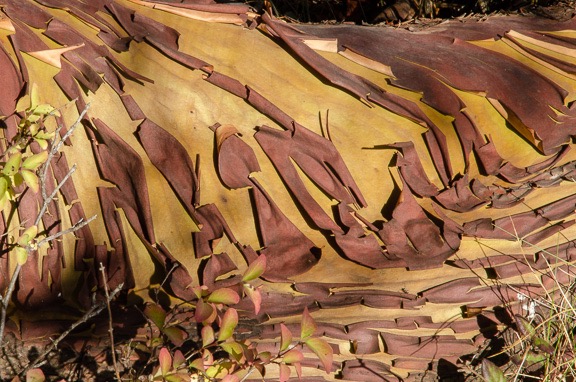
We started off as a group, but soon split up to wander on our own. Sucia is a park and is covered with trails that wind through dense forest of conifers and madrone trees. The madrone were fascinating, reminding me a lot of the manzanita I knew from northern Arizona. Their red peeling bark was very photogenic and I got more than a few shots.

Madrone Bark
The bark peeling off a madrone limb, which was growing at an odd angle on Sucia Island.

I got into a little bit of trouble for not using my tripod on every shot, but when Al and John realized that I’d prefer to make my own mistakes and learn from them (if I was making a mistake at all), they didn’t bother me about it. I did drag my tripod along on every shoot that weekend except the last and I used it for about a third of the photos I took when we were on land. (I plan to blog a bit more about tripods soon.)

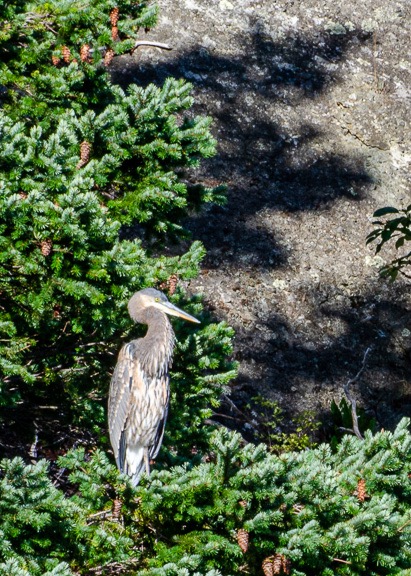
Great Blue Heron
A great blue heron perched in a conifer.

One of the oddest things I saw (and photographed) was a great blue heron perched on a conifer near the beach where we’d landed. He stayed almost perfectly still for at least 30 minutes and all of us got photos of him. I think Christine’s came out the best; she had a lens able to get in really close and capture a lot more feather detail than I could with mine.

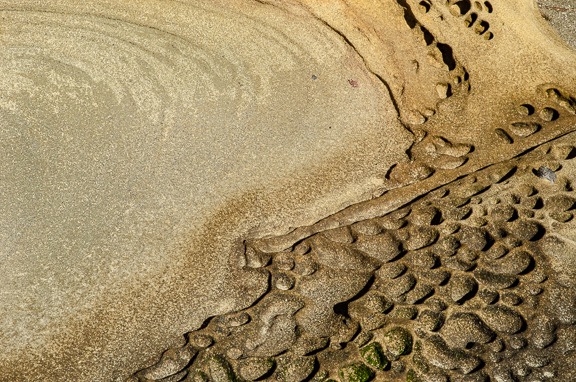
After 90 minutes or more, we gathered together on the gravel beach for Jeffrey’s return on the skiff. From there, we cruised along the south shore of Ewing Island, which is just covered with amazing tafoni formations. The water was relatively smooth and Jeffrey was able to get quite close. With my 75mm to 300mm zoom lens and a 1/1000 shutter speed, I had no trouble capturing full frame shots of the rock formations. Best of all, the late afternoon light deepened shadows and enhanced colors. Since texture is one of the themes I like to explore in my photography, I was in heaven. So were Al and John, who apparently had never had the opportunity to spend so much time in this area. For close to an hour, the skiff was full of the sound of shutter clicks and photographer oohs and aahs.

Tafoni and Sandstone
Contrast was one of the themes suggested by Al and John. This is sandstone with tafoni formations in the lower right corner.

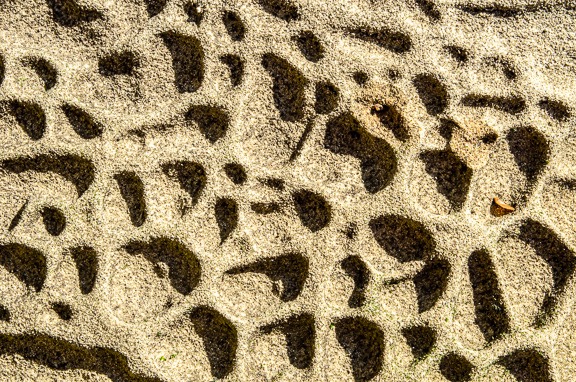
Tafoni Closeup
Here’s a closeup shot of some tafoni. I’m pretty sure I shot this one at my feet while I was still on Sucia Island.

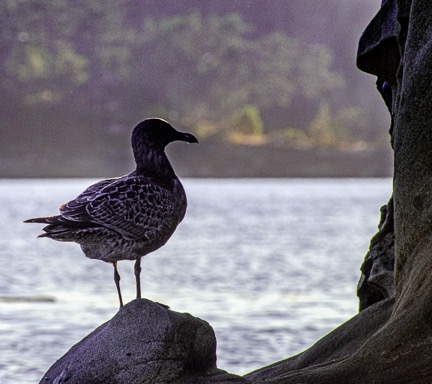
Lone Gull
What struck me about this was the back lighting and silhouette. Lightroom brought out a lot of detail in the bird, but also put a halo around its body which required more work to remove.

I didn’t just shoot rocks as we inched along the shoreline. There were also birds — mostly gulls — and distant views of Mount Baker’s snow-covered top. My shutter clicked.

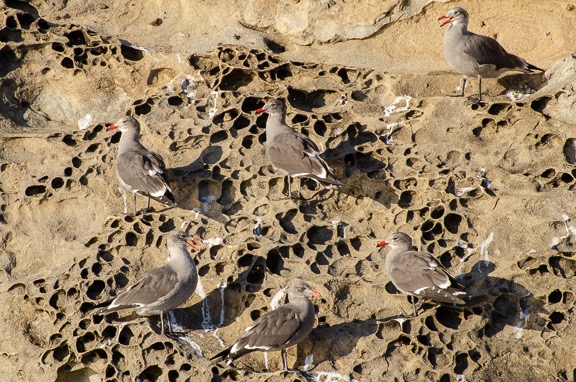
Birds on Tafoni
These birds seemed to pose for a photo. Although I think the composition and mechanics are fine, I’m disappointed by the lack of contrast. I wish the birds were white so they’d stand out more.

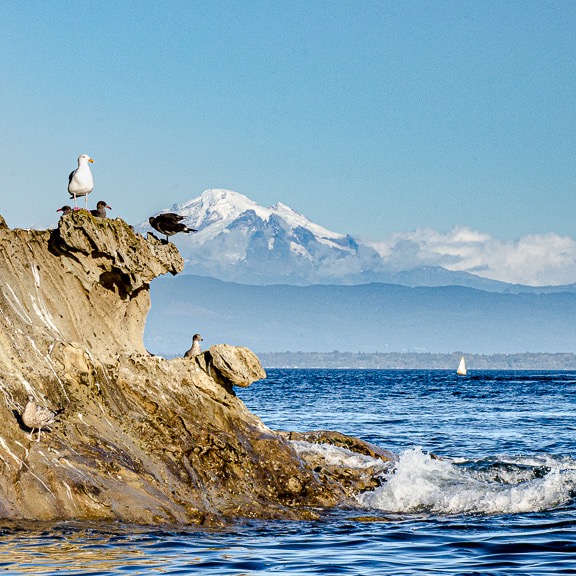
Birds with Mount Baker
The view in this shot was stunning, but it took a lot of work in Lightroom to get it to look this good. Even so, I wish I could do better.

Back on the boat, we got our first Lightroom lesson. The goal was to get the raw images off our SD cards and into our laptops in a Lightroom catalog. I also took the opportunity to back up all of my photos onto one of my photo hard disks, which I’d brought along just for that purpose. Al and John then showed us how to use a lot of the controls in the Basic panel of the Develop module. (Pardon me if I’m getting these terms wrong, but it’s not like I’m writing a book about them.) They encouraged us to ask them for help making any fixes we needed as we worked on images. The goal was to have three images to share for a critique after dinner.

Of course, none of us followed the three image rule. Jeff was the worst, with 11. I submitted the seven you see above plus the other one below for a total of eight, and Betsy submitted five. Oops. Al and John projected them onto the screen and critiqued them, suggesting things like bringing out detail in one spot or toning down the brightness in another or changing the crop. All helpful bits of feedback.

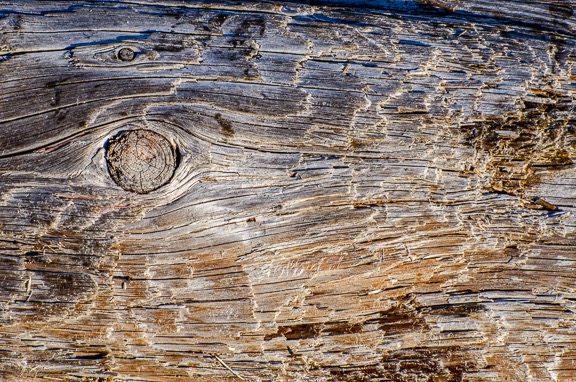
Weathered Log
Here’s the eighth photo I submitted. I really do like capturing textures. This was a log lying along the beach.

Dinner was amazing (as usual on the David B). We had pork tenderloin with mashed potatoes and veggies. I’d brought along a pint sized jar of either homemade mango or cherry chutney — I can’t tell the difference because I made the cherry chutney with yellow rainiers — to go with the pork and it got raves. We ate almost all of it. After chatting for a while in the saloon, we all retired for the night.

I slept like the dead, likely exhausted from a combination of my early start, the stressful drive, and the activity on shore.

Day 2

In the morning, the little cruise ship was gone. It was a beautiful morning.

I tried to launch my drone but it wouldn’t fly. Apparently I was in some sort of restricted area — possibly the park? I was disappointed and didn’t try again.

We had breakfast: spinach frittata, yogurt, granola, sausage, and blueberry muffins. (The David B is not a boat for dieters.) Then we had another Lightroom lesson and planned our next photo outing.

The plan was to stay right where we were for the day. We’d go onshore at Echo Bay and could walk anywhere on the island. Christine wanted to show us what she called the sunken forest — a place where trees that had grown in a low-lying area had been killed off, likely from the invasion of salt water. There was also Fossil Bay (where there were fossils) and China Caves (which were cavelike formations). The entire island was heavily wooded, but there were plenty of trails, some of which were wide enough for the ranger who lived there to get around on a six-wheeled Gator.

By the time we got onshore, the weather had changed. Clouds were moving in and it looked like we might get rain. The group stayed together for a while, crossing the island at the narrow point we’d landed at and then following a trail to the sunken forest. There was a very large school group on the island and we must have passed about 30 kids ranging in age from 5 to 12 going the other way. There were adults, too; one of them was a woman carrying two babies. I took some photos around the sunken forest and didn’t like anything I shot. Betsy wanted to check out the fossils so I went with her.

It started to rain just as we began walking. At first, I thought the thick forest canopy would keep us dry, but soon it was obvious that it wouldn’t. I was glad I’d had the foresight to bring my rain jacket instead of my cotton sweatshirt as my outer layer. Although my jeans were getting wet, I was staying warm and dry up top. The rain became a downpour just as we reached a trail intersection where there were some signs and maps covered by an overhang. Al and Ilene were already in there. We joined them.

Hail
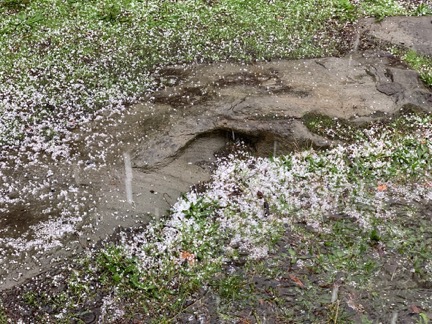
Hail outside the shelter I waited in with Al and Ilene.

Betsy didn’t stay long. She wanted to find fossils and took off in the direction of the area where they could be found. The ranger eventually found the rest of us and told us there was a more comfortable shelter a little farther down the trail. We made our way there. It was a big wooden shelter with windows all around and a concrete floor, filled with picnic tables. We’d just gotten inside when the downpour became a torrential downpour and it began to drop pea-sized hail all around us.

Oddly, I didn’t mind the rain. It wasn’t cold and even though my legs were damp, my upper body was warm and dry. I took off my rain jacket and draped it over a table to dry a little and watched the rain come down. Being a desert dweller, I really do enjoy a good rainstorm now and then.

It eventually let up and I headed out in search of Betsy and the fossils. I found her at the head of Fossil Bay, stowing loose day packs and jackets under a picnic table. The school group we’d passed had left everything out to get completely soaked by the rainstorm.

She showed me two fossils she found and together we headed back to where Jeffrey would be picking us up with the skiff. We made only two wrong turns before getting on the right trail. I found a single chanterelle mushroom along the way.

On the way back to the boat I realized that I’d taken very few pictures. Instead, I’d really enjoyed the hike in the dense woods, despite the rain.

We had another Lightroom lesson and then worked on our images for a while. I was really starting to like using Lightroom. I had never really understood the point of it since I’d been using Photoshop for so long. But now I could see that when working with RAW images, it was an excellent non-destructive tool for fine-tuning photographs.

Day 3

We headed away from the Sucia Islands just after breakfast on Saturday. Our destination was Garrison Bay on San Juan Island. Keep in mind that none of these islands were very far from each other, but when you’re cruising at a whopping 6 knots, it takes a while.

Spieden Island to Garrison Bay
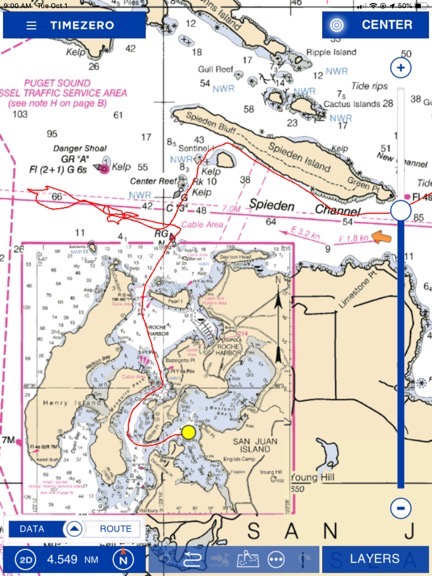
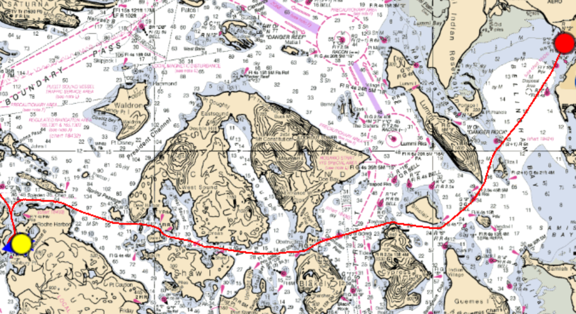
Here’s the chart and some of our track (in red) for the trip to Garrison Bay.

One of the highlights of the day’s cruise was a trip up the south shore of Spieden Island. This privately owned island was once the site of a hunting preserve. The original owners had brought in a bunch of miniature deer, bighorn sheep, and other animals and let them loose on the island. When the hunting preserve business failed, the owners abandoned the place, leaving the animals behind. They quickly reproduced with their limited gene pool resulting in some unusual animals. Jeffrey got close enough to see lots of these animals grazing on the grassy slopes of the island or climbing around on the rocks near the shore. I didn’t take any photos but regret it; Betsy got at least a few nice ones.

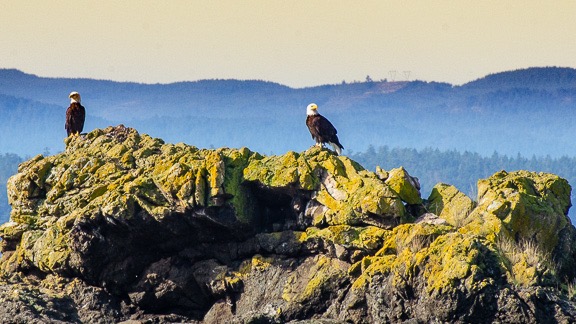
We saw a pair of bald eagles perched atop Sentinel Rock just as we made the turn inbound toward San Juan Island. We were all out there snapping away. I got a few nice shots, but none of them were good enough to make the cut for the next critique.

Bald Eagles
Bald eagles on Sentinel Rock. I manipulated this in Lightroom, but never got it as good as I’d like. I eventually gave up.

We were in the middle of another Lightroom lesson with the windows curtained and the screen separating the saloon from the wheelhouse when Jeffrey appeared suddenly and lifted the screen. “There’s a whale outside,” he announced.

You never saw so many middle aged people jump to their feet, grab their cameras, and head outside so quickly.

The whale was a humpback and it was only a few hundred yards away. Two whale watching boats were already with it — at least they were as close as they’re allowed to go. The smaller boat was listing to one side as all of its passengers gathered there.

I soon realized there was a pattern to the whale’s appearances. First there would be a burst of spray as its blowhole reached the surface and it took a breath. Then we’d see its long back and top fin. Then it would disappear for about 10 to 30 seconds. That whole routine happened five to eight times in a row before the dive. That’s when you’d see the whale’s tail emerge from the water as its body headed down to the depths. Once it dove, it would be five to 10 minutes before it appeared again, usually somewhere else.

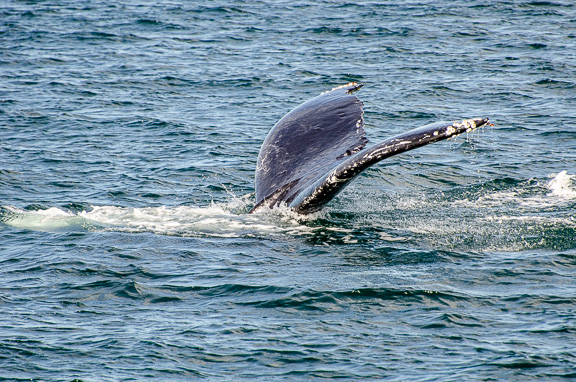
After shooting too many disappointing pictures of the whale’s back, I decided to focus on getting a shot of the tail. Each time it came back to surface, Jeffrey would try to get closer and we’d all move into position to photograph it. For one round, I put my camera in continuous mode, which enables you to hold down the shutter button and just keep shooting. I soon realized that the size of the RAW image files the camera was creating limited me to about ten shots like that. Every time the whale would reappear after a dive I’d try something else. Once, when Jeffrey just let the boat idle in position on the water, the whale came up right next to us, not even 100 yards away. That’s when I got my best shot: a beautiful view of a barnacled tail dripping with seawater.

Humpback Whale Tail
Shot with a 300mm lens from the boat, this image is not cropped. In fact, I didn’t need to make many improvements in Lightroom at all.

We watched the whale for about an hour. You can see our track — the red line — in the chart image above. Finally, when it surfaced quite a distance ahead of us back east on the Spieden Channel, we broke off and headed south into Roche Harbor and beyond it to Garrison Bay. The Lightroom lesson finished in the darkened saloon with a discussion of the HDR and panoramic tools.

This was my second time in Garrison Bay, which is right off shore at English Camp on San Juan Island. We’d stopped there on our way from Bellingham to Ketchikan back in April. It was a sheltered cove, which was a good thing because the wind had definitely picked up.

After lunch, we went to shore at English Camp. I’d been there a few years before during a motorcycle trip to Friday Harbor that I’d made with a friend. It looked different from the water side. The history of the place involves a border dispute and a pig. There are a number of surviving buildings, a formal garden fading for winter, and paths leading up to a small cemetery and the top of 650-foot Young Hill.

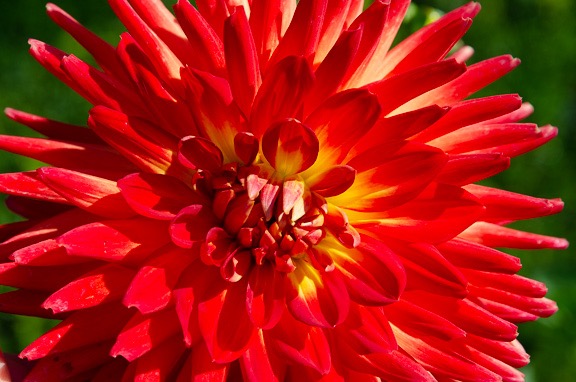
Dalia
I got this closeup shot in the formal garden down near the buildings. This is exactly the way the photo came out of my camera — I didn’t make a single adjustment in Lightroom.

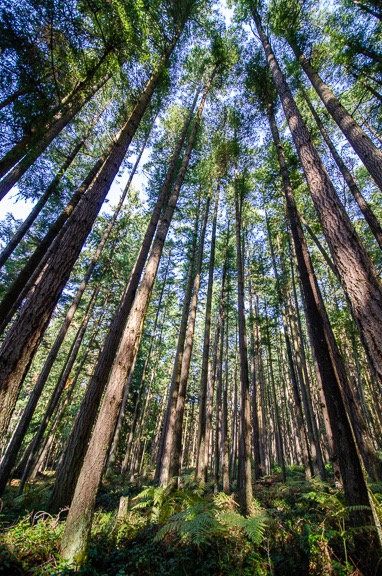
Trees
This is my favorite photo from the trip. I used my 10mm-28mm zoom lens set to 10mm and mounted the camera on a tripod for a good exposure in the dark forest.

The group started together but soon split up with the most athletic taking the mile-long path all the way up the hill. I lingered in the dense forest and eventually made it up to the cemetery, shooting photos along the way. I had dutifully brought along my tripod but soon got tired of using it. On the way back down to the dock, I took my time and shot a lot of photos of mushrooms, using my iPhone for most of them.

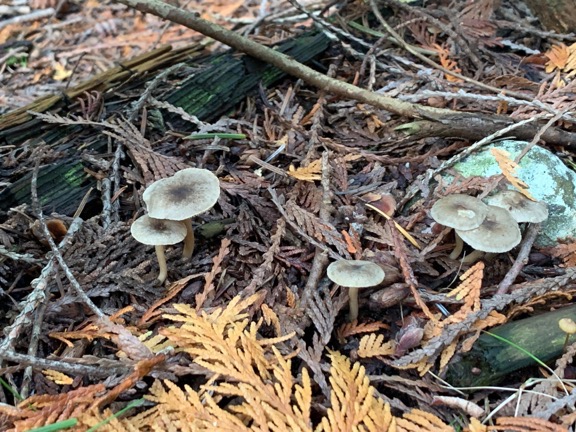
Mushrooms
Nothing beats my iPhone for taking shots of tiny mushrooms on the forest floor from only inches away.

I saw Jeffrey coming back for us while I was still quite a way from the dock. I hurried without running. He said he’d check in every half hour, but I was hoping I wouldn’t have to wait. I didn’t. When I got there, Jeff and Ilene were already on board. The others — Betsy, Al, and John — had gone all the way up to the top of the hill and would catch the next ride. (Christine and Joan had stayed behind.)

The water had gotten choppy and although it wasn’t rough enough to rock the David B, it was enough to have it swinging back and forth at anchor. I sat at the table in the Galley with Ilene to work on my photos while Christine worked on making croissant dough. Betsy soon joined us. We’d have a new show and tell the next day on our way back to Bellingham and I was hoping to have something more interesting to show.

Dinner was halibut cheeks with a cream sauce and veggies. Yum.

John mentioned that it might be possible to see the aurora that night. He’d gotten a text from a friend. But it was cloudy and rain was in the forecast. It was agreed that if either Jeffrey or Christine saw the aurora on their overnight watches — they walk the ship several times a night — they’d wake us up.

I slept badly. The swinging of the ship made weird noises when the anchor chain hit the forward port side of the ship. I heard footsteps overhead and thought I heard voices. I kept waiting for someone to come to the door to tell me the aurora was visible. Finally, at about 4 AM, I gave up trying to sleep and spent time reading instead.

Day 4

As usual, I was the first passenger in the galley that morning, making my appearance at about a quarter past 6. As usual, the coffee was ready. If there had been an aurora event to see, the clouds had hidden it. As someone said later in the day, the trip had been so perfect that the aurora was the only thing that could have made it better.

We were working on images in the saloon when Christine brought out a tray of her croissants. Plain, chocolate, cinnamon, and pepper jelly. Fortunately, they were small. I tried one of each and then had seconds of the ones I really liked.

Breakfast came a little later: cheesy grits with thick bacon, yogurt, granola, and fruit. I ate too much grits.

By that time, Christine and Jeffrey had pulled up the anchor and we were under way, headed to our next stop, Jones Island. The island, which is just off the southwest corner of Orcas Island, is a state park with several small bays, campsites, shelters, and pit toilets. I bet it’s packed on summer weekends. But that day it was nearly deserted, with no one in sight where Jeffrey parked on the south side. We all went ashore for a final photo outing. I purposely left my tripod behind, tired of lugging it around.

We split up quickly. I chose a trail that wound around the west side of the island, hugging the top of a bluff for much of the way. I spotted (and photographed) three deer in three separate spots. I eventually wound up at another camping area that I mistakenly thought was on the north side of the island. It wasn’t until I took the trail that I thought would take me back to my starting place and wound up someplace completely different that I realized I’d only gone one quarter of the way around the island before taking the new trail.

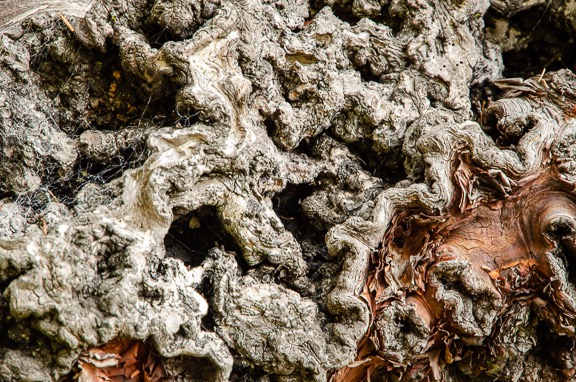
Gnarly Log
Did I mention that I like to photograph textures? This was part of a tree that leaned over the trail. John later said he must have spent an hour at that same tree.

Leaves
Al had suggested contrast as a theme and I thought this was a good example. It’s also a reminder that autumn is on its way.

I found Al and Ilene at the camping area on the north side of the island. I walked back with them for a while, pointing out some of the more attractive mushrooms I spotted along the way. I’m not sure if Al was just being polite but he seemed genuinely interested in some of the ones I pointed out.

We crossed from north to south on the main ADA-compliant gravel trail. Back at the starting point, we started to regroup. A while later, we were on our way back to the David B in the skiff.

Back on the boat, we had enough time to edit images and have lunch before our final critique. My new photos were the ones above: whale tail, flower, trees, gnarly wood, contrasting leaves. They didn’t have many comments to improve any of them.

They had a Canon photo printer with them and offered to print one enlargement for each of us. I chose the trees. The print came out great but with all my wall space filled at home — I have a lot of windows — I’m not sure where I’ll hang it.

Another Goodbye

It was slow going back to Bellingham. We were fighting wind and a 2 knot current — a big deal when you cruise at just 6 knots. But we arrived right on time at 5 PM. By that time, we’d all packed and exchanged cards. I suggested that Jeffrey and Christine borrow my home for a week or so during the winter while I was gone; they could get some skiing in while my house sitter took a break. John was interested in a photo houseboat excursion on Lake Powell and I hoped he’d contact me for tips and advice.

There was a round of hugs as Jeffrey helped us get our luggage off the boat. Then I was headed back up the dock to my car, pulling my wheelie bags behind me, amazed that the weekend had gone so fast.

My Inside Passage Cruise, Part 1: Bellingham to Nanaimo

A summary, with photos, of my spring vacation.

Greetings, Cruisers!

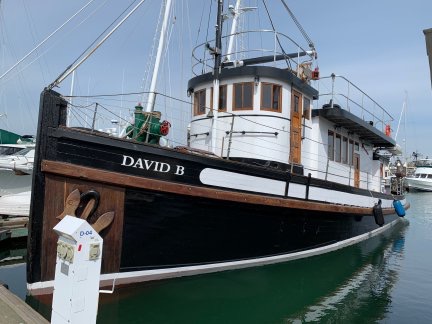
If you’ve found this blog post while Googling for information about big cruise ships in the inside passage, I’m sorry to disappoint you. My cruise was on a 65-foot historic wooden boat. But don’t click away! Read a little more about it or at least look at the photos. And then consider a trip on the David B or another small ship like it instead of an impersonal floating city. It’ll be a trip you remember for the rest of your life.

The past nine or so months has been a crazy travel time for me. A 4-day trip to the Washington coast and Tacoma for a jewelry class in September. An 18-day trip to New York, Washington DC, and Vermont in September and October to visit family and friends and see the sights. A 3+-month trip to Arizona and California in December through March. And then a real vacation: 12 days aboard a small, historic ship called the David B as it cruised slowly up the Inside Passage from Bellingham, WA to Ketchikan, AK at the end of April and into May.

(A side note here: all this travel would not be possible if I were still married. Once again, I have to thank my wasband for freeing me from a boring life in his rut, waiting for him to get his shit together and start enjoying life. Thanks, honey!)

I’ve mentioned elsewhere why I booked Northwest Navigation‘s “Learn to Cruise – The Canadian Inside Passage to Alaska” trip late last year for this spring. It would be a learning experience, and I’ve come to realize that learning experiences are the best experiences because they stay with you the longest and can change your life.

And this trip did not disappoint me in the least. I learned a ton about navigation, small boat cruising, tidal impacts, salt water boat maintenance, customs requirements, and “camping” on the water — which is basically what we did. I see small boats like the David B and the Ranger Tug R-27 I’m considering for my own use to be seaworthy RVs — recreational vehicles for use on the water. Like a motorhome, a boat with living space is a vehicle you can use to travel from place to place with a degree of flexibility, privacy, and comfort. What makes the boat I want different from the David B (other than size: 65 feet vs. 27 feet) is that mine can be easily trailered from place to place giving it almost unlimited options for exploration in fresh and salt water. What I learned on the David B can easily be applied to any serious boating I do in the future.
Anyway, although I brought my old laptop with me on that trip with the idea of blogging daily, that didn’t happen. Who wants to bury their head in a computer when there’s so much going on outside and around you? So I’ll try to share some of my experiences now, along with photos and charts of where we went.

And don’t worry; I’ve split this into multiple parts. I hope you read them all. Lots of photos!

Getting to Bellingham

I won’t bore you with details of my pre-trip travel. The short version is that it involved a flight from Wenatchee to Seattle to Bellingham. I saw no reason to make the 4-hour drive to Bellingham when the trip wasn’t going to finish there. Instead, I bought plane tickets from Wenatchee to my starting point in Bellingham with return flights from my ending point in Ketchikan to Wenatchee.

I spent the night in an AirBnB room that was cheap and walking distance (barely) from the marina where I’d get the boat the next day. It was also the smallest room I’d ever slept in (which turned out to be good preparation for my cabin on the David B). I did a lot of walking on that Tuesday, making the trek down to Anthony’s restaurant where I ate oysters two ways and had wine and dessert — entirely too much food. I then walked along the marina until I found where the David B was parked before walking back to my lodging.

Bellingham Marina
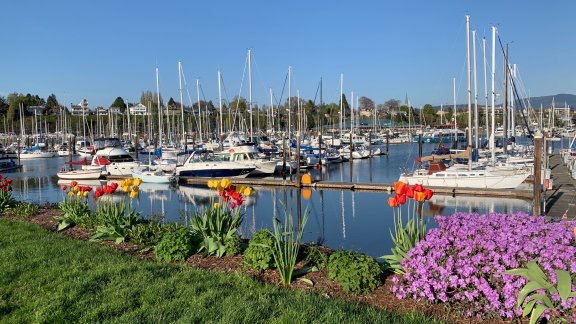
Bellingham’s marina was absolutely gorgeous that late April day.

Day 1: Bellingham to San Juan Island

David B at the Dock
The David B when I arrived on Wednesday morning.

The next day, I took a Lyft to Bellingham’s art district with my giant rolling bag, had coffee in one restaurant, and breakfast in another. I then took a short walk, dragging the bag behind me, visiting a few antique stores to buy old sterling silver and silver plate tableware that I thought might be turned into nice rings. Finally, as the time to board got closer, I called another Lyft to take me the mile or so to the pier. If my bag wasn’t so damn big, I probably would have walked.

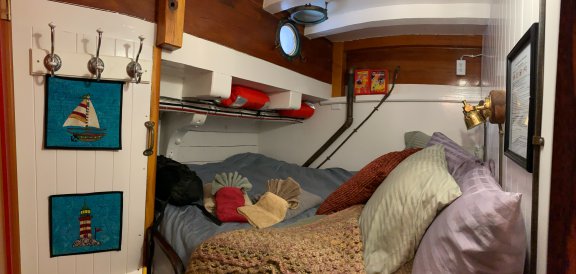
I was a half hour early but they let me board anyway. I wasn’t the first passenger to arrive. I met Sarah, who is in charge of reservations and other office stuff in Bellingham briefly before she left. Captain Jeffrey introduced himself and helped me wrestle my bag down the stairs to where the cabins were. There were five of them, including a crew cabin, and they were tiny. Mine had a queen sized bed, a head with toilet and sink, two portholes (one of which was in the head), and enough space for me to stand next to the bed. There was space under the bed for my bag, but about a third of it was occupied with manufactured logs, which I later learned were for the wood burning stove in the galley. They bring up a whole summer’s supply of logs and one of the other cabins was full of them. I had enough space, but it would have been challenging if I was a very large person or was traveling with a friend. Other cabins had different configurations and were better suited to couples. Mine was fine for me.

My Cabin
My cabin on the David B, as seen from the doorway with a panoramic photo. It was cosy!

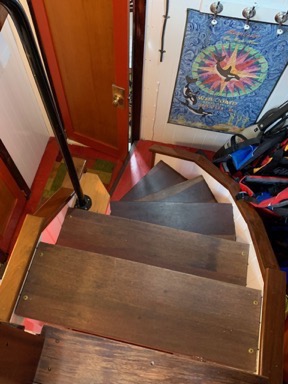
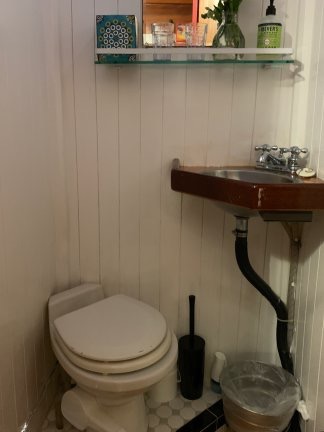
Stairs The Head
The stairs were steep and winding. The first door at the bottom was a spacious bathroom (head) with shower that we shared. My tiny head was so small that when I sat on the toilet seat, I had to put my left arm on the sink counter.

I went back upstairs to the saloon (not salon, as we later learned) and met co-captain/cook Christine, who was Jeffrey’s wife. We chatted for a while in the saloon and I told them about the boat I wanted to buy and what I hoped to learn. (They must have thought I was nuts.) Then I learned about the David B and a little about our trip.

The Saloon
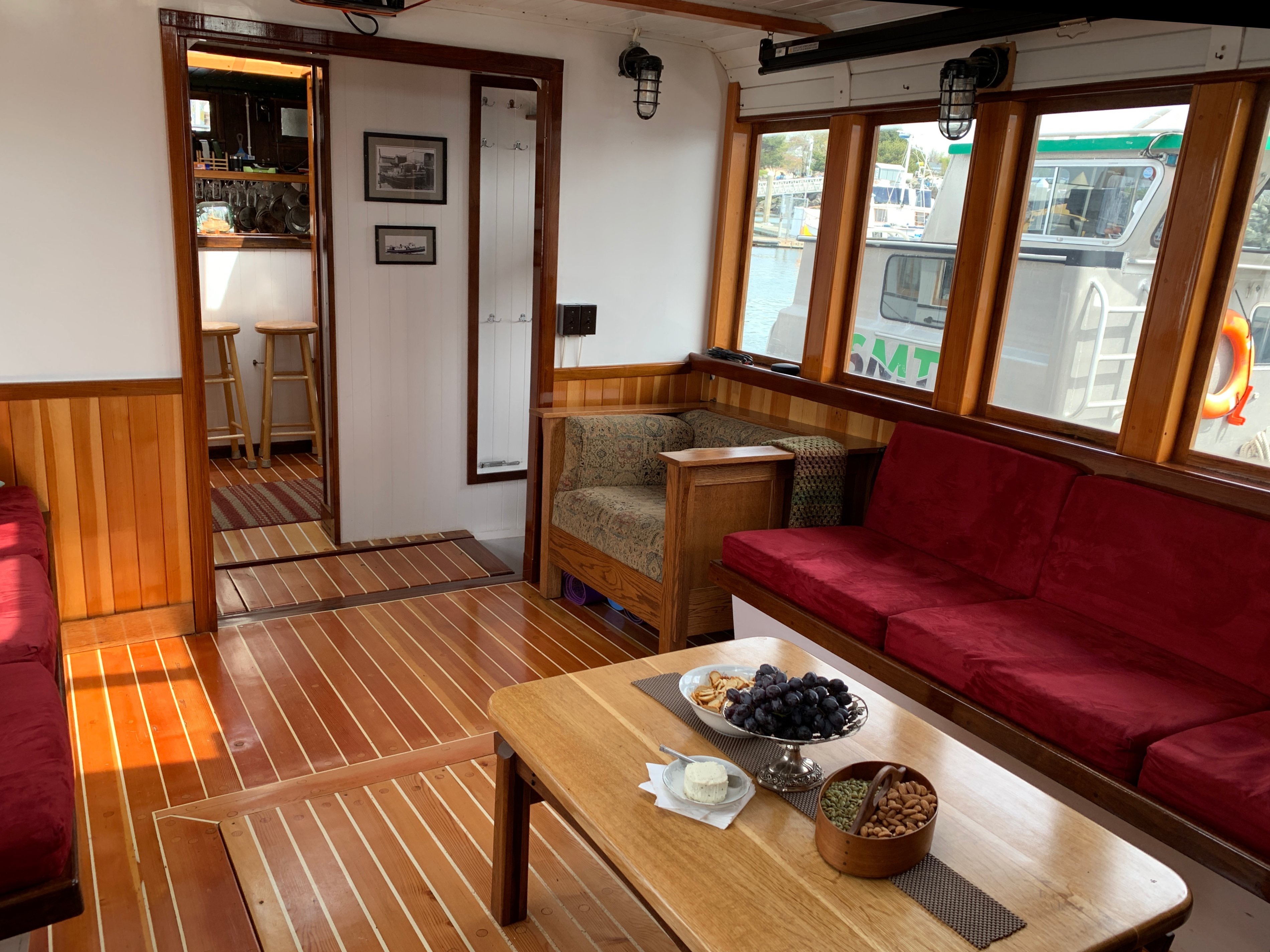
The saloon was our central gathering and lounging place on the David B. The snacks set out on that first afternoon should have warned me of the food to come.

Before long, I met my fellow passengers: Graeme from Australia and David and Leslie from Kettle Falls. Graeme was a wooden boat fan who had made the trip the centerpiece of a visit to the American northwest and Alaska. David and Leslie had just purchased a C-Dory 22 — coincidentally, the same boat my ex-friend at Lopez Island had that got me interested in small boat cruising two years before — and David was very interested in learning more about navigation since they’d just bought a home in Bellingham and I suspect he planned to move the boat there.

And that was it: only four passengers and two crew. I expected to be one of seven passengers, so this was a pleasant surprise.

We left port that afternoon.

I followed Captain Jeffrey down a ladder to the engine room and stood out of the way while he squirted oil into more places than I could count before doing a bunch of other things and then finally bringing the engine to life. I had questions but didn’t want to ask. He reminded me of a pilot preflighting an aircraft and if there’s one thing a serious pilot hates, it’s being interrupted doing a preflight. Then we both climbed back up and I told him I’d watch again, which I did the next morning.

Engine
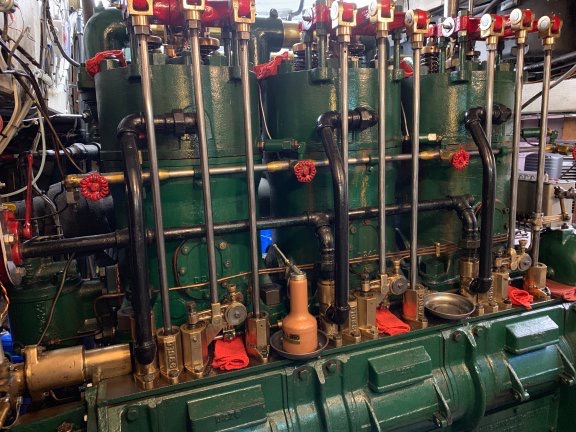
The David B’s three-cylinder engine.

Backing the David B out of its slip was probably the most challenging job; those of us who wanted to help were given big bumpers to separate the boat from other boats or dock parts if we drifted too close to something. But Captain Jeffrey had it covered. Backwards and forwards and backwards and forwards, he inched the 65 feet of wooden boat out and into the space between the slips. Then we were on our way while various friends and family members waved us off from the dock.

Smoke Stack
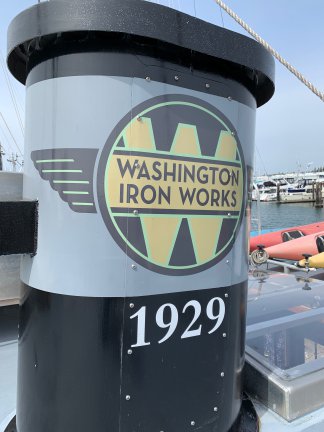
The Washington Iron Works logo adorns the David B’s smokestack atop the ship. The boat was built in 1929 and had just celebrated its 90th birthday.

The day had started to cloud over and get a bit chilly, but there wasn’t much wind and the San Juan Islands area we wound through was only a bit choppy. (I had my Sea Bands on for a while, just in case.) We were all excited about starting off and, after a lunch of hearty chicken soup and salad, spent a lot of time out on the deck or in the pilot house watching the San Juan Islands drift by and chatting about the homes we saw on shore. The David B literally chugged along under the power of its 90-year-old 3 cylinder engine, averaging about 6 to 7 knots of speed. We saw a few other boats, including some large tankers and freighters when we crossed the Rosario Strait. And there were ferry boats, of course.

Pilot House
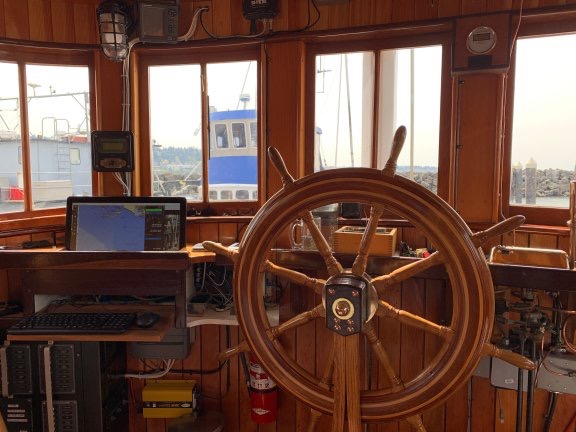
The pilot house is a neat compilation of early 20th century and 21st century technology. For example, the computer ran a navigation application that actually turned the big wooden steering wheel. We all spent a lot of time in this room, which had enough seating for all four passengers.

I’d prepared for the trip by downloading, installing, and subscribing to an iPad app called Time Zero (TZ) iBoat. Throughout the trip, I had tracking turned on so it kept track of our exact route. (Yes, I know I’m a geek.) Looking back at that track now, I can tell you that we passed south of Eliza, Lummi, and Sinclair Islands; between Obstruction and Cypress Island through Peavine Pass; between Orcas and Shaw Islands in Harney Channel; north of Crane Island; south of Jones Island; and then into Roche Harbor on San Juan Island. We passed the main harbor and wound through some channels before finally settling for the night at the mouth of Garrison Bay, which was named for nearby English Camp.

Day 1 on a Chart
Here’s the view of our first day’s track as it appeared zoom-to-view on my iPad.

Captain Jeffrey slowed the boat until it was almost stopped and Christine worked some equipment on the bow to drop one of the two large anchors with enough chain to hold us in place. Then he shut down the engine and the sound we’d been listening to for the past few hours stopped.

The Stove
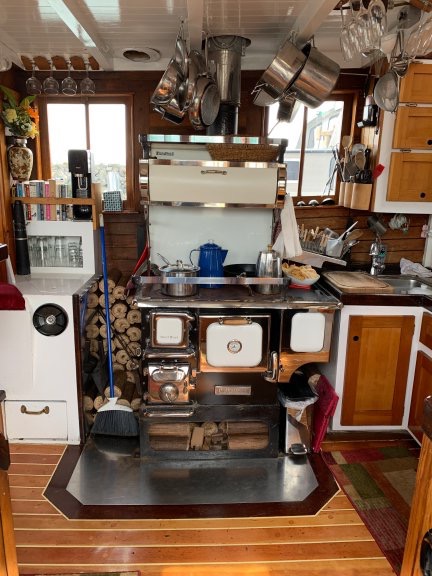
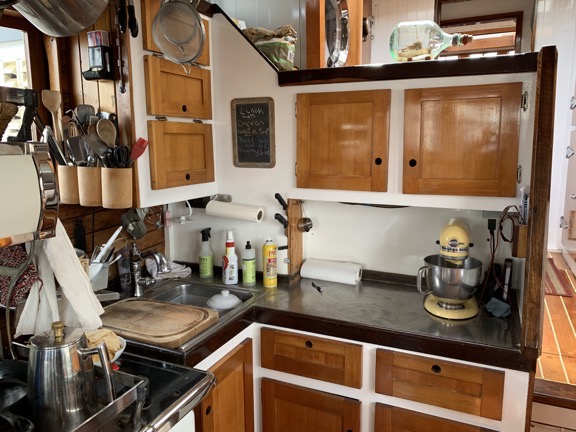
A fully-functional replica wood-burning stove was the centerpiece of Christine’s galley.

By this time, Christine was cooking dinner in the amazing galley. I say “amazing” because she was using a wood-fired stove and I personally can’t imagine dealing with the intricacies of such a device after a lifetime of gas, electric, and microwave cooking power. Because the boat had a generator and inverter, she had all the usual appliances — mixer, blender, ice cream maker. There were several refrigerators and freezers. The only thing she didn’t have was a dishwasher, but we all took turns washing the dishes after meals.

Galley
David B’s galley.

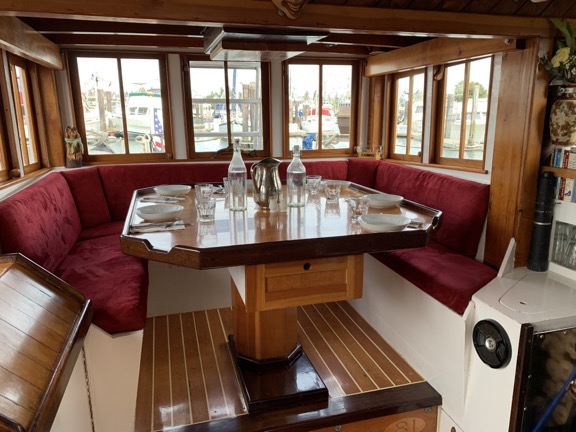
Dining Area
Here’s where we sat for meals. Although Christine plated dinners, breakfast and lunch was usually family style.

We had baked salmon, asparagus, and black rice for dinner. The “bread course” — which became a sort of running joke because every meal had some kind of freshly baked bread — was sourdough. I ate more bread on that trip than I had eaten in the previous year but I simply couldn’t resist.
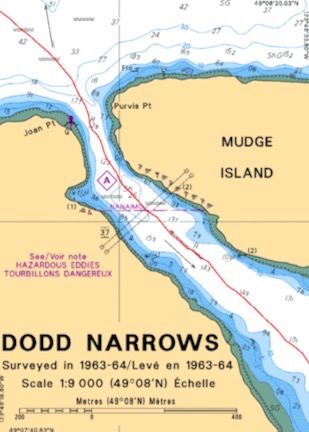
After dinner, we spent some time discussing the next day’s cruise, which would take us into Canada. Part of the trip was a passage through Dodd Narrows, a narrow space between Mudge and Vancouver Islands that was well known for dangerous eddies during tidal flows. We had to plan our arrival at slack tide, a narrow window when the eddies were minimized. If we arrived too early or late, we’d have to wait on the south side of the narrows. An early arrival wasn’t a big deal but a late one would have us waiting for hours until the next safe time to pass through. This was my first introduction to the concept of tidal currents and it came with a lesson on how to use various reference guides to calculate when slack tide would occur.

Not long afterward, we all turned in for the night. I quickly realized that the walls were paper thin and I could hear everything Leslie and David said to each other. They didn’t say anything embarrassing, but I made some noise so they knew how thin the walls were. I suspect they figured it out — probably from hearing me snore! — because they didn’t talk much on subsequent nights.
Day 2: Bellingham to Nanaimo

I woke up early, as I usually do, but with a very sore throat that got me very worried. I’ve been on two vacations where I was sick with a cold and it really sucks. If I was taken down with a cold on this trip, I’d be very upset.

I spent some time lounging in bed with my iPad, which is what I do at home, too. I still had Internet access — heck, we were in the San Juan Islands. Around 5:30, I heard movement upstairs and went up in my pajamas to see what was going on. Christine had stoked up the stove and made coffee. I hung around in the kitchen for a while with my coffee, then went down to put real clothes on. The other passengers appeared one by one. Christine made us a frittata with asparagus (leftover from the previous night), fruit, granola, and yogurt. (The last three would be at every breakfast.) She didn’t have any orange juice, but I did have an orange to start pumping Vitamin C into my system.

The day was beautiful and the water was glassy smooth. I launched my drone for the first time to get some aerial views of the boat. I was a little skittish about flying it over water after my Lopez Island crash, but I faced my fears. There was a big clear area on the roof of the saloon and that’s where I launched from. I did not rely on auto-land to bring it back.

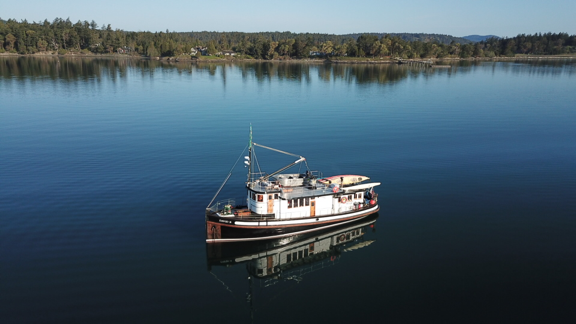
David B at Garrison Bay
The David B at anchor in Garrison Bay.

Afterwards, I went back down into the engine room to get a narrated view of the engine start. I tweeted it.

Captain Jeffrey engaged the windlass and Christine started pulling up the anchor. Once it was stowed, we were ready to go. It was about 9 AM.

We left San Juan Island behind and headed out into Haro Strait. Somewhere northwest of Stuart Island, we crossed into Canada. I spent some time trying to find a good place to sit outside while cruising. The two lounge chairs above the pilot house were windy and chilly. I finally settled — at least for a while — into one of the back facing seats on the stern which was sheltered and in the sun.

It wasn’t long before I realized that the David B was cruising slowly because the David B cruises slow. The engine, which required oiling and other attention every two hours while it was running, was set to a six knot cruise speed. We were going to cruise over 700 nautical miles at 6 knots.

No wonder the trip took 12 days.

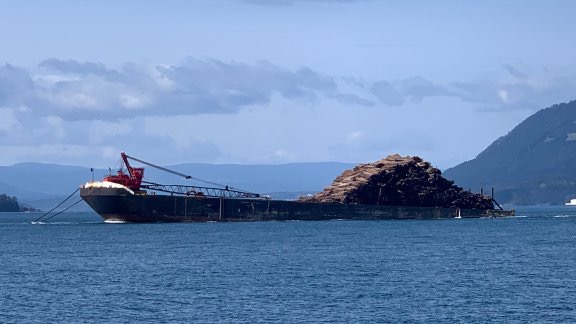
My notes for the second day mention a lot of boats on the water in Canada, including a Canadian Coast Guard boat, tug boats, and a tug boat pulling a barge of oddly loaded logs. I took some pictures, but not many. Everything was big and far away and didn’t look very impressive in photos.

Log Barge
I guess this is one way to load logs on a barge. What’s interesting to me is that in the Pacific Northwest they use chain to attach the tug to the barge and the chain dips way down into the water. This is very different from the barges I remember on the Hudson River when I was a kid; they used cables that were taught when the barge was being towed.

Dodd Narrows
The chart for Dodd Narrows. The red line is our path through it.

We arrived at Dodd Narrows about 30 minutes early. During our slow approach, we could see several boats waiting to enter the narrows, including a tugboat towing a bunch of floating logs tied together. Captain Jeffrey liked the way it looked so he didn’t wait and kept going. A sailboat under engine power pulled in behind us. There was current in there, but it wasn’t bad enough to cause any problems for us. I was glad there weren’t any boats coming through from the opposite direction.

We got into Nanaimo, a port city that’s commonly used by American on private boats to clear Customs into Canada, at about 4 PM. Captain Jeffrey went to shore to deal with the paperwork for himself, Christine, and their four passengers.

Day 2
Day 2’s track from San Juan Island to Nanaimo in British Columbia.

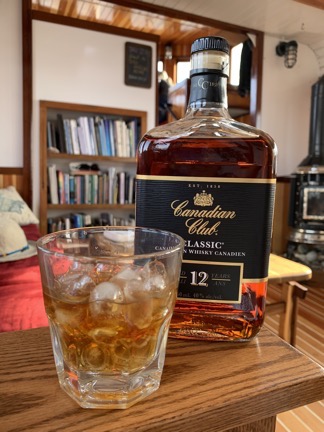
Canadian Club
When in Canada, drink Canadian Club.

I was told that there was a supermarket nearby, so I set off alone in search of orange juice and vitamin C tablets. I had $40 in Canadian money with me and the goal of not being identified as an American. I found the supermarket and accomplished my mission with a credit card so I could save the cash for someplace that didn’t take credit cards, also returning to the boat with a bottle of Canadian Club whiskey and a reusable shopping bag.

Christine made us another amazing dinner with fresh bread. She was feeding us very well. Too well, I think. I’d brought along some snacks in case I got hungry between meals but (1) I didn’t get hungry and (2) there were always snacks available (which is probably why I didn’t get hungry).

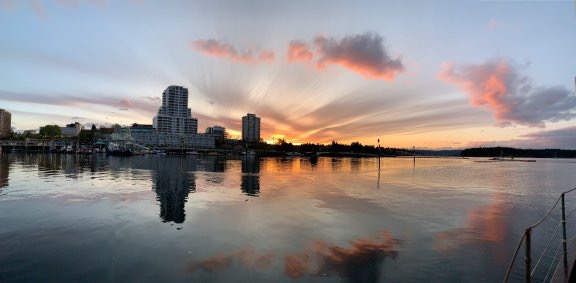
Nanaimo Sunset
Mother nature treated us to an amazing sunset.

Day 3: Nanaimo

The wind kicked up overnight and was blowing hard by 8 AM. Captain Jeffrey decided to delay departure by 2 hours. When that time had gone by, he delayed departure again. After lunch, he announced another delay.

I really couldn’t blame him. The wind was howling and the seas that we could see through a gap in the islands nearby was full of whitecaps. A big cargo ship anchored there drifted 90° or more at anchor. Even the seaplanes based near us at the harbor weren’t flying most of the day.

I spent most of the day reading and wasting time on Twitter. I wanted to go see Avengers Endgame at a theater in town, but the only showing I could see was at 3 PM and we might leave.

In the afternoon there was some excitement when a kayaker capsized about 30 feet from the boat. He couldn’t right the boat and he was hanging on in water that had to be icy cold. We got a line to throw to him while Christine called the coast guard. One of his companions paddled back and helped him to the dock in front of the boat. Fortunately, he’d been wearing a wet suit so he wasn’t that cold. But they went into a panic when they realized another kayaker was missing. They later found him back at their starting point at a nearby island; he’d turned around when he realized the seas were too rough for him.

At 4 PM, Captain Jeffrey announced that we’d be spending another night. He went ashore to pay for our space on the dock.

I walked into town with Leslie. We stopped at a tea shop where she had him make a custom blend of Earl Grey and lavender. We also went into a very nice gift shop. I would have visited more shops — including a chart shop Jeffrey had told us about — but I think Leslie was done so I walked back with her.

Back at the boat, we did more waiting. Then dinner. I think all of us were ready to move on.

The wind started to let up before bedtime.

(More to come…)

A Helicopter Trip to the Anacortes Boat & Yacht Show, Part 2

I fly to my helicopter to the boat show in Anacortes, see a bunch of boats, get tempting special show pricing, and fly home.

(Continued from previous post)

My goal was to be in the air by 8 AM so I’d arrive at Anacortes Airport with plenty of time to get to the Boat Show when it opened. I assumed it would take me all day to see the boats that interested me and was worried that exhibitors would start packing up early since it was the last day of the show.

Weather Woes

But the weather did not cooperate. Overnight, the local forecast had changed. Now it wasn’t expected to clear up until after 11 AM. I don’t need clear skies to fly, but I do need ceilings (cloud bottom heights) above the pass where I expected to cross the Cascades. As I went about my morning routine, the clouds seemed to drop in the west and rain began.

Rain to the West
The view from my deck at 6:34 AM. My route would take me right through the middle of this photo.

I continued my morning routine, but without the same sense of urgency. I showered and dressed in clean jeans and a shirt that suggested it wasn’t out of the question that I might spend nearly a quarter million dollars on a boat. Then Penny and I headed down to Pybus Market, where I’d left my tables and display stuff. I was supposed to be selling my jewelry there that day and had already paid for my spot. But with sales so bad the previous day, I didn’t have high hopes for a good day and didn’t mind eating the fee to do something more interesting with my time. I packed everything up and loaded it into the back of my truck.

Back at the helicopter, I took my time setting up my GoPro, preflighting, adding oil, and settling Penny in the front passenger seat. The rain had passed and it was clearing a little. I used a microfiber cloth to dry the helicopter, which also took any dust off. By the time I was ready to head over to the airport for fuel, it was nearly 10 AM. The weather still looked iffy.

My friend Rich, who bought my friend Jim’s old R44 Raven I, was doing pattern work when I radioed my approach. He landed beside me as the fuel guys were topping off my tanks. I told him where I was headed and that I hoped to get over the ridge at the headwaters of Icicle Creek. I’d discovered on a flight to Lopez Island years ago that that particular ridge is adjacent to Stevens Pass on a more direct line from Wenatchee. If the ridge was clear of clouds and I could cross it, there was a good chance that I could drop into the valley beyond and follow Route 2 due west toward the coast. We chatted about other things and then parted company.

It was just after 10 when I did my walkaround, climbed back on board with Penny, and got my GoPro running. Mounted via suction cup over the front passenger seat, it was connected to a battery power pack and the helicopter’s intercom system. It would shoot continuous video as well as a still image every 60 seconds.

Leaving Pangborn
Here’s the GoPro’s view just before departure from Pangborn Memorial Airport. As you can see, the weather does not look promising.

Nothing ventured, nothing gained. I took off, heading northwest.

The Flight to Anacortes

One of the benefits of flying a helicopter is that there is no minimum airspeed. This makes it extremely suitable for flying in conditions where it might be necessary to slow down or make a very tight 180° turn. As I flew northwest toward the mouth of the canyon at Icicle Creek near Leavenworth, I was mentally prepared to make a turn if low clouds obscured the mountains and made it impossible for me to cross the mountains.

And it sure looked like it would be necessary as I got closer and closer to the ridge. The clouds were sitting atop the Enchantments — that’s the mountains just west of Leavenworth. I was in a relatively narrow canyon with the creek below me and cloud covered mountains on either side. If I couldn’t go forward, I’d have to stop, turn around, and go back.

Of course, you can’t see the end of the canyon from halfway down it. So although it looked very bad at one point, when I rounded a bend, it didn’t look so bad after all. Then bad, round a bend, and not bad. I was at least 1,000 feet off the creek and climbing with the terrain. I never reached the level of the clouds.

Icicle Creek Canyon
This is one of the points where it looked iffy. But when I rounded that bend, it looked much better.

Then the ground came up to a ridge with plenty of space between the treetops and the cloud bottoms. I steered over it and saw Route 2 winding down the west side of Stevens Pass. Just like that, I was over the Cascades. I didn’t even have to slow down.

Crossing the Ridge Crossing the Ridge
These photos, taken 1 minute apart, show me approaching the ridge at the headwaters of Icicle Creek (left)and then topping the ridge where I can see Route 2 coming down the west side of Stevens Pass (right).

I descended down into the valley and followed Route 2 almost due west to Skykomish, then headed northwest toward Anacortes. The canyon opened up and the terrain dropped around me to mere hills. I flew along at a cruise speed between 100 and 110 knots, over creeks and marshes and forests, past logged terrain and waterfalls and quarries. The wind was still calm and the ride was smooth. Penny occasionally stirred in her seat or sat up as if to ask “Are we there yet?”

Over Logged Terrain
I crossed over a lot of wooded, hilly, and logged terrain between Skykomish and the coast.

I tuned into various nearby airport frequencies as I flew. I got close enough to Arlington and Skagit to make radio calls, but didn’t fly over either one.

Eventually, I left the mountains and hillsides behind, crossed I-5, and flew over the flat farmland along the shoreline. As I flew over various waterways, I wondered whether a boat with a 30-inch draft could navigate them. (Yeah, my boat lust had gotten that bad.)

Flying Near the Coast
This was shot somewhere west of Mount Vernon.

Then I was over Fidalgo Island, climbing over one last hill before looking for the airport. I found it very close to the hillside and came in for a landing on the parallel taxiway. I set down in an airplane parking spot near the fuel island, wondering whether the hose would be long enough to reach me where I was parked. I didn’t see a fuel truck.

Landing At Anacortes
Making the turn for landing at Anacortes.

I shut everything down and let Penny out while I gathered everything I’d need for the day. Then, after a quick bathroom visit in the Pilot Lounge, I used Uber to call for a ride. We were on our way to the Marina five minutes later.

At the Boat Show

If you haven’t read the first post in this two-post series, you probably should before continuing. It explains why I wanted to go to the boat show in the first place and the kinds of boats I’m interested in.

Andrew at Ranger Tugs had put tickets aside for me at the Will Call office, so that where I started. The event isn’t expensive — only $10/person — but I think they charge a fee to discourage low-budget lookie Lous. Let’s face it: the Anacortes Boat & Yacht Show has the word “yacht” in it for a reason. The majority of boats on display were far beyond the means of 99% of the people who attended.

BoatShow1
A look to the right from the ramp leading down to the boats for sale.

Boat Show 2
A look to the left at the boats for sale.

I didn’t waste my time looking at boats I couldn’t afford, although I do admit looking at a few that didn’t quite fit my needs. In most cases, the problem was towing: I needed a boat I could easily tow from home to anywhere I wanted to launch it, whether that was 12 miles from home at the boat ramp behind Pybus Market or 1200 miles from home in Arizona’s Lake Pleasant. That meant it could be no wider than 8-1/2 feet, which is the legal limit for normal trailer loads. Wider than that and I’d need a special permit to tow it and would have to get Wide Load signage and possibly a pilot car. The Cutwater boats seemed to fall into this category. Other boats were lacking in the livability department and wouldn’t be comfortable for more than a few days. Some were inboard motors and I preferred an outboard. None of them had the finely honed feature set the R-27 Ranger Tug I lusted for had.

I should mention here that “looking” at a boat didn’t mean looking at it from the dock. It meant climbing on board, and looking from the stern of a boat. All the boats had ramps leading to them so it was an easy deal. In most cases I either left Penny tied up on the dock or I picked her up and brought her on board. Although it would have been quite a treat to explore the giant yachts parked here and there along the dock, there was no reason to make me want something I couldn’t afford. It was best to stick to the program and let the lookie Lous have their fun without me.

I spoke to a sales guy at the Ranger Tugs area where their five models — R-23, R-27, R29, R31, and R41 — were parked. He gave me a sales spiel that included favorable pricing on the R-27 parked there. Prices go up by $10K in July for the 2020 model year, he warned. This was the last boat off the line for the 2019 model year. I checked out the smaller R-22, which I think would be too small for me. I asked questions about the windlass — cruising on the David B had convinced me that I would be unable to pull up an anchor, especially if it had 50 feet of chain and another 100 feet of rode set out. Andrew walked up and I chatted with him about it. He gave me even better pricing. We talked about desalination and dingy storage.

Later, I walked around the marina to look at some used boats on the far end. There was a 2016 Ranger Tug for sale there at the same price as the deal Andrew offered. Jeez. Was it wishful thinking on the part of the owner/broker or did the boats really hold their value that much? Why would anyone buy a used 2016 model when a brand new 2019 model, with all its improvements, from the factory could be had for the same price?

Penny and I left the docks and walked up to where other exhibitors were gathered inside a big tent or outside under smaller canopies. I got into a conversation with a boat broker about her upcoming trip to Ketchikan on her 41 foot Nordic Tug and my recent one on the David B. Her husband joined us and we talked about financing, which I hadn’t even considered. Even though they knew I wasn’t going to buy a boat from them, they were every helpful. And they seemed impressed that I was considering an R-27; the woman said it was an excellent option for me.

I looked on as a sales guy explained a desalination system to a couple. The system was very large and convoluted — not to mention expensive — and I wandered off.

I chatted with two sales guys about a Zodiac boat to use as a tender for an R-27. Andrew had recommended them because they’re relatively light weight. Apparently they come in sizes as small as 6 feet (inside length), although they said the next size up might be better for me. One guy even described how he gets his Zodiac out of the water and stowed on his boat by himself. They seemed confident that I could handle it alone.

I had wanted to look at Bayliners — Captain Jeffrey on the David B mentioned that they had models similar to the tugs I liked — but they were not at the marina. They were in a boatyard who knows where. This morning, as I started researching links for this blog post series, I looked them up. Although they may have had boats like a tug in the past, their current lineup did not include anything remotely similar. So I’m glad I didn’t track them down. It likely would have been a waste of time.

Since I hadn’t had a thing to eat all day, I decided to have lunch before heading out. Fortunately, between the marina entrance and Anthony’s Restaurant, there was a casual dining place called the Cabana. Penny and I walked right through and I got a seat on an Adirondack style chair in the shade of an umbrella — did I mention that the weather was sunny and warm? — overlooking an unused bocce court and the marina. A short while later, I was digging into a blackened rock fish taco while Penny was stretched out in the sun for a nap.

I had a lot to think about. Too much. It was strange to me, almost as if the stars and planets were aligning for me to buy this boat. There’s no doubt that I loved it and that it met all of my needs and most of my desires. (I’ll be honest a much larger boat that came with a bunch of guys to move it around for me would be a lot more attractive but definitely not in my budget.) I knew that I’d be happy with it, perhaps for a very long time. Who knows? It — or something a lot like it — could be my next home.

But I won’t kid you: there are financial hurdles to jump. Selling the helicopter would make the boat easily affordable without any financing, but was I ready to retire from flying? Could I get a seasonal job flying for someone else? Did I really want to sell the helicopter? I’d been an owner for nearly 20 years and I honestly couldn’t imagine life without one.

But could I have both? Did I want the financial burden that came with owning both? The answer to that is no.

Meanwhile, as I sat in the shade at the Cabana, I realized that clouds were building in the mountains to the east. Was I going to have trouble getting home? Time to find out.

The Flight Home

Watch My Helicopter Videos on YouTube

Time for a shameless plug…

Flying M Air Logo

If you like helicopters, you’ll love the FlyingMAir YouTube Channel. Check it out for everything from time-lapse annual inspections to cockpit POV autorotation practice to a flight home from a taco dinner at a friend’s house — and more.

Getting an Uber back to the airport wasn’t quite as quick as I’d hoped. The closest car was 25 minutes away. I tried Lyft, but they didn’t have anyone at all. So I parked myself on a bench near the entrance to the show and waited. Penny found shade under the bench and took another nap.

Back at the helicopter, I decided I had enough fuel to get me home with required reserves. So I just started up — with some trouble, which will be covered in a future post — and took off.

Departing Anacortes
Flying down the west side of Fildalgo Island.

Mountain Obscuration
The clouds were low as I approached the canyon where Route 2 wound up toward Stevens Pass.

The conditions started off nice — after all, it was a really great day out near the San Juan Islands — and then got very iffy. The cloud level in the foothills to the Cascades had definitely dropped since I’d come through that morning. Some of the cloud tops were obscured. A gusty wind was blowing out of the south, setting me up for mechanical turbulence — turbulence caused by the motion of wind over landforms. It began raining lightly.

For a while, I was worried about the flight. Because I hadn’t taken on more fuel at Anacortes, I didn’t have enough on board to do detour around weather looking for a clear passage to the other side. (Yes, I did have enough to get home with required reserves.) That meant that if I hit a dead end on my course, I’d have to go back, probably to Arlington, to get more fuel before trying again. Conditions were likely to get worse before they got better, so going back might even mean spending the night, which I really didn’t want to do.

(They say that the only time you have too much fuel on board is when you’re on fire. It’s always better to have more fuel on board than you need — unless it puts the aircraft weight over limitations. It gives you more flexibility.)

As for the weather, now you can see why I fly to the Seattle side of the mountains so seldom.

Once I got to Skykomish again, however, the rain stopped and the clouds lifted a bit. I was even sheltered from that gusty wind. I reached the ridge near Stevens Pass, climbed up, and hopped over it, down into the Icicle Creek Canyon where it was a beautiful day full of sun and big fluffy clouds.

IcicleCreekCanyon
It was a typically beautiful day on the east side of the mountains as I flew down Icicle Creek.

The rest of the flight was great and I even took a moment to record a little in-flight lecture about what it’s like to be a helicopter pilot and owner. I recently discovered that has far more subscribers than I thought and I’m now motivated to add new content there regularly.

I was back at my base by 5 PM. I spent the rest of the day gardening and doing chores around the house.

If I had driven, I’d be starting my return trip around 6 get back in the dark.