Writing in the 21st Century

A look back at the evolution of writing for publication.

Yesterday, my 72nd printed book went to the printer. For the first time ever, not a single sheet of paper was printed, mailed, or marked up during the writing and editing process for one of my books.

I’ve been a freelance writer since 1990. Most of my work — all of my books and 95% of my articles — has been about using computers. Yet for the first few years I wrote books about using computers, the manuscript files I created weren’t even used for the production of the book.

In the “Old Days”…

Back in the old days, my manuscripts had to be submitted in standard manuscript format. That means I wrote them in Microsoft Works (in the beginning) or Word using a plain font like Courier with double-spacing. What came out of my [$2,000] laser printer printer was a document that looked as if it had been typed on a typewriter by a very careful typist. Hundreds of pages. I was required to submit two printed copies of the manuscript to my editor.

In those days, Staples sold “manuscript boxes.” These were cardboard boxes designed to hold stacks of paper that were 8-1/2 x 11 inches. I’d print two copies of the manuscript, stack them one atop the other in this manuscript box, and mail them to my editor.

One time, in order to make a deadline, I sent the manuscript copies to Manhattan with my next door neighbor, who worked there. She then called a courier company to deliver the manuscript to the publisher’s offices in the Columbus Circle area.

In all honesty, I can’t remember how edits were handled. I don’t even recall getting any marked up copies of that early work. I think I got the galleys, though. They were printed (of course) and I wasn’t allowed to make many changes to them.

The Rise of E-Mail

Around the time of my fourth book (third solo book) in 1992 or 1993, e-mail was starting to get big. I still recall my shock and surprise when I sent an e-mail message to someone and got a response within an hour. Whoa!

That’s the book I started sending manuscript chapters via e-mail to my editor. The idea was that she’d review the chapters as they came in. This really saved my ass when my hard disk crashed and I lost everything on it. I was able to recover all those files from my editor and keep working. But when it came time to final submission, it had to be printed and mailed in: 2 copies, double-spaced.

Database Publishing with FileMaker Pro on the Web

This is one of the few books I wrote and laid out using FrameMaker. Its cross-referencing tools couldn’t be beat back in 1998.

When I started writing Visual QuickStart Guides for Peachpit Press in 1995, I also began doing layout. In the beginning, I used QuarkXPress, but I soon switched to PageMaker and finally to InDesign. I did a number of other books for Peachpit and for AP Professional (Claris Press, FileMaker Press) using FrameMaker, which I still think was the best layout tool out there. (InDesign is getting closer; thank heaven it finally added cross-referencing tools in CS4.)

For the early books, I’d create the chapter files, print them out, and mail them to my editor. Marked up copies would be FedExed back. I’d make the changes in the files. When the project was done, I’d send them a Zip disk or, later, burn a CD on my [$700] CD burner with all the files. That disk would travel by mail or FedEx on top of a stack of printed pages. In the beginning, they wanted 2 copies, but later they began using their own copier to make the copies they needed.

Word Files from Templates

Quicken 99: The Official Guide

This was the first book I wrote that made extensive use of Word templates.

Time went on. For the books I didn’t lay out, Microsoft Word became the standard. At first, I submitted files with the usual double-spaced, plain vanilla formatting. But some of my publishers got fancy and started sending templates with styles and macros and buttons built in. Although these files were always created on a Windows PC, they worked fine on my Mac. They usually came with detailed instructions for use; by applying the styles and submitting the files, my formatting would ease the task of getting it typeset on their system. Some of my publishers had terribly antiquated systems that required a lot of effort on the part of the production staff.

The use of Microsoft Word meant that my manuscript could go through a series of editors — copy, technical, and proofreader — with all edits clearly identified using the revision feature. I’d get edits back, review them, and either accept or reject them. Then I’d send them on to the next editor. The process was long and tedious, with lots of editing and a manuscript file that looked like a colorful mess of type. Often one editor’s changes would be changed back by another editor. Whatever.

I was required to send printed manuscript pages for most of the 1990s, but the files were transferred by e-mail, with a backup copy of all files on CD sent along with the printouts. I also got all galleys printed. That was often a lot of paper — hundreds of pages. In the mid 2000s, I started bringing the one-sided pages to my local copy shop to have them cut and padded; I’d use the back side of each page as scratch paper.

The Rise of PDFs

In the mid 2000s, I started seeing galleys as PDFs. I’d review them onscreen — no easy task when you have a smallish monitor and can’t read an entire page at once — then print out the pages with problems, mark them up, and send them into my editor. One of the reasons I bought a 20″ monitor a while back was to be able to proofread page by page.

Around the same time, Peachpit wanted to send me markups of my laid out book pages as PDFs. I resisted for quite a while because reviewing edits and making changes to the laid out page files with just one monitor was such a pain in the ass. My office now has a pair of 24″ monitors connected to one computer so I can review corrections on one screen while making corrections to manuscript pages on the other.

The End of Paper

200907212014.jpg

My most recent book was written and edited without an exchange of paper.

The book I finished yesterday (Mac OS X 10.6 Snow Leopard: Visual QuickStart Guide) was the first one that had absolutely no exchange of paper. I’d create book pages using InDesign and turn chapters into PDFs. I’d upload the PDFs and a zipped folder full of chapter files to Peachpit’s secure and private FTP server. The chapter files were my offsite backup — I did all of my work on this book from a camper or hotel and did not have a spare hard drive to back up to. My production and tech/copy editor would review the PDFs, mark them up with Acrobat — they use the full version, which I don’t have — and put them in a different folder on the FTP site. I’d download them, review them, and make manuscript page changes. Then I’d upload new PDFs to yet another folder and send fresh zipped files. My indexer got her own set of PDFs with accurate page numbers as we finalized pagination from one chapter to the next. When all editing was done, I updated the InDesign book file and its individual chapter files to finalize cross-references. (This is also the first Visual QuickStart Guide I’ve written that has cross-references to actual book pages rather than chapters.) I generated my table of contents and laid out the index when it arrived from my Indexer yesterday morning. Although I was still handling edits on Wednesday morning, by 10 AM yesterday (the next day), my editors at Peachpit had all the final files. By 5 PM the same day, the printer had those files.

I expect to see printed books within 3 weeks.

There are a lot of folks who see printed books as a terrible waste of paper. Although print publishing is definitely on the decline, there are many people — myself included — who prefer reference work in printed format. I don’t think print publishing will ever completely die.

I’m very pleased, however, that the production process didn’t add any more paper waste to landfills or recycling centers. I, for one, don’t need any more scratchpads.

Anyway, I thought some writers out there might be interested in the evolution of the writing/production process as seen by an “old timer” like me.

I’m just glad I never had to use a typewriter for my writing work. Using one in college was bad enough.

My Cherry Drying Season Extended

A pleasant surprise; but my book work continues.

Last week, I was very surprised to get a phone call from a grower I’d contacted back in May and June about late season drying. I’d called him several times to leave messages and managed to connect with him sometime in June. At that time, he said he was interested in hiring me for about 10 days starting at the end of July. Then nothing from him at all for weeks. I assumed he’d either changed his mind — we had a long dry spell here — or that he’d found someone else. So you can imagine my surprise when he called last week and said he’d like to sign me up for three weeks starting August 1.

Yesterday morning was overcast here in Washington. My phone rang at 6:55 AM. It was the grower. He was certain it would be raining over his orchard within an hour. Could I start that day?

I could. Technically, my other contracts in Quincy had all finished. The last one had ended the day before, although that grower was still picking. I wanted to keep myself available for him that day, but I’d go where I was needed. I was thrilled by the idea of my contract starting a week earlier.

So I suited up, grabbed my paperwork, GPS, and a book to read during downtime, and headed out to Wenatchee airport in the helicopter. I landed by the fuel pumps, topped off the tanks, and looked out toward the hills where the orchard was. No rain. I called the grower to let him know where I was. Then I grabbed the airport courtesy car, drove down to McDonalds, and grabbed some breakfast at the drive-thru. (I don’t eat much fast food, but I do like those damn bacon, egg, cheese biscuits.) By the time I got up to the airport, there was sun out toward my orchard. I checked the radar. The big cell that had worried the grower so much had drifted due south, missing his orchard by about 2 miles.

I waited while the weather cleared even more. Back at my trailer in Quincy, my computers were cued up with the software and files I needed to complete my work on Chapter 19 of my Snow Leopard book. At the Wenatchee Airport, I was completely unproductive. And a deadline clock was ticking.

When it became clear that no rain was likely fall within the next two hours, I called my grower and left him a message, telling him I was flying back to Quincy. I told him I could be back within 20 minutes if he needed me. Then I took off, overflew his orchard to get a GPS fix on it — I’d forgotten to bring my GPS when I got an orchard tour during the week — and returned to Quincy.

I spent the entire day working on Chapter 19 and watching the weather radar. My new orchard dodged the bullet (so to speak) at least five times. I can’t tell you how many times I almost suited up or called the grower. A storm cell would approach and then either go around or dissipate before reaching the orchard. This happens to me all the time. I joke with my growers that putting me on contract is better than getting cherries dried — it virtually ensures that it won’t rain on the trees.

OrchardThe orchard is 86 acres in the hills. This GoogleMaps satellite image doesn’t clearly show the hilliness of the area. The two red outlines indicate the blocks of trees. There’s a small one to the southwest but most of the trees are in a series of blocks all bunched together around roads, buildings, and irrigation ponds on the sides of hills. This is not the easy rectangular blocks of uniformly sized trees I dried in Quincy. This would be more challenging. Not only would I have to come up with a dry pattern that was efficient, but I had to make sure I didn’t miss any of the blocks.
The red X in the image is where I’ll be parking the helicopter. After about seven weeks living in my trailer at the golf course, I’ll be relocating to a motel in East Wenatchee, not far from the bridge I’ll need to cross to get to the orchard. It would take roughly the same amount of time to get to the airport as it would to get to the orchard, so I decided to base the helicopter at the orchard. There was a nice, flat grassy area that would make a perfect landing zone. It was far enough away from the packing area, trees, and roads to ensure that heavy equipment wouldn’t be a threat. The grower agreed to let me park there. In fact, I think he was glad I’d have the helicopter on-site.

I’ll also be bringing my trailer up there, parking it nearby. I have to park it somewhere and I rather like the idea of using it as a base near the helicopter. On a day when rain is very possible, I can drive up there and settle into the camper for the day, getting work done on my book projects while waiting to be launched. I’ll stay warm and dry if it rains. I can be airborne within 5 minutes of the launch call. But what’s more important to me is that I won’t have to wait around in my truck, bored out of my mind, while waiting for rain to come or stop. I can be productive, listen to music, even watch DVDs from Netflix on a laptop if there’s no writing work to do. I won’t extend the camper’s beds, but I will put out the slide-out to make room. I’ll have access to a clean bathroom, refrigerator, and stove if I need it. The microwave and A/C won’t work without an electric hookup, but the solar panel on the roof should keep the batteries charged enough to power my computer(s) with an inverter.

Meanwhile, Alex the Bird and I will move into a motel in East Wenatchee. I’m really looking forward to a shower that lasts longer than 5 minutes. I got a great rate on a room at a nice place. There’s WiFi and a pool. Free breakfast, too. I’ll be there for three to four weeks.

In the meantime, today’s goal is to knock off Chapter 20 on my book. I’ll finish the remaining chapters — Chapter 25, Appendix A, and the Introduction — on Monday or Tuesday. The book is scheduled to go to the printer on Wednesday. Talk about taking it right to the wire!

The Blog Posts I Wanted to Write this Week…

…but couldn’t because I’m writing something I’m getting paid to write.

If I had to choose between writing blog posts and writing 400+ page books about using computers, I’d take the blog posts any day. They’re shorter — I can knock one off in an hour or less — so I get immediate gratification. They’re also about a wide range of topics I choose to write about, so they can be a lot of fun to write. I can include color photos and other illustrations that don’t require me to set up a computer screen just so and snap a picture. Best of all, I can archive them here in my blog with almost 2,000 others, building a living journal of what’s going on on my life. You don’t know how much I love reading blog posts from the past five years of blogging just to remember what was on my mind back then.

200907212014.jpgBut I’m not blogging much this week. I’m writing something else: a 648-page revision to my Mac OS X Visual QuickStart Guide to cover the features of Snow Leopard.

I’m working my proverbial butt off on this book. 648 pages is a lot of pages. And, as usual, I’m not just writing it but also laying it out, page by page, using InDesign CS4. So I’m sitting in front of my 24″ iMac and my new 13″ MacBook Pro, both of which are set up on the dining table in my camper, typing, mousing, screen-snapping, and Photoshopping my way through the project. I have 4 of the book’s 25 chapters left to churn out — roughly 120 pages. My editors (production and copy) are keeping up with me nicely, so we’re turning around finished chapters at an amazing rate. Even my indexer is hard at work with the first 18 chapters properly numbered and ready to index.

A lot of people think I fly for a living. I don’t. This is what I do for a living. I write books about how to use computers.

Of course, when you do something for a living, that means you get paid to do it. I get advances on the books I write and when they sell a bunch of copies, I get quarterly royalty checks. That’s how I pay my bills and, when my helicopter business isn’t busy enough to pay its bills, my writing work pays its bills, too.

I don’t get paid to blog. And I don’t have blogging deadlines. And my blog will never become a bestseller, featured in the Apple store and on Amazon.com. (Yes, it’s true that the first edition of my Mac OS Visual QuickStart Guide, which covered Mac OS 8, got all the way up to #41 in rank on Amazon.com.) So I set my priorities accordingly and my priorities tell me to get this book off my plate so they’ll send me more money and I can get to work on the two books lined up right behind it.

Yes, you read that right: this is the first of three books I have to revise this summer. The other two, which I’m not at liberty to discuss right now, are also more than 400 pages. Each.

But I thought I’d take a moment to list the blog posts I didn’t write this week:

  • Where I was when Neil Armstrong stepped foot on the moon. I was almost eight years old and my mother kept me and my six-year-old sister up to watch the activities on television. It was late and I was tired. It was boring. But my mother said that we were watching history. All I can remember is wondering what was taking so long for them to come out and why there was so much beeping in the sound.
  • Miscellaneous Political Things. I’m thinking about Sarah Palin, who isn’t a quitter or a dead fish, but gave up mid-term, likely to pursue book and television deals while she’s still hot. I pray she doesn’t try running for president. I’d hate to get a real count of the number of Americans stupid enough to vote for someone who doesn’t know Africa is a continent and thinks living in a state between Canada and Russia gives her foreign policy experience. I’m thinking of Mark Sanford, the South Carolina governor who disappeared off the face of the earth for 5 days without telling anyone where he was going, leaving his state unmanaged so he could pursue an extra-marital affair. I’m thinking of that same guy giving Clinton grief for being serviced by an intern in his office, insisting Clinton resign and now not resigning himself. I’m wondering whether his name will appear beside the word hypocrite in dictionaries or Wikipedia. I’m thinking of the guy who owes him a good dinner (or maybe an all-expense paid trip to Argentina), John Ensign, the Nevada senator who, under threat of blackmail, revealed that he’d had an affair with a member of his staff (no pun intended). A member of a Christian Ministry that calls itself the Promise Keepers, he evidently didn’t think his marriage vows were a promise worth keeping. And I’m thinking of a wise Latina, Sonia Sottomayor, allowing herself to be submitted to the indignity of cross-examination by members of the Republican party trying to make her look hot-headed and unprofessional. They failed because, after all, she is a wise Latina indeed.
  • Blessed by Arizona Highways (Again). My phone started ringing this week with more calls for Flying M Air’s Southwest Circle Helicopter Adventure. Someone had written in a blog comment that I was listed on page 29 of “AZ Magazine.” Turns out, the listing is in Arizona HIghways magazine, the same publication that did a 10-page story on my company’s excursions in the May 2009 issue. This time, I’m listed as the “Best Way to See Arizona in a Week” in the August 2009 issue. While I’m thrilled to be getting the additional press, I’m also a bit worried — I didn’t bring enough marketing material with me to send out the info packets that are being requested daily.
  • My New Old Mechanic. That would be a brief post about how glad I am that my original R44 helicopter mechanic has left the company he worked for to go solo. His boss wouldn’t let him fix my helicopter because of insurance issues and I wound up with a long line of inferior mechanics. Until recently, of course, when I started getting my annual done up here in Washington state. But now I can use my old mechanic for my 100-hour inspections each winter and feel good about the quality of maintenance.
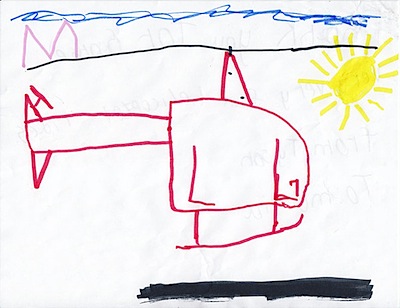
  • Helicopter ArtworkAn Orchard Party with Three Helicopters. That would be an account of the party my friend Jim and I attended near Othello, WA the other day. I was invited by another cherry pilot I’d met on my blog and was meeting her for the first time. Jim came along. We both flew — in two helicopters. We had great Mexican food, met really nice people, and gave 12 lucky raffle winners helicopter rides around the orchards. We were promised artwork from the kids (hopefully like this piece I received last week after giving a grower’s kids a ride) so maybe I’ll blog about it then.
  • The Evolution of Twitter. This would cover my observations of two Twitter accounts I maintain, how I maintain them, and what the results are. I’m pretty sure I’ll write this one sometime this month.
  • On Skeptics. Why I’m a skeptic and how it makes me look at the world. I haven’t thought this one out much yet, so I might still write it. I know it needs to be written.

These are only a few topics I didn’t get a chance to write about. And if you know me, you know I’d write a lot more than I’ve written here. But when I get this book done, I have about a week before I need to start the next one. Maybe I’ll churn out some fresh and interesting content then.

Or maybe I’ll get out of this camper and away from my computer and enjoy the area while I’m here.

Why I Can’t Just Enjoy My New 13″ MacBook Pro

It really is a business expense.

13Last week, I finally broke down and ordered a new MacBook Pro. I’d been wanting a computer like the 13″ MacBook for a while, but what I really wanted was a Mac netbook. When Apple unveiled the 13″ MacBook Pro at the Apple Worldwide Developer’s Conference earlier this month, I finally stopped denying the truth: that there would be no Mac netbook in my immediate future. Instead, I saw the new 13″ MacBook Pro as a reward for my patience. Not only did it have more features than the MacBook I’d been looking at, but it would cost less money.

Apple also announced some new features in Snow Leopard. While I’m not prepared (because of NDA stuff) to write publicly about Snow Leopard, I am in the middle of a revision to my Mac OS Visual QuickStart Guide for Mac OS X 10.6 Snow Leopard. One of the hurdles I was facing was not being able to show and discuss features of Mac OS X that work on the new MacBooks. About two years ago, I bought a 15-inch MacBook Pro to use as my “test mule” for writing about Leopard. That computer simply doesn’t have the bells and whistles of the newer models I need to write about.

It looked as if I’d have to buy a new MacBook Pro so I could write about it for my book.

This is both good and bad:

  • Good because having to buy a new computer for work means I can deduct the cost of it from my taxes. (I use my computers for all of my various business endeavors — I don’t play games on my computers. If I’m not working, I’m out having fun somewhere or sleeping.) And let’s face it: it’s always nice to have a computer with the latest technology.
  • Bad because having to buy a new computer means having to come up with the money to pay for it. Just because I can deduct it as a business expense doesn’t mean it’s free. (So many people don’t understand this simple fact: you still have to pay for business expenses; it’s just like being able to buy them at a discount equal to your tax bracket percentage.) In this case, the final price tag came to just under $2K. Ouch.

It’s also bad because I never seem able to buy a new computer and just enjoy it like a normal person.

Believe it or not, this is my first “unboxing” video. Let’s just say it doesn’t completely suck. The weird noises you hear in the background are coming from Alex the Bird.

Most folks buy a computer, open the box, fire it up, and start exploring. I, on the other hand, buy a computer, open the box, fire it up, erase the hard disk, and install beta operating system software on it. I then get to spend several weeks exploring the minutiae of the operating system’s elements, including every single window and dialog that might appear to the average user. I take screen shots of everything I see and write about it in an unbelievable level of detail.

So right now, as I type this, I’m waiting for the Developer Preview of Snow Leopard to install on my brand new, just-out-of-the-box 13″ MacBook Pro’s freshly erased hard disk. I’ll put some sample files on it, set it down on my workspace table beside my 24-inch iMac, get them talking to each other via AirPort network, and start exploring the current topic I’m writing about, which is the Dashboard and Widgets. I’ll put my old 15-inch MacBook Pro away in its case and set it atop the Dell laptop I’ve also brought along with me this summer to revise another book for another publisher.

When I get back to Arizona, if I’m not too busy doing other things, I’ll use the discs that came with the 13″ MacBook Pro to restore it to its factory hard drive configuration. Then maybe — just maybe — I’ll put it back in the box and have a reopening, trying my best to pretend it’s brand new again.

Pay the Writer (and the Pilot and the Photographer…)

A rant worth watching.

One of my Twitter friends, @PattyHankins, retweeted a link to the video embedded here. It’s an interview with author Harlan Ellison, clipped from the upcoming documentary film, Dreams with Sharp Teeth. In it, Ellison rants against people expecting professionals to work for free and the writers who are willing to work for free.

As Patty points out, this applies to photography, too. But as a writer and a helicopter pilot who has often been asked to work for free, it really hits home for me. Too many organizations expect you to work for free, as if your association with them will pay you for your time and expertise. That’s just wrong.

Watch this video. Ellison uses some colorful language throughout, but no more colorful than I’d use if I were sufficiently riled up and not afraid to speak candidly in front of a camera.