
Twitter and the Strikeout Rule

How I decide when it’s time to stop following a Twitter friend.

Twitter logoI don’t follow many people on Twitter — less than 100, in fact. I think part of the reason for this is that when I follow someone, I follow him/her. I sit at my desk with Twitterrific running on the right side and, thoughout the day, I peek at it to see what’s going on with the people I follow. I respond a lot, which I know is falling out of favor these days. But that’s because the people I follow are my office co-workers, so to speak. They keep me company while I work and, like any workplace environment, social conversation is part of the picture.

Enter, the Abusers

Anyway, because I read all the tweets of the people I follow — well, at least all of those that appear in Twitterrific while I’m at my desk or on the Web when I happen to take a peek with my Treo — I see patterns in the way they tweet. I wrote about this at some length last June. (Is it that long ago already?) And I soon discover which ones have joined Twitter for purely self-promotional reasons.

You know these people. Almost every tweet they make is a link to something they’ve written. While I’m guilty of using Twitterfeed to automatically tweet about new blog entries as I post them, these folks often go far beyond that by repeatedly tweeting the same damn links, sometimes over several days. This wouldn’t be so bad if what they were linking to was something worth reading, but often, it’s just more self-promotional crap.

These people don’t last long as my Twitter friends.

Three Strikes and You’re Out

To make it easier to identify the Twitter friends who are most guilty of using Twitter primarily (or, worse yet, exclusively) for self-promotion, I’ve developed the Twitter Strikeout Rule. It’s very simple and can easily be applied by anyone who knows the rules of American baseball.

Here’s how it works:

  • Each time a person tweets, he’s “at bat.”
  • If the tweet is entirely self-promotional in nature, that tweet is a strike.
  • If the person has three strikes in a row, he’s out. (That means I simply stop following him.)

The way I see it, my life is already bombarded with advertisements. One of the few places I can get some relief is in my own office, at my desk. Do I really need to see an endless stream of self-promotional bullshit from the people I let into my workplace? Of course not. So I merely push them out.

Once of the nice things about Twitter is that it doesn’t tell people when someone has stopped following them. That’s nice because it means I don’t have to insult anyone. They don’t even notice I’m gone. Most of these folks have far more followers than they deserve anyway.

A Home Run

Taking the baseball analogy a bit further — heck, why not? — a Twitter Home Run is a tweet that’s really good. Usually it’s a link to a video or blog post or plain old Web page that is funny or makes you think or teaches you something really useful.

Sometimes — but rarely — its just a plain linkless tweet that does the same thing.

Merlin Mann (@hotdogsladies), for example, has the uncanny ability to pop these things off more often than anyone else I follow. Here’s one from a while back that I favorited:

Starting a blog solely to make money is like learning ventriloquism to meet girls.

John Gruber (@gruber) writes the funniest rants. Sherrie Holmes (@sherrieholmes) can be hysterically funny. Tom Negrino (@negrino) comes across as a very funny, grumpy, old guy. (Sorry, Tom. I know you’re not old. But you must admit you write grumpy tweets.)

Think about the achievement of using 140 characters or less to communicate something memorable, something to make a reader laugh or think. That’s pretty special. It’s something that all serious Twitter members should aspire to.

But then again, that’s just my opinion. What do you think? Which of your Twitter friends hit home runs? Use the Comments link or form to tell us.

More on Twitter

I’ve been using Twitter for about a year now. (The first blog post where I refer to it dates back to March 21, 2007.) I’ve tweeted 3,806 times since then. Most tweets come from Twitterrific, but I also tweet right from the Twitter Web page at my desk or via text message from my Treo when I’m out and about. Amazingly, I still enjoy it. I’ve made a bunch of real friends and have strengthened my relationships with people I knew before Twitter.

If you’re interested in reading more about what I have to say about Twitter, you might find these articles interesting:

On Avatars

Why can’t they look at least a little like the person they represent?

Like so many techno-geeks these days, I’m involved in a bunch of social networking sites: Twitter, LinkedIn, FaceBook, RedBubble, Flickr, MyBlogLog, etc. And all of these sites give each member the ability to include an avatar — an image to represent that user.

Maria Langer AvatarMaybe I’m not very creative, but my avatar is a photo of me. It was taken by photographer Jon Davison during one of our flights last September. It shows me in one of my favorite places: at the controls of my helicopter, flying over the Arizona desert. (I think I’m over the Little Colorado River Gorge in this shot.)

The way I see it, my avatar is supposed to represent me. What could represent me better than a photo of me doing something I like to do?

Evidently, not everyone has the same idea. While many of the avatars I see in Twitterrific are photos or drawings of the people they represent, quite a few are not. And in other social networking sites — MyBlogLog comes to mind — the majority of avatars don’t bear any resemblance to the people they’re supposed to represent.

I find this bothersome, especially among my Twitter friends. Why? Well, in most cases, an avatar is the only visual representation I have for a person. If the avatar features purple hair or a goofy cartoon face — you know who you are, folks! — that’s the image I have of that person. And it’s a lot tougher for me to take these unrealistic avatars seriously.

Maybe I’m old fashioned, but I find it easier to communicate with people I can take seriously.

A few more notes on avatars:

  • Some people seem to like using their Second Life avatars as their social networking avatar. While I could write a dissertation covering my thoughts about Second Life — starting with, is your first life so bad that you need a second one? — I’ll just say that Second Life avatars are generally a highly stylized version of how people want to look. While few of us are supermodels, surely there’s a decent photo of these people somewhere that they can use online.
  • Some people use glamour photos for avatars. I have a colleague who does this. When I met her in real life, I didn’t recognize her. Let’s face it, we only look like our glamour photos in our glamour photos — after they’ve done the photo shoot and brought our faces into Photoshop for some digital plastic surgery. Every time I see this avatar, I have to remind myself that she doesn’t really look like the photo. (Of course, it’s also made me want to get a glamour photo.)
  • Some people use photos of their pets as avatars. Talk about going to the dogs! Do the dogs really look better? Or do they just identify with their dogs? Ditto for cats, birds, and miscellaneous wild animals.

Of course, none of this has to do with special-purpose avatars used to promote an idea or cause. An example is the Frozen Pea avatars that many of us wore on Twitter for a few Fridays to raise awareness and funds for Breast Cancer Research through the Frozen Pea Fund. I was a single pea for the day. My favorite avatar was one Twitter friend who created an image of his head sticking out of a pea car.

But I’d like to start a movement among serious social networkers. Be proud of your face and show it off as your avatar! It doesn’t have to be a full-face shot; it can be creative. (Some of the best avatars I’ve seen show only part of a person’s face.) But it should show you, as you really are.

I’d just like to see who I’m tweeting to.

Twitter Sluts

A new term defined.

Okay, so maybe this isn’t a new term. And maybe I’m not qualified to define terms like these. But as I get an e-mail to inform me of yet another Twitter follower who has nothing in common with me, I came up with this term and felt a need to share it and its definition with the blogosphere.

A Twitter slut is a Twitter member who indiscriminately adds Twitter friends to his (or her) account. He may be doing this for one or more of the following reasons:

  • He’s believes that all of the people he adds as friends will reciprocate and add him as a friend so he has a large audience for his tweets. I discussed this phenomena in my “Twitter Spam” post.
  • He’s hoping that other people will respond directly to his tweets using the standard @membername format so other people will make him their friend.
  • He’s desperate to follow the tweets of anyone who can type intelligible comments into Twitter. That is a minority that I am apparently part of.

Twitter sluts can easily be identified by their friends to followers ratio. If that ratio exceeds 3:1 (that is, 3 friends for each 1 follower), that person is may be a Twitter slut. If the ratio is around 5:1 (5 friends for each 1 follower), that person is likely to be a Twitter slut. It the ratio is closer to (or higher than) 10:1 (10 friends for each 1 follower), that person is definitely a Twitter slut.

Twitter Ratio.jpgHere’s an example. This person has been a member of Twitter for only 9 days. Yet he’s added over 4,000 members as friends. With only 9 updates to his name, he has apparently attracted 398 suckers to reciprocate his friendship.

(Okay, okay. I’ll try to tune down the cynicism. But it’s very difficult sometimes.)

The other day, a Twitter member on the public timeline asked, “Am I the only one who gets a bunch of new friends every time I post a tweet?”

The answer: no, you’re not. Like the rest of us, you’ve just been discovered by a handful of Twitter sluts.

Message to Twitter Users: Use a Lint Screen

A plea to those who [should] care.

I write about Twitter too much. I know that. But Twitter has become part of my life and, like other things that are part of my life, it has given me plenty to write about.

lint screenToday’s topic is Twitter fluff. That’s my term for the kinds of tweets that are downright boring and childish, written by people who should know better. The sole purpose of these tweets seems to be to fill the Twitter world with content. Trouble is, the quality of that content is about equal to the quality of the stuff that accumulates in a clothes dryer’s lint screen.
While you expect that kind of behavior from people who really don’t have anything to tweet about or people too immature to realize the significance of their everyday experiences, you don’t expect it from people with experiences worth sharing.

I’m not naming names here. Or Twiter IDs, for that matter. But I recently added a professional journalist to my list of Twitter friends. This is a person who works for a media organization and typically follows stories relating to the Iraq war and politics — stories that matter. An adult. A professional. Someone who should have interesting tweets.

What I found, however, is that more than half of this person’s tweets are messages to his new Twitter friends to greet them. For example, “Hi new Twitterfriends, @AlexTheBird, @JackTheDog, and @mlanger!” While it’s very friendly of this person to greet all his new friends, reading dozens of tweets like this throughout the day — between the daily “Good morning, Twitter!” and nightly “Good night, Twitter!” posts — is pretty much a waste of my time. I’m interested in what this guy is doing. Who is he interviewing? What has he learned? What insight can he share about his professional journalism world? How can what he’s doing make me think about the world around me?

I need to mention here that I don’t expect every tweet I read to contain some kind of deep revelation for me. (If that were possible, I’d spend all of my time reading Twitter tweets.) This morning, one of my Twitter friends posted a tweet in which the text was all upside-down. How the heck did she do that? She followed up with a link that showed us how. Useless? Yes. Trivial? Sure. But fun? You bet! And a heck of a lot more interesting than “Hello new Twitterfriends @joe, @jim, and @jake!”

And, for those of you ready to go on the offensive, I’m also not saying that my tweets are anything special. I just tweet about the things I’m doing. Some of them are pretty dull. (Who cares that I’m reading my e-mail?) Some of them are pretty interesting. (How many people land their helicopters in a new friend’s backyard?) But I’m not filling the Twitter world with fluff, either.

Anyway, I’m kind of hoping this journalist friend reads this and recognizes himself and thinks about what he’s typing to the world — especially to all of those new friends he keeps greeting. No offense guy, but you can do much better than that. I know you can.

Twitter "Friendships"

Can following a person’s tweets make him a real friend?

Sometime last night or this morning — I can’t keep track with the time zone thing — Andy Piper posted a Twitter tweet with a link to an article by Clive Thompson about Twitter. Because the article reinforces something I’d mentioned in my most recent post here about Twitter, I thought I’d share it.

The key paragraph (as far as I’m concerned) from “Clive Thompson on How Twitter Creates a Social Sixth Sense” on Wired.com is this:

When I see that my friend Misha is “waiting at Genius Bar to send my MacBook to the shop,” that’s not much information. But when I get such granular updates every day for a month, I know a lot more about her. And when my four closest friends and worldmates send me dozens of updates a week for five months, I begin to develop an almost telepathic awareness of the people most important to me.

This is pretty much I was trying to say in the introduction of my post. But I can go on to say that even though many of these people started out as strangers, reading their tweets day after day have given me a certain awareness about them that a real friend — but perhaps not a good friend — would have.

Twitter as a Way to Make Friends

I see Twitter as a way to make friends across the world. Although, I don’t ever expect to ever meet most of these people in person, there is a chance that I might actually make real friends with one or two.

For example, I’m actively seeking out interesting Twitter members who live in Arizona to follow. By following their tweets, I can get a sense of what these people are all about. If we have a lot in common, it’s easy enough to take the next step to start a real friendship. And it’s easy enough for them to respond or ignore me.

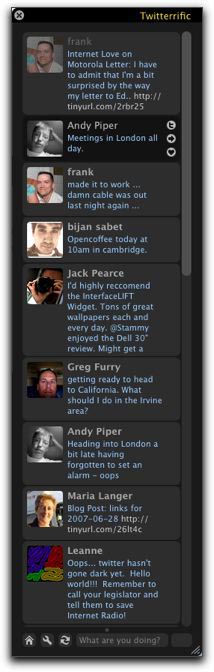
TwitterificI’m not talking instant friendships here. I’m talking about possibly months of watching tweets as part of my day. In my case, that means having Twitterific open on my Mac’s desktop and peeking at the tweets of a handful of people as they come in. I delete “friends” who really don’t seem to be on the same wavelength with me and add “friends” who might. Over time, the ones who remain on my desktop are the ones that could become real friends. If they’re in the area, why not get together for coffee or a hike or a museum trip?

It All Comes Down to Being Picky

It all comes down to using Twitter seriously, which I’ve discussed in at least one other blog post about Twitter. Use a Twitter tool (like Twitterific or some other program that selectively tracks tweets) to track only the tweets of people who interest you. Obviously, real friends should be included — if you can get them to use Twitter.

To find new people to follow, I’ll occasionally watch Twittervision and read the tweets posted in the US, especially in my area. I’ll add one or two “friends” to track for a while. I also use the Public Timeline to find interesting tweets and add corresponding Twitter members. In both cases, I limit my time to about 5 minutes — without setting a limit, either of these monitoring tools could suck hours away from your life.

My biggest problem: Most Twitter users are between 18 and 27 years old. That really shows in their posts. (Take that any way you like.) My goal is to find mature, interesting people to follow.

And, little by little, I think I’m building up a good group of Twitter “friends.”

But the question remains: will any of these people become real friends? We’ll see.